Masked members of the cutter James crew and Commandant Adm. Karl L. Schultz (front, center), along with interagency partners, stand among interdicted narcotics at Port Everglades, Florida, on June 9. U.S. COAST GUARD / Petty Officer 3rd Class Brandon Murray
The Acquisition Directorate reports they have released a draft request for proposal (RFP) to “design a River Buoy Tender (WLR) and an Inland Construction Tender (WLIC) – two variants of one design – and build 16 WLRs and 11 WLICs.” I have duplicated their post below:
The Coast Guard released a draft request for proposal (RFP) July 29, 2020, for detailed design and construction of the river buoy and inland construction tenders as part of its Waterways Commerce Cutter acquisition program. The draft RFP is available here.
The deadline to submit feedback on the draft RFP is Sept. 18, 2020.
The Coast Guard is recapitalizing its 35 river, construction and inland buoy tenders, which collectively average more than 55 years in service. The fleet is responsible for maintaining more than 28,200 marine aids throughout 12,000 miles of inland waterways, facilitating the movement of 630 million tons of cargo annually.
There are currently 18 river buoy tenders and 13 construction tenders in the inland tender fleet. Based on extensive analysis of mission needs, the Coast Guard plans to replace these ships with newly designed river buoy tenders and construction tenders that have greater endurance, speed and deck load capacity than their predecessors. The Coast Guard plans to acquire these two variants on the same contract due to major design commonality including hull form, deck layout and standardized equipment. The inland buoy tender replacements will be acquired separately.
Replacing the aging fleet is critical to sustaining the overall safety of the U.S. Marine Transportation System, which accounts for $5.4 trillion of economic activity annually and sustains approximately 30.7 million jobs.
For more information: Waterways Commerce Cutter program page. Additional resources and previous industry engagement materials can be located under the “Resources” tab at the bottom of the page.
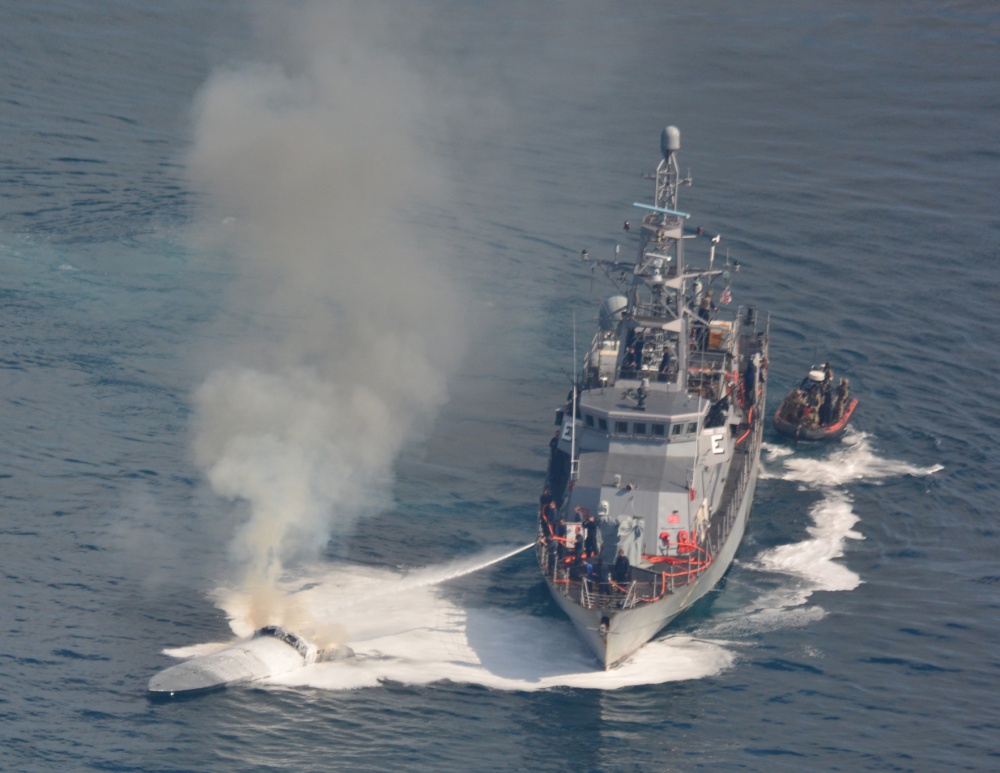
Cyclone-class patrol coastal USS Zephyr (PC 8) crew conducts ship-to-ship firefighting to extinguish a fire aboard a low-profile go-fast vessel suspected of smuggling in international waters of the Eastern Pacific Ocean April 7, 2018. Photo by Petty Officer 1st Class Mark Barney
I learned recently that the Navy expects to decommission their 13 Cyclone class patrol craft in FY2021. This is significant for the Coast Guard for a couple of reasons.
The three based in Mayport have consistently been used to augment Coast Guard vessels, hosting Law Enforcement Detachments for drug enforcement (a recent example). .
Second, these vessels frequently partner with Coast Guard patrol boats of PATFORSWA based in Bahrain. Their decommissioning may put a greater load on the Coast Guard unit as it begins to receive Webber class as replacements for the existing six Island class patrol boats.
ARABIAN GULF (Sept. 16, 2018) A MK-60 Griffin surface-to-surface missile is launched from coastal patrol ship USS Thunderbolt (PC 12). (Photo by MC2 Kevin Steinberg)
For the Island class cutters in the Persian Gulf, the Cyclone class have served as better armed, big brothers, adding a bit of muscle to escort missions where Iranian Fast Inshore Attack Craft might be encountered. While the Webber class, that will be replacing the Island class, are a bit better armed than the 110s, unless they are extensively modified, they will not come close to replacing the missile armed Cyclone class. LCS are supposed to replace the Cyclone class, but they still have not demonstrated the ability to sustain a reasonable number of vessels in a remote theater. LCS are also too large to go many of the places the Cyclone class were able to.
USS Hurricane (PC-3)
These little ships have seemed to count for very little to the Navy. Regularly we see a count of “Battleforce ships”“Battleforce ships” that includes everything from aircraft carriers down to civilian crewed, unarmed fleet tugs (T-ATF), salvage ships (T-ARS), and high speed intra-theater transports (T-EPF, really aluminum hulled, high speed ferries). The Cyclone class were only included in the count one year (2014), so their loss will be largely invisible. (Significantly, this count of what many must assume is the National Fleet also makes no mention of Coast Guard assets either.)
Until ten of the class found a home in Bahrain, the Navy seemed to have had a hard time figuring out what to do with them. Originally intended to support the special warfare community, they were considered to large for that mission. Of the original fourteen one was transferred to the Philippine Navy. Five had been temporarily commissioned as Coast Guard cutters.
Other than the far larger LCS, the navy has no plans to replace these little ships, that have reportedly been the busiest ships in the Navy.
DAHLGREN, Va. (Nov. 6, 2004) Coast Guard Cutter Shamal (WPC-13) . USCG photo by Joseph P. Cirone, USCG AUX
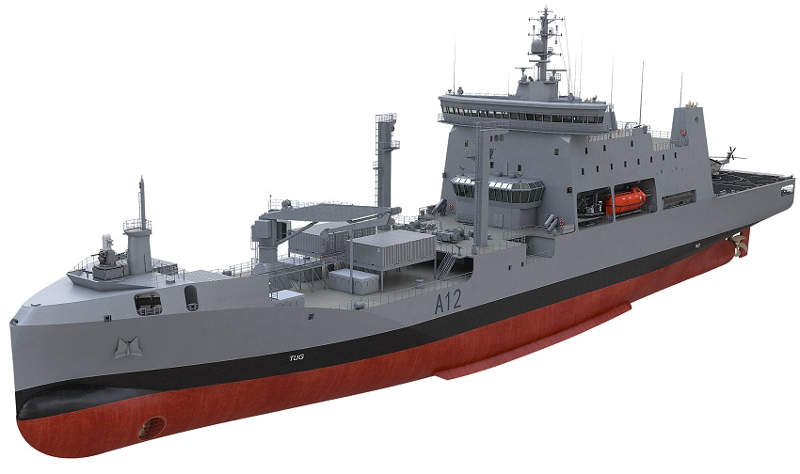
Naval News reports that the New Zealand Navy has commissioned what I believe is a one of a kind vessel, a Polar class underway replenishment vessel, HMNZS Aotearoa (not that it is an icebreaker, no icebreaking bow).
(Anyone know if the Polar Security cutters can do underway replenishment?)
Unlike US Navy replenishment ships, this will be armed and have a military crew.
I doubt the ice-strengthening and winterization really cost a whole lot. With the Arctic opening up, maybe the Navy should be thinking about something like this.
Army Times reports that the Army has developed a new hybrid device that can reduce the noise, recoil, and flash of a variety of weapons including those common in the Coast Guard. It functions as a muzzle break to reduce recoil that adversely effects accuracy, as a suppressor to reduce noise that may cause hearing loss without the usual adverse effects of a suppressor, and as a flash hider.
“It’s a hybrid device that cuts half the volume at the shooter’s ear, reduces recoil by a third and drops volume down range by one quarter, said Gregory Oberlin, a small arms engineer at the Army’s Combat Capabilities Development Center Army Research Lab.”
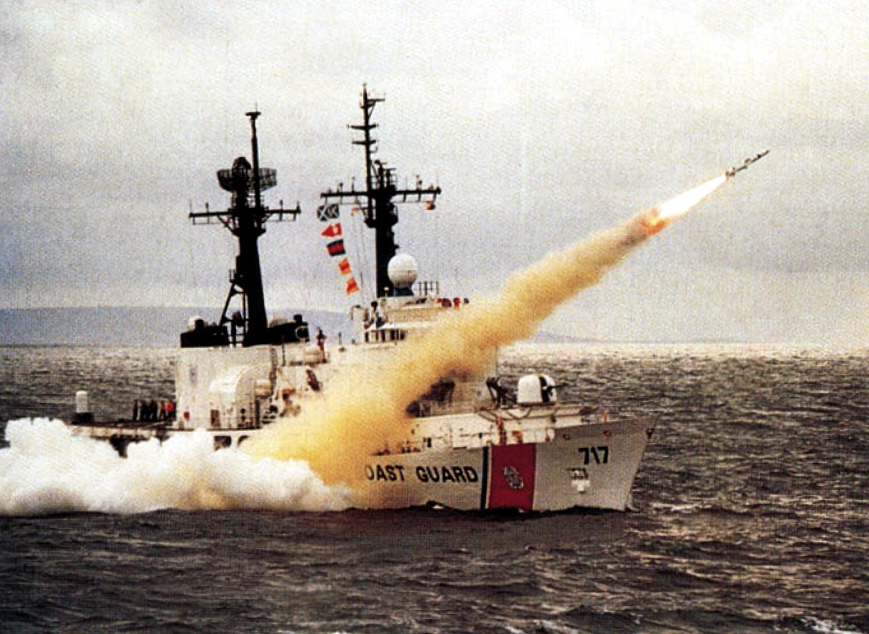
USCGC Mellon seen here launching a Harpoon anti-ship cruise missile in 1990.
I have a bone to pick with Pacific Area, public affairs (D11-DG-M-PACAREA-PA@uscg.mil). First I got a news release dated Friday, Jul 17, 2020 7:22 pm. Reading it I found what I thought were errors and emailed them with comments.
I wrote,
Just read the news release and there are some errors in this paragraph.
“In January of 1990, the Mellon was the first and only Coast Guard cutter to become fitted with an anti-ship missile. The cutter also received an anti-submarine warfare suite that included the AN/SQS-26 sonar and Mark 46 torpedoes. The suite and anti-ship missile served as proof of capability for all Coast Guard cutters; however, they were later removed due to budget constraints.”
Mellon may have been the only 378 to test fire a harpoon, but all the 378s were equipped to launch Harpoon.
The 378s were all built with an ASW suite that included the AN/SQS-38 sonar and Mk32 torpedo tubes for launching light weight ASW torpedoes, first the Mk44, then the Mk46.
The FRAM replaced the 5″/38 and Mk56 gun fire control system with the 76mm Mk75 gun and Mk92 fire control system, added the Phalanx CIWS (Close In Weapon System), they received equipment to support the LAMPS I ASW helicopter and a collapsible hangar was added.
None of the 378s including Mellon were ever equipped with the AN/SQS-26 sonar.
The ASW equipment was removed after the Soviet Union collapsed which largely eliminated the submarine threat.
–
Three days later PACAREA sent out a revised news release dated Mon, Jul 20, 2020 9:41 am. You can see it repeated here. It included this revised paragraph:
–
“In January of 1990, the Mellon was the first of five Coast Guard cutters to become fitted with an anti-ship missile. The cutter also received an anti-submarine warfare suite that included the AN/SQS-38 sonar and Mark 46 torpedoes. The suite and anti-ship missile served as proof of capability for all Coast Guard cutters; however, they were later removed due to budget constraints.”
–
We have noted some tendency for the Coast Guard to be somewhat careless in preserving and telling its history, but this telling says that Mellon got her sonar and torpedoes at the same time she got her Harpoons and then quickly had them removed because it cost money. It ignores the fact that Mellon and the other eleven 378s had been equipped with sonar and torpedoes since they were built, beginning with Hamilton in 1967. For over 20 years these ships were part of the US response to the Soviet Union’s submarine threat. For over 20 years ASW training was part of their annual refresher training and it only stopped after the collapse of the Soviet Union seemed to mark the end of the submarine threat.
Naval News reports on a virtual conference expo showcasing five systems presented by Leonardo aimed at Middle Eastern clientele.
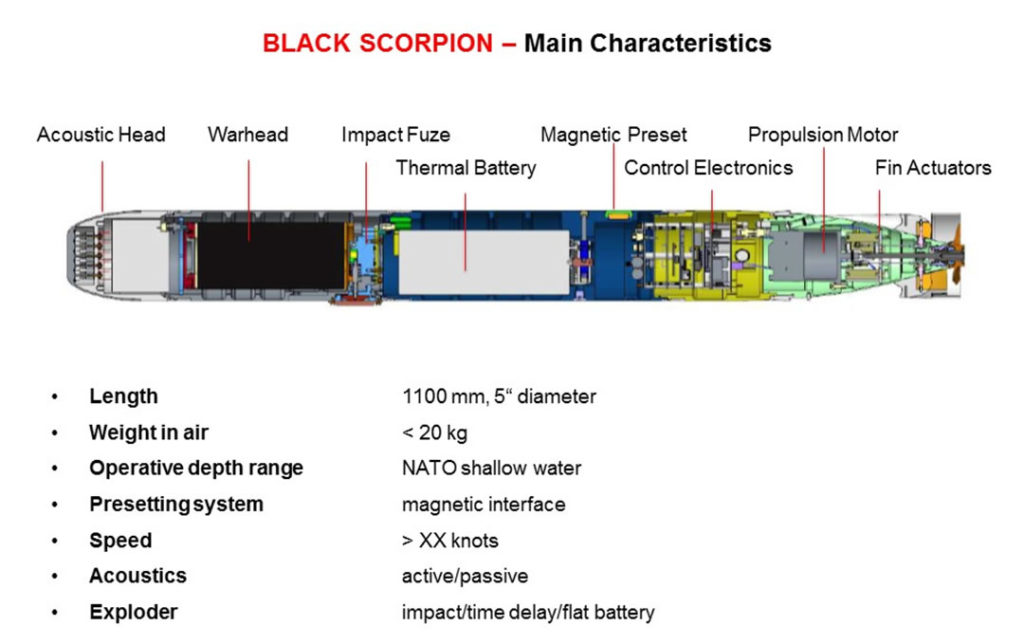
There is information about an anti-torpedo defense system, the 5″/64 gun, the familiar 76mm/62 gun, and the Marlin 40mm gun systems and their associated ammunitions and support systems. But the real surprise was a mini-torpedo, called Black Scorpion.
Graphic from Leonardo
I have a hard time figuring what will be done with this mini(micro)-torpedo. They say it will work from “Unmanned Surface Vessels (USVs), SEAL Delivery Vehicles (SDVs), Patrol Boats, Fast Attack Crafts, helicopter/drones, Unmanned Aerial Vehicles (UAVs), and Unmanned Underwater Vessels (UUVs).”
Launchers are illustrated for submarines, fast inshore attack craft, and helicopters and drones.
There are a lot of unexplained parameters for this weapon. Presumably it can operate at depth some depth if it is to be launched from a submarine but there is specific reference to ASW in the littoral, so it might be relatively shallow. What is its range and speed? Less than 44 inches long and with an all up weight of less than 44 pounds, it is unlikely the warhead is much larger than ten pounds. It unlikely to sink anything of more than about 100 tons, but it might be enough to disable the rudder or propeller on even a large ship. There are warnings in the text not to expect too much.
“The Leonardo conference host presenter stressed that this is a miniature lightweight torpedo and performs as such. Thus, the user should not expect the range, performance, and characteristics of a comparable lightweight, medium, or heavyweight torpedo…”
I sure would like to see some testing of this and the Grumman Common Very Light Weight Torpedo which is about five times larger. One of them might be the ship stopper the Coast Guard needs.
Navy Recognition reports that Russia’s Burevestnik scientific-and-research Institute has developed a naval version of their 57mm Remotely Controlled Weapons Station (ROWS).
The baseline AU-220M ROWS weighs 3,650 kg (with a gun mount) (about 8000 pounds–Chuck) and is armed with a 57 mm automatic cannon and a 6P7K 7.62 mm coaxial general-purpose machinegun (GPMG). The main gun’s ammunition load comprises 80 armor-piercing (AP), high-explosive fragmentation (HE-Frag), and guided artillery (GAP) projectiles. (It is not clear if the guided projectile would work against a moving target–Chuck) The weapon produces a rate of fire of 80 rounds per minute and engages ground targets at a distance of up to 14.5 km. The GPMG carries an ammunition load of 500 7.62 mm cartridges. The module’s frontal armor provides Level 5 STANAG 4569 protection against 30 mm rounds; the station also features Level 3 STANAG 4569 all-round protection against 7.62 mm bullets. The AU-220M’s sensor suite comprises a TV camera, a thermal imager, and an independent dual-axis field-of-view stabilizer. The module is also fitted with laser rangefinders.
For comparison, our 57mm Mk 110 weighs 16,535 lbs. (7,500 kg), more than twice as much, and requires a separate, additional fire control system. The 25mm Mk38 Mod3 weighs 2,300 lbs. (1,042 kg).
The Swedish designed USN 57mm does have a higher rate of fire (220 rpm vs 80) and more rounds on the mount. Range and projectile weight are similar. Our firecontrol systems associated with the USN 57mm are certainly more sophisticated than the one included on this stand alone Russian system.
I’m guessing, but the US system probably also has higher train and elevation rates, making it a better anti-aircraft mount, but that would have little effect on its performance against surface target.
It may be used in lieu of the 30 mm/65 (1.2″) AK-630. U.S. Navy Photograph No. DN-SC-93-05853 aboard USNS Hiddensee.
I suspect we may see this mount used much like the 25mm Mk38 Mod 2/3, instead of the AK-630, 30mm Gatling gun (above), currently mounted on many small Russian Combatants (including Russian Coast Guard vessels like these) with only simple optical fire control systems. For these installations, it is primarily an anti-surface system rather than an anti-missile Close In Weapon System.
I do envy their 57mm’s Armor Piercing round. That might be useful in forcibly stopping a vessel.
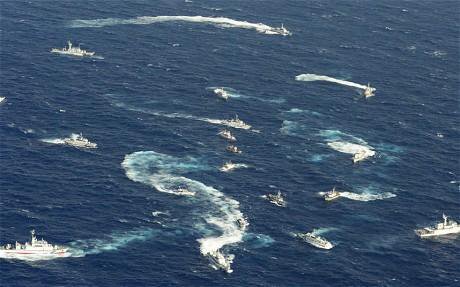
A water cannon battle between Taiwanese and Japanese Coast Guard vessels.
Center for International Maritime Security (CIMSEC) is partnering with the Yokosuka Council on Asia Pacific Studies, the Institute for Security Policy Kiel University, and the Dominican Command and Naval Staff School in a call for articles addressing the impact of regional maritime powers and strategies on future international maritime security.
There is certainly no shortage of problems to address. We have Chinese bullying in the South China Sea; piracy in the Gulf of Guinea; transnational criminal organizations; Illegal, Unreported, Unregulated (IUU) fishing; excessive claims of sovereignty by Russia and Venezuela; unresolved claims to mineral resources in the Eastern Mediterranean.
Hopefully some of our readers will have opinions that might address these or other concerns.
Patria and Kongsberg Defence & Aerospace have teamed up for the future U.S. turreted mortar programs.
The news here is simply that the US Army has a program to procure a turreted mortar. I don’t think the US has ever had one, at least not since the 19th century.
They offer some interesting possibilities for arming small naval craft like patrol boats. For our purposes, they are effectively low velocity short range cannon, that can fire a relatively large projectile, while requiring far less of the vessel than a typical higher velocity naval gun.
Looking specifically at the 120mm mortar, it fires a 4.7″ diameter projectile weighing about 30 pounds (I have seen weights quoted from 28 to 31 pounds. Part of the weight would be consumed propelling the projectile since this is both projectile and propellent). That is less than half the weight of a modern 5″ projectile (70 pounds) but about five times the weight of a 57mm projectile, and the Patria turret has been mounted on some very small vessels. It has even been tested at sea in a standard sized 20 foot container.
Unguided mortar rounds tend to be less accurate than typical naval guns, but guided rounds are changing that. The Army is working on a new round.
The HEGM program objective is to create a round accurate to within one meter CEP, with dual GPS/SAL (Semi-Active Laser–Chuck) guidance to hit targets that have relocated and to function in a GPS-degraded environment.
Range is about 8,000 yards, similar to that of the Hellfire or the effective range of the 57mm Mk110 or 76mm Mk75 guns using unguided projectiles. I have seen ranges double that for smart mortar rounds. In any case, it would have sufficient range to fire from outside the effective range of likely improvised armament for a terrorist controlled vessel.
The Coast Guard is not without experience in the use of mortars on patrol boats, having mounted them on 82 foot WPBs as well as other vessels during the Vietnam era.
Gun crew on board USCGC Point Comfort (WPB-82317) firing 81mm mortar during bombardment of suspected Viet Cong staging area one mile behind An Thoi.(August 1965)
It is behind the pay wall, but the US Naval Institute Proceedings has a short argument for the Navy to look seriously at adding mortars to Its inventory of weapons. In addition to its use as a weapon, the author contends that they could be used to launch decoys or UAS. He suggests:
“The Navy could take an incremental approach to integrating mortars onto ships:
“Task the Naval Surface Warfare Center at Indian Head, Maryland, with testing a variety of available mortar rounds for effectiveness against maritime targets, potential for countermeasure launching, and suitability for shipboard use.
“Encourage the Marine Corps and the Naval Research Lab to pursue an anti-armor version of the ACERM.
“Fire existing Marine Corps and Army mortars from ships during a SinkEx. Assess their effectiveness on the target and their structural impact on the ship.”
This is not as good an answer to the problem of stopping larger vessels, that might be used in a terror attack, as torpedoes (probably the best solution) or missiles like Hellfire (a good solution against small vessel threats with some capability against larger vessels), but it has some capability and would also make our patrol boats more useful in the support of troops in the littorals against targets on land.
As always, this is never going to happen unless the Navy adopts the weapon. That is unlikely for the larger Navy, but the Special Warfare community might be interested.










 Chuck Hill's CG Blog