Comments on the Tri-Service Strategy, “Advantage at Sea” –Part 1

USCGC Stratton (WMSL-752), left, and the U.S. Navy Arleigh Burke-class guided-missile destroyer USS McCampbell (DDG-85) maneuver in formation during Talisman Sabre 2019 on July 11, 2019. US Navy Photo

From my Coast Guard perspective, my number one question when viewing the new tri-service strategy, “Advantage at Sea,” is “What is the Coast Guard expected to do?” It does not appear that we have been given a clear answer, particularly in regard to our role in a major conflict.

Below, I quote every part of the strategy that refers uniquely to the Coast Guard. (I have not included those sections where “Coast Guard” or “coast guardsmen” are lumped in with Navy and Marine Corps or sailors and marines.)

In part 2, we will look at the strategy in more detail. I will also talk about what I see as logical use of the Coast Guard in a major conflict.


“The Coast Guard is expanding its global engagements and capacity-building efforts in key vulnerable regions.” –from Foreword

“The Coast Guard’s mission profile makes it the preferred maritime security partner for many nations vulnerable to coercion. Integrating its unique authorities—law enforcement, fisheries protection, marine safety, and maritime security—with Navy and Marine Corps capabilities expands the options we provide to joint force commanders for cooperation and competition.” p.7, “Integrated All-Domain Naval Power”

“In the homeland, the Coast Guard protects the marine transportation system that
underpins America’s economic vitality.” p.10, “Employing Naval Forces, Operating Across the Competition Continuum, In Day-to-Day Competition”

“Navy and Coast Guard ships conduct freedom of navigation operations globally,
challenging excessive and illegal maritime claims. Coast Guard cutters and law enforcement detachments aboard Navy and allied ships exercise unique authorities to counter terrorism, weapons proliferation, transnational crime, and piracy. All three services enforce sanctions through maritime interdiction operations, often as part of international task forces.” p.11, “Employing Naval Forces, Operating Across the Competition Continuum, In Day-to-Day Competition”

“Coast Guard forces provide additional tools for crisis management through capabilities that can de-escalate maritime standoffs nonlethally.” p.12, “Employing Naval Forces, Operating Across the Competition Continuum, In Crisis”

“Rapidly deployable Coast Guard cutters, Port Security Units, and Advanced Interdiction Teams will provide specialized capabilities, augmenting operations in theater.” p.13/14, “Employing Naval Forces, Operating Across the Competition Continuum, In Conflict”

“The Coast Guard will ensure the safe, secure, and efficient marine transportation
system essential to sustaining forces in war.” p.14 “Employing Naval Forces, Operating Across the Competition Continuum, In Conflict”

“A modernized Coast Guard fleet will enhance global deployability and provide expanded options across the competition continuum.” p.15/16, “Developing Naval Forces, Delivering Integrated All-Domain Naval Forces”

“The Coast Guard will prioritize readiness, capacity, and future capability—including cyber, C5ISR, and modernizing the cutter fleet—over legacy capability. ” p.17, “Developing Naval Forces, Delivering Integrated All-Domain Naval Forces, Integrated naval modernization

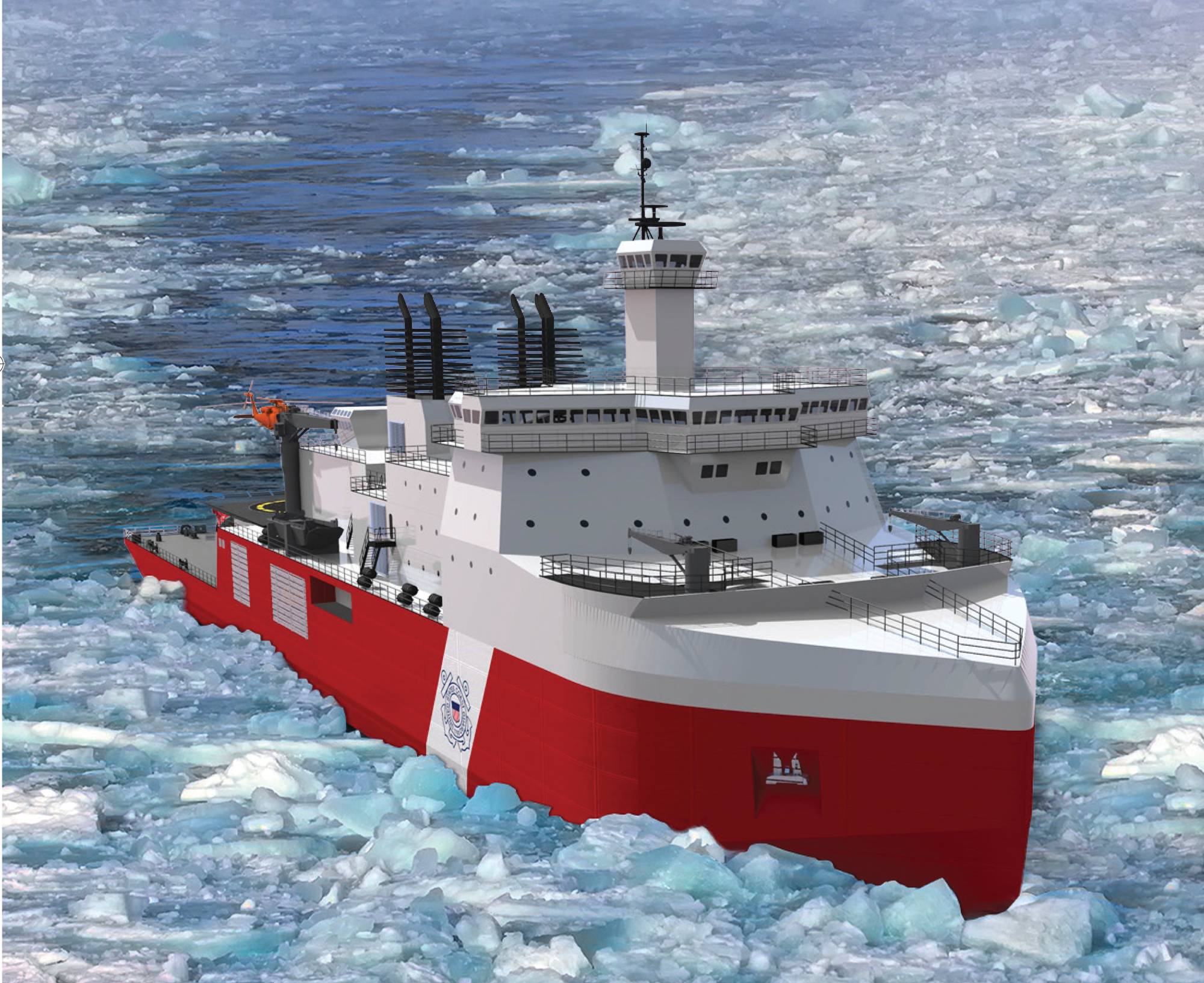
“The Coast Guard’s fleet modernization, including acquisition of the Offshore Patrol Cutter, Polar Security Cutter, Arctic Security Cutter, and Waterways Commerce Cutter, will provide the capacity and capabilities necessary to facilitate advancing maritime governance and protecting U.S. maritime sovereignty.” p.23, “Annex: Naval Service Investments, Prevailing in day-to-day competition”

“Coast Guard will maintain investments in ships, talent, and infrastructure to operate a modernized cutter fleet.” p.24. “Annex: Naval Service Investments, Operational readiness”


Recognizing Fishing Vessels Using Force Labor

gCaptain reports,

Fishing vessels with crews of forced laborers behave in systematically different ways to the rest of the global fleet, according to a study purporting to be the first to remotely identify vessels potentially engaged in modern slavery.

Using satellite data, machine learning and on-the-ground expertise from human rights practitioners, U.S. researchers found up to 26% of about 16,000 industrial fishing vessels analyzed were at high risk of using forced labor.

It is not unlikely that the same vessels that engage in this practice, also violate other norms including Illegal, Unregulated, and Unreported fishing.

Not sure how the Coast Guard should go about attacking this international problem, but it is something to consider. Certainly vessels flagged as meeting these characteristics should attract our interest.

Britain Does Things a Little Differently

Royal Navy’s new patrol vessel HMS Tamar is ready for action and will be based in Portsmouth. An offshore patrol vessel, similar in many respects to a Coast Guard cutter. (Picture source: Royal Navy)

Many other countries do not have a coast guard that serves as a maritime law enforcement agency. Their solutions for maritime law enforcement frequently fall on their navies. Recently Great Britain has seen a need for a change.

Thanks to Brymar Consulting for bringing this to my attention.


Published 17 December 2020, from Ministry of Defence

Statutory Instrument on Royal Navy Police enforcement powers

A Regulation has been introduced to the Policing and Crime Act 2017 to provide Royal Navy Police with enforcement powers as the transition period for Britain’s exit from the EU comes to an end.

The Ministry of Defence has laid a Statutory Instrument in Parliament to introduce a Regulation under the Policing and Crime Act 2017. This will provide Royal Navy Police with additional law enforcement powers as the transition period for Britain’s exit from the EU comes to an end. Additional powers would come into effect on Thursday 07 January 2021 and will apply to England and Wales territorial waters only.

The Government is determined to ensure the security of UK waters from a range of threats under all circumstances. Contingency work for the end of the EU Transition Period has identified that there may be an operational requirement to extend law enforcement powers to Royal Navy Police.

Royal Navy personnel already routinely conduct enforcement activity in UK waters and Royal Navy Police are specially trained to conduct a range of enforcement activity safely and in line with civilian policing procedures. Currently, any interventions at sea are joint operations between the police and military. However, the deployment of civilian police officers to a maritime incident may be impractical in some circumstances. Providing extra powers will give greater flexibility to authorities to act effectively.

Royal Navy Police will only use these powers if requested to do so by civilian police forces. No decisions on the use of enforcement will be taken independently by military personnel, and the new powers are only extended to Royal Navy Police, a specific branch of the Royal Navy with trained military police officers.

The extension of enforcement powers to Royal Navy Police will be reviewed in six months.

Space Force Personnel to be Called “Guardians,” Their Boss Has Seat on JCS

An illustration of HawkEye 360’s first satellite constellation, called Pathfinder, orbiting Earth. HawkEye 360/UTIAS Space Flight Laboratory

DefenseOne reports that, “Two days before the U.S. Space Force’s first birthday, its troops received their collective name: Guardians.”

Also that “Since its standup on Dec. 20, 2019, the Space Force has grown to about 2,400 active-duty personnel, mostly Air Force personnel who were responsible for the military’s space mission before the new service was created. In 2021, the Space Force is expected to grow to about 6,400 active-duty Guardians, as Army and Navy personnel start transferring into the new service…”

And that, Gen. Jay Raymond, the Chief of Space Operations, will officially become a member of the Joint Chiefs of Staff (JCS).

The JCS members are the Chairman of the Joint Chiefs of Staff, the Vice Chairman, the Army Chief of Staff, the Chief of Naval Operations, the Air Force Chief of Staff, the Commandant of the Marine Corps, the Chief of the National Guard Bureau and, now, the Chief of Space Operations.

From time to time, Coast Guardsmen have been called Guardians. Presumably that will stop. I don’t think it ever really caught on. Still I don’t think it will stick for the Space Force either, although it is better than some names that might have been chosen. (Feel free to offer alternatives in the comments.)

Space Force, even if grown to 6,400, will still be by far the smallest US military force. The Coast Guard will still be six or seven times as large. Presumably they will get a relatively larger budget, but still it suggests that, perhaps the Commandant has at least as much reason to be a JCS member. Not sure he would really want to attend all their meetings, but the Coast Guard has become an important tool in US “whole of government” foreign relations organization. Plus the JCS Chairman is probably less likely to fully understand the Coast Guard than any other military service.

Sea Services’ Strategy–CG News Release

Below is the Coast Guard’s news release regarding the new Tri-Service Strategy

united states coast guard

 News Release

U.S. Coast Guard Headquarters
Contact: Headquarters Public Affairs
Office: (202) 372-4630
mediarelations@uscg.mil
Headquarters online newsroom

Navy, Marine Corps and Coast Guard Release Maritime Strategy

WASHINGTON ̶ The U.S. Navy, Marine Corps, and Coast Guard released a new tri-Service maritime strategy today, entitled Advantage at Sea.

The document provides strategic guidance on how the sea services will prevail in day-to-day competition, crisis, and conflict over the next decade. It also directs the services to deepen tri-service integration, aggressively pursue force modernization, and continue robust cooperation with allies and partners.

“Our integrated Navy, Marine Corps, and Coast Guard must maintain clear-eyed resolve to compete with, deter, and, if necessary, defeat our adversaries while we accelerate development of a modernized, integrated all-domain naval force for the future,” wrote Chief of Naval Operations Adm. Michael M. Gilday, Marine Corps Commandant Gen. David H. Berger, and Coast Guard Commandant Adm. Karl L. Schultz in the strategy’s forward. “Our actions in this decade will shape the maritime balance of power for the rest of this century.”

Advantage at Sea places particular focus on China and Russia due to their increasing maritime aggressiveness, demonstrated intent to dominate key international waters and clear desire to remake the international order in their favor.

“China’s and Russia’s revisionist approaches in the maritime environment threaten U.S. interests, undermine alliances and partnerships, and degrade the free and open international order,” the document states. “Moreover, China’s and Russia’s aggressive naval growth and modernization are eroding U.S. military advantages.”

The strategy also emphasizes the maritime domain is integral not only to America’s security and prosperity but to those of all nations. The oceans connect global markets, provide essential resources, and link societies and businesses. Shared interests create opportunities for greater cooperation with allies and partners.

“As Sailors, we are on the leading edge of Great Power Competition each and every day,” said Gilday. “Sea control, power projection and the capability to dominate the oceans must be our primary focus. Our forces must be ready today, and ready tomorrow, to defend our nation’s interests against potential adversaries at any time. This strategy helps us do exactly that.”

The strategy directs the Services to pursue an agile and aggressive approach to force modernization and experimentation. The future fleet will combine legacy assets with new, smaller ships, lighter amphibious ships, modernized aircraft, expanded logistics, resilient space capabilities, and optionally manned and unmanned platforms. To succeed in a dynamic operating environment, the Services will also invest in warfighter development, delivering innovative training and education to ensure our Sailors, Marines, and Coast Guardsmen remain the world’s premier naval force.

Advantage at Sea also reflects the dual roles of the Service Chiefs: advising on the employment of forces in day-to-day competition, crisis and conflict, and developing a modernized future force that deters potential adversaries and advances and defends U.S. interests.

“The Marine Corps is conducting a sweeping force design transformation to fulfill our role as the Nation’s expeditionary force-in-readiness while simultaneously modernizing the force in accordance with the operating environment described in the National Defense Strategy and the tri-Service maritime strategy. We must embrace new ways of operating within the concepts of integrated U.S. naval power to deter future adversaries and generate better strategic choices,” said Berger.

As the Services pursue greater integration, to include training and education; capabilities and networks; plans, exercises, and experiments; analysis and wargaming; investments and innovation; and force design, Advantage at Sea states they will collaborate with allies and partners to build capability, enhance interoperability, and generate unity of effort. Alongside allies and partners, the Services will be able to establish sea denial and sea control where and when needed, project power, and hold critical adversary targets at risk.

“As the only military service in the Department of Homeland Security, the U.S. Coast Guard provides unique multi-mission and intelligence capabilities to complement the ability of our Marines and Navy to protect our national interests when necessary and deliver lethality across the globe,” said Schultz. “Our hallmark is working daily with partner agencies, sister sea services, and international navies and coast guards to counter maritime coercion and uphold the rules-based order – partnerships work.”

To read the full strategy, please visit: https://www.uscg.mil/tsms

Authorization (not money) for Six Icebreakers and Better Comms in the Arctic

The Coast Guard Research, Development, Test, and Evaluation Program, in partnership with the Department of Homeland Security Science and Technology Directorate, launched two 6U CubeSats from Vandenberg Air Force Base, California, as part of the Polar Scout project. Photo courtesy of SpaceX.

Breaking Defense reports the National Defense Authorization Act (NDAA) includes six icebreakers for the Coast Guard and better satellite communications for the polar regions.

Not really a reason to get too excited yet. Authorization does not include any money. There was already general bipartisan acceptance of the idea that the Coast Guard needs new icebreakers with the 3 heavy and 3 mediums apparently seen as reasonable. Funding ($555M) for the second Polar Security Cutter was requested by the administration and agreed to by both Senate and House oversight committees, so should be in the FY2021 budget.

The addition of better comms may be the best news in the NDAA for the Coast Guard. It has been a major problem in US Arctic operations.

“Defense Health Primer: U.S. Coast Guard Health Services” –CRS

New Orleans, September 5, 2005 – A Disaster Medical Assistance Team member (left) assures a rescued man that the trip to the airport will be safe. Thousands of people are airlifted from the Ernest N. Morial Convention Center pickup site to the New Orleans Airport every day. Photo by Win Henderson / FEMA photo.

The Congressional Research Service has another Coast Guard related “primer,” a two page basic explanation, written for congressmen and their staffers, to provide basic understand. This one is on healthcare, “Defense Health Primer: U.S. Coast Guard Health Services.”

It covers mission, organization, budget, USCG healthcare personnel, USPHS support to the USCG, USCG health services, interaction with TriCare, and current challenges including electronic health records, USPHS support, and the disability evaluation system.

Thanks to Bryant’s Maritime Consulting for bringing this to my attention.

Maybe the Largest Self Right Motor Surfboat in the World

Intermarine Launches New SAR Patrol Boat for Italian Coast Guard

Naval News Reports that, “Italian shipbuilder Intermarine launched the longest self-righting and unsinkable boat ever built in Italy.” At 33.6 meters (110′), length overall, this may be the largest self-righting rescue craft in the world.

Our own 52′ Motor lifeboats are becoming unsupportable, as made clear by the recent withdrawal of Victory, now 64 years old, from service. Our 87′ patrol boat are approaching the end of their service life. It may be time to look at what others have done and procure a larger, more powerful, and  extremely seaworthy self righting boat capable of replacing both the 87 footer and the 52 foot MLB, at least in ports where a maritime terrorist threat is extremely unlikely. 

Specifications here: Scheda nave nuova classe cp 420 Natale De Grazia (slideshare.net) (Thanks to W B Young)


A Google Translation: 

Ship board new class cp 420 Natale De Grazia
1. New Naval Unit class CP 420 Technical Sheet CP 420 – Christmas Ship DE GRAZIA…………………………………. (delivery expected December 2020) CP 421 – Ship Roberto ARINGHIERI………………… (delivery expected December 2021) Classification RINA C (✠) Rescue and Maritime Police Self-thinning and Unsinkable – Navigation Unrestricted Length 33.60 m. Width 8.15 m. Draw 1.34 m. Full load displacement ~ 150 tons Max speed 31 knots > 1000 nm. (28 knots) Construction material Aluminum Alloy Propulsion Hydrojet n.2 KONGHSBERG 2 x MTU : 16V2000M96 (2 X 1790 KW / 2 X 2490HP) Electrical generation 2 DDGG Deutz/Koelmo (2 x 85 KW)
2. Boarding capacity 200 people including 50 hospitalized and sitting in the room shipwrecked with adjacent decontamination area and infirmary Crew 10 (logistics accommodations: (2 x 2pl) + (2 x 4pl) T.V. Command (CP) Operating and communication systems no. 2 GPS – no. 2 RADAR (X and S band) – ECDIS – VSAT – VHF/FM – n.2 HF 500/150W RodeSwarts – Warship AIS NAVNET system – Optronic system – Ecosounder Other operating capacities Sea holding 6 – wind F9 Service boat on fly bridge Dedicated area for operations such as Vertrep/Medevac 0.5 ton feeding table crane for shipwreck recovery 75 mc/h high pressure fire monitor Fendering perimeter system: profile “D” (80×40) expanded polyethylene core (closed cell density 33 Kg/mc) coated the polyurea with differentiated thickness with high resistance (to fire 175°C) orange color RAL2004 Capacity : Water Crates 3.6 mc (in addition to the dissalators) Diesel Crates : 55 mc Construction site INTERMARINE spa La Spezia – Shipyard of Messina


31 knots would be remarkably fast for a vessel of this size with the power indicated, faster than either the 87 footers or the 110s with less power than either. 

“Here Is What…Missiles Actually Costs” –The Drive

The Drive brings us estimates of the per round price for several types of missiles in the US inventory, “ship launched” here and “air launched” here. The “air launched” list includes a couple of missiles that can also be surface launched, LRASM and Hellfire. I have pulled out info on those systems that could someday up-arm Coast Guard cutters.

These numbers might look quite scary at first glimpse, but if you consider the cost of an operating day, for a ship like the $650M National Security Cutter, (I don’t really know, but a very rough estimate would be on the order of –don’t quote me– $250,000/operational day, see foot of the post for how I got this) it does not look that much out of line. (Reportedly the 57mm Mk110 gun cost $7.2M and the rounds $1200 each. The fire control systems, maintenance, training, and support personnel are additional cost.) By comparison, the Hellfire looks like an absolute bargain. We could probably mount a set of up to eight on an FRC for less than the cost of a 25mm Mk38 mod3.

Keep in mind, that if the Navy sees a need to arm Coast Guard cutters, the Navy pays for the systems. (I do believe the Navy does not really understand or appreciate our counter terrorism needs, maybe the Coast Guard does not either.)

We had some earlier estimates of the cost to arm cutters here, here, and here.


Evolved Sea Sparrow Missile (ESSM) – $1,795,000 (average for the entire projected Fiscal Year 2021 purchase, which includes ESSM Block I and Block II versions).

Mk49 “SeaRAM launcher for Rolling Airframe Missiles.

Rolling Airframe Missile (RAM) – $905,330 – This unit price is an average across the full projected Fiscal Year 2021 order, which includes multiple RAM variants, including the Block II and IIA.

Tactical Tomahawk (TACTOM) Block V – $1,537,645 (base land-attack variant). Conversion kits to transform Block V missiles in Block Va Maritime Strike Tomahawk (MST) anti-ship missiles approximately $889,681.

The U.S. Navy littoral combat ship USS Gabrielle Giffords (LCS-10) launches a Naval Strike Missile (NSM) during exercise “Pacific Griffin” on 2 October 2019. The NSM is a long-range, precision strike weapon that is designed to find and destroy enemy ships. Pacific Griffin is a biennial exercise conducted in the waters near Guam aimed at enhancing combined proficiency at sea while strengthening relationships between the U.S. and Republic of Singapore navies. U.S. Navy photo by Mass Communication Specialist 2nd Class Kenneth Rodriguez Santiago

Naval Strike Missile (NSM) – $2,194,000 (Navy only requested funds to purchase 15 of these missiles in the 2021 Fiscal Year budget).

ARABIAN GULF (Sept. 16, 2018) A MK-60 Griffin surface-to-surface missile is launched from coastal patrol ship USS Thunderbolt (PC 12). Ships attached to U.S. 5th Fleet’s Task Force 55 are conducting missile and naval gun exercises against high speed maneuvering targets to advance their ability to defend minesweepers and other coastal patrol ships. U.S. 5th Fleet and coalition assets are participating in numerous exercises as part of the greater Theater Counter Mine and Maritime Security Exercise to ensure maritime stability and security in the U.S. Central Command area of responsibility, connecting the Mediterranean and the Pacific through the western Indian Ocean and three strategic choke points. (Photo by MC2 Kevin Steinberg)

Griffin – None included in current budgets, but  2019 Fiscal Year unit cost  $127,333. 

ATLANTIC OCEAN—A Longbow Hellfire Missile is fired from Littoral Combat Ship USS Detroit (LCS 7) on Feb. 28 2017 as part of a structural test firing of the Surface to Surface Missile Module (SSMM). The test marked the first vertical missile launched from an LCS and the first launch of a missile from the SSMM from an LCS. (Photo by U.S. Navy)

Hellfire (AGM-114):  A number of different costs were reported. This is apparently due to the large number of different versions of the missile. The average price for the Navy was reported as $45,409, for the Air Force $70,000, and for the Army $213,143.

Long Range Anti-Ship Missile (LRASM)

LRASM (Long Range Anti-Ship Missile): AGM-158C Long Range Anti-Ship Missile (LRASM) for the Air Force – $3.960 million, for the Navy – $3.518 million


How I got a very approximate cost for an operational day for a National Security Cutter.

Annual Coast Guard budget approximately $12M, divide by 40,000 (approximate number of uniformed active duty Coasties, about $300,000 each), multiply by 150 (approximate number of crew members ($45M/year), divide by 180 operating day/year=$250,000/day. (Back in the 1980s I figured a 378 cost forty or fifty thousand per op day. Forget what it was exactly but the higher cost of today’s NSC sounds about right.)