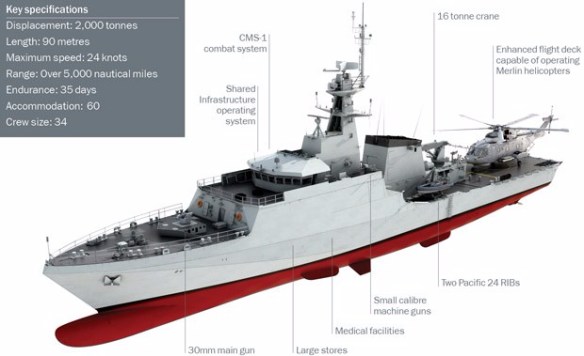
The Royal Navy is looking at how they might increase the lethality of their new River Class Batch II Offshore Patrol Vessels. Save the Royal Navy looks at how they might be upgraded. “Save the Royal Navy” describes itself as “an online campaign but not an organisation as such,” so not an official voice of the Royal Navy.

Royal Navy’s new patrol vessel HMS Tamar is ready for action and will be based in Portsmouth. (Picture source: Royal Navy)
These are effectively the UK’s WMECs. They do fisheries, SAR, and drug enforcement, but they are looking to use them for a bit more. They have the three River class Batch I OPVs to do fisheries around the home turf, so they plan to use most of these in the overseas territories or providing presence in distant theaters of operation. One is currently deployed to the South Atlantic operating out of the Falklands and a second is tasked with operations upholding UK interests in the Caribbean, Gulf of Mexico, and Western North Atlantic. It is likely one will go to Gibraltar and another to the SW Asia/Persian Gulf/Indian Ocean Area.
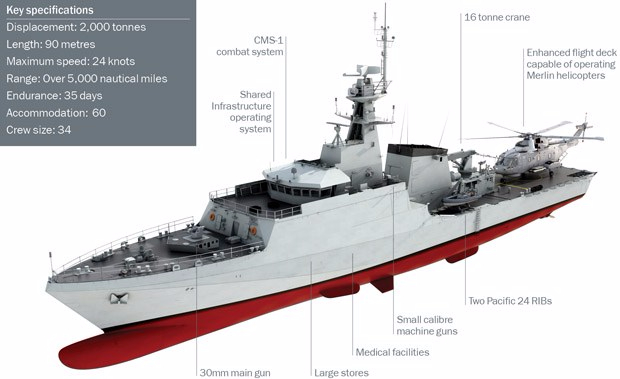
Compared to our own WMECs, the River Class Batch IIs are bigger and faster than the Bear class.
- 2000 tons vs 1800 tons
- 297′ (90.5 meters) vs 270′
- 24 knots vs 19.5 knots
But they are equipped more like a 210. They have no helicopter hangar and only a single 30mm gun in an optionally manned remote weapon station while the Bear class has a 76mm gun and radar fire control system and they have nothing like the Bear class’s SLQ-32 and decoy systems.
“Save the Royal Navy” considers upgrade packages that were labeled, in order of increasing complexity, “OPV Plus”, “OPV Max”, and “Corvette”.
“OPV Plus” includes a container based rotary wing UAS like the Schiebel Camcopter S100, two 30mm guns, a BAE Bofors 40mm/70 Mk4 with a possible fire control upgrades, and Long Range Acoustic Device (LRAD).
“OPV Max” includes a collapsible hanger for an Agusta/Westland AW-159 Wildcat helicopter, two 30mm guns, added Martlet LMM (Light Multirole Missile) to the 30mm mounts, and a BAE Bofors 57mm Mk110 and associated fire control system, but for some reason lost the LRAD.
“Corvette” traded the hangar for Anti-Ship Cruise Missiles (ASCM) and exchanged a RHIB for an armed Unmanned Surface Vessel. In addition to two 30mm guns with LMM Martlet missiles, and a BAE Bofors 57mm Mk110 and associated fire control system, it also adds an enlarged operations room (CIC), decoy launchers, and a multirole Artisan 3D radar.
Its easy to understand why upgrades might be in order when you consider some of the duties that these ships might be called upon to perform.
–
These ships will often be far from any backup. They might be escorting Russian warships through UK EEZ; facing off against
Argentine OPVs in the South Atlantic or
Spanish OPVs in Gibraltar’s EEZ. And of course operating in areas where the Islamic Republic Revolutionary Guard Corps’s Navy may be encountered is likely to raise your pulse rate. Not that shooting is expected, but it is a lot easier to stand your ground or perhaps intimidate the other guy if you have the weapons to back up your position.
–
I have always thought that the requirement to be able to land and refuel the very large Merlin helicopter (max gross weight 14,600 kg or 32,187 lb), that seemed to preclude a hangar was a poor choice. Having a helicopter aboard at all times, particularly an armed aircraft, could help the ship with both peacetime and wartime missions.
–
The 30mm gun is a close relative of the 25mm found on USCG cutters, but we know that
it is more effective. Having more than one seems a good idea. If a helicopter hangar is added, they could have one on the roof of the hangar that could bear directly aft. That means they could have as many as four, one forward, one aft, and one on each bridge wing. They could put up to three guns on a target.
–
The Martlet LMM probably should be added to whatever 30 mm guns are mounted. It could make these ships much more lethal inside 5,000 yards.
–
I like the 40mm70 MK4. It could function to some degree as a counter to ASCMs, but I doubt the improvement is sufficient to justify replacing a 30mm/Martlet LMM combination considering it would require introducing a second gun, second ammunition, a fire control system, and additional training. Being able to bear three 30mm and 15 Martlet LMM on a target would be very effective against a single target if within range. The combination could be useful against swarming boats as well. In the Straits of Hormuz, I would still worry about IRGC torpedo and missile boats that could engage from longer range, but the armed Wildcat helicopter with Martlet LMM should be effective against them.
–
The case for the 57mm is much more convincing than that for the 40mm, given the
smart projectiles that are being developed for it.
–
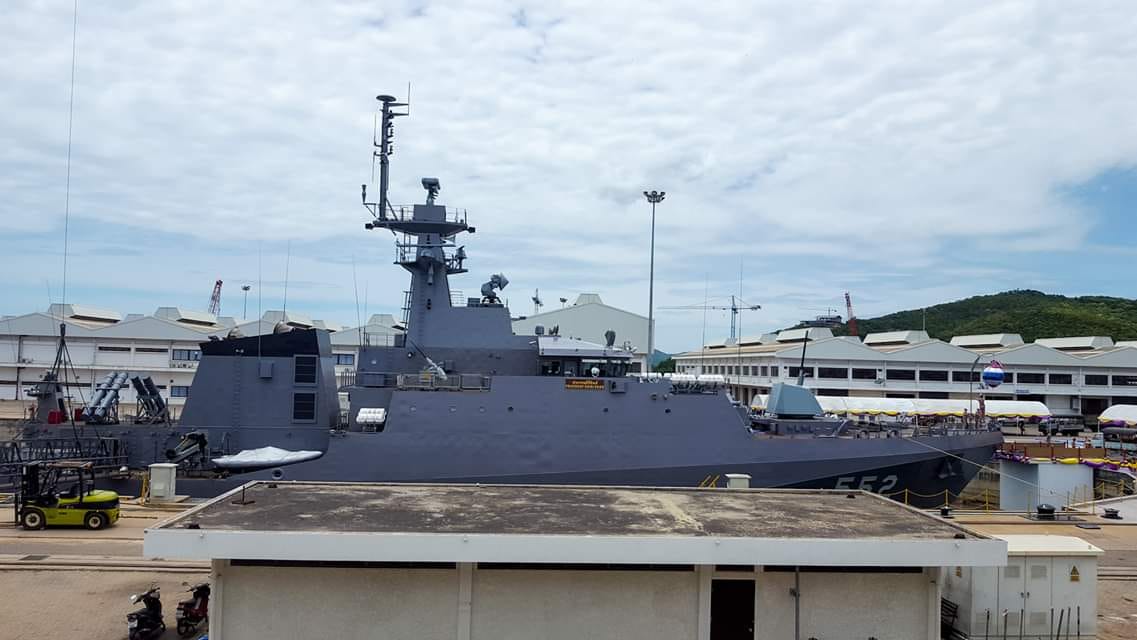
The author seems unenthusiastic about the corvette option, and since adding anti-ship cruise missiles would likely mean no helo hangar, and an armed USV replacing an RHIB needed for peacetime duties, I can understand his reservations. On the other hand, if they fail to add a hangar, being prepared to add ASCMs, quickly might be wise. We have already seen this done to a
Thai OPV built to an earlier version of this design.
–







 Chuck Hill's CG Blog