Pacific Fisheries Standoff

HMNZS Wellington intercepts suspected toothfish poachers

HMNZS Wellington intercepts suspected toothfish poachers

We don’t often talk about fisheries, because normally the operations are routine, but something interesting is happening in the western Pacific.

BBC reports the New Zealand Navy OPV Wellington (which looks a lot like Eastern’s design for the OPC) has intercepted three Equatorial Guinea flagged (but believed to be Spanish owned) fishing vessels apparently fishing illegally for Patagonian Toothfish, commonly called Chilean Sea Bass, a highly valued and overfished resource. Despite being given permission to board by the flag state, the fishing vessels are resisting efforts to board.

Australian advocates are pointing to this incident as evidence Australia’s apparent inability to do what New Zealand is doing. There is more here.

This does appear to be symptomatic of inadequate enforcement.

Generally, it appears, that our own efforts in the Western Pacific may also be inadequate. It is probably not common knowledge that the US EEZ around islands West and South of Hawaii is larger than our EEZ around Alaska, the West Coast, or the East and Gulf Coast, and many of the fish taken in these waters are extremely valuable. In spite of new tasking in the area, we don’t seem to be giving this area much attention. There is also the question of who polices what would be the Antarctic EEZ if any country had sovereignty their.

Extend Counter Piracy Efforts in the Indian Ocean to Include Other Maritime Governance Missions

With Piracy effectively suppressed in the Indian Ocean and the Gulf of Aden, the Australian Strategic Policy Institute is recommending that steps be taken to allow these forces to counter other international crimes beginning with drug smuggling.

There are a number of impediments to effective enforcement, but the study authors suggest there are also mechanisms in place that may make this effort mort effective.

Good maritime governance has been lacking in this region. If they could create, what would amount to an international Coast Guard with a supporting judicial system, it might also serve as a model for other areas such as West Africa, the Straits of Malacca, and the Caribbean.

Navy Rethinking Ship Designations–Time for the CG to do so too?

cropped-uscgc_waesche_by_yerba_buena_island2.jpg
Photo: Doesn’t this look like a Patrol Frigate?

The USNI is reporting that, “The modified Littoral Combat Ship (LCS) class will be redesigned as frigates, Secretary of the Navy Ray Mabus announced on Thursday at the Surface Navy Association 2015 symposium on Thursday.”

Mabus noted, ““It’s not an ‘L’ class ship,” he said. “When I hear ‘L’ I think amphib, so does everybody else.”

The FF designation for the LCS will be the first of a planned set of nomenclature changes for other ships classes as well that will come in the coming weeks, Mabus said.

Apparently he also intends to address the designations of the Afloat Forward Staging Base (AFSB), the Mobile Landing Platform (MLP), and the Joint High Speed Vessel (JHSV).

I will repost something I quoted in a comment to a previous post regarding an article by Norman Polmar in the US Naval Institute Proceedings “US Navy-LCS, JHSV, MLP…What?”

Quoting his conclusion: “Unquestionably, the LCS, JHSV, and MLP designations must be changed—it is logical and sensible to do so. It can be done with the stroke of a pen by a Secretary of the Navy notice. At the same time, two other ship classes should have their hull numbers changed: The three ships of the Zumwalt (DDG-1000) class and the three submarines of the Seawolf (SSN-21) class should be assigned realistic hull numbers within their respective types, and thus be in accord with the 90-year-old directive that stated ships were to be designated in sequential order within their designation types…“The U.S. Navy’s basic ship-designation system is excellent and deserves to be carried out professionally and logically.”

Perhaps it would be a good time for the Coast Guard to take another look at their designation system too, and bring them back into line with the Navy system. I talked about this earlier, “Ship Type Designations–The Bertholfs are Minesweepers?”

The designations currently chosen for the Bertholf class (WMSL) and the Offshore Patrol Cutter (WMSM) are do not fit within the established and customary designation conventions of either the US Navy or NATO.

I would suggest, W-PFL (CG Patrol Frigate, Large) for the Bertholfs and W-PFM for the Offshore Patrol Cutters or more simply W-PL (CG Patrol, Large) and W-PM (CG Patrol, Medium). We might also apply the new designations to existing WHECs and WMECs as well.

We might also want to take a look at icebreakers and AtoN vessels, but those designations are really less problematic.

The 2015 Budget is Coming, Really it is, Maybe, Sometime

While the rest of the Federal Government has a 2015 budget, Homeland Security still does not. The DefenseDaily reported the bill out of committee in the House, describing the provisions, including this regarding the Coast Guard:

“The bill would give the Coast Guard $439.5 million above the president’s request, primarily by rejecting proposed cuts “that would have gutted vital Coast Guard operations,” according to the news release. The House committee increased Coast Guard funding to allow more cutter and aviation operating hours, training and maintenance; and to purchase the eighth National Security Cutter, two Fast Response Cutter patrol boats, an additional C-130J aircraft and one H-60 remanufactured helicopter.”

At this point the bill has been approved by the House and sent on to the Senate. DefenseNews talks about why Homeland Security is tied up in Immigration Policy.

It is good to see some additional operational funds, but I am frankly disappointed that there are only two Webber class WPCs included. This was the administration request, but I had hoped to see more added as has been done in the past. It could still happen, so we will have to wait and see.

This does raise the question of what CG-9, the Acquisitions Directorate, is doing about the contract for follow-on WPCs? All options on Bollinger’s original winning bid have expired. The Coast Guard paid for and now owns the design. A new bidding process was expected for the remaining ships, but last year’s buy was apparently negotiated without competition. As the number of ships remaining to be built gets smaller the ability and incentive for other yards to compete against Bollinger’s already established assembly line will decrease.

We also seem to have missed the opportunity for making a Multi-Year Procurement (See also).

Funding an Icebreaker

In thinking about how to fund a new icebreaker, it is apparent, (1) Congress, the administration, and the department have the (unrealistic) idea that ship building budgets need to be consistent from year to year (they never have been). (2) Cost of a single icebreaker is so high, funding it from the Coast Guard’s customary shipbuilding budget would disrupt ongoing programs and result in higher costs in out years to restart these disrupted programs.

The Navy is facing a similar, though as a percentage, less severe problem with the Ohio SSBN replacement program. The proposed solution is to fund the new submarines outside the Navy’s shipbuilding budget. This way the additional money does not establish a precedence for a higher Navy shipbuilding budget, and Congress has the illusion of holding the line on spending.

The advantage the Navy has here, is being part of the Defense Department. Nuclear Deterrence is obviously a DOD mission. On the other hand it is hard to make the case that icebreaking is a Homeland Security mission, so we are unlikely to be able to kick the funding requirement upstairs to the DHS.

Still it might be possible for some interested Congressional delegation to sponsor a separate special appropriation, outside the Coast Guard’s normal (inadequate) shipbuilding budget to cover the cost of a new icebreaker. After all, $1B is only .033% of an annual three trillion dollar budget. Maybe no one will notice.

Largest Ship

You have to see this. Makes aircraftcarriers look small.

gCaptain reports the arrival of the largest ship in the world at Rotterdam. There are different ways to measure ships, but this is 382 meters (1,253 feet) in length and 124 meters wide (407 feet) of beam, anyway you look at it, this thing is big. It is made for picking up and moving offshore drilling rigs.

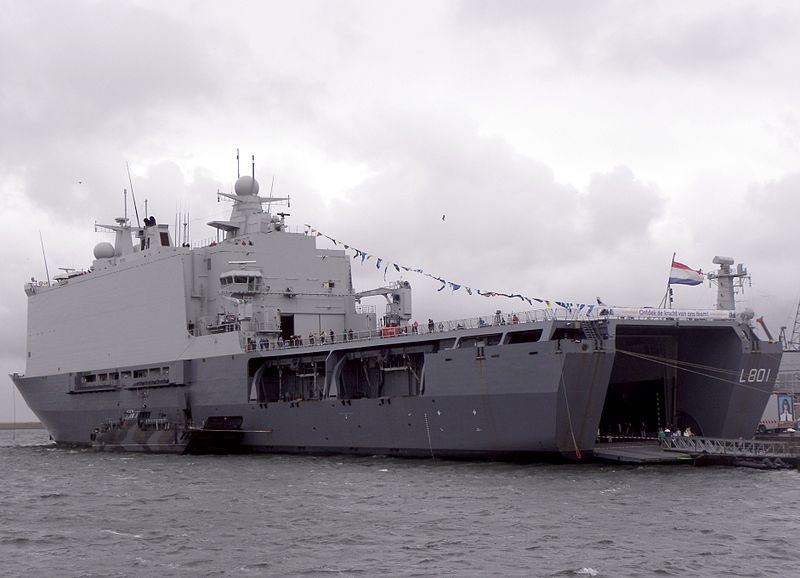
Dutch Mothership?

L 801 Johan de Witt Uploaded by Oxyman

L 801 Johan de Witt Uploaded by Oxyman

The following was reported by the German Navy blog Marine forum, “8 January, PIRACY–Anti-Piracy Forces: Sweden is preparing for another mission (M-04) in support of EU operation “Atalanta”, this time working jointly with the Netherlands navy … COMBAT BOAT 90 fast interceptor craft, helicopters and 70 personnel to embark on Netherlands Navy dock landing ship JOHAN DE WITT.”

As you may recall, I have advocated using WPCs supported by a mother ship to supplement the larger cutters for distant drug interdiction operations.

We have done cooperative counter drug operations with the Netherlands Navy in the past. Early last year, the Netherlands OPV Zeeland embarked both a CG LEDET and a CG helo det.

Perhaps we could run a test using the Johan de Witt or her sistership Rotterdam to try out the mothership concept. Their crew size is similar to that of the National Security Cutters (less than that of the Hamilton class), but they have berthing for hundreds more. They have aviation facilities for up to six helicopters. They can handle boats from both davits and a well deck. They have excellent Command and Control facilities.

“The ships have a complete Class II hospital, including an operating theater and intensive care facilities. A surgical team can be stationed on board.” That could make them welcome in a lot of ports.

Would the Dutch be interested? The Dutch Navy has already demonstrated its commitment to counter drug trafficing. They have used these ships several times for counter-piracy. Counter drug operations are not that much different, and piracy seems to be in decline. When it was being finished, there were reports that the Dutch wanted to sell the Johan de Witt. Operating off Latin America might be seen as an opportunity to demonstrate both this class and the Netherlands’ ship building expertise in an international market.

What might the experimental effort include. In addition to the mothership, perhaps three MH-65s, add a mix of Webber class WPCs, WPBs, Response Boat Mediums (RB-M), and Navy Riverine Command Boats (the US Navy version of the Combatboat 90).

In addition to its counter drug objectives, the deployment might be seen as a partnership station effort, training as well as working with the locals, and if there should be a natural disaster while they are in the area, it will be a ready made Coast Guard response.

CBP Drones not Meeting Expectations–DHS IG

FierceHomelandSecurity is reporting that the Department Inspector General (IG) has found that the U.S. Customs and Border Protection Agency’s eight year effort to use Unmanned Air Systems (UAS) commonly called drones, has failed to live up to expectations and should not be expanded finding that money proposed for expansion of the program “could be put to better use by investing in alternatives such as manned aircraft and ground surveillance.”

“Although CBP anticipated increased apprehensions of illegal border crossers, a reduction in border surveillance costs, and improvement in the U.S. Border Patrol’s efficiency, we found little or no evidence that CBP met those program expectations,” the report said.

The Coast Guard has been cooperating with CBP in evaluating use of land based UAS. According to the IG, CBP has failed to establish evaluation criteria, the drones are flying only 22% of anticipated flight hours, the cost per flight hour has been significantly underestimated, and the program has not demonstrated any improvement in capability.