Line of Duty Fatality

This is a Coast Guard news release quoted in its entirety.

Coast Guard mourns passing of shipmate

Petty Officer Third Class Travis Obendorf died in a Seattle hospital Dec. 18 as a result of injuries he sustained during search and rescue operations near Amak Island, Alaska, Nov. 11, while serving aboard Coast Guard Cutter Waesche. Photo courtesy Coast Guard Cutter Waesche.
Petty Officer Third Class Travis Obendorf died in a Seattle hospital Dec. 18 as a
result of injuries he sustained during search and rescue operations near Amak
Island, Alaska, Nov. 11, while serving aboard Coast Guard Cutter Waesche.
Photo courtesy Coast Guard Cutter Waesche.

ALAMEDA – Petty Officer Third Class Travis Obendorf died in a Seattle hospital Dec. 18 as a result of injuries he sustained during search and rescue operations near Amak Island, Alaska, Nov. 11, while serving aboard Coast Guard Cutter Waesche.

Obendorf’s family was by his side when he passed away in Swedish Hospital following surgery.

“Our thoughts and prayers are with Petty Officer Obendorf’s family and his shipmates aboard Coast Guard Cutter Waesche during this difficult time,” said Vice Adm. Paul Zukunft, commander, U.S. Coast Guard Pacific Area.

At the time of his injury, Waesche personnel were conducting small boat operations to assist the disabled fishing vessel Alaska Mist with 22 mariners aboard. During the first transfer of passengers, Obendorf was injured while recovering the small boat. A Coast Guard helicopter crew transported him to Cold Bay for a commercial medevac to Anchorage and further medical care. Obendorf’s family arrived in Anchorage shortly thereafter.  He was then transferred to Swedish Hospital Dec. 6 for continued medical care.

“Petty Officer Obendorf’s selfless actions directly contributed to rescuing five mariners in distress.  His willingness to assist others, even amidst the dangerous environment of the Bering Sea, truly embodies the Coast Guard’s core values,” said Waesche’s commanding officer, Capt. John McKinley. “Travis will be sadly missed.”

The Coast Guard is investigating the incident.

For information about the Alaska Mist search and rescue case, please see http://www.uscgnews.com/go/doc/4007/1962946/.

A Quick Look at Guam.

File:Guam in Oceania (-mini map -rivers).svg

BreakingDefense has a post on the inadequacies of Guam’s infrastructure for support of additional Military presence. I’m referencing it here because, I think in the long run we are going to need to put more assets in Guam, to look after the huge Western Pacific EEZ. Ultimately I think it would be a good idea to base two or three Offshore Patrol Cutters there. Right now the Coast Guard has a 225 foot buoy tender and two 110s. The Navy supplies SAR helicopter assets in lieu of CG air assets.

To see how much of our EEZ is in the Western Pacific, look here, and keep in mind that Mercator projections are deceptive, making areas in the high lattitudes looks disproportionately large. The US has the Largest EEZ in the World and 85% of it is in PACAREA.

Late addition: Incidentally, it is about 3300 nautical miles from Guam to Hawaii, long way. The HC-130Js can fly that far unrefueled, if we had any in the Pacific, but the older “H” models at CGAS Barbers Point can’t. Even the “J”s would not have a lot of excess for doing searches flying between Oahu and Andersen AFB. It is almost 600 miles further from Kodiak. Maybe we ought to have some fixed wing there too.

More “FRC” for India

Earlier we talked about a new Indian Patrol Vessel (48 meter, 34 knots), similar to the Webber Class Fast Response Cutter (FRC) (46.8 meter, 28 knots). That was the eighth of a class of eight all delivered in 2012 and 2013. Now The Hindu is reporting a contract for 20 more similar vessels.

But really, I should have consulted my Combat Fleets of the World, because the Indian Coast Guard already had another 26 similar vessels:

5 Rani Abbakka Class, 51.1 meters, 34 knots

7 Sarojini Naidu Class, 48.14 meters, 35 knots

8 Priyadarshini Class, 46 meters, 24 knots

6 Tara Bai Class, 44.9 meter, 26 knots.

All are lighter than the Webber Class. All entered service since 1987 and all but seven are newer than our newest 110 (34 meter, 29.5 knots).

Vice Adm. Currier Pushes Back

The US Naval Institute News reports, “Coast Guard Pushes Back Against Congressional Calls for Reductions.”

Nice to see Vice Adm. John Currier standing his ground before Congress. Congress seems to want the Coast Guard to tell them which of its eleven missions it should stop doing entirely.

That really makes no sense, because if the job needs to be done, they will have to create a new agency to do it with all the initial start up problems reorganization can entail. Better to simply scale back operations in some areas, retain the expertise, and be ready to expand again if and when additional funds become available.

If on the other hand Congress sees no reason for some missions to be done at all, they should have the courage to repeal the laws and accept the consequences.

US to Buy boats for Vietnam Coast Guard–Sec State

There has been a report that the US will be providing assistance in the form of maritime enforcement assets to some ASEAN nations, notably those in conflict with China.

“On his first visit to Vietnam as America’s top diplomat, Kerry pledged an additional $32.5 million for members of the Association of Southeast Asian Nations to protect their territorial waters and navigational freedom in the South China Sea, where four states have competing claims with China. Included in the new aid is up to $18 million for Vietnam alone that will include five fast patrol-boats for its Coast Guard. With the new contribution, U.S. maritime security assistance to the region will exceed $156 million over the next two years, he said.”

This isn’t really a lot of additional capability when a Webber class cost on the order of $50M. Five vessels totaling $18M, and that will certainly include training, spares, etc. so less than $3.6M each. They could be talking about Response Boat, Mediums. The last contract was $89M for 40, roughly $2.4M each. Add the miscellaneous additional expenses and it might come to to $18M.
At any rate, it is likely the Coast Guard will be tasked with doing some of the training. It’s also possible the Coast Guard’s Foreign Military Sales effort will be a bit busier.

New Long Range Interceptor

NCS Hamilton Christening
U.S. Coast Guard photo

The Acquisition Directorate’s Blog is reporting that the Coast Guard is ordering four Long Range Interceptors. These are 11 meter boats specifically for operation from the stern ramp of Bertholf Class National Security Cutters. This is a second generation boat replacing the Coast Guard’s first effort.

“The LRI-II is 35 feet long with a range of over 220 nautical miles and capable of achieving speeds in excess of 38 knots. The stern-launched LRI-II’s high speed and extended range significantly enhances its host cutter’s ability to execute missions while underway, particularly in migrant interdiction and law enforcement operations where teams need to be put on scene quickly. Its ability to extend the reach of its host cutter is also critical to search and rescue operations, enabling NSC cutter crews to patrol larger search areas. The LRI-II can carry up to 15 passengers, including crew, and safely operate in seas up to 13 feet.”

Indian CG Commisions their Eighth “FRC”

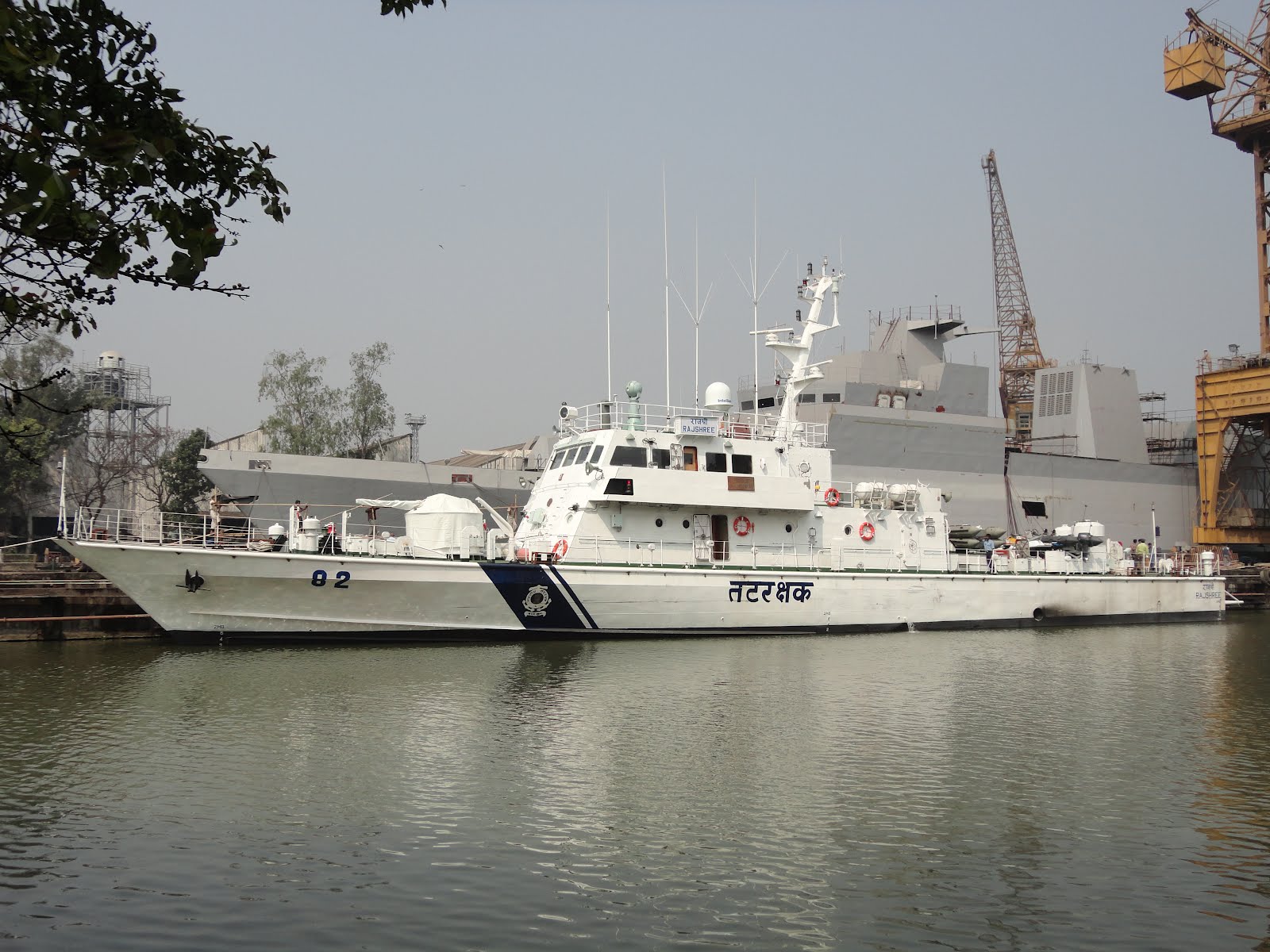
Photo: Rajshree class IPV (Wiki Info) Click on the photo for larger size

Indian Coast Guard is on a roll. NetIndian is reporting they have just commissioned their eighth new Inshore Patrol Vessel, CGS Rajdhwaj, essentially a fast response cutter, except that theirs is a bit larger, faster, and more heavily armed. Doesn’t have quite the range though. The ship is the last in the series of eight.

The first of these Rajshree-class Inshore Patrol Vessels was commissioned only in Feb. 2012.

Another Successful Laser Test

Business Insider reports another successful test of a laser weapon. This time by the Army from a truck mounted system. Nothing here about how the system recognized the incoming threat but apparently good enough for taking out inbound mortar rounds and UAVs,

Why do we care–

  • Makes the magazine essentially infinitely deep.
  • Don’t have to keep explosives on board that constitute a hazard of secondary explosion.
  • Maybe turn the power down when you need a non-lethal weapon.

Contrary to the report I don’t see the project’s seventh year, 2013 fiscal year $12.4 million budget as staggering. Don’t think this author has not covered a lot of DOD projects.

CG to get C-27J

uscg-c-27j-impression
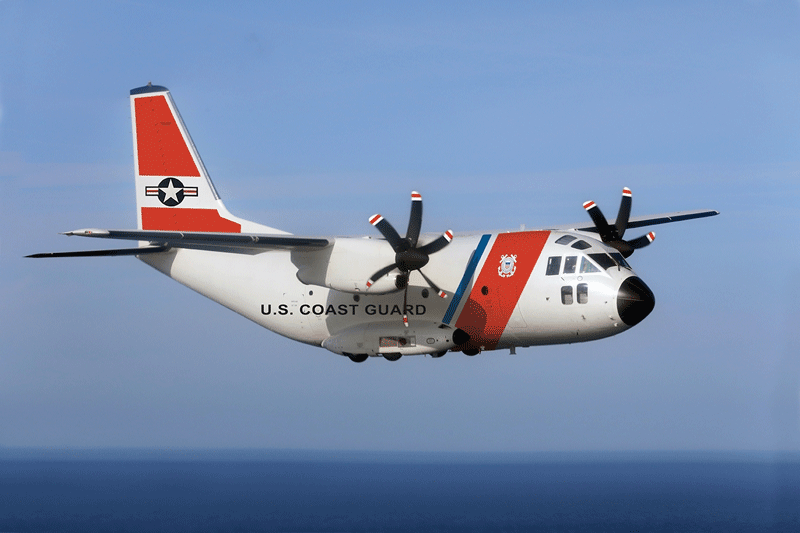
Alenia Aermacchi impression of a C-27J Spartan in U.S. Coast Guard livery. (Photo: Alenia Aermacchi)

I did note this in a comment on the previous post about this, but its probably too important to not to have its own post. Apparently we have confirmation that the Coast Guard will be getting the Air Force’s excess C-27Js.

Question is, if we were going to buy 36 HC-144s and we have bought 18, doesn’t getting 14 C–27s still leave us 4 planes short? and if we are giving some older C-130s to the Forrest Service perhaps a few more?

Does it mean the Coast Guard will be getting more C-130Js?