It is too early to say where these changes will take the Coast Guard, but both the acting Commandant and the Senior Advisor to the Secretary for the Coast Guard (SASCG) Mr. Sean Plankey, are Coast Guard Academy graduates (class of 1987 and 2003). Both seem to be firmly grounded in the military nature of the Coast Guard. Both have spent a lot of time in close contact with DOD.
“Force Design 2028 is the way we will become a more agile, capable, and responsive fighting force(emphasis applied–Chuck) to best serve the American people,” ADM Lunday said.
Some of the steps outlined in Force Design 2028 appear specifically intended to move the Coast Guard closer to DOD.
–Align with the DoD’s “Rapid Force-Wide Review of Military Standards” for physical fitness, body composition, and grooming standards. We’ll follow DoD standards to the maximum extent possible and build processes that are necessary to ensure total force readiness.
–Increase Coast Guard engagement with the Defense Innovation Unit (DIU) to accelerate technology and capability acquisition and adoption by leveraging leading edge disruptive technology development in the private sector. This includes increasing our footprint at DIU and maximizing the number of training allowance billets available at the DIU Immersive Commercial Acquisition Program.
I certainly see a need for more attention to the Coast Guard’s Defense Readiness Mission and to Ports, Waterways, and Coastal Security.
My impression is that the Coast Guard will be increasingly focused on protecting the Maritime Transportation System, particularly in cyberspace.
April 3, 2025
Coast Guard Force Design 2028
By MyCG Staff
Acting Commandant Kevin E. Lunday recently announced Force Design 2028 (FD 2028). Directed by Department of Homeland Security Secretary Kristi Noem and led by the Senior Advisor to the Secretary for the Coast Guard (SASCG) Mr. Sean Plankey, FD 2028 is creating a blueprint to ensure the Service is ready for the future and the Nation’s demands.
“Force Design 2028 is the way we will become a more agile, capable, and responsive fighting force to best serve the American people,” ADM Lunday said.
FD 2028 is focused on four campaigns:
People
Organization
Acquisition and Contracting
Technology
Here are some details about each campaign, including some of the first steps already underway. Additional details can be found in ALCOAST 155/25.
People
We are building the Coast Guard’s future force, starting today. Increased national demand for our Coast Guard requires a larger, more capable military workforce. This campaign will improve training systems, boost access to medical care, and modernize both the Coast Guard Reserve and the civilian management system.
Early actions:
Align with the DoD’s “Rapid Force-Wide Review of Military Standards” for physical fitness, body composition, and grooming standards. We’ll follow DoD standards to the maximum extent possible and build processes that are necessary to ensure total force readiness.
Starting in Promotion Year 2026, best qualified selection boards will be required to employ in-zone reordering to the maximum authorized by law to reorder those officers of particular merit for promotion.
Remove administrative burdens on our members by reducing reporting and other requirements that are redundant and of little value. (See ALCOAST 145/25 for details.)
Restore maximum Commander and Officer-in-Charge discretion and flexibility in their use of non-judicial punishment (NJP) under Article 15 of the Uniform Code of Military Justice (UCMJ). This change is consistent with the ultimate responsibility entrusted to commanders to maintain good order and discipline at their units.
Organization
As global security threats, technological advancements, and operational demands continue to evolve, the Coast Guard must adapt its organizational construct and internal decision making and governance processes to remain relevant, effective, and responsive.
Early actions:
Delegate operational authorities to the appropriate level of command to increase mission effectiveness and reduce risk to Coast Guard personnel. The recent delegation of non-compliant vessel use of force authorities to pursuit coxswains and cutter commanding officers is one example that empowers those at the tactical edge with the authorities, capabilities, and effective command and control needed to deliver operational results.
Establish a USCG HQ Director of Staff, reporting to the Vice Commandant, who is responsible for streamlining executive decision-making, enhancing agility and integration, aligning strategic messaging, and optimizing HQ processes.
Restructure the Deputy for Personnel Readiness (DPR) enterprise to optimize support for our most valuable resource-our people. This transformation establishes a comprehensive, people-centric approach across four business lines: accessions and training, total workforce management, workforce and family services, and healthcare delivery. We will separate policy/program management from service delivery to best meet the needs of our people.
Restructure the Deputy for Materiel Readiness (DMR) enterprise to focus on a systems approach to assets, ensuring the Coast Guard has the right capabilities, in the right place, at the right time. This transformation includes creating new business lines to oversee the total lifecycle management of our surface, air, C5I, and shore infrastructure, and integrating acquisition and sustainment functions for greater efficiency and effectiveness.
Establish the Assistant Commandant for Operational Integration and Response Policy (CG-3/5R) to align operational integration and planning at the Service level to increase decision-making speed and resource allocation to our operational commanders and advance national level planning and preparedness while increasing situational awareness for the Secretary, Department, Joint Staff, and Interagency partners.
Acquisitions and Contracting
Develop a high velocity acquisition and contracting system to rapidly deliver the assets the Service needs to fulfill its commitment to the American people.
Early actions:
Eliminate or minimize bureaucratic delays to delivering the assets the Service needs. An example is the recent elevation the Simplified Acquisition Procedures and micro- purchase limits to the maximum extent allowed by law and regulation, ensuring rapid distribution of goods and services to the field units charged with carrying out our front-line missions.
Increase Coast Guard engagement with the Defense Innovation Unit (DIU) to accelerate technology and capability acquisition and adoption by leveraging leading edge disruptive technology development in the private sector. This includes increasing our footprint at DIU and maximizing the number of training allowance billets available at the DIU Immersive Commercial Acquisition Program.
Improve the speed of contracting and procurement by empowering our contracting professionals in the field, reducing redundant and sequential approval and review process that add unwarranted mission risk.
Provide improved transparency and accountability in the contracting process through development of a quick-to-field contract tracking system and establish clear metrics and targets that consider mission impact.
Technology
The Coast Guard will accelerate the adoption of secure, state-of-the-market technologies to enhance data sharing, situational awareness, and operational effectiveness.
Early actions:
Leverage efficient industry solutions to dramatically accelerate the Authority To Operate (ATO) process for Information Technology systems and achieve the goal of ATOs in 30 days. This will begin with the Software Factory and minimize bureaucratic delays to deliver essential capabilities required for Coast Guard mission success.
Establish data teams in each mission domain to make sure we’re fully leveraging data to improve operations.
Establish a Rapid Response Rapid Prototype Team to transform how we deliver mission-critical technology solutions. This effort will span operations, engineering, acquisitions, finance, information technology, logistics, data science, and change management/integration – delivering proven innovation where it matters most.
How we will stay on course
An FD 2028 implementation team comprised of permanently assigned military and civilian personnel is being established and will report to the new Director of Staff. The team will coordinate a Coast Guard wide effort to implement the Secretary’s intent on FD28 as well as continue the actions already started.
“We are executing transformational change to renew the Coast Guard,” said ADM Lunday. “Force Design 2028 will ensure the Coast Guard remains Semper Paratus, Always Ready, to serve the American people.”
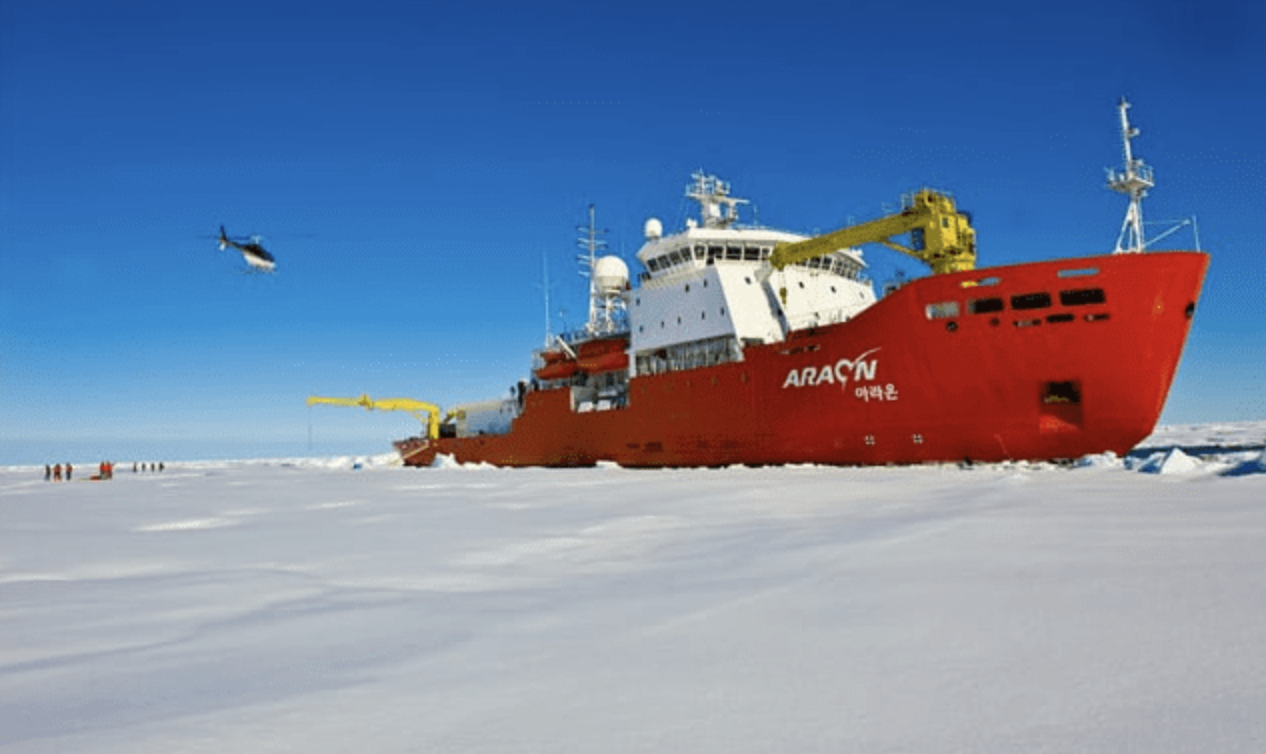
South Korea’s research icebreaker Araon, operated by the Korea Polar Research Institute. (Source: Korea Polar Research Institute)
gCaptain reports South Korea is building an icebreaker, “With a displacement of 16,560 tonnes the dual-fuel icebreaker – it can use both low-sulfur diesel and LNG – will be twice as large as the country’s existing icebreaker, Araon.”
But more interesting to me is that South Korea has been instrumental in operationalizing Russia’s Norther Sea Route.
All fifteen Arc7 ice-class LNG carriers for the Yamal LNG project were constructed by DSME (now Hanwha) with additional vessels and vessel elements for Arctic LNG 2 built by both Hanwha and SHI. Ice-capable oil tankers also originate at South Korean shipyards.
The country has also been a key anchor for expanded Arctic shipping with several container ship voyages via Russia’s Northern Sea Route originating or terminating at South Korean hubs, including Busan.
The Northern Sea Route certainly has the potential to facilitate trade between South Korea and Europe. The ships they have been building can traverse the Northern Sea Route without the aid of icebreakers.
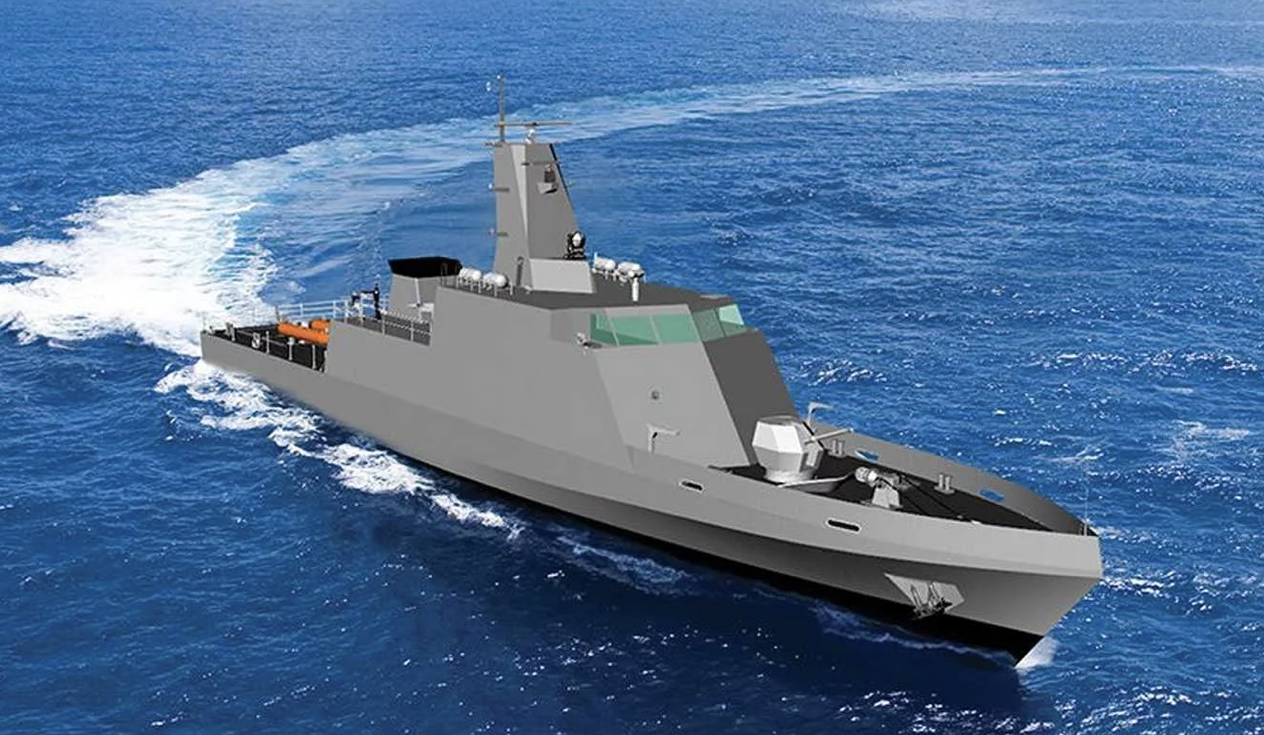
The planned total cost for the eight NPa500MB OPVs is estimated at 2.8 billion reais (~476 million USD), while three other vessels will be specifically configured for mine countermeasures operations. (Picture source: Emgepron)
“…February 24, 2025, the Brazilian Navy’s Naval Systems Design Center (CPSN) delivered the basic engineering plan for the 500-ton offshore patrol vessel (NPa500MB) to Emgepron, a state-owned company responsible for naval projects, in late January. This step is part of the Patrol Vessel Acquisition Program (PRONAPA), which involves the domestic construction of 11 offshore patrol vessels (OPVs) with a high percentage of locally sourced components. These vessels are designed for the surveillance and protection of the Exclusive Economic Zone (EEZ), search and rescue operations, and combating illegal activities such as illegal fishing.
Brazil has the tenth largest EEZ in the world at 3,830,955 km sq., about one third that of the US, less than Canada, Japan, or New Zealand, but more than Chile, Kiribati, or Mexico.
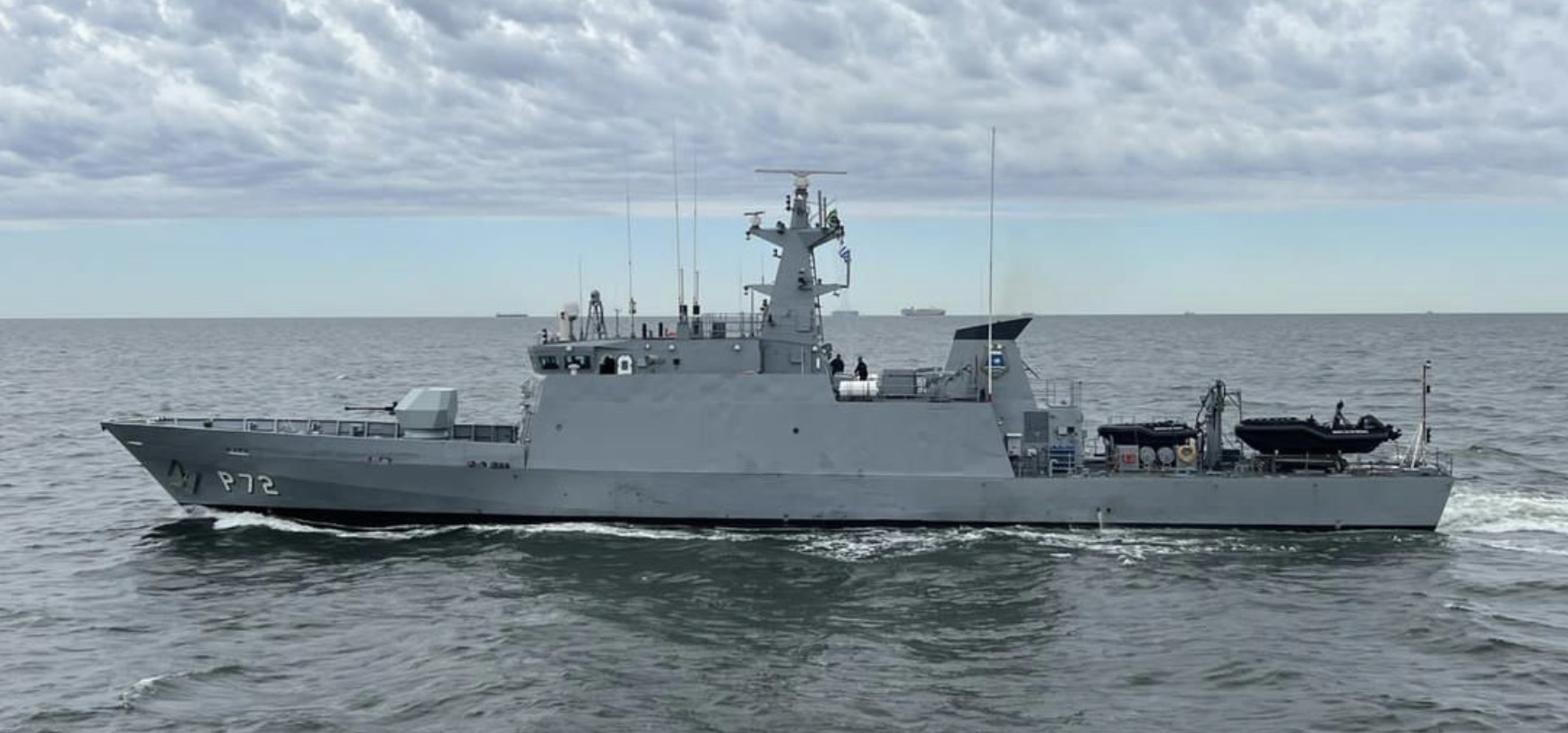
The remaining three are 500 ton, 182’5″, 21 knot Macaé class. Two vessels of this class are still building.
Macaé class patrol craft Navio-Patrulha Maracanã (P72) – 2023
If the Brazilian patrol vessel fleet were to provide the same coverage as the US Coast Guard in proportion to the size of their EEZ, they would need 12 large patrol ships (over 1000 tons) and about 20 smaller patrol craft. (They may be supplementing their patrol force with other classes of vessels.)
The new design appears to be an evolutionary outgrowth of the Macaé class since it is only slightly larger and has similar layout and performance: overall length of 58.9 meters (193’3″), a beam of 9.0 meters (29’6″), a maximum draft of 2.5 meters (8’2″), and a displacement of 564 tons
Presumably the Brazilian Navy sees the Macaé class as successful, but the new ships do not appear to be a significant improvement over the Macaé class. As I noted earlier (How Long Should an OPV be? Is There a Minimum?) I believe a length of at least 80 meters is the minimum for a truly fully capable OPV. In addition to better range, endurance, and seakeeping, the additional length allows incorporation of features that appear to be becoming standard on OPVs, including multiple, more capable, 8 to 11 meter RHIBs (perhaps a stern ramp), space for containerized mission modules and unmanned systems, and a flight deck and hangar for at least UASs.
The Macaé class was based on the 400 ton, 55 meter French P400 class patrol vessel. The French came to believe they needed a larger vessel and have begun replacing their P400 class with vessels with the 80 meter POM. Perhaps Brazil should again look to France and base their next OPV on the more capable POM.
Yesterday we learned that Canada had awarded a contract to Seaspan to build a 26,000 ton Polar Icebreaker. Today we learn that Canada awarded a second contract to a different shipyard, to build an additional 22,800 ton, 138.5 meter, polar icebreaker to a different design.
It is almost impossible to accurately compare shipbuilding costs internationally, but the cost of this Canadian contract, $3.25B Canadian ($2.26B US), seems to suggest current estimates for the Polar Security Cutter are at least in the ballpark, and not outrageously high, rather that the initial contract was significantly underbid.
Davie Awarded Major Contract by Canada to Build Polar Icebreaker
March 8, 2025
Lévis — Davie, the Québec-based international shipbuilder, today announced it has been awarded a contract by the Government of Canada for the construction of a needed polar icebreaker. This initiative will leverage Davie’s international presence, with work beginning in 2025, under a robust contract framework that will enable Davie and Canada to set new standards of efficiency and productivity in vessel procurement.
Through this agreement, valued at $3.25 billion, Davie will deliver its production-ready heavy icebreaker design called the Polar Max to Canada by 2030. To support the rapid delivery of the ship, Davie will capitalize on the expertise of Helsinki Shipyard, which was acquired by Davie in 2023 with the support of the Québec government. Helsinki Shipyard has built over 50% of all the world’s icebreakers.
“Today marks a significant milestone in our commitment to enhancing our nation’s maritime capabilities” said The Honourable Jean-Yves Duclos, Minister of Public Services and Procurement and Quebec Lieutenant. “The contract awarded to Chantier Davie Canada Inc. for the build of a new polar icebreaker underscores our dedication to ensuring safe and efficient navigation in Arctic regions. This state-of-the-art vessel will not only strengthen our icebreaking fleet, but will also support critical scientific research and environmental protection efforts, and ensure national security in the Arctic. We are proud to take this step forward in strengthening our maritime infrastructure for safeguarding Canada’s sovereignty in the Arctic.”
While the early phase of the polar icebreaker construction is underway, the modernization of Davie’s Lévis Shipyard will continue, giving Davie time to accelerate the hiring of skilled workers across all trades. This will enable Davie to leverage its Canadian supply chain sooner than anticipated, while ensuring the completed polar icebreaker is delivered from Lévis. Davie plans to implement a workforce exchange, enabling Québec employees to learn world-class icebreaker construction expertise first-hand from their Finnish colleagues.
Davie President & CEO, James Davies, said: “Today’s announcement is truly transformative. Canada deserves immense credit for partnering with Davie on this groundbreaking procurement. Delivering such a special ship in a timely manner is in the best interests of all Canadians. It will accelerate economic benefits for Quebecers and strengthen the skills of our talented Lévis’ shipbuilders. In a volatile world, we can and must forge shipbuilding collaborations with trusted allies like Finland to secure shared interests. If not now, then when?”
“It is fitting that this announcement comes as Davie celebrates its 200th anniversary. The construction of the polar icebreaker will create opportunities for our employees and will place us firmly on track to create thousands of jobs far more quickly. Our Québec suppliers will be rapidly activated to help us deliver this needed ship in record time. There is a geopolitical imperative to act to protect our interests and we thank the Government of Canada and the Government of Québec for their vision and recognizing the time is now,” commented Alex Vicefield, Chairman and CEO of Inocea, the parent company of Davie Shipbuilding.
This contract is huge win for the ICE Pact. The Polar Max will be the first flagship project of the trilateral partnership. It will be proof that transatlantic collaboration is possible with the Polar Max delivered by Canadian shipbuilders supported by their Finnish colleagues.
A Win for Québec and for Canada
This announcement will bring immense benefits to Québec and the rest of Canada. Davie is committed to building a strong network of shipbuilding suppliers and plans to invest more than $200 million in local small- and medium-sized businesses to help them scale and reap the opportunities of shipbuilding contracts over the coming years and further Québec’s position as a naval construction hub.
Building on the success of our delivery of the NSC Asterix in 2018, Davie is once again committed to delivering on time and on budget.
As the global leader in Arctic shipbuilding, Davie stands out for its innovative approach and commitment to doing things differently. By working closely with Canada, Davie designed the strategy to expedite production and improve efficiency. This program will showcase Davie’s shipbuilding excellence, strengthen the local shipbuilding value chain, and create future major export opportunities for everyone involved.
About Davie
Based in Québec, Canada since 1825, Davie is a world-class designer and builder of specialist, mission-critical ships such as icebreakers, ferries and warships for government and commercial customers. Davie became a partner in the Government of Canada’s National Shipbuilding Strategy on April 4, 2023. This historic agreement is for the design and construction of the largest and most technologically advanced ice-going ships ever constructed in and for Canada. The initial $8.5 billion package of work includes seven heavy icebreakers and two large hybrid-powered ferries. In November 2023, Davie acquired Finland’s Helsinki Shipyard, the world leader in icebreaker design and construction. Find out more at davie.ca and helsinkishipyard.fi.
DAVIE AND CANADIAN GOVERNMENT AGREE ON HEAVY ICEBREAKER CONSTRUCTION – WORK TO BEGIN AT HELSINKI SHIPYARD
8.3.2025
Canadian-owned Davie, which owns the Helsinki Shipyard, signed an agreement with the Canadian government to construct a heavy icebreaker. The new vessel will be based on Davie’s advanced Polar Max icebreaker, created by the Helsinki Shipyard basing on Aker Arctic’s original Aker ARC 148 hull form.
Polar Max is the first newbuild project at the Helsinki Shipyard under Davie’s ownership, and it will be carried out in collaboration between Finnish and Canadian maritime industry experts. The work will begin in Helsinki and be completed at Davie’s shipyard in Canada. The finished vessel is scheduled to be delivered to the Canadian government by 2030. The unique expertise of the Helsinki Shipyard will play a significant role in delivering the vessel on such a fast schedule.
The construction of the icebreaker is expected to increase the direct workforce at the Helsinki Shipyard by around 500 employees, with many hundreds more employed throughout the Finnish maritime industry cluster.
The icebreaker order is part of Canada’s national shipbuilding program. This new order is the second heavy icebreaker project in this program. The project is also aligned with the principles of the Icebreaker Collaboration Effort (“ICE Pact”) between Finland, the United States and Canada, which originated from President Trump’s 2020 discussions with the Finland government. The ICE Pact supports the West’s urgent need to build advanced icebreaker fleets to counter the expansion of adversaries in the polar regions.
“When we acquired Helsinki Shipyard, we pledged to rebuild this historic business. The Polar Max project is evidence that we are delivering on our promise. We can’t wait to begin this new chapter in Helsinki Shipyard’s story. The Canadian government deserves immense credit for partnering with Davie on this groundbreaking procurement. In such a volatile world, we can and must forge shipbuilding collaborations with trusted allies like Finland to defend our shared interests. If not now, then when?” said James Davies, President & CEO, Davie Shipbuilding.
“The Polar Max project is an important milestone in expanding production and design in Helsinki. The project is an excellent example of Finland’s leading Arctic shipbuilding expertise, which is in significant demand internationally,” said Kim Salmi, CEO of Helsinki Shipyard.
Polar Max will be 22,800 tonnes vessel with a length of 138,5 meters. Additionally, it functions as a research vessel, capable of performing oil spill response operations and emergency towing year-round. Davie continues to promote similar projects internationally and aims to accelerate the development of Finland’s maritime industry ecosystem and the creation of Finnish maritime innovations.
March 7, 2025 – North Vancouver, BC – Today, Seaspan Shipyards (Seaspan) has been awarded the construction contract to build one of the Canadian Coast Guard’s (CCG) new heavy polar icebreakers.
The polar icebreaker will be built entirely in Canada at Seaspan’s Vancouver Shipyards, located in North Vancouver, British Columbia. With the contract now in place, Seaspan is ready to cut steel on this ship and begin full-rate construction on Canada’s newest vessel under the National Shipbuilding Strategy (NSS). Construction of this ship will support the work of a team of more than 1,000 local shipbuilders and a broad Canadian supply chain of over 800 Canadian companies contributing massive strategic value, innovation and economic benefits to Canada.
Building this complex and densely-outfitted multi-mission ship will mark the first time a polar icebreaker has been built in Canada in more than 60 years and will have more advanced capabilities than the CCG’s current heavy icebreakers. Once delivered, this made-in-Canada heavy polar icebreaker will be one of the most advanced and capable icebreakers in the entire world. It will be one of only a handful of Polar Class 2 ships in operation and will allow for the CCG to operate self-sufficiently year-round in the high-Arctic, down to temperatures at -50°C.
The new polar icebreaker will be the seventh vessel designed and built by Seaspan under the NSS. It will also be the fifth Polar Class vessel to be built for the CCG, and one of up to 21 icebreaking vessels overall that Seaspan is constructing.
Functional design of the polar icebreaker was completed in 2024 by Seaspan, prior to the start of construction. For this ship, Seaspan worked extensively to build out the largest marine design and engineering team in Canada, which includes Seaspan employees and Canadian partners, while simultaneously working alongside established Finnish companies who have extensive experience in designing Arctic-going vessels.
Seaspan is the only Canadian shipyard with the expertise, facilities, and domestic supply-chain to build polar icebreakers in Canada. Official start of construction for this new heavy polar icebreaker is scheduled for April 2025.
QUOTES
“Today’s contract signing is the next step in our journey of fulfilling the vision of the National Shipbuilding Strategy, which is to build ships for Canada, in Canada, by Canadians. The NSS is demonstrating that a made-in-Canada approach is not only possible, but also imperative to our security and sovereignty. We look forward to starting construction on this ship next month, and to building more Polar Class vessels for Canada and our Ice Pact partners.”
John McCarthy, CEO, Seaspan Shipyards
“The contract awarded to Seaspan’s Vancouver Shipyards for the build of a new polar icebreaker is a significant step forward for Canada’s economic and natural resource sectors. This advanced vessel will not only ensure safe and efficient navigation in our polar regions but also support the sustainable development of our natural resources. By enhancing our icebreaking capabilities, we are opening new opportunities for economic growth, scientific research and environmental stewardship. This project exemplifies our commitment to leveraging cutting-edge technology to benefit our economy and protect our unique polar environments for future generations.”
The Hon. Jonathan Wilkinson, Minister of Energy and Natural Resources and MP for North Vancouver
“Today marks a significant milestone in our commitment to enhancing our nation’s maritime capabilities. The contract awarded to Seaspan’s Vancouver Shipyards for the build of a new polar icebreaker underscores our dedication to ensuring safe and efficient navigation in Arctic regions. This state-of-the-art vessel will not only strengthen our icebreaking fleet, but will also support critical scientific research and environmental protection efforts, and ensure national security in the Arctic. We are proud to take this step forward in strengthening our maritime infrastructure for safeguarding Canada’s sovereignty in the Arctic.”
The Hon. Jean-Yves Duclos, Minister of Public Services and Procurement and Quebec Lieutenant
“The National Shipbuilding Strategy is providing the Canadian Coast Guard with its fleet of the future. The polar icebreaker to be built by Vancouver Shipyards will be able to operate in the Arctic year-round, further bolstering our ability to deliver crucial services to Northern communities and support Canadian sovereignty in the Arctic.”
The Honourable Diane Lebouthillier, Minister of Fisheries, Oceans and the Canadian Coast Guard
“Our partnership with Seaspan to construct a polar icebreaker underscores our government’s steadfast commitment to ensuring the Canadian Coast Guard can continue to protect Canada’s sovereignty and interests, while also revitalizing Canada’s shipbuilding industry, creating high-paying jobs and maximizing economic benefits across the country.”
The Honourable François-Philippe Champagne, Minister of Innovation, Science and Industry
QUICK FACTS
The polar icebreaker will be 158 metres long and 28 metres wide, with a design displacement of 26,036t.
Highlights of key design features, include:
IACS Polar Class 2 (PC2) Heavy Icebreaker
More than 40MW of installed power
Ice-classed azimuthing propulsion system
Complex, multi-role mission capability
Scientific Laboratories
Moon Pool (to allow for safe deployment of equipment from within the ship)
Helicopter flight deck and Hangar
Vehicle Garage and future Remotely Piloted Aircraft System (RPAS) capability
Seaspan has already gained significant experience designing and building Polar Class vessels including three offshore fisheries science vessels which are now in service with the CCG; an offshore oceanographic science vessel that will be delivered to the CCG in the coming months; and a class of up sixteen multi-purpose icebreaking vessels (also Polar Class) that is currently in Construction Engineering.
Seaspan is one of the most modern shipyards in North America, following its privately funded $200M+ shipyard modernization, development of a skilled workforce and state-of-the-art, purpose-built infrastructure to deliver large, complex vessels.
Under the NSS, Seaspan has become a major economic and job creation engine. According to an economic analysis conducted by Deloitte, Seaspan has contributed $5.7 billion to Canada’s GDP between 2012-2023, while also creating or sustaining more than 7,000 jobs annually.
Seaspan’s NSS supply-chain has now grown to ~800 Canadian companies from coast-to-coast, with more than half being SMEs.
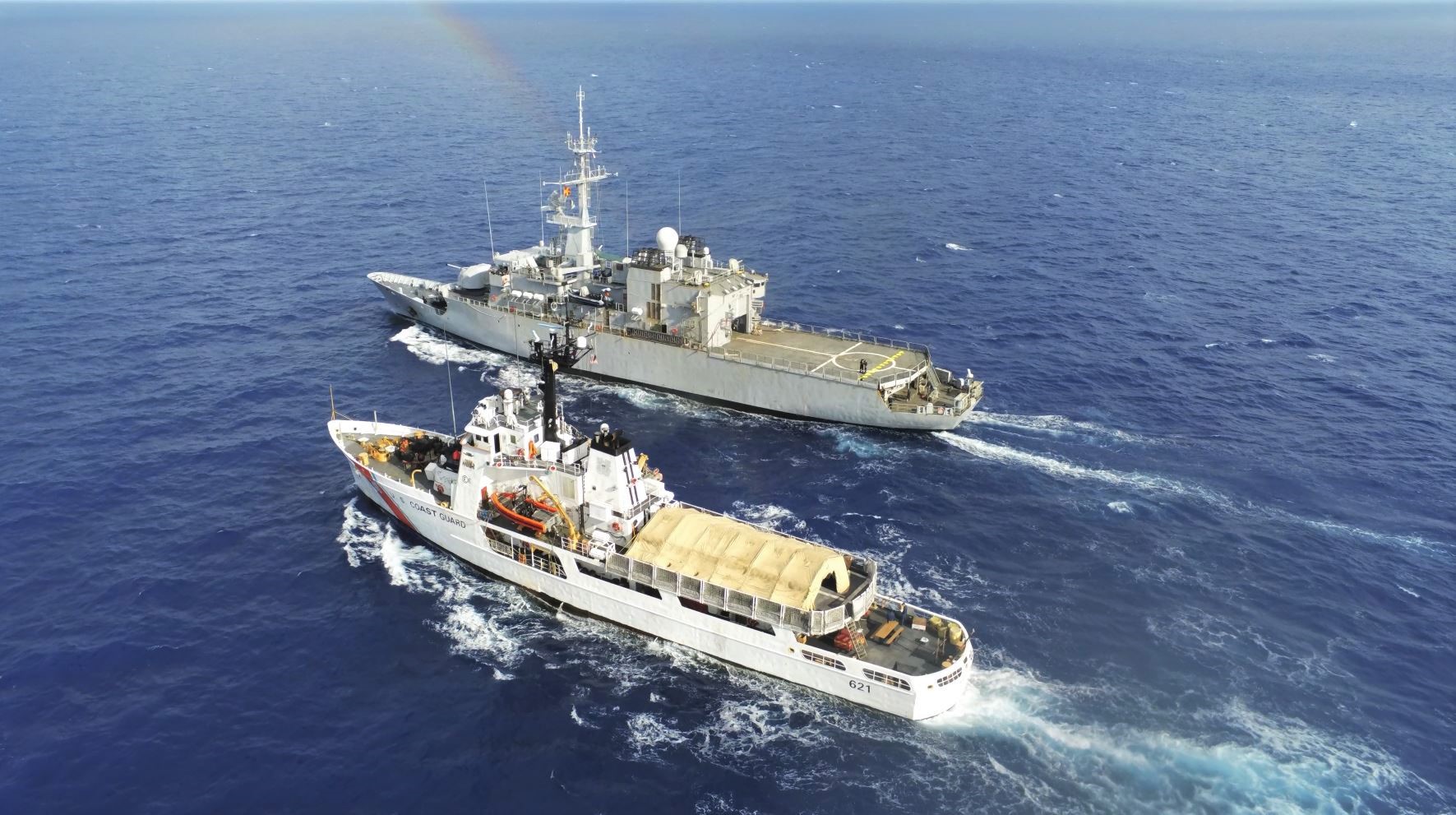
U.S. Coast Guard Cutter Valiant (WMEC 621) and French Navy Frigate FS Ventôse (F733) conduct joint exercises at sea, Sept. 29, 2024, while underway in the Windward Passage. The crew of Valiant conducted a 49-day migrant interdiction operations patrol in the region to protect life at sea and enforce U.S. maritime law. (Photo courtesy of FS Ventôse)
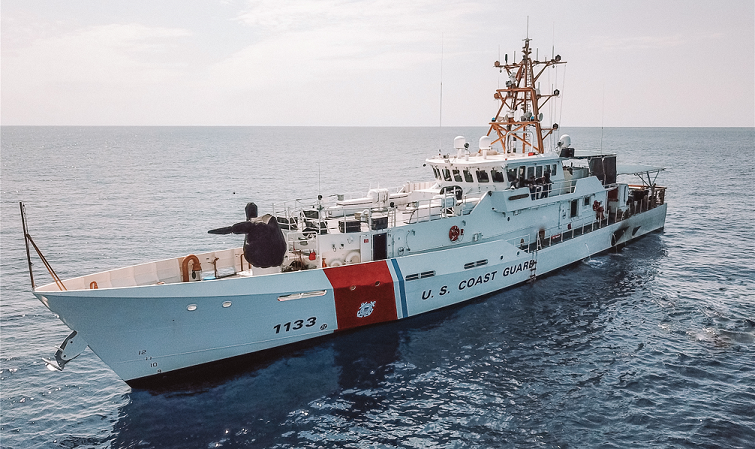
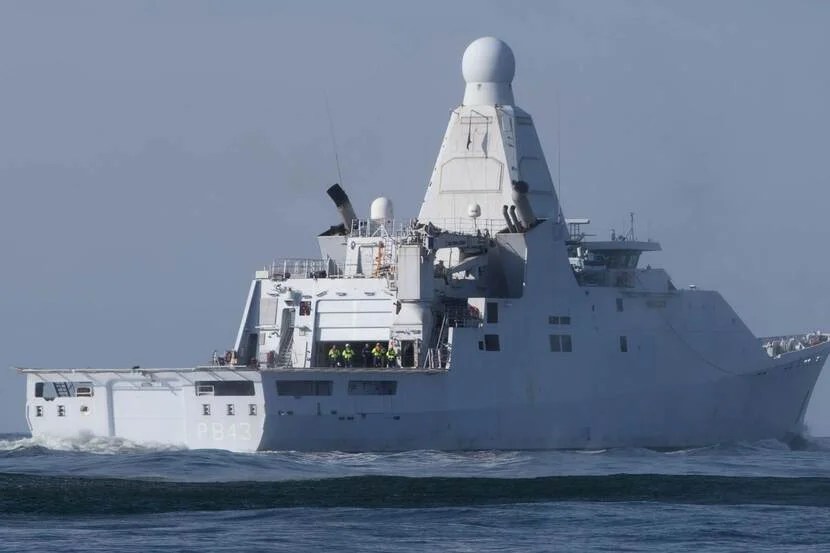
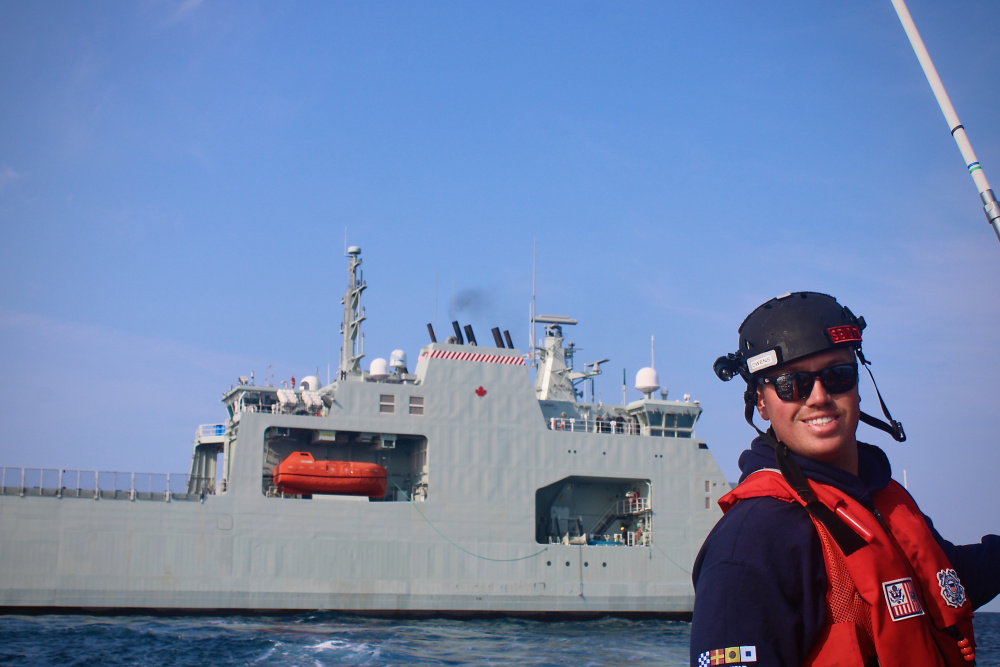
Below is a news release. It included no photos. I wanted to give some more credit to the other units and countries involved, so I have added photos of all four ships involved in the six interdictions. We get a lot of help from allies with territories in the Western Hemisphere–UK, France, and in this case Canada and the Netherlands.
USCGC Joseph Doyle (WPC-1133)
Netherlands OPV Groningen, 19 April 2017.
USCGC Richard Snyder (WPC 1127) participates in Operation Nanook in the Davis Strait on Aug. 4, 2021. Snyder worked alongside USCGC Escanaba (WMEC 907), the Royal Canadian Navy’s HMCS Harry Dewolf (AOPV 430), and HMCS Goose Bay (MM 707) in Operation Nanook to enhance collective abilities to respond to safety and security issues in the High North through air and maritime presence activities, maritime domain defense, and security exercises. (U.S. Coast Guard photo by USCGC Richard Snyder)
March 5, 2025
MEDIA ADVISORY: Coast Guard Cutter Valiant offloads $141 million in illicit drugs interdicted in the Caribbean Sea
MIAMI — Members of Coast Guard Cutter Valiant are scheduled to offload 12,471 pounds of illicit narcotics with a street value of more than $141 million.
WHO: Coast Guard Cutter Valiant, Seventh Coast Guard District
WHAT: The Coast Guard Cutter Valiant’s crew will offload 12,471 pounds of illicit narcotics with a street value of more than $141 million. Media are invited to interview a Coast Guard Cutter Valiant crew member in both Spanish and English.
WHEN: Thursday, March 6, at 9 a.m.
WHERE: Coast Guard Base Miami Beach, 100 MacArthur Cswy, Miami Beach, FL 33139
The offload is a culmination of six interdictions conducted by the crews of:
U.S. Coast Guard Valiant
U.S. Coast Guard Joseph Doyle
Royal Netherlands Navy HNLMS Groningen
Royal Canadian Navy HMCS Harry DeWolf
U.S. Coast Guard Tactical Law Enforcement Team Pacific
U.S. Customs and Border Protection Air and Marine Operations
Media are required to bring media credentials to get on Base Miami Beach. Media who do not have official credentials or do not RSVP will not be allowed entry. It is recommended to carpool due to space constraints. Plan to arrive at the front gate no later than 8:30 a.m. for escort to the pier.
After the continued frustration of the Polar Security Cutter program, the ICE Pact agreement between Finland, Canada, and the US seems promising, but we have heard little about how it will work or what it will produce. Forbes discusses the possibilities here.
We may be seeing the first steps of implementation as Canada’s Davie shipyard, which has already purchased a shipyard with a long history of building icebreakers in Finland, seeks to buy a shipyard in the US. There aren’t many possibilities, I would guess either the old Navy yard in Vallejo that has been doing the five year rolling service life extension on Polar Star or the Philly Shipyard currently building “National Security Multi-Mission Vessels” for the merchant marine academies.
Davie, a Quebec shipbuilder set to play a key role in a joint icebreaker production agreement between Canada, the United States and Finland, is moving forward with plans to expand its operations south of the border despite a looming trade war threatening the continent.
As part of the expansion, the Canada-based multinational shipbuilder has set out to acquire an American shipyard, which would secure an initial and important footprint in the U.S. for the company.
Davie is very clearly specializing in icebreakers while continuing to produce ice strengthened commercial ships.
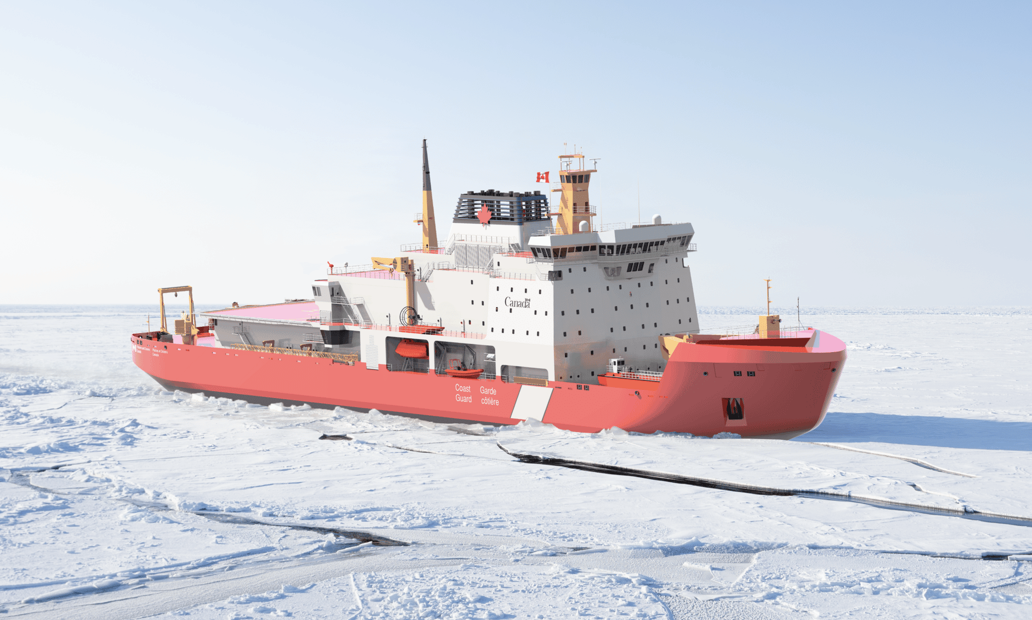
The first of Canada’s Polar Icebreakers (pictured above) is being built by Seaspan, with the second of class being built by Davie. These will be heavy icebreakers, even by US Coast Guard standards, bigger and more powerful than the Polar Security Cutters.
Length Overall 158.2m (519 ft)
Beam: 28m (91 ft 10 in)
Draft: 10.5m (34 ft 5 in)
Classificaton:LLoyd’s Polar Class PC2
Installed Power: 46 MW (61,687 HP)
Top Speed:18 knots
Icebreaking2.5m @ 3 knots continuous
Design Displacement: 26,000 tons
Complement:100 Persons
Canada’s “Program Icebreaker.” Six are planned.
The design for the six “Program Icebreakers” might provide a basis for both the Coast Guard’s Arctic Security Cutter (medium icebreaker program) and the new Great Lakes icebreaker. (It would be a substantial improvement of USCGC Mackinaw and we really need some medium icebreakers.) Their specifications are:
Length: 100-110 m (328 to 360 ft)
Beam: under 23.8 m (78 ft) for Great Lakes;
Draft: 6-8 m (20 to 26 ft)
Icebreaking: Capable of maintaining 3 knots in 1.4 m (4.6 ft) of ice
Accommodations: more than 30 crew and program teams of 34
Range: 20,000 nautical miles at 12 knots
Able to operate and maintain one medium helicopter
Significant general and containerized cargo capacity
Don’t get the impression that the H-65 is going away anytime soon. Expect at least another decade of service. The last of the parent design AS365 Dauphin was manufactured in 2021. The closely related Eurocopter AS565 Panther is still being manufactured and has seen service in eleven countries.
Coast Guard celebrates 40 years of service with H-65 helicopter
Dec. 18, 2024 —
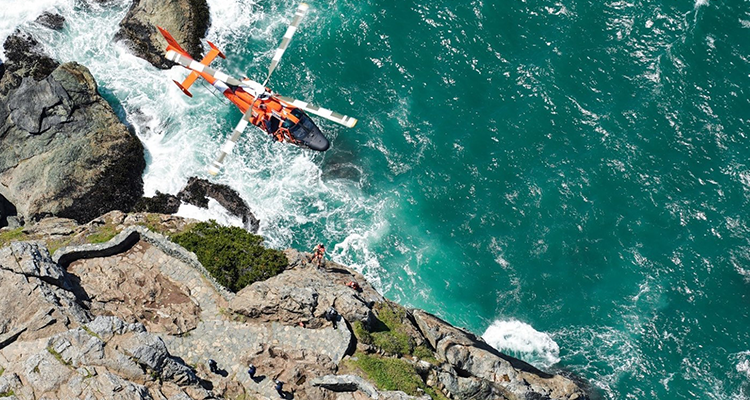
Upgrades throughout the 40-year history of the H-65 were strategically completed to allow for expanding missions and operations in the most challenging maritime conditions, such as cliff rescues. Here an MH-65 crew conducts vertical surface training off the coast of Humboldt Bay, California, to hone critical skills to ensure precise and efficient hoisting techniques in this rugged, coastal environment. U.S. Coast Guard photo.
It’s 2007. Coast Guard Air Station Port Angeles, Washington, receives a call about an injured mountain climber at the summit of The Brothers, a pair of prominent mountain peaks in Olympic National Park near Seattle. The elevation: 6,866 feet. And it’s snowing.
A search and rescue mission was deployed using the HH-65C short range recovery helicopter. “We were right up against that line where it was clear. If we had gone much further toward the peak, we would have been in blizzard conditions. We had to dump fuel at altitude to get light enough,” recalled Cmdr. Christian Polyak, co-pilot on the rescue mission and now commanding officer of Coast Guard Air Station Detroit. “We were able to reach the summit, pluck the injured mountain climber off the peak and get back to the airport in about 15 minutes.”
Unknown to the mountain climber, the Coast Guard H-65 Conversion/Sustainment Program had been working for years – and would continue working in subsequent years – to update the H-65 fleet and support missions like the one that brought the mountain climber to safety. “The rescue couldn’t have been done without the HH-65 and the engine upgrade from Bravo to Charlie,” Polyak explained.
In November 2024, the Coast Guard marked the 40th anniversary of the initial H-65 operation, but the tenure of this critical asset in supporting Coast Guard missions is slowly coming to an end. The service has completed the transition from the MH-65D to the MH-65E, the final upgrade of this airframe. Obsolescence challenges with the MH-65 will lead to the sundowning of aircraft as they reach the end of their service lives.
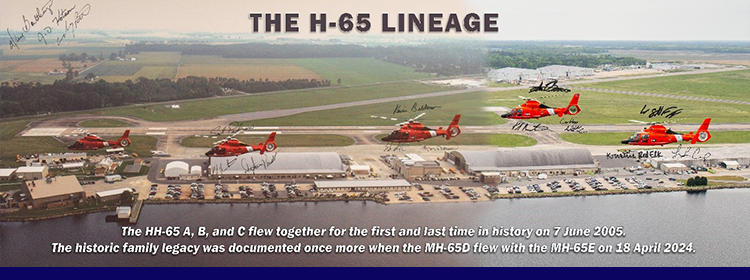
HH-65A
HH-65B
HH-65C/MH-65C
MH-65D
MH-65E
Began operations: 1984
Began operations: 2001
Began operations: 2004
Began operations: 2009
Began operations: 2015
Original Coast Guard version.
Avionics upgrade undertaken on a portion of the fleet, including a night vision goggle compatible integrated flight management avionics suite.
Engines replaced with Turbomeca Arriel 2C2-CG engines, adding 40% more power. Airborne use of force capability added, including 7.62 mm general-purpose machine gun and a .50-caliber precision rifle.
Obsolete subsystems replaced, such as replacing navigation systems and gyros with digital GPS and inertial navigation systems.
Remaining obsolete subsystems modernized, including replacing analog automatic flight control with digital systems, installing digital weather radar systems and installing digital glass cockpit instruments.
Other program milestones included purchase of seven new MH-65 aircraft to identify and intercept non-compliant light aircraft operating within the Washington, D.C., Air Defense Identification Zone and execution of a service life extension program to extend the service life of the helicopters by an additional 10,000 flight hours.
Since their introduction more than 40 years ago, Coast Guard H-65s have been credited with rescuing approximately 26,000 people. For nearly two decades, the Coast Guard has planned and executed targeted improvements to enhance reliability and performance of the operational fleet. Across each iteration, starting with the initial designation of the HH-65A (Alpha) to the current MH-65E (Echo), every upgrade enhanced the airframe’s capabilities, enabling crews to complete lifesaving, law enforcement and national security missions more efficiently and effectively.
Retired Capt. Keith Overstreet has flown every model of the H-65, starting with the Alpha in 1995 at Air Station Savannah, Georgia. “I started flying the 65 when it was relatively new … when we purchased the H-65 it was really an advanced aircraft with advanced avionics. It allowed us to fly coupled approaches down to the water with a fairly precise position. It could control not only the lateral, the guiding left to right, but vertically down to the water as well.”
As modern as it was for its time, regular upgrades kept it relevant.
“The Alpha had a small navigation screen where you could create a flight plan. It had a forward-looking radar that would map out vessels and terrain,” said retired Cmdr. Kevin Barres, who flew 65s throughout his entire 25 years in the Coast Guard. “Then Bravo came up and you had a color display that differentiated some terrain,” which helped in developing flight plans.
“Charlie meant changes to the engine, and the engine control. It went from mechanical control using air and linkages to digital control. Echo replaced analog avionics components with a digital cockpit that has significant commonality with the H-60 fleet. There were enhancements to the automatic flight control system and there was a complete rewire of the aircraft. Its modern glass cockpit is standard across the board,” Overstreet said.
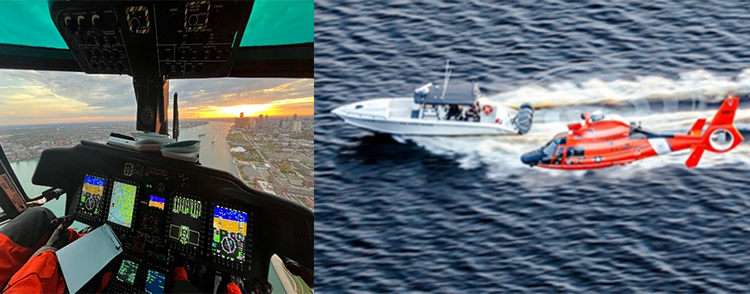
LEFT: A glass or digital cockpit replaced analog instruments in the MH-65E. RIGHT: The updates for missions requiring airborne use of force capability got underway in August 2006. The Helicopter Interdiction Tactical Squadron specializes in those missions, often used for drug-interdiction, and moved to the MH-65 from the Agusta MH-68A Stingray in 2008. U.S. Coast Guard photos.
“Every upgrade was significant and addressed a specific problem or modernization to accommodate how the mission, aviation and airspace were changing,” Barres said.
Cumulatively, these three pilots have flown nearly 16,000 hours in the H-65 and remember missions completed with fondness and pride.
Barres remembers when a bear-watching float plane split in half in the water, stranding six tourists, the bear guide and the pilot in Haro Bay, Alaska. It was 2006, and he was on his first deployment in Kodiak.
“It was a very windy day. The seas in the bay had built a little bit. When the aircraft tried to take off, the tube that goes across the front that connects the two floats failed and split. The aircraft did a nosedive into the wave and was swamped. They were all able to get out and were standing on the wing while it floated for a little while.”
The Coast Guard responded with an HC-130, an MH-60 and an MH-65. Barres was in the office and volunteered to pilot the MH-65.
“The C-130 got on scene and dropped two survival rafts to them. The bear guide was able to climb up on the capsized life raft and hang on. All the other people were hanging on to the float plane. The plane sunk, and they all ended up in the water for about 10 to 20 minutes.”
They were able to float due to their safety devices, but they all were hypothermic. The two helicopters were able to retrieve everyone, and all survived.
Another “miraculous” search and rescue mission Barres recalls was when he was stationed in Barbers Point, Hawaii. He was involved in rescuing a family that was stranded on a very small skiff in ocean waters for just short of two weeks, surviving on sea water and flying fish, after their small outboard motor malfunctioned. When the family was taken back to their home in Kiribati aboard an H-65, they were met with ecstatic school children and an elected official showered them with gifts of bananas and coconuts.
H-65 does more than search and rescue
“The H-65 has been heavily relied upon for all our aviation special missions,” said Polyak, who currently ranks as the most senior active-duty H-65 aviator.
During a deployment to Japan from Kodiak on a mission to enforce an international fisheries treaty, Polyak was grateful for the enhancements of the satellite communications on the MH-65C.
“Without that upgrade, we wouldn’t have been able to maintain radio communications with the cutter at the distances we were operating the helicopter,” he said. “As a pilot I always want to be able to talk to the ship if I’m 100 miles away from it. When you’re thousands of miles away from land and there’s nowhere else to go, you need to be able to talk to the ship so you can find out where they are and get back to them.”
The stories of the missions are endless. But without the behind-the-scenes mechanics that keep the aircraft operational, none of this would be possible.
“It takes 21 maintenance labor hours for every flight hour,” said Polyak, who served as the branch chief for the H-65 Echo conversion at the Aviation Logistics Center (ALC) in Elizabeth City, North Carolina, leading a team of 36 to deliver MH-65 Echoes to the fleet from 2017 to 2020. “There’s a lot of work happening on the hangar deck. Our enlisted mechanics work very hard to allow this aircraft to continue to operate and do lifesaving missions. There’s an equally important component at the ALC where the overhaul for the aircraft occurs. And there are hundreds of active-duty members, civilians and contractors that only support the H-65 fleet. These quiet professionals are supporting frontline operations. Along that same vein, the Aviation Training Center in Mobile, Alabama, has continued to provide excellent standardization and training support so that pilots and air crews can work together and execute these challenging missions.”
Looking forward, pilots are grateful they had the opportunity to fly the H-65s.
“It’s amazing the way we in the Coast Guard were able to bring it online,” Barres said. “Basically, going from 1960s helicopters to the most modern helicopters in the world at that time and then over 40 years keeping the aircraft upgraded and relevant.”
“At one point we had nearly 100 airframes in the fleet,” he continued. “The 65 never let me down on a mission or my crew or the folks that we were out there trying to help, whether it was law enforcement, or a fisheries patrol or a search and rescue case.”
All three pilots find immense career fulfillment in completing search and rescue missions made possible by the capabilities of the H-65.
“That day when you look somebody in the eye,” Overstreet said. “And you know, and they know that they would not be on this earth alive if you hadn’t been there. That makes it easy to put your all into your work every day.”
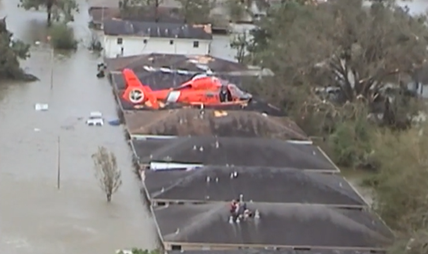
An airman from Air Station New Orleans, who was on the first helicopter that returned following the Hurricane Katrina, recounted, “The second that everyone heard us on Channel 16, Channel 16 just blew up with mayday calls.” Flying on waivers, he did rescues for five days and nights straight. At the time, this was considered the biggest search and rescue event in U.S. history. U.S. Coast Guard photo.
The Coast Guard Deputy Commandant for Operations has issued “United States Coast Guard Force Posture 2024.” Dated October 2024, it is reportedly the first of its kind and a new edition will be published annually. I have appended the Coast Guard News Release regarding the publication below.
“This posture statement informs all audiences about the U.S. Coast Guard’s operational priorities, initiatives, requirements and future challenges across its missions and geographic regions. It conveys how we are “Advancing Mission Excellence” in accordance with the 2022 Coast Guard Strategy and the Department of Homeland Security (DHS) Strategic Plan. This posture statement serves as a window into the breadth and depth of the Coast Guard’s commitments and how it is posturing our workforce, capabilities, and assets to deliver operational services that best serve the American people.
It is organized under four major topics rather than by the eleven statutory missions.
Operating Environment (p.3)
Guiding Principles (p.3/4)
Operating Posture (p.4-7)
Geographic Operating Areas (p.7-11)
I love it, but it does lack a clear summary of what we will do differently. I will try to interpret some of that. Below I provide a readers’ digest version with a few comments, looking first at the eleven Coast Guard missions as listed in 6 U.S. Code § 468, at select Geographic Operating Areas, and finally I will speculate on the long term implications. Given the increased use of the Coast Guard as a tool of foreign policy, I also suggest changes to the Area Commanders’ areas of responsibility (AOR) to make them fit more easily into the national command structure.
MISSIONS
Some of the missions are specifically addressed in the “Operating Posture” section, others are not. The Eleven missions are:
Non-homeland security missions:
Marine safety
Search and rescue
Aids to navigation
Living marine resources (fisheries law enforcement)
Marine environmental protection
Ice operations.
Homeland security missions:
Ports, waterways and coastal security
Drug interdiction
Migrant interdiction
Defense readiness
Other law enforcement.
I will just address them in alphabetical order:
Aids to Navigation:
Aids to Navigation is not called out under a separate heading.
“Our comprehensive approach (to the Marine Transportation System (MTS)) encompasses…Maintaining aids to navigation…” (p.4)
The Coast Guard is reinforcing actions to be “brilliant at the basics” that strengthen…aids to navigation.
The Coast Guard is in the early phase of recapitalizing an aging fleet of inland aids to navigation tenders with new Waterways Commerce Cutters, crucial to maritime commerce in our inland river system. These investments are central to maintaining service delivery in an increasingly complex MTS (Maritime Transportation System–Chuck).
Sounds like minimal changes in the near term but expect improving technology may reduce manpower requirements. Elsewhere there is indications buoy tenders may increasingly be used for non-AtoN missions. This suggests that the number of sea-going buoy tenders (WLBs) is unlikely to be significantly reduced, but their character may change–more on this below.
Defense Readiness
We are increasing attention on the Coast Guard’s defense readiness mission given the increasing threat posed by nation-state competitors. Through integration with Department of Defense efforts, refreshing defense-related plans, and preparedness exercises, we are sharpening readiness to support homeland defense requirements and force deployment commitments for major overseas contingencies. We continue to meet our commitments to North American Aerospace Defense Command (NORAD) for National Capital Region and deployable Rotary Wing Air Intercept and we are adjusting the structure of our Port Security Units (PSU) to address Reserve workforce shortages. We are also integrating PSU elements with DoD expeditionary units to increase their deployment readiness.
This is a welcome recognition of an increasingly hostile world and the emergence of non-state actors who, acting independently or as a proxy for hostile states, can impact national security.
Drug Interdiction is not called out as a separate topic. The only indication of a change is this statement under the section “Western Hemisphere,”
“We will maximize employment opportunities by conducting a mix of missions such as counter drug and combating illegal, unreported and unregulated fishing when appropriate.” (p.9)
Ice Operations:
Ice operations is not called out as a separate mission, but it is addressed in the “Polar Regions” section (p.8/9) of the Geographic Operating Areas section.
Arctic and Antarctic Ice operation will get a big boost as we go from 2 polar icebreakers to eight. In the Arctic there will be a continuing need for non-icebreaking large cutters and we can expect increased exploitation of fixed wing aircraft and particularly satellite for communications and information.
Living Marine Resources
“We will increasingly favor shore-based law enforcement teams and our patrol boat fleet, supported by maritime domain awareness sensors, to ensure we best match this mission.”
Webber class WPCs have proven capable of assuming much of the fisheries protection mission. They can go anywhere fishing vessels can go and stand up to any weather they might be fishing in. So FRCs are stepping up to missions WMECs have traditionally done. Not mentioned, but on the other hand, in Alaska and the distant Pacific there is still a role for larger ships.
Marine Environmental Protection:
There was no section devoted to Marine Environmental Protection as a specific mission. MEP was referred to briefly in the Mission execution section (p.5) Arctic (p.8)
But there was this under “Incident Management and Crisis Response” (p.6)
Management of large, complex incidents is a central Coast Guard competency. Employment of this capability enables success for the most consequential crises and events, builds trust, and supports DHS. However, the Coast Guard does not have a large contingency capacity “in garrison” for emergencies. We will continue to strengthen Coast Guard incident management capacity and proficiency to meet increasing demand, including in the Reserve workforce. The Coast Guard continues to respond to stakeholder requests for assistance for incident management while we prioritize incidents with a Coast Guard nexus and prevent overextending Coast Guard resources.
Marine Safety
There is a lot of activity here,
“The Coast Guard is reinforcing actions to be “brilliant at the basics” that strengthen marine inspection, investigation, Vessel Traffic Services, waterways management, and aids to navigation.”
Changes in the environment include autonomous vessels, offshore renewable energy installations, an emerging space launch and recovery industry, and alternative vessel fuels. All of which require determination of standards.
Migrant Interdiction
“The Coast Guard will deploy cutters and aircraft, and adaptive force packages where practical, sufficient to interdict migrant ventures, save lives, and deter maritime migration. We continue to prepare with partners to respond to a mass migration to mitigate a national crisis. We are also integrating new technology to better anticipate, detect, deter, and interdict migrant ventures.
No significant reprioritization here. This is an area where the Webber class WPCs (20 in D7 alone) have supplemented or replaced WMECs. It is an area where shore based Unmanned Air Systems and Unmanned surface vessels like saildrone could provide persistent initial detection and perhaps reduce demand for fixed wing search aircraft.
Other Law Enforcement
Not surprisingly there is no mention of this “mission” because the Coast Guard does it on an ad hoc incidental basis. The Coast Guard’s specific law enforcement missions, drug and migrant interdiction, marine environmental protection, and fisheries are addressed separately. It is a catchall for any illegal activities. So, no change.
Port, Waterways, and Coastal Security
The Coast Guard’s force posture for this mission was configured for the post 9/11 security environment and the Coast Guard is examining approaches to optimize our capabilities to meet emerging threats. For example, the proliferation of drones poses a growing risk to the MTS and we will continue to employ our counter-UxS technology in conjunction with DHS and other partners to prepare for this threat. We are also taking steps to ensure that our deployable specialized forces are configured for their role as threats and operational needs evolve.
Recognizing and preparing to counter the UxS threat is significant. I’ve already made several suggestions. I hope if we get a hard kill system, it will also improve effectiveness against other potential threats.
This was included under Defense Readiness,
“…we are adjusting the structure of our Port Security Units (PSU) to address Reserve workforce shortages. We are also integrating PSU elements with DoD expeditionary units to increase their deployment readiness.”
To me Ports, Waterways, and Coastal Security is a subset of Defense Readiness once you understand that Defense Readiness is a full time, 24/7 job that does not wait until war is declared or the Coast Guard is transferred to the Navy Department. Attacks like 9/11 or Pearl Harbor, will likely come as a surprise, there may be no time to mobilize before an attack, and our Maritime Transportation System is a likely target.
Search and Rescue:
“Search and Rescue is an enduring, no-fail mission that is deeply ingrained in the Coast Guard’s identity. As it remains a top priority, technical advances now allow us to perform the mission more effectively and with fewer resources.“
SAR success standards are not being lowered, but technology is increasingly taking the search out of search and rescue. Individual units have greater capability so fewer dedicated units may be required. Expect fewer personnel to be assigned to less demanding SAR missions that are also covered by local government first responders.
GEOGRAPHIC OPERATING AREAS
The Operational Posture goes on to discuss specific operating areas. Some of this has been addressed in the mission summaries above, so I will say no more about the Arctic, Western Hemisphere, Middle East and Europe, Caribbean, and Atlantic basin that are discussed individually in the Operational Posture, but I will talk about the Indo-Pacific, Eastern Pacific, and Antarctica.
Indo-Pacific
The Indo-Pacific is a top regional priority given its geostrategic importance, criticality to global trade, and the threat contesting a free, open, and rules-based maritime commons.
Yes, we are paying more attention to the Pacific, the Indian Ocean not so much. We expect to have six Webber class WPCs in Guam. Harriet Lane (WMEC-903) has been moved from Atlantic Area to Hawaii and it looks like a second WMEC may also be moved. Two OPCs each are expected to go to Long Beach and Kodiak. Assuming Alex Healy stays in Kodiak and the last Pacific Area 210 is decommissioned or transferred to Atlantic Area, that will give Pacific Area 13 large patrol cutters–still fewer than the 16 that were in PacArea in 2000 and only 39.4% of the 33 large cutter total I think we have now and will have for the foreseeable future.
Given the great distances involved, the fact that 84% of the US EEZ is in Pacific Area, and because we have an obligation to the Compact of Free Associated States–Federated States of Micronesia, the Republic of the Marshall Islands, and the Republic of Palau–that together have additional EEZ equal to about 50% of the entire US EEZ, it makes no sense for 60% of the large cutters to be in Atlantic Area. More than half of all large patrol cutters should be in Pacific Area.
Eastern Pacific:
“…with declining major cutter and maritime patrol aircraft availability, we will increasingly employ fast response cutters, ocean-going buoy tenders, and adaptive force packages supported by expeditionary logistics.” I am not surprised; this is something that was begun when Admiral Fagan was Pacific Area Commander.
“…we remain committed to supporting the Mexican Navy as they expand their Captain of the Port authorities through increased information sharing, joint training and exercises, and capacity building engagements. This expanded partnership will enhance maritime governance in the Western Hemisphere and contribute to the fight against illicit trafficking of fentanyl and precursor chemicals through Mexican ports into the U.S.”
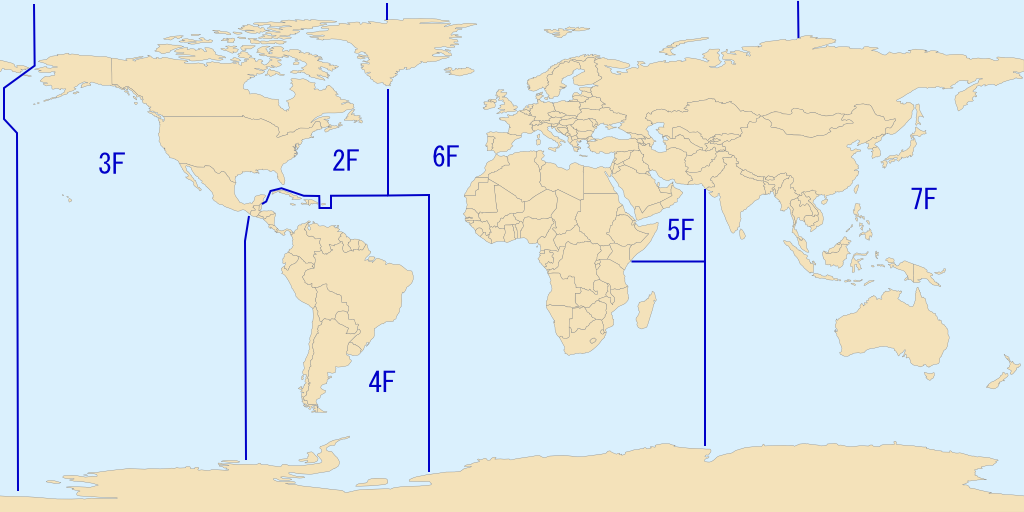
US navy fleets areas of responsibility. Source Wikipedia.
The only mitigating rationale I see for not transferring most of the large cutters to Pacific Area is that the Eastern Pacific drug transit zone is actually closer to Atlantic Area ports than to Pacific Area ports. This is why all of South America is under 4th Fleet, which is an Atlantic Fleet command. Probably an argument should be made for realigning the Coast Guard Area geographic descriptions to match those of the Atlantic and Pacific Fleets. A change of name to Eastern and Western Area might be appropriate and in fact a more accurate description.
Atlantic area includes not only the Atlantic coast but also the great lakes, inland areas, the Gulf of Mexico, Caribbean, and parts of the Arctic and Southern Oceans. Pacific Area also includes inland areas, the Indian Ocean (part of which is under Atlantic Fleet), and parts of the Arctic and Southern Oceans.
A realignment along Fleet dividing lines would also mean the dividing lines would more closely correspond to COCOM areas of responsibility and limit the number of cases where COCOMs would need to deal with both Coast Guard Areas to NORTHCOM. Currently there is also overlap in SOUTHCOM, AFRICOM, and CENTCOM. All three of those COCOMs would only need to deal with the Eastern (Atlantic) Area. That seems to be what is happening with AFRICOM and CENTCOM now anyway. PATFORSWA WPCs, Atlantic Area assets, operate routinely in the Indian Ocean, part of the PACAREA AOR.
Unified Combatant Commander’s Areas of Responsibility.
As Pacific Area assumes more responsibility in the Western Pacific and potentially the Indian Ocean passing off responsibility for all Coast Guard operations in 4th Fleet’s Area of Operations to Atlantic Area might make sense.
Antarctic:
The U.S. priority for Antarctica remains maintaining “a continent reserved for peace and science in accordance with the provisions of the Antarctic Treaty of 1959.”
No real change expected other than more and better icebreakers, but not everyone thinks like the US.
We should have the agility to react to a change from the present “continent reserved for peace and science.” We really have no reason for confidence that Antarctica will not become a zone of Conflict. Fortunately, actions to increase capabilities in the Arctic may also serve us well in Antarctica.
Implications for the Future
Cutter Design:
Patrol Cutters: Moving from “Patrol and Interdict” to “Target and Interdict” suggests that cruise speed endurance may become less important, and that higher max speed and an economical loiter speed may become more important. Greater emphasis on Defense Readiness would also suggest the desirability of greater speed. This suggest that we may want to build fewer than the currently planned 25 OPCs and shift investment to a new design based on a different set of priorities that we can build in greater number; ships with greater speed and increased modularity to accommodate an uncertain future.
Buoy Tenders: Improved aids to navigation may mean tenders will spend less time on routine AtoN maintenance. Still, they will need to be geographically distributed to respond to critical outages. It seems these ships will become more multi-mission by design. They should continue to be able to operate in ice. Their increased use for non-AtoN missions suggest that they may need overflow berthing and more fuel and stores capacity when supporting WPC deployments and to make them more effective in law enforcement roles–more speed, a flight deck and hangar for UAS and a deck gun such as the Mk38 Mod4.
Deployable Teams
Sounds like we will be getting more deployable Law Enforcement Detachments given the proliferation of capacity building objectives. Increased specialization and a desire for continuity in this area may someday result in a new rating.
Thanks to Paul for bringing the video to my attention.
Oct. 25, 2024
Coast Guard unveils first Operational Posture Statement
By Zach Shapiro, MyCG Writer
The Coast Guard just released its first Operational Posture Statement, which outlines the service’s operational priorities, including its plans to adapt to personnel and resource challenges. Vice Adm. Peter W. Gautier, Deputy Commandant for Operations (DCO), unveiled the document Friday during an event at the Center for Strategic and International Studies (CSIS) in Washington, D.C.
Think of the new annual Operational Posture Statement as a tactical annual document that supports the long-term Coast Guard Strategy by providing more specificity.
To improve operational efficiency and effectiveness, for example, the Coast Guard will increasingly use intelligence and data to shift its approach from “patrol and interdict” to “target and interdict.”
And to improve readiness, the Coast Guard will focus on three key elements: the workforce, capabilities, and assets. The Operational Posture recognizes the need to meet increasing demand while addressing workforce and resource shortages. The service will also continue to recapitalize cutters, boats, aircraft, and infrastructure.
The Operational Posture “is our effort to communicate with our stakeholders and be transparent with the American people on how we will confront all of these challenges, this increasing mission demand, and provide the kind of services that Americans deserve,” Gautier said.
Six guiding principles underpin the Operational Posture Statement:
Balance current operations with future readiness
Strengthen maritime governance
Counter strategic competitors while fulfilling our primary responsibility to secure and defend the homeland
Adjust force structure and posture to maximize operational effectiveness while maintaining a high level of support for our people, platforms, and infrastructure
Employ resources holistically to meet growing demands
Leverage intelligence, information, and improved maritime domain awareness to shift from a “patrol and interdict” to “target and interdict” model
These priorities reflect the increasing national and global demands for Coast Guard services. As 90 percent of global trade moves by sea, maritime security is the bedrock of national security and economic prosperity. In the face of rising global maritime tensions, the Coast Guard has a unique and critical role as a law enforcement entity and military agency.
Amidst this evolving environment, Gautier emphasized, the Coast Guard remains committed to its Search and Rescue (SAR) mission. That mission is “a sacred trust with the American people and a no-fail mission. It is our primary lifesaving mission. It defines us as a humanitarian service,” he said.
Moving forward, the Coast Guard intends to release a new Operational Posture Statement annually to outline the ways in which the service is adapting to new challenges and missions to best serve the American people.
To read the Operational Posture Statement in full, please click here.
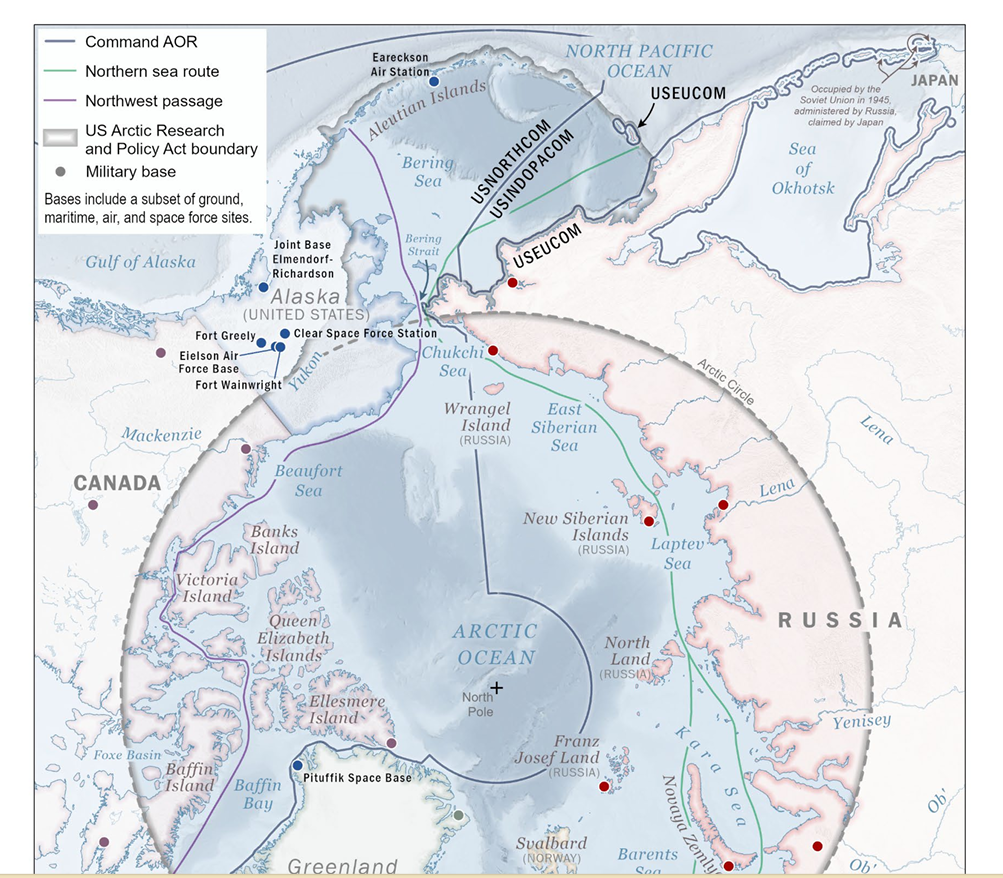
Screen grab from page 2 of the DOD Arctic Strategy, 2024
Here is a link to the new DOD Arctic Strategy here. I found it disappointing. There isn’t much strategy here. I would sum it up as–we are going to keep doing what we are doing, but we are going to do it better. (See critique below.)
“This strategy will strengthen the ability of the United States to build integrated deterrence and effectively manage risk to U.S. interests in the Arctic region by enhancing our domain awareness and Arctic capabilities; engaging with Allies, partners, and key stakeholders; and exercising tailored presence.”
About the US Coast Guard:
The US Coast Guard or USCG was mentioned in three places, once in a caption of a picture of USCGC Healy and these two paragraphs.
DoD will partner with the Department of Homeland Security (DHS), including through the U.S. Coast Guard (USCG), which plays a vital role in maintaining U.S. presence in the Arctic region and supporting domain awareness. The USCG is responsible for operating and maintaining the United States’ icebreaking capability, and DoD will continue to support the USCG’s long-term acquisition of at least eight polar icebreakers that will provide needed icebreaking capability for both military and civilian purposes, including PR/SAR. While disaster response is not a force sizing or shaping requirement, DoD remains ready to support DHS and the Federal Emergency Management Agency in the event of disaster, terrorist attack, or other mass-casualty incident in the Arctic when directed by the President or when requested by a lead Federal department or agency and approved by the Secretary of Defense.
Service-specific, Joint, Interagency, and Combined Exercises. Security and stability in the Arctic depend, in part, on the Joint Force’s ability to respond rapidly and effectively to threats in the region. Exercises increase interoperability with Allies and partners, validate plans, train our ability to rapidly deploy to all parts of the Arctic region, and provide an opportunity to test equipment in Arctic conditions. As such, the Joint Force will continue to exercise frequently in the Arctic through Service specific training, joint exercises —to include with USCG— and
combined exercises with our Allies and partners. DoD will
ensure CCMDs with Arctic equities work toward global integration through joint exercises and ensure key exercise lessons inform capability requirements and strategic planning.
That’s it.
About Icebreakers: Icebreakers are mentioned twice, it the paragraph above and here,
The PRC seeks to bolster its operational expertise in the Arctic, where its presence, while limited, is increasing. The PRC operates three icebreakers—the Xue Long, Xue Long 2, and Zhong Shan Da Xue Ji Di—which enable the PRC’s dual civil-military research efforts in the Arctic. Over the course of the PRC’s 13 Arctic research expeditions to date, the vessels have tested unmanned underwater vehicles and polar-capable fixed-wing aircraft, among other activities. People’s Liberation Army Navy (PLAN) vessels have also demonstrated the capability and intent to operate in and around the Arctic region through exercises alongside the Russian Navy over the past several years.
Critique:
“DoD will reach this end state through a monitor-and-respond approach.”
In other words, we will be reactive rather than proactive.
The threat to Europe in the Polar regions is just part of the long running NATO defense problem. No real change there, except the formal extension of NATO into Sweden and Finland.
The Air Threat over the Pole to North America is looked after by NORAD. Apparently, NORAD does not look after Greenland, but that does not seem to be a central problem.
Ground operations in the Arctic are always going to be difficult. There may be small unit operations but no need to worry about an invasion of North America coming over the pole. NORTHCOM is exercising both land and air assets that would be needed to deal with realistic threats.
The North Slope oil fields and the associated pipeline are probably a target if we become engaged in a long-term conflict that involves combat in or over the arctic. The oil fields are not mentioned in the strategy,
What has changed?
The opening of the Arctic Ocean to maritime commerce has made it a possible avenue for logistics between Russia and China with the potential for militarily valuable shipments moving both ways between the Russian Arctic coast on one end and the Russian Pacific Coast, North Korea, or China on the other. The weakness of Russian transcontinental land transportation systems makes the Northern Sea Route particularly important.
The door to be shut or left open is the Bering Strait.
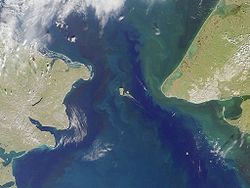
Bering Strait. 44 Nautical miles (82km) wide, with the Diomede Islands in the center.
The “strategy” mentions the Bering Straits only as a choke point,
The Arctic includes multiple strategically significant maritime chokepoints. Reduction in sea ice
due to climate change means chokepoints such as the Bering Strait between Alaska and Russia and the Barents Sea north of Norway, are becoming more navigable and more economically and militarily significant.
We would certainly want to deny use of the Strait by our enemies and ensure that we and our allies have the option to transit through the Strait.
The planned deep-water port in Nome (currently on hold) will be essential to forces that might be used to control access to the Bering Strait. We would also want to make sure St Lawrence Island and Little Diomede remain in US hands. The US might also want to seize Big Diomede. None of these strategic locations are mentioned in the plan.
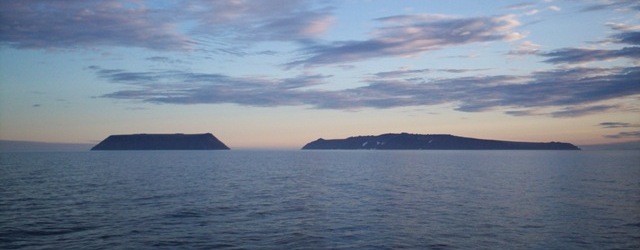
Diomede Islands: Little Diomede Island or Kruzenstern Island (left) and Big Diomede Island or Ratmanov Island in the Bering Sea. Photo is from the north. Photo by Dave Cohoe.
But who is in charge?
First look at the map at the head of this post. They have divided the Arctic so that operations there are under three different Unified Combatant Commands, USEUCOM, USINDOPACOM, and USNORTHCOM. In other words, no one below the President is in charge over the whole area.
These are the Unified Combatant Commander’s Areas of Responsibility. What is not made clear in this graphic is that all of Russia including the larger Asian part is under USEUCOM.
Perhaps most critically, the Pacific interface with the Arctic is under all three COCOMs.
USEUCOM is responsible for the Russian land areas in spite of the fact that the Bering Strait is 4521 statute miles from the COCOM’s headquarters in Stuttgart, Germany, and that is the shorter distance West from Stuttgart across the Atlantic and over the US, rather than over Russia. –This has got to be wrong.
USNORTHCOM has the Bering Strait and the Eastern half of the Bering Sea but normally they have no significant naval force. Their primary responsibility is the air defense of the US and Canada.
USINDOPACOM, which has the naval assets in the Pacific that might be used to attack Russian assets in Asia has responsibility for only the Western half of the Bering Sea below the Bering Strait.
This division of responsibility, placing Russian Asia under USEUCOM, also means that if the US should be at war with both China and Russia, then at least officially, conducting the war in the Pacific would be under two or perhaps three different COCOMs. I doubt this would actually work this way.







 Chuck Hill's CG Blog