“US Coast Guard Cutter Eagle to Depart on Annual Summer Cruise” –Seapower

The Navy League’s online magazine, Seapower, reports the start of USCGC Eagle’s summer training program and their planned port calls.

“Eagle’s 2024 full summer schedule includes port visits to:   

  • May 11: Departs from New London 
  • May 25 – May 28: Santo Domingo, Dominican Republic 
  • June 4 – June 7: Cartagena, Colombia 
  • June 14 – June 17: San Juan, Puerto Rico 
  • June 24 – June 27: Bridgetown, Barbados 
  • July 7 – July 10: Hamiliton, Bermuda 
  • July 18 – July 21: Halifax, Nova Scotia 
  • July 26 – July 29: Portsmouth, New Hampshire 
  • Aug. 2 – August 5: Rockland, Maine 
  • Aug. 9 – August 12: Boston, Massachusetts 
  • Aug. 16: Returns to New London 

Eagle is scheduled to return to New London on Aug. 16. 

“MEDIA AVAILABILITY: US Coast Guard to commission newest national security cutter, named for first Master Chief Petty Officer of the Coast Guard, in North Charleston, South Carolina” –news release

USCGC Calhoun 759 arrives Charleston.

Below is a news release from Coast Guard News.


April 16, 2024

NORTH CHARLESTON, S.C.  — The Coast Guard is scheduled to hold a commissioning ceremony for the U.S. Coast Guard Cutter Calhoun (WMSL 759), the service’s newest national security cutter, Saturday, in North Charlston. The event will be presided over by Coast Guard Commandant Adm. Linda Fagan. The cutter’s namesake comes from the first Master Chief Petty Officer of the Coast Guard, Charles L. Calhoun. The commissioning ceremony’s date of April 20 is in honor of Calhoun’s birthday.

WHO: Coast Guard Commandant Adm. Linda Fagan; Master Chief Petty Officer of the Coast Guard Heath Jones; Capt. Timothy Sommella, the commanding officer of the Calhoun; and Calhoun crew members.

WHAT:  Commissioning ceremony for the Coast Guard’s newest national security cutter.

WHEN: Saturday, April 20, 2024, at 10 a.m.

WHERE: Federal Law Enforcement Training Center, 2000 Bainbridge Ave., North Charleston, SC 29405.

Editors’ Note: Interested media are requested to RSVP by emailing a list of members’ names to Ensign Cody Meyers at Cody.L.Meyers@uscg.mil for base access no later than 5 p.m. Wednesday. Credentialed media are asked to arrive no later than 9 a.m. Saturday with a driver’s license and proof of insurance to clear security. 

Canadian Coast Guard Multi-Purpose Vessel Recapitalization

Canadian CG MPV. Credit Aker Arctic.

Below is a press release from Seaspan Shipyards regarding a contract awarded for the Canadian Coast Guard’s Multi-Purpose Vessel program. We talked about these ships earlier. I am going to repeat some of that earlier post here. Much like USCG Juniper class buoy tenders or the Great Lakes Icebreaker Mackinaw, these Canadian ships are made to both tend buoys and break ice. But these ships will be a lot bigger than the Mackinaw and it appears they can also support a helicopter and probably UAS.

CHARACTERISTICS:

  • Displacement: about 8,500 tons
  • Length, overall: 99.9 meters (328′)
  • Beam: 20.3 meters (66.7′)
  • Draft: 6.2 meters (20’4″)
  • Propulsion: diesel-electric; two azimuthing propulsion units
  • Range 12,000 nautical miles

The relatively shallow draft was a design requirement. 

Canadian CG MPV. Credit Aker Arctic.

ICE CLASS: 

These ships will be Canadian Ice Class 4, meaning they will have the capability to maintain a speed of 3 knots through ice 4 feet thick. The Canadian Coast Guard will consider these heavy icebreakers. We don’t have any figures on horsepower, but they probably will have less than 20,000 HP which, in the USCG system, would classify them as light icebreakers.

Compared to the US Coast Guard’s “heavy” Great Lakes icebreaker, Mackinaw (3,500 tons and 73m), these will be more powerful and more than twice as large. These might be a good design for the planned second USCG Great Lakes icebreaker.

IMPLICATIONS FOR THE USCG:

Aside from possible use of the design for Great Lakes icebreaker, these might be pretty close to what the USCG needs for their planned medium icebreakers. Certainly, consultation with Canadian counterparts will sharpen the focus of the US design effort. We might also have reasons to limit beam and/or draft.

I might add that, ships like these could make good companions (tenders/mother ships) for support of distant FRC operations, carrying fuel, supplies, and air assets.


Seaspan Shipyards Progresses to Next Phase of Designing and Building Multi-Purpose Vessels for the Canadian Coast Guard

 March 26, 2024 – North Vancouver, BC – Seaspan Shipyards (Seaspan) has been awarded the Construction Engineering (CE) and Long Lead Items (LLI) contracts for the pre-construction work of the Canadian Coast Guard’s (CCG) first six Multi-Purpose Vessels (MPV).

Following the successful completion of the vessel’s Basic Design review in late 2023, Seaspan was awarded the CE and LLI contracts to complete the design and engineering work and to procure long lead-time material and equipment to ensure readiness to proceed with the construction of the first six ships of the up to 16 vessel fleet.

“This milestone demonstrates the tremendous capabilities in marine design and engineering that have been developed through the National Shipbuilding Strategy.  Our team, along with our partners from coast to coast, are excited to move to the next phase of this program, and ultimately provide the Canadian Coast Guard with the vessels they need to manage and safeguard Canada’s coastlines. A long run of ships like the MPV program enables Seaspan to continue to drive improvement and generate greater efficiencies, while ensuring we have stability for the next generation of shipbuilders, marine engineers and designers and supply chain in Canada,” said John McCarthy, Chief Executive Officer, Seaspan Shipyards.

“The designers and the ship builders of Seaspan Vancouver Shipyard – are playing key roles in taking the Canadian Coast Guard’s new multi-purpose vessels (MPVs) out of the drawing room and into the open ocean. The contracts announced today are an important milestone to getting these ships completed and represent an important investment in North Vancouver. This will secure good jobs while advancing the delivery of the MPVs to significantly expand the operational capacity of our Coast Guard for years to come.” – The Honourable Jonathan Wilkinson, Minister of Energy & Natural Resources and MP for North Vancouver.

The MPVs will be Polar Class 4 vessels, allowing them to carry out multiple missions including icebreaking in moderate ice conditions and assisting in shipping and flood control, search and rescue, environmental response, as well as maintaining Canada’s marine navigation system composed of approximately 17,000 aids to navigation. The new fleet of MPVs will replace the existing fleet of High Endurance Multi-Tasked Vessels and Medium Endurance Multi-Tasked Vessels.

“The Canadian Coast Guard saves lives at sea, maintains waterways open and safe for the movement of goods and services, protects the marine environment and supports Canadian sovereignty and security. The Multi-Purpose Vessels will be key assets for the Canadian Coast Guard’s future fleet, giving our personnel the modern, reliable tools they need to continue their vital work from coast to coast to coast,” said Mike Kelloway, Parliamentary Secretary to the Minister of Fisheries, Oceans and the Canadian Coast Guard.

Seaspan has already gained significant experience designing and building Polar Class vessels including three Offshore Fisheries Science Vessels which are now in service with the Canadian Coast Guard; an Offshore Oceanographic Science Vessel that is currently under construction; and a heavy Polar Icebreaker, the first of its kind to be designed and constructed in Canada in 60 years. Seaspan is preparing to cut steel on the Polar Icebreaker in late 2024 with the recent completion of a prototype block, ensuring that proper processes, procedures, and equipment are in place to build a vessel of this complexity.

QUICK FACTS ABOUT THE MULTI-PURPOSE VESSELS

  • With a displacement of 8,500 tonnes, the Multi-Purpose Vessels will be 99.9 metres long and 20.3 metres wide, and able to accommodate up to 50 personnel.
  • The area of operation for the MPV will include:
    • Year-round operations in Canada’s eastern and western seaboards, within Canada’s Exclusive Economic Zone (EEZ)
    • Year-round operations in the Gulf of St. Lawrence, the St. Lawrence River, and the Great Lakes
    • Seasonal (summer) operations in the western and lower Arctic
  • Under the NSS, Seaspan has become a major economic and job creation engine. According to an economic analysis conducted by Deloitte, Seaspan has contributed $5.7 billion to Canada’s GDP since 2012, while also creating or sustaining more than 7,000 jobs annually.

SOCIAL MEDIA

Twitter: @Seaspan
LinkedIn: Seaspan ULC
Instagram: @SeaspanULC
Facebook: Seaspan

ABOUT SEASPAN

Seaspan, a division of Seaspan ULC, is a leader in Canada’s ship design, engineering, building and ship repair industry. With modern facilities and a dedicated workforce of approximately 3,900 in North Vancouver and Victoria, the company has proven itself to be a trusted and strategic partner on a range of complex projects for both government and the private sector.

Canada’s New Icebreaker Fleet

Current Coast Guard Icebreakers:  CCGS Henry Larsen  (medium icebreaker, top photo), CCGS Terry Fox (heavy icebreaker, bottom photo)Current Coast Guard Icebreakers: CCGS Henry Larsen (medium icebreaker, top photo), CCGS Terry Fox (heavy icebreaker, bottom photo)

Below are two news releases, first a release by Chantier Davie Canada Inc. (Davie) and second a statement from the Canadian Coast Guard.

The release from Davie is new (it also has an illustration). The Canadian Coast Guard statement dates from July 2019. I added it because it outlines what is expected of the new icebreakers.

The Davie news release says these will be the “largest and most advanced icebreakers ever built in and for Canada.” Currently the largest Canadian Icebreaker is CCGS Louis S. St-Laurent which is 15,324 tons full load, 119.8 m (393.04 ft) in length, and has three electric motors, 3 × 6,714 kW, or 27,011 HP total. Presumably these will be larger and more powerful, still the new icebreakers may turn out to be medium icebreakers, at least according to the US Coast Guard classification system that is based on horsepower, e.g. 20,000 to 45,000 HP are medium icebreakers.

The Davie release also notes, “Davie is a part of Group Davie, which in November 2023 acquired Finland’s Helsinki Shipyard, the world leader in icebreaker design and construction.” Maybe a good idea to buy the expertise you need.


March 26, 2024

Lévis, Canada – March 26, 2024 – Chantier Davie Canada Inc. (Davie) today announced it has been awarded its first National Shipbuilding Strategy (NSS) contract by the Government of Canada for the design of the six-ship fleet of Canada’s future Program Icebreakers. This major milestone marks the beginning of Davie’s NSS work package to replenish Canada’s Arctic fleet and each initiative under the contract will help advance upcoming design, construction, delivery and support phases for these strategic ships.

The Honourable Jean-Yves Duclos, Canada’s Minister of Public Services and Procurement (PSPC) said: “This first contract awarded to Chantier Davie under the National Shipbuilding Strategy brings us a step closer to providing the Canadian Coast Guard with the next generation Arctic ships. They will be among the most advanced, sustainable and durable vessels tailored to the world’s harshest environments. The new fleet will be symbolic of Canada’s Arctic presence and crucial to keeping our country open for business year-round.”

Davie President and CEO, James Davies, said: “This is a momentous first step in our journey to deliver a fleet of the largest and most advanced icebreakers ever built in and for Canada. My heartfelt thanks go to the dedicated teams at Davie, the Canadian Coast Guard and PSPC. They have spent countless hours preparing for this historic milestone. Now, we can’t wait to get working on renewing Canada’s Arctic fleet.”

Davie will establish a Program Icebreaker project management and design office, providing compelling opportunities for current and future generations of Canadian shipbuilders. Davie is committed to recruiting teams of highly skilled shipbuilding professionals, who will drive all aspects of constructing the world’s largest order book of heavy icebreakers.

Moreover, Davie will engage critical subcontractors to design and certify the vessel to established safety, environmental, and performance standards. Building on Davie’s proven track record of delivering vessels of exceptional quality and performance, this early phase is fundamental in guaranteeing sustained operational readiness and capability to best serve the CCG’s missions.

Julian Kenney, Program Director for the Program Icebreakers at Davie, said: “Embarking on the design and construction of Canada’s new icebreaker fleet is a great source of pride for everyone at Davie. We have a strong partnership with the Canadian Coast Guard and our top priority is to design and build the icebreakers Canada needs to keep our waterways open, protect our environment, and secure the Arctic.”

About Davie

Based in Québec, Canada since 1825, Davie is a world-class designer and builder of specialist, mission-critical ships such as icebreakers, ferries and warships for government and commercial customers. Davie became a partner in the Government of Canada’s National Shipbuilding Strategy on April 4, 2023. This historic agreement is for the design and construction of the largest and most technologically advanced ships ever constructed in and for Canada. The initial $8.5 billion package of work includes seven heavy icebreakers and two large hybrid-powered ferries. Davie is a part of Group Davie, which in November 2023 acquired Finland’s Helsinki Shipyard, the world leader in icebreaker design and construction. Find out more at davie.ca and helsinkishipyard.fi.

For further information, please contact: Marcel Poulin Director, External Affairs and Industrial Participation, Davie marcel.poulin@davie.ca +1 581 992-8564


Canadian Coast Guard’s new Icebreakers

Backgrounder

As part of the Government of Canada’s National Shipbuilding Strategy and in accordance with the Canadian Coast Guard’s fleet renewal planning, six new icebreakers will be built for the Coast Guard. These icebreakers are fundamental to year-round safe and efficient movement of ships and goods in Canadian waters.

The new program icebreakers will replace the Coast Guard’s heavy and medium icebreakers that operate in Atlantic Canada and the St. Lawrence waterways during the winter and in the Arctic during the summer.  In Atlantic Canada, these program icebreakers help ensure year-long ferry service, escort ships through ice-covered waters and the clearance of ice from harbours and wharfs, which is essential to Canada’s commercial fisheries. In the Arctic, they provide icebreaking support to ships with vulnerable cargoes, such as dangerous goods and perishable products, and support vessels transporting cargo that is a vital part of the northern communities’ sealift and resupply.

The new program icebreakers will be built at a third strategic shipyard that will be selected through a competitive process under the National Shipbuilding Strategy.

“Coast Guard to commission new ship in New London, Connecticut”

USCGC MELVIN BELL (WPC-1155) Photo by: Petty Officer 2nd Class Briana Carter VIRIN: 240131-G-HT254-1095.JPG

Below is a Coast Guard news release. This may be the first time many cadets will get an opportunity to see a Webber class WPC. Note the approximately four and a half months between delivery and commissioning. The next two FRCs will go to Astoria, Oregon.


March 25, 2024

MEDIA AVAILABILITY: Coast Guard to commission new ship in New London, Connecticut

WHO: Rear Adm. John W. Mauger, the First Coast Guard District commander, Lt. Patrick Kelly, the Coast Guard Cutter Melvin Bell (WPC-1155) commanding officer, Rita Mayer, the cutter’s sponsor, along with additional Bell family members.
WHAT: Commissioning Ceremony for Coast Guard Cutter Melvin Bell
WHEN: Thursday, March 28, at 10:00 a.m.
WHERE: Coast Guard Academy at 31 Mohegan Ave Pkwy, New London, CT 06320.

Editor’s Note: Media interested in attending must RSVP to D1PublicAffairs@uscg.mil by 8 a.m. Wednesday to gain access to the ceremony.

New London, CT. — The Coast Guard Cutter Melvin Bell (WPC-1155) is scheduled to be commissioned during a ceremony Thursday at 10 a.m. at the Coast Guard Academy in New London.

The Coast Guard’s newest cutter was accepted by the Coast Guard on November 16, 2023, and will be the sixth and final fast response cutter homeported in Boston.

The Sentinel-class fast response cutter (FRC) is designed for multiple missions, including drug and migrant interdiction; ports, waterways and coastal security; fishery patrols; search and rescue; and national defense. The Coast Guard has ordered a total of 65 FRCs to replace the 1980s-era Island-class 110-foot patrol boats. The FRCs feature advanced command, control, communications, computers, intelligence, surveillance and reconnaissance equipment; over-the-horizon cutter boat deployment to reach vessels of interest; and improved habitability and seakeeping.

All Coast Guard fast response cutters are named after an enlisted Coast Guard hero who distinguished themselves in the line of duty. Melvin Kealoha Bell was a master chief electronics technician and served in the Coast Guard from November 1938 to December 1958. ETCM Melvin Bell distinguished himself during World War II by transmitting the first warning messages to military installations in Pearl Harbor on the morning of December 7, 1941, when the Japanese attacked. He continued to prove instrumental throughout the war as he helped break enemy codes leading to numerous victories, including the Battle of Midway and in an operation to break up a Nazi espionage network in New York City. ETCM Bell became the first Pacific Islander to achieve the rank of chief petty officer, the first master chief electronics technician and the first master chief petty officer of color.

Why the “J-model” C-130s Make Such a Difference

LIMA, PERU, 10.06.2023, Courtesy Photo, USCG District 11
The aircrew of the Coast Guard 2007, an HC-130 based out of U.S. Coast Guard
Air Station Barbers Point, Hawaii, poses for a picture with observers from the Peruvian Navy and Air Force, in Lima Peru, October 2023. During the course of two weeks, Peruvian observers accompanied the USCG aircrew as they conducted overflights of the fishing fleet on the high seas during Operation Southern Shield 2023. (U.S. Coast Guard photo by pilot-in-charge, Lt. Zachary Hunter.) Note the six bladed props that identify the C-130J. 

Below is a news release, “Coast Guard accepts 16th missionized HC-130J into fleet,” from the Acquisitions Directorate (CG-9). There is more here than the announcement of a newly missionized aircraft. The post goes on to talk about the advantages the C-130Js bring to the service, particularly in the Pacific.

The C-130Js provide a 20 percent increase in speed and a 40 percent increase in range over the HC-130H, as well as much improved avionics. The Coast Guard is moving to a fleet of 22 HC-130Js and retiring all their C-130Hs.

The Coast Guard also has 14 HC-27Js and 18 HC-144s all being equipped with Minotaur.

HC-130J Characteristics

  • Length: 97 feet 9 inches
  • Wingspan: 132 feet 7 inches
  • Height: 38 feet 11 inches
  • Maximum Weight: 175,000 pounds
  • Cruise Speed: 320 knots true airspeed
  • Range: 4,900 nautical miles
  • Endurance: 20+ hours

HC-130J Features

  • Standardized Minotaur mission system across all Coast Guard fixed-wing aircraft
  • Real-time tracking and Rescue 21 integration to enhance common operating picture and maritime domain awareness
  • Advanced radar and electro-optical/infrared sensors for search and rescue, law enforcement and intelligence gathering missions; the Coast Guard’s Super Hercules is the first HC-130 aircraft in the world with a 360-degree, belly-mounted, multimode surface search radar
  • Commonality of command, control, communication, computers, cyber, intelligence, surveillance and reconnaissance components and capabilities with those on the Coast Guard’s medium range surveillance aircraft

Minotaur Features

  • Commonality of command, control, communications, computers, cyber, intelligence, surveillance and reconnaissance components and capabilities across all Coast Guard fixed-wing surveillance aircraft
  • Interoperability with multiple Defense and Homeland Security department platforms
  • Real-time tracking and Rescue 21 integration to enhance common operating picture and maritime domain awareness
  • Automatic Dependent Surveillance – Broadcast technology to receive traffic and weather broadcasts and information about other aircraft, including identification, position and altitude
  • Tactical screen replay to review a target’s entire flight in seconds and track the target via its trajectory, even if the target stops broadcasting information or otherwise evades the sensors

The Coast Guard has nine air stations operating fixed wing search aircraft. There are six in the Atlantic Area, which includes the Gulf of Mexico.

  • Cape Cod, MA (C-144)
  • Elizabeth City, NC (C-130, C-27, C-144)
  • Miami, FL (C-144)
  • Clearwater, FL (C-130)
  • Mobile, AL (C-144)
  • Corpus Christi, TX (C-144)

There are only three Coast Guard air stations operating fixed wing search aircraft in the Pacific Area.

  • Sacramento (C-27)
  • Barbers Point, HI (C-130)
  • Kodiak, AK (C-130)

Kodiak and Barbers Point certainly needed the additional range and on-station time that the C-130Js provide.

Barbers Point is the only Coast Guard air station in the 14th District, despite the fact that the 14th District includes 48% of the entire US’s Exclusive Economic Zone (EEZ), and has additional responsibilities to assist the Federated States of Micronesia (FSM), the Republic of the Marshall Islands (RMI), and the Republic of Palau under the Compact of Free Association which together have an EEZ total equal to more than 49% that of the US.


Coast Guard accepts 16th missionized HC-130J into fleet

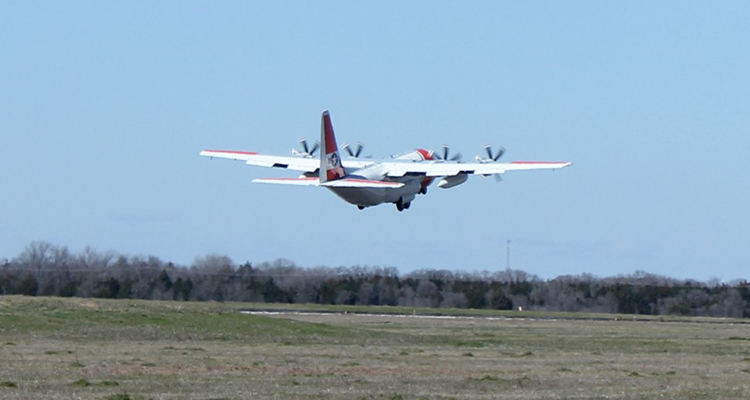
The Coast Guard’s 16th fully missionized HC-130J takes off for its first test flight following the year-long missionization and Block Upgrade 8.1 modification at L3Harris in Waco, Texas. U.S. Coast Guard photo.


The Coast Guard accepted delivery of its 16th fully missionized HC-130J long range surveillance aircraft, CGNR 2016, Feb. 19 following completion of Minotaur mission system integration and Block Upgrade 8.1 installation at L3Harris in Waco, Texas.

The aircraft was delivered to Air Station Elizabeth City in Elizabeth City, North Carolina, returning that air station to its full complement of five HC-130J aircraft. The air station was temporarily operating with four aircraft while an Elizabeth City HC-130J was assigned to Air Station Barbers Point, Hawaii, to complete the transition of that facility to HC-130J operations.

The more advanced engines, six-blade propellors and Minotaur-integrated sensors of the HC-130J enable the Coast Guard to better respond to mariners in peril by improving response times, extending time on scene for search and rescue and law enforcement patrols, and increasing effectiveness and versatility. Regarding the latest air station transition, the improvements are ideally suited for Barbers Point’s vast jurisdiction – 12.2 million square miles of open ocean, atolls and island chains, which make up the Coast Guard’s Fourteenth District.

Three recent natural disasters in Air Station Barbers Point’s area of responsibility have highlighted the value of the improved aircraft, especially the 26% increase in patrol range over the legacy HC-130H.

  • A Barbers Point HC-130J flew 2,300 miles to be the first aircraft on scene after Typhoon Mawar struck Saipan in May 2023, performing overflight assessments and delivering critically needed relief supplies. Over a week, the aircraft flew over 97 flight hours and dispatched 400,000 pounds of cargo and 169 passengers.
  • Barbers Point aircrews responded when wildfires burned thousands of acres in Maui, Hawaii, in August 2023, providing search and rescue and damage assessment along with moving passengers and cargo for disaster relief.
  • Barbers Point HC-130J aircrews answered the call when Tropical Cyclone Lola slammed the island nation of Vanuatu in October 2023, assessing the damage to ports, airports and critical infrastructure. Aircrews also delivered over 80,000 pounds of relief supplies.

The HC-130J and its Minotaur system also play a vital role in identifying and monitoring illegal fishing by providing surveillance and gathering intelligence on suspicious fishing activities. That information is shared with local and national authorities and aids in determining what vessels need to be boarded for inspection.

The service’s Super Hercules aircraft carry out many Coast Guard missions, including search and rescue, drug and migrant interdiction, cargo and personnel transport, and maritime stewardship, as well as providing critical support to Department of Homeland Security partners. The aircraft also can serve as a command and control or surveillance platform capable of identifying and classifying objects and sharing that information with operational forces.

For more information: HC-130J Long Range Surveillance Aircraft Program page and Minotaur Mission System page

“A Nautical Knife Fight” USCGC Spencer vs U-175 –USNI

US Coast Guard crew of cutter Spencer watched as a depth charge exploded near U-175, North Atlantic, 500 nautical miles WSW of Ireland, 17 Apr 1943. Photo by Jack January

The US Naval Institute’s April 2024 edition of Naval History magazine has an excellent article about USCGC Spencer’s destruction of U-175 on 17 April 1943, A Nautical Knife Fight, written by CPO William A. Bleyer, USCG. I have added the link to my heritage page.

I have read several accounts of this action, and this is the best and most detailed.

USCGC Spencer (WPG-36) in 1942 or 1943. Spencer sank U-175 with assistance of USCGC Duane, on April 17, 1943.

Spencer was the Coast Guard’s most successful ASW ship, sinking at least two U-boats (U-633 on March 1943 and U-175 17 April 1943) and possibly a third.

USCG Cmdr Harold S. Berdine of cutter Spencer talking with US Navy Capt Paul Heineman of the Escort Group A-3 after sinking German submarine U-175, North Atlantic, 500 nautical miles WSW of Ireland, 17 Apr 1943. US Coast Guard photo by Jack January

Spencer was one of seven 327 foot Secretary class cutters. As a class they were extremely successful. Unfortunately, one was lost 29 January 1942, after being torpedoed. Another of the class, USCGC Campbell, famously rammed and sank U-606 on 22 February 1943, after the U-boat was forced to the surface by the Polish destroyer Burza. I had the privilege of being XO on one of the class, USCGC Duane, which assisted Spencer in the sinking of U-175 and rescuing survivors.

Related:

“USS LEYTE GULF DEPLOYS FROM NORFOLK TO U.S. 4TH FLEET” –2ND FLEET

040501-N-7586B-122, Gulf of Oman (May 1, 2004) – Members of the Vessel Board Search and Seizure (VBSS) team return to the guided missile cruiser USS Leyte Gulf (CG 55) in a Rigid Hull Inflatable Boat (RHIB) after searching several fishing dhows in the Gulf of Oman. U.S. Navy photo by Photographer’s Mate 1st Class Bart Bauer. (RELEASED)

Below is a US 2nd Fleet news release.

News about Navy ships deployed to 4th Fleet has been sparse, but recently I noted the return of a destroyer, USS Farragut, from the 4th Fleet and remarked on how I was surprised they used a DDG rather than an LCS for this drug interdiction mission. Before they were all decommissioned, these missions were typically done by Perry class frigates. DDGs have been used in the past but lately the mission has been done almost exclusively by LCS. At one point in 2020, the administration made a big point of “surging” ships to the Drug interdiction zone, but in fact, that only happened because the carrier in a carrier strike group was unable to make its deployment and the escorts were suddenly at loose ends and available.

Cruisers are normally AAW coordinators for carrier strike groups. Deploying one independently to 4th Fleet is rare indeed.

Again, I suspect they may be there for reasons unrelated to drug interdiction. The DDG apparently stayed in the Caribbean rather than entering the Eastern Pacific, where we have a greater shortage of capable drug interdiction assets.


USS LEYTE GULF DEPLOYS FROM NORFOLK TO U.S. 4TH FLEET

By Lt.J.G. Jayden Hodgson, USS Leyte Gulf Public Affairs

28 January 2024, 

The Ticonderoga-class guided-missile cruiser USS Leyte Gulf (CG 55) departed Naval Station Norfolk on deployment, Jan. 28.

Leyte Gulf will independently deploy to the U.S. 4th Fleet area of operations.

Throughout the fall, the ship conducted extensive underway operations throughout the Western Atlantic in preparation for their tasking.

“Leyte Gulf and her crew are excited to work with our partner nations and services to maintain maritime security and interoperability in the Caribbean and South American areas of operation,” said Capt. Nate Diaz, commanding officer of Leyte Gulf.

The ship’s crew is comprised of more than 40 officers and nearly 350 enlisted Sailors.

“The crew continued to display a high level of proficiency and readiness during our sustainment phase,” said Leyte Gulf Command Master Chief Jason Kutsch. “We look forward to exercising the capabilities of our ship and crew while deployed.”

While deployed, Leyte Gulf will host Helicopter Maritime Strike Squadron (HSM) 50 and Coast Guard Law Enforcement Detachment 404 to provide robust expertise in keeping illegal drugs from reaching the shores of the U.S. and its regional partner nations. Leyte Gulf is scheduled to conduct passing exercises with other regional partners as well as several theater security cooperation port visits to strengthen maritime partnerships, enhance U.S. maritime posture and counter threats such as illicit drug trafficking.

Leyte Gulf was commissioned Sept. 26, 1987, and commemorates the largest naval battle in modern history fought in Oct. 1944. The Battle of Leyte Gulf was critical in turning the tide in the Pacific during World War II.

“Top Ten Navies by Aggregate Displacement, 1 January 2024” –Analysis and diagram by Phoenix_jz

Two years ago, I did a post with a similar title from the same source. Somehow, I missed the 2023 edition. As I said in the earlier post, I don’t know , but the data appears to be credible, and it looks like readers are checking his figures. 

It is very difficult to read the tonnages at the bottom of the graph unless you are using a computer and click on the graph to see it in a larger size. 

The creator’s notes and some additional comments are below. 


Hello all!

Well, 2024 is upon us, and as such so is the third edition of my top ten navy list. For those unfamiliar, here are links to 2022 and 2023, with a general explainer of the whole concept in the 2022 version.

The long and short of it is that this graph reflects a personal tracker I keep of almost every large and moderately sized navy, and calculates the aggregate displacement of these navies. It’s not a perfect way to display the size of navies – far from it in fact – but it is at least more representative than counting numbers of hulls alone, in my opinion.

To break down what each of these categories mean;

  • Surface Warships is an aggregate of all above-water warships and major aviation and amphibious assault platforms. This category includes CVNs, CVs, CVLs, LHDs, LHAs, LPDs, CGs, DDGs, FFGs, corvettes, OPVs, CPVs, lighter patrol craft, and MCM vessels.
  • Submarines is what it says on the tin – SSBNs, SSGNs, SSNs, SSKs, and for select nations where applicable (and where information is available), special purpose submarines. Please note dedicated training submarines are counted separately.
  • AORs includes all major fleet replenishment vessels (coastal vessels do not count, however).
  • Other Auxiliaries is a very wide net that essentially captures everything else. Special mission ships, support vessels, minor amphibious assault vessels (LSDs, LSTs, LCAC’s, LCM’s, LCU’s), training vessels, tugs, coastal support vessels, hydrography ships – all essential parts of navies, but generally often paid less attention to as they’re not as flashy as the warships proper.

Interesting trends in data that I thought I would share for various navies, and thoughts and observations otherwise;

The USN is, unsurprisingly, still top dog by a huge margin. In spite a net decommissioning of five ships this year, the USN has grown overall by about 32,000 tons – four ‘cruisers’, two SSNs, four LCS, and five patrol craft decommissioned against the introduction of three destroyers, an SSN, five LCS, and a replenishment ship. It is worth noting that 2023 is the first year since 2010 that the USN has commissioned three destroyers in a year, though a repeat performance in the next couple years is unlikely – these ships were launched in 2020 and 2021, and only one destroyer per year was launched in 2022 and 2023.

No one will be surprised to hear that the PLAN has grown for the nth consecutive year, adding the final Type 055 batch I and the remaining Type 054A Batch V, for almost 50,000 tons of new surface combatants. Much of the remaining increase in displacement for this year (which totaled nearly 90,000 tons) reflected a steady pace of modernization in mine warfare, landing forces, and logistical support/other auxiliaries. As with last year, the number of minor patrol craft continue to plummet as the PLAN continues to divest many of its obsolescent brown-water combatants, or relegates them to training duties.

Moving on to ongoing construction, progress on the new destroyer batches continues at pace. At least two Type 055 Batch II appear to be under construction, and the overall number of Type 052D Batch IV appears to be at least ten. The first ship actually launched at the very end of 2022 (at Jiangnan), and two further have been launched by the same yard as well as three at Dalian. Two more remain under construction at each yard. The first of these ships to be launched appears to be on trials and will likely commission this coming year. The Type 054A program of the navy appears to have finally wrapped up (construction of the hull for the China Coast Guard continues), and the Type 054B program has continued at pace if not scale – two ships were launched this year, but modules of further units have been scarce. Rounding things out for major surface vessels, a new Type 075 LHD was launched this past December. Conspicuously absent has been sightings of any modules for new carriers. Considering Fujian (Type 003) began construction at some point from 2015 to 2017, one has to wonder if we will see China launch another carrier before the end of the decade.

Perhaps most consequential of all, however, has been the completion of new production facilities at Bohai and a resumption of Type 093 SSN launches. The first of the new Type 093B launched in 2022, and has been followed up by two more launches this year (possibly up to three). A sustained pace of two submarines a year, or even just three submarines every two years, would quickly add up could see anywhere from nine to eleven new SSNs launched by the end of 2027, and in service by early 2030s. Only time will tell what the actual drumbeat of production will be.

Russia’s VMF woes in the Black Sea have continued unabated, except less at sea and largely fueled by the Franco-British SCALP cruise missile. The most dramatic loss by far was the destruction of the Project 636.3 ‘Improved’ Kilo Rostov-on-Don in drydock at Sevastopol, but similar attacks claimed the destruction or constructive loss of a Karakurt-class corvette (under construction, not in service) and two Ropucha-class LSTs. The infamous TB-2 made a brief return to destroy a Serna-class LCU, and two other LCU’s may have finally become the first victims of Kamikaze USVs this past November, for a total of 11,407 tonnes lost.

In regards to the more regular cycle of commissioning and decommissioning, one frigate, one MCM vessel, and three corvettes were brought into service, as well as a new SSGN, SSBN, and SSK each. Against this a corvette, SSGN, SSBN, and SSK were decommissioned. Overall, in spite of losses the VMF managed a net gain of 6,324 tonnes of surface warships and submarines. Anyone who checks against my figures from last year will note that the increase in the VMF’s overall tonnage this year is far more substantial, due to the auxiliary category. Though some of this was from new vessels, this was mostly down to a badly needed overhaul and reorganization of that part of my tracker, particularly for the tug fleet. Did you know the Russian navy tug fleet displaces more than either the Argentine or Canadian navies? Now you do! Seriously – it would be the 20th largest navy in the world by itself.

As a final note on the VMF – it is worth remembering that ships commissioned in the Russian navy are not always actually in service, as ships can often languish in near-terminal refits or simply be left inactive without a formal decommissioning. Almost half the remaining Projekt 877 Kilo’s, for example, appear to be inactive at this point (5 of 10).

(In comments the author noted the following, “Russian naval losses during the war have totalled 13 vessels for 29,870 tonnes. Quite a bit – but also only about 1.4% of their current overall tonnage.” –Chuck)

The British Royal Navy observes a second year of marginal reduction in overall tonnage (-2,640t, or -0.3%), losing another Type 23 frigate as well as the last Echo-class survey ship. Against this the RFA brought into service the first MROSS, ProteusProteus represents a considerable increase in subsurface capability, though the loss of a frigate with no replacement ship to replace it for another thee to four years is painful, especially given how many of the remaining eleven ships are deep in LIFEX/Post-LIFEX refits. With that said, their new frigate programs are moving on steadily. Steel was cut on two new frigates this year – the future HMS Birmingham (4th Type 26) and HMS Active (2nd Type 31), bringing the total construction volume to five frigates building and one fitting out.

The JMSDF continues to grow, albeit at a more moderate pace this year (+6,530t, or +0.9%), inducting a new Mogami-class frigate and Taigei-class attack submarine, while shifting another Oyashio-class from the active fleet to a training role. Two more FFM were launched this year, though surprisingly they have not started construction on the next pair. This past November, it was announced that the Mogami-class FFM would be curtailed at 12 units (of 22 planned), and followed on by an evolution of the design known as FMF-AAW. The FMF-AAW will feature greater air and surface warfare capabilities. Twelve such ships are planned.

The Indian Navy’s growth in 2023 was far less dramatic than in 2022, but still noteworthy (+9,200t, or +1.5%), as adding a new conventional attack submarine and destroyer to the fleet has finally pushed them over the 600,000-tonne line.

The Marine Nationale grew by almost 9,000 tonnes (2.1%) this year, largely down to the retirement and replacement of a patrol ship, nuclear attack submarine, and tugs with an equal number of replacements. Though it is worth noting that the new attack submarine is not fully operational yet – that will happen in 2024 – so technically the MN’s attack submarine fleet is really four boats at this point in time.

The saga of eight and ninth place swapping around continues, as the ROKN has managed to move back to the position of eighth largest navy in the world. In 2023 they added a net 15,374t (+4.3%), commissioning four Daegu-class frigates, a second KSS-III class attack submarine, an MCM vessel and a pair of LCACs, against the decommissioning of two corvettes and five PKM’s.

In contrast, the Marina Militare continues to feel the bite from the two FREMM sold to Egypt, as well as delays in brining the LHD Trieste into service – intended for 2023 but again pushed back, now to the spring of 2024. The first PPA ‘Light+’, Raimondo Montecuccoli, was brought into service in 2023 – an OPV on paper, but light frigate in practice. Against this one of the elderly Maestrale-class frigates, Zeffiro, was retired, as was one of the fleet’s AORs (Vesuvio) and a water tanker (Bormida), resulting in a real drop of 7,073 tonnes (-1.9%). The drop seen versus the chart versus last year is more dramatic (totals 16,632 tonnes), which reflects both cleaning up data on old auxiliary platforms for which information is scarce, and correcting some minor sheet errors, which totaled 9,559 tonnes.

The outlook should be looking up in the future – as previously mentioned, the LHD Trieste should enter service this year, as should the fourth and fifth PPA. The first of two replacement FREMM (GPe) was launched in late 2023 and a second will follow this spring, with both being slated to enter service in 2025 alongside the sixth PPA and second Vulcano-class replenishment ship – barring any delays.

Finally, the Indonesian Navy saw another year of growth, adding a net 9,930 tonnes (+3.1%), with another hospital ship commissioned, a new survey ship, corvette, and two new MCM vessels and FACs each, as well as several patrol boats. The TNIAL continues a steady program of domestic construction of patrol craft, and construction is ongoing on two Iver Huitfelt derivative frigates, with the keel of the first vessel laid down this past August. They have also cut steel on a new hydrography ship, which will launch in Indonesia and complete fitting out in Germany.

What comes next in terms of major platforms for the TNIAL is somewhat up in the air. As with the year prior, there has been no progress made on the procurement of six FREMM from Italy, despite a contract being signed two and a half years ago (June 2021). In spite of this, they have expressed interest in procuring two PPA to bolster their patrol fleet. In the interest of expediting procurement, they are looking at two ‘Light+’ configuration vessels currently fitting out at Muggiano – Marcantonio Colonna (due for delivery to the MMI in the latter half of 2024) and Ruggiero di Lauria (due for delivery to the MMI in mid-2025). According to the General Manager of Fincantieri’s Naval Vessels Division, Dario Deste, a contract for the two vessels could be signed in the first half of 2024.

(In answer to a question the author added this in the comments–Chuck)

No.11 to 20 are as follows for 1 January 2024;

  • 11: Turkey – 297,298t
  • 12: Taiwan – 268,958t
  • 13 Egypt – 232,046t
  • 14: Spain- 229,373t
  • 15: Germany – 226,655t
  • 16: Australia – 224,074t (decided to add the National Support Squadron, which added about 30kt)
  • 17: Greece – 189,184t
  • 18: Brazil – 162,29t
  • 19: Chile – 161,404t
  • 20: Argentina – 138,620t
(A reader, , added this–Chuck)

Listed by ranking for this year:

Nation Change from 2023 (tonnes) 2023 Ranking Change from 2022 (tonnes) 2022 Ranking
United States +55,658 1st +250,308 1st
China +93,567 2nd +99,299 2nd
Russia + 211,333 3rd +166,682 3rd
United Kingdom -2,640 4th -5,815 4th
Japan +6,530 5th +23,790 5th
India +9,200 6th +62,349 6th
France +8,925 7th +12,145 7th
South Korea +15,374 9th +7,153 8th
Italy -16,632 8th -3,452 9th
Indonesia -70 10th +17,709 10th

Probably not surprising given all these nations are competing more or less with each other, but the rankings have basically remained the same except for Italy and South Korea trading places in 2023, then reverting to their 2022 places again this year. Nobody previous top 10 navy has left the club either.

However, do note that not all of the year-to-year tonnage differences are due to actual changes in fleet size/composition. As Phoenix mentioned in his post, the Russians in particular got a huge tonnage jump this year because he changed the way he counts auxiliaries, and given the discrepancy between his reported +32k figure for the USN and the numbers, there’s probably some math correction involved there too.


“Chinese Submariner Appointed Head of People’s Liberation Army Navy” -USNI

The infographic above is from a May 2023 post, “China’s PLAN Surface and Sub Order of Battle

The US Naval Institute News Service reports,

“China’s President Xi Jinping appointed a new Chief for the People’s Liberation Army Navy in a Monday ceremony in Beijing…Adm. Hu Zhongming…Hu was previously the PLAN Chief of Staff and is a submarine officer though details of his career are sparse, a Chinese media report in 2015 stated that Hu had a served in the PLA 92730 unit, which operates China’s nuclear submarine.”

I have not been able to confirm it, but as I recall the previous head of the PLAN was also a submariner.

It is worth noting that in October 2020 the USNI reported that China was doubling its nuclear submarine building capacity.

It appears that the Chinese intend to match or exceed the US’s normal two nuclear submarine per year build rate, while continuing to build a substantial fleet of conventionally powered air-independent submarines.

Meanwhile NORTHCOM says Russia is close to having cruise missile launching nuclear submarines cruising persistently off the US coasts.

It is becoming apparent, that in any future major conflict, submarines will be a threat, not just in distant waters, but in virtually any ocean right up to the US coast.

It is time for the Coast Guard and Navy to cooperate in redeveloping a Coast Guard role in ASW, whether it be permanently installed or containerized add-ons with Navy helicopter and personnel augmentation.