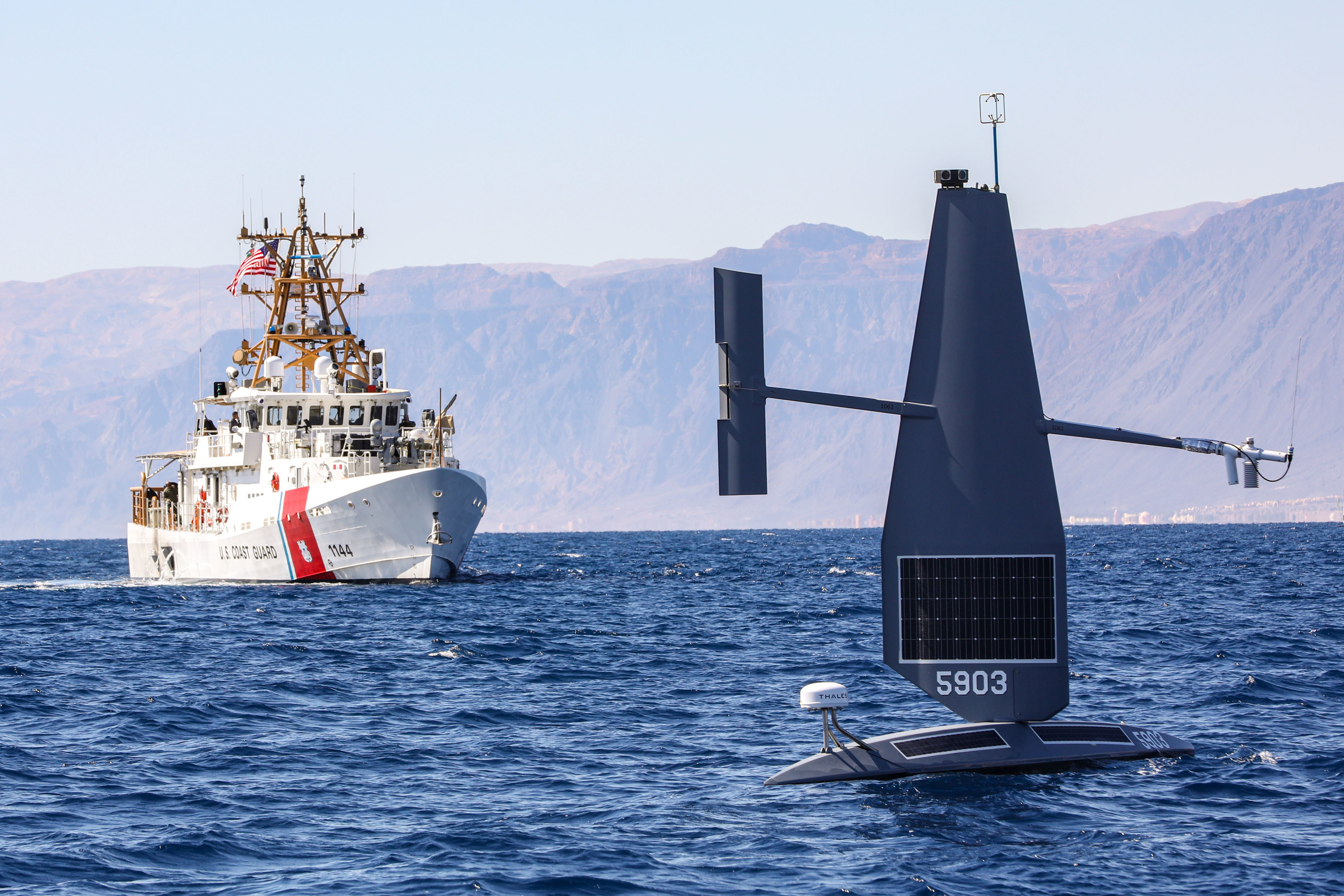
GULF OF AQABA (Feb. 13, 2022) The U.S. Coast Guard Sentinel-class cutter USCGC Glen Harris (WPC 1144) sails near a U.S sail drone explorer during the International Maritime Exercise/Cutlass Express (IMX) 2022, Feb. 13, 2022. IMX/CE 2022 is the largest multinational training event in the Middle East, involving more than 60 nations and international organizations committed to enhancing partnerships and interoperability to strengthen maritime security and stability. (U.S. Army photo by Cpl. DeAndre Dawkins)
“U.S.-based Saildrone will deploy four large unmanned surface vessels in Danish waters next month to conduct maritime surveillance missions and help protect critical undersea infrastructure…Four 10-meter Voyager USVs equipped with a suite of intelligence-gathering sensors and AI data fusion will be sent to Denmark to support the Danish military gain better maritime awareness.”
Below is an Aker Arctic news release. Frankly I didn’t know there was such a thing as an ice load monitoring system, but it sounds like something we would want on ships going into the Arctic or Antarctic. I presume it is monitoring the role rate (Tups do you have more info?)
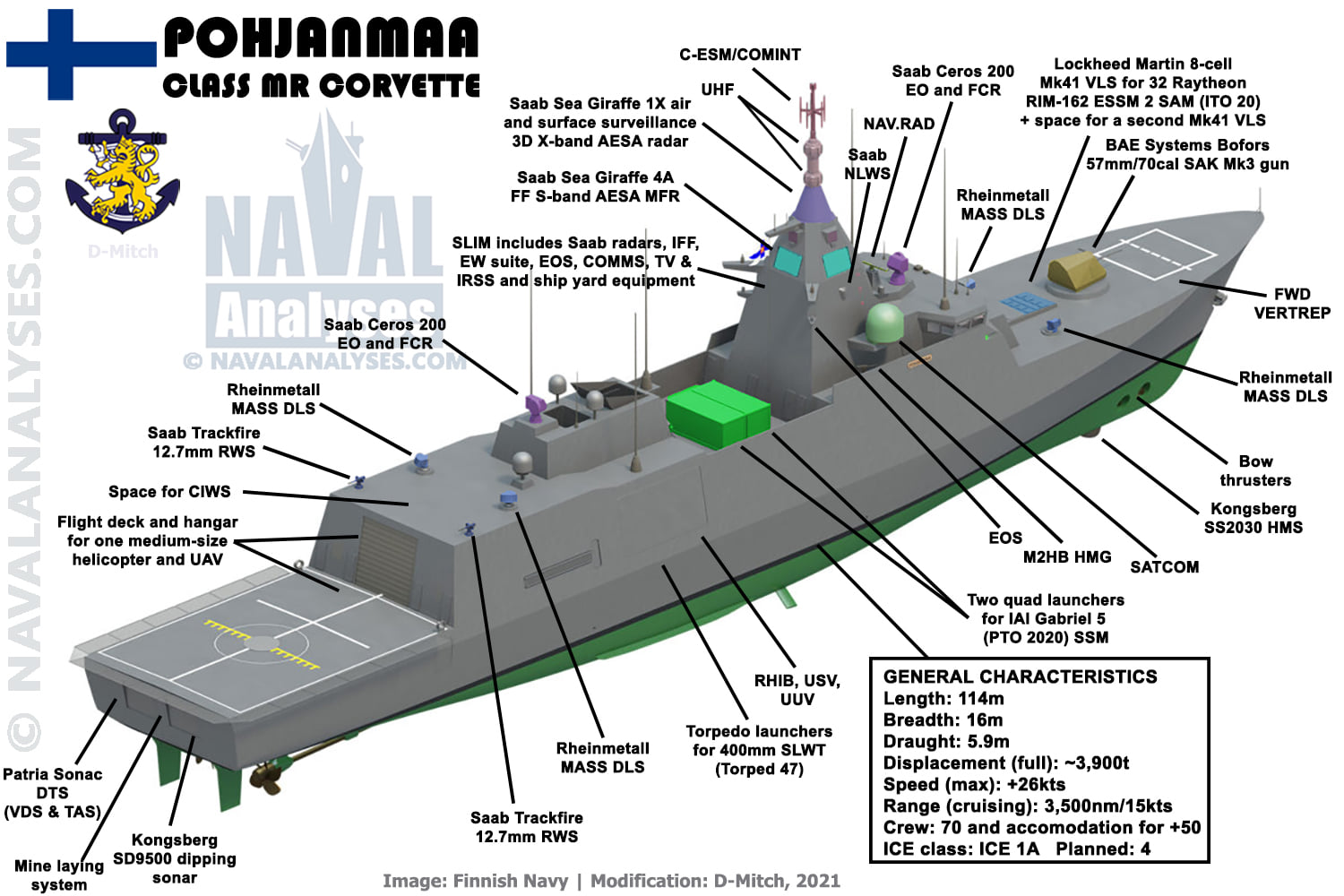
Aker Arctic has been chosen to supply its state-of-the-art ice load monitoring system to the Finnish Defence Forces Logistics Command. The contract includes the delivery of Aker Arctic’s ARC ILMS ice load monitoring, measurement and analysis system for the series of four Pohjanmaa-class multi-role corvettes currently under construction at Rauma Marine Constructions for the Finnish Navy.
The ARC ILMS is Aker Arctic’s platform for measuring loads that the ship’s structure experiences when operating in ice-cover waters, providing feedback to the operator on the safety level of the ship in ice.
“Following our recent successes being chosen to supply the ARC ILMS for the Canadian Coast Guard’s Multi-Purpose Vessels (MPV) (here–Chuck) and our collaboration with French cruise company Ponant measuring ice loads on the Le Commandant Charcot as she made her historic trans-Arctic voyage last summer, we are excited with the vote of confidence the Finnish Navy has put in us to supply our ARC ILMS to their important program” said Kari Laukia, Head of Equipment Business and Special Projects at Aker Arctic.
The contract builds on Aker Arctic’s long-term involvement with the Pohjanmaa-class. In addition to the ARC ILMS, Aker Arctic is supplying the ice-strengthened controllable pitch propellers and their pitch control mechanisms, propeller shafts, bearings and shaft seals. In addition to complete design, calculations and material supplies, Aker Arctic is also responsible for installation supervision and commissioning of the propulsion lines.
The Coast Guard Deputy Commandant for Operations has issued “United States Coast Guard Force Posture 2024.” Dated October 2024, it is reportedly the first of its kind and a new edition will be published annually. I have appended the Coast Guard News Release regarding the publication below.
“This posture statement informs all audiences about the U.S. Coast Guard’s operational priorities, initiatives, requirements and future challenges across its missions and geographic regions. It conveys how we are “Advancing Mission Excellence” in accordance with the 2022 Coast Guard Strategy and the Department of Homeland Security (DHS) Strategic Plan. This posture statement serves as a window into the breadth and depth of the Coast Guard’s commitments and how it is posturing our workforce, capabilities, and assets to deliver operational services that best serve the American people.
It is organized under four major topics rather than by the eleven statutory missions.
Operating Environment (p.3)
Guiding Principles (p.3/4)
Operating Posture (p.4-7)
Geographic Operating Areas (p.7-11)
I love it, but it does lack a clear summary of what we will do differently. I will try to interpret some of that. Below I provide a readers’ digest version with a few comments, looking first at the eleven Coast Guard missions as listed in 6 U.S. Code § 468, at select Geographic Operating Areas, and finally I will speculate on the long term implications. Given the increased use of the Coast Guard as a tool of foreign policy, I also suggest changes to the Area Commanders’ areas of responsibility (AOR) to make them fit more easily into the national command structure.
MISSIONS
Some of the missions are specifically addressed in the “Operating Posture” section, others are not. The Eleven missions are:
Non-homeland security missions:
Marine safety
Search and rescue
Aids to navigation
Living marine resources (fisheries law enforcement)
Marine environmental protection
Ice operations.
Homeland security missions:
Ports, waterways and coastal security
Drug interdiction
Migrant interdiction
Defense readiness
Other law enforcement.
I will just address them in alphabetical order:
Aids to Navigation:
Aids to Navigation is not called out under a separate heading.
“Our comprehensive approach (to the Marine Transportation System (MTS)) encompasses…Maintaining aids to navigation…” (p.4)
The Coast Guard is reinforcing actions to be “brilliant at the basics” that strengthen…aids to navigation.
The Coast Guard is in the early phase of recapitalizing an aging fleet of inland aids to navigation tenders with new Waterways Commerce Cutters, crucial to maritime commerce in our inland river system. These investments are central to maintaining service delivery in an increasingly complex MTS (Maritime Transportation System–Chuck).
Sounds like minimal changes in the near term but expect improving technology may reduce manpower requirements. Elsewhere there is indications buoy tenders may increasingly be used for non-AtoN missions. This suggests that the number of sea-going buoy tenders (WLBs) is unlikely to be significantly reduced, but their character may change–more on this below.
Defense Readiness
We are increasing attention on the Coast Guard’s defense readiness mission given the increasing threat posed by nation-state competitors. Through integration with Department of Defense efforts, refreshing defense-related plans, and preparedness exercises, we are sharpening readiness to support homeland defense requirements and force deployment commitments for major overseas contingencies. We continue to meet our commitments to North American Aerospace Defense Command (NORAD) for National Capital Region and deployable Rotary Wing Air Intercept and we are adjusting the structure of our Port Security Units (PSU) to address Reserve workforce shortages. We are also integrating PSU elements with DoD expeditionary units to increase their deployment readiness.
This is a welcome recognition of an increasingly hostile world and the emergence of non-state actors who, acting independently or as a proxy for hostile states, can impact national security.
Drug Interdiction is not called out as a separate topic. The only indication of a change is this statement under the section “Western Hemisphere,”
“We will maximize employment opportunities by conducting a mix of missions such as counter drug and combating illegal, unreported and unregulated fishing when appropriate.” (p.9)
Ice Operations:
Ice operations is not called out as a separate mission, but it is addressed in the “Polar Regions” section (p.8/9) of the Geographic Operating Areas section.
Arctic and Antarctic Ice operation will get a big boost as we go from 2 polar icebreakers to eight. In the Arctic there will be a continuing need for non-icebreaking large cutters and we can expect increased exploitation of fixed wing aircraft and particularly satellite for communications and information.
Living Marine Resources
“We will increasingly favor shore-based law enforcement teams and our patrol boat fleet, supported by maritime domain awareness sensors, to ensure we best match this mission.”
Webber class WPCs have proven capable of assuming much of the fisheries protection mission. They can go anywhere fishing vessels can go and stand up to any weather they might be fishing in. So FRCs are stepping up to missions WMECs have traditionally done. Not mentioned, but on the other hand, in Alaska and the distant Pacific there is still a role for larger ships.
Marine Environmental Protection:
There was no section devoted to Marine Environmental Protection as a specific mission. MEP was referred to briefly in the Mission execution section (p.5) Arctic (p.8)
But there was this under “Incident Management and Crisis Response” (p.6)
Management of large, complex incidents is a central Coast Guard competency. Employment of this capability enables success for the most consequential crises and events, builds trust, and supports DHS. However, the Coast Guard does not have a large contingency capacity “in garrison” for emergencies. We will continue to strengthen Coast Guard incident management capacity and proficiency to meet increasing demand, including in the Reserve workforce. The Coast Guard continues to respond to stakeholder requests for assistance for incident management while we prioritize incidents with a Coast Guard nexus and prevent overextending Coast Guard resources.
Marine Safety
There is a lot of activity here,
“The Coast Guard is reinforcing actions to be “brilliant at the basics” that strengthen marine inspection, investigation, Vessel Traffic Services, waterways management, and aids to navigation.”
Changes in the environment include autonomous vessels, offshore renewable energy installations, an emerging space launch and recovery industry, and alternative vessel fuels. All of which require determination of standards.
Migrant Interdiction
“The Coast Guard will deploy cutters and aircraft, and adaptive force packages where practical, sufficient to interdict migrant ventures, save lives, and deter maritime migration. We continue to prepare with partners to respond to a mass migration to mitigate a national crisis. We are also integrating new technology to better anticipate, detect, deter, and interdict migrant ventures.
No significant reprioritization here. This is an area where the Webber class WPCs (20 in D7 alone) have supplemented or replaced WMECs. It is an area where shore based Unmanned Air Systems and Unmanned surface vessels like saildrone could provide persistent initial detection and perhaps reduce demand for fixed wing search aircraft.
Other Law Enforcement
Not surprisingly there is no mention of this “mission” because the Coast Guard does it on an ad hoc incidental basis. The Coast Guard’s specific law enforcement missions, drug and migrant interdiction, marine environmental protection, and fisheries are addressed separately. It is a catchall for any illegal activities. So, no change.
Port, Waterways, and Coastal Security
The Coast Guard’s force posture for this mission was configured for the post 9/11 security environment and the Coast Guard is examining approaches to optimize our capabilities to meet emerging threats. For example, the proliferation of drones poses a growing risk to the MTS and we will continue to employ our counter-UxS technology in conjunction with DHS and other partners to prepare for this threat. We are also taking steps to ensure that our deployable specialized forces are configured for their role as threats and operational needs evolve.
Recognizing and preparing to counter the UxS threat is significant. I’ve already made several suggestions. I hope if we get a hard kill system, it will also improve effectiveness against other potential threats.
This was included under Defense Readiness,
“…we are adjusting the structure of our Port Security Units (PSU) to address Reserve workforce shortages. We are also integrating PSU elements with DoD expeditionary units to increase their deployment readiness.”
To me Ports, Waterways, and Coastal Security is a subset of Defense Readiness once you understand that Defense Readiness is a full time, 24/7 job that does not wait until war is declared or the Coast Guard is transferred to the Navy Department. Attacks like 9/11 or Pearl Harbor, will likely come as a surprise, there may be no time to mobilize before an attack, and our Maritime Transportation System is a likely target.
Search and Rescue:
“Search and Rescue is an enduring, no-fail mission that is deeply ingrained in the Coast Guard’s identity. As it remains a top priority, technical advances now allow us to perform the mission more effectively and with fewer resources.“
SAR success standards are not being lowered, but technology is increasingly taking the search out of search and rescue. Individual units have greater capability so fewer dedicated units may be required. Expect fewer personnel to be assigned to less demanding SAR missions that are also covered by local government first responders.
GEOGRAPHIC OPERATING AREAS
The Operational Posture goes on to discuss specific operating areas. Some of this has been addressed in the mission summaries above, so I will say no more about the Arctic, Western Hemisphere, Middle East and Europe, Caribbean, and Atlantic basin that are discussed individually in the Operational Posture, but I will talk about the Indo-Pacific, Eastern Pacific, and Antarctica.
Indo-Pacific
The Indo-Pacific is a top regional priority given its geostrategic importance, criticality to global trade, and the threat contesting a free, open, and rules-based maritime commons.
Yes, we are paying more attention to the Pacific, the Indian Ocean not so much. We expect to have six Webber class WPCs in Guam. Harriet Lane (WMEC-903) has been moved from Atlantic Area to Hawaii and it looks like a second WMEC may also be moved. Two OPCs each are expected to go to Long Beach and Kodiak. Assuming Alex Healy stays in Kodiak and the last Pacific Area 210 is decommissioned or transferred to Atlantic Area, that will give Pacific Area 13 large patrol cutters–still fewer than the 16 that were in PacArea in 2000 and only 39.4% of the 33 large cutter total I think we have now and will have for the foreseeable future.
Given the great distances involved, the fact that 84% of the US EEZ is in Pacific Area, and because we have an obligation to the Compact of Free Associated States–Federated States of Micronesia, the Republic of the Marshall Islands, and the Republic of Palau–that together have additional EEZ equal to about 50% of the entire US EEZ, it makes no sense for 60% of the large cutters to be in Atlantic Area. More than half of all large patrol cutters should be in Pacific Area.
Eastern Pacific:
“…with declining major cutter and maritime patrol aircraft availability, we will increasingly employ fast response cutters, ocean-going buoy tenders, and adaptive force packages supported by expeditionary logistics.” I am not surprised; this is something that was begun when Admiral Fagan was Pacific Area Commander.
“…we remain committed to supporting the Mexican Navy as they expand their Captain of the Port authorities through increased information sharing, joint training and exercises, and capacity building engagements. This expanded partnership will enhance maritime governance in the Western Hemisphere and contribute to the fight against illicit trafficking of fentanyl and precursor chemicals through Mexican ports into the U.S.”
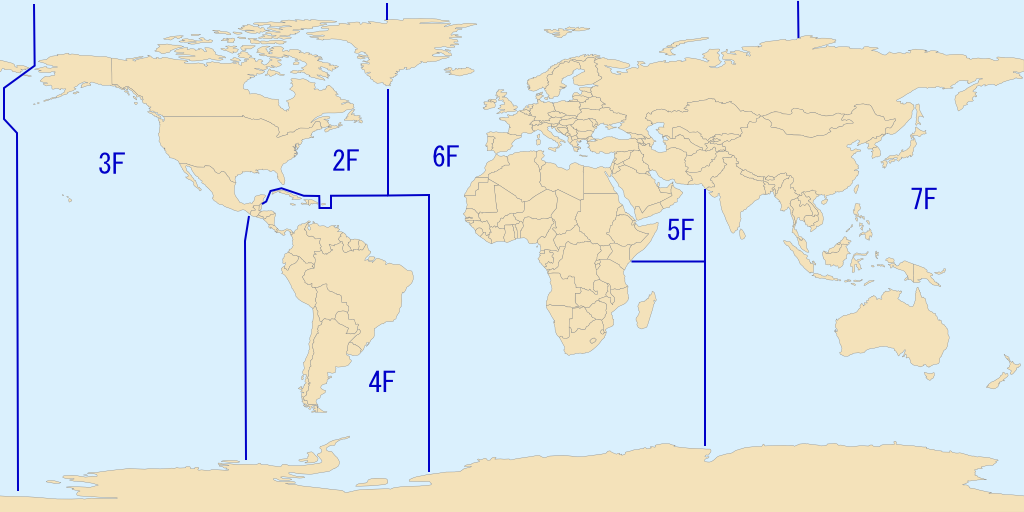
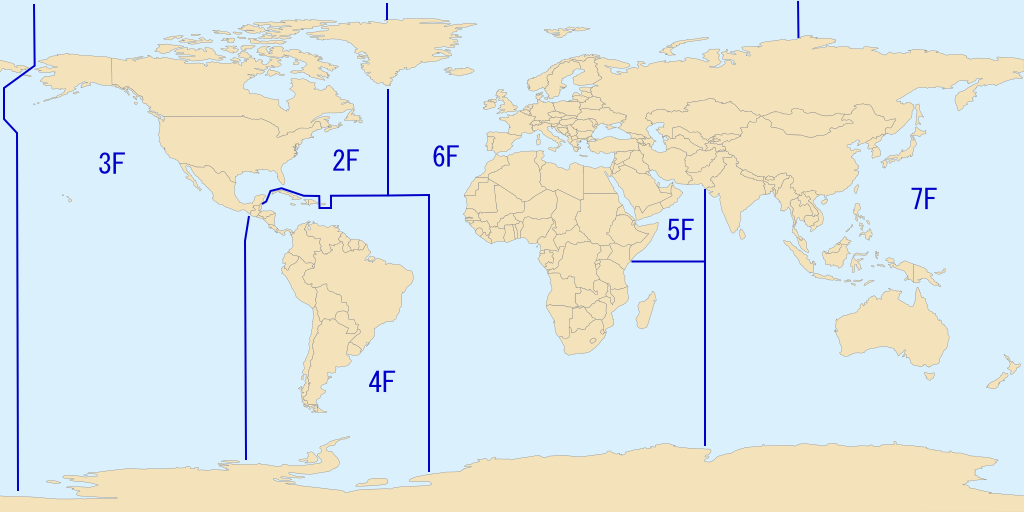
US navy fleets areas of responsibility. Source Wikipedia.
The only mitigating rationale I see for not transferring most of the large cutters to Pacific Area is that the Eastern Pacific drug transit zone is actually closer to Atlantic Area ports than to Pacific Area ports. This is why all of South America is under 4th Fleet, which is an Atlantic Fleet command. Probably an argument should be made for realigning the Coast Guard Area geographic descriptions to match those of the Atlantic and Pacific Fleets. A change of name to Eastern and Western Area might be appropriate and in fact a more accurate description.
Atlantic area includes not only the Atlantic coast but also the great lakes, inland areas, the Gulf of Mexico, Caribbean, and parts of the Arctic and Southern Oceans. Pacific Area also includes inland areas, the Indian Ocean (part of which is under Atlantic Fleet), and parts of the Arctic and Southern Oceans.
A realignment along Fleet dividing lines would also mean the dividing lines would more closely correspond to COCOM areas of responsibility and limit the number of cases where COCOMs would need to deal with both Coast Guard Areas to NORTHCOM. Currently there is also overlap in SOUTHCOM, AFRICOM, and CENTCOM. All three of those COCOMs would only need to deal with the Eastern (Atlantic) Area. That seems to be what is happening with AFRICOM and CENTCOM now anyway. PATFORSWA WPCs, Atlantic Area assets, operate routinely in the Indian Ocean, part of the PACAREA AOR.
Unified Combatant Commander’s Areas of Responsibility.
As Pacific Area assumes more responsibility in the Western Pacific and potentially the Indian Ocean passing off responsibility for all Coast Guard operations in 4th Fleet’s Area of Operations to Atlantic Area might make sense.
Antarctic:
The U.S. priority for Antarctica remains maintaining “a continent reserved for peace and science in accordance with the provisions of the Antarctic Treaty of 1959.”
No real change expected other than more and better icebreakers, but not everyone thinks like the US.
We should have the agility to react to a change from the present “continent reserved for peace and science.” We really have no reason for confidence that Antarctica will not become a zone of Conflict. Fortunately, actions to increase capabilities in the Arctic may also serve us well in Antarctica.
Implications for the Future
Cutter Design:
Patrol Cutters: Moving from “Patrol and Interdict” to “Target and Interdict” suggests that cruise speed endurance may become less important, and that higher max speed and an economical loiter speed may become more important. Greater emphasis on Defense Readiness would also suggest the desirability of greater speed. This suggest that we may want to build fewer than the currently planned 25 OPCs and shift investment to a new design based on a different set of priorities that we can build in greater number; ships with greater speed and increased modularity to accommodate an uncertain future.
Buoy Tenders: Improved aids to navigation may mean tenders will spend less time on routine AtoN maintenance. Still, they will need to be geographically distributed to respond to critical outages. It seems these ships will become more multi-mission by design. They should continue to be able to operate in ice. Their increased use for non-AtoN missions suggest that they may need overflow berthing and more fuel and stores capacity when supporting WPC deployments and to make them more effective in law enforcement roles–more speed, a flight deck and hangar for UAS and a deck gun such as the Mk38 Mod4.
Deployable Teams
Sounds like we will be getting more deployable Law Enforcement Detachments given the proliferation of capacity building objectives. Increased specialization and a desire for continuity in this area may someday result in a new rating.
Thanks to Paul for bringing the video to my attention.
Oct. 25, 2024
Coast Guard unveils first Operational Posture Statement
By Zach Shapiro, MyCG Writer
The Coast Guard just released its first Operational Posture Statement, which outlines the service’s operational priorities, including its plans to adapt to personnel and resource challenges. Vice Adm. Peter W. Gautier, Deputy Commandant for Operations (DCO), unveiled the document Friday during an event at the Center for Strategic and International Studies (CSIS) in Washington, D.C.
Think of the new annual Operational Posture Statement as a tactical annual document that supports the long-term Coast Guard Strategy by providing more specificity.
To improve operational efficiency and effectiveness, for example, the Coast Guard will increasingly use intelligence and data to shift its approach from “patrol and interdict” to “target and interdict.”
And to improve readiness, the Coast Guard will focus on three key elements: the workforce, capabilities, and assets. The Operational Posture recognizes the need to meet increasing demand while addressing workforce and resource shortages. The service will also continue to recapitalize cutters, boats, aircraft, and infrastructure.
The Operational Posture “is our effort to communicate with our stakeholders and be transparent with the American people on how we will confront all of these challenges, this increasing mission demand, and provide the kind of services that Americans deserve,” Gautier said.
Six guiding principles underpin the Operational Posture Statement:
Balance current operations with future readiness
Strengthen maritime governance
Counter strategic competitors while fulfilling our primary responsibility to secure and defend the homeland
Adjust force structure and posture to maximize operational effectiveness while maintaining a high level of support for our people, platforms, and infrastructure
Employ resources holistically to meet growing demands
Leverage intelligence, information, and improved maritime domain awareness to shift from a “patrol and interdict” to “target and interdict” model
These priorities reflect the increasing national and global demands for Coast Guard services. As 90 percent of global trade moves by sea, maritime security is the bedrock of national security and economic prosperity. In the face of rising global maritime tensions, the Coast Guard has a unique and critical role as a law enforcement entity and military agency.
Amidst this evolving environment, Gautier emphasized, the Coast Guard remains committed to its Search and Rescue (SAR) mission. That mission is “a sacred trust with the American people and a no-fail mission. It is our primary lifesaving mission. It defines us as a humanitarian service,” he said.
Moving forward, the Coast Guard intends to release a new Operational Posture Statement annually to outline the ways in which the service is adapting to new challenges and missions to best serve the American people.
To read the Operational Posture Statement in full, please click here.
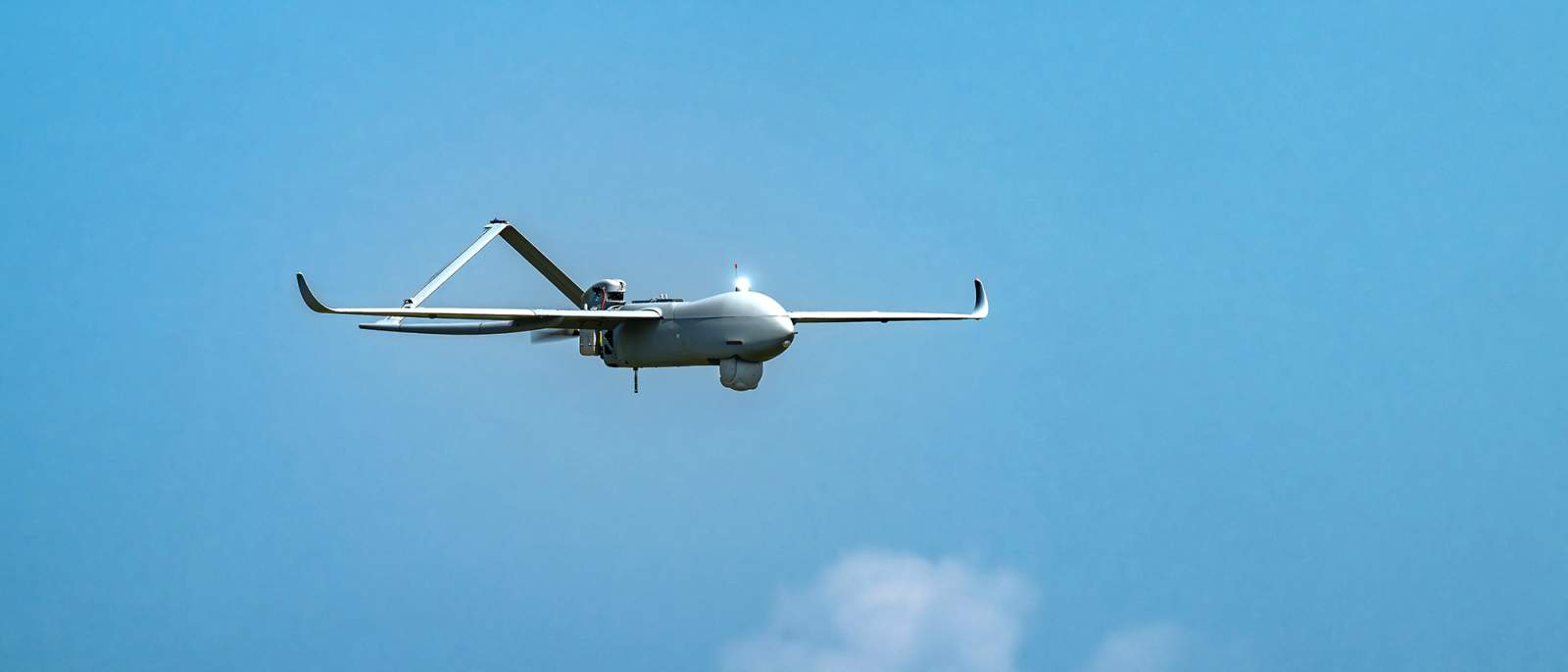
Below are two news releases reporting contracts for Contractor-Owned/Contractor-Operated Aerosonde Uncrewed Air System operation support, first on the Littoral Combat Ships bound for the 5th Fleet (Central Command) and second for an unidentified ship deploying to 6th Fleet (European Command).
Textron Systems Awarded Uncrewed Aircraft System (UAS) Contracts For Three Additional U.S. Navy Littoral Combat Ships (LCSs)
Hunt Valley, Md., November 18, 2024 – Textron Systems Corporation, a Textron Inc. (NYSE:TXT) company, announced today that it has been awarded a task order valued at up to $47 million by the U.S. Navy’s Naval Air Systems Command (NAVAIR) to provide COCO UAS services to three Independence Class Littoral Combat Ships (LCS) deploying to 5th Fleet. This award follows a 2023 contract to provide UAS support to LCSs, bringing the total number of U.S. Navy ships supported by the Aerosonde® UAS to 10.
Textron Systems will deploy its Aerosonde UAS and skilled personnel to provide mission overwatch and extended range intelligence, surveillance and reconnaissance (ISR) services with enhanced mission payloads as seen aboard the Expeditionary Sea Base (ESB)-4 and ESB-5, as well as two DDG-class ships and three LCSs. In December 2023, the Aerosonde UAS took its inaugural operational flight from its first LCS, the LCS-28 USS Savannah.
“Textron Systems has delivered COCO services with our Aerosonde UAS for over a decade, demonstrating the flexibility and value a model like this brings to the services,” said David Phillips, Senior Vice President Air, Land and Sea Systems. “Because we are managing the full life cycle of the system, including technology integration, human factors, spares and repairs, employing the Aerosonde UAS enables the Navy customer to focus solely on their mission. We extend the customer’s capabilities across the mission packages of each ship reliably and quickly.”
The Aerosonde UAS offers multi-mission capability built upon a family of systems which have amassed over 700,000 flight hours over more than 10 years. The system is equipped for multiple payload configurations with both vertical takeoff and landing (VTOL) and fixed-wing options.
NAVAIR Public Release SPR-2024-0803. Distribution Statement A – “Approved for public release; distribution is unlimited”
Textron Systems Awarded Uncrewed Aircraft System (UAS) Contract For Additional U.S. Navy Ship
Hunt Valley, Md., November 20, 2024 – Textron Systems Corporation, a Textron Inc. (NYSE:TXT) company, announced today that it has been awarded a task order valued at up to $17 million by the U.S. Navy’s Naval Air Systems Command (NAVAIR) to provide COCO UAS services to a U.S. Navy ship deploying to 6th Fleet. This award brings the total number of U.S. Navy ships supported by the Aerosonde® UAS to 11.
Textron Systems will deploy its Aerosonde UAS and skilled personnel to provide mission overwatch and extended range intelligence, surveillance and reconnaissance (ISR) services with enhanced mission payloads. In September, Textron Systems was contracted to provide support to three additional Littoral Combat Ships (LCS).
“Textron Systems is committed to enhancing the Navy’s mission sets. The continued use of ISR support demonstrates the benefit of the COCO model and the services our Aerosonde UAS provides to the sailor,” said David Phillips, Senior Vice President Air, Land and Sea Systems. “The flexibility in a COCO mission allows the Navy to extend their capabilities while we as the contractor manage the full life cycle of the system, ultimately resulting in greater efficiency and reliability.”
The Aerosonde UAS offers multi-mission capability built upon a family of systems which have amassed over 700,000 flight hours over more than 10 years. The system is equipped for multiple payload configurations with both vertical takeoff and landing (VTOL) and fixed-wing options.
NAVAIR Public Release SPR-2024-0801. Distribution Statement A – “Approved for public release; distribution is unlimited”
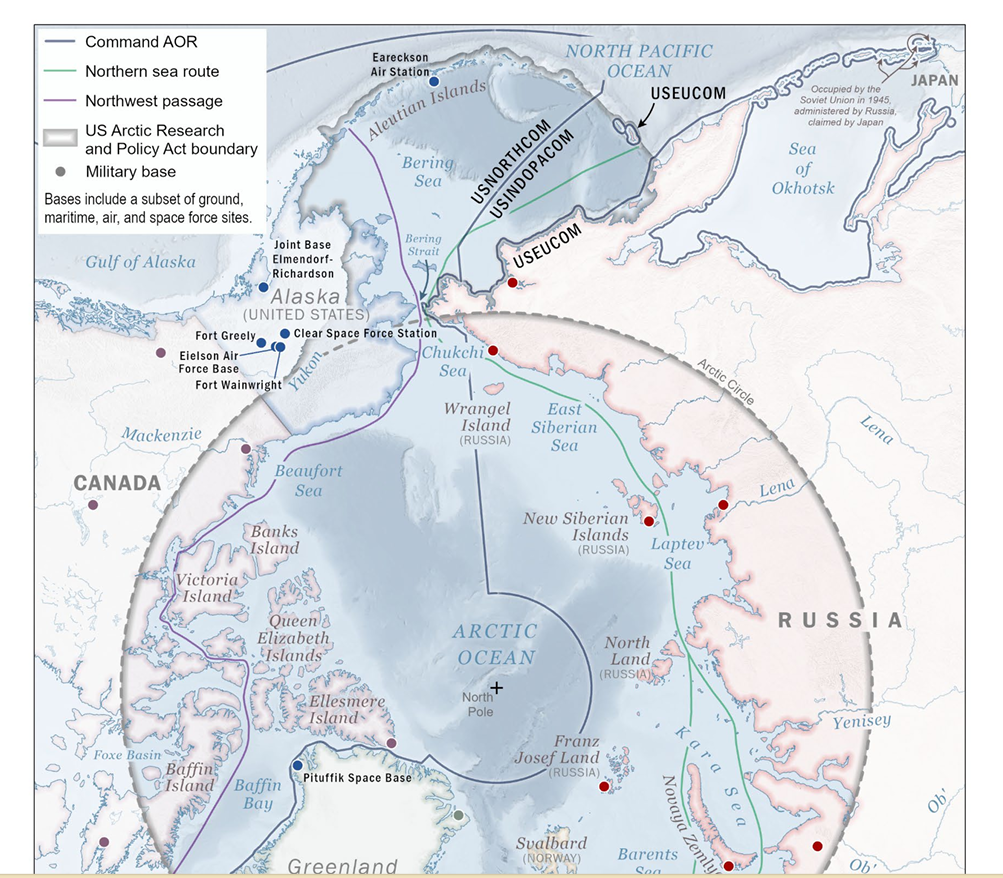
Screen grab from page 2 of the DOD Arctic Strategy, 2024
Here is a link to the new DOD Arctic Strategy here. I found it disappointing. There isn’t much strategy here. I would sum it up as–we are going to keep doing what we are doing, but we are going to do it better. (See critique below.)
“This strategy will strengthen the ability of the United States to build integrated deterrence and effectively manage risk to U.S. interests in the Arctic region by enhancing our domain awareness and Arctic capabilities; engaging with Allies, partners, and key stakeholders; and exercising tailored presence.”
About the US Coast Guard:
The US Coast Guard or USCG was mentioned in three places, once in a caption of a picture of USCGC Healy and these two paragraphs.
DoD will partner with the Department of Homeland Security (DHS), including through the U.S. Coast Guard (USCG), which plays a vital role in maintaining U.S. presence in the Arctic region and supporting domain awareness. The USCG is responsible for operating and maintaining the United States’ icebreaking capability, and DoD will continue to support the USCG’s long-term acquisition of at least eight polar icebreakers that will provide needed icebreaking capability for both military and civilian purposes, including PR/SAR. While disaster response is not a force sizing or shaping requirement, DoD remains ready to support DHS and the Federal Emergency Management Agency in the event of disaster, terrorist attack, or other mass-casualty incident in the Arctic when directed by the President or when requested by a lead Federal department or agency and approved by the Secretary of Defense.
Service-specific, Joint, Interagency, and Combined Exercises. Security and stability in the Arctic depend, in part, on the Joint Force’s ability to respond rapidly and effectively to threats in the region. Exercises increase interoperability with Allies and partners, validate plans, train our ability to rapidly deploy to all parts of the Arctic region, and provide an opportunity to test equipment in Arctic conditions. As such, the Joint Force will continue to exercise frequently in the Arctic through Service specific training, joint exercises —to include with USCG— and
combined exercises with our Allies and partners. DoD will
ensure CCMDs with Arctic equities work toward global integration through joint exercises and ensure key exercise lessons inform capability requirements and strategic planning.
That’s it.
About Icebreakers: Icebreakers are mentioned twice, it the paragraph above and here,
The PRC seeks to bolster its operational expertise in the Arctic, where its presence, while limited, is increasing. The PRC operates three icebreakers—the Xue Long, Xue Long 2, and Zhong Shan Da Xue Ji Di—which enable the PRC’s dual civil-military research efforts in the Arctic. Over the course of the PRC’s 13 Arctic research expeditions to date, the vessels have tested unmanned underwater vehicles and polar-capable fixed-wing aircraft, among other activities. People’s Liberation Army Navy (PLAN) vessels have also demonstrated the capability and intent to operate in and around the Arctic region through exercises alongside the Russian Navy over the past several years.
Critique:
“DoD will reach this end state through a monitor-and-respond approach.”
In other words, we will be reactive rather than proactive.
The threat to Europe in the Polar regions is just part of the long running NATO defense problem. No real change there, except the formal extension of NATO into Sweden and Finland.
The Air Threat over the Pole to North America is looked after by NORAD. Apparently, NORAD does not look after Greenland, but that does not seem to be a central problem.
Ground operations in the Arctic are always going to be difficult. There may be small unit operations but no need to worry about an invasion of North America coming over the pole. NORTHCOM is exercising both land and air assets that would be needed to deal with realistic threats.
The North Slope oil fields and the associated pipeline are probably a target if we become engaged in a long-term conflict that involves combat in or over the arctic. The oil fields are not mentioned in the strategy,
What has changed?
The opening of the Arctic Ocean to maritime commerce has made it a possible avenue for logistics between Russia and China with the potential for militarily valuable shipments moving both ways between the Russian Arctic coast on one end and the Russian Pacific Coast, North Korea, or China on the other. The weakness of Russian transcontinental land transportation systems makes the Northern Sea Route particularly important.
The door to be shut or left open is the Bering Strait.
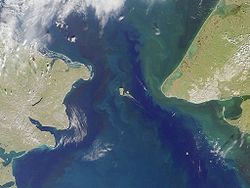
Bering Strait. 44 Nautical miles (82km) wide, with the Diomede Islands in the center.
The “strategy” mentions the Bering Straits only as a choke point,
The Arctic includes multiple strategically significant maritime chokepoints. Reduction in sea ice
due to climate change means chokepoints such as the Bering Strait between Alaska and Russia and the Barents Sea north of Norway, are becoming more navigable and more economically and militarily significant.
We would certainly want to deny use of the Strait by our enemies and ensure that we and our allies have the option to transit through the Strait.
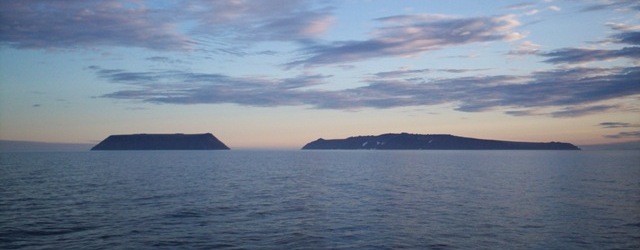
The planned deep-water port in Nome (currently on hold) will be essential to forces that might be used to control access to the Bering Strait. We would also want to make sure St Lawrence Island and Little Diomede remain in US hands. The US might also want to seize Big Diomede. None of these strategic locations are mentioned in the plan.
Diomede Islands: Little Diomede Island or Kruzenstern Island (left) and Big Diomede Island or Ratmanov Island in the Bering Sea. Photo is from the north. Photo by Dave Cohoe.
But who is in charge?
First look at the map at the head of this post. They have divided the Arctic so that operations there are under three different Unified Combatant Commands, USEUCOM, USINDOPACOM, and USNORTHCOM. In other words, no one below the President is in charge over the whole area.
These are the Unified Combatant Commander’s Areas of Responsibility. What is not made clear in this graphic is that all of Russia including the larger Asian part is under USEUCOM.
Perhaps most critically, the Pacific interface with the Arctic is under all three COCOMs.
USEUCOM is responsible for the Russian land areas in spite of the fact that the Bering Strait is 4521 statute miles from the COCOM’s headquarters in Stuttgart, Germany, and that is the shorter distance West from Stuttgart across the Atlantic and over the US, rather than over Russia. –This has got to be wrong.
USNORTHCOM has the Bering Strait and the Eastern half of the Bering Sea but normally they have no significant naval force. Their primary responsibility is the air defense of the US and Canada.
USINDOPACOM, which has the naval assets in the Pacific that might be used to attack Russian assets in Asia has responsibility for only the Western half of the Bering Sea below the Bering Strait.
This division of responsibility, placing Russian Asia under USEUCOM, also means that if the US should be at war with both China and Russia, then at least officially, conducting the war in the Pacific would be under two or perhaps three different COCOMs. I doubt this would actually work this way.
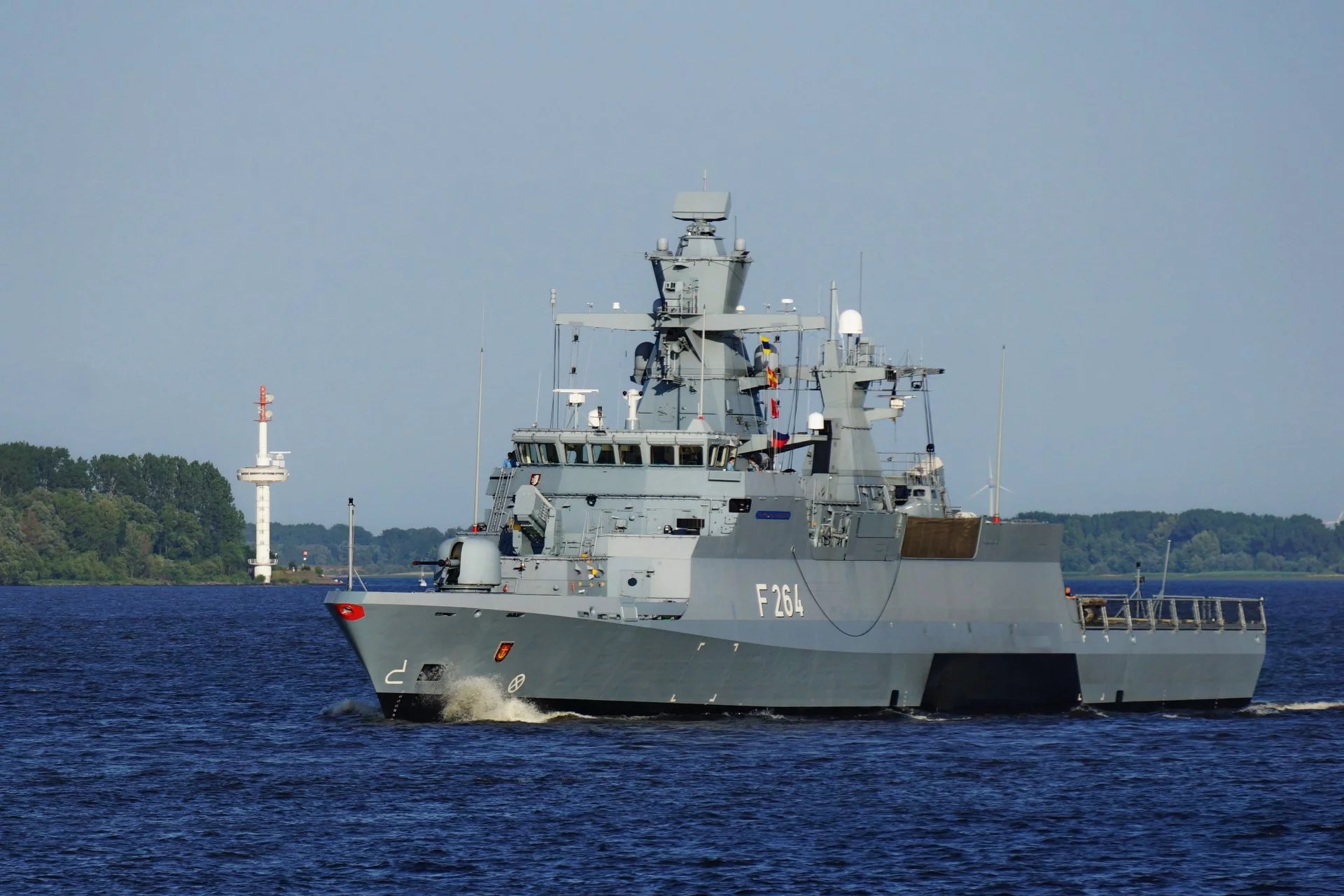
According to information published Die Zeit on October 17, 2024, the German Navy corvette Ludwigshafen am Rhein, deployed as part of the United Nations Interim Force in Lebanon (UNIFIL), successfully intercepted and neutralized an approaching drone near the Lebanese coast.
Unfortunately, the report does not specify which defensive system brought down the drone, but the corvette is relatively small, only a little larger than a WMEC270, and compared to the American DDGs that have been operating against kamikaze drones in the Red Sea, their options were limited. It has two 21 cell RAM (rolling airframe missile) launcher, a 76 mm gun similar to that found on the WMEC270s, two 27mm guns, and an Electronic Countermeasures System.
Most US successes against drones have involved air to air intercepts or the use of very expensive standard missiles, with some attributed to medium range ESSMs (Evolved Sea Sparrow Missiles). In one case a drone was brought down by a Phalanx CIWS (Close in Weapon System) like that mounted on the National Security Cutters, but that was a last ditch effort not a weapon of choice.
The Italian Navy, showing great confidence in their 76mm Strales system, shot down a kamikaze drone after forgoing an opportunity to engage it with surface to air missiles.
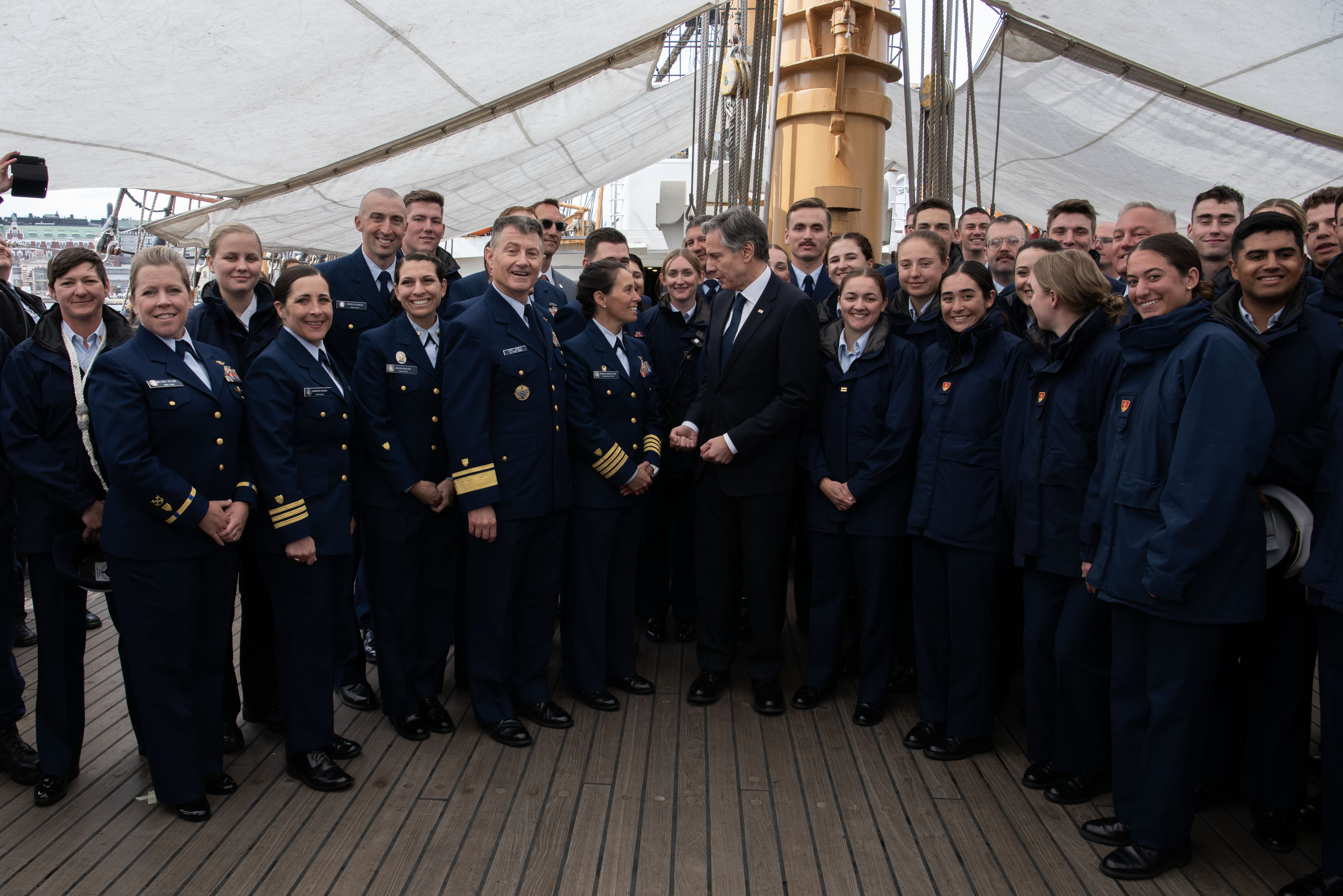
U.S. Secretary of State Antony Blinken, middle, takes a photo with the USCGC Eagle’s crew during a reception aboard the cutter, June 2, 2023, in Helsinki, Finland. Eagle is a tall ship used as a training platform for future Coast Guard Academy officers as well as a vessel utilized for establishing and maintaining domestic and international relationships. (U.S. Coast Guard photo by Petty Officer 3rd Class Carmen Caver)
Guest author Peter Ong provides a look at the continuing relationship between the Coast Guard and new NATO members Sweden and Finland.
NATO’s European members and when they joined the NATO alliance. Source: Wikipedia
I sent a media inquiry to the USCG’s Headquarters, Public Affairs Office, Washington D.C., asking how Sweden and Finland becoming NATO’s newest members might influence the U.S. Coast Guard in terms of icebreaking, cutter designs, exercises, training, enforcement, and maritime security.
The USCG replied, “From a regional perspective, this will increase cooperation and improve interoperability. Information sharing, exercises, and operations will be much easier to coordinate with all the Nordics now in NATO.”
U.S. Coast Guard Petty Officer 1st Class Arthur Flaherty, a boatswain’s mate assigned to the USCGC Hamilton (WMSL 753), prepares to transfer Hamilton crewmembers onto the Swedish Coast Guard vessel Amfitrite in the Baltic Sea, Oct. 31, 2022. Hamilton was on deployment in the U.S. Naval Forces Europe area of operations. (U.S. Coast Guard photo by Petty Officer 3rd Class Alejandro Rivera)
The United States Coast Guard has a history of visiting and working with partner Baltic nations to improve relationships, training, interoperability, communications, intelligence, and coordination. Even before they entered NATO the US Coast Guard had a long-standing relationship with Sweden and Finland through the Arctic Coast Guard Forum.
U.S. Coast Guard Lt. Cmdr. Tanya Kuprak, engineering officer aboard USCGC Hamilton (WMSL 753), gives a tour of the engine room to Swedish Coast Guard members while underway in the Baltic Sea, Oct. 30, 2022. Hamilton was deployed with U.S. Naval Forces Europe and U.S. Sixth Fleet. (U.S. Coast Guard photo by Petty Officer 3rd Class Alejandro Rivera)
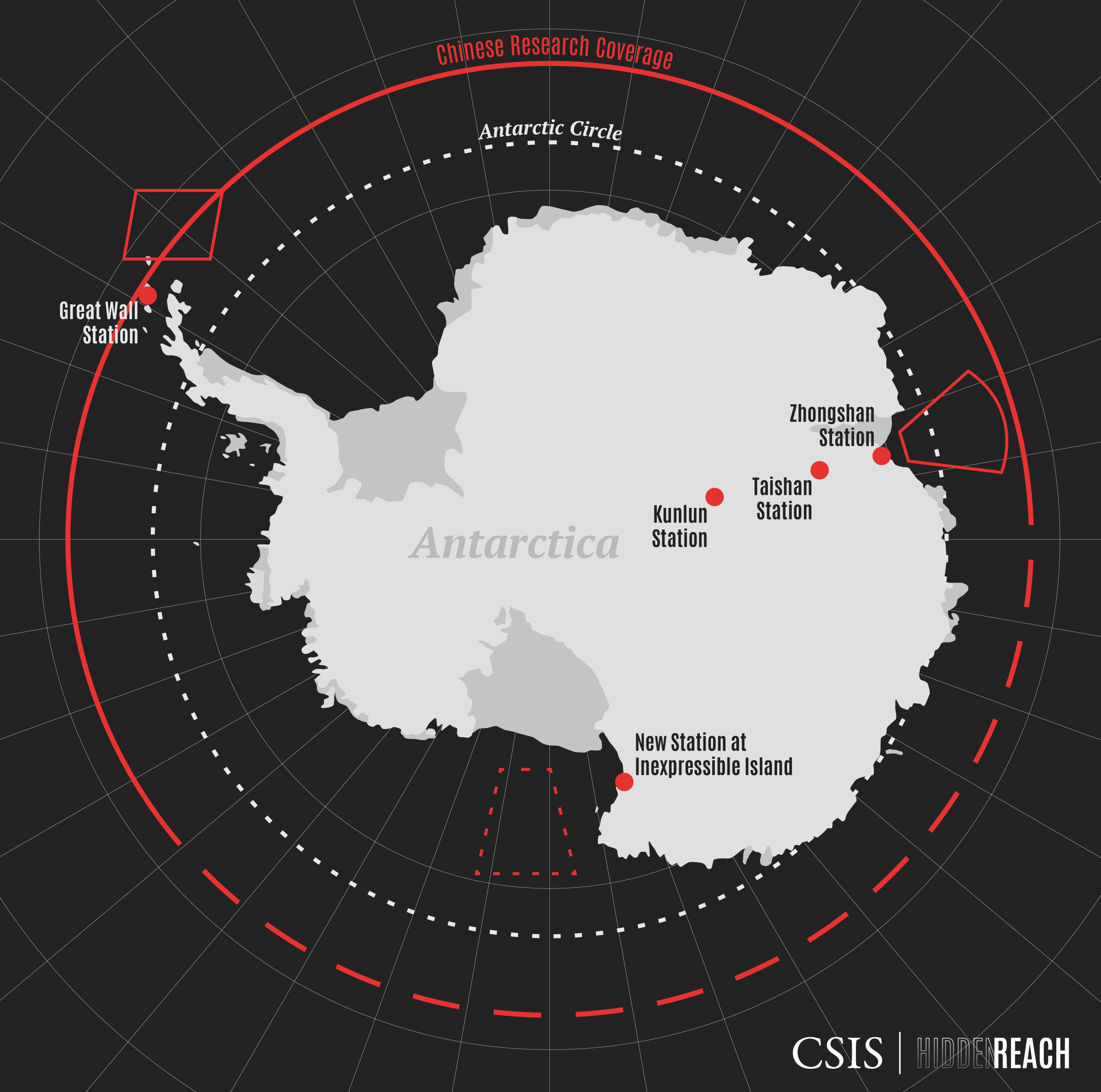
He feels, as I do, that we are headed for conflict over claims to Antarctica. It is after all, the last land area on earth where no nation exercises sovereignty.
China’s presence in the Antarctic is growing rapidly and, as they have shown in the South China Sea, they may choose not to accept the decisions of international courts.
Adapted from a 2021 Chinese environmental evaluation report submitted to the Secretariat of the Antarctic Treaty. Source CSIS
What this boils down to is that, after courts make their decisions, we may have to fight in Antarctic to make those decisions stick.
We don’t seem to have given much thought to the possibility of combat in and around Antarctica, but I believe it is a real possibility, perhaps not soon, but beginning in 2048 when the Antarctic Treaty comes up for renegotiation. 24 years may seem to be a long way off, but we are building now the assets that will be available in 2048.
By then the rapidly growing Chinese presence in Antarctic, as well as their Navy are likely to be in a very strong position. We are already seeing the Chinese apparently establishing dual use (civilian and military) facilities in Antarctica.
In the interim, we can expect China and perhaps others to try to skirt the rules to strengthen their presence. We need to monitor and challenge any gray zone operations.
Command Structure:
These are the Unified Combatant Commander’s Areas of Responsibility.
There is an obvious reason that Antarctica does not seem to be on anyone’s radar. Looking at who is potentially responsible for operations in the Antarctic, it is a hodgepodge. Various parts of the Continent might fall under SOUTHCOM, AFRICOM, and INDO-PACOM.
US Navy Fleet Organization
3rd Fleet, 4th Fleet, 6th Fleet, and 7th Fleet all have a nominal slice, but none of these commands consider the area their primary concern.
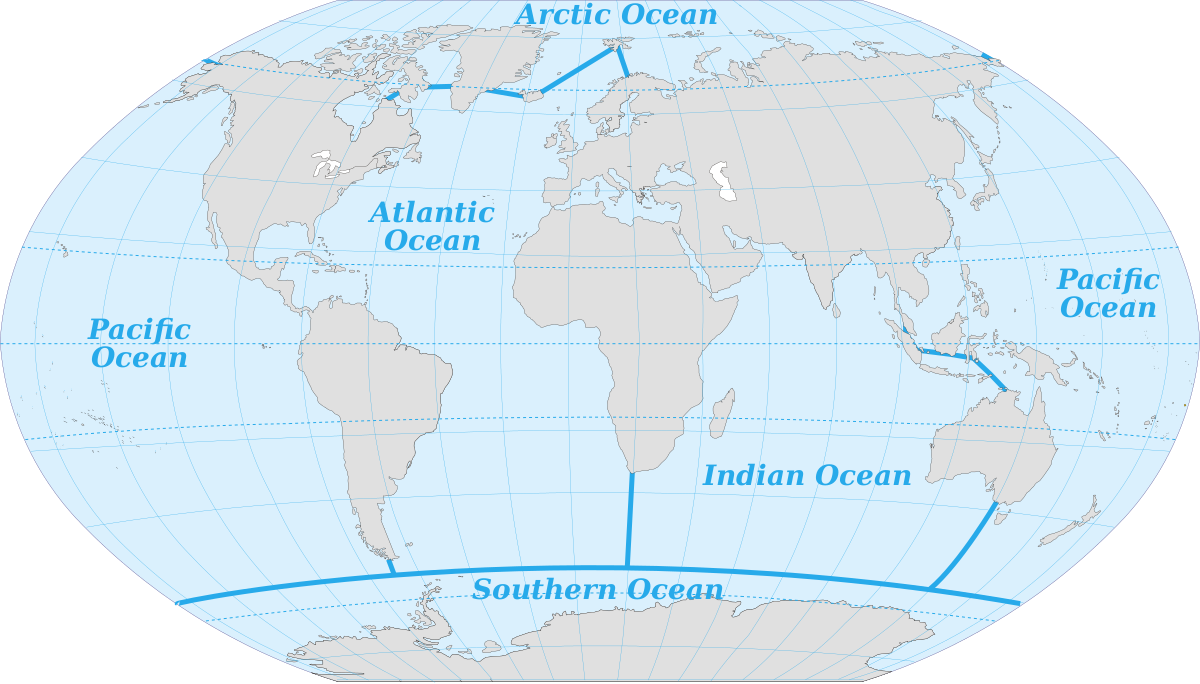
World map of oceans : English version. By Pinpin via Wikipedia.
There is no single national command authority that covers all of Antartica or the Southern Ocean. Really no one is in responsible for the area below 60 degrees South.
It seems likely that in the near term, Southern Ocean fisheries will require some protection. The only nation I have heard of doing fisheries protection in the Southern Ocean outside their own EEZ is New Zealand.
The Coast Guard currently operates the only US polar icebreakers. At some point the Coast Guard may become involved in fisheries protection in the Southern Ocean. If there is conflict in Antarctica, Coast Guard assets will likely be needed to gain access.
Two years ago, I did a post with a similar title from the same source. Somehow, I missed the 2023 edition. As I said in the earlier post, I don’t know Phoenix_jz, but the data appears to be credible, and it looks like readers are checking his figures.
It is very difficult to read the tonnages at the bottom of the graph unless you are using a computer and click on the graph to see it in a larger size.
The creator’s notes and some additional comments are below.
Hello all!
Well, 2024 is upon us, and as such so is the third edition of my top ten navy list. For those unfamiliar, here are links to 2022 and 2023, with a general explainer of the whole concept in the 2022 version.
The long and short of it is that this graph reflects a personal tracker I keep of almost every large and moderately sized navy, and calculates the aggregate displacement of these navies. It’s not a perfect way to display the size of navies – far from it in fact – but it is at least more representative than counting numbers of hulls alone, in my opinion.
To break down what each of these categories mean;
Surface Warships is an aggregate of all above-water warships and major aviation and amphibious assault platforms. This category includes CVNs, CVs, CVLs, LHDs, LHAs, LPDs, CGs, DDGs, FFGs, corvettes, OPVs, CPVs, lighter patrol craft, and MCM vessels.
Submarines is what it says on the tin – SSBNs, SSGNs, SSNs, SSKs, and for select nations where applicable (and where information is available), special purpose submarines. Please note dedicated training submarines are counted separately.
AORs includes all major fleet replenishment vessels (coastal vessels do not count, however).
Other Auxiliaries is a very wide net that essentially captures everything else. Special mission ships, support vessels, minor amphibious assault vessels (LSDs, LSTs, LCAC’s, LCM’s, LCU’s), training vessels, tugs, coastal support vessels, hydrography ships – all essential parts of navies, but generally often paid less attention to as they’re not as flashy as the warships proper.
Interesting trends in data that I thought I would share for various navies, and thoughts and observations otherwise;
The USN is, unsurprisingly, still top dog by a huge margin. In spite a net decommissioning of five ships this year, the USN has grown overall by about 32,000 tons – four ‘cruisers’, two SSNs, four LCS, and five patrol craft decommissioned against the introduction of three destroyers, an SSN, five LCS, and a replenishment ship. It is worth noting that 2023 is the first year since 2010 that the USN has commissioned three destroyers in a year, though a repeat performance in the next couple years is unlikely – these ships were launched in 2020 and 2021, and only one destroyer per year was launched in 2022 and 2023.
No one will be surprised to hear that the PLAN has grown for the nth consecutive year, adding the final Type 055 batch I and the remaining Type 054A Batch V, for almost 50,000 tons of new surface combatants. Much of the remaining increase in displacement for this year (which totaled nearly 90,000 tons) reflected a steady pace of modernization in mine warfare, landing forces, and logistical support/other auxiliaries. As with last year, the number of minor patrol craft continue to plummet as the PLAN continues to divest many of its obsolescent brown-water combatants, or relegates them to training duties.
Moving on to ongoing construction, progress on the new destroyer batches continues at pace. At least two Type 055 Batch II appear to be under construction, and the overall number of Type 052D Batch IV appears to be at least ten. The first ship actually launched at the very end of 2022 (at Jiangnan), and two further have been launched by the same yard as well as three at Dalian. Two more remain under construction at each yard. The first of these ships to be launched appears to be on trials and will likely commission this coming year. The Type 054A program of the navy appears to have finally wrapped up (construction of the hull for the China Coast Guard continues), and the Type 054B program has continued at pace if not scale – two ships were launched this year, but modules of further units have been scarce. Rounding things out for major surface vessels, a new Type 075 LHD was launched this past December. Conspicuously absent has been sightings of any modules for new carriers. Considering Fujian (Type 003) began construction at some point from 2015 to 2017, one has to wonder if we will see China launch another carrier before the end of the decade.
Perhaps most consequential of all, however, has been the completion of new production facilities at Bohai and a resumption of Type 093 SSN launches. The first of the new Type 093B launched in 2022, and has been followed up by two more launches this year (possibly up to three). A sustained pace of two submarines a year, or even just three submarines every two years, would quickly add up could see anywhere from nine to eleven new SSNs launched by the end of 2027, and in service by early 2030s. Only time will tell what the actual drumbeat of production will be.
Russia’s VMF woes in the Black Sea have continued unabated, except less at sea and largely fueled by the Franco-British SCALP cruise missile. The most dramatic loss by far was the destruction of the Project 636.3 ‘Improved’ Kilo Rostov-on-Don in drydock at Sevastopol, but similar attacks claimed the destruction or constructive loss of a Karakurt-class corvette (under construction, not in service) and two Ropucha-class LSTs. The infamous TB-2 made a brief return to destroy a Serna-class LCU, and two other LCU’s may have finally become the first victims of Kamikaze USVs this past November, for a total of 11,407 tonnes lost.
In regards to the more regular cycle of commissioning and decommissioning, one frigate, one MCM vessel, and three corvettes were brought into service, as well as a new SSGN, SSBN, and SSK each. Against this a corvette, SSGN, SSBN, and SSK were decommissioned. Overall, in spite of losses the VMF managed a net gain of 6,324 tonnes of surface warships and submarines. Anyone who checks against my figures from last year will note that the increase in the VMF’s overall tonnage this year is far more substantial, due to the auxiliary category. Though some of this was from new vessels, this was mostly down to a badly needed overhaul and reorganization of that part of my tracker, particularly for the tug fleet. Did you know the Russian navy tug fleet displaces more than either the Argentine or Canadian navies? Now you do! Seriously – it would be the 20th largest navy in the world by itself.
As a final note on the VMF – it is worth remembering that ships commissioned in the Russian navy are not always actually in service, as ships can often languish in near-terminal refits or simply be left inactive without a formal decommissioning. Almost half the remaining Projekt 877 Kilo’s, for example, appear to be inactive at this point (5 of 10).
(In comments the author noted the following, “Russian naval losses during the war have totalled 13 vessels for 29,870 tonnes. Quite a bit – but also only about 1.4% of their current overall tonnage.” –Chuck)
The British Royal Navy observes a second year of marginal reduction in overall tonnage (-2,640t, or -0.3%), losing another Type 23 frigate as well as the last Echo-class survey ship. Against this the RFA brought into service the first MROSS, Proteus. Proteus represents a considerable increase in subsurface capability, though the loss of a frigate with no replacement ship to replace it for another thee to four years is painful, especially given how many of the remaining eleven ships are deep in LIFEX/Post-LIFEX refits. With that said, their new frigate programs are moving on steadily. Steel was cut on two new frigates this year – the future HMS Birmingham (4th Type 26) and HMS Active (2nd Type 31), bringing the total construction volume to five frigates building and one fitting out.
The JMSDF continues to grow, albeit at a more moderate pace this year (+6,530t, or +0.9%), inducting a new Mogami-class frigate and Taigei-class attack submarine, while shifting another Oyashio-class from the active fleet to a training role. Two more FFM were launched this year, though surprisingly they have not started construction on the next pair. This past November, it was announced that the Mogami-class FFM would be curtailed at 12 units (of 22 planned), and followed on by an evolution of the design known as FMF-AAW. The FMF-AAW will feature greater air and surface warfare capabilities. Twelve such ships are planned.
The Indian Navy’s growth in 2023 was far less dramatic than in 2022, but still noteworthy (+9,200t, or +1.5%), as adding a new conventional attack submarine and destroyer to the fleet has finally pushed them over the 600,000-tonne line.
The Marine Nationale grew by almost 9,000 tonnes (2.1%) this year, largely down to the retirement and replacement of a patrol ship, nuclear attack submarine, and tugs with an equal number of replacements. Though it is worth noting that the new attack submarine is not fully operational yet – that will happen in 2024 – so technically the MN’s attack submarine fleet is really four boats at this point in time.
The saga of eight and ninth place swapping around continues, as the ROKN has managed to move back to the position of eighth largest navy in the world. In 2023 they added a net 15,374t (+4.3%), commissioning four Daegu-class frigates, a second KSS-III class attack submarine, an MCM vessel and a pair of LCACs, against the decommissioning of two corvettes and five PKM’s.
In contrast, the Marina Militare continues to feel the bite from the two FREMM sold to Egypt, as well as delays in brining the LHD Trieste into service – intended for 2023 but again pushed back, now to the spring of 2024. The first PPA ‘Light+’, Raimondo Montecuccoli, was brought into service in 2023 – an OPV on paper, but light frigate in practice. Against this one of the elderly Maestrale-class frigates, Zeffiro, was retired, as was one of the fleet’s AORs (Vesuvio) and a water tanker (Bormida), resulting in a real drop of 7,073 tonnes (-1.9%). The drop seen versus the chart versus last year is more dramatic (totals 16,632 tonnes), which reflects both cleaning up data on old auxiliary platforms for which information is scarce, and correcting some minor sheet errors, which totaled 9,559 tonnes.
The outlook should be looking up in the future – as previously mentioned, the LHD Trieste should enter service this year, as should the fourth and fifth PPA. The first of two replacement FREMM (GPe) was launched in late 2023 and a second will follow this spring, with both being slated to enter service in 2025 alongside the sixth PPA and second Vulcano-class replenishment ship – barring any delays.
Finally, the Indonesian Navy saw another year of growth, adding a net 9,930 tonnes (+3.1%), with another hospital ship commissioned, a new survey ship, corvette, and two new MCM vessels and FACs each, as well as several patrol boats. The TNIAL continues a steady program of domestic construction of patrol craft, and construction is ongoing on two Iver Huitfelt derivative frigates, with the keel of the first vessel laid down this past August. They have also cut steel on a new hydrography ship, which will launch in Indonesia and complete fitting out in Germany.
What comes next in terms of major platforms for the TNIAL is somewhat up in the air. As with the year prior, there has been no progress made on the procurement of six FREMM from Italy, despite a contract being signed two and a half years ago (June 2021). In spite of this, they have expressed interest in procuring two PPA to bolster their patrol fleet. In the interest of expediting procurement, they are looking at two ‘Light+’ configuration vessels currently fitting out at Muggiano – Marcantonio Colonna (due for delivery to the MMI in the latter half of 2024) and Ruggiero di Lauria (due for delivery to the MMI in mid-2025). According to the General Manager of Fincantieri’s Naval Vessels Division, Dario Deste, a contract for the two vessels could be signed in the first half of 2024.
(In answer to a question the author added this in the comments–Chuck)
No.11 to 20 are as follows for 1 January 2024;
11: Turkey – 297,298t
12: Taiwan – 268,958t
13 Egypt – 232,046t
14: Spain- 229,373t
15: Germany – 226,655t
16: Australia – 224,074t (decided to add the National Support Squadron, which added about 30kt)
Probably not surprising given all these nations are competing more or less with each other, but the rankings have basically remained the same except for Italy and South Korea trading places in 2023, then reverting to their 2022 places again this year. Nobody previous top 10 navy has left the club either.
However, do note that not all of the year-to-year tonnage differences are due to actual changes in fleet size/composition. As Phoenix mentioned in his post, the Russians in particular got a huge tonnage jump this year because he changed the way he counts auxiliaries, and given the discrepancy between his reported +32k figure for the USN and the numbers, there’s probably some math correction involved there too.
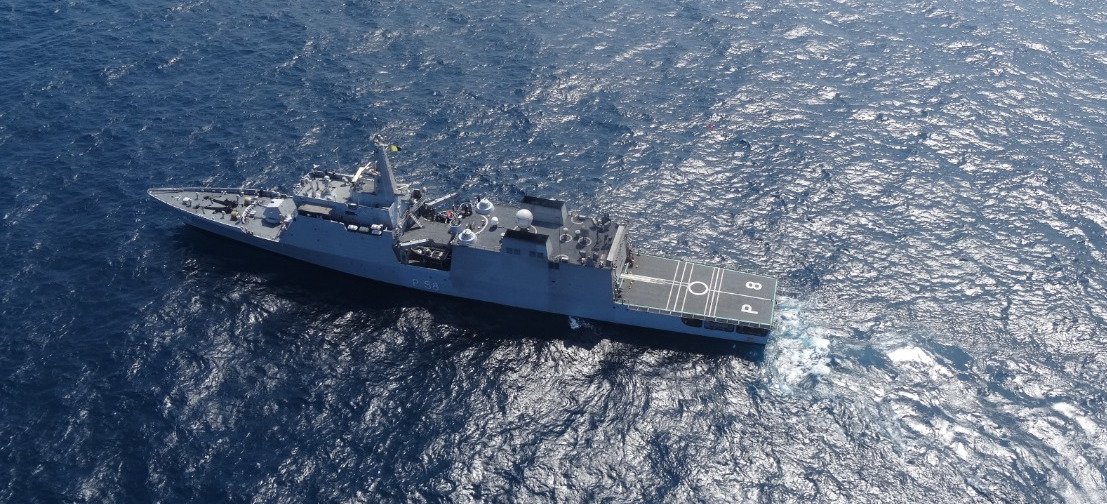
INS Sumedha is on an Extended Range Operational Deployment and is currently operating in the Atlantic Ocean along the West Coast of Africa. During this period, INS Sumedha operated in the Gulf of Guinea (GoG) undertaking a 31 days anti-piracy patrol. This is the second such patrol being undertaken by the Indian Navy in this crucial maritime region. The maiden GoG Anti piracy patrol was undertaken by INS Tarkash in Sep – Oct 22.
This is a new effort by the Indian Navy. US Coast Guard WMECs have been doing similar capacity building in the same area. We might be able to coordinate our efforts.





 Chuck Hill's CG Blog