“Canada, U.S. conduct live-fire exercises, ship exchanges in Bering Sea” –The Watch


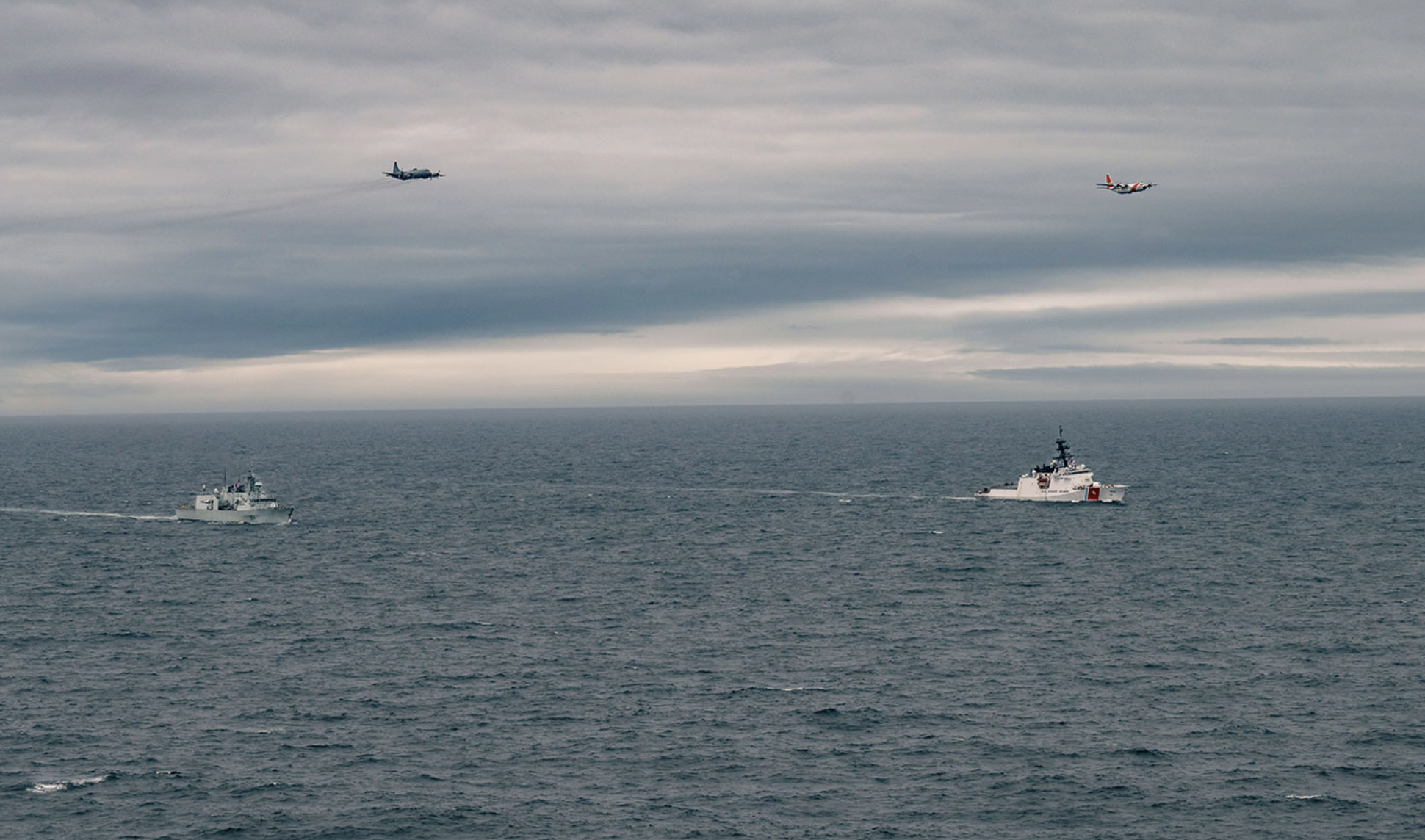
The Royal Canadian Navy ship Regina and the U.S. Coast Guard cutter Waesche sailed through the Bering Sea together for a week in last August 2025, conducting maritime maneuvers, including live-fire exercises, in Operation Latitude. U.S. ALASKAN COMMAND

NORTHCOM’s on-line magazine The Watch reports on a week of joint operations between  USCGC Waesche and Canadian Forces including particularly the Frigate Regina. The two ships are in some ways surprisingly similar, sharing the 57mm Bofors gun, Phalanx CIWS, and LM2500 engine.

The story goes on to describe other exercises the Canadian Navy is conducting.

“Trump Bill Secures $9 Billion for U.S. Arctic Surge, Six New Icebreakers to Counter Russian and Chinese Dominance” –gCaptain

gCaptain reports,

“President Trump’s vast tax and spending bill has secured funds the U.S. Coast Guard has been searching for since the early 2010s. The “One Big Beautiful Bill Act” appropriates close to $9 billion for the expansion of the Coast Guard’s Arctic icebreaker fleet.”

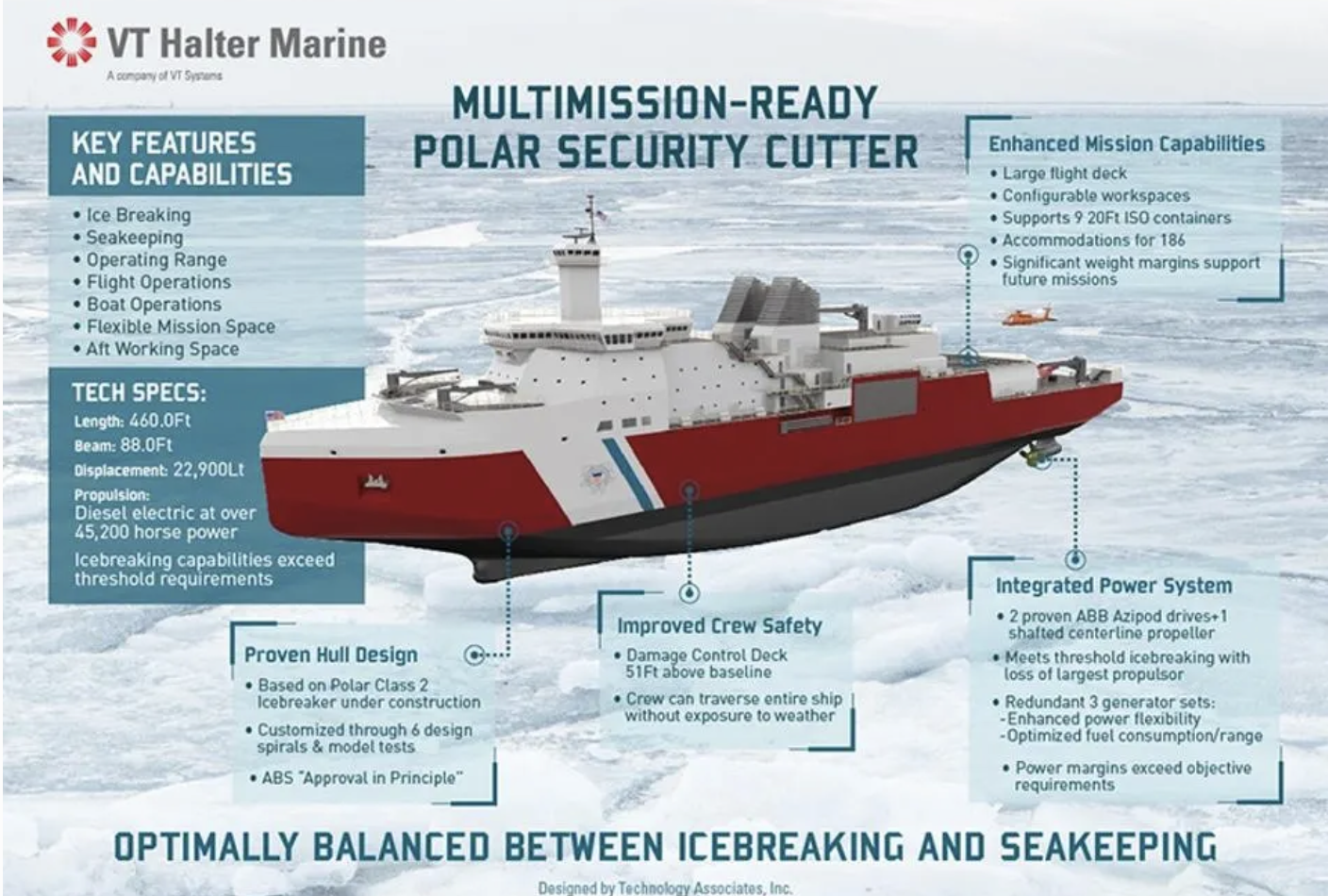
The report provides a breakdown of the appropriations that includes money for Polar Security Cutters, Arctic Security Cutters, and infrastructure in Juneau to support USCGC Storis,

Interestingly it also states,

“Rounding out the Arctic package, the U.S. Navy will also receive $115 million for the exploration and development of existing Polar infrastructure.”

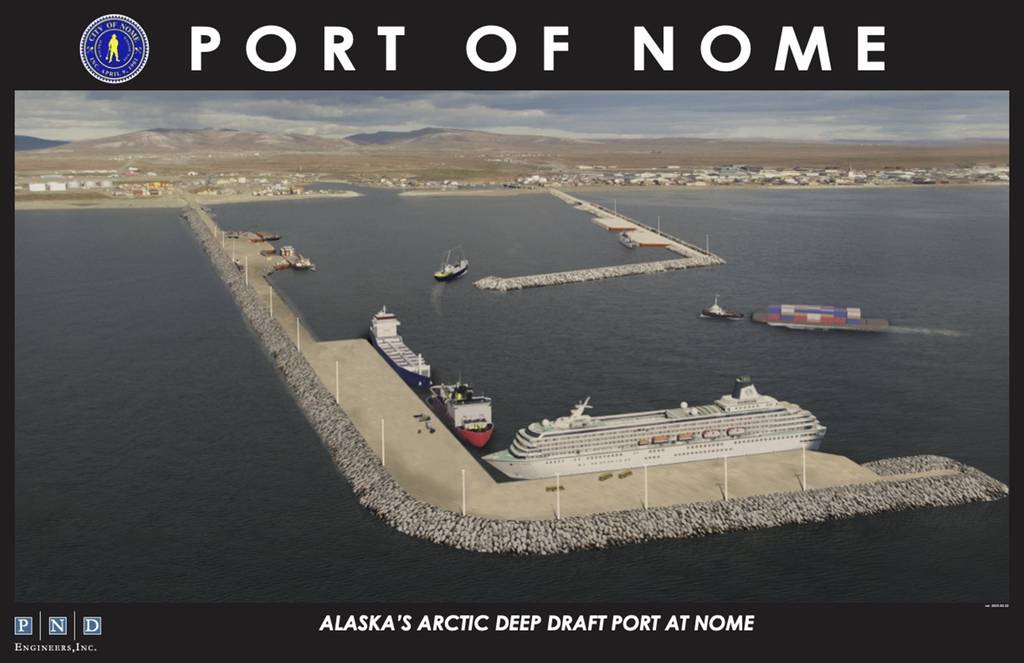
That sounds like improvements in Adak that the Coast Guard might also exploit. It might also refer to development of facilities at Nome but it is not nearly enough to fund plans for a deepwater port that had been shelved by the previous administration.

This rendering provided by the City of Nome shows how the Port of Nome, Alaska, will appear following an expansion project that will cost more than $600 million. Shipping lanes that were once clogged with ice for much of the year along Alaska’s western and northern coasts have relented thanks to global warming, and the nation’s first deep water Arctic port should be operational in Nome by the end of the decade. (PND Engineers Inc./City of Nome via AP)

NAS Adak Reopening?

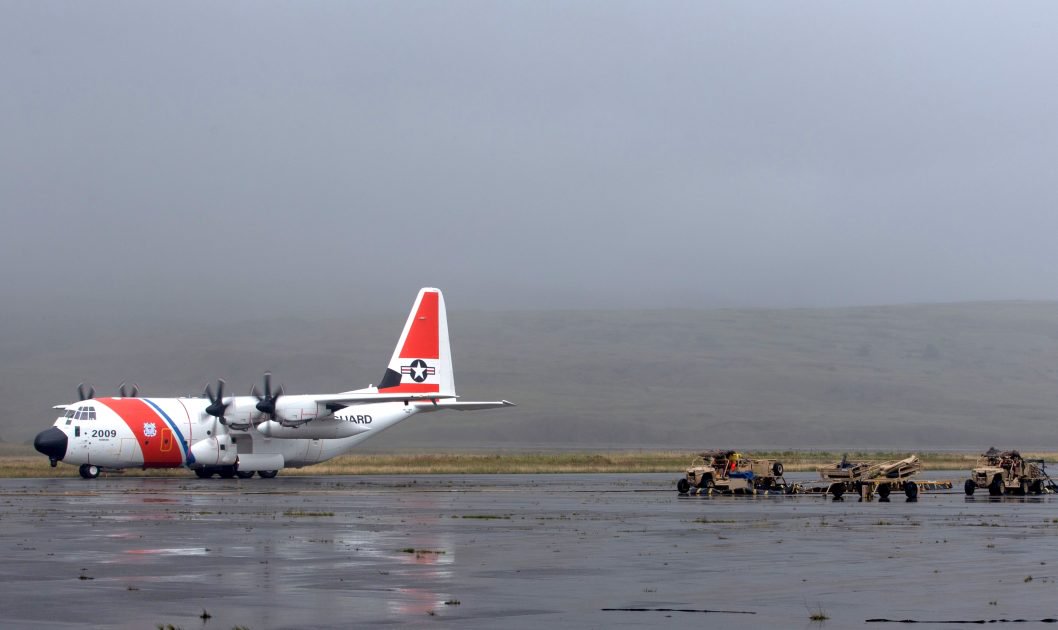
A U.S. Coast Guard C-130 participates in forward arming and refueling point (FARP) operations during Arctic Expeditionary Capabilities Exercise (AECE) in Adak, Alaska on Sept. 18, 2019. US Marine Corps Photo

I am seeing strong indications that DOD may reopen the former US Naval Air Station Adak.

First there was this from Task and Purpose, “The Navy may revive this forgotten Alaskan base that sits halfway to Russia,” published April 17, 2025.

The this, “Shuttered Aleutian naval air base straddling Arctic and Pacific oceans may reopen,” from a more official source, The Watch, NORTHCOM’s on line magazine. 

There is more discussion here.

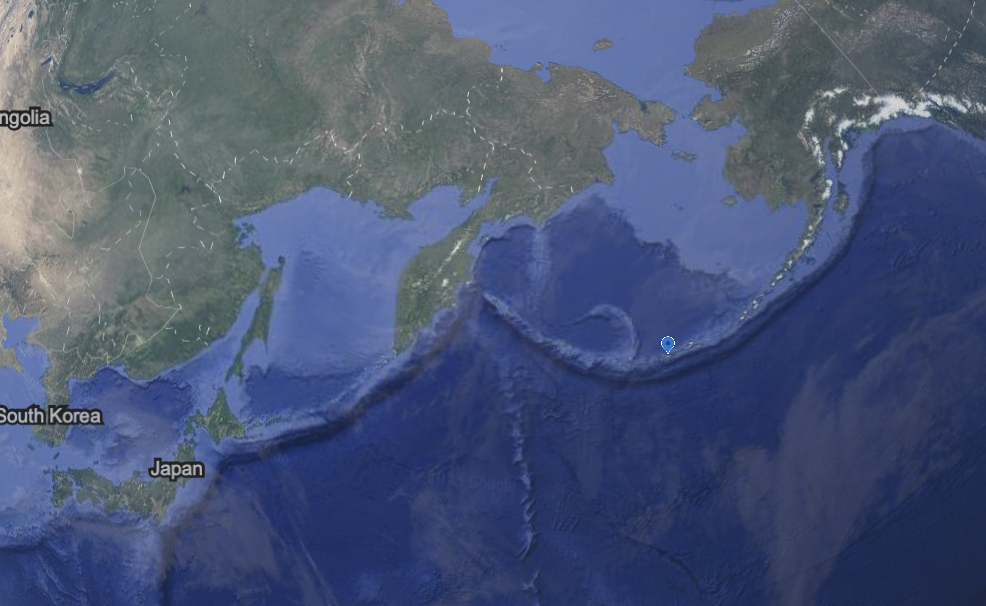
Adak, one of the Aleutian Islands, approximately 877 nautical miles South of the Bering Strait. About 901 nmi from Kodiak, about 2075 imi from Vladivostok.

Why do we care?

For the Coast Guard, it is a potential forward operating base for fixed wing aircraft monitoring fishing in the Bering Sea, and a fueling/replenishment stop for cutters on Alaska Patrol.

For Defense it puts assets in place to protect allied shipping and movements between the US and Asia and to prevent the passage of potentially enemy shipping and movements between the Russian Arctic and China, North Korea, and Russia ports in Asia via the Northern Sea Route and the Bering Strait.

The Coast Guard and DHS should add their voices in support of the idea. 

Ports along the Northern Sea Route have seen a quadrupling of cargo since 2003 from 26.4 million tons in 2003 to 104.8 million tons by 2019 (if slipping to 96 million tons last year (2020) due to Corona). They now handle as much cargo every year as the entire Baltics, which have stagnated for more than a decade.

“North American Arctic defense could shape outcome of Indo-Pacific conflict” –Indo-Pacific Defense Forum

A U.S. Army Green Beret observes an incoming CH-47 Chinook helicopter during Operation Polar Dagger in Wales, Alaska, in August 2024. IMAGE CREDIT: SPC. BRYON DAVIDSON/U.S. ARMY

The Indo-Pacific Defense Forum reported on a Special Operations Command North (SOCNORTH) exercise,

“To address growing concerns in the Arctic, SOCNORTH recently executed two phases of Operation Polar Dagger, an operational series that demonstrates rapidly deployable, joint SOF capabilities throughout the North American Arctic. It forms the basis of options to deter, disrupt and deny adversary activity in support of U.S. Northern Command’s (USNORTHCOM) layered defense of the U.S. homeland…

“In 2023 and 2024, SOCNORTH and the U.S. Navy partnered to deploy the amphibious transport dock ship USS John P. Murtha and the USS John L. Canley, an expeditionary sea base vessel that supports SOF operations and other maritime missions, to the Bering Sea and the Arctic Circle to support Operation Polar Dagger. USSOF is enhancing its navigation expertise in Arctic terrain and has demonstrated the ability to thrive in the region by executing long-range movements, maritime interdiction operations, rapid infiltration/exfiltration, air-to-ground integration, critical infrastructure defense, domain awareness, and medical evacuation validation, among other engagements.”

(I suspect what this means is that USS John P. Murtha participated in 2023 and USS John L. Canley participated in 2024. Both could not have participated both years.)

A lot of the post is an attempt to explain to an Indo-Pacific audience why a NORTHCOM exercise should be important to them.

Observations: 

It appears that Polar Daggar is a part of the larger NORTHCOM NOBLE DEFENDER exercise. This is apparently a regular annual exercise. NORTHCOM’s on-line magazine reported on the 2023 exercise.

“U.S. Army and Navy assets conduct an interdiction operation in the Bering Sea in July 2024.” Note how flat the seas are. That’s not normal. They did do this in July. You can’t count on seas like this. IMAGE CREDIT: SENIOR AIRMAN JOHNNY DIAZ/U.S. AIR FORCE

There is a serious problem here because there was apparently no Coast Guard participation in these exercises. The Navy’s Pacific Fleet almost never has surface ships anywhere near the Arctic. If you have an urgent need for a ship to do something in the Bering Sea, the Coast Guard is really the only option most of the time. SOCNORTH should be learning how they can exploit Coast Guard resources including ships, boats and aircraft. If you want maritime interdiction in the Bering Sea, if you want maritime domain awareness, who should NORTHCOM call? –the Coast Guard.

Want to fly a “Night Stalker” helicopter off of a ship? Want to launch ATACMS from the Chukchi Sea or maybe Tomahawk or SM-6 from a Mk70 launcher? You could put it on the flight deck of a cutter. 

Need follow-up logistics for paratroopers dropped into an isolated coastal location? Coast Guard.

A satellite image of Shemya Island. What is now called Eareckson Air Station, with its lengthy runway, is seen along the southern edge. Google Earth

Not enough Air Force transports available when you need to move troops to reinforce Shemya? Kodiak C-130Js can help with that.

Cutter might even put a landing party ashore to provide quick protection for a critical facility and stand offshore to provide some AAW protection with its 57mm.

East-Coast-based U.S. Naval Special Warfare Operators (SEALs) conduct an over the beach infiltration on Shemya Island, Alaska, Sept. 6, 2023, as part of Operation Polar Dagger. During the operation, special operations forces projected the ability of U.S. forces to defend critical infrastructure, enhanced all-domain awareness, demonstrated operational reach, and strengthened our understanding of activity in the Arctic. (U.S. Navy photo by Mass Communication Specialist 2nd Class Matthew Dickinson)

In 2023, Special Forces operating from USS John P. Murtha (LPD-26) did an infiltration exercise. A cutter could have done the same thing, and it probably would have been more realistic since an LPD is unlikely to be available.

Any surface or land action at the start of a conventional conflict against Russian and/or China that involves the Arctic is likely to be a surprise involving small units, probably involving covert actions from unconventional platforms, paratroopers, and small unit insertions. At least initially, it will be a “run what you brung” war. We will have to fight with what we have and effectively the Coast Guard is the surface navy for Alaska.

The “Center of Gravity” for the theater is likely to be the Bering Strait. As long as the US controls the strait, the Northern Sea Route will be useless for traffic between the Russian North coast and China or the Russian Pacific Coast.

The photo that leads off this post was taken at Wales, Alaska, population 145, 111 miles (179 km) northwest of Nome. The location is significant in that it is on the Eastern edge of the Bering Strait. It appears someone has recognized the significance of the location.

DOD Arctic Strategy, 2024, a Critique

Screen grab from page 2 of the DOD Arctic Strategy, 2024

Here is a link to the new DOD Arctic Strategy here. I found it disappointing. There isn’t much strategy here. I would sum it up as–we are going to keep doing what we are doing, but we are going to do it better. (See critique below.)

“This strategy will strengthen the ability of the United States to build integrated deterrence and effectively manage risk to U.S. interests in the Arctic region by enhancing our domain awareness and Arctic capabilities; engaging with Allies, partners, and key stakeholders; and exercising tailored presence.”

About the US Coast Guard:

The US Coast Guard or USCG was mentioned in three places, once in a caption of a picture of USCGC Healy and these two paragraphs.

DoD will partner with the Department of Homeland Security (DHS), including through the U.S. Coast Guard (USCG), which plays a vital role in maintaining U.S. presence in the Arctic region and supporting domain awareness. The USCG is responsible for operating and maintaining the United States’ icebreaking capability, and DoD will continue to support the USCG’s long-term acquisition of at least eight polar icebreakers that will provide needed icebreaking capability for both military and civilian purposes, including PR/SAR. While disaster response is not a force sizing or shaping requirement, DoD remains ready to support DHS and the Federal Emergency Management Agency in the event of disaster, terrorist attack, or other mass-casualty incident in the Arctic when directed by the President or when requested by a lead Federal department or agency and approved by the Secretary of Defense.

Service-specific, Joint, Interagency, and Combined Exercises. Security and stability in the Arctic depend, in  part, on the Joint Force’s ability to respond rapidly and   effectively to threats in the region. Exercises increase interoperability with Allies and partners, validate plans, train our ability to rapidly deploy to all parts of the Arctic region, and provide an opportunity to test equipment in Arctic conditions. As such, the Joint Force will continue to exercise frequently in the Arctic through Service specific training, joint exercises —to include with USCG— and
combined exercises with our Allies and partners. DoD will
ensure CCMDs with Arctic equities work toward global integration through joint exercises and ensure key exercise lessons inform capability requirements and strategic planning.

That’s it.

About Icebreakers: Icebreakers are mentioned twice, it the paragraph above and here,

The PRC seeks to bolster its operational expertise in the Arctic, where its presence, while limited, is increasing. The PRC operates three icebreakers—the Xue Long, Xue Long 2, and Zhong Shan Da Xue Ji Di—which enable the PRC’s dual civil-military research efforts in the Arctic. Over the course of the PRC’s 13 Arctic research expeditions to date, the vessels have tested unmanned underwater vehicles and polar-capable fixed-wing aircraft, among other activities. People’s Liberation Army Navy (PLAN) vessels have also  demonstrated the capability and intent to operate in and around the Arctic region through exercises alongside the Russian Navy over the past several years.

Critique:

“DoD will reach this end state through a monitor-and-respond approach.”

In other words, we will be reactive rather than proactive. 

The threat to Europe in the Polar regions is just part of the long running NATO defense problem. No real change there, except the formal extension of NATO into Sweden and Finland.

The Air Threat over the Pole to North America is looked after by NORAD. Apparently, NORAD does not look after Greenland, but that does not seem to be a central problem.

Ground operations in the Arctic are always going to be difficult. There may be small unit operations but no need to worry about an invasion of North America coming over the pole. NORTHCOM is exercising both land and air assets that would be needed to deal with realistic threats.

The North Slope oil fields and the associated pipeline are probably a target if we become engaged in a long-term conflict that involves combat in or over the arctic. The oil fields are not mentioned in the strategy,

What has changed?

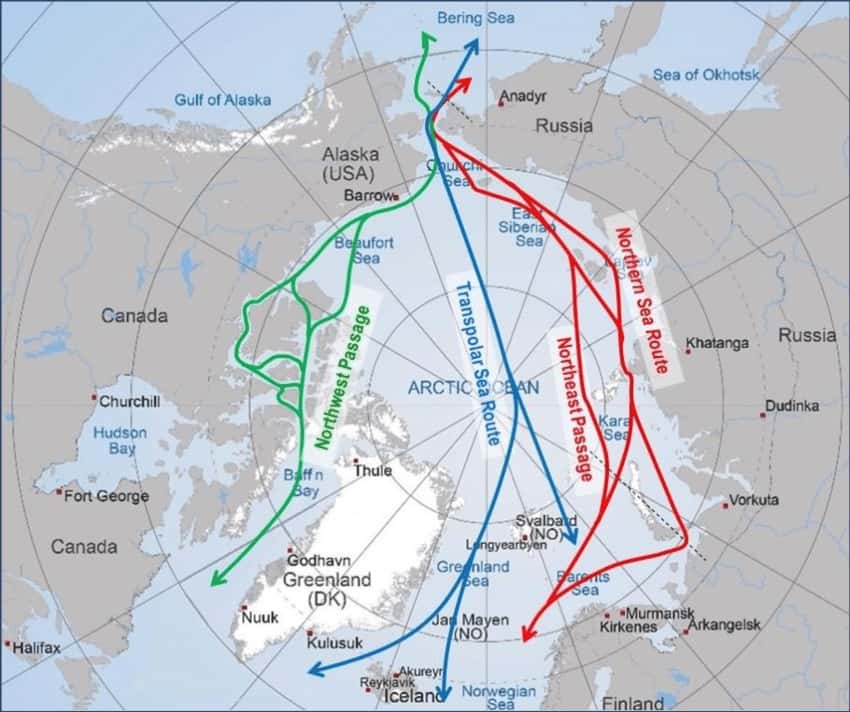
The opening of the Arctic Ocean to maritime commerce has made it a possible avenue for logistics between Russia and China with the potential for militarily valuable shipments moving both ways between the Russian Arctic coast on one end and the Russian Pacific Coast, North Korea, or China on the other. The weakness of Russian transcontinental land transportation systems makes the Northern Sea Route particularly important.

The door to be shut or left open is the Bering Strait.
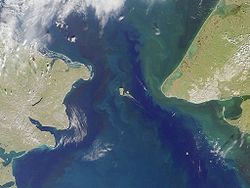
Bering Strait. 44 Nautical miles (82km) wide, with the Diomede Islands in the center.

The “strategy” mentions the Bering Straits only as a choke point,

The Arctic includes multiple strategically significant maritime chokepoints. Reduction in sea ice
due to climate change means chokepoints such as the Bering Strait between Alaska and Russia and the Barents Sea north of Norway, are becoming more navigable and more economically and militarily significant.

We would certainly want to deny use of the Strait by our enemies and ensure that we and our allies have the option to transit through the Strait.

The planned deep-water port in Nome (currently on hold) will be essential to forces that might be used to control access to the Bering Strait. We would also want to make sure St Lawrence Island and Little Diomede remain in US hands. The US might also want to seize Big Diomede. None of these strategic locations are mentioned in the plan.
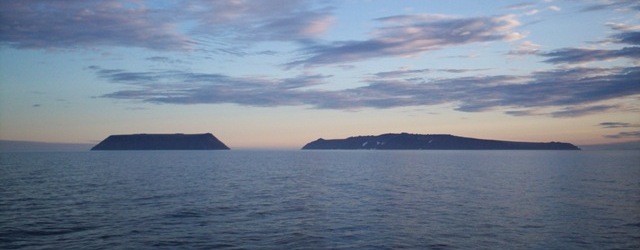
Diomede Islands: Little Diomede Island or Kruzenstern Island (left) and Big Diomede Island or Ratmanov Island in the Bering Sea. Photo is from the north. Photo by Dave Cohoe.

But who is in charge?

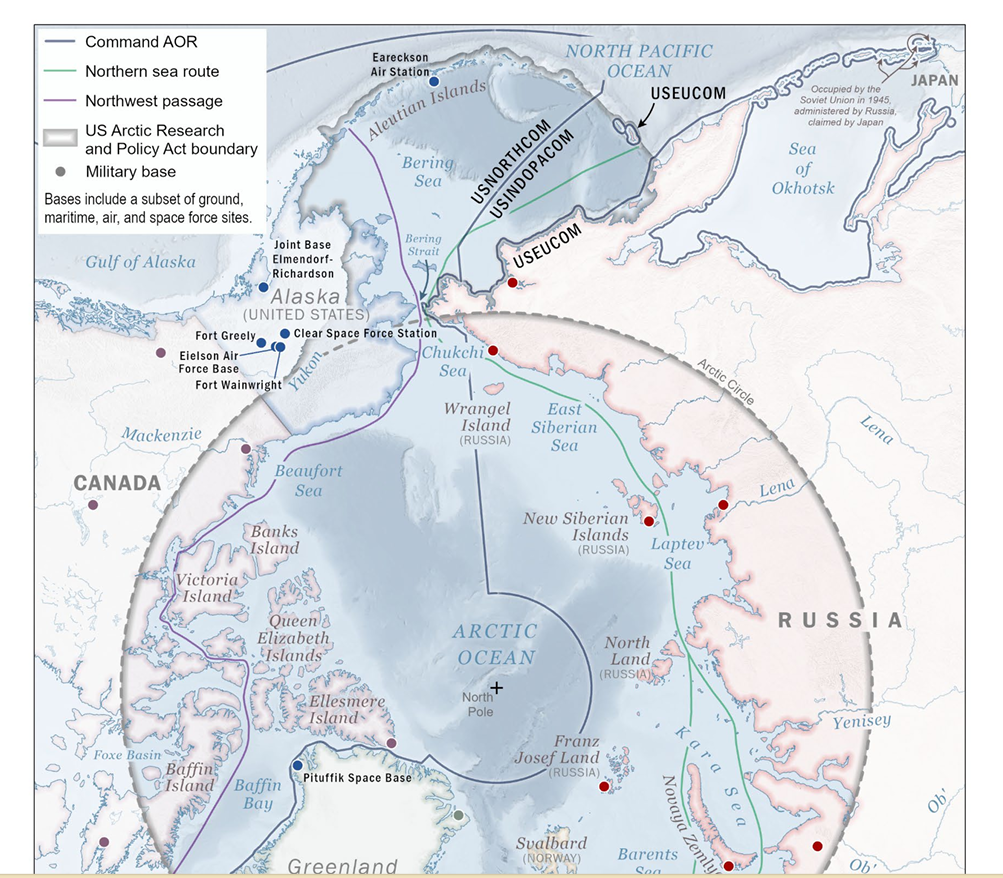
First look at the map at the head of this post. They have divided the Arctic so that operations there are under three different Unified Combatant Commands, USEUCOM, USINDOPACOM, and USNORTHCOM. In other words, no one below the President is in charge over the whole area.

These are the Unified Combatant Commander’s Areas of Responsibility. What is not made clear in this graphic is that all of Russia including the larger Asian part is under USEUCOM.

Perhaps most critically, the Pacific interface with the Arctic is under all three COCOMs.

  • USEUCOM is responsible for the Russian land areas in spite of the fact that the Bering Strait is 4521 statute miles from the COCOM’s headquarters in Stuttgart, Germany, and that is the shorter distance West from Stuttgart across the Atlantic and over the US, rather than over Russia. –This has got to be wrong.
  • USNORTHCOM has the Bering Strait and the Eastern half of the Bering Sea but normally they have no significant naval force. Their primary responsibility is the air defense of the US and Canada.
  • USINDOPACOM, which has the naval assets in the Pacific that might be used to attack Russian assets in Asia has responsibility for only the Western half of the Bering Sea below the Bering Strait.

This division of responsibility, placing Russian Asia under USEUCOM, also means that if the US should be at war with both China and Russia, then at least officially, conducting the war in the Pacific would be under two or perhaps three different COCOMs. I doubt this would actually work this way.

“Enhancing Domain Awareness in the Arctic” –Third Fleet

A U.S. Navy P-8A Poseidon takes off at Joint Base Elmendorf-Richardson, Alaska, Sept. 14, 2024. The P-8 Poseidon aircrew assigned to Patrol Squadron (VP) 9 and a U.S. 3rd Fleet Naval and Amphibious Liaison Element (NALE) supported joint and bi-national forces from Alaskan North American Aerospace Defense Command Region and Alaskan Command during Operation POLAR VORTEX by providing maritime domain awareness in conjunction with the 611th Air Operations Center air component to provide domain awareness during operations and exercises in remote regions of Alaska and the Arctic. (U.S. Air Force photo by Senior Airman Quatasia Carter)

Below is a 3rd Fleet press release. Notably missing is any mention of the Coast Guard, that might be understandable, but I have also seen no Coast Guard news release about participation in Operation POLAR VORTEX. If you are doing Maritime Domain Awareness anywhere around Alaska, you would think the Coast Guard would be involved.


Oct. 28, 2024

Enhancing Domain Awareness in the Arctic

By Tech. Sgt. Donald Hudson

During Operation POLAR VORTEX, a Naval and Amphibious Liaison Element (NALE) led by U.S. 3rd Fleet and supported by U.S. Fleet Forces was embedded into the bi-national Alaskan North American Aerospace Defense Command (NORAD) Region at Joint Base Elmendorf-Richardson, Alaska.

The NALE is primarily a function of the Navy Reserve, with Reserve personnel filling roughly 98 percent of NALE billets, given the operational tempo of this unique work. NALE Sailors train in mobilization to billet (MOB to-billet) positions and generally deploy on 90 to 270-day orders, responding both to planned operations and emergent crises, including training exercises, freedom of navigation operations, and humanitarian assistance and disaster relief. MOB-to-billet is the activation (other than for training) of SELRES Sailors to serve in the authorized and funded manpower billet at the command to which they are permanently assigned.

NALE units are attached to U.S. Fleet Forces Command, U.S. Pacific Fleet, U.S. Naval Forces Europe and Africa, and most numbered fleets.

While in Alaska, the NALE worked alongside U.S. Air Force and Royal Canadian Air Force (RCAF) members in the 611th Air Operations Center (AOC) to increase domain awareness in the Arctic region during Operation POLAR VORTEX by instantly linking maritime and air domain awareness.

“The situational awareness the NALE has provided is the most maritime awareness the AOC has had in the 14 years I’ve been here,” said Alaska Air National Guard Col. Jeff Smith, deputy commander, 611th AOC. “It’s been great to see the coordinated efforts between air and maritime domains.”

By co-locating, the NALE and 611th AOC were able to coordinate information instantly to the Joint Force Air Component Commander (JFACC) and provide a detailed real-time operating picture from the surface to air across some of the most remote operating areas in Alaska.

The NALE worked to seamlessly integrate their expertise of maritime domain awareness and employ a Navy P-8 Poseidon alongside joint and bi-national air assets. The cooperation increased tactical performance of joint forces validating command and control and tactical execution of mission objectives between various aircraft including exercising simulated air-to-surface strikes.

“The NALE has been essential to air operations,” said RCAF Brig. Gen. David Moar, deputy commander, Alaskan NORAD Region. “They were key in synchronizing air operations with naval air assets and providing information to enable the JFACC to coordinate and support the maritime component.”

3rd Fleet operations in U.S. Northern Command’s (USNORTHCOM) area of responsibility throughout the Gulf of Alaska aligned with Commander, U.S. Pacific Fleet objectives to demonstrate resolve and credible deterrence in defense of the homeland in the area. The operations also supported USNORTHCOM and NORAD’s mission of homeland defense, aerospace warning and control, and preserving a stable Arctic region in cooperation with U.S. Allies and partners.

“The NALE is an essential part of integrating the Maritime Operations Center (MOC) and AOC to provide multi-domain awareness to both Component Commanders,” said U.S. Navy Capt. Chris “Turtle” Turl, NALE director. “By coordinating information between each Commander’s guidance, the NALE facilitates the planning and execution of the mission to effectively meet the commander’s intent.”

NALE Sailors regularly engage in training exercises, freedom of navigation operations, and humanitarian assistance and disaster relief to enable better integration between joint air assets. The NALE provide the necessary face to-face contact among planner, commanders and staff to ensure mutual understanding, unity of effort and reduce friction between components.

Operating across the vast distances and remote areas in the Arctic comes with many operational hurdles to overcome such as harsh weather and sea conditions causing increased risk to aircrews should an incident occur. Enhancing communication between joint forces is essential to meet the mission while overcoming obstacles and lowering operational risks.

Through joint and bi-national teamwork the NALE and 611th AOC were able to maximize domain awareness and more effectively employ air assets saving time, and costs while reducing risk and increasing efficient use of tactical air assets and manpower.

“U.S. Coast Guard encounters joint Chinese Coast Guard, Russian Border Guard patrol in Bering Sea” –Coast Guard News

Russian Okean class Patrol Ship. This is the larger of the two Russian ships. “An HC-130J Super Hercules airplane crew from Coast Guard Air Station Kodiak observes two Russian Border Guard ships and two Chinese Coast Guard ships approximately 440 miles southwest of St. Lawrence Island Sept. 28, 2024. This marked the northernmost location where Chinese Coast Guard vessels have been observed by the U.S. Coast Guard. (U.S. Coast Guard courtesy photo)”

Below is a CG news release, presumably from District 17 (Alaska).

An earlier post reported joint Russian/Chinese Coast Guard exercises and the formation of this four-ship combined task force.

They are in the Bering Sea. Will be interesting to see if they go up into the Arctic. It is a period of near minimal ice.

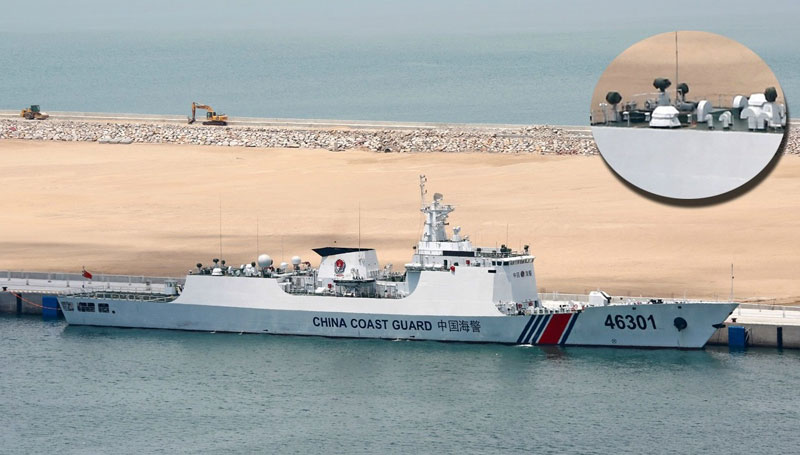
There is an interesting contrast between the two Russian ships and the two Chinese ships. In spite of the fact that this is happening in Russia’s back yard, the Chinese ships clearly outclass the Russian ships, being newer, larger, and faster.

China Coast Guard type 818 cutter like the two deployed with the Russian Coast Guard

Why four ships hanging together when the US Coast Guard does Alaska Patrols in the Bering with only one ship? The Chinese tend to operate in groups. We haven’t seen this with the Russian Coast Guard, but I really haven’t seen much from them anyway.

Could the Chinese be teaching the Russians how to do gray zone operations, or is it just that totalitarian regimes need someone to do the work and someone to watch them?

On the other hand, the China Coast Guard has lots of ships but relatively few aircraft, and they operate primarily in two heavily trafficked, contested areas, the South and East China Seas.

News Week also has a good report on this.


Oct. 1, 2024

JUNEAU, Alaska – The U.S. Coast Guard located four vessels from the Russian Border Guard and Chinese Coast Guard conducting a joint patrol in the Bering Sea, Saturday.

While patrolling the maritime boundary between the United States and Russia on routine patrol in the Bering Sea, a HC-130J Super Hercules airplane crew from Coast Guard Air Station Kodiak observed two Russian Border Guard ships and two Chinese Coast Guard ships approximately 440 miles southwest of St. Lawrence Island.

The vessels were transiting in formation in a northeast direction, remaining approximately five miles inside the Russian Exclusive Economic Zone. This marked the northernmost location where Chinese Coast Guard vessels have been observed by the U.S. Coast Guard.

 “This recent activity demonstrates the increased interest in the Arctic by our strategic competitors,” said Rear Adm. Megan Dean, commander of the 17th Coast Guard District. “The demand for Coast Guard services across the region continues to grow, requiring continuous investment in our capabilities to meet our strategic competitors’ presence and fulfill our statutory missions across an expanding operational area.”

The HC-130 aircrew operated under Operation Frontier Sentinel, an operation designed to meet presence with presence when strategic competitors operate in and around U.S. waters. The Coast Guard’s presence strengthens the international rules-based order and promotes the conduct of operations in a manner that follows international law and norms.

“U.S. Coast Guard encounters Russian naval vessels near Point Hope, Alaska” — CG News

“The crew of U.S. Coast Guard Cutter Stratton (WMSL 752) encountered and shadowed four Russian Federation Navy (RFN) vessels 57 miles northwest of Point Hope, Alaska, Sept. 15, 2024. The Russian Surface Action Group consisted of a Severodvinsk-class submarine, a Dolgorukiy-class submarine, a Steregushchiy– class Frigate, and a Seliva-class tug. Stratton patrolled under Operation Frontier Sentinel, a Coast Guard operation designed to meet presence with presence when strategic competitors operate in and around U.S. waters. (U.S. Coast Guard courtesy photo)”

Below is a news release from Coast Guard news.

Point Hope, Alaska is well North of the Bering Strait and the Arctic Circle, bordering the Chukchi Sea, 312 miles SW of Utqiagvik (formerly Pt. Barrow) and almost a thousand miles North of Dutch Harbor. None of my Alaska Patrols ever got that far North.

Russian Yasen class SSGN

The Severodvinsk or Yasen class submarine is a nuclear submarine equipped with eight missile silos for up to 32 cruise missiles and ten torpedo tubes.

Russian Borei class SSBN

The Dolgorukiy or Borei class submarine is a SSBN with 16 silos for ballistic missiles.

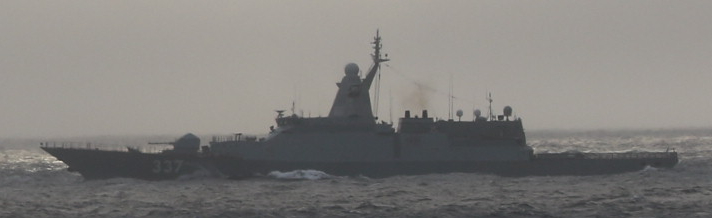
The surface combatant seems to have been miss identified. It is Gremyashchiy (337) lead ship of her class of 2,500 ton Project 20385 corvettes (NATO considers them frigates).

Note, USCGC Stratton is not an ice strengthened vessel.

This may have been a transfer of the SSGN and SSBN to the Russian Pacific Fleet.

The post story seems to indicate Stratton stumbled across this group. Shouldn’t we have known they were there?


Sept. 16, 2024

JUNEAU, Alaska — The U.S. Coast Guard located four Russian Federation Navy (RFN) vessels Sunday, 57 miles northwest of Point Hope, Alaska.

While on a routine patrol in the Chukchi Sea, the crew of U.S. Coast Guard Cutter Stratton (WMSL 752) observed the RFN vessels transiting southeast along the Russian side of the Maritime Boundary Line (MBL).

The crew of the Stratton witnessed the RFN vessels cross the MBL into the U.S. Arctic and moved to observe the vessels. The Russian vessels were assessed to be avoiding sea ice on the Russian side of the MBL and operated in accordance with international rules and customs as they transited approximately 30 miles into the U.S. Exclusive Economic Zone.

“We are actively patrolling our maritime border in the Bering Sea, Bering Strait, and Chukchi Sea, with our largest and most capable cutters and aircraft, to protect U.S. sovereign interests, U.S. fish stocks, and to promote international maritime norms,” said Rear Adm. Megan Dean, Commander of Coast Guard District Seventeen. “Coast Guard Cutter Stratton ensured there were no disruptions to U.S. interests.”

The Russian Surface Action Group consisted of a Severodvinsk-class submarine, Dolgorukiy-class submarine, Steregushchiy– class Frigate, and Seliva-class tug.

The Stratton is patrolling under Operation Frontier Sentinel, an operation designed to meet presence with presence when strategic competitors operate in and around U.S. waters. The Coast Guard’s presence strengthens the international rules-based order and promotes the conduct of operations in a manner that follows international law and norms.

Coast Guard Cutter Stratton is a 418-foot legend class national security cutter homeported in Alameda, Calif.

“GAO says Coast Guard needs better ‘performance measures’ in Arctic” –Workboat

The USCGC Sycamore (WLB 209) crew participates in a navigation exercise with a HDMS Knud Rasmussen (P570), a Royal Danish Navy Knud Rasmussen-class patrol vessel and the FNS Fulmar (P740), a French Navy patrol vessel, off the coast of Southern Greenland, June 13, 2023. Deployed forces demonstrated U.S. Coast Guard capabilities to build partner capacity and expertise in search and rescue, navigation, and damage control. These efforts solidify key strategic relationships while achieving mutual Danish, Greenlandic, and U.S. goals in the North American Atlantic Arctic and Northwest Atlantic Ocean. (U.S. Coast Guard photo by Lt. Cmdr. Katherine Blue)

Workboat reports,

“The Coast Guard hasn’t fully tracked the time spent on its Arctic activities,” according to the GAO, which is the non-partisan auditing and accounting arm of Congress. “Complete information would help the Coast Guard better allocate its constrained resources and assess its progress toward achieving its Arctic strategic goals.”

It seems GAO is always critical, but that is sort of their job. Reports are a pain in the ass, but it does seem that the Coast Guard has been lax in both making reports and in using them to justify additional resources, and this does not just apply to the Arctic.

For instance, I have not seen reports like this in a very long time.

To compete for budget dollars, an agency should be able to show return on investment. Money spent on the Coast Guard is a good investment. We need to be able to document that.

Thanks to Paul for bringing this to my attention. 

“Runaway costs and design delays: Are Coast Guard’s new icebreakers worth it?” –The Sandboxx

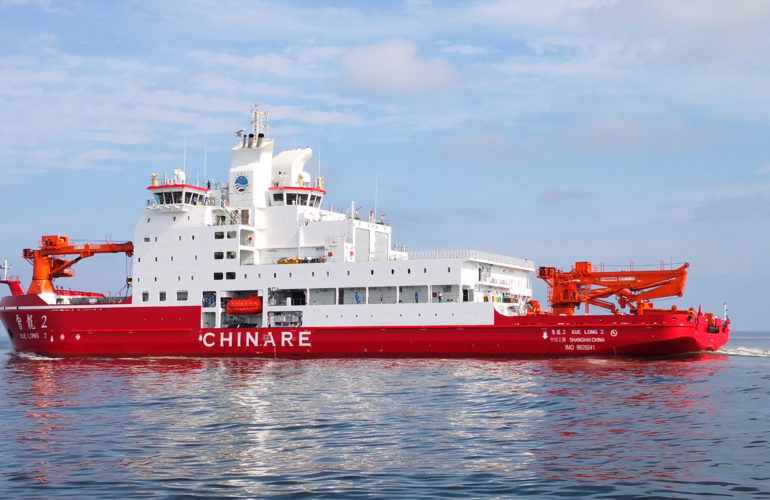
Xue Long 2 on sea trials. Photo by PRIC.

The Sandboxx has a brief look at the problems the US has had in fielding replacement icebreakers.

What I think they leave out of the article is that while the Chinese seem to be planning heavy icebreakers including possibly nuclear-powered ones, the Chinese icebreakers built so far are nowhere near as powerful as Polar Star or the Polar Security Cutter. Mostly they have been ice capable research ships. Their only Chinese built medium ice breaker, Xue long-2, is smaller and a third less powerful than Healy. The three Chinese icebreakers currently in the Arctic include the much smaller 5,600-ton, 8,600 HP (6.4KW) Polar Class 6 Ji Di, smaller than the old Wind class icebreakers.

Aerial view of China’s icebreaker Ji Di berthing at the pier of Qingdao Olympic Sailing Center on July 3 in Qingdao, Shandong Province of China.
© Sun Qimeng/VCG via AP, “China and Russia to Expand Scientific Cooperation in Arctic: Report” –Newsweek

By some counts the US, and most notably Canada, have more icebreakers than China. All of China’s icebreaker construction is not directed at the Arctic. They also have interests in Antarctica (which I find more troubling), and they have ports that ice over requiring domestic icebreaking.

The Sandboxx also describes the 8,500 ton Project 23550 ice class patrol vessels as Russia’s “… first “combat icebreaker,” a small, agile, and armed-to-the-teeth escort ship with launchers installed for anti-ship and cruise missiles.” That is hyperbole. It has provision for placing two containers on the stern. Those containers could contain cruise missiles, but any ship that can mount containers in a position where the space above the container is unobstructed could have a similar capability. Other than being armed with containers, they are armed very much like a Coast Guard cutter. They have a single medium caliber gun, either 76mm or 100mm. They have no surface-to-air missile system other than perhaps man portable air defense systems (MANPADS) and no CIWS of any kind. Furthermore, they are not Russia’s first armed icebreaker. Russia has had armed icebreakers since at least WWII, including the Project 23550’s predecessors, the Ivan Susanin class, eight ships completed 1973 to 1982, four of which are still in service. I went aboard one of them in San Francisco, when they came to help celebrate the 200th anniversary of the beginning of the US Coast Guard.

It would not be too difficult for the US to build counterparts to the Project 23550s for the US Coast Guard or Navy, especially after the recent ICE Pact agreement with Canada and Finland. Ships don’t have to be as capable as the Polar Security Cutters to be useful. The Chinese are proving that.