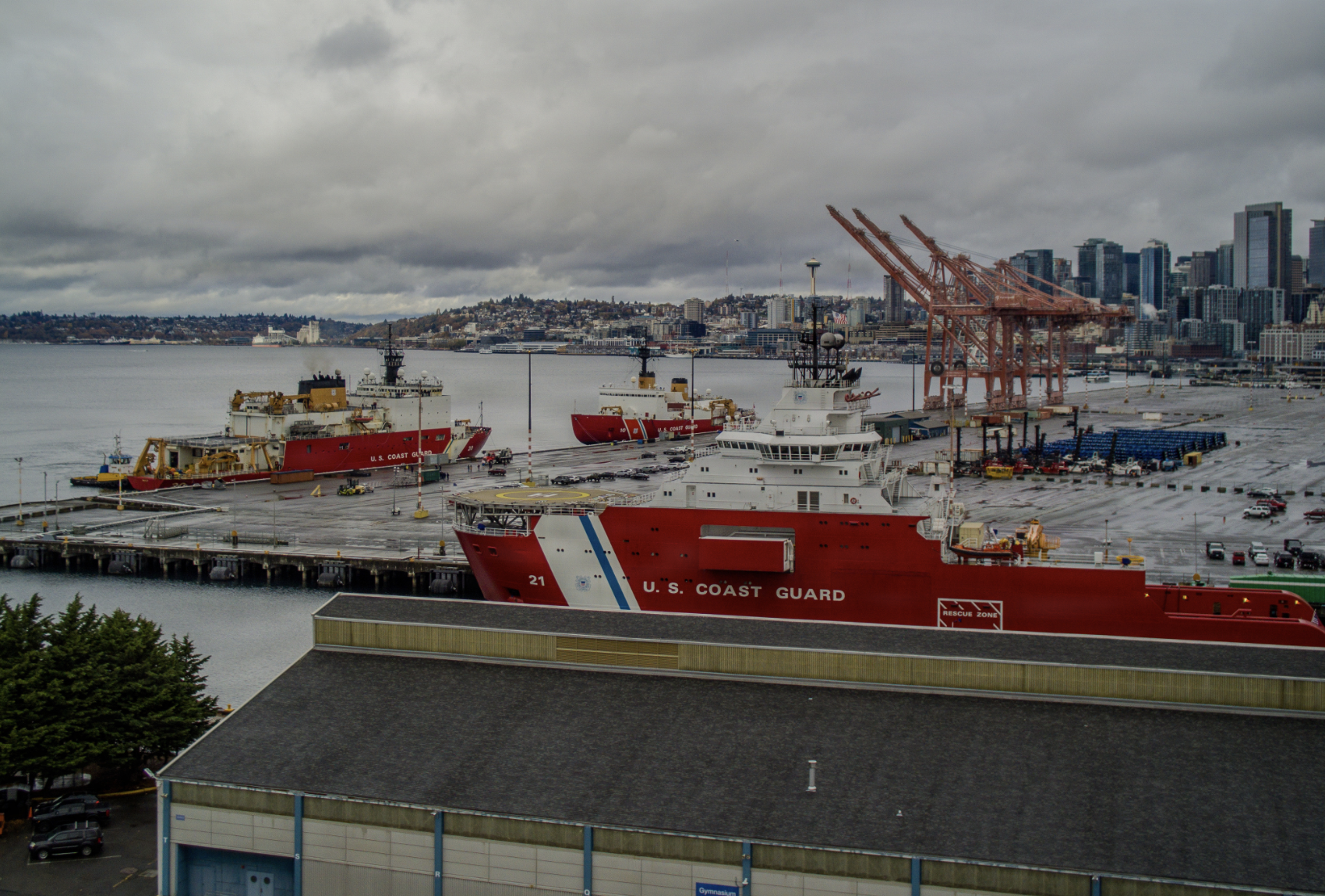
Polar Star, Storis, and Healy. U.S. Coast Guard Cutter Healy (WAGB-20) arrives at Pier 46 on Coast Guard Base Seattle, Oct. 26, 2025. The crew of the Healy transited over 20,000 miles, supporting Operation Arctic West Summer and Operation Frontier Sentinel, protecting U.S. sovereign rights and territory, and promoting national security in the Arctic. (U.S. Coast Guard photo by Lieutenant Christopher Butters)
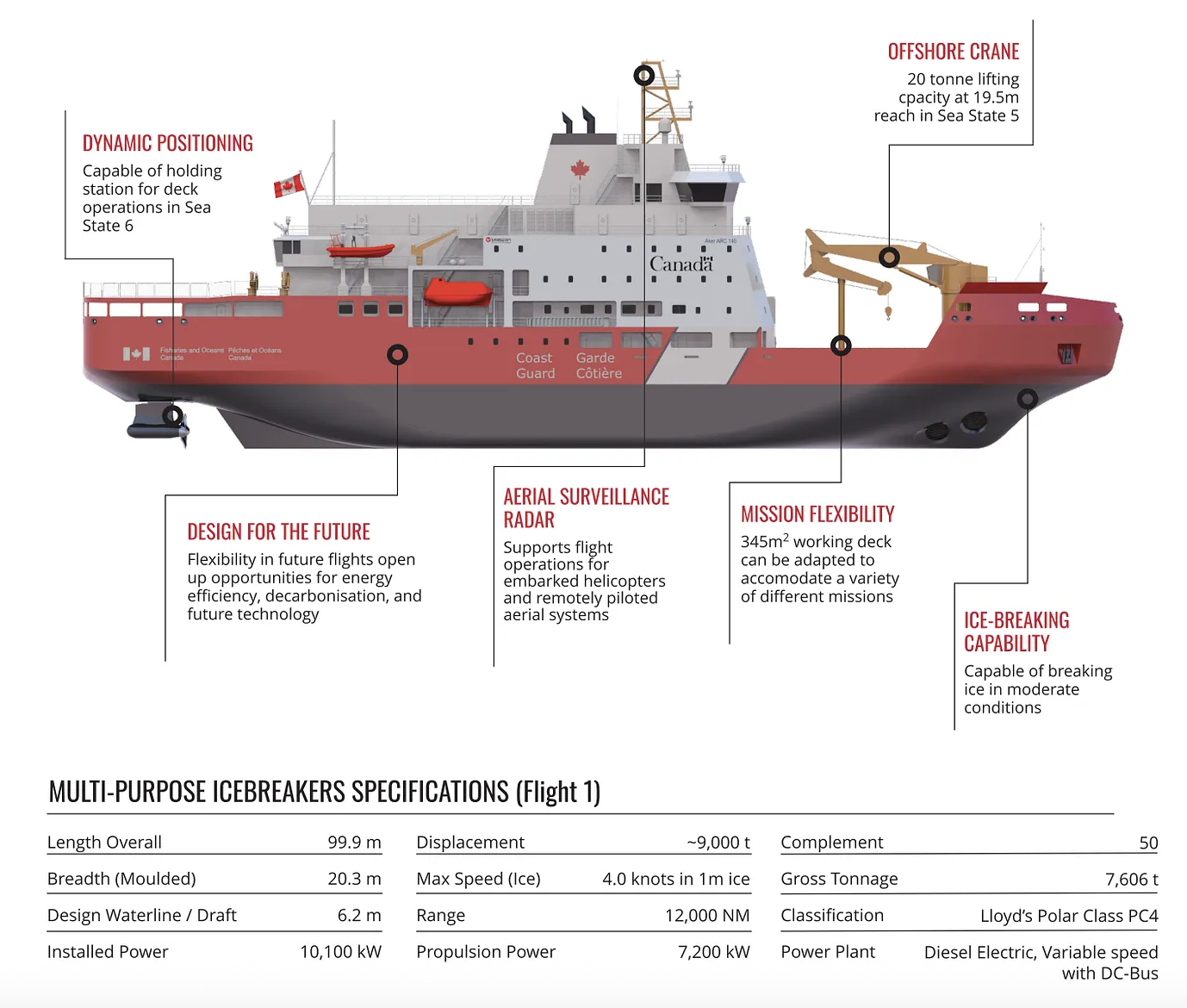
Canadian Coast Guard Multi-Purpose Icebreaker (MPI). Source: Seaspan Note: The MPI image does not show the right propulsors; it will use Steerprop’s contra-rotating propulsors (CRP). Additionally according to Seaspan, the design could easily be upgraded to PC3. Confirmation from Seaspan and Aker Arctic.
Jan. 6, 2026
A polar plunge: The Coast Guard bets on the burgeoning Arctic
By Katie Duckett, The Circuit writer
Editor’s note: This article was originally published in The Circuit C5ISC blog. (CAC required)
After decades of watching its polar fleet degrade toward obsolescence, the Coast Guard is now poised for a historic transformation in the world’s coldest waters. The spending bill signed on July 4, 2025 has delivered nearly $9 billion for icebreaker construction to the Coast Guard, the single largest polar investment in service history, setting the stage for what officials are calling a new era of American presence in the Arctic and Antarctic.
The timing couldn’t be more fitting. For years America’s polar ambitions have rested largely on the shoulders of USCGC POLAR STAR (WAGB-10), an icebreaker commissioned in 1976. Now 49 years old and nearly two decades past her designed service life, she remains the only American ship capable of punching through the thick ice surrounding McMurdo Station in Antarctica, a mission she has performed faithfully for 28 consecutive years during Operation Deep Freeze.
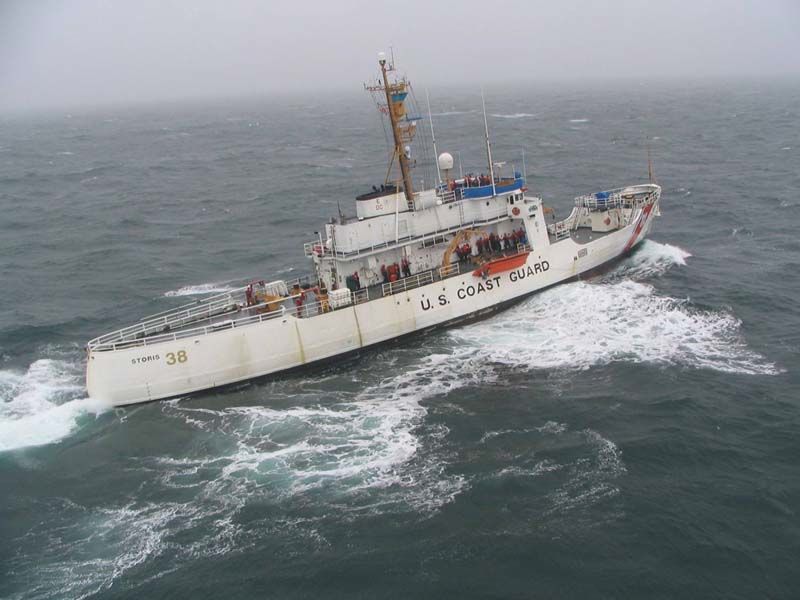
Alongside POLAR STAR, USCGC HEALY (WAGB-20) has spent a quarter century conducting Arctic research and patrol, identifying underwater volcanoes and mapping the seafloor while monitoring the increasing presence of Russian and Chinese vessels in polar waters. But electrical fires and mechanical strain have tested this workhorse; in December 2024, USCGC STORIS (WMEC-38) became the first polar icebreaker added to the fleet in 25 years, offering immediate relief. Commissioned in Juneau last August, she completed a 112-day inaugural Arctic patrol that fall, shadowing five Chinese research vessels operating in American waters. The purchase served as a bridge strategy, buying time until heavier reinforcements would arrive.
Announced this May, the Coast Guard’s Force Design 2028 initiative has designated polar capability a cornerstone of service transformation. FD28 explicitly calls for delivering “icebreakers needed to provide assured U.S. access and presence to the polar regions” while streamlining acquisitions to accelerate timelines that have historically lagged.
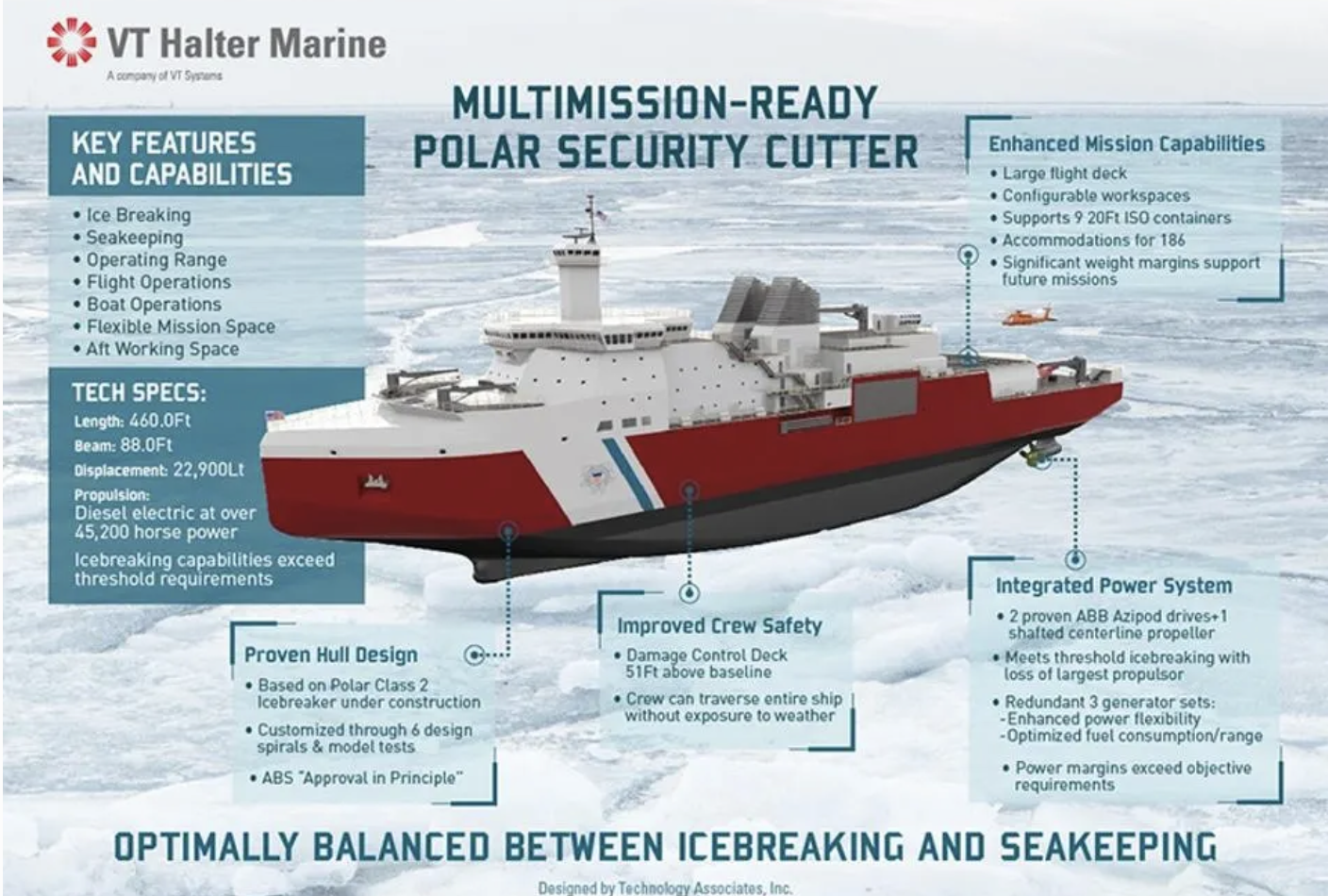
The Coast Guard’s vision for polar operations is now bankrolled at historic scale. This year’s spending bill allocates $4.3 billion for three Polar Security Cutters, massive 460-foot heavy icebreakers capable of smashing through ice 21 feet thick. The first of these, USCGC POLAR SENTINEL (WMSP-21), is expected to enter service around 2030. Another $3.5 billion will fund the Arctic Security Cutter program, which received a dramatic boost in October 2025 when the President signed an agreement with Finland to deliver 11 medium icebreakers, with the first five set to arrive by 2028. When combined with the additional light icebreaker funding included in the bill, the legislation enables construction of 17 new vessels in total, a number that would have seemed unthinkable just five years ago.
The urgency of Arctic operations extends beyond aging hulls. Russia currently operates more than 40 icebreakers, continuing to militarize its Arctic coastline. China, despite possessing no Arctic territory, has declared itself a “near-Arctic state” and deployed its own coast guard vessels alongside Russian patrols near Alaska. And a changing climate is unlocking shipping lanes and resources that will demand American presence and enforcement.
After decades of deferred maintenance and delayed procurement, the Coast Guard’s polar plans are finally scaled to the challenge. This frozen frontier, once patrolled by a single aging ship, will soon host a fleet befitting American strategic interests at both poles.
Here we have a post from Peter Rybski (prybski@gmail.com) thought many of my readers might find interesting. It’s reprinted with his permission.
It suggests that a partnership of Canadian and Finnish shipyards may be in the lead to provide two Arctic Security Cutters using the design for the Canadian Coast Guard’s Multi-Purpose Vessel, a light icebreaker, and that follow on ships of this class would be built in the US.
This is not the first time Peter’s analysis has appeared here:
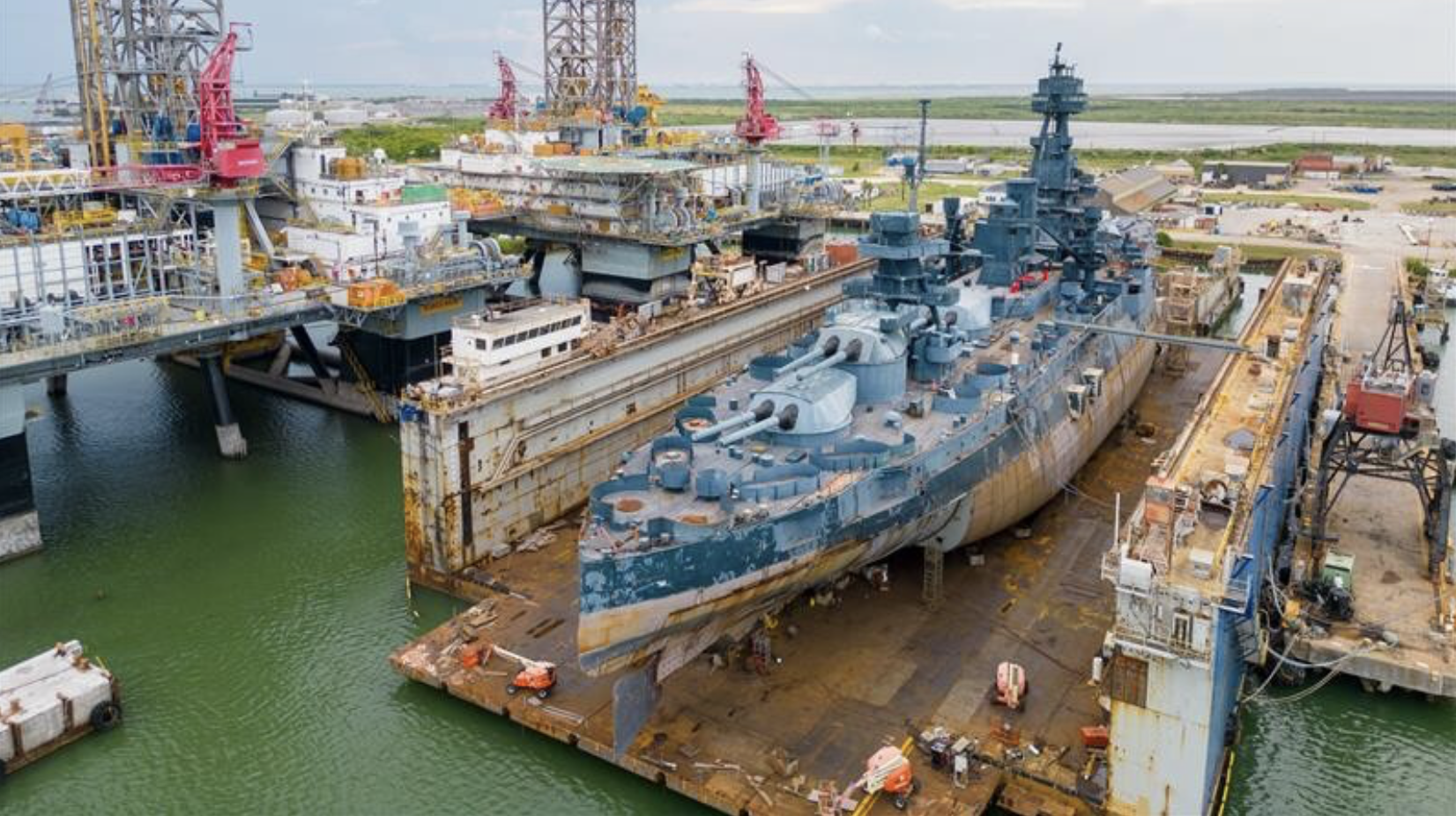
Note also that Canadian Shipbuilder Davie has announced an intention to acquire and modernize Gulf Copper & Manufacturing Corporation with facilities in Port Arthur and Galveston.
Aerial photo of Gulf Copper Dry Dock and Rig Repair in Galveston, Texas. In the dry dock is the former USS Texas, length 573 ft (175 m) (overall), beam 95 ft 2.5 in (29.020 m), displacement 27,000 tons, so big enough for a Polar Security Cutter. Shutterstock photo by Felix Mizioznikov.
Finnish and Canadian Firms Team Up to Offer Arctic Security Cutters to U.S. Coast Guard
According to the proposal, Seaspan’s Multi-Purpose Icebreaker design would be built in Finland by Rauma Marine Constructions (RMC), with Aker Arctic (who did the concept design) providing support.
I’m currently away from Finland, visiting family in the USA. Last week, while I was grilling hamburgers and hot dogs during a family Independence Day Barbecue, a regional Finnish newspaper (Satakunnan Kansa) ran a very interesting article:
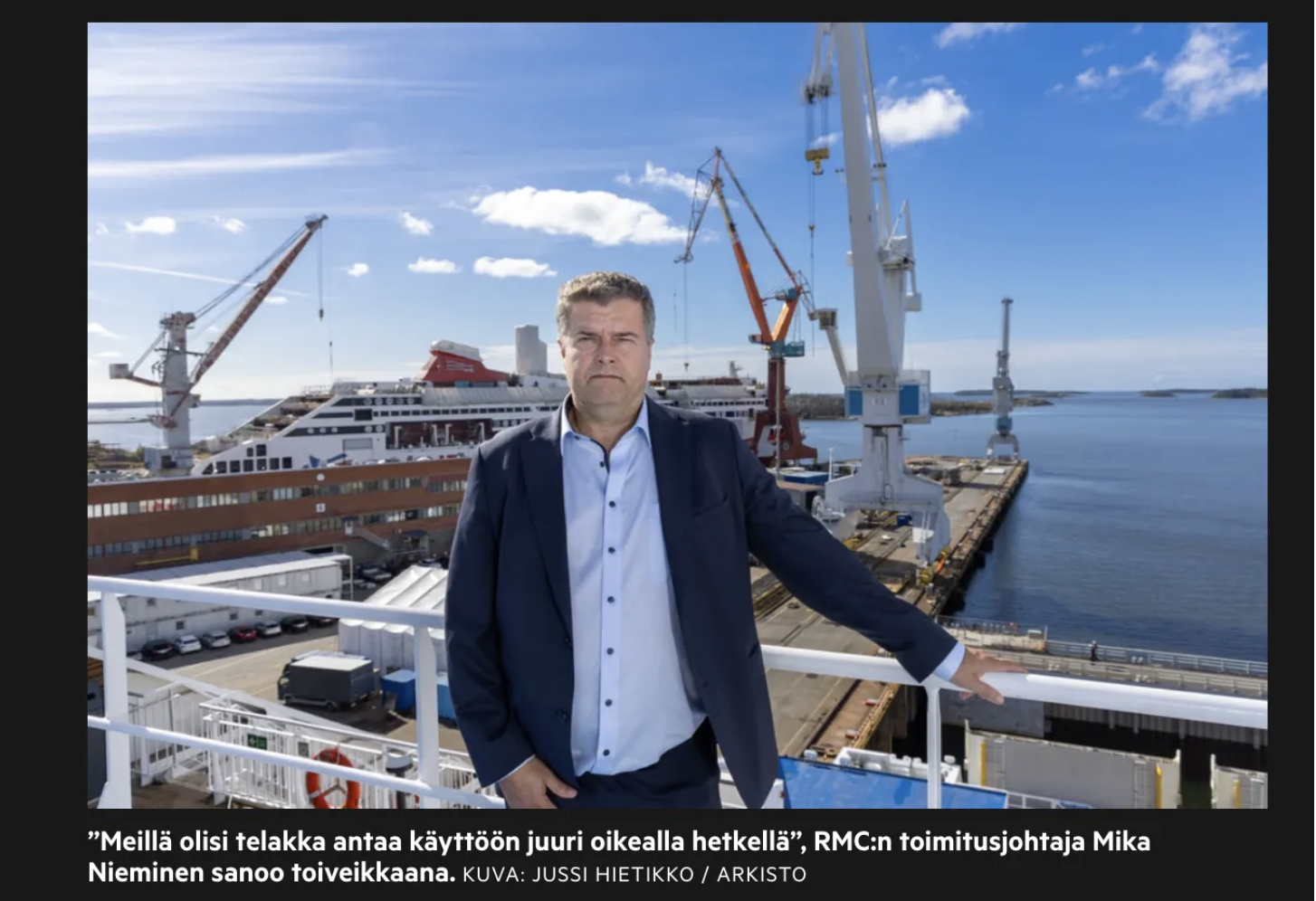
RMC’s Nieminen returned from a sales trip to the USA: “Rauma Shipyard is Number One.”
RMC is part of a consortium that is offering two icebreakers to the U.S. Coast Guard, as well as extensive training.
Caption: “We would have the shipyard ready for use at just the right time,” says RMC CEO Mika Nieminen hopefully.
(translation via google, with some corrections for clarification):
A satisfied man walked through Helsinki-Vantaa Airport on Thursday afternoon. RMC CEO Mika Nieminen returned from a sales trip to the USA, where he brought back some good news.
Nieminen was presenting the ship design of the consortium he represents to the US Coast Guard and the reception was excellent.
“Our ship design exceeded expectations and it is the design that the Coast Guard wants. The number one is the Rauma shipyard, which would also build it. The feedback was very positive.”
In addition to RMC, the consortium represented by Nieminen includes the Canadian shipbuilder Seaspan Shipyards and the Finnish ship design firm Aker Arctic Technology Oy.
The Canadian shipyard will start building medium-sized icebreakers based on the same model next year. Canada plans to build 16 icebreakers. This same ship model is now being offered to the US Coast Guard, but with RMC building the ships.
This is clearly referring to Seaspan’s Multi-Purpose Icebreaker (MPI) design, which I discussed in a recent article:
Analyzing the Arctic Security Cutter Request for Information
Canada’s Multi-Purpose Icebreaker (MPI, formerly known as the Multi-Purpose Vessel): Modern design that meets all of the listed requirements [for the U.S. Coast Guard’s Arctic Security Cutters]. The first flight of six vessels (of a planned sixteen) are scheduled to be built by Seaspan at their Vancouver shipyard….
Seaspan’s Vancouver Shipyard is at capacity through approximately 2029. While they will begin building MPIs for the Canadian Coast Guard, there is no room to build one for the U.S. Coast Guard in the relevant timeframe….
Building MPIs at RMC is an interesting idea, but I have no idea if that is actually under consideration.
It is more than just under consideration. According to the Satakunnan Kansa article, RMC would build the first two MPIs for the U.S. Coast Guard in Finland by 2028. The deal would also involve working with U.S. shipbuilders to ensure they had the training and skill to build subsequent vessels of the class in the USA. Cost information is not yet available.
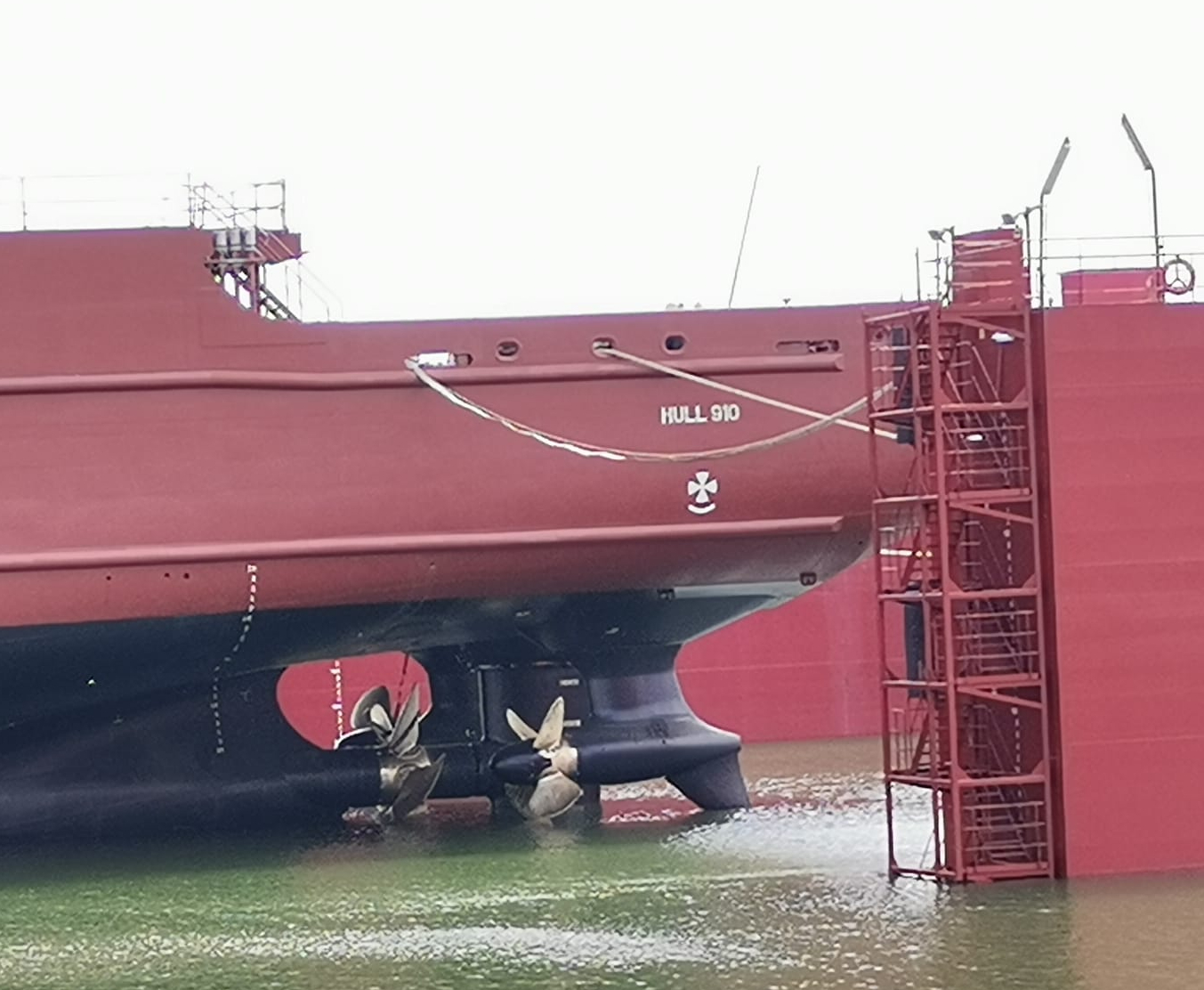
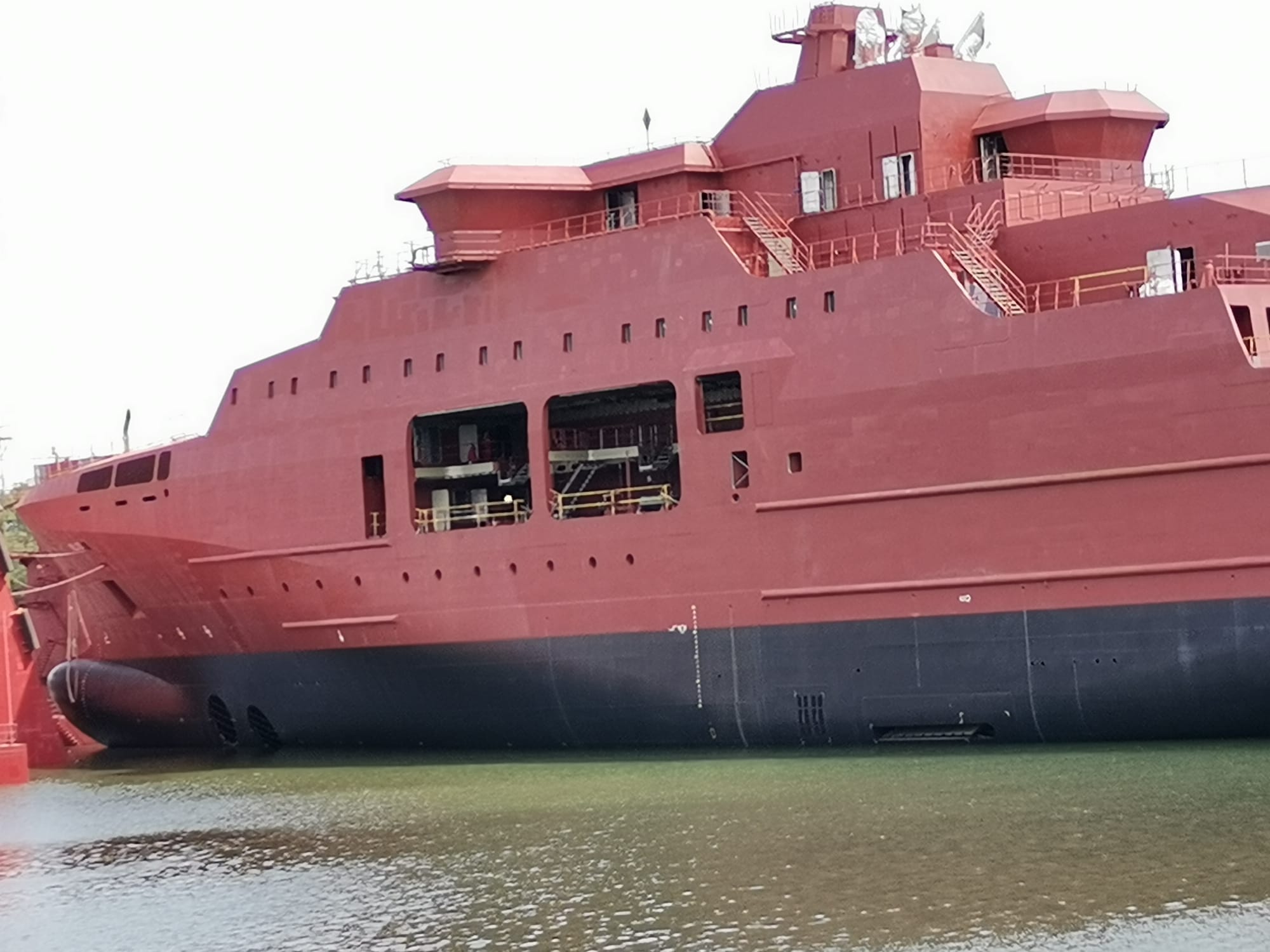
Canadian Coast Guard Multi-Purpose Icebreaker (MPI). Source: Seaspan Note: The MPI image does not show the right propulsors; it will use Steerprop’s contra-rotating propulsors (CRP). Additionally according to Seaspan, the design could easily be upgraded to PC3. Confirmation from Seaspan and Aker Arctic.
In April, Finnish newspaper Helsingin Sanomat published an article about negotiations between the U.S. Coast Guard and RMC to build a significant number of icebreakers, but the details were not subsequently confirmed. Before publishing this article, I reached out to RMC, Seaspan, and Aker Arctic for comments. As of press time, Aker Arctic and Seaspan responded, confirming many of the details in the article.
Arto Uuskallio, Head of Sales at Aker Arctic, commented via e-mail:
It’s natural that we are involved, since the MPI is an Aker Arctic concept, and it’s good to have a partner onboard who understands the possibilities and limitations of the ship concept. More detailed comments will likely come from the shipyards.
Dave Hargreaves, Seaspan’s Senior Vice President for Strategy, Business Development, and Communication, provided the following comments via e-mail:
We have consulted with many U.S. and non-U.S. shipyards regarding their readiness and aptitude to build the MPI design for the U.S. Coast Guard ASC program including Rauma Shipyard in Finland.
Rauma has a track record of delivering ice-capable vessels in less than 36 months — including recent programs. As a fully capable, end-to-end shipyard, Rauma is the lowest risk and best option to meet the 36-month requirement. Unlike other shipyards, Rauma has an active panel line and block fabrication facility that is ready to start production today — it does not require any further investment or ramp up in workforce to begin construction. This significantly lowers the risk of meeting the schedule requirement.
Together, with Rauma and Aker, Seaspan has developed a comprehensive plan detailing how we will work with a U.S. shipyard to transfer the design, knowledge, expertise and build plans to enable future ASC vessels to be built in the United States. This approach will deliver a comprehensive, U.S.-built ASC fleet for the U.S. Coast Guard while enhancing domestic icebreaker shipbuilding — avoiding the delays, costs and risks of long-term, high-investment alternatives.
I take his comment about schedule risk as a subtle dig at Davie/Helsinki Shipyard. I’ve been reading these press releases and comments long enough to see the back-and-forth, sometimes subtle, between Seaspan and Davie, and RMC and Helsinki Shipyard. I expect to read more of this, but am much more interested in tracking the progress of ongoing ship construction (such as the Canadian Polar Icebreakers being built by Seaspan and Davie) than in following their rhetorical barbs.
Helsinki Shipyard has an excellent track record of delivering icebreakers in less than thirty-six months, as I noted here.
Rauma Marine Constructions was unable to provide additional comments by publication time, but did say that more information would be coming out soon.
Thoughts and Comments
The Multi-Purpose Icebreaker is a solid design, and Rauma Marine Constructions is a capable shipyard with a solid track record. As my goal in writing about icebreakers has always been to assist the U.S. Coast Guard in getting the ships that it needs in a relevant timeline, I view the Seaspan/RMC/Aker consortium’s proposal as a positive development.
Davie does not comment on any of its ongoing negotiations, but it seems likely that it is offering its MPPS-100 to the U.S. Coast Guard to be built first in Helsinki Shipyard, and later (perhaps) in Texas.
The only announced player without any information about its proposed design is the United Shipbuilding Alliance created by Bollinger and Edison Chouest Offshore.
May the U.S. Coast Guard get the best ships for its needs in the shortest amount of time and at a good price! I’ll certainly be tracking all of these details closely.
Thanks for reading. Be sure to subscribe and share so that you never miss an update on this fast-moving and important topic.
“President Trump’s vast tax and spending bill has secured funds the U.S. Coast Guard has been searching for since the early 2010s. The “One Big Beautiful Bill Act” appropriates close to $9 billion for the expansion of the Coast Guard’s Arctic icebreaker fleet.”
The report provides a breakdown of the appropriations that includes money for Polar Security Cutters, Arctic Security Cutters, and infrastructure in Juneau to support USCGC Storis,
Interestingly it also states,
“Rounding out the Arctic package, the U.S. Navy will also receive $115 million for the exploration and development of existing Polar infrastructure.”
That sounds like improvements in Adak that the Coast Guard might also exploit. It might also refer to development of facilities at Nome but it is not nearly enough to fund plans for a deepwater port that had been shelved by the previous administration.
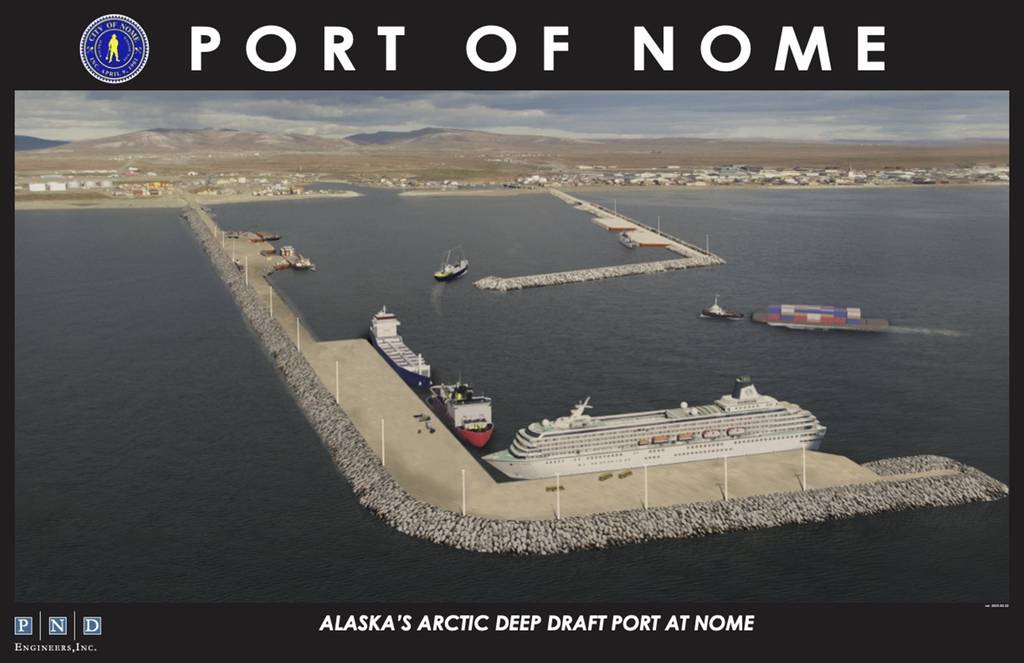
This rendering provided by the City of Nome shows how the Port of Nome, Alaska, will appear following an expansion project that will cost more than $600 million. Shipping lanes that were once clogged with ice for much of the year along Alaska’s western and northern coasts have relented thanks to global warming, and the nation’s first deep water Arctic port should be operational in Nome by the end of the decade. (PND Engineers Inc./City of Nome via AP)
Flexible patrol ship scale model on Danske Patruljeskibe booth at DALO Industry Days 2024.
Naval News reports that the Danish Navy is now planning to increase the armament of a proposed class of up to six ice strengthened patrol vessels. The design has not been finalized, but they have decided the security situation demands additional installed weapon systems.
The spouse of a Coast Guard Cutter Healy (WAGB 20) crewmember waves goodbye as the cutter departs Base Seattle for a multi-month deployment to the Arctic, June 12, 2024. (U.S. Coast Guard photo by Petty Officer 3rd Class Annika Hirschler)
Service life extension program for Coast Guard Cutter Healy will occur in a five-year phased production between 2026 and 2030. Healy is a 420-foot cutter, the service’s only active medium polar icebreaker, which was commissioned in 1999. When completed, the SLEP effort will recapitalize a number of major systems and extend the service life of the cutter until the polar security cutters are operational.
This sounds an awful lot like what was done to Polar Star over a five year period. Healy, like Polar Star, is based in Seattle, but Polar Star’s five year rolling Service Life Extension Program was not done in Seattle, it was done in Vallejo, CA. Vallejo is 776 miles from Seattle. These five phased Yard periods were extremely long, so the ship spent about half its down time far from home. I know they tried to mitigate the effect on the crew, but it had to be bad for crewmembers whose families were in Seattle.
I can’t help but think it would have been a good idea to change Polar Star’s homeport to Vallejo or Alameda (water depth at the Support Center permitting). Vallejo is a lower priced area than Seattle and there is property there from the old Navy shipyard that the city is still trying to develop. Pretty sure the city would be happy to have Healy homeported there.
If Vallejo was not possible, it is 31 miles from Vallejo to Alameda. That is not a particularly long commute in the Bay area, for the relatively short time the ship would be in Alameda, and there are relatively affordable places to live in between.
Is it going to be different for Healy?
I also notice this, that the SLEP is intended to “extend the service life of the cutter until the polar security cutters are operational.” Since Healy is nominally a medium icebreaker, I would have thought the Coast Guard would keep her in service until replaced by an Artic Security Cutter (medium icebreaker). Healy was commissioned in 1999, so I would have thought she would remain in service 40 years, until 2039. A SLEP ending in 2030/31 also suggests another ten years of life. Are we going to have to wait until 2039 for the Polar Security Cutters to be completed?
USCGC Storis, 2,030 ton Arctic Patrol Cutter (1942 to 2007).
A recent discussion in the comments of an earlier post, Canadian Coast Guard Multi-Purpose Vessel Recapitalization, led me to a sudden realization that every nation with a coastline in the Arctic, except the US, is building new ice strengthened patrol vessels.
Are we missing something?
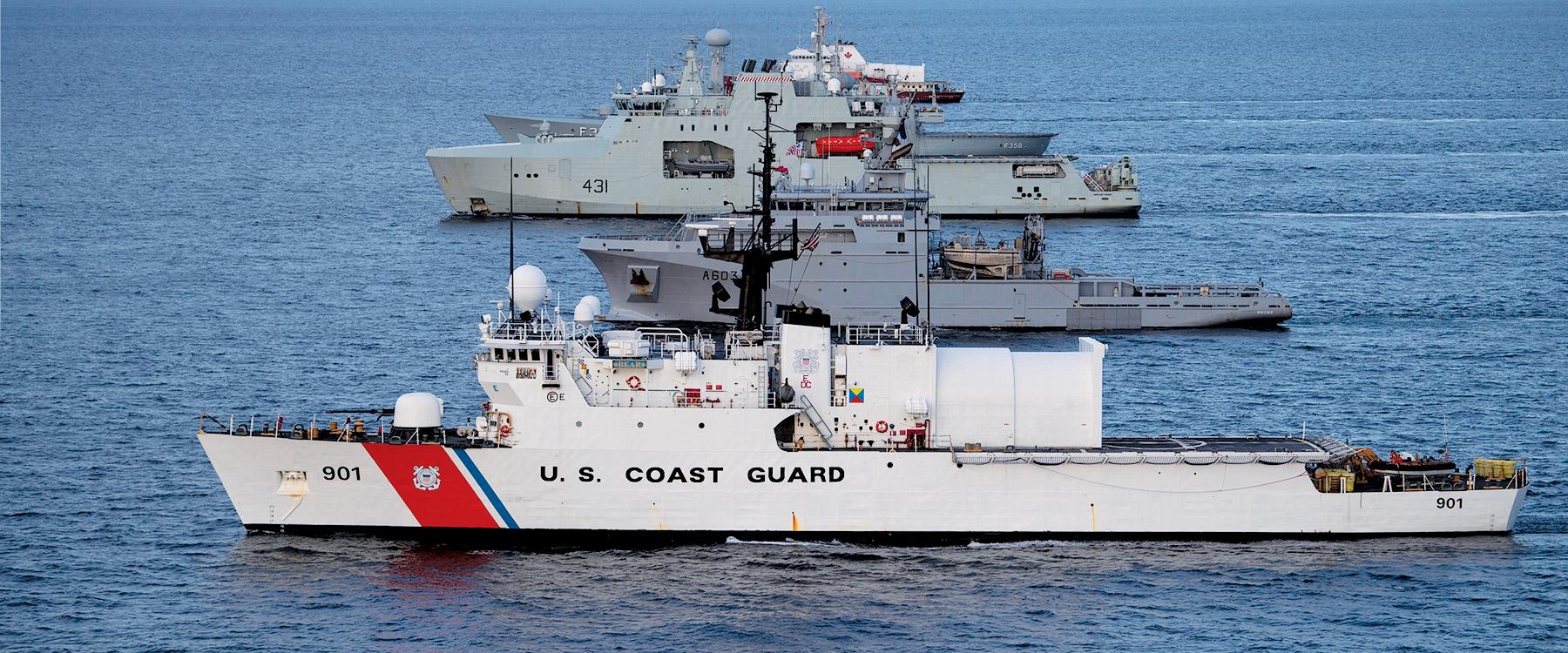
The USCGC Bear (WMEC-901) and allied ships from Canada, Norway, France, and Denmark steam in formation in the North Atlantic Ocean during Operation Nanook in August 2022.
These vessels may have some of the characteristics of icebreakers, but while intended to operate in an icy environment, they would be expected to spend a lot of time on solitary patrol rather than being used primarily to open ice covered waterways for other ships.
Now Canada, Denmark, Norway, and Russia–every nation with an Arctic Ocean coast except the US–are building ice-capable patrol vessels.
New programs, built, building or planned, are expected to produce five classes, a total of 25 ships (14 for Canada alone) that might be considered Arctic patrol vessels.
Canada:
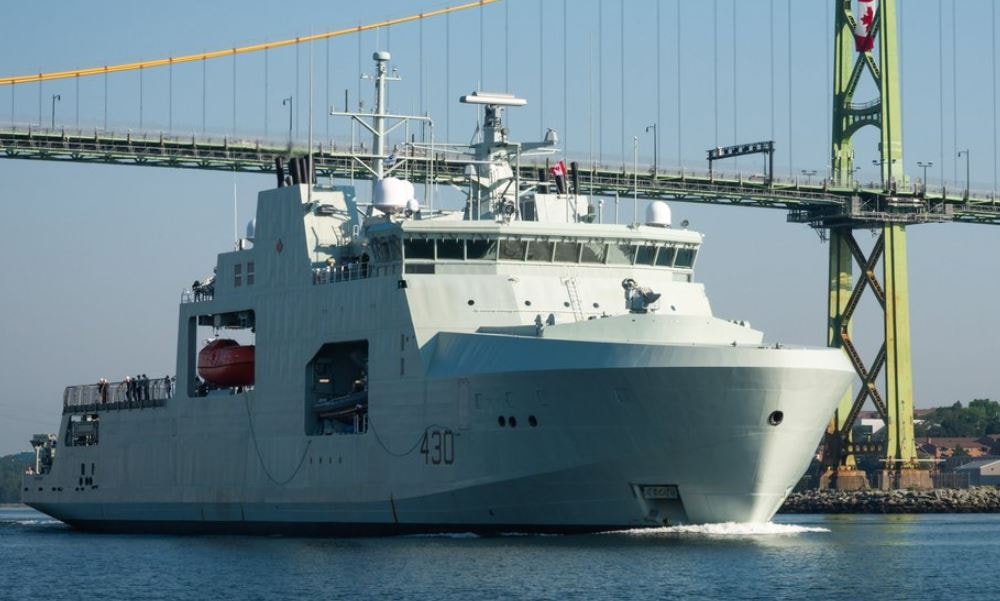
HMCS Harry DeWolf, leaving HMC Dockyard in Halifax and steaming under Angus L. Macdonald suspension bridge crossing Halifax Harbour in Nova Scotia, Canada
Canada is building a class of eight “Arctic Offshore Patrol Ships,” the Harry DeWolf class, six for their Navy and two for their Coast Guard. First of class was laid down in 2017. Four ships have been completed.
Displacement: 6,615 tons (full load)
Length: 103.6 m (339 ft 11 in)
Beam: 19 m (62 ft 4 in)
Draft: 5.7 m (18 ft 8 in)
Propulsion: Diesel electric, 4×3.6MW generators, two 2×4.5MW, twin shaft drive, total 12,000 HP.
Speed: 17 knots
They are Canadian Polar Class 4, meaning can maintain a speed of 3 knots through ice 4 feet thick.
—
Canadian CG MPV. Credit Aker Arctic.
Canada is also building six “Multi-Purpose Vessels” for the Canadian Coast Guard, that the USCG would probably classify as light icebreakers. I have no information on their speed or horsepower. They are also Canadian Polar Class 4 (speed of 3 knots through ice 4 feet thick. (I will refer to these as CCG MPV.) It might be debated that these are not really patrol vessels since the Canadian Coast Guard is neither a military nor a law enforcement agency. Their primary missions are icebreaking, buoy tending, and cargo, but the Canadian Coast Guard does provide transportation for Canadian law enforcement agencies.
Displacement: about 8,500 tons
Length, overall: 99.9 meters (328′)
Beam: 20.3 meters (66.7′)
Draft: 6.2 meters (20’4″)
Propulsion: diesel-electric; two azimuthing propulsion units
Range 12,000 nautical miles
Russia:
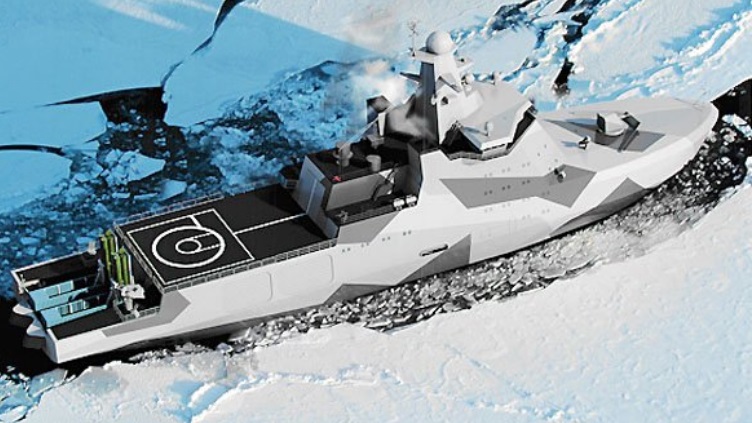
Project 23550, Ivan Papanin class icebreaking patrol vessel with towing capability and containerized cruise missiles.
Russia is building a class of small armed icebreakers, Project 23550. Four ships are planned, two for the Navy and two for the Russian Coast Guard. The first ship was laid down in 2017. None of the class have been completed.
Displacement: 8,500 tons (full load)
Length: 114 m (374 ft 0 in)
Beam: 18 m (59 ft 1 in)
Draft: 6 m (19 ft 8 in)
Propulsion: two 6,300-kilowatt propulsion motors for 16,800 HP
Speed: 18 knots
They are diesel electric with conventional twin shaft drive. They are designed to break ice up to 1.7 meters (5 ft 7 in) thick.
These ships have gotten a lot of press because they have been associated with use of containerized cruise missile systems. Such systems were also associated with the Project 22160 patrol ships, but in spite of the fact that all Project 22160 ships are based in the Black Sea, I have seen nothing to indicate they have actually been used as missile launchers.
The patrol, rather than icebreaker, character of this class is reflected in its length to beam ratio (6.33:1) which is greater than that of any of the other ships looked at here, with the exception of the Thetis class (7.8:1). That is also substantially greater than the length to beam ratios of Glacier (4.18:1), Healy (5.12:1), the Polar class (4.79:1), or Polar Security Cutter (5.19:1).
Otherwise, the Project 23550 ships seem to be logical successors of the Ivan Susanin class of eight small military icebreakers that date back to the 1970s.
Norway:
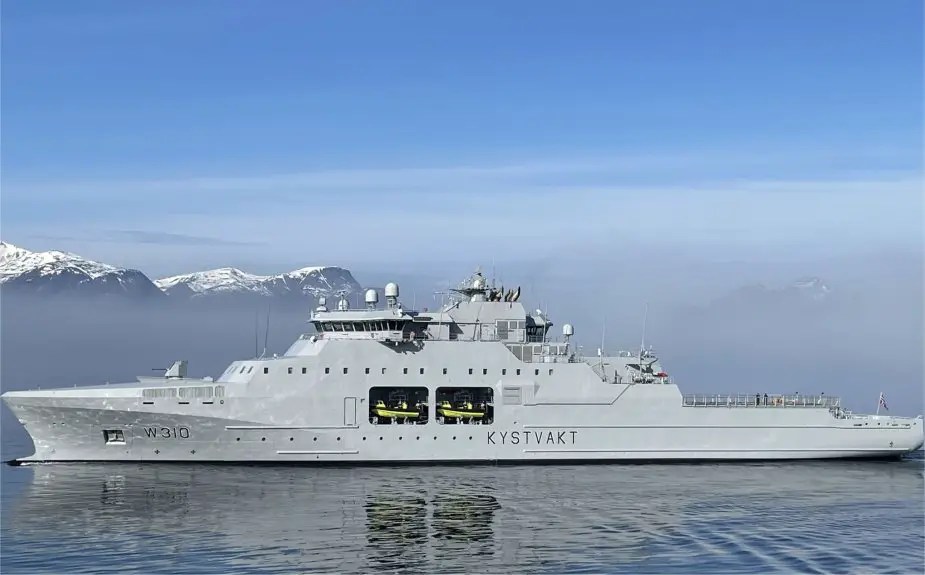
Jan Mayen class Offshore patrol vessel Jan Mayen. (Picture source: Vard)
Norway is completing a three-ship class of ice capable Offshore Patrol Vessels, the Jan Mayen class. The first was laid down in 2020 and at least two are already commissioned, with the third expected this year.
Displacement: 9,800 tons (Standard, full load will be greater. These are big OPVs.)
Length: 136.4 meters (447.4 ft) loa
Beam: 22 meters (72.16 ft)
Draft: 6.2 meter (20.3 ft)
Speed: 22 knots.
They are expected to hangar two NH90 helicopters (10,600 kg/23,370 lb max take-off weight) with deck space to land an AW101 (14,600 kg/32,188 lb max TO weight). They are expected to have an endurance of eight weeks, accommodations for 100, collective CBRN protection, and space for containers on deck. (See late addition at the end of the post for more details.)
Denmark is in the preliminary stages of designing a replacement for their Thetis class ice capable frigates. Earlier reports had indicated a consortium has been selected to design and build vessels of a new class (pictured above) referred to as the MPV-80, a design intended to be “future proof” by the incorporation of modular systems. Later information seems to indicate no particular design has been chosen.
Trends:
I was curious to see if there were evolutionary changes over time in this type of ship. Chronologically, based on the “laid down” date of the first ship of class, from earliest to latest for which we have data, the order is:
First Group
Thetis (Denmark), 1988
Svalbard (Norway), 2000
Knud Rasmussen (Denmark), 2005
Protector class (New Zealand), 2005
Second Group
Harry DeWolf (Canada), 2016
Project 23550 (Russia), 2017
Jan Mayen (Norway), 2020
Canadian CG MPV, TBD
Thetis class replacement (Denmark), TBD
We have four new designs to look at. As with the earlier group, some seem more closely related to icebreakers (Svalbard, Harry DeWolf, Project 23550, and CCG MPV classes) while others are more conventional OPVs with adaptations for operating in ice.
Let’s look at how the new members of the two groups compare with their older counterparts.
Size
There has not been a lot of change in size between Svalbard (Norway), 6,375 tons, the only near icebreaker in the earlier group, and her newer Canadian and Russian counterparts. In fact, the Harry DeWolf class is, in some ways, a simplified version of the Svalbard design. The CCG MPV and Russian Project 23550 ships will be about 28.5% larger than the Svalbard. On the other hand, the Project 23550s and CCG MPV can be seen as 229% larger than the Ivan Susanin class of the late 70s, about 30% larger than the Wind class icebreakers of the 1940s, or almost exactly the same size as USS/USCGC Glacier, commissioned in 1955. They are only a little over half the size of USCGC Healy, and about 37% the size of the Polar Security Cutter.
Norway’s 9,800 ton Jan Mayen class, as the only new non-icebreaker example we have for an Arctic Patrol Cutter, represents a big jump in size from the earlier group, 2.8 times as large as the Thetis class, 5.2 times as large as the Protector class, and 5.7 times larger than the Knud Rasmussen class. Also, about 15% larger than the largest of the icebreaker style designs, the Project 23550s and CCG MPV. It should be noted that the Jan Mayen class will not replace the Svalbard, they are replacements for the Nordkapp class ice-strengthened patrol frigates, which were 3,200 tons full load. (See the late addition note at the end of the post. The Jan Mayen class bow does seem to have been designed to break ice.)
Speed
Here we see significant differences between the icebreaker group and the rest. All the icebreaker patrol ships have speeds between 17 and 18, with almost no difference between Svalbard (Norway, 2000) 17.5 knots, Harry DeWolf (Canada, 2016) 17 knots, and Project 23550 (Russia, 2017) 18 knots.
With the exception of the Knud Rasmussen class, (Denmark, 2005) 17 knots, which is a minimalist design, the non-icebreaker patrol ships show remarkable consistency, Thetis (Denmark, 1988), Protector class (New Zealand, 2005), and Jan Mayen (Norway, 2020) all have top speeds of 22 knots.
Propulsion
All the icebreaker designs are diesel electric, but while the Svalbard is powered by Azipods, the newer Harry DeWolf and Project 23550 designs use twin conventional shafts. The CCG MPV seem to replicate the Svalbard’s basic design.
All the older non-icebreaking patrol ships use geared diesel propulsion. The Danish Thetis and Knud Rasmussen classes using single shaft propulsion; the Protector class has twin shafts. The newer, much larger Jan Mayen class have three screws including a center shaft and what appear to be Azipods providing the outer propellers.
Norwegian Jan Mayen class OPV under construction showing its three propellers, a conventionally shafted prop on the centerline and two rotating units. In addition, there is a rudder behind the centerline pro to allow directional control when the trainable units are idling.
Aviation
All eight of the classes of ships have flight decks and only the small Knud Rasmussen class lack a hangar. Only the newest and largest, the Jan Mayen class has provision for hangaring two helicopters (NH-90s). The Jan Mayen class also has a torpedo magazine for storage of helicopter weapons.
Weapons and Add-On Systems
There seems to be no particular trend in how they are armed as built. Three classes are equipped with 76mm guns, the Thetis and Knud Rasmussen classes from the earlier group and the Russian Project 23550 class from the newer group. Two classes are equipped with 57mm guns, the Norwegian Svalbard and Jan Mayen classes. Two classes are equipped with 25mm guns, the older New Zealand Protector class and the newer Canadian Navy Harry Dewolf class. The Canadian Coast Guard Harry DeWolf and CCG MPV classes, like all Canadian CG cutters is essentially unarmed.
Most of these ships include some provision for upgrades using modular or containerized systems. Even the oldest Danish ships incorporated the StanFlex system, that allowed addition of weapons including AAW and ASuW missiles and ASW torpedoes. The Russian Project 23550 has the reported ability to accept containerized cruise missiles. The Canadian Harry DeWolf class have tested use of a “Towed Reelable Active Passive Sonar” TRAPS. It appears that when Denmark does choose a design for their next class, it will incorporate even more flexibility using the SF Defense “Cube” system.
It should be noted that all of these designs, with the exception of the CCG MPV, were done before the Russian invasion of Ukraine set Europe on edge and before China became a “near Arctic power.” It appears, Denmark is determined that their Arctic Patrol Ship will be upgradable to a credible combatant.
Conclusions:
While the US plans to build medium icebreakers for Arctic patrol, the other four Arctic nations, that have been patrolling Arctic waters for decades are building different types of ship.
We still see both Arctic patrol vessels that include strong icebreaker characteristics and some that do not. (See the late addition note at the end of the post. All the new arctic patrol vessels have icebreaker characteristics.) Maximum speeds have not materially changed, ranging from 17 to 22 knots. Clearly, they value good aviation facilities with preferably at least two aircraft, at least one helicopter and a UAS or second helicopter.
I have to believe the Norwegian Jan Mayen and the Russian Project 23550 represent the latest thinking on an Arctic patrol ship. The Canadian Harry Dewolf class is not much of a departure from the Norwegian Svalbard, and patrol was not a primary driver in the design of the CCG MPV.
The Norwegians have had a decade and a half experience with the Svalbard and apparently decided one icebreaker was enough. They had almost four decades of experience with the Nordkapp class before designing the Jan Mayen.
The Jan Mayen will certainly be able to go anywhere fishing vessels or other non-icebreakers will be able to go in the Arctic. Still, I think they may regret not giving the ships an icebreaker bow. (A second look shows that the Jan Mayen does have a bow designed for icebreaking. See late addition note at the foot of the post.)
The Jan Mayen design might have been a bit different if it had been designed after the Russians attacked Ukraine.
The Project 23550 design is fairly conservative and probably relatively inexpensive. Compared to the preceding Ivan Susanin class, it is more than twice as large, 8,500 vice 3,710 tons; much longer, 374 vice 230 ft; faster, 18 vice 15.4 knots; but perhaps not as well armed if not equipped with containerized cruise missiles. While the project 23550 has a single 76mm gun, the older ships were armed with a twin 76mm and two 30mm Gatling guns. Notably the project 23550 has no credible defense against cruise missile or even UAS. Like all these ships, it was designed before the Russian Navy experienced combat in the Black Sea against Ukraine.
Reflection:
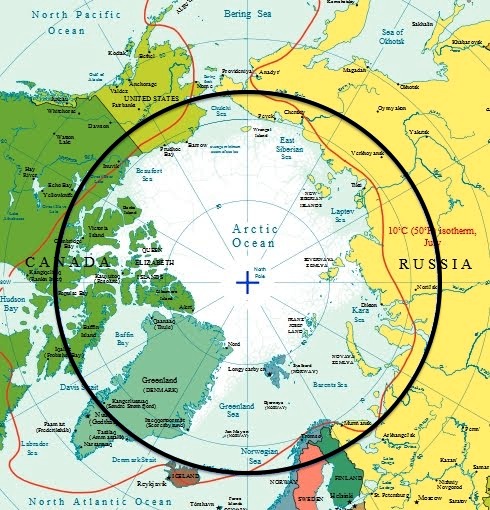
(In the comments below, when I say Arctic, I refer to the area North of the Arctic Circle. There are other definitions.)
The US icebreaker fleet is frequently compared to that of Russia, but the economic case for icebreakers for service in the Arctic for those two nations is completely different. The Russian economy is heavily dependent on mineral extraction from the Arctic. They have a relatively large population in the Arctic. They have several ports in the Arctic from which the minerals are shipped. They need icebreakers to keep those ports open and keep the minerals moving to export markets. Most of their icebreakers operate for commercial purposes. The Russian Navy and Coast Guard operate only a few light icebreakers.
If we compare our icebreaker fleet to that of other Arctic nations, we see an entirely different picture.
Canada has more interests in the Arctic than the US, though much less than Russia. They have a lot more area, and I believe a larger population in the Artic than the US. Their fleet of Polar icebreakers is nowhere near as large as large as that of the Russians. While they have a fairly large number of what the USCG would call light icebreakers, some of which operate in the Arctic during the summer, they have only a couple of what the USCG would call medium icebreakers. They do intend to build a couple of what the USCG would call heavy icebreakers, but currently they have none.
The Mainland of Norway extends about as far north as the Northern most parts of Alaska (71degrees 17′ 26″N). In addition, they administer the Arctic island archipelagoes of Jan Mayen (71 degrees N) and Svalbard (74-81 degrees N), but the Norwegian Navy and Coast Guard operate only one icebreaker, the Svalbard, which the USCG would consider a light icebreaker.
Denmark administers Greenland, most of which is in the Arctic. Cape Morris Jesup, the most northerly point in Greenland is only 383.4 nautical miles (710 km) from the North Pole, while the most northerly point in Alaska, Utgiagvik (formerly Pt. Barrow) is 1127 nautical miles from the Pole, but the Danish Navy has no icebreakers at all.
What does this mean for the US Coast Guard?
The US Coast Guard has not built nor operated any patrol vessels specifically for the Arctic since USCGC Storis was decommissioned in 2007 (commissioned 1942). Storis was one of the ships intended to be replaced by the Deepwater Program of Record.
The Coast Guard has recognized a growing need for presence in the Arctic for SAR, fisheries protection, and potentially pollution response. Currently it appears these missions will go to the planned new class of medium icebreakers, the “Arctic Security Cutters.”
The Arctic Security Cutters are likely to be large, complex, and expensive ships similar to Healy, but I have also seen reference to the need for shallow draft.
For fisheries protection and SAR, the Coast Guard needs the ability to go wherever fishing vessels are likely to go. On the other hand, significant frequent commercial traffic over the length of the Northwest Passage is unlikely, and if it develops, that would be primarily Canada’s responsibility.
It seems we could build two or three light icebreaking Arctic Patrol Cutters of less than 10,000 tons for the price of one medium icebreaker. It is true that they might not be able to go everywhere a medium icebreaker could go, but they could go where most of the missions require. Even light icebreakers can be remarkably capable. Svalbard has made it to the North Pole several times and took over recovery of research buoys for Healy when she had a major machinery casualty. Even little Storis, with only 1,800 HP, transited the Northwest Passage. A Harry DeWolf class also transited the Northwest Passage as part of a circumnavigation of North America.
Perhaps the Coast Guard should consider if perhaps one more Heavy Icebreaker and a number of Arctic Patrol Cutters with light icebreaking capability might be both cheaper and more effective than a new class of medium icebreakers. Given the difficulties we have had with the Polar Security Cutter program, it might also be quicker way to get more Arctic presence.
Late addition:
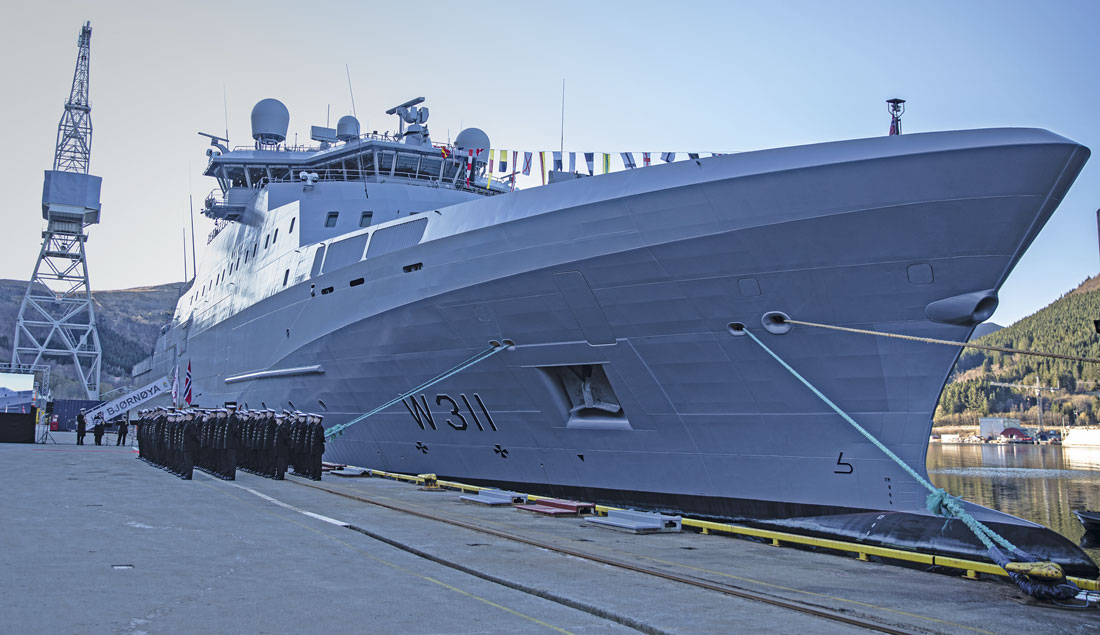
I ran across a diagram of the Knud Rasmussen class after writing the post above and found that the class has the cutaway bow typical of icebreakers. That made me wonder if perhaps I had misjudged the shape of the Jan Rasmussen class bow, so I took another look. If you click on the photo below and look closely at the bow below the waterline you will see that while it is a bulbous bow, the bottom of the bulb is the spoon shape typical of modern icebreakers.
The USCG might do well to buy and build the Jan Mayen design with minimal changes. They may actually have enough horsepower to be considered medium icebreaker, though they are probably much different from what the Coast Guard has been thinking of for their Arctic Security Cutter.
I would also hope that we would apply a sense urgency to the program and not wait until the Polar Security Cutter program is finished.
Jan Jayen forward.“Another photograph of Bjørnøya shows how there’s a sharp “ridge” on top of the bulbous bow. That should help splitting the floes before they come in contact with the stem.” –Tups
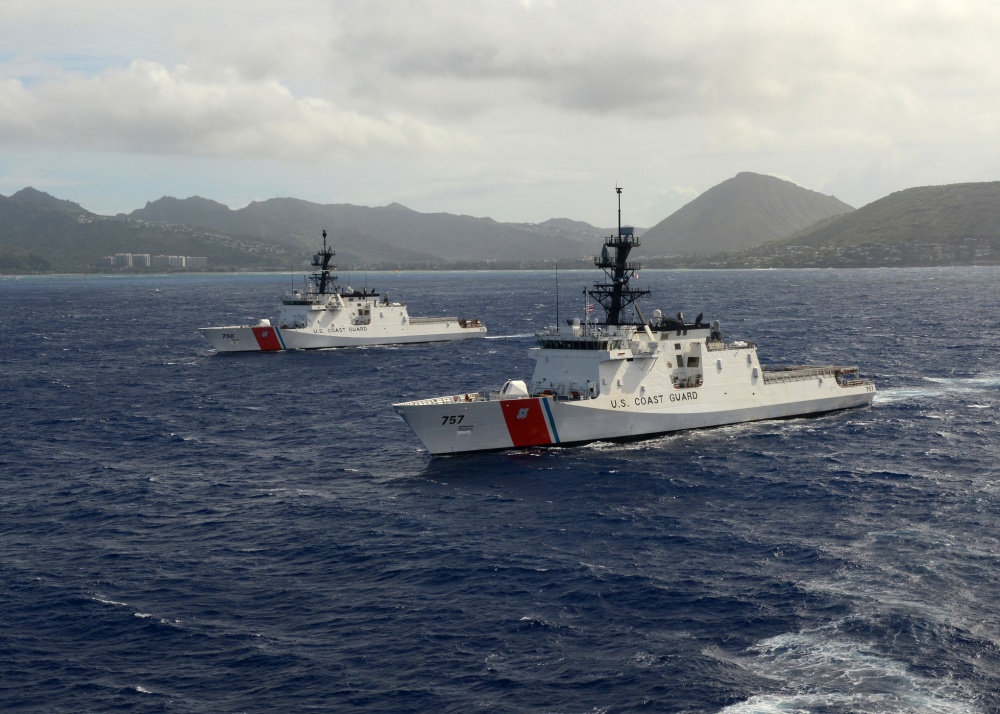
The crews of the Coast Guard Cutters Midgett (WMSL 757) and Kimball (WMSL 756) transit past Koko Head on Oahu, Hawaii, Aug. 16, 2019. The Kimball and Midgett are both homeported in Honolulu and two of the newest Coast Guard cutters to join the fleet. (U.S. Coast Guard photo by Petty Officer 3rd Class Matthew West/Released)
Sorry, this is late. I got bogged down in details. So, this is a streamlined commentary, but I hope still relevant.
The December 2023 issue of US Naval Institute Proceedings has an article by Lieutenant Brian Adornato, U.S. Navy Reserve, suggesting it is time to consider designing a replacement for the Bertholf class National Security Cutters.
He points out that, based on the history of the Offshore Patrol Cutter and the Polar Security Cutter, it now typically takes 14 years from project initiation to commissioning.
“The Coast Guard began discussions with industry regarding the medium-endurance cutter replacement, the offshore patrol cutter (OPC), in 2010. The first OPC is scheduled to commission in 2024.2 The initial integrated product team for the next heavy ice breaker, the polar security cutter (PSC), was assembled in 2013, and the first ship is scheduled for delivery in 2028.3 The first NSC was commissioned in 2008 with a service life of 30 years, so the Coast Guard must start the process now to field the NSC(X) in 2038.
The Coast Guard is going to have to change its behavior if we are going to start replacing National Security Cutters (NSC) when they are “only” 30 years old. But even if we don’t, that doesn’t mean we should not be considering new cutter designs.
The first NSC was commissioned more than 15 years ago so its concept and requirements really originated more than 20 years ago and there is still one more ship that has not been delivered yet.
The OPCs’ concept was firmed up more than 10 years ago and the last is not expected to be delivered until 2038. That would be more than 25 years from concept to deployment of the last ship. I don’t think it will happen. I don’t think it should happen. It would be putting our collective brains on cruise control.
Instead, we should periodically reevaluate. One design may not be the most economical way to meet all our needs where weather, endurance, speed, and facilities vary from location to location. Trying to meet the most demanding requirements of every possible environment may preclude building enough ships to do all the missions well.
We know the Coast Guard has completed a new Fleet Mix Study. It has not been made public, but you can bet it suggests we need more large patrol ships. The original 2009 Fleet Mix Study indicated we would need 66 large cutters (NSCs and OPCs) to meet all our statutory mission requirements, and if anything, our commitments seem to have increased.
In 2000, when the program of record was being formulated, the Coast Guard had 44 patrol ships of six classes, each over 1000 tons full load. (12 x 378s, 13 x 270, 16 x 210, Alex Haley, Acushnet, and Storis).
Ships were distributed in recognition of their relative strengths and weaknesses. Stout, very sea worth, but relatively slow ships, Alex Haley, Acushnet, and Storis were based in Alaska to do fisheries patrol. 10 of 12 WHEC378s were assigned to the Pacific to take advantage of their long legs and seakeeping to conduct Alaska Patrol and deal with the great distances in the Pacific. 210s were generally assigned to where the weather was more benign, so that their small size was not a significant disadvantage. 270s, more seaworthy than the 210s, but not really suitable for Alaska Patrol, were generally assigned to more Northerly East Coast homeport from which they did fisheries and drug enforcement.
The original Program of record would have provided only two classes totaling 33 large patrol ships (8 NSCs and 25 OPCs). Congress has added three NSCs so it looks like we are working toward 36 (11 NSCs and 25 OPCs)
Once the announced decommissionings are completed, looks like we will have 33 (10 NSCs, 13 x 270s, Alex Haley, and 9 x 210s). I don’t expect any numerical increase as the last NSC and OPCs are completed and WMECs are decommissioned. Certainly, if we proceed as planned, we can’t expect to have even 36 until the completion of the OPC program in 2038.
The last Fleet Mix Study did not attempt to identify minimum requirements for different mission sets, rather it considered using only the NSC, OPC, and FRC as possible alternatives. This meant that the cutters might be “over qualified,” for specific missions and locations, because alternatives with different sets of characteristics were not considered. Being overbuilt may not sound like a bad thing, but if it means you can’t build as many ships as you need, it is.
The out years on the contracts we have are options. If the Coast Guard determines that it would be better served by contracting for a different design in the out years, the Coast Guard is free to do so, and, at this time, there are not even options for the last ten OPCs.
We know change is the only constant. Demands on the Coast Guard change. What the Coast Guard does changes. Technology options change. Threats change. I would argue the Defense Readiness mission has taken on increased urgency.
We need to reevaluate periodically. We really should have at least two broad classes of patrol cutters, the larger more capable ship that can operate in the most demanding environments and a second more numerous type to operate in the more typical circumstance. You can’t really say that is the case if we only have NSCs and OPCs, their size and capabilities are too similar. I am not a particular fan of the HEC/MEC designations, but it is a familiar construct that conveys the idea (why not WPL and WPM, Coast Guard Patrol Large and Patrol Medium).
Designs need to be reevaluated at least every ten years, we might decide to continue to build what we are building, but that should be a conscious decision, not just sleepwalking.
We could do it as rotating five year programs. I would suggest we need a true medium cutter than can be built in larger numbers than the OPC first and then look at designs for a new large cutter. That would still give us time to go through all the steps that seem to be necessary to design and contract for a ship.
The designs of the NSC and OPC were about ten years apart and it has now been more than ten years since the design of the OPC. We should not let our design and contracting skills atrophy. It is time to at least start the process to see if we cannot come up with a better design to address our changing requirements.
We should never stop building patrol cutters. I suspect we need more than 60. We really should be producing two per year, either one large patrol cutter and one medium patrol cutter or two medium patrol cutters every year.
Thought I would share this video. Found it on a SeaWaves post, Patrolling Greenland on Denmark’s HDMS Triton. HMDS Triton a Thetis class patrol frigate. These ships do Coast Guard type work in or near the Arctic. It is a type of ship that you will not find in the Coast Guard fleet, but one that we may want to add in the future. It is ice strengthened. As a ship that operates in an area where icing is common. its ground tackle (anchor handling equipment) is below the foc’sle deck, and its boats and boat handling gear can be enclosed. The crew is relatively small (I think they are double crewed to get more underway time), but additional berthing is available, and weapons can be added using the Stanflex system.
Arctic (orthographic projection) with national borders and land highlighted. Credit Heraldry, Isochrone, via Wikipedia, 23 July 2023.
Below is the narrative that accompanied the YouTube video.
The Arctic region is the gateway to the North Atlantic. For NATO and its Allies, maintaining a strong presence here is vital to protect trade, transport and communication links between North America and Europe.
As climate change causes the polar ice caps to melt and the sea levels to rise, new sea routes are beginning to emerge, which could present a threat to Euro-Atlantic security. Greenland is considered by scientists to be ground zero for climate change. Along with the Faroe Islands, it forms part of the Kingdom of Denmark and is therefore under Danish military protection. That protection falls to the Joint Arctic Command, or JACO, a Danish-led operational command with a central headquarters in Nuuk, Greenland’s capital.
Join the Danish Armed Forces in Greenland, at sea, in the air and on land, to discover more about how security might be affected in this region and learn about the capabilities and experience NATO Ally Denmark has in the North Atlantic area.
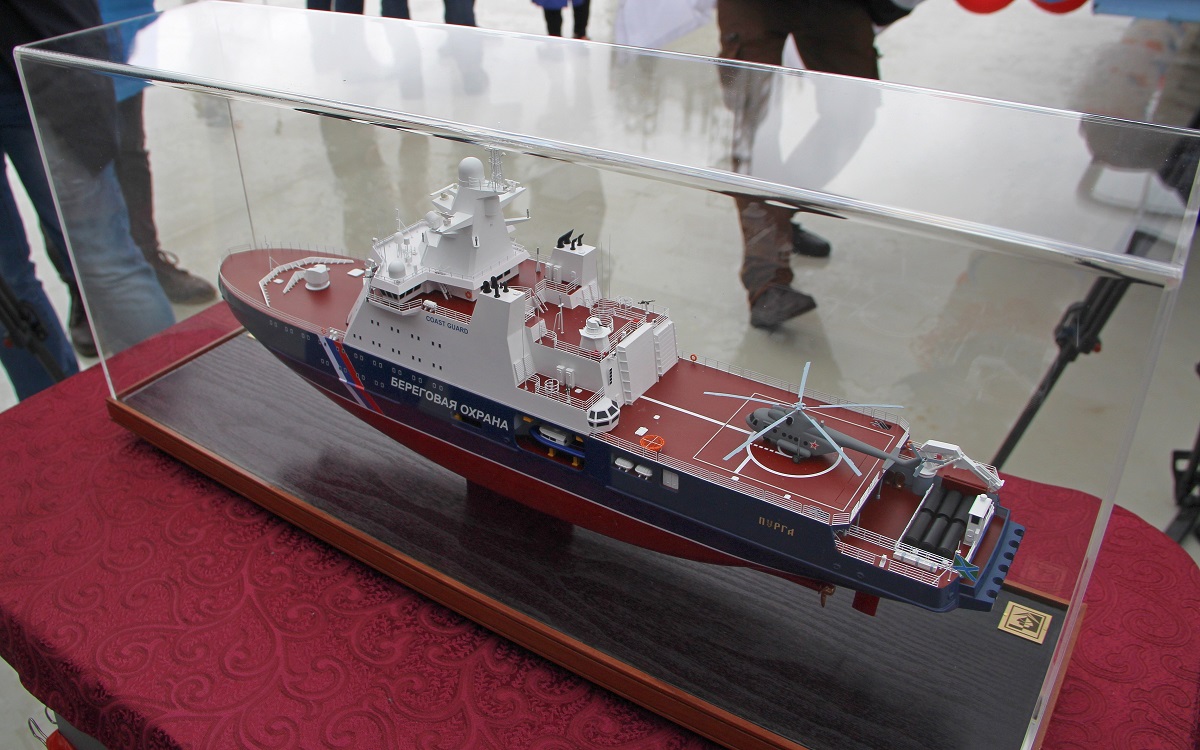
Official scale model of the Project 23550 ice-class patrol ship “Purga” for the Russian Coast Guard presented during the commissioning ceremony. Picture by Curious / forums.airbase.ru
Naval News reports the launch of a 9,000 tons, 114 meter icebreaker patrol ship for the Russian Coast Guard.
We have talked about this class before. Artist depictions of the class mounting containerized Kalibr cruise missile systems caused a bit of a stir, but we have yet to see containerized weapons on this class, nor have we seen Kalibr launched from containers against Ukraine. At this point, Russia may not have enough missiles to fully outfit its more capable combatants.
This is the first of the class for the Russian Coast Guard. The first two ships of the class were for the Russian Navy.
As I noted earlier, I really don’t think we need to mirror the Russian capability to put containerized missiles on our icebreakers, but the Polar Security Cutters will be valuable, almost irreplaceable auxiliaries, and unlike the Russians, we have very few icebreakers, so we need to be able to quickly upgrade their defensive capabilities.
These ships are in many respects similar to the Canadian Arctic Offshore Patrol Ships, but they are reportedly slightly faster at 18 knots and much better armed–but only to a level similar to the OPCs, unless containerized weapons are added. I expect our Artic Security Cutters may be more like these than the Healy, though they probably will be larger than the Russian ships.
USCG Cutter Bear transits out of Torngat National Park, Canada, on Aug. 9, 2022. The Bear was partaking in the Tuugaalik phase of Operation Nanook, an annual exercise that allows the United States and multiple other partner nations to ensure security and enhance interoperability in Arctic waters. (Matthew Abban/U.S. Coast Guard)
This isn’t through the budgeting process, but it is more indication of the Congress’ bipartisan support for the Coast Guard. Seems likely much of this will be incorporated in the final budget.
Stars and Stripes reports on action by the Senate Committee on Commerce, Science and Transportation, that would provide money for the third Polar Security Cutter, establish an Arctic Security Cutter program, and provide “more options for child care, better access to affordable housing and expanded medical care and education opportunities…”
The bill would authorize $14.94 billion for the service for fiscal 2023, which begins Oct. 1. It would amount to a 21.5% budget increase from fiscal 2021.
The bill would support greater Arctic presence, combat IUU fishing, and improve polution response.








 Chuck Hill's CG Blog