“Arctic Council boycotts Russia meetings over Ukraine invasion” –The Watch

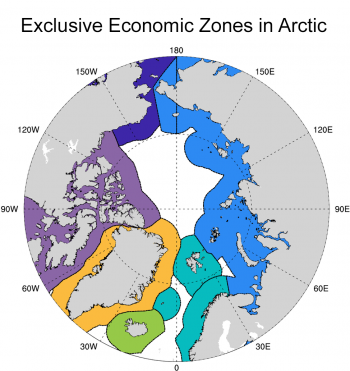
This map show the exclusive economic zones (EEZs) within the Arctic: Canada (purple), Greenland (orange), Iceland (green), Norway (turquoise), Russia (light blue), and USA (dark blue). As sea ice reduces there will be more opportunity for ice to drift from one EEZ to another, which has implications for the potential spread of pollutants.
Credit: DeRepentigny et al., 2020

This looks important. NORTHCOM’s online magazine “The Watch” reports,

Countries of the Arctic Council declared March 4, 2022, they would boycott future talks in Russia over its Ukraine invasion, throwing international cooperation in the region into upheaval at a time when climate change is opening it up to resource exploitation.

The countries — Canada, Denmark, Finland, Iceland, Norway, Sweden and the United States — said they were suspending their work indefinitely and would skip planned talks in May 2022 in the northern Russian city of Arkhangelsk due to Moscow’s “flagrant violation” of Ukraine’s sovereignty and territorial integrity.

While the action is perfectly justifiable, and marks unity between the non-Russian Arctic nations, unfortunately, it further isolates Russia and cuts another line of communications.

“THERE’S A RACE FOR ARCTIC-CAPABLE DRONES GOING ON, AND THE UNITED STATES IS LOSING” –Modern War Institute

Modern War Institute alerts us to the limitations of US drone technology in the Arctic.

“America’s drones struggle to compete against Russia in the Arctic. In 2019, Russia’s equivalent of the Defense Advanced Research Projects Agency announced a drone capable of remaining airborne for four consecutive days in the Arctic. Russian state sources report their drones can navigate in the Arctic without the use of jammable satellite-based navigation instead employing the alternative GIRSAM system. While the processes behind this system are unknown, supposedly it does not rely on GPS satellites or those of the Russian-developed GLONASS. Not until 2021—two years later—did an American MQ-9A Reaper drone complete a flight navigating with satellites past the seventy-eighth parallel north. Additionally, Russia plans to build an Arctic drone reconnaissance base four hundred and twenty miles off the Alaskan coastline. By 2025, the ability of Russian drones to monitor air, surface, and subsurface activity will far outpace the United States in the Arctic region.”

This is certainly an area the Coast Guard is interested in and one where the Coast Guard’s assets can be of assistance.

“From Chinese ambition to Saami tradition, an Arctic snapshot” –The Watch

A small-boat crew from the U.S. Coast Guard Cutter Alex Haley medevacs a man from the Chinese research vessel Xue Long, 15 nautical miles from Nome, Alaska, in 2017

NORTHCOM’s on-line magazine, “The Watch,” reports on a conference on the Arctic. This is a follow-on to an earlier post.

The Watch report looks at China’s interests and roles in the Arctic and a perspective from a representative of indigenous peoples in the European Arctic.

“An Arctic presence grows more important for U.S. and its partners” –The Watch

This map show the exclusive economic zones (EEZs) within the Arctic: Canada (purple), Greenland (orange), Iceland (green), Norway (turquoise), Russia (light blue), and USA (dark blue). As sea ice reduces there will be more opportunity for ice to drift from one EEZ to another, which has implications for the potential spread of pollutants.
Credit: DeRepentigny et al., 2020

NORTHCOM’s on-line magazine, The Watch, has a short post about the Arctic.

I would note that most of the discussion centers on the Atlantic side of the Arctic, whereas the Coast Guard concentration has primarily been on the Pacific side. We have seen some indications there may be Coast Guard Arctic capable assets on the Atlantic side in the future. Not too early to think about that.

The Coast Guard has had good relations with the Russians in the Arctic because of a common interest in fisheries, SAR, and environmental protection. That is all to the good. At some future date, the Coast Guard will probably do a Freedom of Navigation Exercise through the at least parts of the Northern Sea Route. Hopefully we can find ways to, perhaps, disagree amicably as we have with the Canadians in regard to the Northwest Passage.

“U.S. Coast Guard cutter completes North American circumnavigation” –The Watch

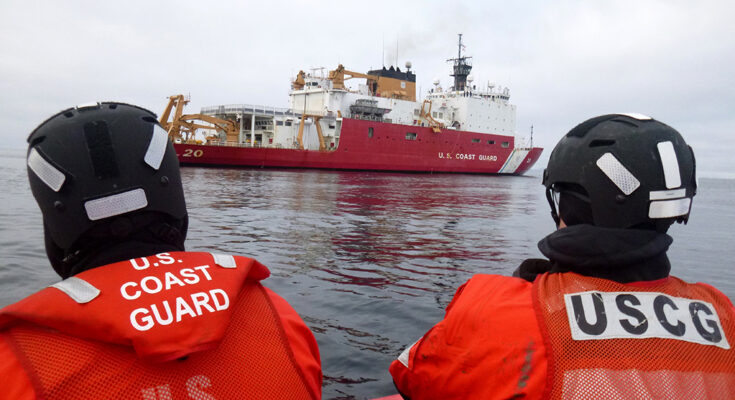
The NORTHCOM website, “The Watch” reports on USCGC Healy’s circumnavigation of North America.

There is a related story at MyCG about Polar Regions Technology Evaluation (PRTE), “Coast Guard research aimed at improving performance at high latitudes.” It includes some information about what Polar Star is doing.

“WEB EXCLUSIVE: Q&A With Adm. Karl Schultz, Commandant of the Coast Guard” –National Defense

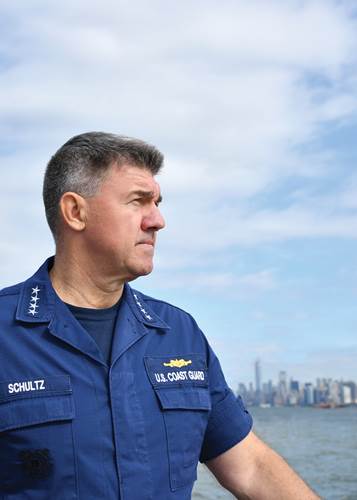
Coast Guard Commandant Adm. Karl Schultz. U.S. Coast Guard photo by Petty Officer 1st Class Jetta Disco.

National Defense has an interview with the Commandant. There is a lot of discussion about COVID and how the Coast Guard has adapted to the reality of annual continuing resolutions (CR).

There is a good deal of discussion here about icebreakers. Polar Security Cutter construction is the program most effected by COVID and the first of class is now not expected until 2025. The Commandant actually wants more than six icebreakers, perhaps as many as nine, including some for the Atlantic side, more than three PSCs, and (for the first time I have heard this) we are also looking at something less than a medium icebreaker.

 “I’ve been having a conversation for most of my tenure that we really need a minimum of six icebreakers. Of that six, three will be Polar Security Cutters. We’ll have a hot production line, I hope that conversations is really about more than three Polar Security Cutters, but we’re also talking about maybe something a little less than a medium icebreaker. We’ve done some work at the behest of the last National Security Council in the Trump administration that has played forward for this administration. They seem very interested. So, I think we’re having the right conversations about a fleet of maybe six or nine that can work in the high latitudes both the High North and down in Antarctica.”

There was brief discussion of armament for the icebreakers. The Commandant noted that the PSC design included space, weight and power for upgrades (type unspecified), but no intention to make those upgrades now. There was no mention of Antarctica in that discussion.

There is a discussion about the Coast Guard in the Western Pacific in regard to both the Webber class FRCs and deployment of National Security Cutters to the far Western Pacific.

The interviewer seemed to be pushing the Commandant to acknowledge that the hardware elements of the Deepwater program were essentially complete. The Commandant’s response was more muted, noting that the Offshore Patrol Cutters are the “backbone” of the recapitalization and that program has essentially only just begun.

There was only one question that mentioned unmanned systems and the Commandant’s response made no mention of them. There was also no discussion of replacement of the H-65s with H-60s.

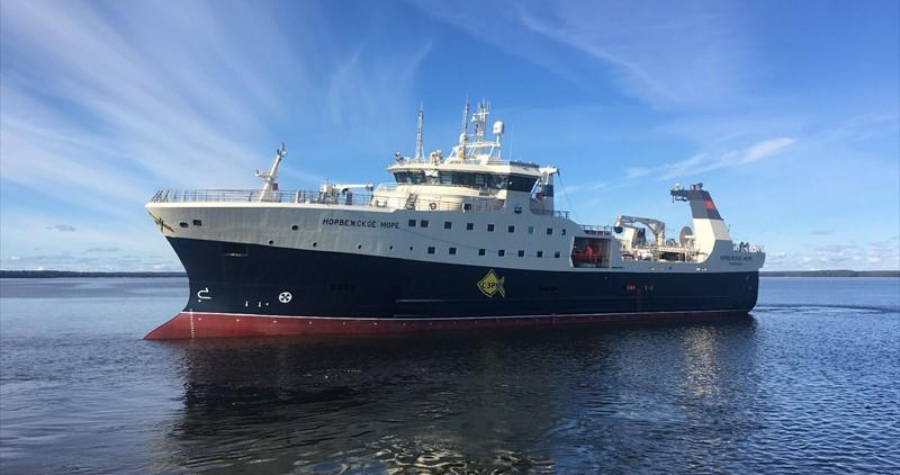
“VESSEL REVIEW | NORVEZHSKOYE MORE – ICE-CLASS TRAWLER TO OPERATE IN RUSSIA’S NORTHERN FISHERY BASIN” –Baird Maritime

Photo: MarineTraffic.com/Ivan Filatov

If you have any doubt, that there will be fishing in the Arctic, take a look at this report from Baird Maritime, about an Ice3 class trawler, second of a class of four, built in Russia, which is expected to operate in the “Northern Fishery Basin just off Norway’s Svalbard archipelago.”

According to Wikipedia, “Svalbard…is a Norwegian archipelago in the Arctic Ocean. North of mainland Europe, it is about midway between the northern coast of Norway and the North Pole. The islands of the group range from 74° to 81° north latitude…”

The Point Barrow, the Northern most point in the US extends to 71°23′20″N.

The Arctic Circle currently runs 66°33′48.8″ north of the equator, so the Southern most islands of the Svalbard archipelago are about 446 nautical miles (826 kM) North of the Arctic Circle. Other islands in the archipelago extend about 866 nautical miles (1604 kM) North of the Arctic Circle.

“Military Planners Should Map Out Operations in Warming Arctic Waters, Expert Says” –USNI

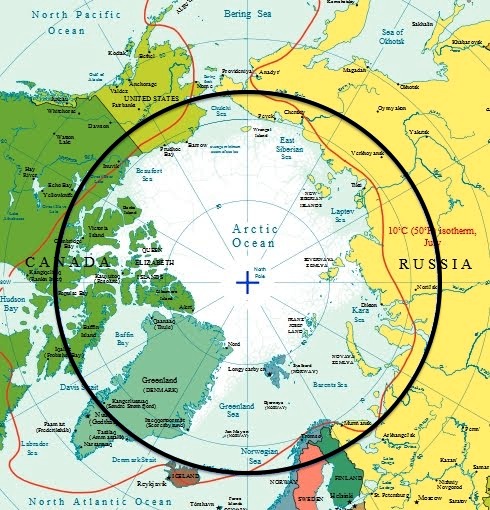
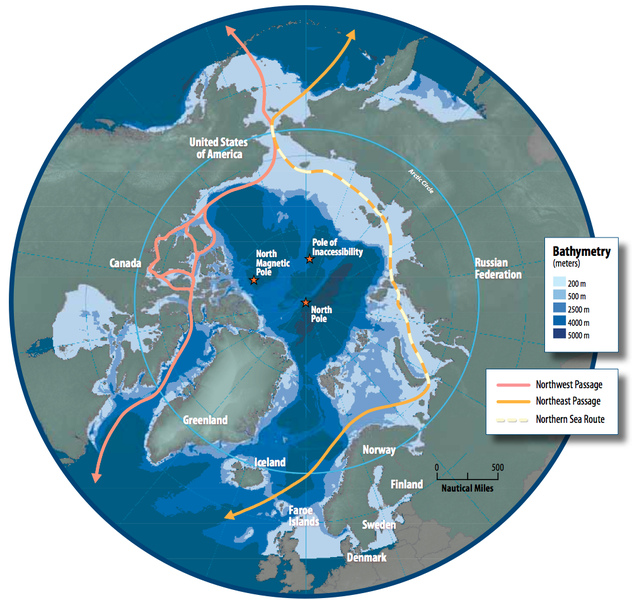
Map of the Arctic region showing shipping routes Northeast Passage, Northern Sea Route, and Northwest Passage, and bathymetry, Arctic Council, by Susie Harder

A reminder from the US Naval Institute of an issue that Russia and Canada share in opposition to the US–passage through Arctic Straits.

Let’s not forget that, when the US Navy wants to do “Freedom of Navigation” Exercises through the Northern Sea Route, there will be a Coast Guard icebreaker leading them.