“North American Arctic defense could shape outcome of Indo-Pacific conflict” –Indo-Pacific Defense Forum

A U.S. Army Green Beret observes an incoming CH-47 Chinook helicopter during Operation Polar Dagger in Wales, Alaska, in August 2024. IMAGE CREDIT: SPC. BRYON DAVIDSON/U.S. ARMY

The Indo-Pacific Defense Forum reported on a Special Operations Command North (SOCNORTH) exercise,

“To address growing concerns in the Arctic, SOCNORTH recently executed two phases of Operation Polar Dagger, an operational series that demonstrates rapidly deployable, joint SOF capabilities throughout the North American Arctic. It forms the basis of options to deter, disrupt and deny adversary activity in support of U.S. Northern Command’s (USNORTHCOM) layered defense of the U.S. homeland…

“In 2023 and 2024, SOCNORTH and the U.S. Navy partnered to deploy the amphibious transport dock ship USS John P. Murtha and the USS John L. Canley, an expeditionary sea base vessel that supports SOF operations and other maritime missions, to the Bering Sea and the Arctic Circle to support Operation Polar Dagger. USSOF is enhancing its navigation expertise in Arctic terrain and has demonstrated the ability to thrive in the region by executing long-range movements, maritime interdiction operations, rapid infiltration/exfiltration, air-to-ground integration, critical infrastructure defense, domain awareness, and medical evacuation validation, among other engagements.”

(I suspect what this means is that USS John P. Murtha participated in 2023 and USS John L. Canley participated in 2024. Both could not have participated both years.)

A lot of the post is an attempt to explain to an Indo-Pacific audience why a NORTHCOM exercise should be important to them.

Observations: 

It appears that Polar Daggar is a part of the larger NORTHCOM NOBLE DEFENDER exercise. This is apparently a regular annual exercise. NORTHCOM’s on-line magazine reported on the 2023 exercise.

“U.S. Army and Navy assets conduct an interdiction operation in the Bering Sea in July 2024.” Note how flat the seas are. That’s not normal. They did do this in July. You can’t count on seas like this. IMAGE CREDIT: SENIOR AIRMAN JOHNNY DIAZ/U.S. AIR FORCE

There is a serious problem here because there was apparently no Coast Guard participation in these exercises. The Navy’s Pacific Fleet almost never has surface ships anywhere near the Arctic. If you have an urgent need for a ship to do something in the Bering Sea, the Coast Guard is really the only option most of the time. SOCNORTH should be learning how they can exploit Coast Guard resources including ships, boats and aircraft. If you want maritime interdiction in the Bering Sea, if you want maritime domain awareness, who should NORTHCOM call? –the Coast Guard.

Want to fly a “Night Stalker” helicopter off of a ship? Want to launch ATACMS from the Chukchi Sea or maybe Tomahawk or SM-6 from a Mk70 launcher? You could put it on the flight deck of a cutter. 

Need follow-up logistics for paratroopers dropped into an isolated coastal location? Coast Guard.

A satellite image of Shemya Island. What is now called Eareckson Air Station, with its lengthy runway, is seen along the southern edge. Google Earth

Not enough Air Force transports available when you need to move troops to reinforce Shemya? Kodiak C-130Js can help with that.

Cutter might even put a landing party ashore to provide quick protection for a critical facility and stand offshore to provide some AAW protection with its 57mm.

East-Coast-based U.S. Naval Special Warfare Operators (SEALs) conduct an over the beach infiltration on Shemya Island, Alaska, Sept. 6, 2023, as part of Operation Polar Dagger. During the operation, special operations forces projected the ability of U.S. forces to defend critical infrastructure, enhanced all-domain awareness, demonstrated operational reach, and strengthened our understanding of activity in the Arctic. (U.S. Navy photo by Mass Communication Specialist 2nd Class Matthew Dickinson)

In 2023, Special Forces operating from USS John P. Murtha (LPD-26) did an infiltration exercise. A cutter could have done the same thing, and it probably would have been more realistic since an LPD is unlikely to be available.

Any surface or land action at the start of a conventional conflict against Russian and/or China that involves the Arctic is likely to be a surprise involving small units, probably involving covert actions from unconventional platforms, paratroopers, and small unit insertions. At least initially, it will be a “run what you brung” war. We will have to fight with what we have and effectively the Coast Guard is the surface navy for Alaska.

The “Center of Gravity” for the theater is likely to be the Bering Strait. As long as the US controls the strait, the Northern Sea Route will be useless for traffic between the Russian North coast and China or the Russian Pacific Coast.

The photo that leads off this post was taken at Wales, Alaska, population 145, 111 miles (179 km) northwest of Nome. The location is significant in that it is on the Eastern edge of the Bering Strait. It appears someone has recognized the significance of the location.

“Russia and China Sent Large Naval Patrol Near Alaska” –Wall Street Journal

The Wall Street Journal reports,

“Eleven Russian and Chinese ships steamed close to the Aleutian Islands, according to U.S. officials. The ships, which never entered U.S. territorial waters and have since left, were shadowed by four U.S. destroyers and P-8 Poseidon aircraft.”

The Russians and Chinese have been doing these joint deployments into the Bering Sea for at least a few years, and normally it has been the Coast Guard that followed them. This time the Navy sent a capable force, in addition to P-8 Maritime Patrol Aircraft they sent USS John S. McCain (DDG-56), the USS Benfold (DDG-65), the USS John Finn (DDG-113) and the USS Chung-Hoon (DDG-93).

Previous reports: 

Coast Guard Cutter Kimball encounters Russia and People’s Republic of China military naval presence in Bering Sea” –D17, Sept. 2022

“Chinese Warships Sailing Near Alaska’s Aleutian Islands Shadowed By U.S. Coast Guard” –Small Wars Journal, Sept. 2021

Chinese Navy Operating Off Alaska, Sept. 2015

http://www.state.gov/e/oes/ocns/opa/arc/uschair/258202.htm . This map of the Arctic was created by State Department geographers as part of the U.S. Chairmanship of the Arctic Council.

Why are they there?:

Russia is easy to understand. This is very close to their territory and their Pacific Fleet base in Petropavlovsk, but why the Chinese?

Russia is China’s top crude oil source, and much of that oil comes from Russia’s Arctic. In any conflict China’s energy sources are likely to be a target and the Bering Strait is the choke point on the most direct route from the Russian Arctic to Chia.

I would note that China’s excursions into the Bering Sea all seem to be toward the end of summer, which is about as nice as it gets in the Aleutians.

“First US deep water port for the Arctic to host military, cruise ships” –Navy Times

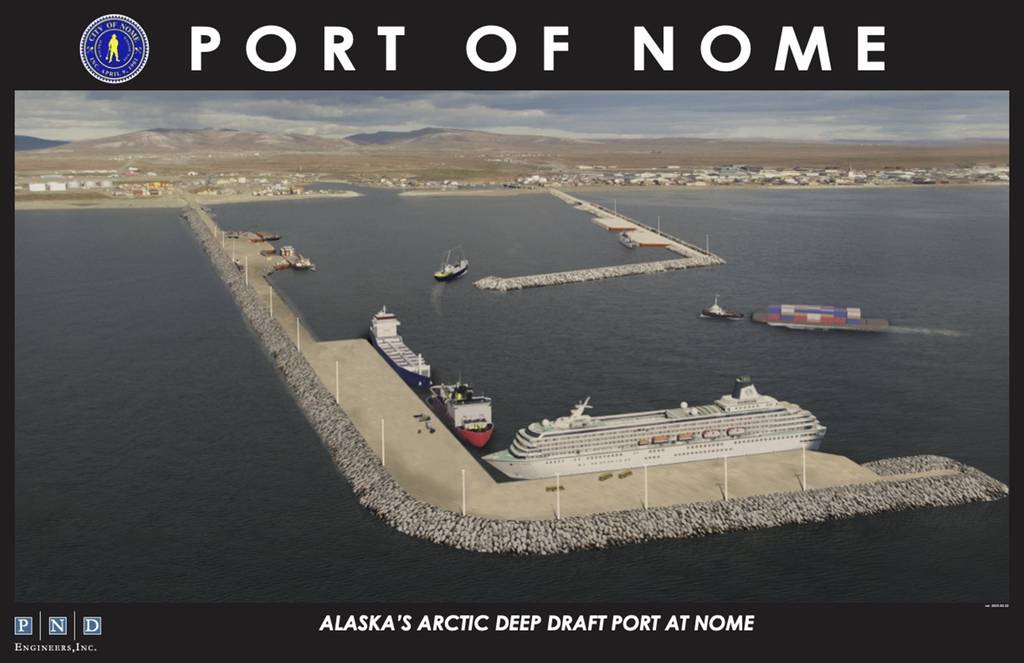
This rendering provided by the City of Nome shows how the Port of Nome, Alaska, will appear following an expansion project that will cost more than $600 million. Shipping lanes that were once clogged with ice for much of the year along Alaska’s western and northern coasts have relented thanks to global warming, and the nation’s first deep water Arctic port should be operational in Nome by the end of the decade. (PND Engineers Inc./City of Nome via AP)

Navy Times reports,

Workers will dredge a new basin 40 feet (12.2 meters) deep, allowing large cruises ships, cargo vessels, and every U.S. military ship except aircraft carriers to dock, Port Director Joy Baker said.

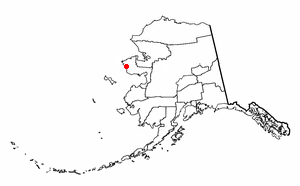
Nome in red. Adapted from Wikipedia’s AK borough maps by en:User:Seth Ilys.

We have been talking about a deepwater port in the area for some time,

Alaska and the Bering Strait

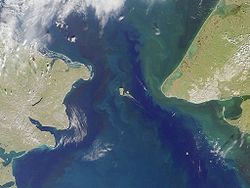
Nome isn’t actually in the Arctic, despite the fact that the US government defines the Arctic to include the Bering Sea. The Arctic Circle runs just a little North of Nome, essentially at the Bering Strait. The Bering Strait connects the Pacific with the Arctic Ocean and is about 44 nautical miles (82 kilometers) wide at its narrowest point. Whoever controls the Bering Strait can regulate traffic between the Pacific and the Arctic Oceans. Having a nearby deepwater port would certainly help, if it were desirable to regulate that traffic. Nome is within 160 nautical miles of the Russian side of the Strait.

Traffic through the Strait has increased and the possibility of a cruise ship disaster in the Arctic is probably a District 17 nightmare, but I think the probability is low that large numbers of CG units will be based at Nome. As noted earlier, I don’t think we will see either large patrol cutters (unless it is the Alex Haley) or FRCs based there but moving one of the Juniper class seagoing buoy tenders there, with its light icebreaking capability might make sense. A medium icebreaker might be a possibility, but that is a very long shot.

As I have noted before, the US Navy’s Pacific Fleet surface ships have not really shown much interest in operating in the Arctic. Their “Arctic” exercises have been in the Gulf of Alaska or little, if at all, North of the Aleutians.

We might see Air Force and Marines in the area in time of War. Airpower and/or shore based anti-ship missiles could control surface traffic through the Strait. Those forces would have to be supplied, which would mean logistics shipping to what we now know will be the deepwater port at Nome. The shipping would presumably require naval protection, air and/or surface.


Three Missile Armed Cutter X for Senegal, 20 Patrol Boats for Ukraine

OPV 58 S from PIRIOU

Two posts from Naval News. French shipbuilders are doing well in the patrol vessel market.

First, “The Ministry of Armed Forces of Senegal and French shipbuilder PIRIOU signed November 17 a procurement contract for three OPV 58 S for the Navy of Senegal. The vessels will be fitted with missile systems, a first for this African navy.”

Second, “The Government of Ukraine gave its green light for the procurement of 20 FPB 98 patrol vessels made by French shipyard OCEA.”

The Senegalese OPVs:

The ships for Senegal fall into that class significantly larger than the Webber class, but significantly smaller than the OPCs. They will be even a little smaller than the 210s. It would be at the lower end of a type, I have called cutter X, vessels with a crew and equipment similar to that of a Webber class FRC, but with better sea keeping and longer endurance. Specifications are:

  • Length: 62.20 meters (204′)
  • Width: 9.50 meters (31.2′)
  • Draft: 2.90 meters (9.5′)
  • Speed: 21 knots
  • Range / Endurance: 25 days, 4,500 nautical miles @ 12 knots
  • Hull / Structure: Steel / Aluminum
  • Accommodations: 48 (24 crew + 24 mission personnel)
  • Stern ramp for two RHIBs

For an Offshore Patrol Vessel, it is very well armed with:

  • A 76mm main gun on the Foc’sle
  • 4x Marte MK2/N anti-ship missiles forward, between the gun and the bridge
  • 2x 12.7mm manned manchine guns on the bridge wings
  • 2x 20mm remote weapon stations (Narwhal by Nexter) at the back of the bridge
  • A SIMBAD-RC surface to air system

The Marte MK2/N missile weighs 310 kg (682#) and is 3.85 metres (12.6′) long. The warhead weighs 70 kilogram (154 pound). The missile, has “an effective range in excess of 30 km, is a fire and forget, all weather sea skimming missile with inertial mid-course navigation through way points and active radar terminal homing. These missiles give these boats a range almost double that of the 57mm or 76mm guns.

SIMRAD-RC is a remote weapons station for launch of two Mistral missiles. Developed as a shoulder launched, Man Portable Air Defense (MANPAD) system, Mistral is a short ranged (6km) IR homing missile. It is claimed to be capable against a range of air targets as well as small surface targets.

Ukrainean OCEA FPB 98 patrol boat:

OCEA FPB 98 patrol boat (Credit: OCEA)

This is a deal, we discussed in July, when it appeared likely. I will repeat the description here.

They have a GRP hull and are powered by two 3,660 HP Caterpillar diesels using waterjets. Specs for vessels of this type sold to Algeria.

  • Displacement: 100 tons
  • Length: 31.8 meters (104’4″)
  • Beam: 6.3 meters (20’8″)
  • Draft: 1.2 meters (3’11”)
  • Speed: 30 knots
  • Range: 900 nmi @ 14 knots
  • Crew: 13

They will probably be equipped with a 20 to 30mm gun.


“The United States Needs a Deep-water Arctic Port” –USNI

Nome, Alaska location. Adapted from Wikipedia’s AK borough maps by en:User:Seth Ilys.

The US Naval Institute Proceedings for Sept has a short article by By Captain Lawson Brigham, U.S. Coast Guard (Retired) advocating development of a deep-water port in Nome, Alaska.

Interest in a deep draft port in northern Alaska has been expressed in Congress, by the Secretary of the Navy, and the Commandant of the Coast Guard. Earlier we talked about the possibility of locating this facility at Port Clarence.

Port Clarence actually seems the larger natural harbor and has some infrastructure, including a runway, left over from when there was a Coast Guard LORAN station there. Nome (terminus for the Iditarod dog sled race) has a much larger population (about 3800 vs 24) and would require less supporting infrastructure development.

Aerial view from the West of Nome, Alaska, in July 2006, by ra64

In any case it seems likely that the ability to control the Bering Strait will become strategically important some time in the future. Both are within 160 miles of the Russian side of the Strait, with Port Clarence being about 50 miles closer.

Alaska and the Bering Strait

Until that time, it seems likely that the Coast Guard may establish a seasonal air station.

Full disclosure, Captain Brigham and I attended the same Naval War College class. 

New Base at Port Clarence?

Bering Strait. Port Clarence bay is the large bight in the southeast.

Adapted from Wikipedia’s AK borough maps by Seth Ilys.

At the National Press Club Headliners Luncheon on Thursday, Dec. 6, the Commandant discussed the Coast Guard’s Arctic presence. We noted the Commandant’s remarks on the Polar Security Cutter earlier, that he was guardedly optimistic, but the US Naval Institute report on the same presentation, brings us more information about the possibility of a new port facility in Western Alaska.

Long-term, Schultz said it’s possible the Coast Guard would look to create a permanent presence in the Arctic. Most likely, Schultz said, the Coast Guard would look for a sea base, possibly in the far northern Port Clarence area. One option, Schultz said, is for the Coast Guard to install moorings to provide a safe haven. Port Clarence, Alaska, had a population of 24, according to the 2010 Census.

Port Clarence was at one time a LORAN Station, and it appears it may still have a substantial runway, so it might also develop into a seasonal air station.

The Secretary of the Navy has already expressed an interest in having a strategic port in Alaska. From the Navy’s point of view it is near the potentially strategically important Bering Strait.

Coast Guard Commandant Adm. Karl Schultz meets with Secretary of the Navy Richard V. Spencer and Alaska Sen. Dan Sullivan in Nome and Port Clarence, Alaska to discuss the construction of deep draft ports in western Alaska, Aug. 13, 2018. This would allow the Coast Guard and Navy to have a strong presence in the U.S. Arctic. U.S. Coast Guard photo by Petty Officer 1st Class Jetta Disco.

China unveils vision for ‘Polar Silk Road’ across Arctic–Reuters

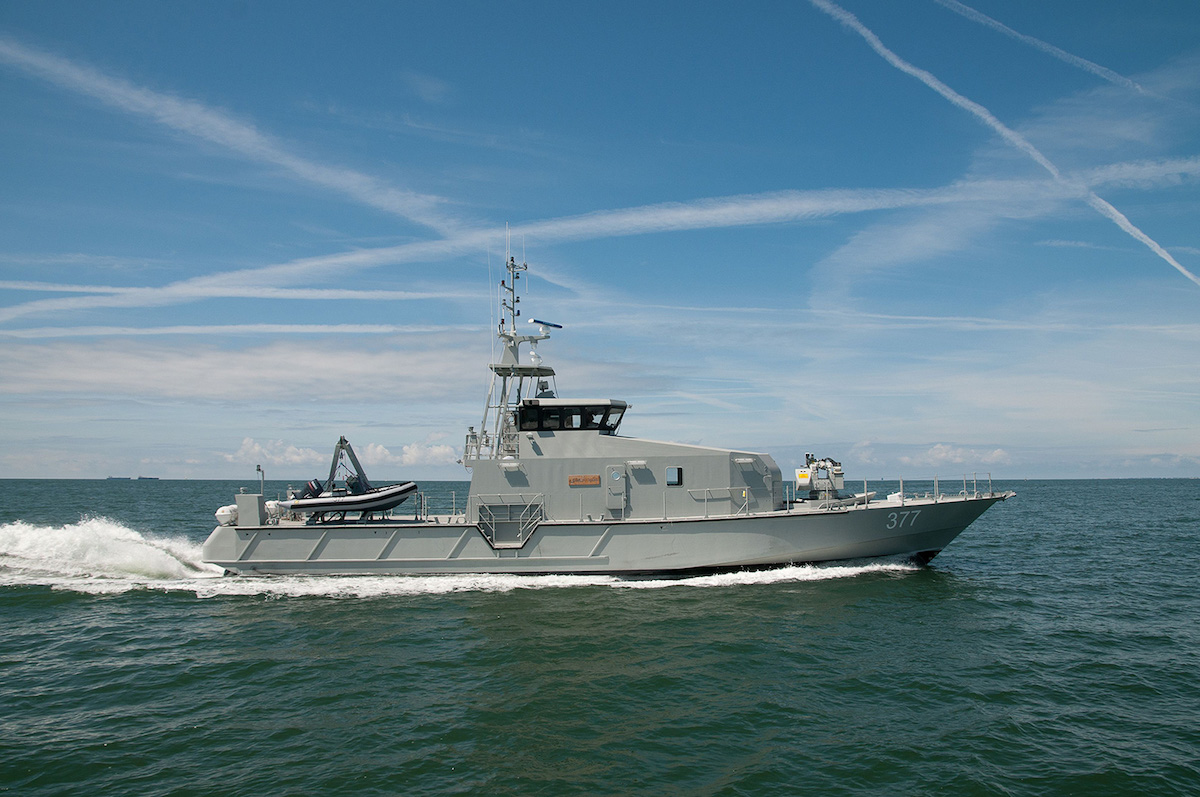
Chinese icebreaking research vessel Xue Long (Snow Dragon), Photo by Bahnfrend

Reuters has an interesting short article about China’s interest in the Arctic. Initially this will probably be primarily concerned with shipment of Russian LNG, but it appears we can expect other activities as well, including fishing. Certainly we should expect more traffic through the Bering Strait, bringing with it the possibility of SAR and Marine Environment Protection incidents.

“The white paper said China also eyes development of oil, gas, mineral resources and other non-fossil energies, fishing and tourism in the region. It said it would do so “jointly with Arctic States, while respecting traditions and cultures of the Arctic residents including the indigenous peoples and conserving natural environment”. “