When is a Flight Deck Not a Flight Deck?

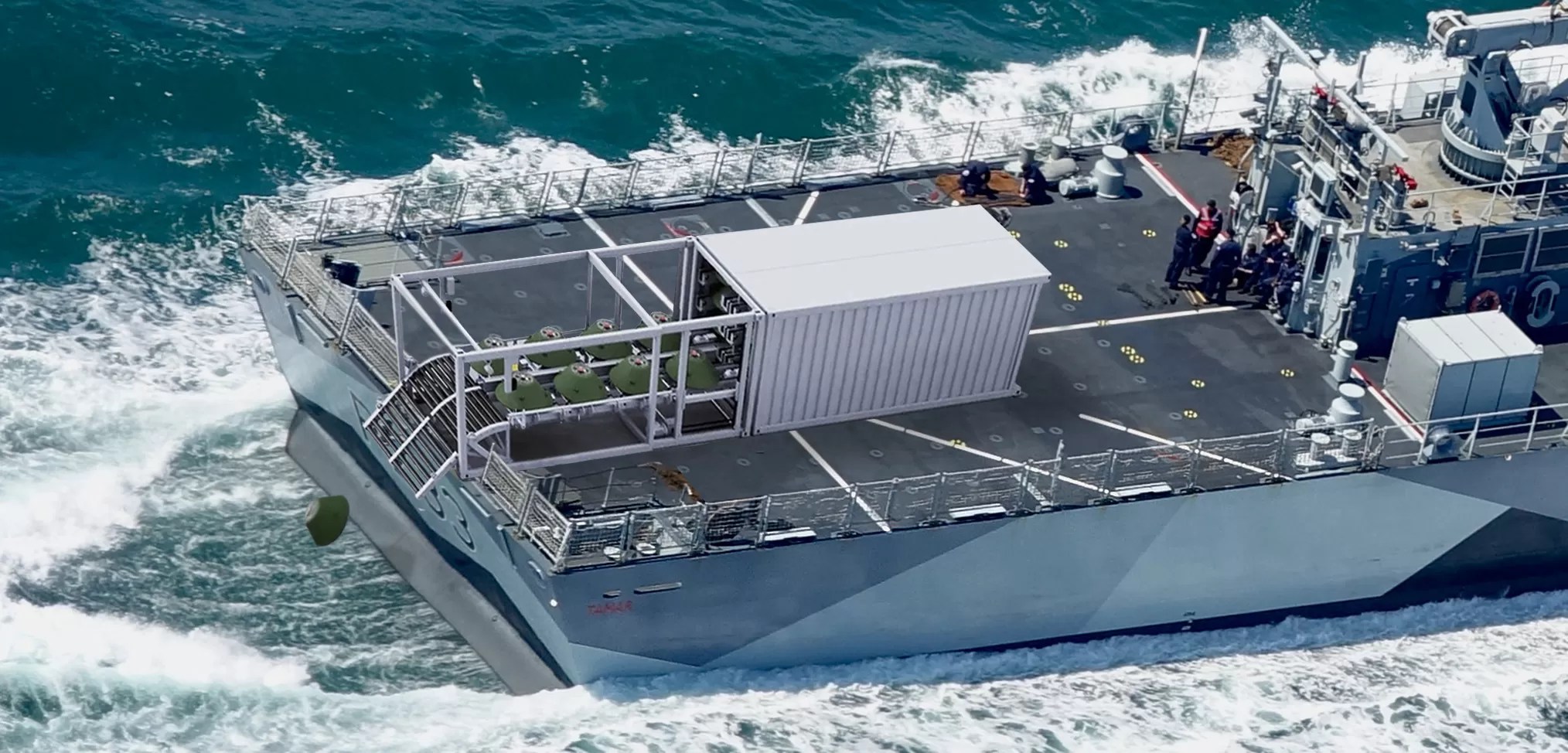
Containerized minelaying system on a River Batch 2 Offshore Patrol Vessel

It has been said that aircraft carriers are the ultimate modular warships because their primary weapons (aircraft) are interchangeable.

A flight deck on an Offshore Patrol Vessel (OPV) certainly offers a degree of aviation options. General purpose, cargo, ASW, and ASuW helicopters and a range of Unmanned Air Systems, but it appears our allies, the UK and particularly Australia may be looking at other ways to use this large open space.

Royal Navy:

Navy Lookout had a post that talked about restoring a naval mining capability in the Royal Navy. There was no specific reference to using flight decks or to Offshore Patrol Vessels.

The RN does not need dedicated minelaying vessels. The SSNs have a theoretical minelaying capability but XLUUVs are a much lower risk and stealthier solution for covert and sensitive missions. Where stealth is less important, containerised minelaying solutions are being developed that can be secured to the deck and dispense mines over the stern. (emphasis applied–Chuck)

But the photo, above, definitely got my attention. There we see an SH Defence “CUBE” containerized mine laying system developed by RWM Italia S.p,A. (Rheinmetall). on the flight deck of a River Batch 2 Offshore Patrol Vessel (HMS TAMAR).

Australian Navy:

Australia is planning to produce up to 14 flight deck equipped Arafura class OPVs including two intended specifically for Mine Counter Measures (MCM). These ships were always intended to accept containerized mission loads. It appears they are now planning what these ships will do in wartime.

Missile Launcher:

We already saw “Australia Considering Modular C-Dome For Arafura OPVs” –Naval News
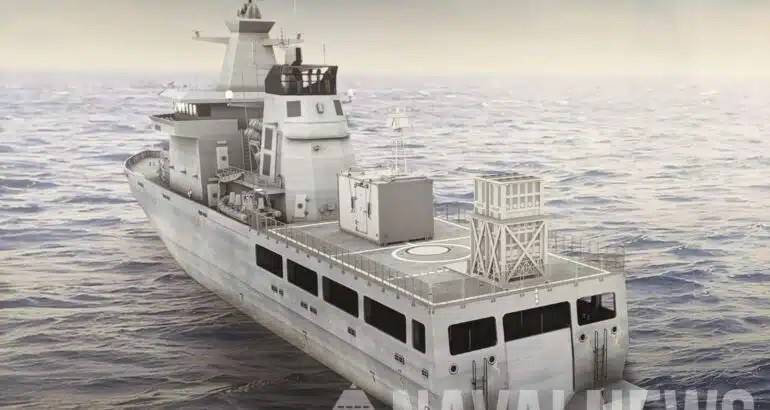
Australia Considering Modular C-Dome For Arafura OPVs
Illustration of Arafura-class OPV fitted with C-DOME

Mine Layer:

As noted in the Navy Lookout, Australia is planning to buy and produce large numbers of mines. Naval News reports,

“Australia is set to accelerate the procurement of sea mines as part of Project SEA 2000…The decision to rapidly procure the capability, reportedly from a European supplier, will deliver a ‘significant’ deterrent effect according to Defence…it’s understood that the government has budgeted approximately $500 million to 1 billion Australian dollars for the acquisition…the weapons being brought are smart mines, able to disseminate between civilian vessels and a variety of military targets, allowing a strategic anchorage to be denied to hostile forces, all the while preserving access for aligned vessels(emphasis applied–Chuck)

This all points to large numbers of mines being used in defensive fields. Such minefields will almost certainly be laid by surface vessels. Australia does have some civilian crewed support ships that might be used for mine laying, but as the Arafura class comes online, they will be the most likely surface minelayers.

SURTASS-E:
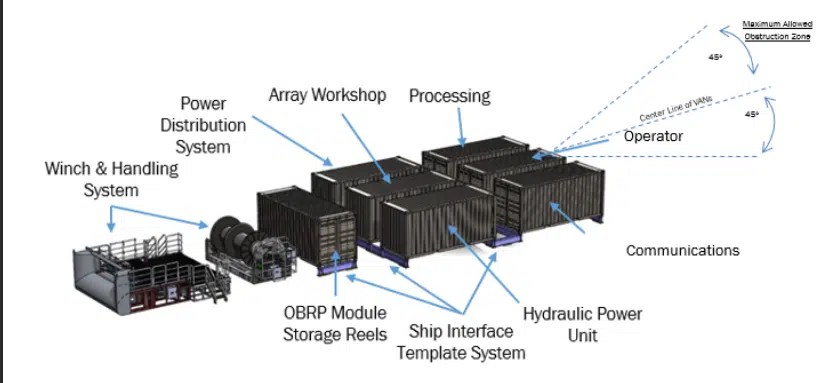
SURTASS-E. (U.S Department of Defense)

Then there is these reports from Naval News and The Drive that Australia is getting SURTASS-E systems.

SURTASS-E is expected to provide long range detection and cuing for tactical weapons, against both diesel- and nuclear-powered submarines. Again, the Arafura class seems a likely host, because the system is intended for military crew manning and, unlike the civilian manned National Support Squadron ships, these ships are armed and have communication systems that include tactical data link.

Now About the Coast Guard:

Using a flight deck for non-aviation purposes is not a foreign idea to the Coast Guard. They do it all the time to provide a holding area for migrants. 
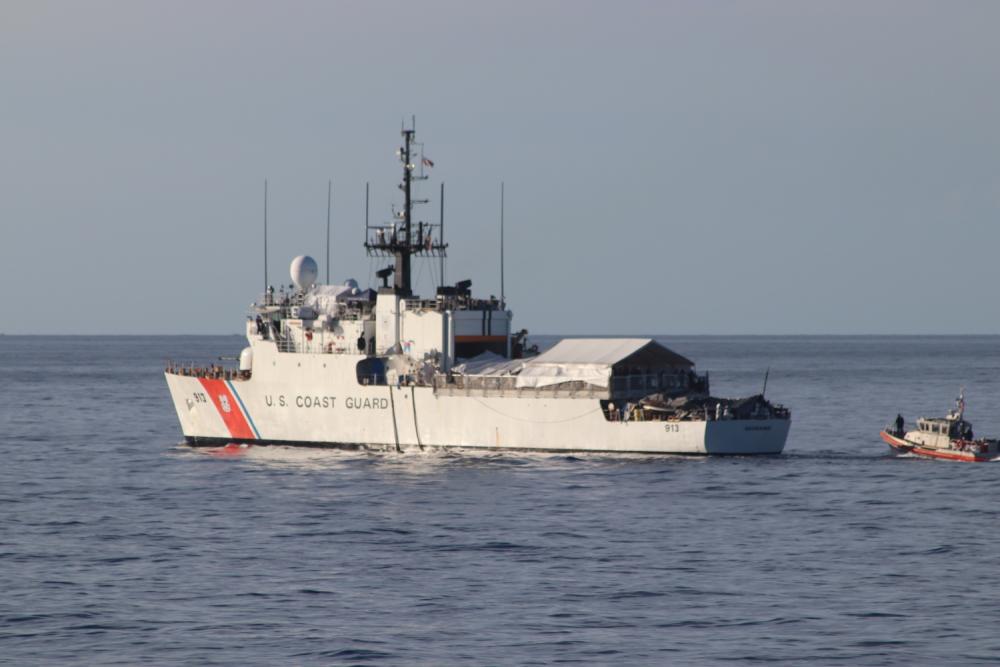
USCGC Mohawk’s (WMEC 913) crew patrols the South Florida Straits during Operation Vigilant Sentry, Jan. 5, 2023. Mohawk’s crew patrolled the Florida Straits and Caribbean Sea in support of Homeland Security Task Force—Southeast and Operation Vigilant Sentry in the Coast Guard Seventh District’s area of operations for a 46-day patrol. (U.S. Coast Guard photo by USCGC Legare (WMEC 912)

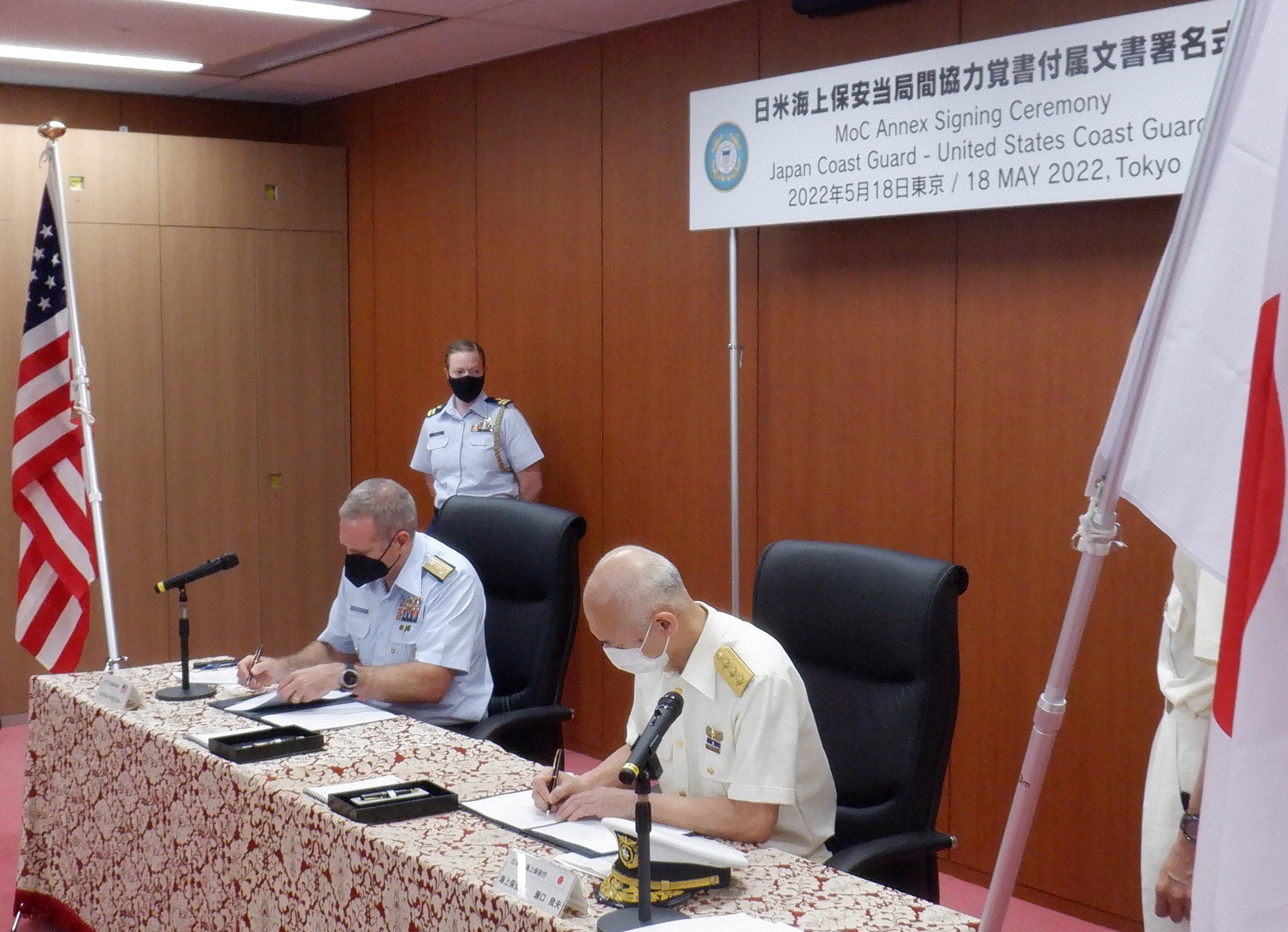
“US, Japan coast guards formally expand cooperation” –PAC AREA News Release / “Royal Navy and US Coast Guard to Forge Closer Bonds”

Ships from the U.S. Coast Guard and Japan Coast Guard conducted exercises near the Ogasawara Islands of Japan, Feb. 21, 2021. The U.S. Coast Guard Cutter Kimball and Japan Coast Guard Ship Akitsushima, two of the respective services’ newest and most capable vessels, operated alongside helicopters and unmanned aerial vehicles to practice interdicting foreign vessels operating illegally inside Japanese waters. (U.S. Coast Guard photo courtesy of the Coast Guard Cutter Kimball/Released)

The Coast Guard has been busy increasing its international visibility. Below is a news release concerning increased cooperation with the Japanese Coast Guard that came out yesterday. Today, I see a SeaWaves report, also dated yesterday that,

“The Royal Navy and US Coast Guard have vowed to work more closely to fight crime and protect the planet. The two services already combine to stop drugs traffickers in the Caribbean and Middle East, assist each other with operations in the polar regions, run exchange programs for sailors and frequently work and train side-by-side around the globe.”

The new relationship with the Royal Navy includes expanded personnel postings that began back in 2014.

There are also plans to build on already successful exchange programs, which allows USCG engineers to work with the Royal Navy but will soon also allow pilots and aircrew to do the same. (emphasis applied–Chuck)

Perhaps we are not too far from exercising something like my proposed “Combined Maritime Security Task Force Pacific” with a US Coast Guard Cutter, a Japanese Coast Guard Cutter, and a Royal Navy River Class OPV working with navies and coast guards of SE Asia to protect their EEZ. Perhaps the Indian Coast Guard will join as well.

News Release

May 19, 2022
U.S. Coast Guard Pacific Area

US, Japan coast guards formally expand cooperation

US, Japan coast guards formally expand cooperation US, Japan coast guards formally expand cooperation

Editors’ Note: Click on images to download high resolution version.

TOKYO — The United States and Japan coast guards formally expanded cooperative agreements and established a new perpetual operation during a ceremony Wednesday in Tokyo.

Vice Adm. Michael McAllister, commander of U.S. Coast Guard Pacific Area, and Vice Adm. Yoshio Seguchi, Japan Coast Guard vice commandant for operations, represented their respective services during the historic document signing ceremony and celebration at Japan Coast Guard Headquarters.

Although a memorandum of cooperation between the sea services has existed since 2010, strengthened relationships, increasing bilateral engagements and continued focus on maintaining a free and open Indo-Pacific necessitated expansion of the memorandum.

The new operation’s name, SAPPHIRE, is an acronym for Solid Alliance for Peace and Prosperity with Humanity and Integrity on the Rule of law based Engagement, and it honors the gem regarded as an emblem of integrity and affection found throughout the Indo-Pacific.

Operation Sapphire encompasses all the annual interactions between the Japan and U.S. coast guards, with the goal of increasing interactions over time.

To formalize the expanded cooperation, annexes were added to the existing memorandum of cooperation outlining Operation Sapphire to include standard operating procedures for combined operations, training and capacity building, and information sharing.

“We rely on our partners, allies, and like-minded nations to achieve our shared missions,” said McAllister. “As evidenced by this agreement, our relationship with the Japan Coast Guard is stronger than ever, and I am looking forward to many more decades of partnership and collaborative operations in the Indo-Pacific.”

“We will conduct smooth cooperation in the fields of joint operation, capacity building and information sharing by this agreement” said Seguchi. “Sapphire embodies the rule-of-law based engagement between the coast guards, and we will expand the principle of Free and Open Indo-Pacific to other nations.”


“British Army drone to fly over English Channel to monitor migrant boats” –Independent

Thales Watchkeeper WK450

Like the US Coast Guard, the UK Border Force conducts Alien Migrant Interdiction Operations. They are reportedly getting some assistance from the British Army in the form of Unmanned Air Vehicles (UAV) being used to patrol the English Channel.

The UAVs are Thales Watchkeeper WK 450s (manufacturer’s brochure here) an improved version of the Israeli Elbit Hermes 450 with the addition of a dual-mode synthetic aperture radar and ground moving target indication system, providing all weather target acquisition.

The Watchkeeper program has not been cheap, about 1.2 billion pounds to provide and support 54 drones, and it has had its problems. They were supposed to have been operational in 2010, but apparently only reached Initial Operational Capability in 2014. Five have crashed. Regarding the current fleet,

“45 Watchkeeper airframes were in service as at 23 July 2020. 13 have flown in the past 12 months and 23 have been in storage for longer than 12 months. Of those flying, 10 have been operated by the Army from Akrotiri in Cyprus and Boscombe Down in Wiltshire, three have been used for test and evaluation. The airframes in storage are held at specific, graduated, levels of readiness. This is commensurate with practices used on other Defence capabilities and assets.”

The airframes are:

  • Length: 19.69 ft (6 m)
  • Span: 34.45 ft (10.5 m)
  • Engine: Winkel rotary, 52 hp
  • Max Speed: 95 knots
  • Operational Radius: 200 km; 108 nm (Line of Sight)
  • Endurance: 16+ hours
  • Service ceiling 18,045 feet (5,500 m)

This means, it is about half the size of the familiar MQ-1 Predator, also a bit slower and their service ceiling is lower.

The British Maritime and Coastguard Agency (MCA) has selected Israel’s Elbit to demonstrate the capabilities of their larger Eblit Hermes 900 UAVs. which has capabilities similar to those of the MQ-1. Meanwhile the RAF is also flying surveillance over the English Channel.