“Royal Marines snipers shoot out engines to bring drug-runners’ boat to a halt” –Forces.Net

HMS Dauntless has a Wildcat helicopter and Royal Marines sniper team from 42 Commando who provide reconnaissance, surveillance, and aerial support (Picture: Royal Navy).

Looks like the Royal Navy now has their own “Airborne Use of Force” Team to do the same sorts of things the Coast Guard has been doing.

Forces.Net reports,

A Royal Marines sniper team has brought a Caribbean drug-runners’ power boat to a “juddering halt” after shooting out its engines.

US Coast Guard personnel, working alongside the sailors and marines on board Royal Navy destroyer HMS Dauntless, were then able to seize £60m worth of cocaine, which the smugglers had been attempting to throw overboard.

Read on in the linked report. HMS Dauntless has been doing good work in cooperation with a US Coast Guard Law Enforcement Detachment. HMS Dauntless is the second of six Type 45 Guided Missile Destroyers, roughly the Royal Navy counterpart of the Burke class DDGs and almost twice as large as the National Security Cutters.

HMS Dauntless (foreground) and HMS Daring. Photo: LA(Phot) Ian Simpson/MOD

Thanks to David for bring this to my attention.

“Defending the Dutch Caribbean: An Assessment” –Geopolitical Monitor

Willemstad, Feb. 2022. The Netherlands the royal family was transported from Aruba to Curacao aboard the Holland-class offshore patrol vessel HNLMS Holland (P-84).

Geopolitical Monitor discusses the six islands of the Dutch Caribbean, part of the Kingdom of the Netherlands.

The Netherlands has been a good partner in drug interdiction operations in the Caribbean. The four ships of the Holland class are in many ways similar in size and characteristics to the Offshore Patrol Cutters. The Netherlands Navy tends to keep one of these ships in the Caribbean, and they frequently host US Coast Guard Law Enforcement teams. At least once they also hosted a Coast Guard H-65 airborne use of force helicopter.

The post talks about the Dutch Caribbean Coast Guard (DCCG, or Kustwacht Caribisch Gebied: KCG),

“…which has facilities in Aruba, Curaçao, and Sint Marteen. This agency carries out missions involving search and rescue, law enforcement, and maritime interdiction. The DCCG’s fleet includes three Damen Stan Patrol 4100 cutters (slightly smaller but similar to the Webber class–Chuck), Jaguar, Panther, and Puma, five Boston Whaler Justice 20 craft, and 12 Metal Shark Defiant interceptor vessels. In addition, in April 2022, the Dutch organization for defense equipment (Defensie Materieel Organisatie) announced that two helicopters were acquired from Bristow Helicopters and will be delivered in 2023. The DCCG currently operates two DHC-8 aircraft and two AgustaWestland AW139 helicopters.”

They even have had long range, medium altitude unmanned search aircraft assigned, something the US Coast Guard still does not have,

“The DCCG’s surveillance capabilities were expanded in late March 2022, with the arrival to Curaçao of three General Atomics MQ-9A Reaper unmanned aerial vehicles and two ground stations. The Reapers assist Dutch Caribbean military personnel in combating organized crime and illegal fishing, among other activities. They will remain in Curacao until 1 July 2023.”

The post alludes to Venezuelan’ threats to Dutch Caribbean islands that lay off the Venezuelan coast (Aruba, Curaçao, and Bonaire). While the Venezuelan military is far more powerful than the forces the Netherlands keeps in the Caribbean, it is hard to take these threats seriously since, an attack on even one of the islands, would be an attack on NATO.

On a personal note, really enjoyed a stopover in Aruba in the early 80s while it was snowing back in our Portland, Maine homeport–my wife will never let me forget.

Thanks to Lee for bringing this to my attention.

“Operation Vigilant Sentry: Stopping illegal migration at sea” –CG HQ

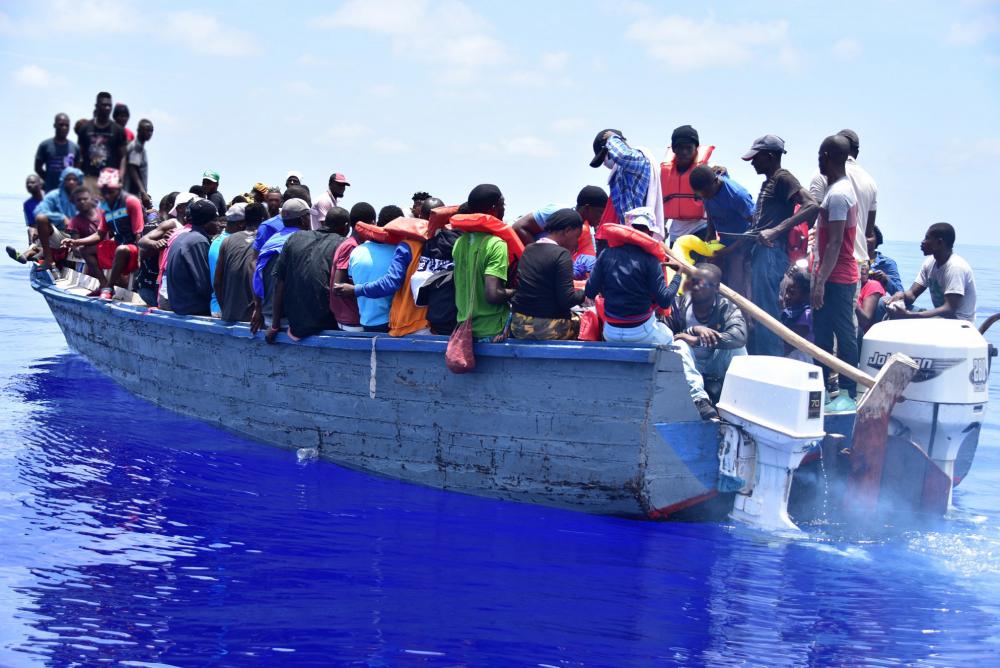
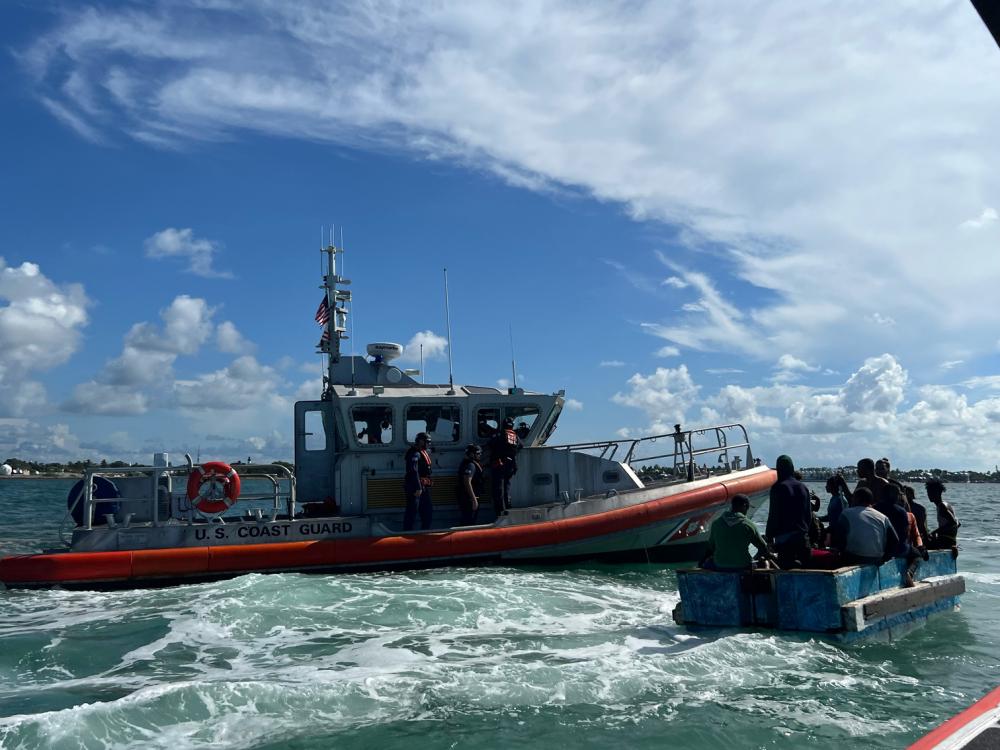
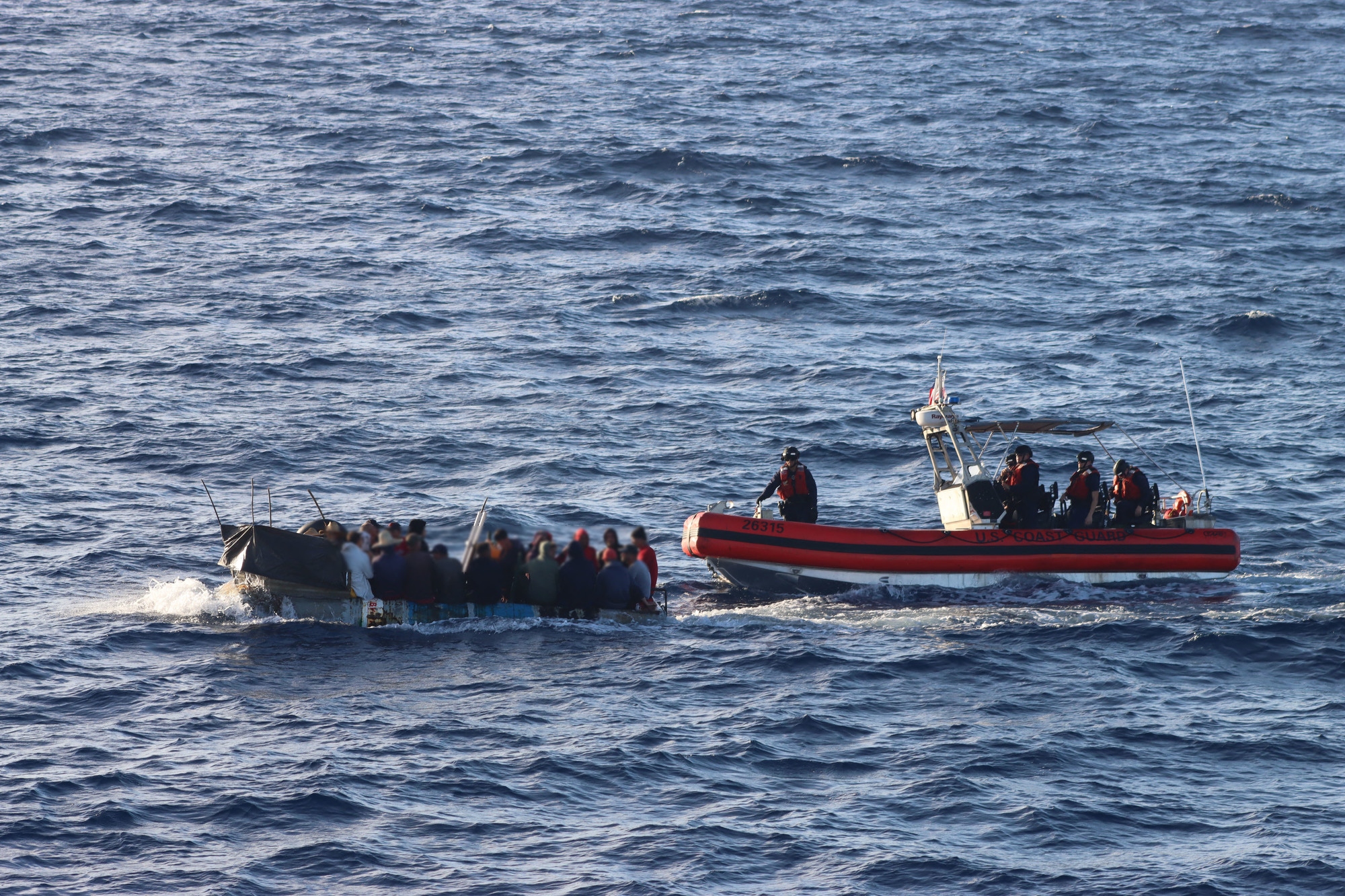
A Coast Guard Cutter Campbell law enforcement crew stopped a grossly overloaded, unsafe vessel near Turks and Caicos, May 9, 2022. (U.S. Coast Guard photo by Petty Officer 3rd Class Erik Villa-Rodriguez)

Below is a news release from Coast Guard Headquarters discussing the history and current situation of the Homeland Security Task Force – Southeast and of Operation Vigilant Sentry, a D7 lead Department wide Alien Migrant Interdiction Operation.

I have also included the text of the DHS Secretary’s remarks that were referenced in the release.

This release got wide distribution. I got it from HQ, LANTAREA, and PACAREA.


Jan. 27, 2023

Operation Vigilant Sentry: Stopping illegal migration at sea

By Petty Officer 1st Class Nicole J. Groll

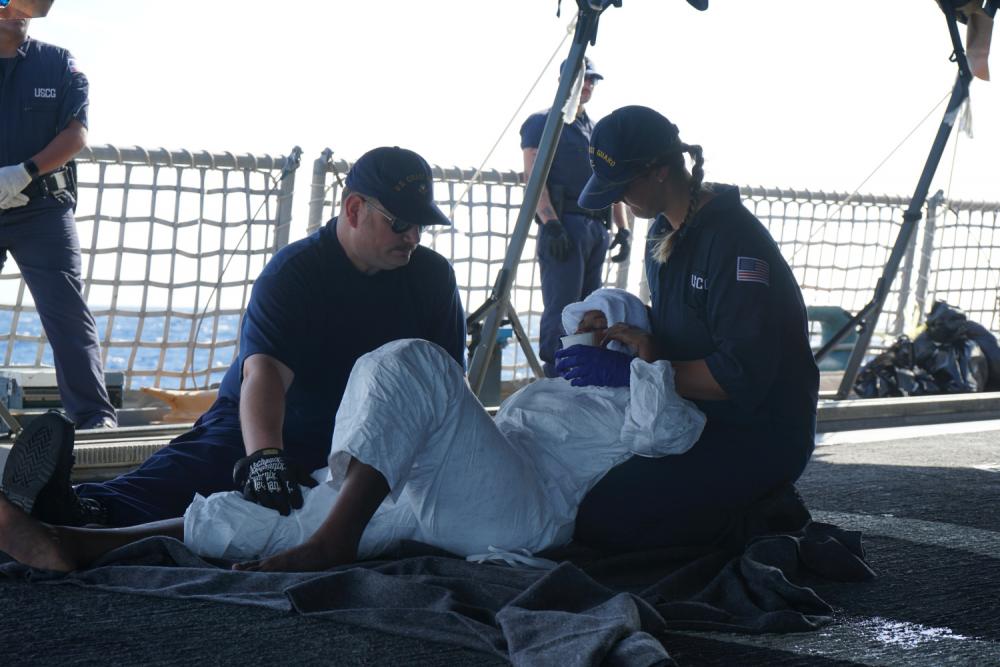
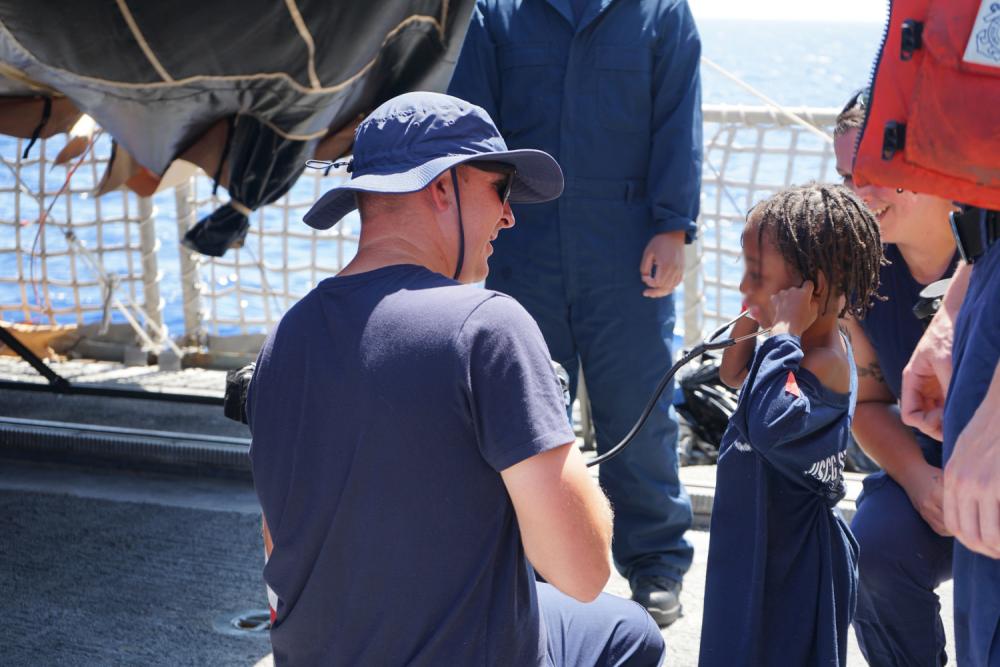
A Coast Guard Cutter Campbell law enforcement crew stopped a grossly overloaded, unsafe vessel near Turks and Caicos, May 9, 2022. Coast Guard Cutter Campbell is homeported in Kittery, Maine. (U.S. Coast Guard photo by Petty Officer 3rd Class Erik Villa-Rodriguez) Two Coast Guard Cutter Campbell crew members assist a person suffering dehydration symptoms in the Windward Passage, April 30, 2022. Coast Guard Cutter Campbell is homeported in Kittery, Maine. (U.S. Coast Guard photo by Campbell's crew) A Coast Guard Cutter Campbell medical crew member lets a child listen to his heart using a stethoscope in the Windward Passage, May 9, 2022. The people were repatriated to Haiti on May 11, 2022. (U.S. Coast Guard photo by Petty Officer 3rd Class Erik Villa-Rodriguez) 

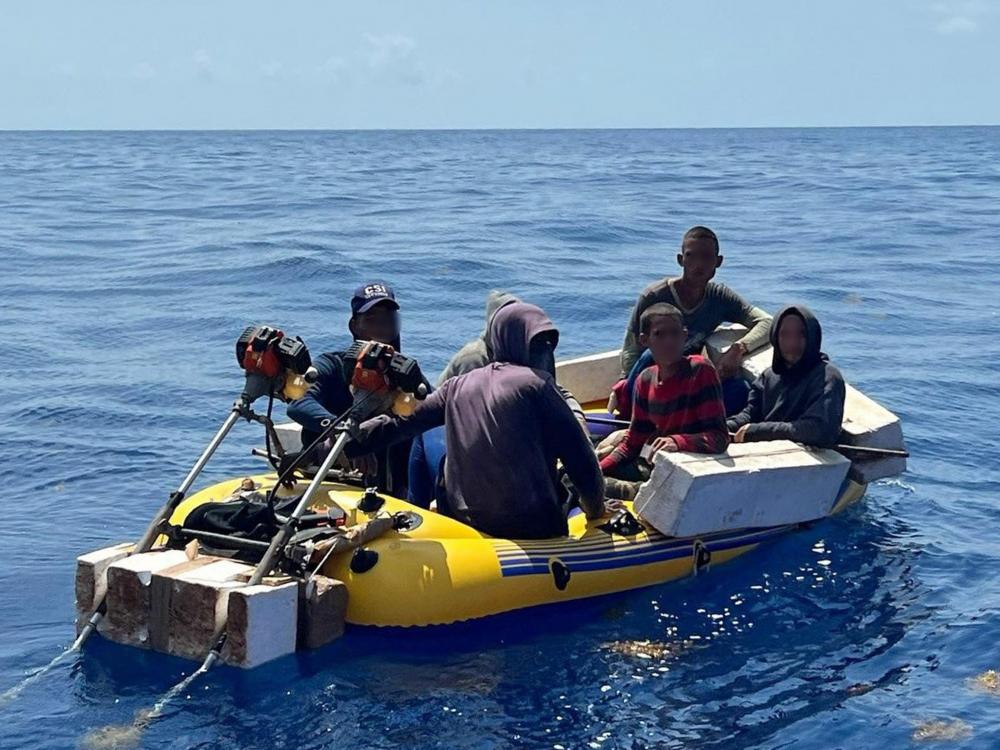
A Coast Guard Air Station Clearwater C-130 aircrew alerted Sector Key West of a wooden vessel 25 miles south of Sugarloaf Key, Florida, Jan. 23, 2023. The people were repatriated on Jan. 25, 2023. (U.S. Coast Guard photo) A good Samaritan notified Coast Guard Sector Key West watchstanders of a rustic vessel about 13 miles south of Marquesas Key, Florida, June 12, 2022. The people were repatriated to Cuba on June 17, 2022. (U.S. Coast Guard photo) A Coast Guard Station Key West law enforcement crew alerted Sector Key West watchstanders of this migrant vessel about 3 miles south of Key West, Florida, July 6, 2022. The people were repatriated to Cuba on July 8, 2022. (U.S. Coast Guard photo by Station Key West) 

Editor’s note: Click on images to download high-resolution version.

Homeland Security Task Force – Southeast was established in 2003 by the Department of Homeland Security. This interagency task force is comprised of resources and assets from the U.S. Coast Guard, the departments of Homeland Security, State, Defense, Health and Human Services, as well as those from state and local agencies. These agencies provide the organizational framework to monitor migration trends to detect and respond to a maritime mass migration.

Operation Vigilant Sentry was first approved in 2004. It is the arm of the task force that deploys joint air and surface assets and personnel to address illegal maritime migration in the Caribbean corridor of the United States. The primary objective: to protect the safety of life at sea, and to deter and dissuade a maritime mass migration with our federal, state and local partners.

The director of Homeland Security Task Force – Southeast is the commander for the Seventh Coast Guard District. Migrant interdiction is one of the 11 statutory missions assigned to the Coast Guard by Congress, giving the military service the authority to take the lead role in the ongoing and historic migrant surge.

OVS is also not country specific, but it is a framework for any Caribbean country. The most common nationalities trying to illegally migrate to Florida by sea are Cuban and Haitian. Despite the unique challenges faced by each country, the rationale for illegal migration can occur for any number of various reasons.

“The risk migrants are willing to take are unfathomable to most Americans: escaping poverty, violence, human trafficking, and persecution are a few realities,” said Cmdr. Ray Caro, chief of intelligence for Operation Vigilant Sentry. “Although change is gradual across nations in the Western Hemisphere, the frequency at which these challenges present themselves is certainly increasing. Politics, migration policies and natural disasters amplify those realities and trigger migration. As a result, maritime migration has been a lifesaving priority for the Coast Guard for more than 40 years.”

The weather, the possibility of drowning, the general unpredictability of the maritime domain all stand as barriers not just to the goals of illegal migrants, but also as threats to their very lives.

“These individuals are ignoring real risks,” said Chief Warrant Officer Matthew James, Coast Guard Station Islamorada’s commanding officer. “Just about every vessel we encounter in these voyages were constructed haphazardly with improvised materials and were taking on water. The few vessels that appeared to be well built were dangerously overloaded and capsizing was imminent when we arrived on scene. It’s very dangerous to try and cross the Florida Straits this way.”

In 2022, the Coast Guard saw one of the deadliest years for illegal migration in recent history with approximately 65 people dying trying to make it to the U.S. In 2020, the Coast Guard recorded 17 deaths and five in 2021. Despite the increased numbers and risk, the service remains dedicated to the preservation of life, imploring those who would see illegal maritime migration as an option.

“The Coast Guard and our partners are working to stop senseless migration-related deaths at sea by rescuing people in rustic, unsafe vessels,” said Capt. Benjamin Golightly, incident commander, Operation Vigilant Sentry. “Help us by not paying smugglers and instead, encourage safe, legal migration.”

Historically, Florida is no stranger to illegal migration. According to the Department of Homeland Security and U.S. Citizen and Immigration Services, the Cuban Adjustment Act of 1966 was established to allow Cuban natives and citizens living in the U.S. at least two years to apply to become lawful permanent residents by getting a Green Card. This applied to the Cuban arrivals who were paroled into the U.S. fleeing communism. In 1995, the so-called Wet Foot/Dry Foot policy was adopted. This meant if illegal migrants were stopped at sea, they were returned to their country of origin or departure. If they were stopped on land, they would eventually be paroled and able to apply for the Cuban Adjustment Act. In 2017, former President Obama repealed the Wet Foot/Dry Foot policy.

After the repeal, illegal migration by sea declined for several years, but Coast Guard crews are seeing an increase once again.

Haitians started coming to the U.S. at the end of 1972 fleeing communism, according to the University of Texas’ history department. In 1998, the Haitian Refugee Immigration Fairness Act was enacted by Congress for eligible Haitian nationals in the U.S. to become legal permanent residents.

“As Haiti’s overall situation continues to erode, our crews have witnessed an alarming uptick in maritime migration; we see spikes in this dangerous activity following natural disasters or socio-economical events,” said Capt. Robert Kinsey, operations chief for Operation Vigilant Sentry. “These vessels are shockingly overloaded; when you see it firsthand, it’s almost unbelievable. Smugglers are coercing desperate people to endure unthinkable conditions for long periods of time. Many of our crews arrive just in time to rescue them from peril.”

The typical 40 to 50-foot Haitian sail freighter intercepted by Coast Guard assets have anywhere from 150 to 300 people aboard these overcrowded, unsafe vessels. A typical safe sailboat can safely hold about 30.

Back in July 2021, Department of Homeland Secretary Alejandro N. Mayorkas told Cubans and Haitians in a press conference not to come to the U.S. by sea, noting the clear threats posed by the maritime domain.

“The time is never right to attempt migration by sea,” said Alejandro N. Mayorkas, DHS Secretary. “To those who risk their lives doing so, this risk is not worth taking. Allow me to be clear: if you take to the Sea, you will not come to the United States.”

Cubans and Haitians who take to the sea and try to land in the U.S. may be ineligible for the parole process and will be placed in removal proceedings, he said.

People interdicted at sea will be repatriated to their country of origin or departure.

Illegal migration at sea is not only dangerous for the people attempting it, but it causes their family members unnecessary distress due to not knowing if their loved ones are alive or not.

“Family members call our command center all the time,” said Lt. Paul Benyovszky, a Sector Key West enforcement officer. “It can be a struggle to maintain our emotional balance when family members are crying and begging for information we don’t have.”

This isn’t an easy mission, and illegal migration isn’t going to go away, he said.

Since the new fiscal year started in October, crews interdicted 5,321 Cubans and 1,766 Haitians at sea. The service increased manpower and assets to the area to stop illegal migration at sea and rescue those in distress before the sea claims their lives. The Coast Guard continues to be the lead federal agency charged with this mission, and the crews and partner agencies are doing their very best to ensure people go home alive at the end of the day.


“USCGC Mohawk returns home following 46-day Caribbean Sea patrol” –LANT AREA-

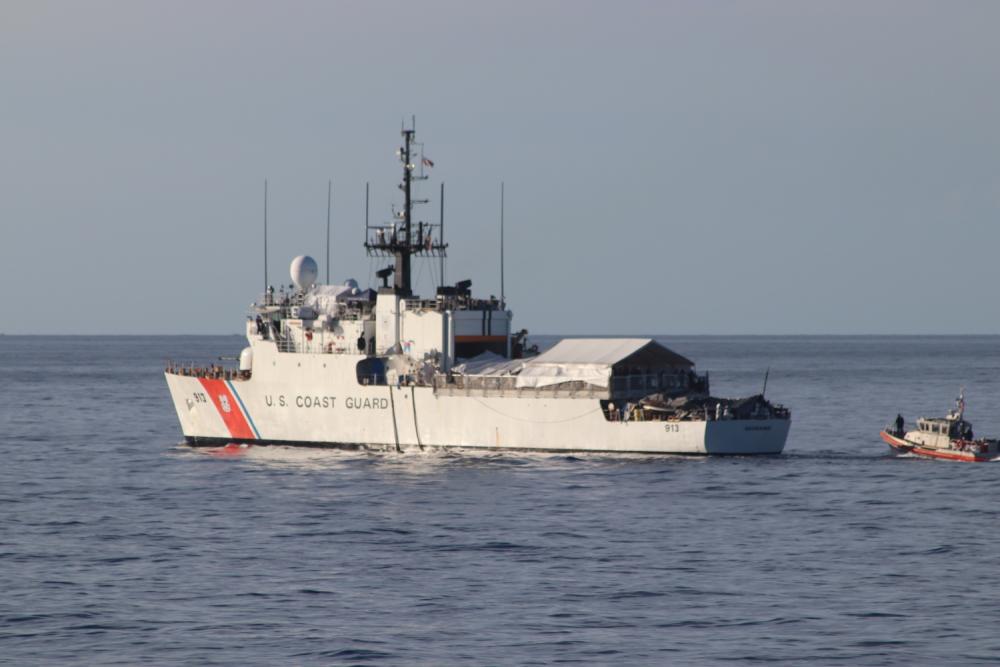
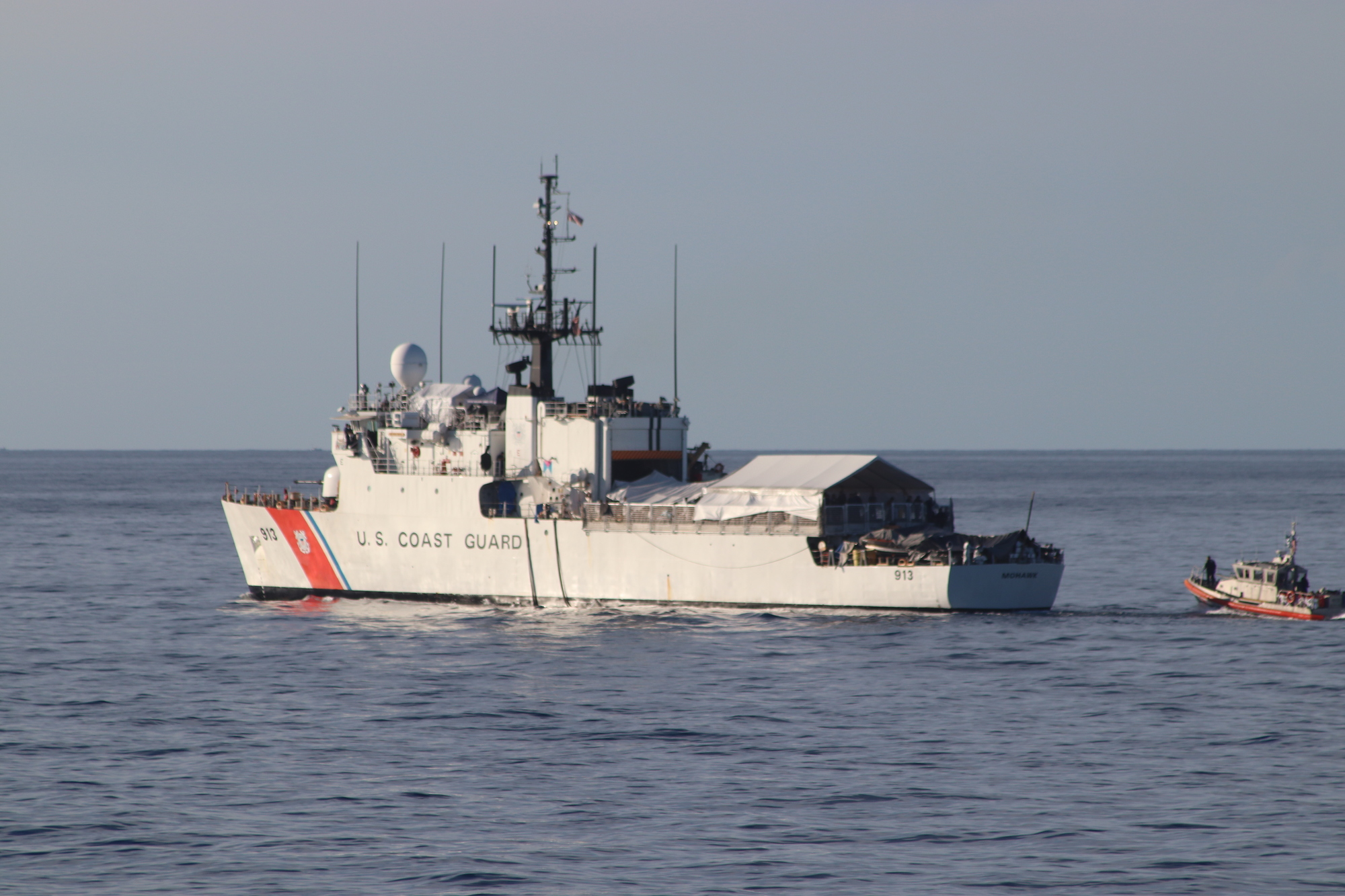
USCGC Mohawk’s (WMEC 913) crew patrols the South Florida Straits during Operation Vigilant Sentry, Jan. 5, 2023. Mohawk’s crew patrolled the Florida Straits and Caribbean Sea in support of Homeland Security Task Force—Southeast and Operation Vigilant Sentry in the Coast Guard Seventh District’s area of operations for a 46-day patrol. (U.S. Coast Guard photo by USCGC Legare (WMEC 912)

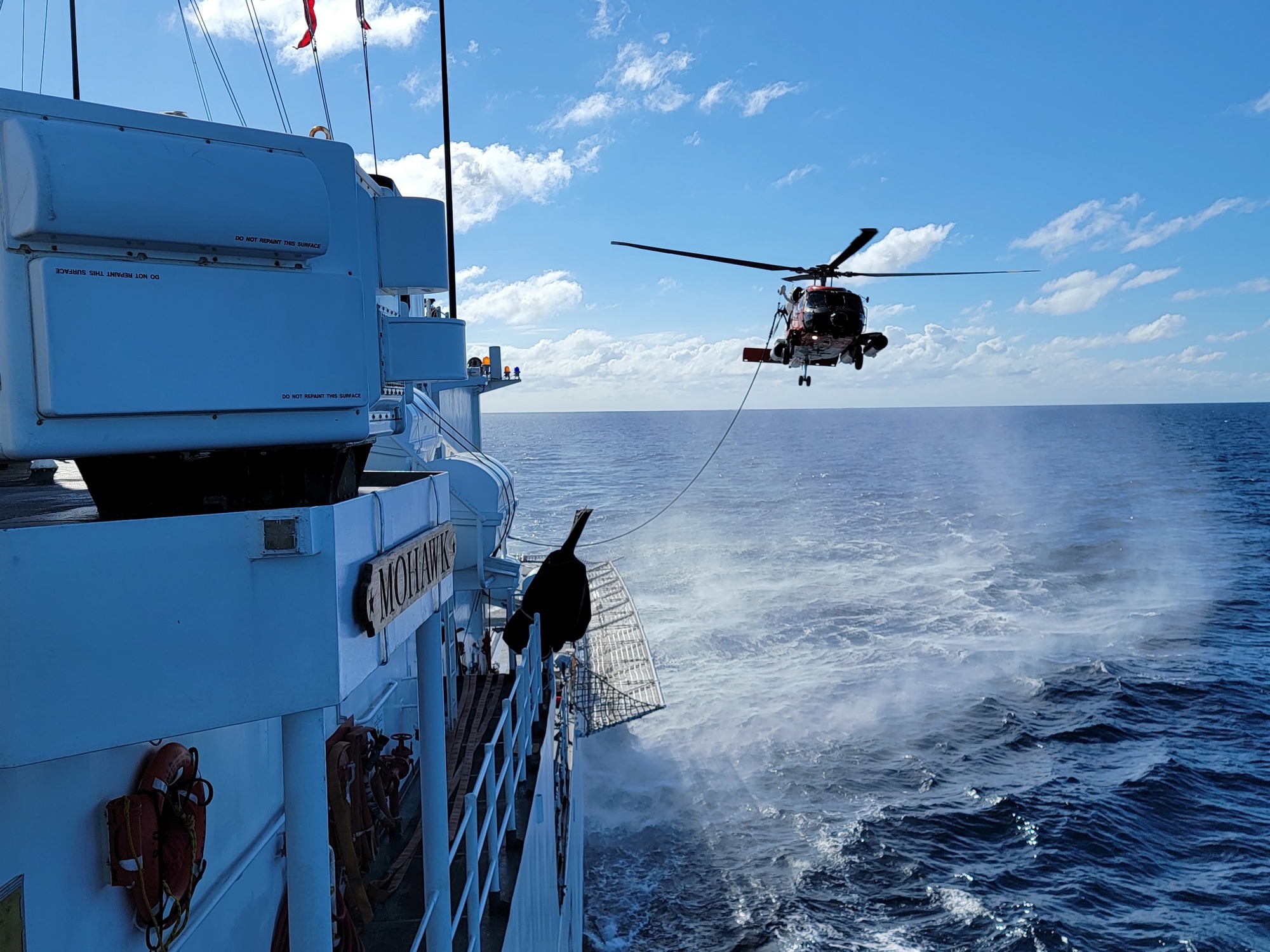
I don’t normally publish a news release like this, it is relatively routine, but I particularly wanted to highlight the photo above and provisions made to shelter migrants which have precluded helicopter operation. We have noted that the migrant traffic has increased substantially. The photo was taken by USCGC Legare, meaning that there were probably at least two 270 foot WMECs, that I would expect to be doing drug interdiction or fisheries, were engaged in Alien Migrant interdiction, in addition to the FRCs and 210 foot WMECs that are more commonly assigned to this mission. Note the large number of migrants interdicted and repatriated. I presume it means Mohawk had at least 273 migrants aboard at one time, out numbering the crew almost three to one.

News Release

U.S. Coast Guard Atlantic Area

Download Image Link Here Download Image Link  Download Image Link Here

Editor’s note: Click on images to download

KEY WEST, Fla.—The crew of the USCGC Mohawk (WMEC 913) returned to their home port in Key West, Monday, after a 46-day deployment in the Florida Straits and Caribbean Sea.

Mohawk patrolled the Florida Straits and Caribbean Sea in support of Homeland Security Task Force—Southeast and Operation Vigilant Sentry in the Coast Guard Seventh District’s area of operations. While underway, Mohawk’s crew conducted counter drug and maritime safety and security missions while working with other Coast Guard cutters and air assets to detect, deter and intercept unsafe and illegal migrant ventures bound for the United States.

During the patrol, Mohawk’s crew cared for 670 migrants interdicted at sea and rescued personnel from seven different unseaworthy vessels. Notably, Mohawk’s crew assisted with the repatriation of 110 Haitian migrants to Cap-Haitien, Haiti, and 273 Cuban migrants to Matanzas, Cuba.

Mohawk’s patrol efforts highlight the Coast Guard’s critical mission of maintaining safety at sea and preventing the potential for loss of life by deterring migrants from taking to the sea in dangerously overcrowded vessels while attempting to enter the United States through non-legal channels.

“It’s never easy being deployed over the holidays, away from family members,” said Cmdr. Andrew Pate, Mohawk’s commanding officer. “I am incredibly proud of the women and men aboard who continue to position Mohawk for success – their role in this historic effort, alongside our state and local partners as well as other Coast Guard units, is nothing short of heroic.”

Mohawk is a 270-foot, Famous-class medium endurance cutter with a crew of 100. The cutter’s primary missions are counter drug operations, migrant interdiction, enforcement of federal fishery laws and search and rescue in support of U.S. Coast Guard operations throughout the Western Hemisphere.

For information on how to join the U.S. Coast Guard, visit GoCoastGuard.com to learn about active duty and reserve, officer and enlisted opportunities. Information on how to apply to the U.S. Coast Guard Academy can be found here.

For more, follow us on FacebookInstagram and Twitter.

“Navy’s Digital Horizon exercise showcases power of ‘mesh networks,’ AI” –Defense News

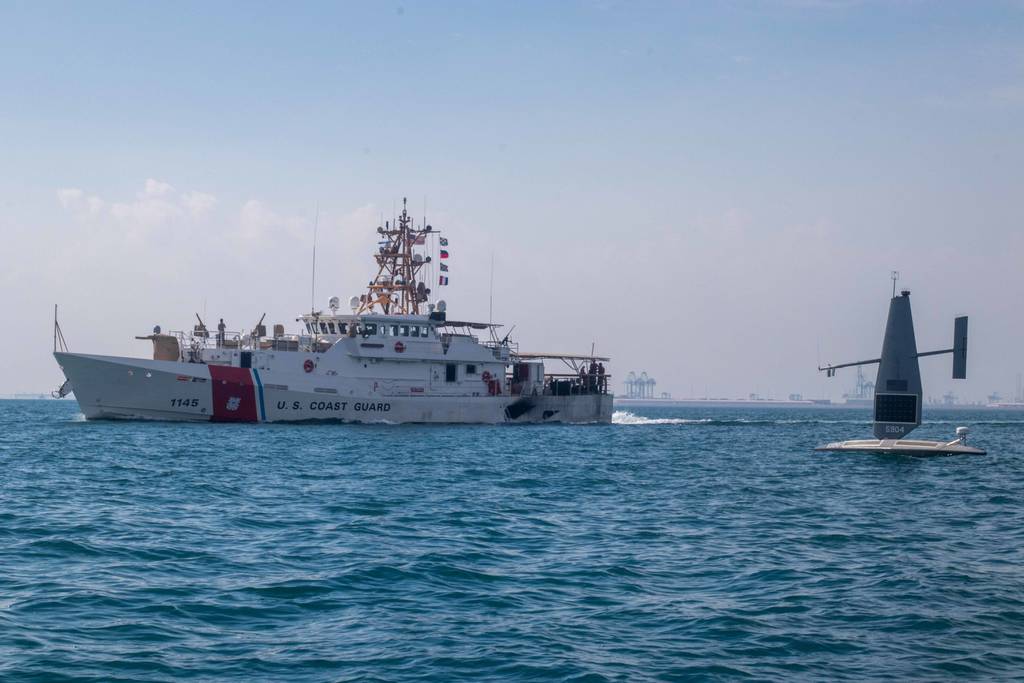
A Saildrone Explorer unmanned surface vessel operates alongside U.S. Coast Guard fast response cutter USCGC Emlen Tunnell (WPC 1145) in the Arabian Gulf, Nov. 29, during Digital Horizon 2022. (Sgt. Brandon Murphy/US Army)

Defense News reports on 5th Fleet’s “Digital Horizon” exercise.

“We have done a lot of work with AI previously, and we’ve done computer vision, we’ve done anomalous behavior detection, we’ve done AI-enabled [command and control], but we’ve done all of those separately,” the commodore explained. “At Digital Horizon, for the first time ever, we did that together on a single stack, and that’s all integrated on a single pane of glass.”

They have been trying a number of new systems, “10 of which are being operated in 5th Fleet for the first time.” We got a look at a portion of this exercise earlier, “Task Force 59 Launches Aerial Drone from Coast Guard Ship in Middle East” –NAVCENT. Also, among the systems they tested was V-Bat UAS.

There is also confirmation here that a similar effort will be going into 4th Fleet (Latin American/Caribbean Waters); that it will involve partner nations; and that it will look at IUU fishing as well as drug interdiction.

Fortunately, it looks like Coast Guard personnel and assets have been intimately involved in this effort and it looks like it will benefit our Maritime Domain Awareness (MDA) efforts.

(Will the Coast Guard’s next class of ships be USV tenders?)

“Navy to establish additional unmanned task forces inspired by Task Force 59” –Defense Scoop

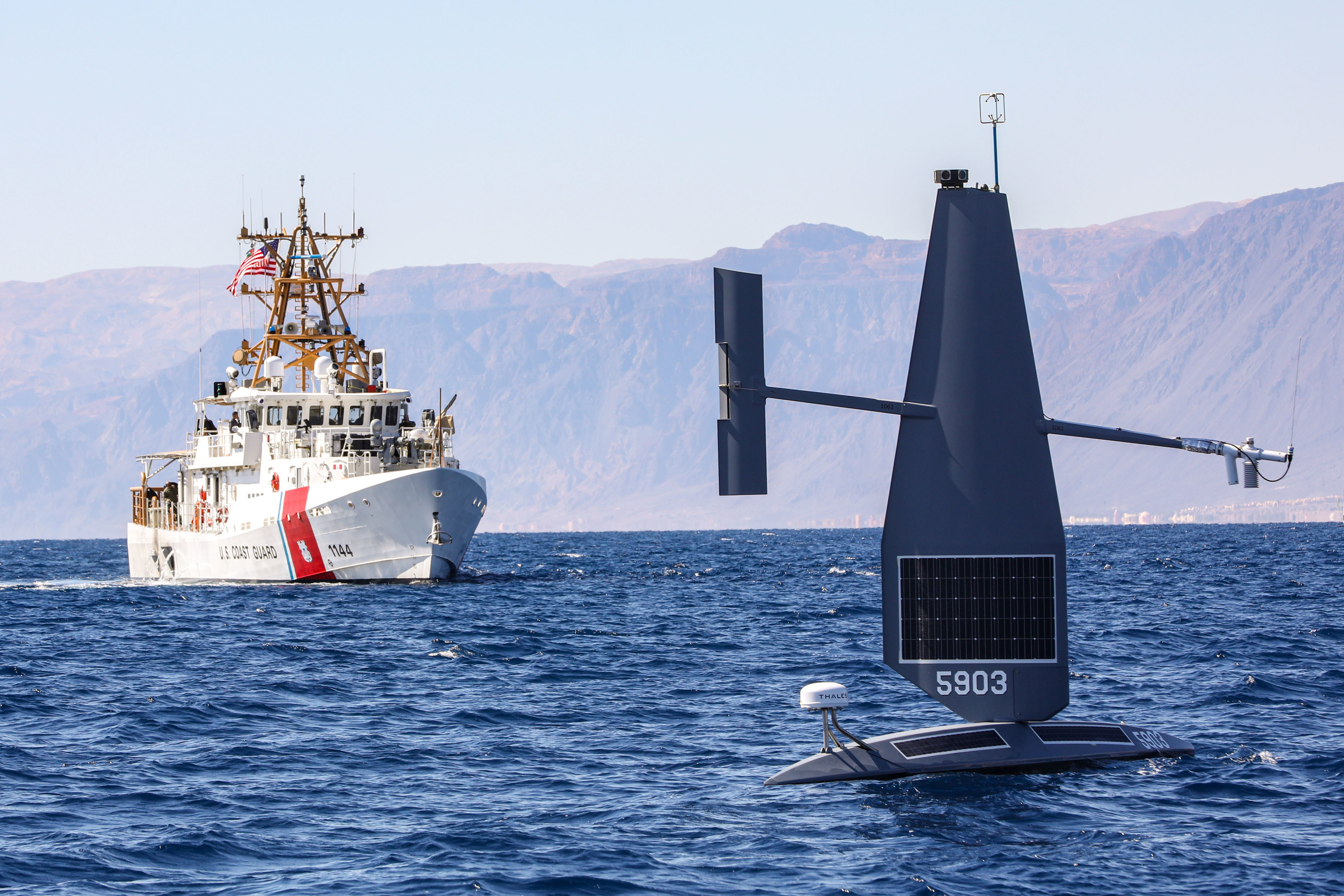
GULF OF AQABA (Feb. 13, 2022) The U.S. Coast Guard Sentinel-class cutter USCGC Glen Harris (WPC 1144) sails near a U.S sail drone explorer during the International Maritime Exercise/Cutlass Express (IMX) 2022, Feb. 13, 2022. IMX/CE 2022 is the largest multinational training event in the Middle East, involving more than 60 nations and international organizations committed to enhancing partnerships and interoperability to strengthen maritime security and stability. (U.S. Army photo by Cpl. DeAndre Dawkins)

Defense Scoop reports:

“The Navy plans to stand up additional unmanned task forces around the globe modeled after Task Force 59 in the Middle East, Navy Secretary Carlos Del Toro told reporters Saturday…“We’ve demonstrated with Task Force 59 how much more we can do with these unmanned vehicles — as long as they’re closely integrated together in a [command and control] node that, you know, connects to our manned surface vehicles. And there’s been a lot of experimentation, it’s going to continue aggressively. And we’re going to start translating that to other regions of the world as well,” Del Toro said during a media roundtable at the Reagan National Defense Forum.”

The report goes on to mention 4th Fleet and Oceana specifically, both regions of intense interest to the Coast Guard in regard to drug interdiction and Illegal, Unregulated, Unreported (IUU) fishing respectively.

This could be a big boost to our Maritime Domain Awareness. In the Eastern Pacific Drug Transit Zone we might need uncrewed surface vessels with passive acoustic sensors since the targets of interest are poor targets for radar and optical sensors. That could lead to practical experience that could improve our ASW capability.

“HMS Medway, U.S. Coast Guard Law Enforcement Detachment Seize Cocaine in Caribbean” –Seapower

HMS MEDWAY and her embarked US Coastguard Law Enforcement team interdicted a vessel carrying over 400kg of cocaine in the Caribbean Sea, 29 Sep 22. Initially spotted by a US Maritime Patrol Aircraft, the ship chased down the boat before the Coastguard boarding team discovered the drugs and detained three individuals. The operation, which lasted overnight, then concluded with the vessel being sunk by Medway’s weapons systems.

A hat tip to our Royal Navy friends. The Navy League’s on line magazine, Seapower, reports,

A Royal Navy ship and U.S. Coast Guard boarding team seized more than 400 kilograms of cocaine worth around £24m on Britain’s streets from a boat in the Caribbean, the U.K. Ministry Of Defence said in an Oct. 28 release.

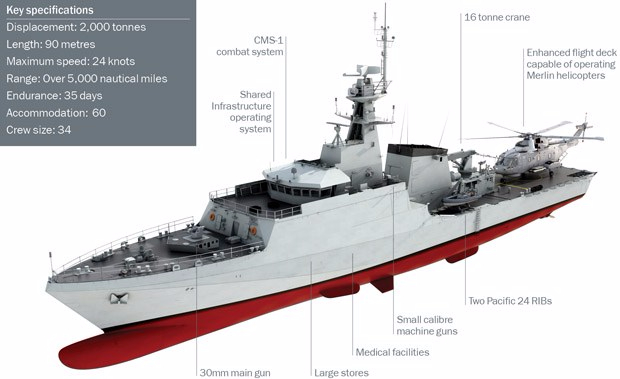
HMS Medway is a River Class Batch II Offshore Patrol Vessel. The Coast Guard would probably call her a medium endurance cutter. They have a relatively small crew and are faster than Coast Guard WMECs or the Offshore Patrol Cutters currently building.

There is no indication they operated with an embarked helicopter. Operating in the Caribbean they would have had adequate fixed wing support. They have a large helicopter landing area but no hangar. The helicopter in the illustration is a very large one, a Merlin, with a max take off weight of over 32,000 pounds.

The gun on these ships is the same gun and mount as the new Mk38 Mod4.

“Coast Guard cutter patrols near Port-au-Prince, Haiti” –District 7

USCGC NORTHLAND (WMEC-904)

Not uncommon for cutters to be in the area, but, if this is more than just training, that the Hatian government asked the Coast Guard to be there is unusual.

News Release

U.S. Coast Guard 7th District Southeast

Coast Guard cutter patrols near Port-au-Prince, Haiti

Editor’s km Note: Click on images to download high-resolution version.

MIAMI — The Coast Guard diverted one of its major cutters to patrol near Port-au-Prince, Haiti, Wednesday, at the request of the government of Haiti and in close coordination with the U.S. okay Department of State.

USCGC Northland (WMEC 904) was diverted to Haiti as a clear sign of U.S. resolve in support of the Government of Haiti and its people, and to rendezvous with the Haitian Coast Guard for training in the area.

Northland was previously patrolling within the Windward Pass under the direction of the Coast Guard’s Seventh District, headquartered in Miami, in support of Operation Vigilant Sentry, a standing maritime law enforcement operation.

“The U.S. Government has a vested interest in regional security throughout the Caribbean Sea and is aware of the ongoing situation of civil unrest and gang violence within Haiti,” said Rear Adm. Brendan C. McPherson, commander of the Seventh Coast Guard District. “The Coast Guard is one part of a whole-of-government approach to assist the Haitian government with security and stability throughout Haiti, especially as it relates to the deterrence and prevention of dangerous, irregular maritime migration.”

The Coast Guard has a longstanding relationship with the Haitian Coast Guard. In January 2010, USCGC Forward (WMEC 911), a 270-foot Famous-class medium endurance cutter, was the first U.S. asset to respond and render humanitarian aid and assistance following a 7.0-magnitude earthquake in Haiti. In August 2021, the Coast Guard was among the first U.S. agencies to respond with humanitarian aid following a 7.2-magnitude earthquake in Haiti.

In August 2022, USCGC Robert Yered (WPC 1104), a 154-foot Sentinel-class fast response cutter, delivered firefighting equipment sourced as a donation from Miami-Dade Fire Rescue to better equip the Haitian firefighting department at Port-au-Prince-Toussaint Louverture International Airport. In September 2022, the Coast Guard’s international training team visited Haiti to facilitate the second of two iterations of small boat operations training with the Haitian Coast Guard to ensure uniform and repeatable training standards for the maintenance and safe operation of the Haitian Coast Guard’s surface fleet.

The Coast Guard continues to patrol the Caribbean Sea to deter undocumented migration by sea. In fiscal year 2022, the Coast Guard interdicted 7,173 Haitian migrants attempting to enter the United States illegally by sea.

Northland is a 270-foot Famous-class medium endurance cutter homeported in Portsmouth, Virginia. Northland’s missions include law enforcement, search and rescue, drug interdiction, fisheries enforcement, migrant interdiction, homeland security and defense operations, international training, and humanitarian operations. Northland patrols the offshore waters from Maine to Florida, the Gulf of Mexico, the Eastern Pacific Ocean and the Caribbean Sea.

For more breaking news or information about D7 follow us on Twitter, Facebook and Instagram.

“Colombia inks deal that could see Damen build five Sigma frigates” –Defense News

Colombian Navy SIGMA frigate

Defense News reports, one of our primary partners in drug interdiction efforts is expected to significantly upgrade their naval capabilities.

Colombia is launching a $2 billion shipbuilding program that would see its Navy acquire five frigates.

The announcement, made last week, was followed by the signing on Tuesday of an initial contract between local shipbuilder Cotecmar and Dutch company Damen to adapt the latter’s Sigma 10514 design to meet the Colombian Navy’s requirements.

This is a significant step toward self sufficiency in naval construction. It is a step up after Cotemar built three Fassmer 80 meter Offshore Patrol Vessels.

The new ships will replace four smaller 95 meter, 1850 ton full load, German built light frigate/corvettes that were commissioned in 1983/84.

If these new ships are in fact 120 meters in length and at least 2800 tons full load, they will be the largest ships of the SIGMA series. (At one time I expected a SIGMA series ship would have been a contender in the Offshore Patrol Cutter program.)

Apparently they have not made a final choice of weapons and sensors. I would not be surprised if they were equipped much like the Mexican SIGMA frigate, which is armed with weapons sourced from the US, including RGM-84L Harpoon Block II, eight Mk56 VLS for ESSM, MK 54 Mod 0 lightweight torpedoes with two MK 32 Surface Vessel Torpedo Tubes (SVTT) triple tube launchers, Block II Rolling Airframe Missile (RAM) missiles and Bofors 57 mm gun.

It seems likely the additional length compared to the Mexican ship will be to improve some capability, I would guess ASW. Mk41 VLS would allow greater flexibility including launch of ASROC and potentially land attack missiles.

It is widely known Colombia and Venezuela have not been getting along well. Colombia probably considers Venezuela their pacing threat. If that is the case, most, if not all five of the new ships will likely be based on the Caribbean side. These ships should provide an advantage vs the Venezuelan Navy.

Major naval bases of the Colombian Navy (Armada de la República de Colombia – ARC)
Colombian Navy (ARC) Marine Infantry Primary base and training school, Covenas
Source: Iceman0108. Background map: Mapa de Colombia (relieve-ríos) by Milenioscuro

Below, video of the latest SIGMA series ship, Mexican frigate ARM Benito Juárez (F 101), as it arrives for participation in RIMPAC 2022: 

“Coast Guard offloads more than $475 million in illegal narcotics in Miami” –LANTAREA

HNLMS Groningen’s crew interdicts a suspected drug boat in the Caribbean Sea, Sept. 27, 2020. HNLMS Groningen is a Holland-class offshore patrol vessel operated by the Royal Netherlands Navy. (Royal Netherlands Navy photo)

Below is a news release from USCG Atlantic Area. What I found notable was the participation of a Netherlands OPV and a USN Freedom class LCS. (No not the first time ships of these classes have been used for drug interdiction.)

The Holland class OPVs are very similar, in general terms, to the Offshore Patrol Cutters.

I expect Dutch participation to continue, but if the Navy gets their way, there will be a lot fewer LCSs.

181206-N-N0101-028, MARINETTE, Wis. (Dec. 6, 2018) The future littoral combat ship USS Billings (LCS 15) conducts acceptance trials on Lake Michigan, Dec. 6, 2018. (U.S. Navy photo courtesy of Marinette Marine/Released)

News Release

U.S. Coast Guard Atlantic Area

Coast Guard offloads more than $475 million in illegal narcotics in Miami

A U.S. Coast Guard member offloads suspected narcotics from USCGC Legare in Miami, FloridaSuspected narcotics are removed via crane from USCGC Legare in Miami, Florida

Editors’ Note: To view more or download high-resolution imagery, click on the photos above.

MIAMI — The crew of the USCGC Legare (WMEC 912) offloaded approximately 24,700 pounds of cocaine and 3,892 pounds of marijuana, worth an estimated $475 million, Thursday at Base Miami Beach.

The drugs were interdicted in the international waters of the Caribbean Sea and the Eastern Pacific Ocean by crews from:

“I am proud of the crew’s continued devotion to duty that made this offload possible,” said Cdr. Jeremy M. Greenwood, commanding officer of Legare. “Through the coordinated efforts of the Legare, the LEDETs, HNLMS Groningen, CGC James, and the USS Billings crews, we significantly contributed to the counter-drug mission and the dismantling of transnational criminal organizations. The drugs seized through this coordinated effort will result in significantly fewer drug-related overdoses.”

The fight against drug cartels in the Caribbean Sea and Eastern Pacific Ocean, and the transnational criminal organizations they are associated with, requires a unity of effort in all phases; from detection and monitoring to interdiction and apprehension, and on to criminal prosecutions by international partners and U.S. Attorneys’ Offices in districts across the nation.

Detecting and interdicting illegal drug traffickers on the high seas involves significant interagency and international coordination. The Joint Interagency Task Force South in Key West, Florida conducts detection and monitoring of aerial and maritime transit of illegal drugs. Maritime interdiction of illicit smuggling activity in the Caribbean Sea is coordinated by the Seventh Coast Guard District, headquartered in Miami. The Dutch Caribbean Coast Guard also coordinates maritime interdiction of illicit smuggling activity with deployed Royal Netherlands Navy ships and their embarked Dutch Fleet Marine Corps squadrons and U.S. Coast Guard LEDETs in the Eastern Caribbean Sea near the Netherlands Antilles and Aruba. Maritime interdiction of illicit smuggling activity in the Eastern Pacific Ocean is coordinated by the Eleventh Coast Guard District, headquartered in Alameda, California. The U.S. Navy and allied foreign ships conduct law enforcement missions under the authority of embarked Coast Guard LEDETs from Tactical Law Enforcement Teams based in Miami and San Diego.

The Legare is a 270-foot Famous-class medium endurance cutter stationed in Portsmouth, Virginia. Legare’s missions include Law Enforcement, Search and Rescue, Protection of Living Marine Resources, Homeland Security and Defense Operations, international training, and humanitarian operations. Legare patrols the offshore waters from Maine to Florida, the Gulf of Mexico, the Eastern Pacific, and the Caribbean.

For information on how to join the U.S. Coast Guard, visit www.GoCoastGuard.com to learn more about active duty and reserve officer and enlisted opportunities. Information on how to apply to the U.S. Coast Guard Academy can be found at www.uscga.edu.