A multiple-award contract to support current and future unmanned surface vehicle family of systems and subsystems is awarded to the following 49 industry partners: Anduril Industries Inc.,* Costa Mesa, California (N0002424D6306); Applied Research Associates Inc., Albuquerque, New Mexico (N0002424D6307); Asymmetric Technologies LLC,* Dublin, Ohio (N0002424D6308); AT&T Corp., Oakton, Virginia (N0002424D6309); Atlas Technologies Inc.,* North Charleston, South Carolina (N0002424D6313); Autonodyne LLC,* Boston, Massachusetts (N0002424D6315); Beast Code LLC,* Fort Walton Beach, Florida (N0002424D6316); Bigelow Family Holdings LLC, doing business as Mettle Ops,* Sterling Heights, Michigan (N0002424D6317); Bollinger Shipyards Lockport LLC, Lockport, Louisiana (N0002424D6318); CACI Inc. – Federal, Chantilly, Virginia (N0002424D6319); Carnegie Robotics LLC, doing business as CR Tactical,* Pittsburgh, Pennsylvania (N0002424D6320); Cydecor Inc.,* Arlington, Virginia (N0002424D6361); DELTA Resources Inc., Alexandria, Virginia (N0002424D6363); Fairbanks Morse LLC, Beloit, Wisconsin (N0002424D6364); Teledyne FLIR Surveillance Inc., North Billerica, Massachusetts (N0002424D6365); General Atomics Aeronautical Systems Inc., Poway, California (N0002424D6366); GIRD Systems Inc.,* Cincinnati, Ohio (N0002424D6367); Herren Associates Inc.,* Washington, D.C. (N0002424D6368); Honeywell International Inc., Clearwater, Florida (N0002424D6369); IERUS Technologies Inc.,* Huntsville, Alabama (N0002424D6370); Integer Technologies LLC,* Columbia, South Carolina (N0002424D6371); KIHOMAC Inc.,* Reston, Virginia (N0002424D6372); Leonardo Electronics US Inc., Huntsville, Alabama (N0002424D6373); MAK Technologies Inc., Cambridge, Massachusetts (N0002424D6374); Marine Ventures International Inc.,* Stuart, Florida (N0002424D6375); Marinette Marine Corp., Marinette, Wisconsin (N0002424D6376); Metron Inc.,* Reston, Virginia (N0002424D6378); Microsoft Corp., Redmond, Washington (N0002424D6379); Murtech Inc.,* Glen Burnie, Maryland (N0002424D6380); NewSat North America LLC,* Indian Harbour Beach, Florida (N0002424D6381); Noblis MSD LLC, Philadelphia, Pennsylvania (N0002424D6382); Novetta Inc., McLean, Virginia (N0002424D6383); Ocean Specialists Inc.,* Stuart, Florida (N0002424D6384); PACMAR Technologies LLC,* Honolulu, Hawaii (N0002424D6377); Persistent Systems LLC,* New York, New York (N0002424D6385); Physical Sciences Inc.,* Andover, Massachusetts (N0002424D6386); Prescient Edge Corp.,* McLean, Virginia (N0002424D6387); Programs Management Analytics & Technologies Inc.,* San Diego, California (N0002424D6388); Reliability & Performance Technologies LLC,* Dublin, Pennsylvania (N0002424D6389); Saab Inc., East Syracuse, New York (N0002424D6390); Scientific Systems Co. Inc.,* Woburn, Massachusetts (N0002424D6391); Secmation, LLC,* Raleigh, North Carolina (N0002424D6392); SES Government Solutions Inc., Reston, Virginia (N0002424D6393); SIMIS Inc.,* Portsmouth, Virginia (N0002424D6394); Sparton DeLeon Springs LLC, De Leon Springs, Florida (N0002424D6395); Systems and Proposal Engineering Co.,* Manassas, Virginia (N0002424D6396); Systems Technology & Research Inc.,* Huntsville, Alabama (N0002424D6397); TDI Technologies Inc.,* King of Prussia, Pennsylvania (N0002424D6398); and Triton Systems Inc.,* Chelmsford, Massachusetts (N0002424D6399), are each awarded a firm-fixed-price, fixed-price-incentive-firm-target, cost-plus-incentive-fee, cost-plus-fixed-fee, and cost only, indefinite-delivery/indefinite-quantity contract for the procurements involving one or more functional areas, i.e. payloads, non-payload sensors, mission support systems, autonomy and vehicle control systems, ashore and host platform elements, and logistics and sustainment for the Unmanned Surface Vehicle Family of Systems. The maximum dollar value for all (total number) contracts combined is $982,100,000. Each awardee will be awarded $1,000 (minimum contract guarantee per awardee) at contract award. Work will be performed in various locations in the contiguous U.S. and is expected to be completed by February 2025. These contracts include a five-year ordering period option which, if exercised, will continue work through February 2030. Fiscal 2024 research, development, test and evaluation (Navy) funding in the amount of $49,000 will be obligated at the time of award and will expire at the end of the current fiscal year. All other funding will be made available at the delivery or task order level as contracting actions occur. These contracts were competitively procured via SAM.gov and there were 55 offers received. Naval Sea Systems Command, Washington Navy Yard, D.C., is the contracting activity.
Category Archives: contract
“Coast Guard releases request for proposal for maritime unmanned aircraft system services” –CG-9

The unmanned aircraft sensor payload capability is varied based on the Coast Guard’s desired mission and search conditions: MWIR 3.5 is a mid-wave infrared for thermal imaging capability, for use at night or periods of low visibility; EO-900 is a high-definition telescopic electro-optical (EO) imager to zoom in on targets at greater distance; and ViDAR is a visual detection and ranging wide-area optical search system that is a comprehensive autonomous detection solutions for EO video. Courtesy Photo.
Below is a news release from the Acquisitions Directorate (CG-9). The solicitation is for Group 2 or 3 UAS.
The minimum performance specifications are not particularly demanding, including:
- 50 knot cruise speed,
- 70 knot dash speed,
- 12 hours daily continuous coverage, but that could include two sorties,
- Range 40 nmi in clear conditions, 35 nmi in light rain,
- Operate from a flight deck 80 x 48 feet (Host Cutter drawings provided are for NSC, but also presumably OPCs. Not likely for icebreakers or Alex Haley because they have no air search radar, see below) within limits: pitch +/- 3 degrees, roll +/- 5 degrees.
- The UA must have space, weight, and power to concurrently operate vendor
provided: Electro-Optical (EO) sensor, Infra-Red (IR) sensor, AIS, VHF/UHF
communications relay, aeronautical transponder, and non-visible IR marker for
the required flight endurance. (I found no minimum payload weight.)
There are some interesting specifications that may reflect how the systems are used.
- The UA must provide a non-visible, near-IR marker or FDA approved illuminator to
aid manned assets using NVDs for target acquisition at night - The UAS must be capable of operations in light icing conditions defined as
accumulation of ¼ inch of ice in 15-20 minutes (Objective)(so not a minimum requirement–Chuck) - The UA must have an Infrared (IR) anti-collision lighting subsystem (providing a night visibility range of 3+ statute miles) producing energy emitted in a 360-degree pattern around the UA +30 degrees (above) and -30 degrees (below) the horizontal plane of the UA. The IR-light intensity must be at least of a Class B Night Vision Imaging System (NVIS) radiant intensity (NRIb) of 2.31 E -04 NRI. The Ground Control Station must have the capability to turn the IR anti-collision light on or off.
- In addition to other sensor requirements identified in this document, when such a
system is commercially available, the UA must be capable of incorporating a
collision avoidance system (i.e. Detect and avoid (DAA) or Sense and avoid (SAA)
systems) to extend the UA’s range beyond the host cutter’s air search radar
envelope while maintaining compliance with international due regard. (Objective) (Not a minimum requirement. Meaning we will likely be operating these systems without a sense and avoid system, so will have to operate within the range of the cutter’s air-search radar. Also precludes operating these systems on vessels without an air-search until such a system is installed–Chuck) - At an operating altitude of 3,000 feet when the UAS is directly overhead of the target of interest (no slant range), the UA must be acoustically non–detectable per MIL STD-1474 (series), Level 1, requirements (quiet rural area with the closest heavily used highway and community noises at least 2.5 miles away)
- The Contractor provided Datalinks must be capable of operating, with
unobstructed Line of Sight (LOS), at a minimum range of 40 nautical mile
(NM) (threshold) / 100 NM (Objective).
This sounds very much like a continuation of the Scan Eagle operations already being conducted on National Security Cutters (here, here, here, here, and here). Forgive me if I point out that I recommended we try this system back in 2011, five years before we actually did.
Coast Guard releases request for proposal for maritime unmanned aircraft system services
Requirements for the MUAS include fully automated flight operations, a minimum 12 hours of flight time a day, ability to be launched and recovered from the host cutter flight deck, and ability to provide services 24 hours a day, seven days a week. The MUAS must be capable of carrying a payload including electro-optical and infrared sensors and communications relay and be capable of providing surveillance, detection, classification and identification for all of the host cutter’s operational missions.
The Coast Guard plans to award one indefinite-delivery, indefinite-quantity firm fixed price contract. Initially, the contract will be used to continue UAS capability on the national security cutter (NSC) class; however, the contract could be used to support additional cutter classes in the future.
The full RFP is available here. Responses are due by 1 p.m. EST Jan. 11, 2024.
For more information: Unmanned Aircraft Systems Program page
“Stage 2 of the Coast Guard offshore patrol cutter moves forward” –CG HQ News Release
Below is a news release. Just minutes before I saw this, I recieved an email from Jessica Ditto, Eastern’s VP, Communications
As you might have seen, ESG is going to the Court of Federal Claims (COFC) to challenge the OPC stage II award decision. COFC is not an appeal, but a new proceeding that allows ESG to seek the disclosure materials that have been withheld by the government in the GAO protest. Here is our statement:
“The federal procurement process is designed to be fair and transparent. Ordinarily, the government discloses reasonable justification for its award decisions to the attorneys representing the parties in a protest. The government has declined to voluntarily disclose the information that might offer that justification. As a result, we are seeking the information and justification through a different legal pathway,” said Joey D’Isernia, President of Eastern Shipbuilding Group, Inc.
| News Release |
U.S. Coast Guard Headquarters |
Stage 2 of the Coast Guard offshore patrol cutter moves forward
WASHINGTON — The Coast Guard today issued a notice to Austal USA, the offshore patrol cutter (OPC) Stage 2 contractor, to proceed on detail design work to support future production of OPCs. The Coast Guard issued the notice following the withdrawal of an award protest filed in July with the Government Accountability Office by an unsuccessful Stage 2 offeror.
The Coast Guard on June 30, 2022, awarded a fixed-price incentive (firm target) contract through a full and open competition to Austal USA to produce up to 11 offshore patrol cutters. The initial award is valued at $208.26 million and supports detail design and long lead-time material for the fifth OPC, with options for production of up to 11 OPCs in total. The contract has a potential value of up to $3.33 billion if all options are exercised.
The Coast Guard’s requirements for OPC Stage 2 detail design and production were developed to maintain commonality with earlier OPCs in critical areas such as the hull and propulsion systems, but provide flexibility to propose and implement new design elements that benefit lifecycle cost, production and operational efficiency and performance.
The 25-ship OPC program of record complements the capabilities of the service’s national security cutters, fast response cutters and polar security cutters as an essential element of the Department of Homeland Security’s layered maritime security strategy. The OPC will meet the service’s long-term need for cutters capable of deploying independently or as part of task groups and is essential to stopping smugglers at sea, interdicting undocumented non-citizens, rescuing mariners, enforcing fisheries laws, responding to disasters and protecting ports.
For more information: Offshore Patrol Cutter Program page.
“Eastern Shipbuilding protesting Austal’s cutter win, cites ‘unfair competitive advantage’” –Breaking Defense
WASHINGTON: Eastern Shipbuilding Group is formally protesting a Coast Guard shipbuilding contract potentially worth billions that was awarded late last month to Austal USA, in part due to what ESG claims was an “unfair competitive advantage and conflict” among other issues.
This may further delay this much delayed program. Can’t help but wonder if OPC #1, the future USCGC Argus, will be delivered before the end of FY2022 as it had been scheduled. If not, it is going to undermine Eastern’s case as to their own competence.
Thanks to Lee for bringing this to my attention.
Contract Option for Second Polar Security Exercised
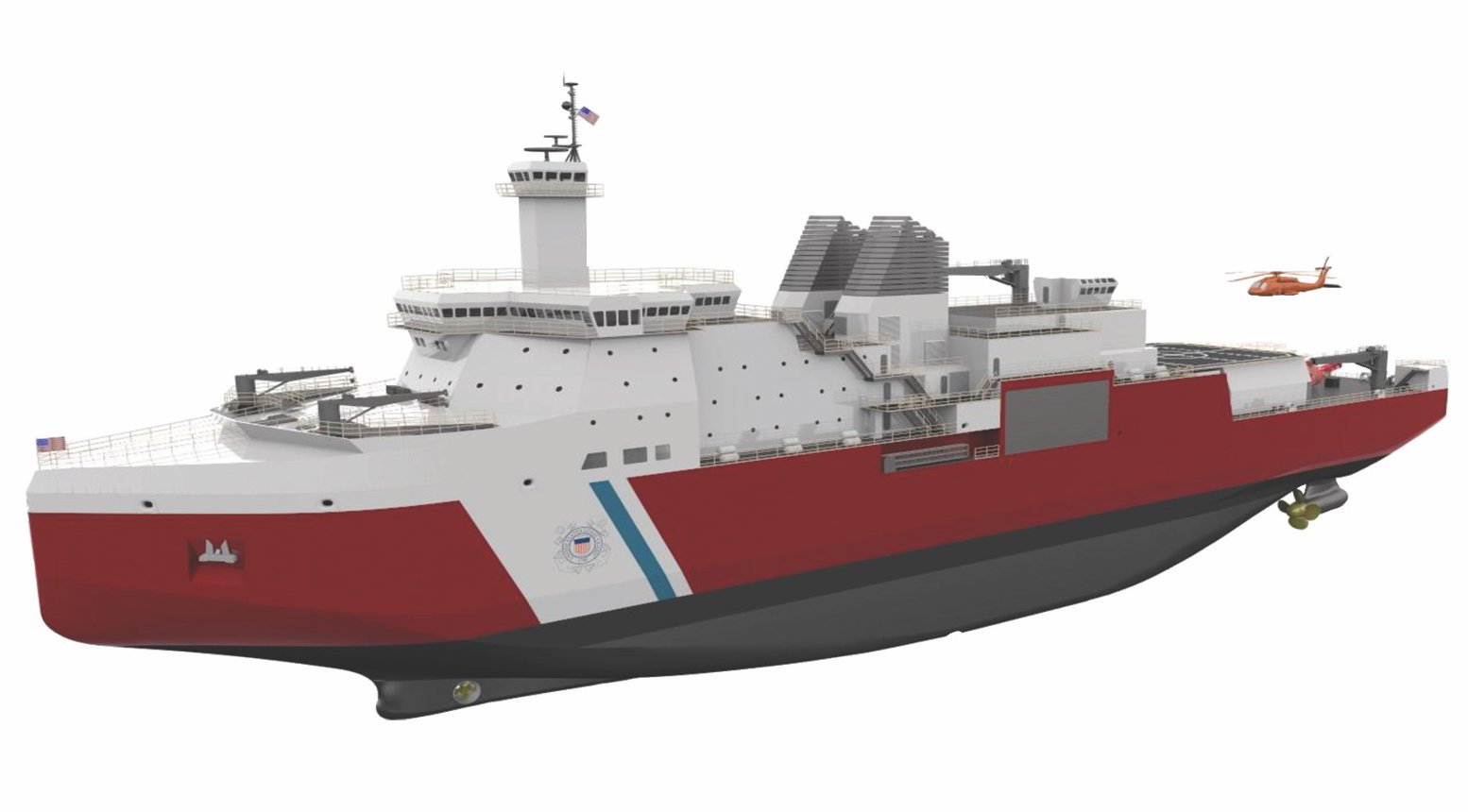
DOD reports a contract option for design and construction of the Second Polar Security Cutter has been exercised. Notably this is a Navy contract. Completion expected Sept. 2026.
VT Halter Marine Inc., Pascagoula, Mississippi, is awarded a $552,654,757 fixed-price incentive modification to previously awarded contract N00024-16-C-2210 to exercise an option for the detail design and construction of the second Coast Guard Polar Security Cutter. Work will be performed in Pascagoula, Mississippi (61%); Metairie, Louisiana (12%); New Orleans, Louisiana (12%); San Diego, California (4%); Mossville, Illinois (4%); Mobile, Alabama (2%); Boca Raton, Florida (2%); and other locations (3%), and is expected to be completed by September 2026. Fiscal 2021 procurement, construction, and improvement (Coast Guard) funds in the amount of 485,129,919 (80%); fiscal 2020 procurement, construction, and improvement (Coast Guard) funds in the amount of $100,000,000 (17%); and fiscal 2019 procurement, construction, and improvement (Coast Guard) funds in the amount of $20,000,000 (3%) will be obligated at time of award and will not expire at the end of the current fiscal year. The Naval Sea Systems Command, Washington, D.C., is the contracting activity.
Thanks to Paul for bringing this to my attention.
Coast Guard Special Purpose Craft Law Enforcement Generation II (SPC-LE II)

Photo: Not positive, but this seems to be the boat we are talking about.
The DOD recently announced a boat contract, awarded through the Navy, that involves boats for the Coast Guard (you have to look pretty far down to find it).
Silver Ships Inc.,* Theodore, Alabama, was awarded an $8,239,095 firm-fixed price, indefinite-delivery/indefinite-quantity single award contract (N00024-21-D-2205) for design and construction of up to 110 Navy 8-meter and 11-meter Surface Support Craft and Coast Guard Special Purpose Craft Law Enforcement Generation II (SPC-LE II). Work will be performed in Theodore, Alabama, and is expected to be completed in August 2023. This contract includes options which, if exercised, would bring the cumulative value of this contract to $51,663,787. Fiscal 2020 other procurement (Navy) funds in the amount of $3,242,628 (39%); fiscal 2021 other procurement (Navy) funds in the amount of $3,187,680 (39%); and fiscal 2021 other procurement (Coast Guard) funds in the amount of $1,808,787 (22%) will be obligated at time of award and will not expire at the end of the current fiscal year. This contract is a small business set-aside. This contract was competitively procured via the beta.sam.gov website, with four offers received. The Naval Sea Systems Command, Washington, D.C., is the contracting activity. (Awarded Sept. 30, 2021)
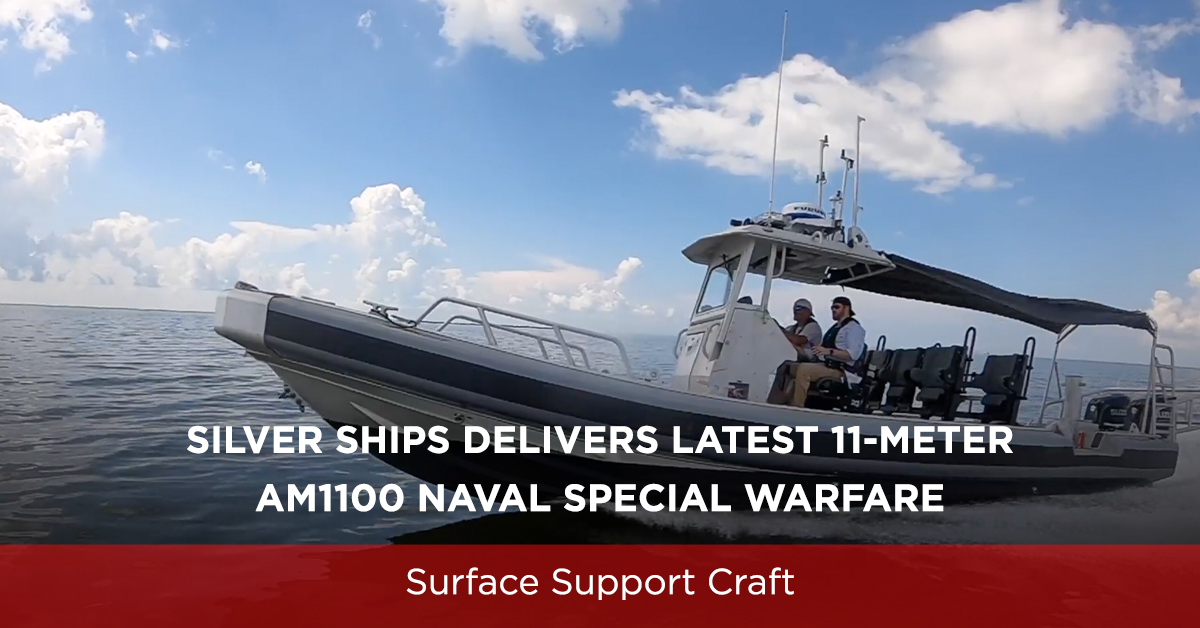
This is Silver Ships’ announcement.
This appears to be the boat the Coast Guard will be getting. The Coast Guard will get the “Open Center Console (Open) variant.”
Each boat will use three outboards. These are the engines specified in the contract.
Thanks to Paul for bringing this to my attention. He also provided the following that gives more detail:
C-1 PART 1 – GENERAL STATEMENT OF WORK
This Statement of Work (SOW) defines the effort required for the, design, construction, testing, configuration control, documentation, and program management for the acquisition of the 8m variant,11m variant of the Naval Special Warfare (NSW) Surface Support Craft (SSC) and the United States Coast Guard (USCG) 11m variant (Special Purpose Craft Law Enforcement).
C-1.1 BACKGROUND
The 8m variant and 11m variant NSW SSC boats operate from inshore littorals to blue water, over the horizon locations, in and up to moderate sea states (NSW) in widely diverse climatic conditions (tropical to arctic). They provide over-watch and coverage for diverse NSW waterborne operations, such as: transit for at sea personnel, water parachute jump, diving, surface swimmer support, medical evacuation and command, control, communications, computers, and intelligence duties. The SSCs also provide support for all NSW garrison locations and allow NSW to certify units for deployment in support of Navy and COMNAVSPECWARCOM requirements.
The USCG will use the 11m SSC variant to conduct counter-smuggling, search and rescue (SAR), recreational boating safety (RBS), and ports and waterways coastal security (PWCS) missions and will operate in higher sea states than the USN variants.
All boat variants are desired to provide comparable to enhanced performance of current capabilities while focusing on commonality to maintain reduction in Total Ownership Costs (TOC).
The NSW SSC requires two configuration variants of the 8m and 11m, Open Center Console (Open) and Enclosed Cabin (Cabin), to support mission needs.
The USCG requires the 11m Open Center Console (Open) variant to support mission needs.
C-1.2 QUANTITIES
The resulting contract will be a 5-year Indefinite Delivery, Indefinite Quantity (IDIQ) contract for an estimated one hundred and ten (110) total craft. The initial award is for an estimated fourteen (14) boats.
C-2.2.1 Boat – The Contractor shall provide the boat and trailer in accordance with the Specification
(Attachment 1).
C-2.2.2 UID – The Contractor shall provide UIDs for each boat in accordance with Attachment 6.
C-2.2.3 Boat Specific Technical Data Package (TDP) – The contractor shall provide for each boat one (1) hard copy and one (1) electronic copy (CD/DVD) of the Final 11m OPEN USCG Variant TDP developed under CLIN 1022 specific to each boat.
C-2.2.4 Mercury Verado Engines– The Contractor shall provide three (3) Mercury Verado engines per boat in accordance with the Specification (Attachment 1). The Contractor shall complete the engine break-in in accordance with the Specification (Attachment 1) as part of the boat CLIN.
C-2.14 CLIN 1014 AND IF EXERCISED, CLINs 2014, 3014, 4014 AND 5014 – SHIPPING – USCG
STATION SAN DIEGO, CA and also USCG STATION SOUTH PADRE ISLAND, TX; USCG STATION MIAMI, FL; USCG MARITIME LAW ENFORCEMENT ACADEMY, CHARLESTON, SC.
The Contractor shall deliver the boat to the location specified in Section F (Deliveries or Performance) and in accordance with Section C, Part 3. Items not integrated into the boat shall be wrapped in protective packaging or container and shall be shipped to the same location either with the boat or via separate shipping.
C-2.18 CLIN 1018 AND IF EXERCISED CLIN 4018 – CREW FAMILIARIZATION (USCG) SAN DIEGO (and the locations listed above)
The Contractor shall provide crew familiarization and training for USCG personnel at San Diego, CA. Crew familiarization shall include craft operations, main equipment operations and maintenance. This shall include Contractor and/or OEM training and component change out for engines, electrical, and HM&E systems. At a minimum training shall be two (2) full days at End User‘s location for up to ten (10) students. The Contractor shall provide all training materials.
“Coast Guard releases request for proposal for offshore patrol cutter follow-on detail design and production” –CG-9
The following is reproduced from the Acquisitions Directorate announcement: Interesting to look though some of the linked documents. Shows how complex contracting has become.
Feb. 1, 2021 —
The Coast Guard released a request for proposal (RFP) Jan. 29 for detail design and production of up to 11 offshore patrol cutters (OPCs). The RFP is available here. The competition is open to all interested offerors.
Establishing a new, full and open competitive environment for the OPC program is a key component of the Coast Guard’s strategy to recapitalize its offshore surface capabilities. The RFP was informed by extensive industry engagement, including contracted industry studies with eight U.S. shipyards, an invitation to review and respond to a draft RFP and the establishment of an OPC technical library. The OPC technical library provides updated design information that reflects the current state of OPC acquisition activities to potential offerors.
The deadline to submit responses to the RFP is May 28, 2021. Contract award is scheduled to occur in the second quarter of fiscal year 2022.
The OPC acquisition program meets the service’s long-term need for cutters capable of deploying independently or as part of task groups, and is essential to stopping smugglers at sea, interdicting undocumented migrants, rescuing mariners, enforcing fisheries laws, responding to disasters and protecting ports and waterways. The acquisition of up to 25 OPCs will complement the capabilities of the service’s national security cutters, fast response cutters, and polar security cutters as an essential element of the Department of Homeland Security’s layered maritime security strategy.
For more information: Offshore Patrol Cutter program page
“Coast Guard Modifies Contract to Construct Second Offshore Patrol Cutter, Acquire Long Lead-Time Material for Third Offshore Patrol Cutter” –CG-9
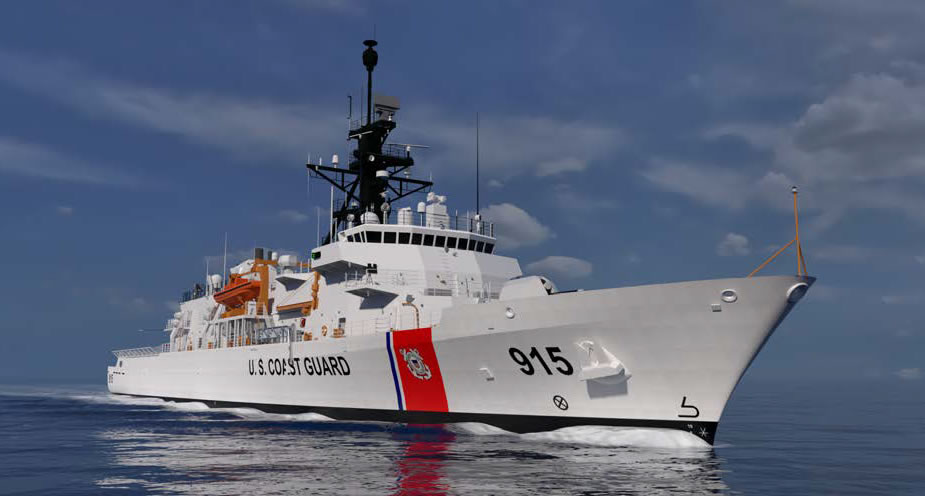
Above: Artists rendering from Eastern Shipbuilding Group
Contract for the Second Offshore Patrol Cutter, the future USCGC Chase, and long lead time items for the third. Presumably this is a contract modification, rather than the exercise of a contract option, because the price is higher than the original option. Still this does not look a great deal higher than the previous contract ($317.5M), for the first OPC and long lead time items for the second. Following from the Acquisitions Directorate, CG-9:
The U.S. Coast Guard modified its contract with Eastern Shipbuilding Group (ESG) April 2 to begin construction of the second Offshore Patrol Cutter (OPC) and to acquire long lead-time material (LLTM) for the third OPC. Contract delivery of the second OPC, to be named Chase, is scheduled to occur in 2023.
The total value of the construction and LLTM orders is $343 million. In addition to ordering construction of the second OPC, this contracting action also covers the initial order of components and materials necessary to support the future construction of the third OPC by acquiring propeller and steering components, marine diesel engines, the ship integrated control system, switchboards, and generators.
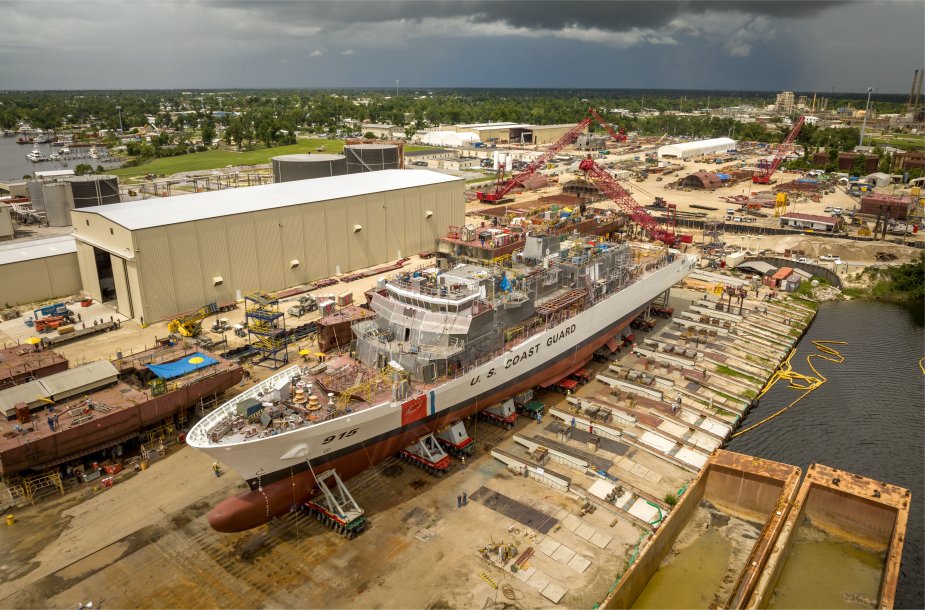
The lead OPC is currently in production at ESG’s shipyard in Panama City, Florida. Production of the lead cutter, Argus, commenced January 7, 2019. Delivery of Argus is scheduled for 2022.
The OPC meets the Service’s long-term need for cutters capable of deploying independently or as part of task groups and is essential to stopping smugglers at sea, interdicting undocumented migrants, rescuing mariners, enforcing fisheries laws, responding to disasters and protecting our ports. The acquisition of 25 OPCs will complement the capabilities of the Service’s National Security Cutters, Fast Response Cutters and Polar Security Cutters as an essential element of the Department of Homeland Security’s layered security strategy.
For more information: OPC program page