Chuck Hill's CG Blog

Chuck Hill's CG Blog

“First Coast Guard aerial vehicle pilot gets his wings” –MyCG

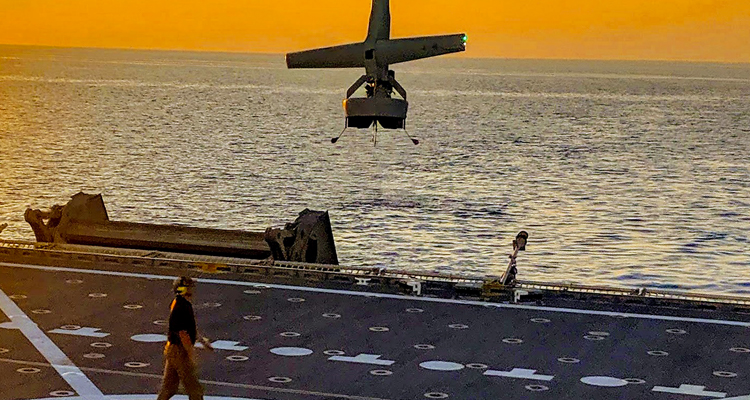
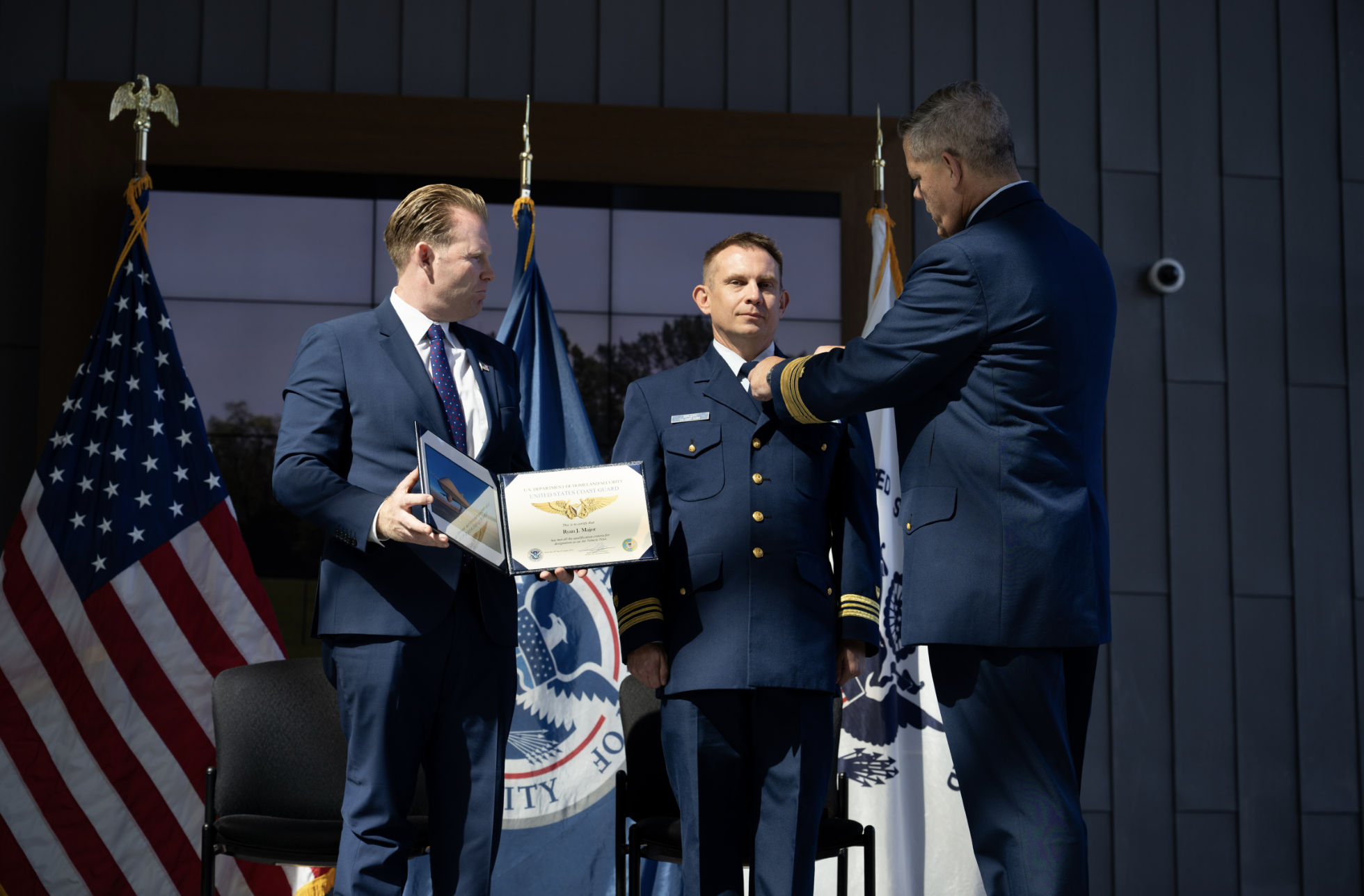
Lt. Cmdr. Ryan Major awarded U.S. Navy Aerial Pilot (AVP) insignia at the RAS Exposition
Vice Commandant Adm. Thomas Allan presents Lt. Cmdr. Ryan Major the U.S.Navy Aerial Pilot (AVP) insignia at the Robotics and Autonomous Systems (RAS) Exposition held at Coast Guard Headquarters in Washington, D.C. on August 26, 2025. Major is the first Coast Guard UAS pilot to receive this distinction who has not completed traditional military flight training.

Below is a MyCG story.

The decision to buy shore based Medium Altitude Long Endurance MQ-9 drones along with this appear to mark a major shift away from the Coast Guard’s past dependence on Customs and Border Protection and Contractor Owned/Contractor Operated UAS. (The relationship with Customs and Border Protection remains close.)

We may be seeing the birth of an entire new community. I have been hoping to see UAS be made more an integral part of the Coast Guard.


Sept. 24, 2025

First Coast Guard aerial vehicle pilot gets his wings

By Kathy Murray, Senior Writer, MyCG

Navy Aerial Vehicle Pilot (AVP) insignia

As a boy, Lt. Cmdr. Ryan Major was fascinated with flying. Not only had his great grandfather flown B-25s in WW II, two of his cousins became military pilots and his parents both worked for the airline industry. “I grew up around aviation and have always loved it,” he says.

So, Major was understandably thrilled last month when he became the first Coast Guard aerial vehicle pilot to earn his wings.

Major, an unmanned aircraft systems (UAS) aviator based in San Angelo, Texas, took the stage to receive this honor during the Robotic and Autonomous Systems (RAS) Exposition held at Coast Guard headquarters on August 26. As his parents watched from the audience, Vice Commandant, Adm. Tom Allan pinned the Navy Aerial Vehicle Pilot (AVP) insignia to his uniform.

“We are entering a new era of Coast Guard aviation where unmanned systems will play and increasingly vital role,” Allan said. “So we’ve opened up MQ-9 Flight Assignments to a broader range of qualified personnel.”

To Major, the recognition marked the culmination of an aviation career he’s been building for more than 20 years. Even prior to joining the Coast Guard in 2004, Major completed civilian flight training and became a certified flight instructor. Once in, he excelled as an aviation electronics technician and got a bachelor’s degree in aeronautical science. He served as a rotary wing sensor instructor, then later earned a commission and worked at the Coast Guard Research and Development Center (RDC) and managed projects at C5 ISC.

When the Coast Guard solicited for the new insignia, Major was working as an IT/Project Management Officer. But having accumulated more than 1,500 manned civilian flight hours over his career, he knew he had the required time in the air. “I jumped at it,” he said.

To qualify for the AVP, Major also had to complete the approved Customs and Border Protection Air and Marine Operations (CBP AMO) initial MQ-9 flight training course and local training syllabus. Historically, only Coast Guard aviators have been eligible for assignment to this JPO. But because of the unique differences between manned and unmanned aircraft, this requirement was recently adjusted to allow Coast Guard members who meet the CBP MQ-9 hiring requirements to also be eligible for assignment.

Coast Guard officials determined Major’s civilian training and certifications, together with his CBP MQ-9 training exceeded the typical requirements to wear the AVP insignia.  As a result, he is now designated as Coast Guard MQ-9 Aircraft Commander and assigned the AVI 13 officer subspecialty code.

“Being an MQ-9 pilot was my pathway to become a Coast Guard pilot,” says Major, noting he’s always enjoyed being part of a crew with a common mission. “I also like the interoperability aspect of working the CBP AMO.”

The AVP insignia is reminiscent of traditional aviator wings. It features an inverted delta displayed on the shield centered on two cross anchors and flanked by wings.

Establishing a new pilot insignia for UAS pilots who operate the MQ-9 paves the way for a new career path in the service and is part of a larger initiative to expand the use of robotics and autonomous capabilities across all Coast Guard missions. In July, a program executive office—the RAS PEO—was set up to accelerate the adoption of uncrewed systems (UxS) in the field as part of Force Design 2028 modernization efforts.

This rapidly evolving technology is expected to be the biggest enhancement to operations since the inception of aviation.  The RAS PEO will focus on testing and acquiring unmanned aircraft, surface, subsurface, and space systems and developing a future-ready workforce equipped to use them in the field.

The Coast Guard received $24.59 billion in the spending bill the President signed in July.  Some $266 million of that is earmarked to purchase as many as four MQ-9 drones to assist with migrant and drug interdictions.  These long-range drones, which can operate up to 24 hours collecting intelligence in a 60-to-80-mile radius, are significant force multipliers for the Service.
“Coast Guard offloads over $517.5 million in illicit drugs interdicted in Eastern Pacific Ocean” –D7

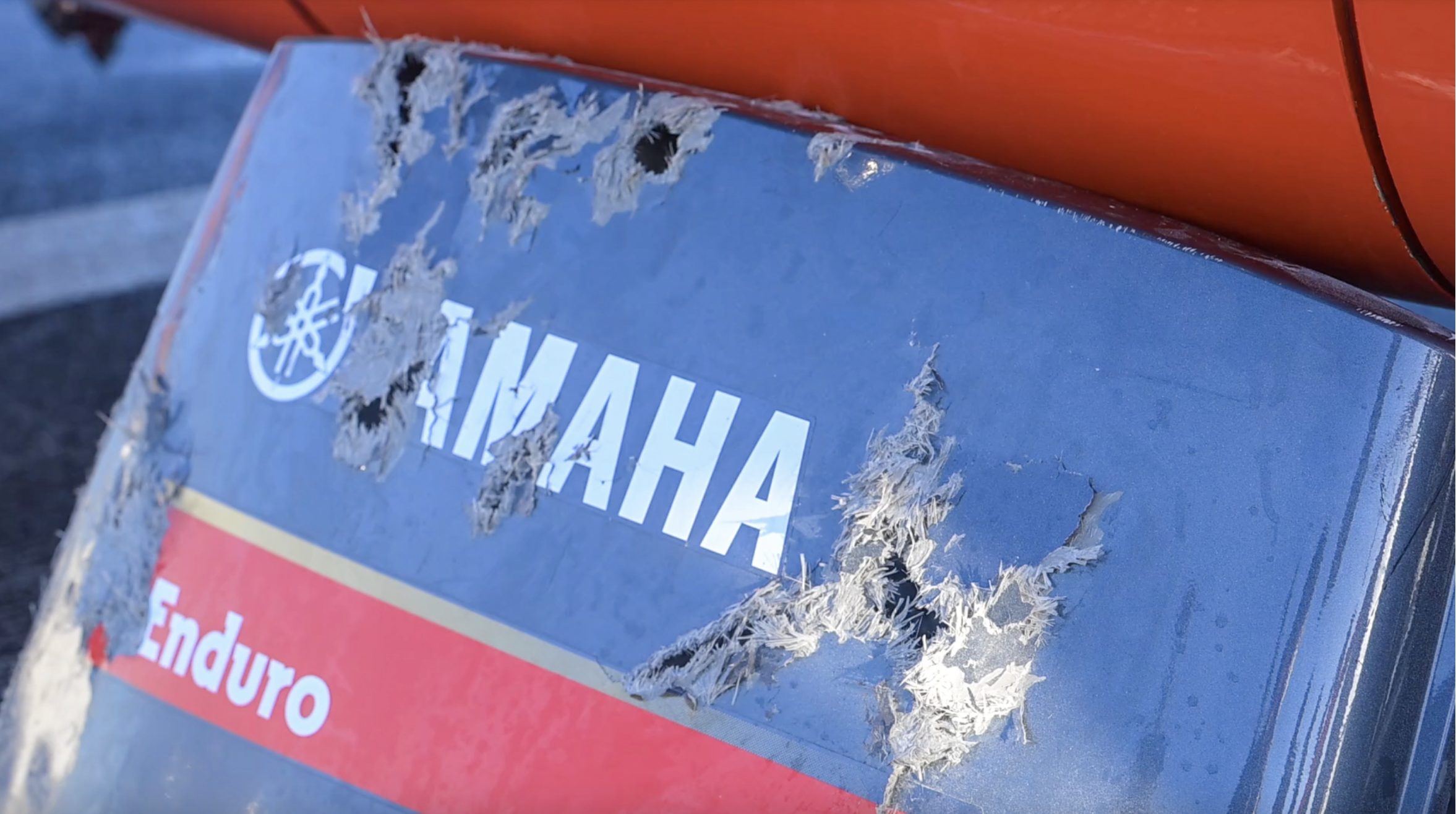
An engine cowling rests against an MH-65 dolphin helicopter at Port Everglades, on March 20, 2025. After attempts to stop a non-complaint vessel failed, the Coast Guard’s Helicopter Interdiction Tactical Squadron was authorized to use force, including disabling fire. (Coast Guard photo by Petty Officer 3rd Class Nicholas Strasburg)

Below is a news release from District Seven. I don’t pass along every ship’s off load of  drugs because they have gotten to be routine, but this patrol was anything but routine.

  • For one ship to interdict 12 drug smugglers in a single patrol is unusual.
  • This interdiction of four go-fast vessels operating in company moving almost as if in formation was unusual.

“On Feb. 19, Stone’s embarked UAS crew detected multiple suspicious vessels approximately 110 miles south of the Galapagos Islands, Ecuador. Stone’s embarked HITRON aircrew employed airborne use of force tactics to compel the non-compliant vessels to stop, and their boarding teams interdicted four go-fast vessels, apprehending eight suspected smugglers and seizing approximately 10,885 pounds of cocaine.”

  • Success of the UAS was notable.
  • The location of that interdiction is unusual in that it is probably at least 500 nautical miles west of Ecuador and well South of Colombia, the country we normally think of as the source for cocaine.

(Could the four vessels intercepted Feb. 19 have been on the way to meet a larger vessel offshore? –either to transfer the load or to refuel?)

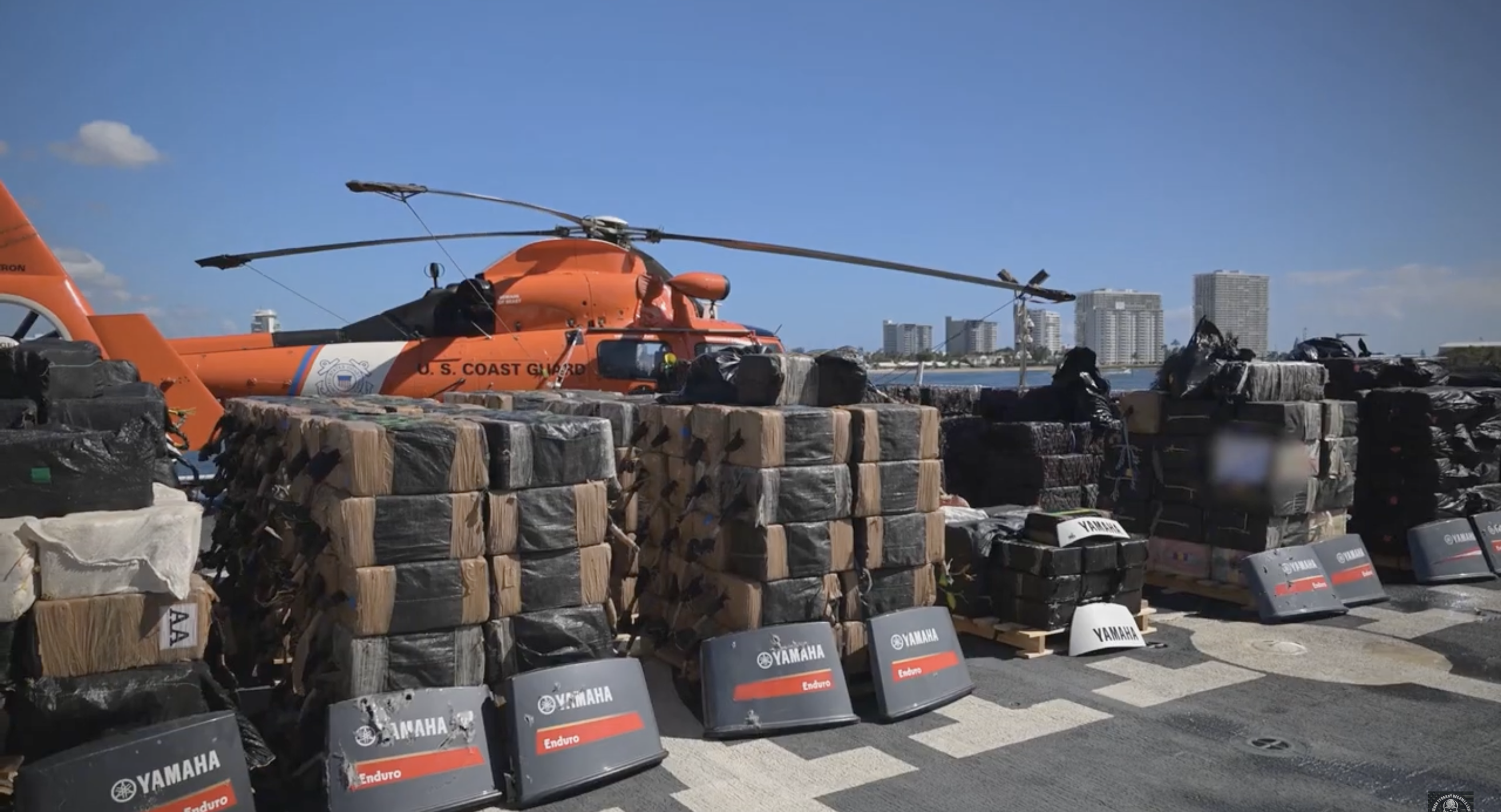
The photo above, at the head of this post, was the first thing that really got my attention, but apparently, that cowling was not unique.

USCGC Stone (WMSL-758) delivers $517.5 million in illicit drugs interdicted in Eastern Pacific Ocean. Along side are displayed cowlings of outboard motor disabled by the Airborne Use of Force crew from the Coast Guard’s Helicopter Interdiction Tactical Squadron (HITRON) based in Jacksonville, FL.


March 20, 2025

Coast Guard offloads over $517.5 million in illicit drugs interdicted in Eastern Pacific Ocean

MIAMI – The crew of U.S. Coast Guard Cutter Stone offloaded approximately 45,600 pounds of illicit narcotics worth more than $517.5 million at Port Everglades, Thursday.

The seized contraband was the result of 14 interdictions in international waters of the Eastern Pacific Ocean, and 35 suspected smugglers were transferred ashore to face federal prosecution in U.S. courts.

“You heard it said before that the Coast Guard’s national security cutters are game changers in the counter-drug mission, but they still require a crew of men and women willing to serve on or over the sea, and place themselves in harm’s way,” said Capt. Jonathan Carter, commanding officer of Stone. “I’m incredibly proud of our crew’s performance and their efforts to combat narco-terrorism this deployment. In one exceptional case, the crew interdicted four go-fast vessels in 15 minutes, seizing nearly 11,000 pounds of cocaine that will never be mixed with deadly fentanyl to threaten American lives here at home.”

On Dec. 21, Stone’s embarked aircrew from Coast Guard Helicopter Interdiction Tactical Squadron detected a suspicious vessel in international waters approximately 321 miles west of Ecuador. Stone’s boarding team interdicted the go-fast vessel, apprehended three suspected smugglers and seized over 1,630 pounds of cocaine.

On Dec. 22, a maritime patrol Dash-8 aircrew detected a suspicious vessel in international waters approximately 180 miles southeast of the Galapagos Islands, Ecuador. Stone’s embarked HITRON aircrew and boarding team interdicted the low-profile go-fast vessel, apprehended three suspected smugglers and seized approximately 12,220 pounds of cocaine.

On Jan. 9, a maritime patrol Dash-8 aircrew detected a suspicious vessel in international waters approximately 148 miles west of Salinas, Ecuador. Stone’s embarked HITRON aircrew and boarding team interdicted the go-fast vessel, apprehended three suspected smugglers and seized approximately 2,370 pounds of cocaine.

On Jan. 28, Stone’s embarked unmanned aircraft system (drone) crew detected a suspicious vessel in international waters approximately 459 miles south of Manzanillo, Mexico. Stone’s boarding team interdicted the vessel, apprehended five suspected smugglers and seized approximately 3,885 pounds of cocaine.

On Jan. 30, Stone’s embarked UAS crew detected a suspicious vessel in international waters approximately 715 miles off Mexico. Stone’s boarding team interdicted the vessel, apprehended two suspected smugglers and seized approximately 3,800 pounds of cocaine.

On Jan. 31, Stone’s embarked UAS crew detected a suspicious vessel in international waters approximately 630 miles off Mexico. Stone’s embarked HITRON aircrew employed airborne use of force tactics to compel the non-compliant vessel to stop, and the boarding team apprehended three suspected smugglers and seized more than 2,565 pounds of cocaine.

On Feb. 12, Stone’s embarked UAS crew detected a suspicious vessel in international waters approximately 655 miles south of Mexico. Stone’s embarked HITRON aircrew employed airborne use of force tactics to compel the non-compliant vessel to stop, and the boarding team apprehended three suspected smugglers and seized more than 3,640 pounds of cocaine.

On Feb. 18, Coast Guard Cutter Mohawk’s crew detected and boarded a sailing vessel approximately 70 miles northwest of Isla Malpelo, Colombia. Mohawk’s boarding team apprehended three suspected smugglers and seized approximately 635 pounds of cocaine.

On Feb. 19, Stone’s embarked UAS crew detected multiple suspicious vessels approximately 110 miles south of the Galapagos Islands, Ecuador. Stone’s embarked HITRON aircrew employed airborne use of force tactics to compel the non-compliant vessels to stop, and their boarding teams interdicted four go-fast vessels, apprehending eight suspected smugglers and seizing approximately 10,885 pounds of cocaine.

On Feb. 25, Mohawk’s crew detected and interdicted a suspicious vessel approximately 230 miles south of Costa Rica. Mohawk’s boarding team apprehended three suspected smugglers and seized approximately 1,600 pounds of cocaine and 330 pounds of marijuana. Costa Rican authorities took custody of the fishing vessel, suspects and bulk contraband for prosecution.

On March 10, Stone’s embarked HITRON aircrew detected a suspicious vessel in international waters approximately 270 miles southeast of the Galapagos Islands, Ecuador. The HITRON aircrew employed airborne use of force tactics to compel the vessel to stop, and Stone’s boarding team interdicted the go-fast vessel, apprehending two suspected smugglers and seizing approximately 3,980 pounds of cocaine. The transfer of custody from this case will occur at a later date.

“The fight against drug trafficking and transnational criminal organizations doesn’t begin at our U.S. maritime borders,” said Cmdr. David Ratner, commanding officer of Mohawk. “Our efforts to defend Americans at home begins with denying drug traffickers access to maritime routes and disrupting the flow far out at sea where we operate alongside interagency and strategic regional partners like Costa Rica.”

The following assets and crews were involved in the interdiction operations:

Detecting and interdicting illicit drug traffickers on the high seas involves significant interagency and international coordination. Joint Interagency Task Force-South, in Key West, conducts the detection and monitoring of aerial and maritime transit of illegal drugs. Once an interdiction becomes imminent, the law enforcement phase of the operation begins, and control of the operation shifts to the U.S. Coast Guard for the interdiction and apprehension phases. Interdictions in the Eastern Pacific Ocean are performed by members of the U.S. Coast Guard under the authority and control of the Eleventh Coast Guard District, headquartered in Alameda, California.

The Coast Guard continues increased operations to interdict, seize and disrupt transshipments of cocaine and other bulk illicit drugs by sea. These drugs fuel and enable cartels and transnational criminal organizations to produce and traffic illegal fentanyl, threatening the United States.

Each of these interdictions initiate criminal investigations by federal law enforcement partners. Several were tied to the transnational criminal organizations responsible. Drug evidence from these cases is linked to cartels recently designated as foreign terrorist organizations by the U.S. government, including Sinaloa and Cartel Jalisco Nueva Generaciόn. These interdictions denied those criminal organizations more than half a billion dollars and provide critical evidence for their total elimination.

USCGC Stone is one of four 418-foot Legend-class national security cutters homeported in Charleston, South Carolina under U.S. Coast Guard Atlantic Area Command. The U.S. Coast Guard Maritime Law Enforcement Academy where Coast Guard boarding officers train to conduct these missions, in Charleston, celebrated its 20th anniversary on March 14.

For breaking news, follow us on X (formerly Twitter). For additional information, find us on Facebook and follow us on Instagram.

Make a difference on land, at sea or in the air with the Coast Guard. Visit GoCoastGuard.com to learn more about active duty and reserve, officer and enlisted opportunities. Information on how to apply to the U.S. Coast Guard Academy can be found here.

“Army Cancels High-Speed Armed Reconnaissance Helicopter Program” –The WarZone

Sikorsky’s Raider X, advanced compound helicopter design (FARA prototype)

The Warzone reports,

The U.S. Army says it is cancelling its Future Attack Recon Aircraft (FARA) program which had been centered on the acquisition of a new type of high-speed armed scout helicopter. This is part of a larger restructuring the Army plans for its future fleets of helicopters and other crewed and uncrewed aircraft.

This is essentially half of the Army’s Future Vertical Lift program. The Coast Guard has been following the program in anticipation of development of vertical takeoff and landing aircraft that would offer “twice the range and twice the speed” of existing helicopter types. We might still see that in a version of the Bell V-280 for land-based operations.

Note this video is four years old, so the prototype has been flying for a long time. I have heard concern about the downwash, but if you look at the windsock visible from time 2:20, downwash does not seem to be excessive. My back of the envelope calculations suggests the overpressure directly under the rotor discuses would be about 67% higher under the V-280’s props compared to the H-60J’s rotor. That might be mitigated at the hoist pickup point because, unlike in the H-60, the props are not rotating over the fuselage of the V-280.

It does appear that the H-60s may have a new engine option in the future.

The FARA cancellation is part of what the Army is currently calling the Aviation Investment Rebalance. The service says it will delay production of the General Electric T901 turboshaft engine developed under the Improved Turbine Engine Program (ITEP), which had been heavily tied to FARA, as part of this plan. The immediate focus will now be on integrating T901s onto existing AH-64 Apache attack helicopters and UH-60 Black Hawk utility helicopters.

GE Aerospace claims, “The T901 engine provides 50% more power 25% better specific fuel consumption, and reduced life cycle costs -with fewer parts, a simpler design, and proven, reliable technology.” 

Basically, the Army has decided that Unmanned aircraft and Satellites can do the job of scouting better and cheaper, as well as safer, than a helicopter. This means they will be putting more money into those areas.

The Coast Guard might still benefit in its maritime domain awareness and its search function. I have not put much thought into the possibility that UAS (and perhaps satellites) might supplement or replace fixed wing for the SAR search function or MEP detection, but those are real possibilities.

I am disappointed that we are not likely to see a ship-based helicopter with twice the range and twice the speed any time soon, but on the other hand, we are already using UAS for search that have many times the endurance of the H-65 or even the H-60. For that function, endurance is more important that speed.

“Inside the U.S. Navy’s Cutting-Edge Drone Boat Tech”–WSJ

A reader brought the video above to my attention, recognizing the significant Coast Guard participation in the program. 

Below I have reproduced the text that accompanied the video on YouTube. 


Drone boats appear to be on the cusp of a revolution. The U.S. Navy’s Task Force 59 has been pairing cutting-edge unmanned surface vehicles with artificial intelligence to expand the military’s eyes and ears in the Middle East. Now, similar efforts will be rolled out in the Pacific and Central and South America. The military’s objective is to leverage machine learning to detect and anticipate threats before they occur. Experts say the U.S. is currently the leader in this field, but competitors like China and Russia are racing to catch up. I traveled to Manama, Bahrain to see the high-tech drones in action and speak to officials about how they’re preparing for a future with robots in the world’s waters. 0:00 A rare look at the U.S. Navy’s drone boat operation 0:30 Meet the Navy’s Task Force 59 2:14 Drone boat capabilities 4:05 How artificial intelligence is layered with the drone boats 5:11 The global race to advance unmanned marine vehicles 7:23 What’s next for the U.S. military? Check out more from my exclusive interview with Vice Admiral Brad Cooper, commander of U.S. Naval forces in the Middle East, about unmanned vessels and the Navy’s future fleet:    • Drone Boats, AI and the Future of Mar…   I’m Shelby Holliday, a reporter for WSJ. Subscribe to join me as I explain some of today’s most pressing geopolitical events, from superpower showdowns and conflicts to supply chain snarls and natural resource struggles.


The link embedded above was to this video. 

Thanks to David for bringing this to my attention.

“Southern Command: Russia disperses ships in fear of Ukrainian strikes” –Kyiv Independent

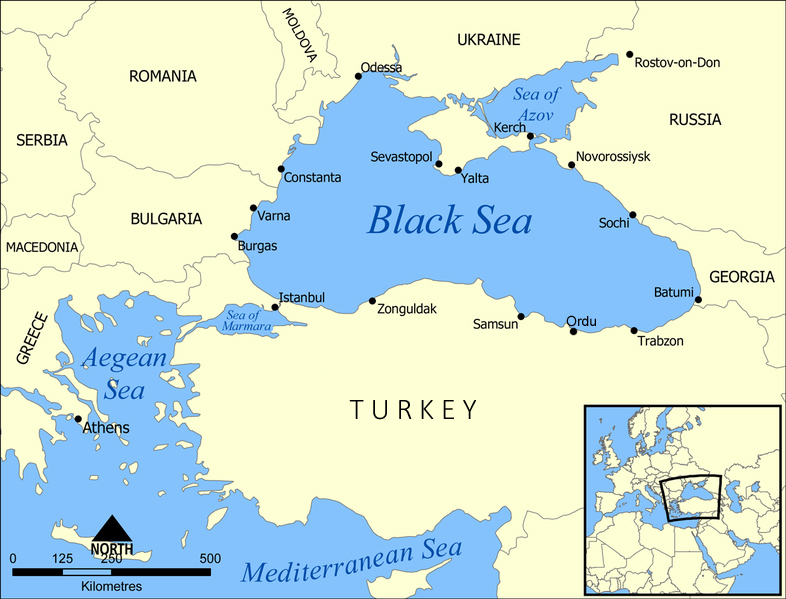
A map showing the location of the Black Sea and some of the large or prominent ports around it. The Sea of Azov and Sea of Marmara are also labelled. Created by User:NormanEinstein, Wikipedia

Kyiv Independent reports,

Russia has dispersed its naval forces in the Black Sea between the southeastern coast of Crimea and Novorossiysk in fear of Ukrainian surface drone strikes, Southern Command spokesperson Natalia Humeniuk said on Aug. 18.

Well, the US Navy is all a twitter about “Distributed Maritime Operations” (DMO) so is this a good idea for the Russian Black Sea Fleet? Like most such questions, it depends.

It depends on how good Ukrainian intelligence is. The supposed advantage for the Russian Fleet would be that their ships are harder to find, but is this case? Not only does Ukraine have access to some Western intelligence sources, but they seem to have good independent intelligence. All their successful USV attacks seem to have been against valid targets though there are many more potential targets that were not directly supporting the Russian military. When Russian ships are in port, the Ukrainians are going to know it.

Convoying has been a feature of Naval Warfare for over a thousand years because it is a defensive tactic that takes the choice of where and when to concentrate out of the hands of the offense. Spreading out the potential targets requires diluting the defense. That leaves the choice of where and when to concentrate effort in the hands of the Ukrainians.

To be successful, the defense has to detect all of the incoming USVs at a distance from their target and have sufficient numbers of countermeasures systems, in the right place, to engage all incoming USVs as they are detected.

The Ukrainian USVs don’t seem to be too hard to defeat once they are detected. Most of the successful countermeasures seem to have used machineguns, but you need one or more within effective range to engage every attacking USV.

The Ukrainians have told the world that no Russian Black Sea port is safe.

On August 4, Ukraine’s maritime authorities issued a “war risk area warning” to all international mariners headed for six Russian Black Sea ports, including Novorossiysk and the smaller oil-exporting terminals of Tuapse and Taman. The warning is scheduled to go into effect on August 23 and continue “until further notice” (Interfax-Ukraine, August 5). And on August 8, Zelenskyy’s economic adviser Oleh Ustenko told US media that “everything the Russians are moving back and forth on the Black Sea are our valid military targets,” including oil tankers or terminals.

When you multiply the number of points you have to defend, you divide your defensive force. USVs are cheap and readily produced. Ukraine will not have trouble finding targets. Ukraine will attempt to overwhelm the defenses by creating situations where even if the defense is taking out say four out of five or six out of seven attacking drones, the Russians still loose, even if it is only one ship at a time.

“US Navy ‘operationalizes’ drones in 4th Fleet’s UNITAS event” –Defense News

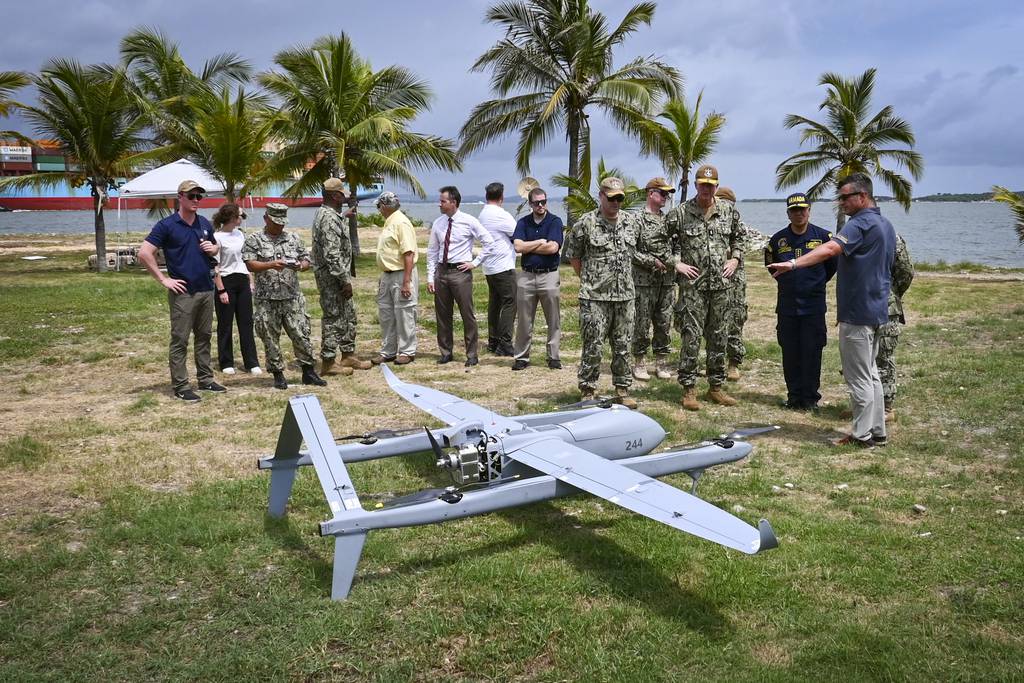
Personnel from the U.S. and Colombian navies attend a demonstration of Aerosonde MK4.7 Hybrid Quad drone during UNITAS on July 16, 2023. (MC1 Hunter Harwell/U.S. Navy)

Defense News reports,

“The U.S. Navy leveraged air and surface drones throughout its two-week UNITAS 2023 naval exercise near Latin America, the first major event since service leadership announced the region would host the sea service’s second unmanned operations hub.”

The Coast Guard certainly has an interest in 4th Fleet’s use of unmanned systems since their area of responsibility (AOR) includes the Eastern Pacific drug transit zones and the Caribbean.

Apparently, not all the systems are in place yet.

“Some of the same systems will return this fall for operations and exercises in the Caribbean and Eastern Pacific Ocean, he added.”

Importantly 4 Fleet is developing a “mesh network that compiles a detailed common operating picture of the region — then AI tools could help flag areas where potentially problematic activities are happening.”

Hopefully we will see video of the SINKEX as recorded by the UAS.

“UNITAS LXIV to begin in Colombia” –USNAVSOUTH/4TH FLEET PUBLIC AFFAIRS

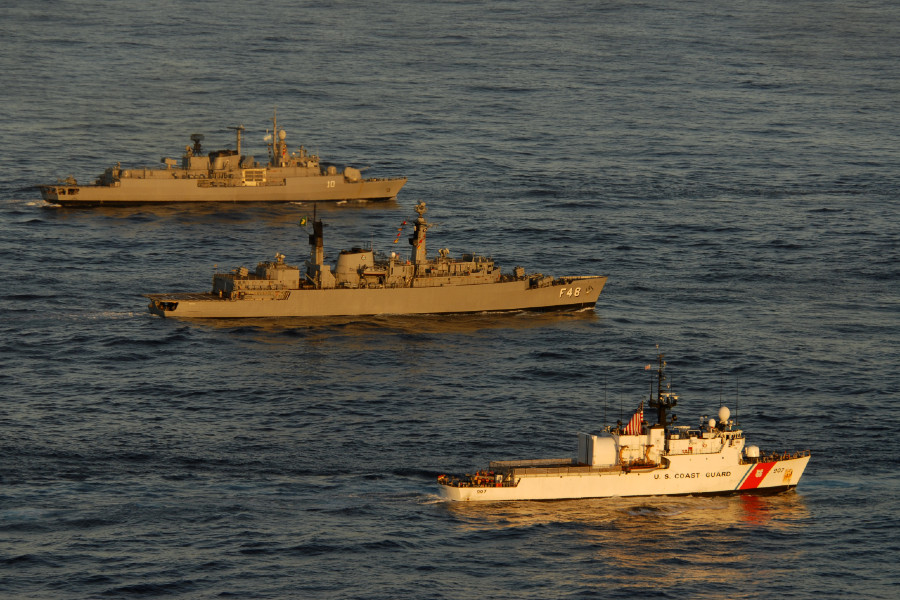
The US Coast Guard cutter USCGC Escanaba (WMEC 907), Brazlian Navy ship BNS Bosisio (F 48) and Argentinian navy ship ARA Almirante Brown (D-10) move into formation for a photo exercise during the Atlantic phase of UNITAS 52 on May 4, 2011. The formation included a total of ten ships from the US, Brazil, Mexico and Argentina. (Photo: US Navy/Mass Communication Specialist 1st Class Steve Smith)

Below is a news release announcing the start of exercise UNITAS LXIV (64 if you are not up on your Roman numerals). There is no mention of Coast Guard participation, but maybe they “simply forgot us.” Think we can bet there are some Coasties involved.

Britain’s Royal Navy also sent one of their highly regarded destroyers, HMS Dauntless.

With 26 surface vessels and three submarines participating, I think this is larger than most of the recent UNITAS exercises. In 2022 it was 19 ships, one submarine, 21 aircraft, accounting for approximately 5,500 total military personnel.

This year will see an attempt at large scale integration of unmanned systems into the exercise by 4th Fleet.


July 11, 2023

UNITAS LXIV to begin in Colombia

By USNAVSOUTH/4TH FLEET PUBLIC AFFAIRS

– U.S. Navy and Marine forces are set to arrive in Cartagena in support of UNITAS LXIV, the world’s longest-running multinational maritime exercise in the world, scheduled to start July 11, 2023.

The Colombian navy will host this year’s UNITAS, which will feature 26 warships/vessels, three submarines, 25 aircraft (fixed wing/helicopter), and approximately 7,000 people from 20 partner nations. Forces will conduct training operations off the coast of Cartagena, Colombia, and ashore in Covenas and Barranquilla, Colombia, through July 21. This year marks the 64th iteration of the exercise. Additionally, this year Colombia will celebrate the bicentennial of its navy, a historical milestone commemorating 200 years of the country’s maritime forces.

“UNITAS is so much more than a two week exercise. All participating nations have given much time, energy and effort into the months of planning leading up to what will be one of the most complex UNITAS to date,” said Rear Admiral Jim Aiken, commander U.S. Naval Forces Southern Command/U.S. 4th Fleet. “Utilizing air, surface, sub-surface, and unmanned assets, and land units, UNITAS will provide the multinational force a challenging environment in which to conduct training across the full spectrum of maritime operations. UNITAS strengthens maritime partnerships, enhances proficiency and improves interoperability of the participating forces, which is why so many partner nations are taking part this year.”

As part of the U.S. Navy’s future hybrid fleet, the Chief of Naval Operations has tasked U.S. 4th Fleet to scale unmanned platforms to the fleet level. An addition to this year’s UNITAS will include the integrated operations of unmanned air, surface, and subsurface systems into the exercise. UNITAS’ challenging training address key aspects of multinational and combined operations such as technology standardization and common operating procedures.

“This is our first opportunity to integrate unmanned systems into our operations at sea,” said Rear Adm. Aiken. “UNITAS has often served as a test bed for technology, so it is appropriate that we begin our unmanned integration campaign to operationalize the hybrid fleet here in UNITAS.”

In addition to the United States, UNITAS LXIV will bring together 19 nations from all over the world to train forces in joint maritime operations that enhance tactical proficiency and increase interoperability. Participating nations include Belize, Brazil, Canada, Chile, Colombia, Dominican Republic, Ecuador, France, Germany, Honduras, Jamaica, Mexico, Panama, Peru, Paraguay, Spain, South Korea, United Kingdom, United States, and Uruguay.

Following the UNITAS LXIV Opening Ceremony on July 12, the in port phase of the exercise will feature subject matter expert exchanges, professional symposia, ship rider exchanges, and operations meetings. During this time, Marines and Sailors will conduct expeditionary training events in Covenas to include riverine operations and diving and salvage operations.

During the UNITAS LXIV Underway Phase, forces will participate in events testing all warfare operations, to include live-fire exercises such as a SINKEX and an amphibious ship-to-shore landing and force retraction.

“Marines and Sailors from across the United States will travel to Colombia to not only train alongside our partner nations’ militaries, but to hone the skills required to operate as part of a larger maritime force focused on sea control and sea denial,” said Lt. Gen. David G. Bellon, commander, U.S. Marine Corps Forces, South, and U.S. Marine Corps Forces, Reserve. “We will be exercising command and control from a forward position as Marines set up and employ Expeditionary Advanced Base Operations to enhance naval capabilities as part of UNITAS.”

U.S. forces participating in UNITAS LXIV include USS New York (LPD 21), USS Cole (DDG 67), USS Little Rock (LCS 9), USS Pasadena (SSN 752), and USNS Burlington (T-EPF 10). Other U.S. participants include Patrol Squadron Five (VP 5), Mobile Diving and Salvage Unit (MDSU) 2, Explosive Ordnance Disposal Mobile Unit (EOD) 612, Mine Countermeasures Group 3, (MCMGRU 3), Expeditionary Mine Countermeasures EOD Company 61 (EODMU 61), East-coast based Naval Special Warfare units, Helicopter Sea Combat Squadron 22 (HSC 22), Helicopter Maritime Strike Squadron 70 Detachment 2 (HSM 70 Det 2), Joint Communications Support Element (JCSE), Fleet Surgical Team (FST) Eight, and the Meteorological Environmental Team (MET). U.S. Marine forces include 3rd Battalion, 23rd Marine Regiment (3/23), 4th Amphibious Assault Battalion (4th AABn), 8th Combat Logistic Battalion (CLB 8), 4th Combat Engineer Battalion (4th CEB), Marine Medium Tiltrotor Squadron 774 (VMM 774), Marine Light Helicopter Attack Squadron 775 (HMLA 775), Marine Aerial Refueler Transport Squadron 234 (VMGR-234), Marine Aircraft Control Group – 48 (MACG-48), and Marine Fighter Attack Squadron 112 (VMFA-112). Finally, Commander, Destroyer Squadron 40, (COMDESRON 40), Commander, Amphibious Squadron Four (COMPHIBRON FOUR), U.S Marine Corps Forces South (MARFORSOUTH), Special Operations Command South (SOCSOUTH), USNAVSOUTH/FOURTHFLT, and U.S. Southern Command (USSOUTHCOM) are participating in UNITAS LXIV.

UNITAS, which is Latin for unity, united, or oneness, was conceived in 1959 during a previous era of strategic competition when representatives at the first Inter-American Naval Conference in Panama agreed to conduct an annual maritime exercise with one another. Prior to UNITAS I in 1960, U.S. Chief of Naval Operations Adm. Arleigh Burke reviewed preparations for the multinational exercise. He commended planners for their progress, especially in building compatible communication systems among navies, and predicted that UNITAS would build strong relationships among Sailors of the Western Hemisphere.

U.S. Naval Forces Southern Command/U.S. 4th Fleet supports U.S. Southern Command’s joint and combined military operations by employing maritime forces in cooperative maritime security operations to maintain access, enhance interoperability, and build enduring partnerships in order to enhance regional security and promote peace, stability and prosperity in the Caribbean, Central and South American region.

U.S. Marine Corps Forces, South is the Marine Corps component to U.S. Southern Command, is responsible for planning exercises, operations, and overall Marine Corps support for the SOUTHCOM assigned area of responsibility.

Portugal to Build a New Type of Ship–UxS Carrier

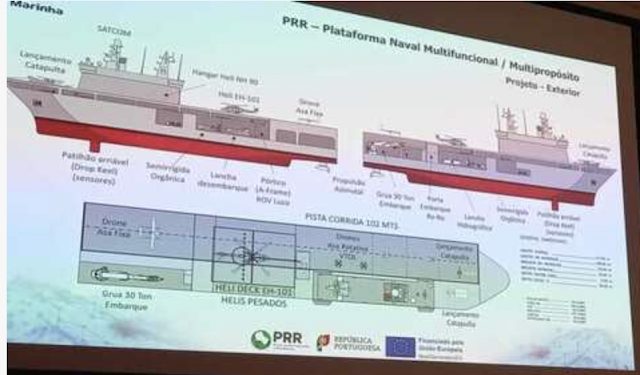
The “plataforma naval multifuncional” (multifunctional naval platform). Portuguese Navy image.

It is not often an entirely new category of ship emerges, but this seems to be the case. Perhaps it was inevitable, but it looks like the Portuguese may be the first to make it happen–a specialized, built for purpose, unmanned systems mothership.

Wish the specs in the lower right above were readable. 

First heard about this ship from Cdr. Salamander. He has some interesting ideas about how such a ship could be used. It is part research ship, part disaster response vessel, and, significantly for the Coast Guard, part Offshore Patrol Vessel. There is more about the ship from Naval News. It is not particularly large, with a crew of about 90 and accommodations for another 100. The cost is reportedly about $100M US, much less than the cost of the Offshore Patrol Cutter. Judging by the size of the helicopter (reportedly an NH-90) on the model, it appears to be 100 to 110 meters (328-360 feet) in length, about the length of the OPC, maybe less. It must be pretty broad if that is an MQ-1C Gray Eagle on the deck. The Span of the Gray Eagle is 56 ft (17 m), but it just does not look like it is in scale. Maybe they have a European sourced UAS in mind. Beam looks to be about 20 to 22 meters based on my presumptions about the length, that is 66 to 72 feet. Those proportions are similar to those of the 6,615 ton Canadian Harry DeWolf class Arctic Offfshore Patrol Ship, 103.6 m (339 ft 11 in) long and a beam of 19 m (62 ft 4 in). By comparison, the beam of both the NSC and OPC is 16m or 54 feet.

The thing that makes this ship totally unique is the runway and ski-jump designed expressly for fixed wing unmanned air systems.

Artist rendering of MQ-9B STOL landing on a big-deck amphibious assault vessel. Photo: Courtesy of General Atomics Aeronautical.

What might make this very useful is the newly developed STOL version of the MQ-9B with shorter span, high lift, folding wings.

Not sure I like this particular design. It is not clear how many UAS and helicopters can be carrier or if there is hangar space. The island is unnecessarily thick and looks too far forward. No indication of speed or endurance. The speed in unlikely to exceed 20 knots, between 16 and 18 knots seems likely, but the concept is novel. Look forward to seeing the ship in final form.

Late Addition: 

After posting this on Facebook, I got some additional information. This is a Google translate from Portuguese. Thanks to Pedro Mateus.

MULTI-PURPOSE PLATFORM SHIP Lisbon, Portugal June 20, 2022 On June 20, 2022, the Portuguese Navy launched a tender limited by simplified prior qualification, via procedure no. of a Multipurpose Vessel/Platform (N-PM), with an execution period of up to 3 years (with delivery until December 2025), for a base price of 94.5 million Euros.

This Multipurpose Ship/Platform (N-PM) will have a total length, between perpendiculars, of 100 meters, a maximum beam (at flight deck level) of 20 meters and a maximum draft of 7.5 meters. It will follow STANAG 4154 (Ed 3) standards and will be able to maintain the operation of lowering and hoisting vessels in sea state 5 on the Douglas Scale. Its garrison will be composed of 1 commander, 7 officers, 8 sergeants and 29 soldiers, in a total of 45 elements. It has accommodation sized up to 28 officers, 30 sergeants and 32 enlisted men, for a total of 90 elements (in addition to the commander). It will be dimensioned for a range of 45 days at a cruising speed of 10 knots.

The N-PM shall comprise a set of aviation facilities including, among others, a flight deck (a ski-jump runway, a spot for helicopter operation, with lighting system, GPI, etc.), hangar for a helicopter (with support for hydraulic maintenance stations, overhead crane, technical lighting, etc.) and a hangar for unmanned aircraft. In terms of organic helicopter, it should support the Lynx MK95A and NH90 aircraft (either in “spot” or in hangar) and EH101 (“spot”). The flight deck must allow the operation of different types of unmanned aircraft, commonly known as “drones” (Ogassa OGS42, Tekever AR3, etc.), as well as all the support required for vertical refueling operations (VERTREP).

Within the scope of semi-rigid vessels, the N-PM will have 3 vessels: a vessel with
SOLAS (“Safety of Life at Sea”) certification for operation as “Fast
Rescue Boat”, with a power of not less than 250 hp; and two non-cooperative approach vessels, with capacity for 8 equipped soldiers, with a maximum speed of 35 knots or higher and a minimum autonomy of 60 nautical miles, for inspection missions , policing, combating drug trafficking, assault and support for a small embarked force.

Following the good practices and installation and operation recommendations of the “Alliance of European Research Fleets” (EUROFLEET), in terms of support systems for scientific research, the N-PM will be designed to be able to operate subsurface Unmanned Vehicles (VENTs) and remotely operated vehicles – “Remotely Operated Vehicle” (ROV). It will have a sensor pavilion (“drop keel”) for the installation of scientific and acoustic sensors; a large volume “Rosette” CTD system (for deep water sampling, with probe capable of operating up to 6,000 m); an MVP system, “Moving Vessel Profiler”, capable of operating up to 700 meters deep with the ship sailing at 8 knots; an “Acoustic Doppler Current Profiler” (ADCP); a “Global Acoustic Positioning System” (GAPS), capable of operating up to 4,000 meters deep. In addition to these organic systems, the N-PM will have the capacity and integration for several other non-organic systems (Piston Corer – Calypso, Vibrocorer, Box Corer, Multi Corer, etc.) as well as all operating and support winches.

Under an integrated architecture of command and control, platform management, and digital information processing and management systems, this N-PM will have a set of navigation systems (IBS, DDU, TACAN, Secure GPS, etc.), with navigation radar surveillance systems, combined warning radar (ARPA capability, “Automatic Radar Plotting Aid” and IMO certification; ECM and Anti-Jamming) and IFF/W-AIS identification systems, as well as underwater surveillance systems (bathythermograph; support for XBT/XSV probe used in the Navy (XBT4, XBT5, XBT7 and MK-8 XBT/XSV) or CTD type probes). In terms of external communications, it will have, among others, satellite communication systems SATCOM and MILSATCOM, GMDSS, submarine telephone, SART, EPIRB and ICCS.

In terms of armament, the N-PM will be equipped, at least, with 4 “softmounts” for a Browning M2 .50 heavy machine gun, with a firing range limiter and respective accessories, and a base, with ballistic protection for the Browning part and respective operator; and with 2 pieces of Hotchkiss salvo. The N-PM will be equipped with magazines and armories capable of storing various portable weapons, ammunition, pyrotechnic material and demolition material and respective detonators.

Technical drawing and 3D model via the Portuguese Navy Ships Directorate
Editing and composition by “Espada & Escudo”

“Navy Arming Surface Ships with Drone Repellent System” –USNI

USCGC Charles Moulthrope (WPC-1141) prior to departure for PATFORSWA

The US Naval Institute News Service has a short post about a system that will reportedly detect and if required jam the radio frequency signals that control small Unmanned Air Systems like the commercially available hobby drones and similar control systems that might be used on larger UAS.

We noted the presence of this or a similar system on the Webber class cutters being transferred to PATFORSWA in February.

While there are autopilots that allow drones to travel considerable distances to reach fixed geographic points, operating drones that lack autonomous targeting, against moving targets, typically require two radio frequencies, one the video link from the drone back to the operator and one to control the drone, from the operator back to the drone. Jamming either of the frequencies would probably disable the drone. Generally these frequencies are UHF or VHF, limited to line of sight.

Gunner’s Mate Kyle Mendenhall shows the Drone Restricted Access Using Known Electromagnetic Warfare (DRAKE) system aboard USS Kansas City (LCS-22) on Aug. 16, 2021. USNI News Photo

If you expand the photo of USCGC Charles Moulthrope above, you can see a similar system, with its two vertical antenna of different sizes, on the mast port side, slightly below and behind the port blue flashing light, and above and inboard of the small round fixed air search radar antenna.

Martin V-BAT “Guard evaluates new technology for unmanned aircraft system operations” –Acquisitions Directorate (CG-9)

Below I have reproduced a story from the CG-9 Website. To put this into perspective the V-Bat system has a slightly smaller wing span than the ScanEagle (9′ vs 10’3″) and weighs about twice as much (88 lbs (40 kg) vs 44-48.5 lb. (22 kg)), heavier, but still easily handled. There is a skid under the nose to allows the V-BAT to be laid on the deck. Cruise speeds are similar. Dash speed is actually a little higher for the V-BAT (90 vs 80 knots). V-BAT has “Wind Limitations: 20 kt + 5 kt gust spread” for takeoff that should be relatively easy to achieve by adjusting course and speed to minimize wind over deck, but it might be a factor if we want to launch during a chase. V-BAT has a 182cc 15 HP 2-cylinder EFI engine which can use either a Gas-Oil Mix or JP-4/5/8. It has a remote start and can provide 500 watts onboard electrical power. It has a 350 mile range (statute miles I presume, so about 300 nautical miles) and has a highly accurate fuel monitoring system

Martin V-BAT UAV

Interestingly, for operation from say a Webber Class FRC, there is also a smaller electric eV-BAT.

  • Wing Span: 5 ft
  • Length: 4 ft
  • Weight: 18 lbs
  • Ceiling: 5k ft
  • Speed: 50 kts
  • Propulsion: 3 HP electric motor

The electric eV-BAT is probably both very reliable and very quiet. I am guessing, based on what I know the technology it has an endurance of about 20 minutes. Its sensors would be limited by the lower payload weight.

Don’t believe any of these smaller UAVs have a “sense and avoid” system to prevent mid-airs so they, and the surrounding air space, has to be monitored while they are airborne.

The News Release:

—-

Guard evaluates new technology for unmanned aircraft system operations

V-BAT vertical take-off and landing

A V-BAT vertical take-off and landing (VTOL) unmanned aerial system prepares to land on the flight deck of the Military Sealift Command expeditionary fast transport vessel USNS Spearhead during a C4F “innovation cell” test of the VTOL. Photo courtesy of Martin UAV V-BAT.


The Coast Guard Research and Development Center (RDC), Coast Guard Atlantic Area and U.S. Southern Command (USSOUTHCOM) conducted a collaborative unmanned aircraft system (UAS) pilot program utilizing a vertical takeoff and landing (VTOL) UAS Aug. 13-14. The pilot program utilized contractor-owned, contractor-operated UAS services on-board Coast Guard Cutter Harriet Lane in the USSOUTHCOM area of responsibility for a short-term deployment.

“SOUTHCOM has long had interest in the demonstration of this technology, and we are always looking for opportunities to advance our knowledge of its capabilities,” said Cameron Stanley, command science adviser for USSOUTHCOM. “This was a great opportunity to evaluate the potential use of this technology alongside our critical interagency partners to advance the state of practice and enable our collective response to common operational challenges.”

The Martin UAV V-BAT was used for this program; it is the first-ever VTOL medium range UAS to be evaluated during an operational Coast Guard patrol. Because of the vertical takeoff, a VTOL UAS does not require any additional gear on the flight deck to support operations, unlike other UAS that require launch and recovery devices.

The deployment is providing the RDC invaluable data for supporting future VTOL medium range UAS capabilities and efforts involving Beyond Visual Line of Sight operations. While the evaluation is looking at how successfully VTOL systems take off and land on board a Coast Guard cutter, patrol data can be used to refine the concept of operations and requirements for installing and integrating VTOL UAS across current and future cutter classes.

UAS technology has already proven to be a game changer for the Coast Guard. Information provided by sensors aboard UAS “impacts timelines for obtaining a statement of no objection for boarding vessels, provides situational awareness for boarding crews prior to embarking on targets of interest and provides a better covert means for tracking targets of interest,” resulting in enhanced maritime domain awareness and mission execution, explained Stephen Dunn, RDC aviation research scientist. “The VTOL system takes things a step further by reducing the footprint of the UAS for future Coast Guard cutter acquisitions,” Dunn said.

For more information: Research and Development Center program page and Research, Development, Test and Evaluation program page