Former CG Manned WWII Destroyer Escort De-Commissioned

Destroyer ship ARM Manuel Azueta D111 is retired by Mexicos Navy

The Mexican Navy recently decommissioned a destroyer escort that, during the Second World War, was manned by the Coast Guard. The ARM Manuel Azueta (D-111) was the former USS Hurst (DE-250). She was first commissioned 30 Aug. 1943. Her first CO was LCdr. Bret H. Brallier.

Looks like she is still very close to her World War II configuration. The depth charges are gone, but three 3″/50s and 40mm anti-aircraft guns remain. You can see a nice selections of photos here.

Would be nice if this ship could be preserved as a museum.

“The Sea Based Logistics Response to the Haiti Earthquake”–Thinkdefence


The day following the Haitian Earthquake, Commandant, Adm. Thad Allen discusses the Coast Guard Response.

British Blog, Thinkdefence, has an interesting and very detailed examination of the response to the 2010 Earthquake in Haiti. There seems to be an omission of the 270s role as first US ships on scene, but it is really focused on the delivery of relief supplies. The blogger has a recognized fascination with containers that is almost a running gag, so don’t be surprised if there is a lot of talk about containers.

It is a great primer for disaster response planning.

The Old (Coast) Guard Was Tougher

Recently saw this on Bill Wells FaceBook page and thought it might be worth opening a discussion. I am republishing it here with his permission.

The current Coast Guard, and that of the immediate past, has relieved officers and enlisted men from command for any number of reasons. The “Relief for Cause,” or the “Loss of Confidence” reasons can mean anything and usually do. However, there is no legal process, the officer or enlisted man has little recourse and their careers as over. Many of the cases have devolved into using the “failure to abide by the Core Values.” It must be remembered that Core Values were implanted as part of the now defunct Total Quality Management System. The initial use of the values were to provide a guide for organizational conduct as shown in the Business Dictionary that defines Core Values as, “A principle that guides an organization’s internal conduct as well as its relationship with the external world. Core values are usually summarized in the mission statement or in a statement of core values.”

However, since inception the Core Values have been used as a hammer for punitive, extra-legal functions. The Coast Guard’s Core Values of Honor, Respect, and Devotion to Duty are claimed to have come from the Coast Guard’s history, but no one has pointed to that source. It is more faith and a belief system gone wrong. When first adopted no one could define just what the three words meant to the Coast Guard at large. So, explanatory paragraphs became additions to the words but these only confused the issue because the additional wording contained more core values, rules, and philosophical sloganeering. Still seeing the troops did not understand the additions, the Coast Guard added Twenty-Eight Competencies of leadership that all circled back to the Core Values providing more confusion.

So, how was the Old Guard tougher? They followed the prevailing rules. For example, in 1913 the Treasury Department charged Captain Horace B. West, USRCS, at a General R. C. S. Court with:

Neglect of Duty with six specifications.
Violating lawful regulations with eight specifications.
Conduct unbecoming an officer and gentleman with four specifications.

All these charges sound series until the reasons for the charges are known. West was found guilty on ‘neglect of duty’ and violating regulations and not guilty for unofficer-like conduct. His crimes consisted solely of his apparent dislike for paper work. West failed, according to the New York Times, to make “reply to several reports and communications transmitted to him from the Treasury Department. Although, the USRCS had had a service motto, “Semper Paratus,” since 1896, he was not charged being in violation of it and all it could have referenced was he was not ready to do paper work. The charges were not his first brush with not filing paperwork. In 1905, while in command of the cutter Woodbury at Portland, ME., he failed to submit assistance reports and for not having officers comply with a General Order. The assistance reports were more important because they provided the statistical data the Treasury Department used to justify the existence of the USRCS.

His sentence consisted of a suspension from the service for six months on half pay. A vacation of sorts and he resumed full service and his command with no real adverse effect on his career. Of course, West understood it all. He was an 1880 graduate of the Revenue Cutter School of Instruction (later the Coast Guard Academy).

The Treasury Department of West’s era would have never relieved him for cause. If they had specific charges and proof they brought the person to a legitimatize trial to exact that pound of flesh. Using the sloganeering of core values does little to inspire confidence in the ability of the Coast Guard’s leadership to address situations in a fair and military manner. Perhaps it is time to look at the Core Values and see that they do represent the Service beyond being a punitive cat o’ three tails.

CG-83527

No caption.  No date listed; probably June 1944.  No photo number.  Photographer unknown.

No caption.
No date listed; probably June 1944.
No photo number.
Photographer unknown.

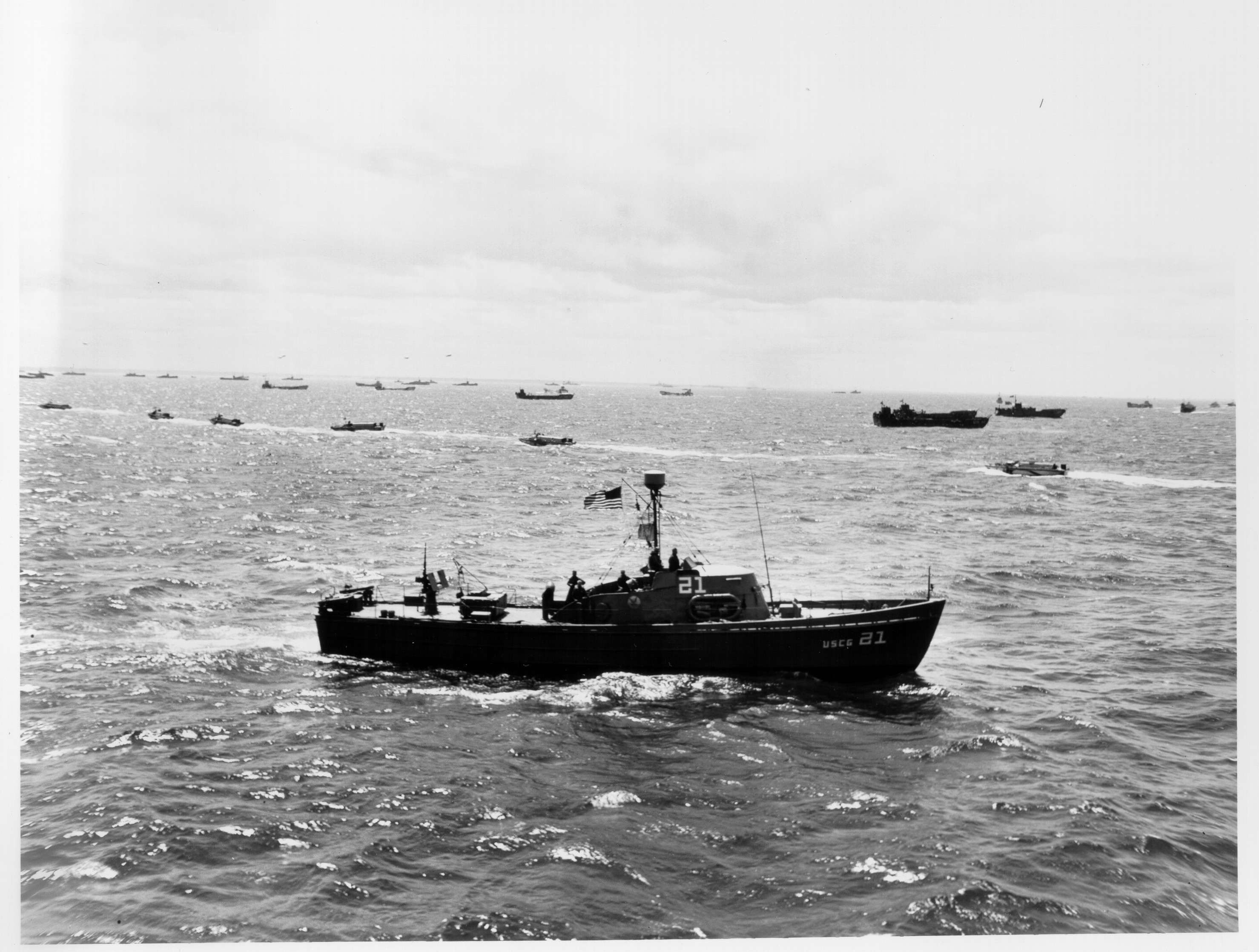
One of the proudest achievements in Coast Guard history was the performance of the sixty 83 foot gasoline powered, wooden hull patrol boats of Rescue Flotilla One, that saved 1,438 American and Allied lives during the Normandy landings in June 1944. An average of approximately 24 rescued for each boat.

"Crew of CG-16 pointing to the tally board of 126 rescued soldiers."  Photo courtesy of Terry Hannigan. (NOT AN OFFICIAL USCG PHOTOGRAPH)

“Crew of CG-16 pointing to the tally board of 126 rescued soldiers.”
Photo courtesy of Terry Hannigan.
(NOT AN OFFICIAL USCG PHOTOGRAPH)

There is at least one vessel of this class, CG83527, still in near original condition.

She’s in Everett, WA. Unfortunately the boat is not currently open to the public. The caretaker organization is having a hard time keeping the boat up. They need some help. Dan Withers, Cell: 206-947-2303, danwithers@q.com, is heading the organization.

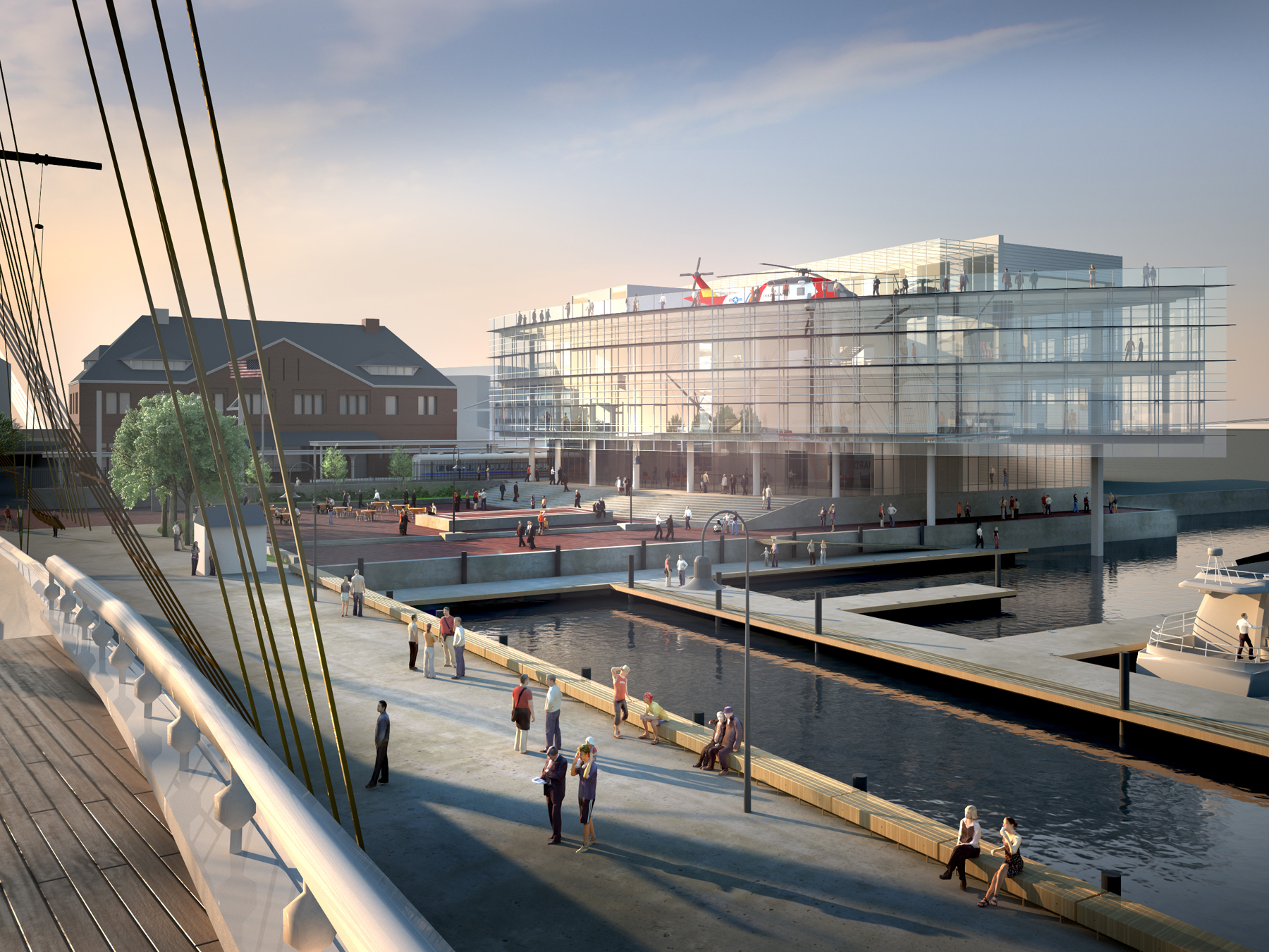
At some point, I hope we will have this vessel, or another of its class, at the new Coast Guard museum being built at New London.

The 83-foot Coast Guard cutter USCG 1 off Omaha Beach on the morning of D-Day, tied up to an LCT and the Samuel Chase

The 83-foot Coast Guard cutter USCG 1 off Omaha Beach on the morning of D-Day, tied up to an LCT and the Samuel Chase

More Lessons Learned, “Guardians of the Gulf: A History of Coast Guard Combat Operations in Support of Operation Iraqi Freedom, 2002-2004”

1024px-USCGC_Adak

Photo: USCGC Adak, part of Patrol Forces, South West Asia, note extra machinegun mount behind the pilothouse. Click on the photo to enlarge.

Not long ago we talked about the need to preserve lessons learned from atypical (usually military) Coast Guard operations like participation in the Vietnam War or operations in South West Asia. Craig Allen Jr. brought to my attention a LANTAREA historian’s publication, “Guardians of the Gulf: A History of Coast Guard Combat Operations in Support of Operation Iraqi Freedom, 2002-2004” (pdf) by William H. Thiesen, PhD, June 2009

Regarding the deployment of WPBs the study noted, “Even though the Coast Guard served a similar mission in Vietnam, there existed no operational plan to provide guidance for OIF planning and preparations.

If the Coast Guard does not yet have a contingency plan for deployment of patrol vessels there is enough detail to make a fair start on a checklist of things to be done. The experience of the WPBs deployed to the Mediterranean can leave little doubt of the Webber Class’ ability to go almost anywhere, given time to avoid bad weather.

“On May 14, the five cutters (one 378 and four 110s–Chuck) began the return trip; however, this time the smaller cutters followed Dallas across the Atlantic rather than riding on board an MSC vessel. The 5,000-mile voyage set a record as the longest transit ever completed by a 110-foot cutter. The PATFORMED fleet had performed its escort and MIO mission admirably. Moreover, the WPBs in the Mediterranean and the Arabian Gulf had set records for hours of operation with some of them deploying for over thirty days of operation.”

For the future, there might be some advantage in organizing at least a few of the Webber class in deployable divisions (3 units) and squadrons (six units) as discussed earlier, with or without augmentation since there will be several location with three or more WPCs.