
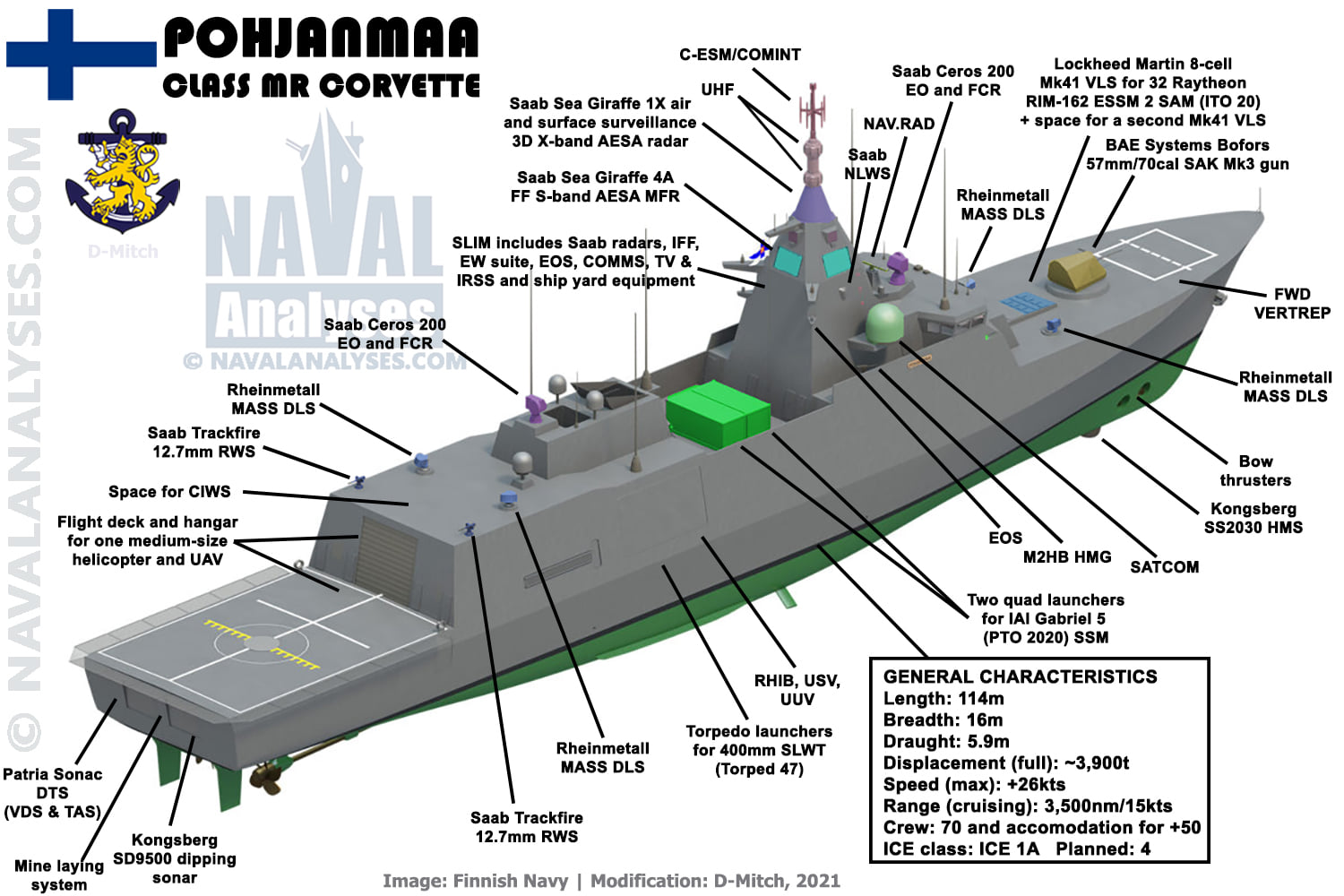
Below is an Aker Arctic news release. Frankly I didn’t know there was such a thing as an ice load monitoring system, but it sounds like something we would want on ships going into the Arctic or Antarctic. I presume it is monitoring the role rate (Tups do you have more info?)
Specs for the class have been updated since the graphic above:
- Displacement: 4300 tons
- Length: 117 m (384′)
- Width: 16 m (52.5′)
- Draught: 5 m (16.4′)
- Speed: 26 knots (48 km/h)
- Crew: 73
More on this new class of warships here and here.
Aker Arctic has been chosen to supply its state-of-the-art ice load monitoring system to the Finnish Defence Forces Logistics Command. The contract includes the delivery of Aker Arctic’s ARC ILMS ice load monitoring, measurement and analysis system for the series of four Pohjanmaa-class multi-role corvettes currently under construction at Rauma Marine Constructions for the Finnish Navy.
The ARC ILMS is Aker Arctic’s platform for measuring loads that the ship’s structure experiences when operating in ice-cover waters, providing feedback to the operator on the safety level of the ship in ice.
“Following our recent successes being chosen to supply the ARC ILMS for the Canadian Coast Guard’s Multi-Purpose Vessels (MPV) (here–Chuck) and our collaboration with French cruise company Ponant measuring ice loads on the Le Commandant Charcot as she made her historic trans-Arctic voyage last summer, we are excited with the vote of confidence the Finnish Navy has put in us to supply our ARC ILMS to their important program” said Kari Laukia, Head of Equipment Business and Special Projects at Aker Arctic.
The contract builds on Aker Arctic’s long-term involvement with the Pohjanmaa-class. In addition to the ARC ILMS, Aker Arctic is supplying the ice-strengthened controllable pitch propellers and their pitch control mechanisms, propeller shafts, bearings and shaft seals. In addition to complete design, calculations and material supplies, Aker Arctic is also responsible for installation supervision and commissioning of the propulsion lines.



 Chuck Hill's CG Blog