“Russia Selects India Over China To Construct Its ‘Cutting-Edge’ Icebreaker Ships; But Why Delhi Over Beijing?” –Eurasian Times

Russian Icebreaker Viktor Chernomyrdin, the largest diesel-electric icebreaker ever built by a Russian shipyard

The Eurasian Times reports,

Russia has chosen India over China for its non-nuclear icebreaker construction program. This decision comes as Russia seeks to develop its Northern Sea Route (NSR) and navigate the challenges posed by Western sanctions…In a significant move towards strengthening maritime cooperation, the Indian government is in talks with two shipbuilders—one state-owned and the other private—to construct four non-nuclear icebreaker ships valued at over Rs 6,000 crores ($750 million).

Does this really signify a preference for India over China? Not really, “…shipyards in China, South Korea, and Japan are fully booked until at least 2028.” India is probably eager for the business. Relations between Russia and India have been good for decades. While India has moved closer to the US in response to Chinese aggressiveness, India has maintained ties with Russia.

India has been developing their ship building industry, and logically they have the cheap labor that could make them very competitive, but they still lag far behind China, S. Korea, and Japan. That Russia is not building these ships in Russia is an indication of the weakness of their own shipbuilding industry.

I don’t think India has ever built an icebreaker. There is no indication of how large or powerful these icebreakers would be other than the price, four for $750M. (That is four icebreakers for about half the price of a Polar Security Cutter.) If this happens, it will be worth watching.

“MAN ES to provide propulsion systems for Canadian Coast Guard’s AOPSs” –Naval Today

Three AOPSs at pier before the commissioning ceremony for HMCS Margaret Brooke (AOPV-431). Canadian Navy photo

Naval Today reports,

“German manufacturer MAN Energy Solutions (MAN ES) has received a contract to provide propulsion systems for two Arctic offshore patrol ships (AOPSs) for the Canadian Coast Guard.”

The Coast Guard versions of the Arctic Offshore Patrol Ships apparently have the same propulsion system as the preceding six Navy versions, but there are details about the propellers in this announcement that I had not heard before.

“Finally, MAN Energy Solutions will deliver 2 × MAN Alpha-branded five-bladed, bolted propellers that meet PC5 rules and which can even be exchanged underwater. These cater for higher cavitation inception speeds, possible shock impacts, and mission-critical conditions requiring additional redundancy, silent operation with minimal hydro-acoustic signatures, and suppressed underwater-radiated noise, the company highlighted.”

I don’t know what a “bolted propeller” is, but the idea that they can be changed without dry docking sounds like it might be useful, particularly on a vessel that operates in ice where we have had some experience with damaged propellers.

“Runaway costs and design delays: Are Coast Guard’s new icebreakers worth it?” –The Sandboxx

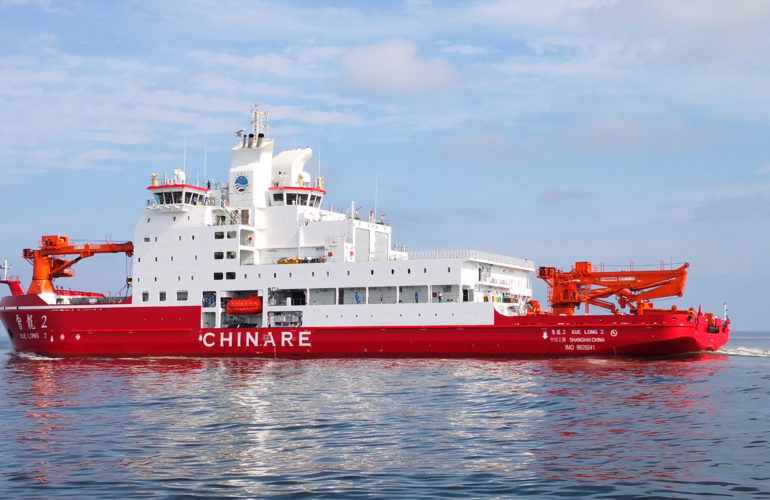
Xue Long 2 on sea trials. Photo by PRIC.

The Sandboxx has a brief look at the problems the US has had in fielding replacement icebreakers.

What I think they leave out of the article is that while the Chinese seem to be planning heavy icebreakers including possibly nuclear-powered ones, the Chinese icebreakers built so far are nowhere near as powerful as Polar Star or the Polar Security Cutter. Mostly they have been ice capable research ships. Their only Chinese built medium ice breaker, Xue long-2, is smaller and a third less powerful than Healy. The three Chinese icebreakers currently in the Arctic include the much smaller 5,600-ton, 8,600 HP (6.4KW) Polar Class 6 Ji Di, smaller than the old Wind class icebreakers.

Aerial view of China’s icebreaker Ji Di berthing at the pier of Qingdao Olympic Sailing Center on July 3 in Qingdao, Shandong Province of China.
© Sun Qimeng/VCG via AP, “China and Russia to Expand Scientific Cooperation in Arctic: Report” –Newsweek

By some counts the US, and most notably Canada, have more icebreakers than China. All of China’s icebreaker construction is not directed at the Arctic. They also have interests in Antarctica (which I find more troubling), and they have ports that ice over requiring domestic icebreaking.

The Sandboxx also describes the 8,500 ton Project 23550 ice class patrol vessels as Russia’s “… first “combat icebreaker,” a small, agile, and armed-to-the-teeth escort ship with launchers installed for anti-ship and cruise missiles.” That is hyperbole. It has provision for placing two containers on the stern. Those containers could contain cruise missiles, but any ship that can mount containers in a position where the space above the container is unobstructed could have a similar capability. Other than being armed with containers, they are armed very much like a Coast Guard cutter. They have a single medium caliber gun, either 76mm or 100mm. They have no surface-to-air missile system other than perhaps man portable air defense systems (MANPADS) and no CIWS of any kind. Furthermore, they are not Russia’s first armed icebreaker. Russia has had armed icebreakers since at least WWII, including the Project 23550’s predecessors, the Ivan Susanin class, eight ships completed 1973 to 1982, four of which are still in service. I went aboard one of them in San Francisco, when they came to help celebrate the 200th anniversary of the beginning of the US Coast Guard.

It would not be too difficult for the US to build counterparts to the Project 23550s for the US Coast Guard or Navy, especially after the recent ICE Pact agreement with Canada and Finland. Ships don’t have to be as capable as the Polar Security Cutters to be useful. The Chinese are proving that.

Polar Star is Home–Finally

Polar Star at Mare Island Dry Dock LLC undergoing the fourth phase of its five-year Service Life Extension Project. U.S. Coast Guard photo by Cmdr. Jeremy Courtade.

Below are two news releases, first one from Coast Guard News, the second from the Acquisitions Directorate (CG-9).

The Coast Guard has been working very hard to make sure that Polar Star can meet her annual commitment to open a path for resupply of the Antarctic Base at McMurdo, but it has to have been hard on the crew. They just completed the fourth phase of a five-part Service Life Extension Program (SLEP), but unlike the single phase SLEPs and MMAs we are seeing with the buoy tenders and medium endurance cutters at the Coast Guard Yard, here the crew stays aboard. After 138 days on the resupply mission, instead of returning to Seattle, their homeport, they went to Vallejo, California, where they spent about 140 days. Altogether, 285 days away from homeport, and over a one-year period, more days in Vallejo than in homeport.

Polar Star has only one more of these to go, but it looks like the Crew of USCGC Healy is going to go through the same 5-year SLEP cycle, where they will spend more time in Vallejo than in their homeport. This is just wrong. There are only two yards on the West Coast that can accommodate ships of this size. The Navy, with its huge presence, is a strong competitor for the use of the one in Seattle. By contrast the Bay Area has virtually no Navy presence. It is likely the Icebreakers will have to use the yard in Vallejo for almost all their drydocking. Maybe it is time to change their homeport to somewhere in the San Francisco Bay Area, maybe even Vallejo.

Improvements are planned for Base Seattle, largely on the assumption that the Polar Security Cutters (PSC) will be based there, but they can expect to run into the same problem. Given the greater size of the PSCs and the long-term probability the Navy presence in Seattle will remain large and may well increase, the problem is not going away. The dry dock in Vallejo was built to accommodate battleships. It is big enough.


U.S. Coast Guard Cutter Polar Star (WAGB 10) (left) sits moored next to U.S. Coast Guard Cutter Healy (WAGB 20) at Coast Guard Base Seattle, Aug. 25, 2024. The Polar Star and Healy are routinely deployed to Arctic and Antarctic locations to support science research or help resupply remote stations. (U.S. Coast Guard photo by Lt. Chris Butters)

Aug. 28, 2024

Coast Guard heavy icebreaker returns to Seattle following Antarctic deployment, months-long Service Life Extension Project in California

SEATTLE — The U.S. Coast Guard Cutter Polar Star (WAGB 10) and crew returned to Seattle, Sunday, after 285 days away from the cutter’s home port.

Following a 138-day deployment to Antarctica supporting Operation Deep Freeze 2024, the Polar Star reported directly to Mare Island Dry Dock (MIDD) LLC. in Vallejo, California, to commence the fourth phase of a five-year Service Life Extension Project (SLEP).

The work completed at MIDD is part of the in-service vessel sustainment program with the goal of recapitalizing targeted systems, including propulsion, communication, and machinery control systems, as well as effecting significant maintenance to extend the cutter’s service life.

Polar Star’s SLEP work is completed in phases to coordinate operational commitments such as the cutter’s annual Antarctic deployment. Phase four began on April 1, 2024, targeting three systems:

  • Boiler support systems were recapitalized, including the electrical control station that operates them.
  • The heating, ventilation and air conditioning (HVAC) system was refurbished through the overhaul of ventilation trunks, fans and heaters that supply the cutter’s berthing areas.
  • The flooding alarm system was redesigned, providing the ability to monitor machinery spaces for flooding from bow to stern.

Additional work not typically completed every dry dock included removing and installing the starboard propulsion shaft, servicing and inspecting both anchor windlasses, inspecting and repairing anchor chains and ground tackle, cleaning and inspecting all main propulsion motors and generators, installation of an isolation valve to prevent seawater intrusion into the sanitary system, and overhauling the fuel oil purifier.

Phase four of Polar Star’s SLEP took place over approximately 140 days and represented a total investment of $16.8 million. By replacing outdated and maintenance-intensive equipment, the Coast Guard will mitigate lost mission days caused by system failures and unplanned repairs. The contracted SLEP work items and recurring maintenance is taking place within a five-year, annually phased production schedule running from 2021 through 2025.

The Coast Guard is investing in a new fleet of polar security cutters (PSC) that will sustain the service’s capabilities to meet mission needs in both the Arctic and Antarctic regions. The SLEP allows Polar Star to continue providing access to the Polar regions until the PSCs are operational and assume the high latitude missions. Polar security cutters will enable the U.S. to maintain defense readiness in the Polar regions; enforce treaties and other laws needed to safeguard both industry and the environment; provide ports, waterways and coastal security; and provide logistical support – including vessel escort – to facilitate the movement of goods and personnel necessary to support scientific research, commerce, national security activities and maritime safety.

“Completing a dry dock availability is a positive milestone, and despite challenges due to being away from home port, our crew’s energy and resilience inspires me every day,” said Capt. Jeff Rasnake, Polar Star’s commanding officer. “The amount of time and effort put into Polar Star and its mission is truly remarkable. The dedication and teamwork displayed across all stakeholders exemplifies the Coast Guard’s flexibility and commitment to ensuring the continued success of Operation Deep Freeze as well as strengthened partnerships among nations invested in the Antarctic latitudes. I look forward to observing how this crew will continue to grow as a team and to discovering what we can accomplish together.”

Along with the rigorous maintenance schedule, Polar Star held a change of command ceremony on July 8, 2024, in Vallejo, where Rasnake relieved Capt. Keith Ropella as the cutter’s commanding officer. Rasnake served as the deputy director for financial management procurement services modernization and previously served as Polar Star’s executive officer. Ropella transferred to the office of cutter forces where he will oversee the management of the operational requirements for the cutter fleet and develop solutions for emerging challenges facing the afloat community.

Polar Star is the Coast Guard’s only active heavy polar icebreaker and is the United States’ only asset capable of providing year-round access to both polar regions.

Commissioned in 1976, the cutter is 399 feet, weighing 13,500 tons with a 34-foot draft. Despite reaching nearly 50 years of age, Polar Star remains the world’s most powerful non-nuclear icebreaker with the ability to produce up to 75,000 horsepower. Polar Star’s SLEP is important to the survival of the Antarctic mission and crucial to the well-being and success of Polar Star and crew during these long missions.


Coast Guard completes fourth phase of service life extension work on Polar Star

Coast Guard Cutter Polar Star completed the fourth phase of its five-year Service Life Extension Project (SLEP) at the Mare Island Dry Dock LLC in Vallejo, California. The cutter departed the San Francisco Bay Area on August 22, for its homeport in Seattle.

The SLEP, a key initiative within the Coast Guard’s In-Service Vessel Sustainment (ISVS) Program, aims to extend the service life of the Polar Star by modernizing targeted systems, including propulsion, communication, and machinery control systems. Concurrent with the SLEP work, crews conducted significant maintenance efforts to ensure the cutter remains capable of operating within some of the most extreme environmental conditions on earth.

SLEP work on the Polar Star is conducted in phases to align with the cutter’s operational commitments, such as the cutter’s annual Antarctic deployment. Phase four began on April 1, 2024, focusing on the following systems:

  • Heating, ventilation and air conditioning systems were refurbished with ventilation trunks, fans and heaters to improve air circulation and maintain comfortable living environment for the ship’s crew during extended deployments.
  • Boiler support systems were recapitalized, including the electrical control station that operates them to generate reliable heating and steam supply to the water maker.
  • The flooding alarm system was redesigned to enable the crew’s ability to monitor the ship’s machinery spaces for flooding from bow to stern.

Additional work completed during this phase, beyond routine dry dock maintenance, was critical to ensuring the Polar Star’s operational readiness. This included significant overhauls and inspections of key propulsion and anchoring systems that are essential for the cutter’s operational performance.

Kenneth King, Program Manager for the ISVS Program, commented on the milestone, saying, “I am tremendously proud of the joint In-Service Vessel Sustainment Program, the Long Range Enforcer Product Line team and their significant efforts in completing Phase 4. Our dedicated professionals continue to exemplify our service’s core values to ensure Polar Star meets its multifaced missions in the polar regions until the arrival of the Polar Security Cutter Fleet.”

For more information:In-Service Vessel Sustainment Program page and Polar Security Cutter Program page.

“Broken Breakers” –What’s Going On With Shipping

Sal Mercogliano’s video, like the one above are generally about merchant shipping, but he occasionally touches on the Coast Guard, as he has done here. This video is a brief overview of where we are in terms of icebreakers. It avoids the usual temptation to compare the US icebreaker fleet with the number the Russians operate, but it still paints a pretty bleak picture of the current situation.

I am hoping we will start hearing some good news about the program in the near future, but we have an identified need for nine icebreakers. But there does not seem to be a sense of urgency. It seems the Coast Guard has done nothing to start procurement of the medium icebreakers we know we need. There is no reason we could not have the two programs running parallel. For instance, we could have a prototype Arctic Security Cutter built in Finland and outfitted in the US. I think we can honestly say that currently there is no US shipyard capable of taking on the project other than Bollinger, and they are already working at capacity. We can increase capacity over time, but we need some help.

I suspect the feeling is that the medium icebreaker (Arctic Security Cutter) procurement can’t begin until the heavy icebreaker (Polar Security Cutter) program is completed, but that is not necessarily the case. Sure, it would require a larger acquisitions budget, but you never know until you ask. Right now, we haven’t even done the low-cost research it would take to plan the acquisition. Particularly if the Polar Security Cutter Program is further delayed, it would be good to have medium icebreakers plans prepared so that we can accomplish something.

We have the new ICE Pact agreement with Canada and Finland. It is long past time to start the medium icebreaker procurement planning process. I’d begin by asking if we can’t do with something simpler like the Arctic Patrol Ships all the other Arctic nations are currently building.

“Q&A: Vice Admiral Andrew J. Tiongson, Commander, Pacific Area and Commander, Defense Force West, U.S. Coast Guard” –Seapower

Tiongson speaks at a press conference before the crew of the Coast Guard Cutter Waesche offloads 18,219 pounds of cocaine, worth more than $239 million, on Dec. 6, 2023. U.S. Coast Guard

The Navy League’s on-line magazine, Seapower, has an interview with the Pacific Area Commander. There is a lot of good information here.

HC-130Js (and C-27Js):

CGAS Sacramento will “transition” to HC-130Js. Pacific Area certainly needs the long range aircraft because, while 84% of the US EEZ is in Pacific Area they have only three fixed wing air stations (Kodiak, Barbers Point, and Sacramento) while Atlantic Area has five fixed wing air stations to cover only 16% of the US EEZ.

What will happen to the C-27Js? No mention was made of these. They might go to Guam. That would be helpful in providing fixed wing search aircraft in the Western Pacific. Recently there was a SAR case in the Western Pacific. A C-130 was dispatched from Barbers Point, but the flight was so long the crew needed a day’s rest before the aircraft could be used in the search. On the other hand, Guam might not be an optimal location since it is so far West. There are other options.

Fast Response Cutters:

As I read the statement, the intention is to have a total of six FRCs in Guam and add a fourth in Hawaii.

His discussion about these little ships clearly indicates that their nominal five-day endurance (same as the preceding 110 foot WPBs) is being exceeded regularly.

“The FRCs, first off, are game changers for the Coast Guard in general. Back in the day, we had patrol boats that were limited in terms of the sea states they could handle, the food that they could carry, the number of crew members and certainly their duration at sea. The FRCs have changed that.”

Six WPCs in the same port is not unusual. District 7 has three different ports, each homeport to six or seven Webber class, but this may be a move toward replicating a PATFORSWA type organization to support 7th Fleet in the Western Pacific.

Large Patrol Cutters:

There was a brief discussion of the Offshore Patrol Cutters, but no indication of when they are expected to arrive in PACAREA.

A second “Harriet Lane or Indo-Pacific support cutter” is on PACAREA’s unfunded priority list. For some reason, I think this may happen.

Commercial Icebreaker Procurement:

Plans for the commercial icebreaker (Aiviq) were discussed. It will be homeported in Juneau, as reported here in March, but still has not been purchased and it will take two years to complete changes to make it fully operational.

The admiral was asked, “Is the commercial icebreaker going to be crewed by Coast Guardsmen or by a contract crew?” and there was no definitive answer. Should the Coast Guard adopt a hybrid crew, as has been done by some Navy vessels it would be a major change in Coast Guard policy.

The Eastern Pacific Drug Transit Zone: 

Atlantic Area cutters are not assisting in Eastern Pacific drug transit zone interdiction efforts, as they normally would, because they are heavily engaged in migrant interdiction operations.

Trusted Partner:

The Area Commander talked a lot about what being a trusted partner meant, about partnerships with Asian coast guards, and the outsized effect of having a few good people in liaison positions.

Are We Going to do the Same Thing to the Crew of Healy that was done to the Crew of Polar Star?

The spouse of a Coast Guard Cutter Healy (WAGB 20) crewmember waves goodbye as the cutter departs Base Seattle for a multi-month deployment to the Arctic, June 12, 2024. (U.S. Coast Guard photo by Petty Officer 3rd Class Annika Hirschler)

Having recently reread the Acquisition Directorate’s In-Service Vessel Sustainment web page, I found this.

Service life extension program for Coast Guard Cutter Healy will occur in a five-year phased production between 2026 and 2030. Healy is a 420-foot cutter, the service’s only active medium polar icebreaker, which was commissioned in 1999. When completed, the SLEP effort will recapitalize a number of major systems and extend the service life of the cutter until the polar security cutters are operational.

This sounds an awful lot like what was done to Polar Star over a five year period. Healy, like Polar Star, is based in Seattle, but Polar Star’s five year rolling Service Life Extension Program was not done in Seattle, it was done in Vallejo, CA. Vallejo is 776 miles from Seattle. These five phased Yard periods were extremely long, so the ship spent about half its down time far from home. I know they tried to mitigate the effect on the crew, but it had to be bad for crewmembers whose families were in Seattle.

I can’t help but think it would have been a good idea to change Polar Star’s homeport to Vallejo or Alameda (water depth at the Support Center permitting). Vallejo is a lower priced area than Seattle and there is property there from the old Navy shipyard that the city is still trying to develop. Pretty sure the city would be happy to have Healy homeported there.

If Vallejo was not possible, it is 31 miles from Vallejo to Alameda. That is not a particularly long commute in the Bay area, for the relatively short time the ship would be in Alameda, and there are relatively affordable places to live in between.

Is it going to be different for Healy?

I also notice this, that the SLEP is intended to “extend the service life of the cutter until the polar security cutters are operational.” Since Healy is nominally a medium icebreaker, I would have thought the Coast Guard would keep her in service until replaced by an Artic Security Cutter (medium icebreaker). Healy was commissioned in 1999, so I would have thought she would remain in service 40 years, until 2039. A SLEP ending in 2030/31 also suggests another ten years of life. Are we going to have to wait until 2039 for the Polar Security Cutters to be completed?

Chile’s New Icebreaker

Chilian Icebreaker “Almirante Viel”.

Andrés Tavolari, a lawyer and Chilean Marine Reserve Officer, who wrote one of our most popular posts, Three Nations Share German OPV Design has stayed in touch and tells me, on July 3rd the Chilean Navy commissioned their new Icebreaker/Antarctic supply ship, “Almirante Viel”. This is how he described it.

The ship is a PC-5 icebreaker equipped with a flight deck and has a hangar for two medium helicopters of the Super Puma or Cougar type. The crew is 86 people + 32 scientists. It can transport 19 containers of 20 feet, 2,202 m³ of fuel, 153 m³ of fresh water, and 86 m³ of aviation fuel for the helicopters. Its maximum speed is 15 knots and 3 knots in ice 1 meter thick. Its range is 14,000 miles and it has an autonomy of 60 days. Its length is 111 meters, it has a beam of 21 meters, and a draft of 7.2 meters. Its propulsion plant is composed of 2 main engines of 6,303 hp and a bow thruster of 670 hp.
With Andrés’ help we did a 2016 post on the ship when it was in the planning stages that, with the attached comments, has a lot of discussion about the ship’s mission, Chile’s coast guard counterpart, the Chilean Navy and Marines.
Andrés sent along a link to the YouTube video of the commissioning ceremony I have posted below. It is off course in Spanish. He suggested that “…it is most interesting from minute 31 to minute 34 and from minute 57 up to the end.”
We see the crew board the ship beginning about 31:30. Something I have not seen at a USCG commissioning, the entire crew was singing beginning about 37:00 to 39:30. They sing again 57:50 to 1:00:00 during which the video shows some drone footage of the ship’s exterior and photos of interior compartments.
The Chilean Navy has a long association with the British Royal Navy. I think you can see it in their uniforms.

“U.S. Coast Guard Cutter Healy departs Seattle for Arctic deployment” –News Release

The spouse of a Coast Guard Cutter Healy (WAGB 20) crewmember waves goodbye as the cutter departs Base Seattle for a multi-month deployment to the Arctic, June 12, 2024. The Healy was commissioned in 2000 and is one of two active polar icebreakers in the Coast Guard’s fleet. (U.S. Coast Guard photo by Petty Officer 3rd Class Annika Hirschler)

Below is news release.


June 13, 2024

U.S. Coast Guard Cutter Healy departs Seattle for Arctic deployment

SEATTLE — U.S. Coast Guard Cutter Healy (WAGB 20) departed Seattle Wednesday, beginning their months-long Arctic deployment.

The crew will support scientists conducting three distinct science missions during Healy’s 2024 Arctic deployment.

The first mission is supporting the Arctic Observing Network, funded by the U.S. National Science Foundation (NSF). During this mission, the cutter will service subsurface moorings in the Beaufort Sea, north of Alaska, and conduct a broad-scale survey of the boundary current system from the Bering Strait to the western Canadian Arctic. This program has been ongoing for more than two decades to improve understanding of the Pacific Arctic ecosystem in a changing climate. Ancillary programs include measurements of harmful algae blooms and a variety of biogeochemical parameters.

For the second mission, Healy will embark 20 early career polar scientists and their mentors on a Polar Chief Scientist Training Cruise sponsored by the NSF and University-National Oceanographic Laboratory System to conduct multidisciplinary research. During a transit of the Northwest Passage, these early career scientists will conduct mapping to fill critical bathymetric gaps and scientific sampling across various disciplines, in addition to developing skills in shipboard leadership, coordination, and execution.

The final mission of the deployment will support the Global Ocean Ship-Based Hydrographic Investigations Program (GO-SHIP), where they aim to make the first ever single ship, single season, high-resolution transect of hydrographic observations across the Arctic basin. This global effort builds on data from as far back as the 1990s to collect repeat oceanographic data from a series of ocean basin transects around the world. The high-resolution surface-to-bottom multidisciplinary observations the team collects during this mission will be compared to earlier partial datasets to better understand the Arctic environment.

“We are excited to support three significant missions in the northern high latitudes,” said Healy’s Commanding Officer Capt. Michele Schallip. “Two of these missions are part of long-standing data collection projects, aimed at enhancing our understanding of a changing Arctic. The third mission is dedicated to inspiring future principal investigators who will continue this important work. At a time when scientific interest in the Arctic Ocean Basin is intensifying, Healy substantially enhances the American Arctic research capability. Healy’s crew have been unwavering in their efforts during our in-port maintenance period, ensuring the cutter is ready to meet the demands of these missions.”

Healy is the United States’ largest and most technologically advanced polar icebreaker and the Coast Guard’s only icebreaker designed and equipped with scientific instrumentation by the NSF to support Arctic research. The platform is ideally specialized for scientific missions, providing access to the most remote reaches of the Arctic Ocean. Healy is designed to break 4.5 feet of ice continuously at three knots and can operate in temperatures as low as -50 degrees Fahrenheit.

U.S. Coast Guard Heavy Icebreaker Returns to the U.S. (but Not to Homeport) Following Completion of Antarctic Mission

The U.S. Coast Guard Cutter Polar Star (WAGB 10) sails under San Francisco’s Golden Gate Bridge after its 138-day deployment to Antarctica for Operation Deep Freeze 2024, March 31, 2024. The cutter will soon enter a Northern California drydock for phase four of its five-year service life extension program to prepare the cutter for the following year’s Operation Deep Freeze, which is the annual logistical support mission provided by the Department of Defense to the National Science Foundation, managed by the U.S. Antarctic Program. (U.S. Coast Guard photo by Seaman Autumn Riewestahl)

Below is a Coast Guard News release. Note that while Polar Star has returned to the US, she did not return to Seattle, her homeport. Once again Polar Star will spend much of her inport time, probably the majority, away from homeport. Last year, in 2023, it was 19 weeks. The year before that, 2022, it was at least 146 days. I couldn’t find the figure for 2021, but I am sure it was similar. The decision not to change the ship’s homeport to the Bay Area, when they knew how much time the ship would spend away from homeport seems to me, cruel and unusual. I hope we never do this again.


April 4, 2024

U.S. Coast Guard heavy icebreaker returns to the U.S. following completion of Antarctic mission

SAN FRANCISCO – The Coast Guard Cutter Polar Star (WAGB 10) and crew returned to the United States Sunday, following a 138-day deployment to Antarctica to support Operation Deep Freeze 2024.

This deployment marks the Polar Star’s 27th journey to Antarctica in support of Operation Deep Freeze, an annual joint military service mission to resupply the United States Antarctic stations, in support of the National Science Foundation (NSF) – the lead agency for the United States Antarctic Program (USAP). This year also marks the 64th iteration of the annual operation.

The Polar Star crew departed Seattle bound for Antarctica on Nov. 15, 2023, traveling more than 27,500 miles through the North Pacific, South Pacific, Indian, and Southern Oceans, as well as the Bering Sea and Gulf of Alaska, which included stops on four continents.

While en route to Antarctica, the Polar Star made three logistical stops in Pearl Harbor, Hawaii, Sydney, and Hobart, Australia. In Hobart, the cutter and crew hosted the U.S. Ambassador for Australia, Caroline Kennedy, Australian members of parliament, Australian and Tasmanian government representatives, and local industry partners.

After arriving in Antarctica, the cutter broke a 38-mile channel through fast ice up to 12 feet thick, creating a navigable route for cargo vessels to reach McMurdo Station. The Polar Star and crew executed three close-quarters ice escorts for cargo vessels through difficult ice conditions to guarantee the delivery of nine million gallons of fuel and 80 million pounds of cargo to advance scientific endeavors in the most remote region of the world. The cutter departed the Antarctic region on Feb. 14 after 51 days of operations in support of Operation Deep Freeze 2024.

On the return journey, the Polar Star evaded a severe bomb cyclone in the Southern Ocean and had stops in Auckland, New Zealand, Yokosuka, Japan, and Dutch Harbor, Alaska. The Polar Star’s stop in Yokosuka consisted of a media visit and formal reception hosted aboard the cutter, where the crew conducted professional exchanges with senior maritime representatives from the United States, Japan, Australia, and New Zealand, underscoring the importance of collaboration within the Indo-Pacific to promote security and stability across the region.

“The successful completion of this mission stands as a testament to the relentless commitment and selflessness exhibited by our crew,” said Capt. Keith Ropella, Polar Star’s commanding officer. “Despite adverse weather, difficult ice, and formidable mechanical challenges, the crew of Polar Star not only achieved their mission but did so with remarkable expertise and teamwork, proof of their devotion to duty and dedication to their shipmates.”

Operation Deep Freeze is the annual logistical support mission the Department of Defense provides to the NSF, which the USAP manages. This includes strategic and tactical inter-theater airlift and airdrop coordination, aeromedical evacuation support, search and rescue response, sealift, seaport access, bulk fuel supply, port cargo handling, and transportation requirements supporting the NSF. This unique mission demonstrates U.S. commitment to the Antarctic Treaty and scientific research programs. The Polar Star and crew contribute to this yearly effort by breaking the solid ice channel to clear the way for supply vessels.

The Polar Star is now in Vallejo, California, for phase four of its five-year Service Life Extension Project (SLEP). SLEP was awarded to Mare Island Dry Dock, LLC to recapitalize targeted systems, including the propulsion, communication, and machinery control systems, and conduct significant maintenance to extend the cutter’s service life. The Coast Guard will mitigate the risk of lost operational days due to unplanned maintenance or system failures by replacing obsolete, unsupportable, or maintenance-intensive equipment. Each phase is coordinated so that operational commitments, like Operation Deep Freeze missions in Antarctica, will still be met.

The Seattle-based Polar Star is the United States’ only asset capable of providing access to both Polar Regions. The cutter is a 399-foot heavy polar icebreaker commissioned in 1976. It weighs 13,500 tons, is 84 feet wide, and has a 34-foot draft. The six diesel and three gas turbine engines produce up to 75,000 horsepower.