“Top Ten Navies by Aggregate Displacement, 1 January 2024” –Analysis and diagram by Phoenix_jz

Two years ago, I did a post with a similar title from the same source. Somehow, I missed the 2023 edition. As I said in the earlier post, I don’t know , but the data appears to be credible, and it looks like readers are checking his figures. 

It is very difficult to read the tonnages at the bottom of the graph unless you are using a computer and click on the graph to see it in a larger size. 

The creator’s notes and some additional comments are below. 


Hello all!

Well, 2024 is upon us, and as such so is the third edition of my top ten navy list. For those unfamiliar, here are links to 2022 and 2023, with a general explainer of the whole concept in the 2022 version.

The long and short of it is that this graph reflects a personal tracker I keep of almost every large and moderately sized navy, and calculates the aggregate displacement of these navies. It’s not a perfect way to display the size of navies – far from it in fact – but it is at least more representative than counting numbers of hulls alone, in my opinion.

To break down what each of these categories mean;

  • Surface Warships is an aggregate of all above-water warships and major aviation and amphibious assault platforms. This category includes CVNs, CVs, CVLs, LHDs, LHAs, LPDs, CGs, DDGs, FFGs, corvettes, OPVs, CPVs, lighter patrol craft, and MCM vessels.
  • Submarines is what it says on the tin – SSBNs, SSGNs, SSNs, SSKs, and for select nations where applicable (and where information is available), special purpose submarines. Please note dedicated training submarines are counted separately.
  • AORs includes all major fleet replenishment vessels (coastal vessels do not count, however).
  • Other Auxiliaries is a very wide net that essentially captures everything else. Special mission ships, support vessels, minor amphibious assault vessels (LSDs, LSTs, LCAC’s, LCM’s, LCU’s), training vessels, tugs, coastal support vessels, hydrography ships – all essential parts of navies, but generally often paid less attention to as they’re not as flashy as the warships proper.

Interesting trends in data that I thought I would share for various navies, and thoughts and observations otherwise;

The USN is, unsurprisingly, still top dog by a huge margin. In spite a net decommissioning of five ships this year, the USN has grown overall by about 32,000 tons – four ‘cruisers’, two SSNs, four LCS, and five patrol craft decommissioned against the introduction of three destroyers, an SSN, five LCS, and a replenishment ship. It is worth noting that 2023 is the first year since 2010 that the USN has commissioned three destroyers in a year, though a repeat performance in the next couple years is unlikely – these ships were launched in 2020 and 2021, and only one destroyer per year was launched in 2022 and 2023.

No one will be surprised to hear that the PLAN has grown for the nth consecutive year, adding the final Type 055 batch I and the remaining Type 054A Batch V, for almost 50,000 tons of new surface combatants. Much of the remaining increase in displacement for this year (which totaled nearly 90,000 tons) reflected a steady pace of modernization in mine warfare, landing forces, and logistical support/other auxiliaries. As with last year, the number of minor patrol craft continue to plummet as the PLAN continues to divest many of its obsolescent brown-water combatants, or relegates them to training duties.

Moving on to ongoing construction, progress on the new destroyer batches continues at pace. At least two Type 055 Batch II appear to be under construction, and the overall number of Type 052D Batch IV appears to be at least ten. The first ship actually launched at the very end of 2022 (at Jiangnan), and two further have been launched by the same yard as well as three at Dalian. Two more remain under construction at each yard. The first of these ships to be launched appears to be on trials and will likely commission this coming year. The Type 054A program of the navy appears to have finally wrapped up (construction of the hull for the China Coast Guard continues), and the Type 054B program has continued at pace if not scale – two ships were launched this year, but modules of further units have been scarce. Rounding things out for major surface vessels, a new Type 075 LHD was launched this past December. Conspicuously absent has been sightings of any modules for new carriers. Considering Fujian (Type 003) began construction at some point from 2015 to 2017, one has to wonder if we will see China launch another carrier before the end of the decade.

Perhaps most consequential of all, however, has been the completion of new production facilities at Bohai and a resumption of Type 093 SSN launches. The first of the new Type 093B launched in 2022, and has been followed up by two more launches this year (possibly up to three). A sustained pace of two submarines a year, or even just three submarines every two years, would quickly add up could see anywhere from nine to eleven new SSNs launched by the end of 2027, and in service by early 2030s. Only time will tell what the actual drumbeat of production will be.

Russia’s VMF woes in the Black Sea have continued unabated, except less at sea and largely fueled by the Franco-British SCALP cruise missile. The most dramatic loss by far was the destruction of the Project 636.3 ‘Improved’ Kilo Rostov-on-Don in drydock at Sevastopol, but similar attacks claimed the destruction or constructive loss of a Karakurt-class corvette (under construction, not in service) and two Ropucha-class LSTs. The infamous TB-2 made a brief return to destroy a Serna-class LCU, and two other LCU’s may have finally become the first victims of Kamikaze USVs this past November, for a total of 11,407 tonnes lost.

In regards to the more regular cycle of commissioning and decommissioning, one frigate, one MCM vessel, and three corvettes were brought into service, as well as a new SSGN, SSBN, and SSK each. Against this a corvette, SSGN, SSBN, and SSK were decommissioned. Overall, in spite of losses the VMF managed a net gain of 6,324 tonnes of surface warships and submarines. Anyone who checks against my figures from last year will note that the increase in the VMF’s overall tonnage this year is far more substantial, due to the auxiliary category. Though some of this was from new vessels, this was mostly down to a badly needed overhaul and reorganization of that part of my tracker, particularly for the tug fleet. Did you know the Russian navy tug fleet displaces more than either the Argentine or Canadian navies? Now you do! Seriously – it would be the 20th largest navy in the world by itself.

As a final note on the VMF – it is worth remembering that ships commissioned in the Russian navy are not always actually in service, as ships can often languish in near-terminal refits or simply be left inactive without a formal decommissioning. Almost half the remaining Projekt 877 Kilo’s, for example, appear to be inactive at this point (5 of 10).

(In comments the author noted the following, “Russian naval losses during the war have totalled 13 vessels for 29,870 tonnes. Quite a bit – but also only about 1.4% of their current overall tonnage.” –Chuck)

The British Royal Navy observes a second year of marginal reduction in overall tonnage (-2,640t, or -0.3%), losing another Type 23 frigate as well as the last Echo-class survey ship. Against this the RFA brought into service the first MROSS, ProteusProteus represents a considerable increase in subsurface capability, though the loss of a frigate with no replacement ship to replace it for another thee to four years is painful, especially given how many of the remaining eleven ships are deep in LIFEX/Post-LIFEX refits. With that said, their new frigate programs are moving on steadily. Steel was cut on two new frigates this year – the future HMS Birmingham (4th Type 26) and HMS Active (2nd Type 31), bringing the total construction volume to five frigates building and one fitting out.

The JMSDF continues to grow, albeit at a more moderate pace this year (+6,530t, or +0.9%), inducting a new Mogami-class frigate and Taigei-class attack submarine, while shifting another Oyashio-class from the active fleet to a training role. Two more FFM were launched this year, though surprisingly they have not started construction on the next pair. This past November, it was announced that the Mogami-class FFM would be curtailed at 12 units (of 22 planned), and followed on by an evolution of the design known as FMF-AAW. The FMF-AAW will feature greater air and surface warfare capabilities. Twelve such ships are planned.

The Indian Navy’s growth in 2023 was far less dramatic than in 2022, but still noteworthy (+9,200t, or +1.5%), as adding a new conventional attack submarine and destroyer to the fleet has finally pushed them over the 600,000-tonne line.

The Marine Nationale grew by almost 9,000 tonnes (2.1%) this year, largely down to the retirement and replacement of a patrol ship, nuclear attack submarine, and tugs with an equal number of replacements. Though it is worth noting that the new attack submarine is not fully operational yet – that will happen in 2024 – so technically the MN’s attack submarine fleet is really four boats at this point in time.

The saga of eight and ninth place swapping around continues, as the ROKN has managed to move back to the position of eighth largest navy in the world. In 2023 they added a net 15,374t (+4.3%), commissioning four Daegu-class frigates, a second KSS-III class attack submarine, an MCM vessel and a pair of LCACs, against the decommissioning of two corvettes and five PKM’s.

In contrast, the Marina Militare continues to feel the bite from the two FREMM sold to Egypt, as well as delays in brining the LHD Trieste into service – intended for 2023 but again pushed back, now to the spring of 2024. The first PPA ‘Light+’, Raimondo Montecuccoli, was brought into service in 2023 – an OPV on paper, but light frigate in practice. Against this one of the elderly Maestrale-class frigates, Zeffiro, was retired, as was one of the fleet’s AORs (Vesuvio) and a water tanker (Bormida), resulting in a real drop of 7,073 tonnes (-1.9%). The drop seen versus the chart versus last year is more dramatic (totals 16,632 tonnes), which reflects both cleaning up data on old auxiliary platforms for which information is scarce, and correcting some minor sheet errors, which totaled 9,559 tonnes.

The outlook should be looking up in the future – as previously mentioned, the LHD Trieste should enter service this year, as should the fourth and fifth PPA. The first of two replacement FREMM (GPe) was launched in late 2023 and a second will follow this spring, with both being slated to enter service in 2025 alongside the sixth PPA and second Vulcano-class replenishment ship – barring any delays.

Finally, the Indonesian Navy saw another year of growth, adding a net 9,930 tonnes (+3.1%), with another hospital ship commissioned, a new survey ship, corvette, and two new MCM vessels and FACs each, as well as several patrol boats. The TNIAL continues a steady program of domestic construction of patrol craft, and construction is ongoing on two Iver Huitfelt derivative frigates, with the keel of the first vessel laid down this past August. They have also cut steel on a new hydrography ship, which will launch in Indonesia and complete fitting out in Germany.

What comes next in terms of major platforms for the TNIAL is somewhat up in the air. As with the year prior, there has been no progress made on the procurement of six FREMM from Italy, despite a contract being signed two and a half years ago (June 2021). In spite of this, they have expressed interest in procuring two PPA to bolster their patrol fleet. In the interest of expediting procurement, they are looking at two ‘Light+’ configuration vessels currently fitting out at Muggiano – Marcantonio Colonna (due for delivery to the MMI in the latter half of 2024) and Ruggiero di Lauria (due for delivery to the MMI in mid-2025). According to the General Manager of Fincantieri’s Naval Vessels Division, Dario Deste, a contract for the two vessels could be signed in the first half of 2024.

(In answer to a question the author added this in the comments–Chuck)

No.11 to 20 are as follows for 1 January 2024;

  • 11: Turkey – 297,298t
  • 12: Taiwan – 268,958t
  • 13 Egypt – 232,046t
  • 14: Spain- 229,373t
  • 15: Germany – 226,655t
  • 16: Australia – 224,074t (decided to add the National Support Squadron, which added about 30kt)
  • 17: Greece – 189,184t
  • 18: Brazil – 162,29t
  • 19: Chile – 161,404t
  • 20: Argentina – 138,620t
(A reader, , added this–Chuck)

Listed by ranking for this year:

Nation Change from 2023 (tonnes) 2023 Ranking Change from 2022 (tonnes) 2022 Ranking
United States +55,658 1st +250,308 1st
China +93,567 2nd +99,299 2nd
Russia + 211,333 3rd +166,682 3rd
United Kingdom -2,640 4th -5,815 4th
Japan +6,530 5th +23,790 5th
India +9,200 6th +62,349 6th
France +8,925 7th +12,145 7th
South Korea +15,374 9th +7,153 8th
Italy -16,632 8th -3,452 9th
Indonesia -70 10th +17,709 10th

Probably not surprising given all these nations are competing more or less with each other, but the rankings have basically remained the same except for Italy and South Korea trading places in 2023, then reverting to their 2022 places again this year. Nobody previous top 10 navy has left the club either.

However, do note that not all of the year-to-year tonnage differences are due to actual changes in fleet size/composition. As Phoenix mentioned in his post, the Russians in particular got a huge tonnage jump this year because he changed the way he counts auxiliaries, and given the discrepancy between his reported +32k figure for the USN and the numbers, there’s probably some math correction involved there too.


“Australian Border Force crackdown nets 30 foreign fishers, destroys three boats off Kimberley coast” –ABC.net.AU

Map showing the Kimberley Marine Park. The shaded area is a National Park Zone (‘no take’ zone).

ABC.net.au reports the Australian Border Force has seized 30 Indonesian fishers and destroyed three boats in a crackdown against illegal fishing in the 74,469 km2 (28,753 sq mi) Kimberley Marine Park, established in 2018, off Northwestern Australia. The combined catch of the three fishing vessels was over a ton of trepang (sea cucumber).

Australian sea cucumber sells for about $350 (presumably Australian $) per kilogram.(ABC Midwest & Wheatbelt: Chris Lewis)

In addition to the loss of marine catch, there is fear that the fishermen, who frequently come ashore, may bring with them livestock diseases common in Indonesia but not present in Australia.

An illegal fishing vessel is destroyed at sea.(Supplied: Australian Border Force)

Australia has been seeing a resurgence of illegal fishing in their EEZ including Marine Parks, and there have been calls for more vigorous enforcement.

“Japan to supply 5 countries with free patrol boats to counter China” –Navy Recognition

Japanese Aso-class patrol vessel Dewa. (Picture source: Japanese government)

Navy Recognition reports,

For 2024, the OSA (Japan’s Official Security Assistance program–Chuck) has earmarked nations such as Vietnam, Indonesia, the Philippines, Papua New Guinea, Mongolia, and Djibouti. Notably, the first three have ongoing maritime disputes with China in the South China Sea…To strengthen its oversight of territorial waters and skies, Japan is considering equipping these nations with patrol boats, radar tech, drones, and communication tools.

While the US has transferred a lot of overage Coast Guard cutters, the Japanese generally supply new ships on very favorable financial terms. This helps maintain Japan’s shipbuilding capacity.

Japan has already supplied the Philippines with two large patrol cutters and ten smaller patrol craft. Japan has an agreement with Vietnam to build six cutters based on the Aso class pictured above. Japan has gifted at least one older cutter to Malaysia

It is not clear if the patrol boats mentioned in the title are actually free or if they refer to new or previously arranged programs.

Thanks to Lee for bringing this to my attention. 

“Indonesia, Malaysia, Philippines renew commitment to cooperation” –Indo-Pacific Defense Forum

Coast guard leaders and personnel from member states of the Association of Southeast Asian Nations participate in the June 2023 ASEAN Coast Guard Forum in Jakarta, Indonesia. IMAGE CREDIT: Indonesian Maritime Security Agency

The Indo-Pacific Defense Forum reports,

“Joint sea and air patrols conducted by Indonesia, Malaysia and the Philippines under the 2017 Trilateral Cooperative Arrangement (TCA) continue to demonstrate success and remain critical to Indo-Pacific maritime security, according to officials and analysts. The three countries agreed in June to build on their cooperative efforts going forward.

“Regular patrols, coordination and intelligence sharing established by the TCA are known as INDOMALPHI. The patrols have successfully countered threats including piracy and terrorism with no reported threat events in the first six months of 2023, according to Indonesia’s Ministry of Defense. This compares to 99 reports of piracy and armed robbery in 2017 in the patrol area.”

This sort of cooperation might lead to my proposed Combined Maritime Security Task Force. They don’t need the US Coast Guard to do it, but US participation might add some much-needed gravitas, if they have to face down the Chinese.

“How a new Vietnam-Indonesia deal will affect South China Sea disputes” –Defense News

Defense News reports that Vietnam and Indonesia have agreed on demarcation of their respective EEZs where they had previously been in dispute.

Peaceful settlement of conflicting SE Asian nation claims would go a long way toward presenting a united front against China’s expansive 9 Dash Line claims and clarify IUU fisheries enforcement.

“Practically, the successful Indonesia-Vietnam EEZ [exclusive economic zone] demarcation will help both countries to resolve illegal, unreported, and unregulated (IUU) fishing, which has been a serious bilateral irritant and a broader issue involving third-party countries, including China and Thailand,” according to Bich Tran, a visiting fellow writing in the Fulcrum, a publication of the ISEAS—Yusof Ishak Institute in Singapore.

“Southeast Asian partners enhancing trilateral maritime patrols” –Indo-Pacific Defense Forum

Law Breakers frequently attempt to exploit divisions of jurisdiction. How to deal with this? The Indo-Pacific Defense Forum contributor Gusty Da Costa reports from Indonesia (reproduced in full below),

IMAGE CREDIT: INDONESIAN DEFENSE MINISTRY

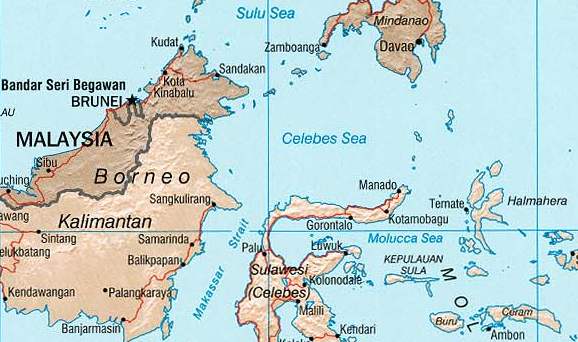
The launch about five years ago of maritime patrols in the Sulu and Celebes seas involving the armed forces of Indonesia, Malaysia and the Philippines have corresponded with a sharp drop in piracy and terrorism, officials and analysts said. The three nations plan to enhance the patrols with improved surveillance, intelligence and communication to boost security and economic stability.

The INDOMALPHI patrols, a moniker that combines the names of the partner nations, began in 2017 as a result of the Trilateral Cooperative Arrangement (TCA) signed a year earlier by the three governments. Security challenges are “especially daunting” in the seas, where the three nations’ maritime borders converge in an area “with a complex political history and a long legacy of illicit maritime activity,” according to Stable Seas, a nonprofit research initiative.

“The main objective is to enhance security in the Sulu and Sulawesi [Celebes] seas,” Indonesian Army Col. Kurniawan Firmizi, a senior official at the Indonesian Defense Ministry, told FORUM. “A high level of protection with all parties can be beneficial. It can increase the economy, facilitate traffic flows between countries adjacent to the Sulu Sea area, and improve border security and international cooperation. The goal is to secure the Sulu Sea and maritime border waters for all three countries.”

Since their launch, the INDOMALPHI patrols have deterred and defended against attacks on vessels at sea by pirates and violent extremist organizations such as the Abu Sayyaf Group, Kurniawan said. According to Indonesia’s Defense Ministry, known as Kemhan, there were no reports of piracy for ransom in the patrolled waters in 2021. As recently as 2017, there were 99 reports of piracy and armed robbery in the area, according to the Regional Cooperation Agreement on Combating Piracy and Armed Robbery against Ships in Asia.

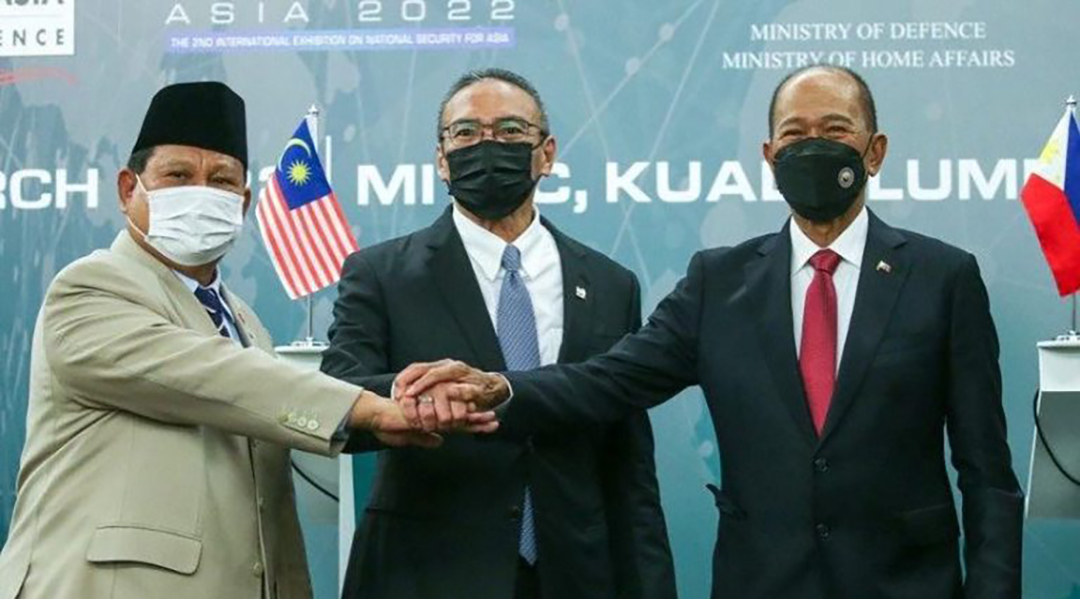
Four categories of patrol enhancements were announced at the TCA Ministerial Meeting in Kuala Lumpur, Malaysia, in late March 2022, Kemhan reported. They are: optimizing communication by deploying a liaison officer from each partner nation to each country’s maritime command center; conducting trilateral maritime exercises; adopting an intelligence-led approach to surveillance operations; and improving the TCA structure, communication and coordination to increase partners’ participation and commitment. (Pictured, from left: Indonesian Defense Minister Prabowo Subianto, Malaysian Senior Defence Minister Hishammuddin Tun Hussein and Philippine National Defense Secretary Delfin Lorenzana attend the Trilateral Cooperative Arrangement Ministerial Meeting in Kuala Lumpur, Malaysia, in March 2022.)

“There has been an increase in surveillance technology, including drones and satellite systems,” Kurniawan said.

The INDOMALPHI patrols demonstrate the expansive benefits of multilateralism, Connie Rahakundini Bakrie, a defense analyst and the author of “Defending Indonesia,” told FORUM.

“These countries will undoubtedly increase their cooperation with other regions, such as Europe, by securing their maritime areas,” she said. “The reason is that trading traffic will be smoother since it is safe, so the risk-cost will be lower.”

She recommended two additional improvements: increase patrol frequency in the Sulu Sea; and supplement patrols with “additional aircraft such as reconnaissance aircraft, close air support or attack aircraft, commandos from helicopters, etc.”

“Indonesia spearheading regional cooperation in South China Sea” –Indo-Pacific Defense Forum

Indonesian Maritime Security Agency vessel KN Tanjung Datu, left, sails alongside U.S. Coast Guard Cutter Stratton during joint exercises in the Singapore Strait in August 2019. IMAGE CREDIT: PO1 LEVI READ, USCG

The Indo-Pacific Defense Forum reports,

Indonesia is reaching out to its South China Sea neighbors to foster harmony on maritime sovereignty issues and enhance cooperation among regional coast guards, analysts say. The nation engaged closely with Vietnam in late 2021 and plans to add five countries to the collaborative effort in 2022.

It appears Indonesia is working with its SE Asian neighbors to resolve their bilateral maritime territorial disputes based on UNCLOS and develop multi-lateral agreement.

This would allow the ASEAN nations to present a united front, to push back against China’s expansive claims. It might even lead to something like my proposed Combined Maritime Security Task Force.

Indo-Pacific Strategy of the United States

U.S. Coast Guard Cutter Munro and Japan Coast Guard Patrol Vessel Large Aso, transit together in formation during a maritime engagement in the East China Sea Aug. 25, 2021. U.S. Coast Guard members aboard the Munro deployed to the Western Pacific Ocean to strengthen alliances and partnerships and improve maritime governance and security in the region. (Photo courtesy of Japan Coast Guard)

The Whitehouse has issued a new Indo-Pacific Strategy, and it specifically mentions the US Coast Guard.

The document calls out China for its aggressive behavior,

This intensifying American focus is due in part to the fact that the Indo-Pacific faces mounting challenges, particularly from the PRC. The PRC is combining its economic, diplomatic, military, and technological might as it pursues a sphere of influence in the Indo-Pacific and seeks to become the world’s most influential power. The PRC’s coercion and aggression spans the globe, but it is most acute in the Indo-Pacific. From the economic coercion of Australia to the conflict along the Line of Actual Control with India to the growing pressure on Taiwan and bullying of neighbors in the East and South China Seas, our allies and partners in the region bear much of the cost of the PRC’s harmful behavior. In the process, the PRC is also undermining human rights and international law, including freedom of navigation, as well as other principles that have brought stability and prosperity to the Indo-Pacific.

It recognizes the value and values of our allies and partners,

For centuries, the United States and much of the world have viewed Asia too narrowly—as an arena of geopolitical competition. Today, Indo-Pacific nations are helping to define the very nature of the international order, and U.S. allies and partners around the world have a stake in its outcomes. Our approach, therefore, draws from and aligns with those of our closest friends. Like Japan, we believe that a successful Indo-Pacific vision must advance freedom and openness and offer “autonomy and options.” We support a strong India as a partner in this positive regional vision. Like Australia, we seek to maintain stability and reject coercive exercises of power. Like the ROK, we aim to promote regional security through capacity-building. Like ASEAN, we see Southeast Asia as central to the regional architecture. Like New Zealand and the United Kingdom, we seek to build resilience in the regional rules-based order. Like France, we recognize the strategic value of an increasing regional role for the European Union (EU). Much like the approach the EU has announced in its Strategy for Cooperation in the Indo-Pacific, American strategy will be principled, long-term, and anchored in democratic resilience.

It calls for action in five areas:

  1. ADVANCE A FREE AND OPEN INDO-PACIFIC
  2. BUILD CONNECTIONS WITHIN AND BEYOND THE REGION
  3. DRIVE REGIONAL PROSPERITY
  4. BOLSTER INDO-PACIFIC SECURITY
  5. BUILD REGIONAL RESILIENCE TO TRANSNATIONAL THREATS

There is mention of the Coast Guard is in the section “BOLSTER INDO-PACIFIC SECURITY” on page 13.

We will also innovate to meet civilian security challenges, expanding U.S. Coast Guard presence, training, and advising to bolster our partners’ capabilities. We will cooperate to address and prevent terrorism and violent extremism, including by identifying and monitoring foreign fighters traveling to the region, formulating options to mitigate online radicalization, and encouraging counterterrorism cooperation within the Indo-Pacific. And we will strengthen collective regional capabilities to prepare for and respond to environmental and natural disasters; natural, accidental, or deliberate biological threats; and the trafficking of weapons, drugs, and people. We will improve cybersecurity in the region, including the ability of our partners to protect against, recover from, and respond to cybersecurity incidents.

Coast Guard roles presumably extend beyond interdiction and fisheries to include assistance with intelligence, port security, and maritime industry cybersecurity.

The strategy refers to ten lines of effort that are to be pursued in the next 12 to 24 months. The first is “Drive New Resources to the Indo-Pacific” (p.15),

Building shared capacity requires the United States to make new regional investments. We will open new embassies and consulates, particularly in Southeast Asia and the Pacific Islands, and increase our strength in existing ones, intensifying our climate, health, security, and development work. We will expand U.S. Coast Guard presence and cooperation in Southeast and South Asia and the Pacific Islands, with a focus on advising, training, deployment, and capacity-building. We will refocus security assistance on the Indo-Pacific, including to build maritime capacity and maritime-domain awareness.

Sounds like this may include Coast Guard attachés attached to diplomatic staffs and possibly some new basing.

There is a second line of effort that will undoubtably involve the Coast Guard, “Partner to Build Resilience in the Pacific Islands” (p.17),

The United States will work with partners to establish a multilateral strategic grouping that supports Pacific Island countries as they build their capacity and resilience as secure, independent actors. Together, we will build climate resilience through the Pacific Region Infrastructure Facility; coordinate to meet the Pacific’s infrastructure gaps, especially on information and communications technology; facilitate transportation; and cooperate to improve maritime security to safeguard fisheries, build maritime-domain awareness, and improve training and advising. We will also prioritize finalization of the Compact of Free Association agreements with the Freely Associated States.

A Maritime Executive post, New U.S. Indo-Pacific Strategy Singles Out China’s “Coercion”, notes,

In the security arena, the new strategy reiterates that the United States has maintained “a strong and consistent defence presence necessary to support regional peace, security, stability, and prosperity”, pointing to the South China Sea and the East China Sea as a priority. However, it is interesting that while the document underscores the importance of freedom of navigation in the Indo-Pacific, not a single paragraph mentions the US Freedom of Navigation Operations Program (FONOPS) carried out by the US Navy, which has stirred controversy. Conversely, the strategy emphasises the importance of the Coast Guard to lead maritime security cooperation in the region, in “advising, training, deployment, and capacity-building … including to build maritime capacity and maritime-domain awareness”. Indeed, in 2021, the US Coast Guard announced a joint maritime training centre with the Indonesian Coast Guard in Batam.

The emphasis on coast guard cooperation can be seen as a positive gesture since it will be less provocative and sensitive compared to a military presence in the region. And more importantly, coast guard operations in Southeast Asia are very much required to tackle maritime security threats such as illegal fishing.

Thanks to Paul for bringing this to my attention. 

“Coast Guard cutter returns home following Western Pacific deployment” –News Release

Coast Guard Cutter Munro (WMSL 755) crewmember Petty Officer 2nd Class Kurt Chlebek, a boatswains mate, is greeted by his dog after Munro returned to their homeport in Alameda, California, Oct. 20, 2021, following a 102-day, 22,000 nautical mile multi-mission deployment. Munro’s crew departed Alameda in July for a Western Pacific patrol and operated in support of United States Indo-Pacific Command, which oversees military operations in the region. U.S. Coast Guard photo by Chief Petty Officer Matt Masaschi.

Wrap-up of USCGC Munro’s recent deployment to the Western Pacific.

united states coast guard

News Release

Oct. 20, 2021
U.S. Coast Guard Pacific Area

Coast Guard cutter returns home following Western Pacific deployment

Photo of U.S. and Japan Coast Guard vessels
Coast Guard Cutter Munro crew returns home following 102-day, 22,000 nautical mile multi-mission Western Pacific deployment Coast Guard Cutter Munro crew returns home following 102-day, 22,000 nautical mile multi-mission Western Pacific deployment

Editors’ Note: Click on images to download high resolution versions.

Alameda, Calif. – The U.S. Coast Guard Cutter Munro (WMSL 755) and crew returned to their Alameda homeport Wednesday following a 102-day, 22,000-nautical-mile deployment to the Western Pacific.

Munro departed Alameda in July to the Western Pacific to operate under the tactical control of U.S. Navy 7th Fleet to promote a free and open Indo-Pacific.

“Munro’s deployment demonstrated the Coast Guard’s unique authorities in support of the Indo-Pacific command,” said Vice Adm. Michael F. McAllister, commander Coast Guard Pacific Area. “Joint operations help strengthen our partnerships through search and rescue, law enforcement, marine environmental response and other areas of mutual interest which preserve a stable and secure global maritime environment.”

Munro’s crew executed numerous cooperative engagements, professional exchanges and capacity building efforts with naval allies and partners, including the Japan Coast Guard, Japan Maritime Self Defense Force, Philippine Coast Guard and Bureau of Fisheries and Aquatic ResourcesRoyal Australian Navy, and Indonesia Maritime Security Agency.

“Our relationships in the Western Pacific are stronger today, and our partners are unified in their commitment to security,” said Capt. Blake Novak, commanding officer of Munro. “It was an incredible opportunity for our crew to participate alongside allies, sharing search and rescue and law enforcement concepts to promote peace, prosperity, and the sovereign rights of all nations.”

As both a federal law enforcement agency and an armed force, the U.S. Coast Guard is uniquely positioned to conduct defense operations in support of combatant commanders on all seven continents. The service routinely provides forces in joint military operations worldwide, including the deployment of cutters, boats, aircraft, and deployable specialized forces.

Munro is one of four 418-foot national security cutters homeported in Alameda. National security cutters like Munro feature advanced command and control capabilities, aviation support facilities, stern cutter boat launch, and increased endurance for long-range patrols, enabling the crews to disrupt threats to national security further offshore.

Photos from the Munro’s deployment are available here.

“U.S. Coast Guard cutter trains with Indonesia’s Maritime Security Agency” –News Release

Members onboard U.S. Coast Guard Cutter Munro man the rails during a maritime engagement with the Indonesia Maritime Safety Agency in the Singapore Straight, Sept. 20, 2021. Coast Guard Cutter Munro is currently deployed to the Western Pacific to strengthen alliances and partnerships, and improve maritime governance and security in the region. (U.S. Coast Guard photo by Marine Corps Sgt. Kevin G. Rivas)

Below is a Pacific Area News release, more of USCGC Munro’s adventures in the Western Pacific. You can also see the four accompanying photos here.

Indonesia has a unique organization that includes two coast guard like institutions,

The relationship between the two agencies seems to have been in flux. The Indonesian Navy also has a number of patrol boats that would correspond to US Coast Guard patrol boats. The Indonesian Navy is also constructing Offshore Patrol Vessels comparable to large Coast Guard Cutters.

The Indonesian ship seen in the photographs is KN Dana (323), a 80 meter Offshore Patrol Vessel, one of a class of three Damen designed vessels of the Bakamla. There is also a larger 110 meter OPV, all are relatively new.

united states coast guard

News Release

U.S. Coast Guard Pacific Area
September 21, 2021
Contact: Coast Guard Pacific Area Public Affairs
Office: (510) 437-3375
D11-DG-M-PACAREA-PA@uscg.mil
Pacific Area online newsroom

U.S. Coast Guard cutter trains with Indonesia’s Maritime Security Agency

U.S. Coast Guard and Indonesian Coast Guard U.S. Coast Guard Captain Novak waves to Indonesian Coast Guard vessel U.S. Coast Guard and Indonesian Coast Guard

Editors’ Note: Click on images to download high resolution version.

ALAMEDA, Calif. — The U.S. Coast Guard Cutter Munro (WMSL 755) conducted operations and exercises with the Indonesian Maritime Security Agency and coast guard, the Badan Keamanan Laut (known as BAKAMLA), September 20, in the Singapore Strait.

 Together, the crews participated in ship-to-ship communications drills, multi-unit maneuvering and maritime domain awareness while at sea.

 “These maritime exercises with our Indonesian partners forge a stronger relationship, allowing our respective crews to work together and build on each others’ strengths,” said Munro’s Commanding Officer Capt. Blake Novak. “Strengthening our alliances and partnerships fosters our unified commitment to a free and open Indo-Pacific and promotes peace, security, prosperity and the sovereign rights of all nations.”

 The U.S. Coast Guard partnership with Indonesia continues to grow stronger. In 2019, the Coast Guard Cutter Stratton conducted engagements with BAKAMLA as part of the Western Pacific deployment, including a port call in Batam and an exercise in the Riau Islands Province. The Stratton also participated in Cooperation Afloat Readiness and Training with the Indonesian Navy in 2019.

Munro, a 418-foot national security cutter, departed its home port of Alameda, California, in July for a months-long deployment to the Western Pacific. Operating under the tactical control of the U.S. Navy’s 7th Fleet, the cutter and crew are engaging in professional exchanges and capacity-building exercises with partner nations and patrolling and conducting operations as directed. National security cutters like Munro feature advanced command and control capabilities, aviation support facilities, stern cutter boat launch, and increased endurance for long-range patrols, enabling the crews to disrupt threats to national security further offshore.

“The U.S. Coast Guard is proud to operate with the Indonesian Maritime Security Agency and coast guard to enhance capabilities, strengthen maritime governance, security and promote rules-based international order,” said Vice Adm. Michael F. McAllister, commander U.S. Coast Guard Pacific Area. “Strengthening partnerships contributes to the region’s maritime common good in search and rescue, law enforcement, marine environmental response and other areas of mutual interest.” 

As both a federal law enforcement agency and an armed force, the USCG is uniquely positioned to conduct defense operations in support of combatant commanders on all seven continents. The service routinely provides forces in joint military operations worldwide, including the deployment of cutters, boats, aircraft, and deployable specialized forces.

More photos from Munro’s Western Pacific deployment are available here. Subscribe here to receive notifications when new photos are added.