“Gaza Pier Announced by the US, How the US Military Builds a Pier, Joint Logistics Over the Sea” –What’s Going on with Shipping

Above is a YouTube video, talking about the pier that is expected to be built to bring supplies into Gaza as announced in the President’s State of the Union address.

Reportedly this will not involve putting US “boots on the ground” in Gaza, but…the Coast Guard may be involved in providing waterside security, states-side load out, and perhaps in the processing of shipments through Cyprus.

The War Zone discusses the risks of the operation here, “This Is How The U.S. Could Set Up a Gaza Beachhead, But Not Without Risks.”

A US Army logistics ship is already on the way.

U.S. Army Vessel General Frank S. Besson (LSV-1) from the 7th Transportation Brigade (Expeditionary), 3rd Expeditionary Sustainment Command, XVIII Airborne Corps, departed Joint Base Langley-Eustis, Va., March 9, 2024, en route to the Eastern Mediterranean carrying the first equipment to establish a temporary pier to deliver vital humanitarian supplies. (U.S. Central Command photo)

Meanwhile, World Central Kitchens is working on its own possible solution. It is not unlikely other non-government organizations will want to bring in supplies as well. Presumably these supplies will also have to be processed through Cyprus where the Israelis have set up a check point.

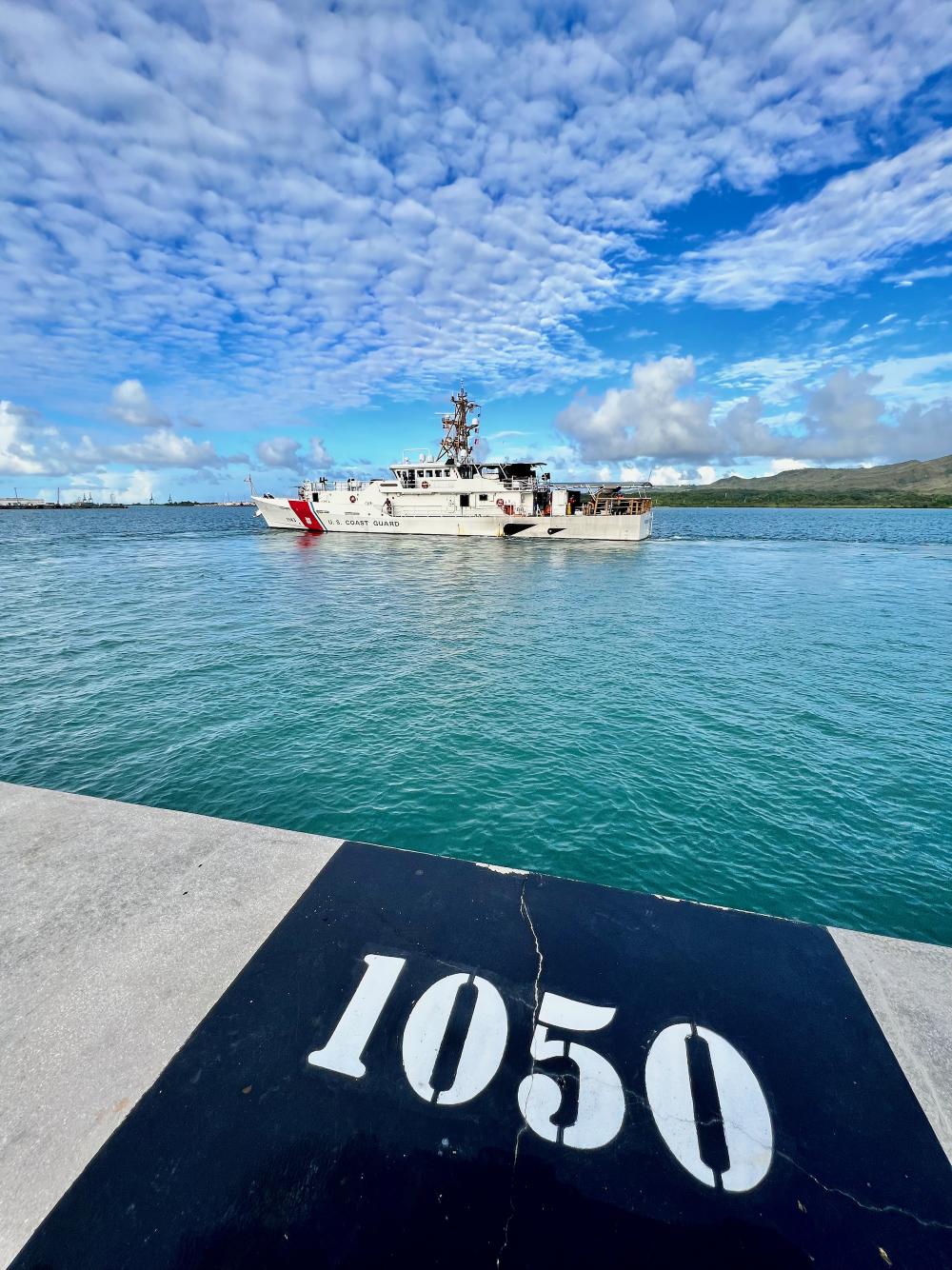
“U.S. Coast Guard formally establishes Base Guam” –CG News

APRA HARBOR, Guam (Aug. 11, 2021) – An aerial view of U.S. Naval Base Guam shows several vessels moored in Apra Harbor, including vessels from the United Kingdom Carrier Strike Group 21, Aug. 9. The deployment is the U.K.’s first by a carrier strike group in the Indo-Pacific for almost 25 years and marks a historic achievement in the bilateral partnership between the U.S. and U.K. The Arleigh Burke-class guided missile destroyer, USS The Sullivans (DDG-68) is deployed with the strike group, as are F-35B Lightning II Joint Strike Fighters of Marine Fighter Attack Squadron 211, HMS Queen Elizabeth (R08), HMS Kent (F78), HMS Defender (D63), RFA Fort Victoria (A387), RFA Tidespring (A136), Royal Netherlands Navy frigate HNLMS Evertsen (F805). French Ship Dupuy de Lome (A759), USNS Rappahannock (T-AO 204), USNS Salvor (T-ARS 52), USS Jackson (LCS 6), USS America (LHA 6), along with the 31st Marine Expeditionary Unit (MEU), were also in Guam for a scheduled port visit. (U.S. Navy photo by Mass Communication Specialist 3rd Class Naomi Johnson)

Below is a news release from Coast Guard News. This is another step in the growing Coast Guard presence in the Western Pacific. We have gone from a WLB and two 110s in Guam to a WLB and three FRCs and occasional CG helicopter presence. (A Navy MH-60S squadron normally provides SAR coverage.) I think we may see additional resources in the near future. Coast Guard Base Guam is a tenant command of Naval Base Guam. (Thanks to Bob for bringing this to my attention.)

Nov. 7, 2023

U.S. Coast Guard formally establishes Base Guam

U.S. Coast Guard Base Guam

SANTA RITA, Guam — The U.S. Coast Guard is proud to announce the establishment of U.S. Coast Guard Base Guam on Nov. 8, 2023, in a ceremony presided over by Rear Adm. Carola List, commander of Operational Logistics Command.

Led by Cmdr. Dana Hiatt, Base Guam, will be pivotal toward enhancing the U.S. Coast Guard’s mission support logistics in the region. This strategic move aligns with the Service’s commitment to increase mission support throughout Oceania. Given Guam’s vital importance to national security, this initiative takes center stage.

The establishment of Base Guam is part of the Consolidated Appropriations Act of 2023 and expands the U.S. Coast Guard’s mission support in the Indo-Pacific region. The establishment will shift current facilities engineering, naval engineering, comptroller and base operations, health, safety, and work life, personnel support, information technology, and procurement billets and responsibility from the existing U.S. Coast Guard Forces Micronesia/Sector Guam to a new Base Guam command structure. The establishment of Base Guam will consist of 17 additional personnel billets and will rely on the realignment of existing elements to provide logistical efficiencies improving U.S. Coast Guard mission support on Guam.

U.S. Coast Guard Base Guam will operate under the direction of the Operational Logistics Command, responsible for mission support logistics across the entire U.S. Coast Guard enterprise while coexisting with U.S. Coast Guard Forces Micronesia/Sector Guam. The base is taking on the role of the lead logistics and support command, a strategic decision aimed at better serving the needs of the operational community and partners. Forces Micronesia/Sector Guam retains the role of operational authority for U.S. Coast Guard activity in the Western Pacific.

The Base crew’s responsibilities encompass contingency logistics planning for joint operational plans, integration of logistics services, and support for tactical logistics needs for deployed operational assets. Additionally, the enterprise maintains a national-level logistics common operating picture and commands the Coast Guard’s 22 existing bases, ensuring the execution of assigned tasking through each of the U.S. Coast Guard’s Logistics and Service Centers.

The establishment of Base Guam marks a significant milestone in strengthening the U.S. Coast Guard’s presence and capabilities in the region. The unit is physically located on the existing U.S. Coast Guard footprint within U.S. Naval Base Guam.

-USCG-

About the DOL commander:
Rear Adm. Carola List currently serves as the commander of Operational Logistics Command in Norfolk, Virginia, overseeing the delivery of mission support logistics and administering procurement policy, guidance, and advocacy while also providing operational procurement and contracting services for all supported commands and units.

About Forces Micronesia/Sector Guam:
U.S. Coast Guard Forces Micronesia/Sector Guam comprises more than 300 dedicated members based in Guam and the Commonwealth of the Northern Mariana Islands. Capt. Nicholas Simmons currently leads Forces Micronesia and serves as the U.S. Coast Guard Captain of the Port for Guam and the CNMI. The U.S. Coast Guard is committed to maritime safety, security, and stewardship in Oceania, operating under the U.S. Coast Guard 14th District umbrella, which oversees Central and Western Pacific operations.

“New office reduces the logistics burden for remote expeditions” –MyCG

ARABIAN GULF (Oct. 20, 2011) Logistics Specialist Seaman Krystal K. Weed inventories supplies in a storeroom aboard the aircraft carrier USS George H.W. Bush (CVN 77). George H.W. Bush was deployed to the U.S. 5th Fleet area of responsibility on its first operational deployment conducting maritime security operations and support missions as part of Operations Enduring Freedom and New Dawn. (U.S. Navy photo by Mass Communication Specialist Seaman Jessica Echerri/Released) 111020-N-JD217-003

Below is a story from MyCG.

This marks a significant change in Coast Guard operations. Not only are there now more distant operations. Operations “halfway around the world” are expected to continue and perhaps increase. Such operations are no longer one off or special. They are becoming routine.

Presumably this is based in Alameda because most of these new distant operations are expected to be in the Pacific, but it will also support Atlantic Area operations.


Aug. 30, 2023

New office reduces the logistics burden for remote expeditions

By Cmdr. Jeff Henderson, Deputy Office Chief, Office of Expeditionary Logistics (DOL-X)

Talk about logistics to any Coast Guard operator deployed to a remote region and they may share a common frustration – getting what they need, when they need it, and in the right location, can be difficult and all-consuming.

The Office of Expeditionary Logistics (DOL-X), the Coast Guard’s solution to relieve the remote logistics burden, celebrated reaching its full operational capability with a ribbon cutting ceremony Aug. 14 in Alameda, Calif.

“DOL-X represents our unwavering commitment to the development and execution of Coast Guard expeditionary logistics,” said Rear Adm. Carola List, Director of Operational Logistics (DOL), during the milestone ceremony.

Without question, expeditionary operations demand more from our existing mission support enterprise. The deputy commandant for Mission Support’s, Mission Support Action Plan, designed DOL-X to reduce logistical burdens for crews operating in remote environments and initial prototype tests have demonstrated real-time, measurable impacts. Expeditionary operations demand innovative solutions that extend operational reach while leveraging support from interagency and joint partners, coalition forces, and host nations. As DOL-X continues to mature, efforts will continue to ensure end-to-end synchronization and reliability and most importantly, lighten the load from the backs of our deployed shipmates.

Before becoming fully operational, DOL-X tested its capabilities with assigned DOL-X personnel providing dedicated logistical support for Coast Guard Cutter Mohawk’s deployment to U.S. Africa Command, two fast response cutters deployed to Patrol Forces Southwest Asia, and Coast Guard Cutter Midgett’s deployment to the Western Pacific. The downrange logisticians successfully integrated into the U.S. Navy’s Fifth, Sixth and Seventh fleets to act as in-theatre logistical integrators. In doing so, DOL-X created first-class partnerships at the fleet and task force level for logistics support.

These initial tests were so successful that DOL-X will now be supporting Coast Guard Cutter Stratton and Munro’s Western Pacific patrols. The former patrol included the completion of a historic Taiwan Strait transit and the first trilateral exercise between the Philippines, Japan, and the U.S. Both deployments were unique and dynamic opportunities to refine DOL-X’s in-theatre deployment support and further enhance interoperability with DoD and partner nations.

Resources:

“Replenishing Controversy: The US Navy’s New Tanker Program” –gCaptain

gCaptain has a post that looks at a Navy proposal to build ten smaller underway replenishment ships, but it goes on to provide an overview of US sealift capacity (see the video above, included in the gCaptain post), and it finds that it is pretty poor.

“…amateurs talk strategy, but professionals talk logistics.”

Why should the Coast Guard care?

Any merchant marine construction in the US is going to be subject to Coast Guard oversight.

The health of America’s shipbuilding industry is in the Coast Guard’s interest.

It would be nice to have enough underway replenishment ships to be able to keep one on station in the Eastern Pacific to support drug interdiction efforts. Might make operating groups of Webber Class WPCs in the drug interdiction role in the drug transit zone more practical. It might even be possible to fly supporting Coast Guard rotary wing or UAS assets from a T-AOL.  It would probably be good to have one in Oceania as well.

Because there are so few US owned merchant ships, and because the MSC and MARAD sealift ships are old, unreliable, and use outdated technology, it is difficult to find crews for them. Then there might also be a problem of getting the mariners we do have, to take what is likely to be a hazardous job.

The Navy has already told MARAD that in wartime they would be on their own. That they should not expect the Navy to protect them.

Take a look at what happened in WWII. The Coast Guard ended up crewing 351 US Navy and 288 Army ships and craft. Many of the Navy vessels and most of the Army vessels were logistics ships. If the Navy has trouble crewing logistics ships, they might well commission them and put Coast Guard crews on them.

The Coast Guard should support MSC and MARAD recapitalization. 

“Photos: U.S. Coast Guard Icebreaker Reaches Antarctica’s McMurdo Station” / “Russian Antarctic Vessel Docks In South Africa As Green Groups Protest”–gCaptain

The heavy ice breaker USCGC Polar Star (WAGB 10) moves the ice pier at McMurdo Station, Antarctica so the U.S. Army 7th Transportation Brigade (Expeditionary) can build a modular causeway system for offloading cargo from resupply ships. U.S. Navy Photo

gCaptain reports the arrival of USCGC Polar Star at McMurdo Station, Antarctica.

Meanwhile, gCaptain also reports,

“A Russian research vessel which has been prospecting for oil and natural gas in the Antarctic docked in South Africa on Saturday following protests by green campaigners who say its operations in the region violate a treaty banning mineral exploration.”

I have to see this as more evidence that mineral exploitation of Antarctica is inevitable and that it will bring with it at least some forms of conflict between claimants.

A member of Extinction Rebellion holds up a placard as the Akademik Alexander Karpinsky, a Russian polar explorer ship, arrives in Cape Town harbour, South Africa, January 28, 2023. REUTERS/Shelley Christians

“U.S. Coast Guard leverages aviation workhorse to overcome challenges in cutter logistics in Oceania” –Forces Micronesia / Sector Guam

The crew USCGC Oliver Henry (WPC 1140) visit Ulithi Atoll on Oct. 31, 2022, the first time a fast response cutter visited the atoll and delivered 20 boxes of supplies, 50 personal floatation devices, and sporting equipment donated by the cutter crew, the extended U.S. Coast Guard Guam family, Ulithi Falalop Community Action Program, Guam Island Girl Power Foundation, and Ayuda Foundation. Ulithi was a central U.S. staging area during World War II, and home to a U.S. Coast Guard Loran-C communications station from 1944 to 1965 before operations relocated to Yap and ultimately shuttered in 1987. (U.S. Coast Guard photo by Petty Officer 3rd Class Zena Suzuki)

Below is a press release that highlights some changes in the way the Coast Guard is operating in the Western Pacific, the employment of Webber class Fast Response Cutters for long periods at great distances from homeport and the much greater reach of the J model C-130s.  

Feature Story

U.S. Coast Guard Forces Micronesia / Sector Guam

U.S. Coast Guard leverages aviation workhorse to overcome challenges in cutter logistics in Oceania
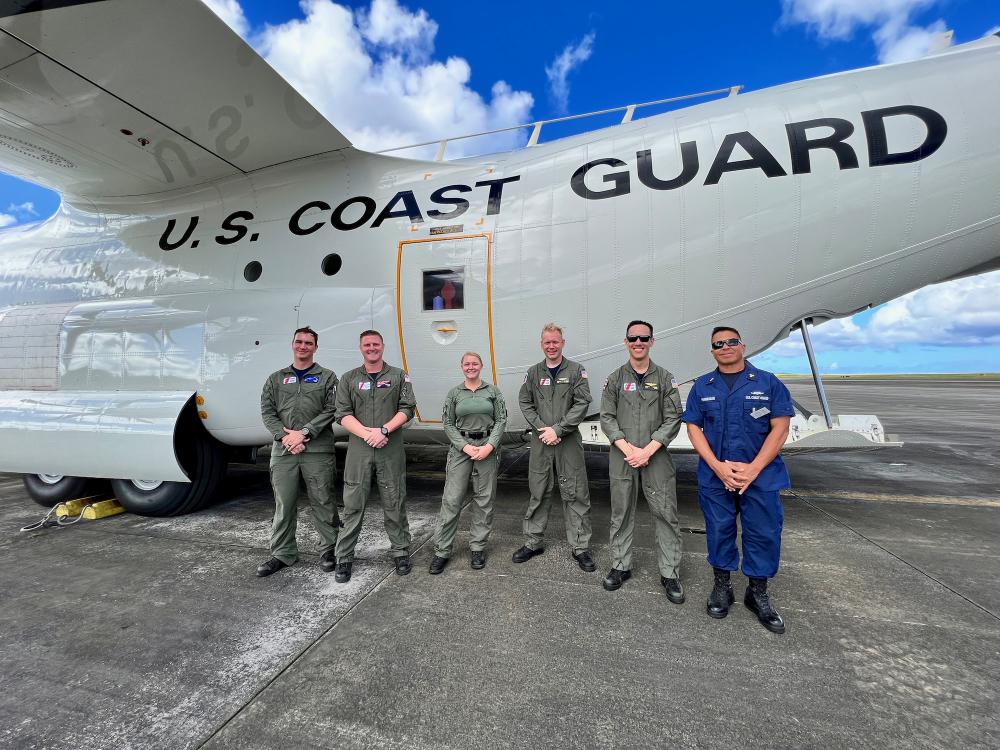
Group photo CGAS Barbers Point and CGFMSG EO FN200 offload from HC-130 Technical installs FN200 bottle  Frederick Hatch departs Guam for patrol

Editor’s Note: Click on the images above to view more or download high-resolution versions.

SANTA RITA, Guam — Guam is home to three 154-foot fast response cutters commissioned in 2021. These ships are built in Lockport, Louisiana. After initial workups, they sailed from Key West through the Panama Canal, more than 10,000 miles to Guam. In the time since the crews have stayed busy conducting the U.S. Coast Guard’s core missions in Micronesia and supporting our Blue Pacific partners.

The Operations Area

For many of the Nation’s fast response cutters, the transit to homeport from Key West is one of the most extended trips they make. Those stateside remain close to most essential services needed to maintain the vessels, designed to operate within 200 nautical miles of homeport. In the case of the Guam-based fleet, they routinely go more than 200 nautical miles to get to the operations area. U.S. Coast Guard Forces Micronesia/Sector Guam has one of the largest areas of responsibility of any sector at 1.9 million square miles. Like its other overseas counterparts, the region can be austere and presents unique challenges.

U.S. Coast Guard Forces Micronesia/Sector Guam (CGFM/SG) differs. The USCGC Oliver Henry (WPC 1140) undertook a more than 6,000-mile expeditionary patrol south through Oceania with inaugural FRC port calls in Papua New Guinea and Australia. Their sister ship, the USCGC Frederick Hatch (WPC 1143), just concluded a similar patrol in support of Operations Rematau and Blue Pacific, the southeast of Guam. The patrol countered illegal, unreported, and unregulated fishing off the Federated States of Micronesia, the Republic of the Marshall Islands, and the Republic of Nauru by enforcing regulatory schemes and individual countries’ sovereignty while strengthening partnerships through shiprider operations, subject matter exchanges, and community engagements.

“What often goes unsaid is the logistics piece enabling the operations,” said Chief Warrant Officer Manny Pangelinan, engineering officer for CGFM/SG. The Oliver Henry required a last-minute shipment of fuel injectors while underway, a package coordinated by the CGFM/SG logistics department with some support from the Surface Force Logistics Center in Baltimore. The package was shipped via a commercial carrier and met them in Australia.

But more oversized items and hazardous materials can present a more complex challenge. Guam is a strategic location, and as a U.S. territory, it is the first line of defense against regional competitors. Logistically, it is remote and depends on maritime cargo for most items. Nearly 90 percent of imports come through the Port of Guam, and travel by sea varies in cost and takes time. Commercial air freight requires less time but can be very expensive.

The Logistics Challenge

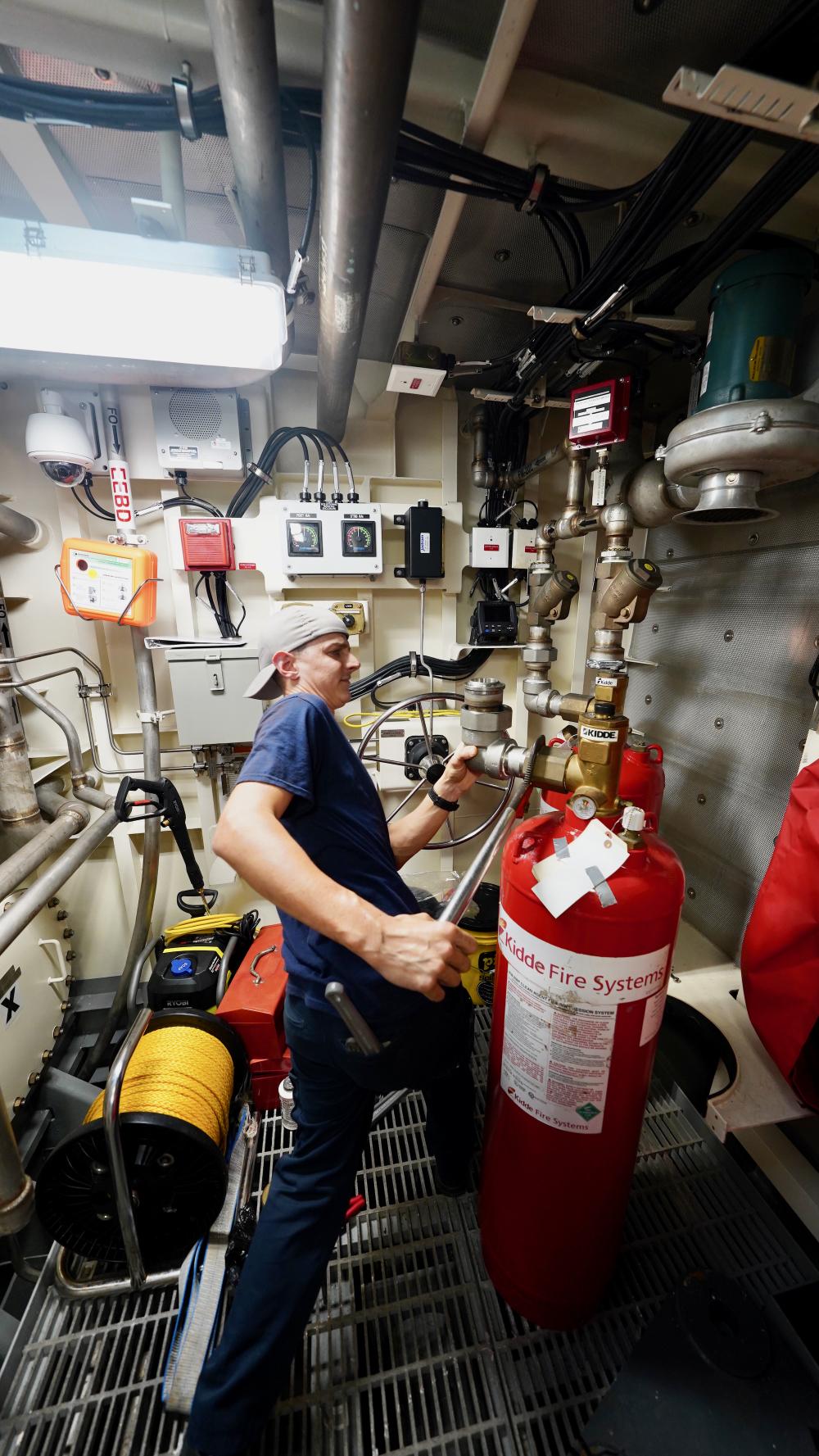
Each FRC has four bottles of compressed gas onboard as part of the fire suppression system. The current design of the FRCs uses FN200 powder and nitrogen gas. Over time these bottles lose nitrogen and need to be recharged, the same as any fire extinguisher. If an extinguisher or system loses its prime, it may malfunction and not adequately suppress a fire. Stateside servicing this equipment is a simple endeavor, but service providers in Guam still need to be created. To further complicate matters, if a local provider converted existing equipment to service this system, it could only be used on FN200 to prevent cross-contamination. The U.S. Coast Guard is currently the only FN200 client on the island.

As the Frederick Hatch prepared for their patrol, the crew noted one of the four bottles was borderline between yellow and red on its pressure. No one wants to be over a thousand miles from shore, with a fire, and risk a system malfunction. But how do you get a 277-pound replacement bottle, considered a hazardous material, shipped from the mainland United States to the territory of Guam? And how do you do it in time to meet the ship’s schedule and enable the crew to fulfill their mission requirements in Micronesia? You keep it in-house and leverage the naval aviation community.

Coast Guard Aviation in Oceania

U.S. Coast Guard Air Station Barbers Point in Hawaii conducts search and rescue, maritime domain awareness and surveillance, law enforcement, and cargo and transportation operations throughout Oceania. They are currently the only U.S. Coast Guard air station in the U.S. Coast Guard 14th District, with the next closest aviation unit in California. Still, from 1947 until 1972, they operated an air detachment in Guam known as Naval Air Station Agana to provide LORAN support for Western Pacific stations.

Today, the Barbers Point team operates four MH-65 Dolphin helicopters and four HC-130 Hercules airplanes. The Hercules airframes were recently upgraded from the H model to the J model. For Guam, this is significant. The J is more capable as a long-range surveillance aircraft providing heavy air transport and long-range maritime patrol capability. Each plane can serve as an on-scene command and control platform or as a surveillance platform with the means to detect, classify, and identify objects and share that information with operational forces. It also has “long legs.” Where the H crews needed to stop for fuel en route to Guam from Hawaii, the J could make the trip in one leg if necessary. This advantage matters when time is of the essence, particularly in search and rescue cases.

Capt. John Rivers, CGAS Barbers Point commanding officer, recently visited Guam. He met with the CGFM/SG team to discuss options for more aviation support to Western and Central Pacific operations. Those ideas include more hours of Hercules activity in this region and possible use of the Dolphin helicopters outside Hawaii.

The Workhorse

Regarding transporting equipment, the aircrew, particularly the loadmaster, has the final say on what goes aboard the plane. The Barbers Point team and the loadmaster were crucial to keeping the Frederick Hatch on schedule.

The team flew the HC-130 Hercules CG 2009 to Sacramento to pick up the shipment of fire bottles, then returned to Hawaii to rest and refuel. Subsequently, they flew to Majuro and landed in Guam on Nov. 9 at the A.B. Won Pat Guam International Airport. The CGFM/SG engineering team and environmental contractors met them to further transport the bottles to the pier.

All told, the movement cost flight hours and personnel time – but that is the nature of logistics. Per Commandant Instruction 7310.1V Reimbursable Standard Rates, the inside government rate for an HC-130J is $19,782 per hour. This includes Direct Costs like labor, employee benefits, fuel, maintenance, etc.; Support Costs: Costs allocated to a particular asset class for the support received from Coast Guard support activities, including but not limited to Area Commands, Districts, Sectors, Sector Field Offices, Bases, etc.; and General and Administrative: Costs allocated to a particular asset class to represent benefit received from Coast Guard general and administrative activities such as legal services, payroll processing, etc.

However, our aircrews make the most out of every flight, coupling logistics with other missions and training whenever possible. Flight crews must also fly a certain number of monthly hours to maintain currency and proficiency.

The personnel hours, in this case, include the coordination and research by the CGFM/SG Engineering Team to enable the technician from the fire services company to come out, install and certify the new bottle. The team kept the cost down by more than $16,000 by flying out one technician instead of two and doing all the manual labor of removing and replacing the existing bottle with the ship’s force. Transporting a 277-pound bottle across the pier, onto the cutter, and into the space with a tripod and chain fall in 90-degree heat with 90 percent humidity is quite an undertaking. According to Reimbursable Standard Rates, the inside government cost of a CWO2 is $79 per hour, a Chief Petty Officer is $71, and a Petty Officer 2nd Class is $55. Still, these personnel, like the aircrew, are salaried. The figures come into play if the Service seeks reimbursement from another branch or outside entity for services. The outside government rate is higher.

One might ask how to avoid this challenge in the future, as this won’t be the last time these bottles need to be recharged. One possible alternative was building a facility to support the maintenance of these systems in Guam to the tune of more than a million dollars. Ultimately, this option was deemed unrealistic. Instead of a new facility, the engineering team procured a larger bottle of FN200 and equipment to be kept onsite to recharge the FRCs’ systems. The team will do the heavy lifting and fly out a technician for the final assembly and certification. Two complete sets of bottles were procured at the same time. The first set came aboard the Hercules, and the second will come by cargo ship at a fee of just under $4,000. However, as of Christmas, the second set of bottles are still in transit and will take around 75 days total to arrive, emphasizing the importance of the Engineering Team’s efforts and choices.

Forecast

“This team continues to deliver on the Commandant’s mandate to be creative and innovative to craft solutions to the challenges we face as a service,” said Capt. Nick Simmons, commander of CGFM/SG. “I am impressed by their commitment and resolve to consistently deliver superior engineering support, keeping us operational in a remote environment.”

In the Fiscal Year 2022, the three Guam-based FRCs spent 324 days away from homeport, with 243 of those days physically underway conducting missions at sea. The other days away from homeport account for port calls, community engagements, and maintenance away from the home station. They worked 25 patrols throughout the region, enforcing the rule of law and strengthening partnerships. Guam’s sister sector in Honolulu also has three FRCs doing local and long-range missions. By comparison, they spent 202 days at sea for roughly the same number of patrols. This underscores the distances and demands Team Guam is covering.

“We have better platforms to help our crews get after the ever-growing mission demand here. But we must not lose sight of the demand on the crews and what is necessary to maintain our availability and effectiveness as a preferred partner in the region,” said Simmons. “That means putting steel on target, remaining flexible, and ensuring our crews have the support they need to succeed in a dynamic operational environment. I thank the CGAS Barbers Point team for ensuring our success and enabling the Frederick Hatch crew to work with our partners in Oceania and protect the Nation.”

This fire bottle transport is an excellent example of integrated logistics across the U.S. Coast Guard enterprise and innovation to find a timely cost-reasonable solution to keep the ship operational and on schedule. It is also a model for expanded Coast Guard aviation support to Guam.

For more U.S. Coast Guard Forces Micronesia/Sector Guam news, visit us on DVIDS or subscribe! You can also visit us on Facebook or Instagram at @USCGForcesMicronesia or Twitter @USCGFMSG. 

“Merchant Mariner Shortage Has Gotten Worse, but a Partial Solution Is Available” –Real Clear Defense

“Convoy WS-12: A Vought SB2U Vindicator scout bomber from USS Ranger (CV-4) flies anti-submarine patrol over the convoy, while it was en route to Cape Town, South Africa, 27 November 1941. The convoy appears to be making a formation turn from column to line abreast. Two-stack transports in the first row are USS West Point (AP-23) — left –; USS Mount Vernon (AP-22) and Coast Guard manned USS Wakefield (AP-21). Heavy cruisers, on the right side of the first row and middle of the second, are USS Vincennes (CA-44) and USS Quincy (CA-39). Single-stack transports in the second row are Coast Guard manned USS Leonard Wood (AP-25, later APA-12) and Coast Guard manned USS Joseph T. Dickman (AP-26 later APA-13).”

Real Clear Defense reports,

A mariner shortfall in 2018 was a grave concern. Today, with an escalating conflict in Europe and an increasingly bellicose China, the lack of seasoned merchant mariners is a clear and present danger to our national security.

Four years ago, the nation was about 1,800 mariners short to sustain sealift in a crisis beyond six months. Today that number is only increasing.

The proposed partial solution is to increae the size of the Merchant Marine Academy classes.

Coast Guard Academy graduates know the Merchant Marine Academy primarily as a football rival, but it is also a source of many Coast Guard Officers.

The central point of the post is that we don’t have enough mariners to support a war. The great distances of the Pacific exacerbate the problem. Logistics, as always, are key.

I would note that the shortages of mariners is not just in the officer ranks, so something more would have to be done.

This have anything to do with the Coast Guard? Well, a few months before the US entry into WWII, there was a test of our maritime logistics capabilities, and it found that the merchant marine crews of Army transport ships were unwilling to operate in the manner the military thought best, including darken ship. What happened? The ships were commissioned and crewed by the Coast Guard.

I am not suggesting that today’s merchant crews are unreliable, but if there are shortages, it is not impossible the nation will again turn to the Coast Guard to supply mariners for high priority logistics ships.

“Solomon Islands doesn’t answer US Coast Guard’s request for port visit, US says” –CNN/Reuters

The USCGC Oliver Henry (WPC 1140) crew arrives in Manus, Papua New Guinea, on Aug. 14, 2022, from Guam as part of a patrol headed south to assist partner nations in upholding and asserting their sovereignty while protecting U.S. national interests. The U.S. Coast Guard is participating with partners to support the Pacific Islands Forum Fisheries Agency-led Operation Island Chief and the larger Operation Blue Pacific through patrols in the Western Pacific in August and September 2022. (U.S. Coast Guard photo by USCGC Oliver Henry)

CNN reports,

A United States Coast Guard vessel was unable to enter Solomon Islands for a routine port call because the Solomon Islands government did not respond to a request for it to refuel and provision, a US official said.

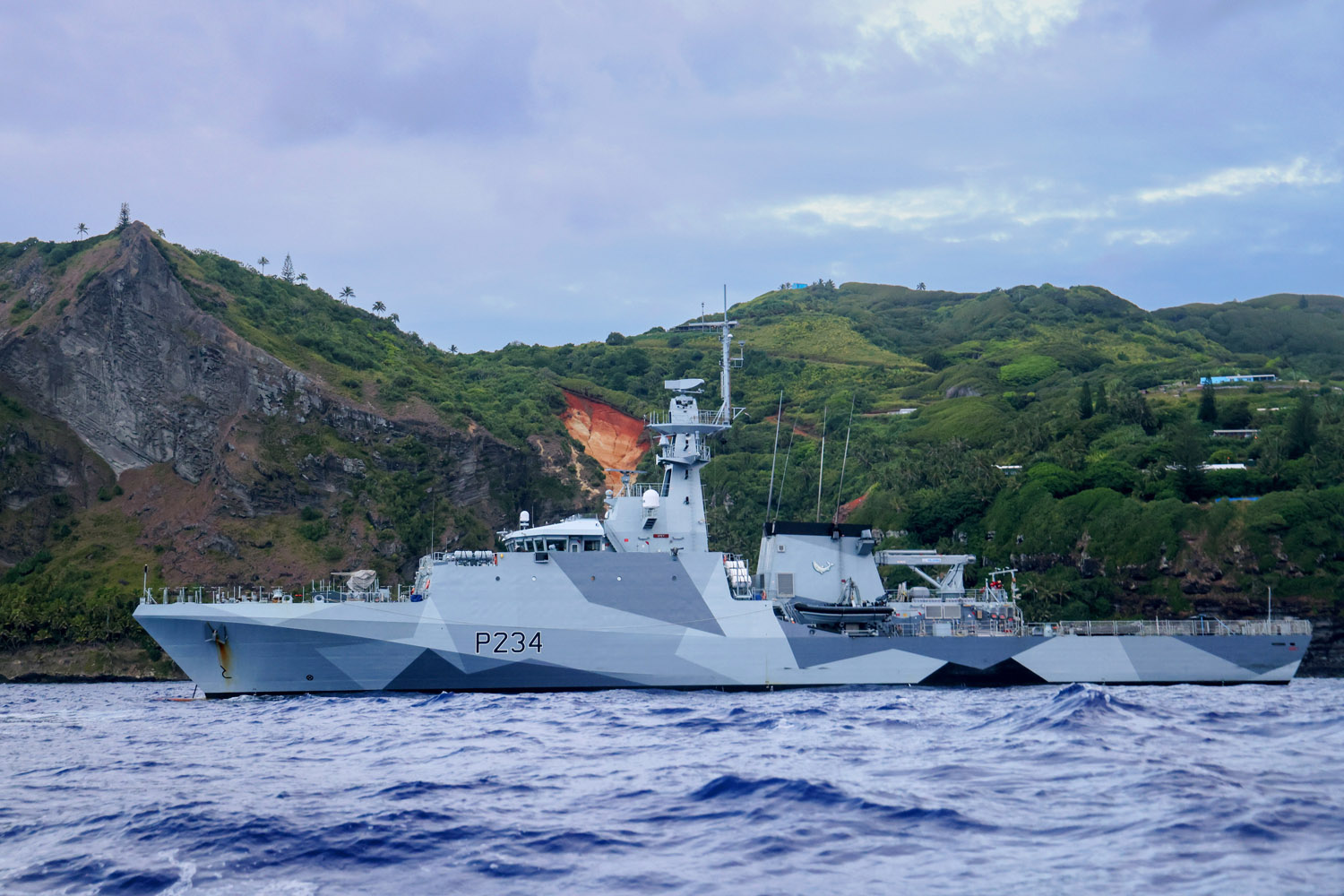
The vessel was USCGC Oliver Henry, hardly a symbol of American hegemony. HMS Spey, a larger offshore patrol vessel, was also reported to have had difficulty arranging a replenishment stop. Both were operating in support of the fisheries agency for the Pacific Islands Forum.

HMS Spey, River class Batch2 OPV

The difficulties may have been resolved,

“The U.S. Department of State is in contact with the Government of the Solomon Islands and expect all future clearances will be provided to U.S. ships”

Still it appears to be a symptom of growing Chinese influence in the Western Pacific.


USNI Proceedings Coast Guard Issue

USCGC Mohawk (WMEC-913), Clarence Sutphin Jr. (WPC-1147), and John Scheuerman (WPC-1146)

Sorry this post is going to ramble a bit.

The Prize Winning Essays: 

The August issue of the U. S. Naval Institute Proceedings is again the “Coast Guard Issue,” and includes the three winning essays in their Coast Guard Essay contest.

First prize went to prolific author and repeat winner, Cdr. Craig Allen, Jr., USCG for his “Expeditionary Cutter Deployments Should Not Be a Mission to Mars.” It talks about some of the logistical difficulties encountered. His comments about the integrated C5ISR, navigation, and engineering systems and “controlled parts exchanges (taking working parts from one cutter and installing them in another) to deploy on schedule and/or remain underway” are partiuclarly troubling.

He offered three suggestions about how to make the Coast Guard more deployable.

  • Improved cutter self-sustainability.
  • Forward operating bases
  • Mission support cutter.

I would note that large cutters are probably already have more self-sustainability than their Navy counterparts making extended single ship deployments with minimal support easier for cutters than for Navy ships, but it does sound like we have made some choices that may put those capabilities at risk.

It is probably diplomatically easier to establish a Coast Guard forward operating base than one for the Navy, particularly in Latin America. Realistically we are probably only talking about a base in the Eastern Pacific, near the drug transit zone. To make that happen would probaby require some initiative from SOUTHCOM.

Elsewhere we could probably ride the coat tails of the Navy and our allies including Australia, New Zealand, Japan, the United Kingdom, France, and the Netherlands.

The mission support cutter, or, more generally, a floating base might be addressed in a number of ways. Presumably SOUTHCOM will get their own Expeditionary Sea Base. Wherever it is moored will become a defacto forward operating base. There should be room aboard for priority Coast Guard unique support requirements. Unfortunately I understand, dispite their tanker origins, they don’t carry fuel for tranfer to other ships. That is unfortunate, but probably something that could be fixed. Any kind of forward operating base could make Webber class deployments to the Eastern Pacific drug transit zones much more productive.

Effectively the Coast Guard has already been using buoy tenders as mission support cutters for Webber class in the Western Pacific.

One might think that a Navy owned MSC vessel might make a good mission support vessel, but the underway replenishment vessels they have currently, are far too large to be dedicated to supporting routine Coast Guard operations.

Something  to consider might be a routine teaming of Charleston based National Security Cutters (NSC) with District 7 Webber class Fast Response Cutters (FRCs). A NSC and a pair of FRCs could make a very effective team, with the NSC providing underway replenishment for the FRCs. There are three NSC in based in Charleston now and there are expected to be five when the program is completed. There are currently 20 FRCs based in district 7. These ships are the closest of their type to the Eastern Pacific Drug Transit Zones.

Second prize went to “The World’s Fishermen as a Maritime Sensor Network,” by Lieutenant Holden Takahashi, USCG, that suggest a cell phone based reporting system could provide additional eyes to Maritime Domain Awareness systems.

Third prize went to “Lost At Sea: Teaching, Studying, and Promoting Coast Guard History,” by Lt. Christopher Booth, USCG, and Mark Snell, U.S. Coast Guard Auxiliary contending,

“To foster pride in its heritage and promote its historic accomplishments to the public, the Coast Guard cannot continue to ignore its past. It must make a major shift in how it approaches, teaches, promotes, and preserves its history. The Coast Guard must rescue the history and heritage of “that long line of expert seamen” and their contributions to the nation, so they are no longer lost at sea.”

Other Posts of Interest:

There are also other posts that directly address the Coast Guard or at least would involve the Coast Guard.

A Campaign Plan for the South China Sea,” by Captain Joshua Taylor, U.S. Navy advocates for persistent low-end presence.

A South China Sea campaign that translates these principles into action in a resource- and diplomatically constrained—but feasible and effective—manner should be organized around the following lines of effort and accompanying messages:

  • Beat Cop. Persistent low-end presence—“The United States has skin in the game.”
  • Neighborhood Watch. Build a regional coalition— “We are stronger together.”
  • Vigilance. Information sharing—“We are always watching.”

ln terms of information sharing, also mentioned was this Maritime Domain Awareness program that I was not aware of.

Since 2016, the United States has invested more than $425 million through the Maritime Security Initiative to help Indo-Pacific countries develop the ability to “sense, share, and contribute” to a regional recognized maritime picture (RMP). While some of these funds have purchased secure communication systems, the standout success story has been the U.S. Department of Transportation’s unclassified web-based SeaVision maritime domain awareness and coordination tool. Drawing on government and commercially contracted datastreams, SeaVision fuses information from terrestrial and satellite Automated Identification System data, the satellite Visible Infrared Imaging Radiometer Suite, satellite synthetic aperture radar, and—soon—satellite electronic signal detection to form a high-quality unclassified RMP that could support a countercoercion campaign in the South China Sea. Indeed, naval services throughout Southeast Asia already use it—with the notable exception of the U.S. Navy.

(My own ideas for a persistent low-end presence are here, Combined Maritime Security Task Force Pacific.)

The Coast Guard’s Firefighting Fiction,” by Chief Boatswain’s Mate Phillip Null, U.S. Coast Guard (Retired) suggests the Coast Guard should take a more active role in marine fire fight.

“Recent tragedies have shown the need for the Coast Guard to revisit its stance on firefighting, not to supplant municipalities or absolve them of their responsibilities, but to support them with real capabilities and expertise and to provide capability in unprotected waters to avert tragedy. The Coast Guard trains and equips its cutter crews to combat fires on board their own vessels, the success of which was recently demonstrated on board the cutter Waesche (WMSL-751) during a Pacific transit.8 Now it needs only to increase the capacity and foam-delivery capability of the pumps carried on its boats, expand the training and equipment available to its boat crews who operate in coastal regions where fire poses the greatest threat, and revise policies that limit involvement and inhibit on-scene decision-making even in unprotected waters.

While on the topic of maritime firefighting, take a look at this post by Cdr Sal, “How Many Fireboats Can You Buy for $1.2 Billion?” that discusses the Navy’s lack of fireboats. In so many cases, a less than optimal resourse on scene in a timely manner is far better that the perfect resource arriving late. Perhaps Coast Guard assets could have helped.

Some people in the Coast Guard are thinking about major ship fires, “Coast Guard, Long Beach and LA fire departments train for maritime fires.

Polar Security Cutters and Coast Guard ASW

The US Naval Institute Proceedings web page has a couple of Coast Guard related articles that did not appear in the print version of Proceedings,

I have reproduced my comments on these topics below.


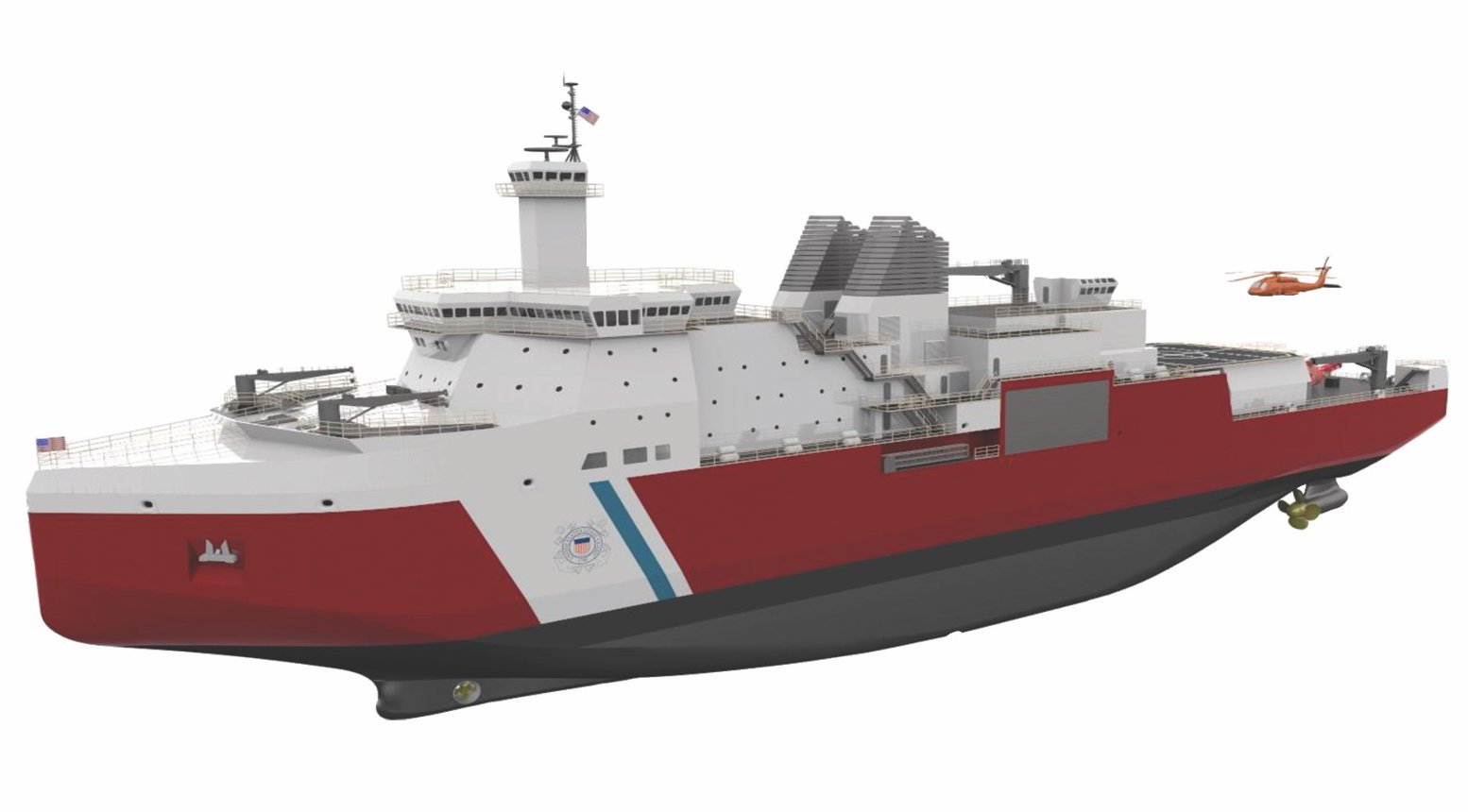
In regard to arming the Polar Security Cutters (the author seemed fixated on cruise missiles. We did discuss this topic earlier here)

There are limits to what we want to put on ships bound for Antarctica, since they have to be open for inspection. On the other hand if we ever do have a near peer conflict involving the Arctic or Antarctic, these will become rare and essential naval auxiliaries. As such they will probably operate with other vessels, including more powerful warships if appropriate, but that does not mean they should not be able to defend themselves against the possibility of leakers. We need to make provision for last ditch defense with systems like SeaRAM.

Meanwhile the fact that they are law enforcement vessels means they should be able to forcibly stop any private or merchant vessel regardless of size. So far it seems they will have at most, 25mm Mk38 Mod3 guns.

The follow on Medium Icebreakers or Arctic Security Cutters, which are unlikely to go to Antarctica, are more likely to be more heavily armed from the start.


Coast Guard ASW (comments were generally surprisingly adverse):

It is a fact that in WWII most U-boats were sunk by aircraft, but about a third (about 230) were sunk by surface vessels, primarily those of our allies Britain and Canada.

Even when surface vessels did not sink U-boats, they often performed valuable service in blocking access to convoys and in rescuing mariners from sunken ships.

US Naval vessels only sank about 38 U-boats. Coast Guard cutters and Coast Guard manned Navy ships were involved in sinking a disproportionate number of those (ten) for various reasons. Most of the US Navy effort went into the Pacific and most of the USN effort in the Atlantic at least through mid-1943, was in escorting high speed troop convoys than largely avoided contact with U-boats.

Circumstances we will face in any near peer conflict may be very different.

The advantages provided by code breaking in WWII are unlikely.

The advantages provided by radar equipped aircraft detecting U-boats charging their batteries or transiting the Bay of Biscay on the surface during the night no longer exists.

The Chinese surface and air threat would divert the most capable USN assets from ASW tasks.

Unlike the Japanese during the Pacific campaign, the Chinese are likely to make a concerted effort to disrupt our logistics train.

We simply do not have enough ASW assets.

Augmenting Coast Guard cutters to allow them to provide ASW escort and rescue services for ships that are sunk by hostile subs, in lower threat areas, is a low cost mobilization option that can substantially increase the number of escorts at low cost.

This could be facilitated by augmenting cutter with USN Reserves. Navy reserve ASW helicopter squadrons could be assigned to fly from cutters.
LCS ASW modules could be placed on cutters and manned by reactivated Navy reservists with LCS ASW module experience.

Our few US merchant ships need to be protected and when inevitably, some are sunk, we need someone to rescue those mariners, because they have become a rare and precious commodity.

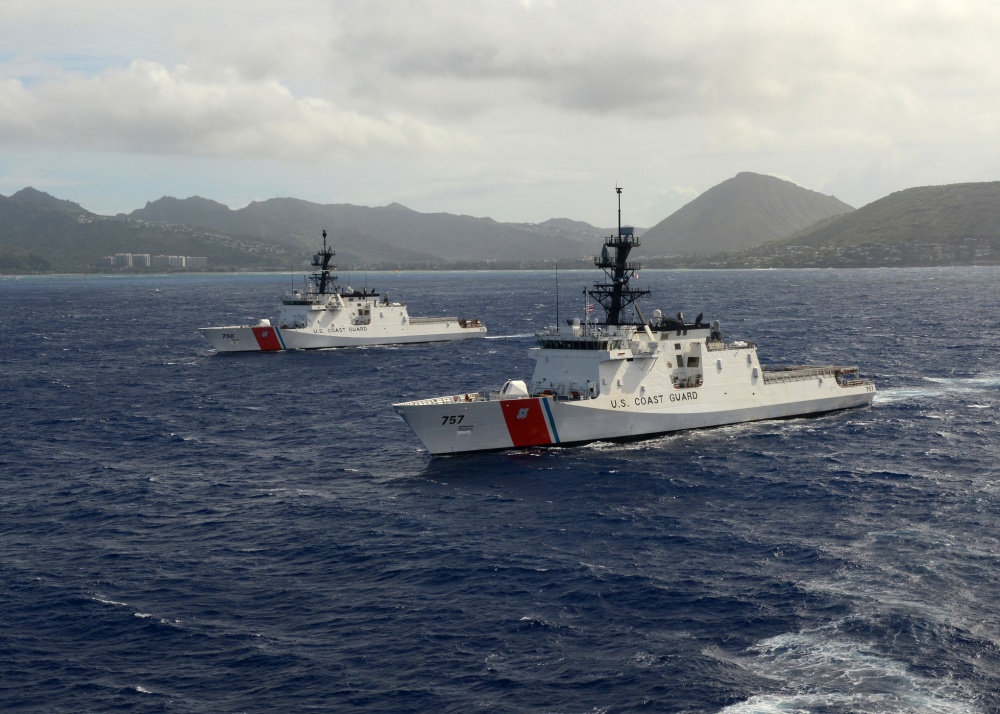
The crews of the Coast Guard Cutters Midgett (WMSL 757) and Kimball (WMSL 756) transit past Koko Head on Oahu, Hawaii, Aug. 16, 2019. The Kimball and Midgett are both homeported in Honolulu and two of the newest Coast Guard cutters to join the fleet. (U.S. Coast Guard photo by Petty Officer 3rd Class Matthew West/Released)


In answer to this comment from James M

Add : For (millions)

ASIST : 6.263
Mk 32 SVTT : 3.237
SLQ-25 Nixie: 1.727
AN/SRQ-4 LAMPS III: 4.625
VDS/MFTA combo: 14.802
ASW Combat Suite: 33.684
64.338 total. I am sure something could be arrived at for less. I look at this as what it takes to fit out an NSC the whole way. For one, OPC will never fit that VDS/MFTA on its stern. At best it would be a Nixie, maybe a container towed sonar we don’t yet use, and the mods for MH-60R. It would be good to know the plan for MUSV as it might help the equation. After all, the 64.338 would buy 2 MUSVs without payload. It could also buy an additional FRC.

So, we could equip ASW equip all eleven projected Bertholf class National Security Cutters (NSC) for less than the cost of a single frigate.

Why do you believe the VDS/MFTA would not fit on the Offshore Patrol Cutter? It is fully as large as the NSCs and does not have the boat launch ramp cut into the stern. They are also substantially larger than the LCSs.

OPC “Placemat”