“Enhancing the Maritime Patrol Operational Picture” –Seapower

A screen grab of the Labyrinth, a Minotaur cloud-platform, software. Labyrinth adds robust scalability in handling and correlating large volumes of data while providing external stakeholders access via a secure web-based interface.

The Navy League’s on-line magazine, Seapower, gives us a look at the growing power of the Minotaur Family of Systems (MFoS), that is being incorporated into all Coast Guard fixed wing patrol aircraft.

Looks like a major piece of the Maritime Domain Awareness puzzle.

Maritime Domain Awareness, “Denmark to field unmanned vessels for monitoring busy shipping routes” –Defense News

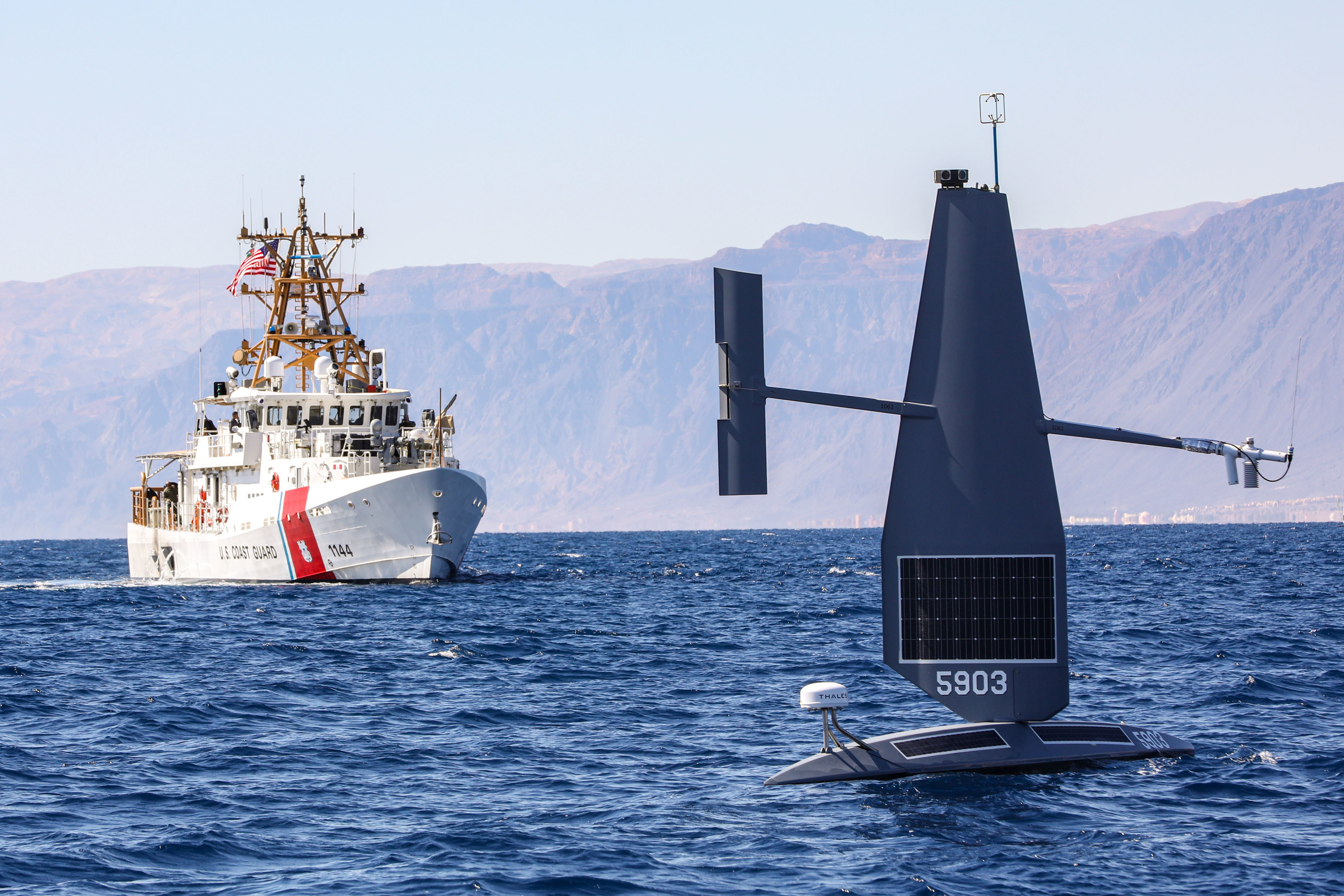
GULF OF AQABA (Feb. 13, 2022) The U.S. Coast Guard Sentinel-class cutter USCGC Glen Harris (WPC 1144) sails near a U.S sail drone explorer during the International Maritime Exercise/Cutlass Express (IMX) 2022, Feb. 13, 2022. IMX/CE 2022 is the largest multinational training event in the Middle East, involving more than 60 nations and international organizations committed to enhancing partnerships and interoperability to strengthen maritime security and stability. (U.S. Army photo by Cpl. DeAndre Dawkins)

Defense News reports,

“U.S.-based Saildrone will deploy four large unmanned surface vessels in Danish waters next month to conduct maritime surveillance missions and help protect critical undersea infrastructure…Four 10-meter Voyager USVs equipped with a suite of intelligence-gathering sensors and AI data fusion will be sent to Denmark to support the Danish military gain better maritime awareness.”

“Enhancing Domain Awareness in the Arctic” –Third Fleet

A U.S. Navy P-8A Poseidon takes off at Joint Base Elmendorf-Richardson, Alaska, Sept. 14, 2024. The P-8 Poseidon aircrew assigned to Patrol Squadron (VP) 9 and a U.S. 3rd Fleet Naval and Amphibious Liaison Element (NALE) supported joint and bi-national forces from Alaskan North American Aerospace Defense Command Region and Alaskan Command during Operation POLAR VORTEX by providing maritime domain awareness in conjunction with the 611th Air Operations Center air component to provide domain awareness during operations and exercises in remote regions of Alaska and the Arctic. (U.S. Air Force photo by Senior Airman Quatasia Carter)

Below is a 3rd Fleet press release. Notably missing is any mention of the Coast Guard, that might be understandable, but I have also seen no Coast Guard news release about participation in Operation POLAR VORTEX. If you are doing Maritime Domain Awareness anywhere around Alaska, you would think the Coast Guard would be involved.


Oct. 28, 2024

Enhancing Domain Awareness in the Arctic

By Tech. Sgt. Donald Hudson

During Operation POLAR VORTEX, a Naval and Amphibious Liaison Element (NALE) led by U.S. 3rd Fleet and supported by U.S. Fleet Forces was embedded into the bi-national Alaskan North American Aerospace Defense Command (NORAD) Region at Joint Base Elmendorf-Richardson, Alaska.

The NALE is primarily a function of the Navy Reserve, with Reserve personnel filling roughly 98 percent of NALE billets, given the operational tempo of this unique work. NALE Sailors train in mobilization to billet (MOB to-billet) positions and generally deploy on 90 to 270-day orders, responding both to planned operations and emergent crises, including training exercises, freedom of navigation operations, and humanitarian assistance and disaster relief. MOB-to-billet is the activation (other than for training) of SELRES Sailors to serve in the authorized and funded manpower billet at the command to which they are permanently assigned.

NALE units are attached to U.S. Fleet Forces Command, U.S. Pacific Fleet, U.S. Naval Forces Europe and Africa, and most numbered fleets.

While in Alaska, the NALE worked alongside U.S. Air Force and Royal Canadian Air Force (RCAF) members in the 611th Air Operations Center (AOC) to increase domain awareness in the Arctic region during Operation POLAR VORTEX by instantly linking maritime and air domain awareness.

“The situational awareness the NALE has provided is the most maritime awareness the AOC has had in the 14 years I’ve been here,” said Alaska Air National Guard Col. Jeff Smith, deputy commander, 611th AOC. “It’s been great to see the coordinated efforts between air and maritime domains.”

By co-locating, the NALE and 611th AOC were able to coordinate information instantly to the Joint Force Air Component Commander (JFACC) and provide a detailed real-time operating picture from the surface to air across some of the most remote operating areas in Alaska.

The NALE worked to seamlessly integrate their expertise of maritime domain awareness and employ a Navy P-8 Poseidon alongside joint and bi-national air assets. The cooperation increased tactical performance of joint forces validating command and control and tactical execution of mission objectives between various aircraft including exercising simulated air-to-surface strikes.

“The NALE has been essential to air operations,” said RCAF Brig. Gen. David Moar, deputy commander, Alaskan NORAD Region. “They were key in synchronizing air operations with naval air assets and providing information to enable the JFACC to coordinate and support the maritime component.”

3rd Fleet operations in U.S. Northern Command’s (USNORTHCOM) area of responsibility throughout the Gulf of Alaska aligned with Commander, U.S. Pacific Fleet objectives to demonstrate resolve and credible deterrence in defense of the homeland in the area. The operations also supported USNORTHCOM and NORAD’s mission of homeland defense, aerospace warning and control, and preserving a stable Arctic region in cooperation with U.S. Allies and partners.

“The NALE is an essential part of integrating the Maritime Operations Center (MOC) and AOC to provide multi-domain awareness to both Component Commanders,” said U.S. Navy Capt. Chris “Turtle” Turl, NALE director. “By coordinating information between each Commander’s guidance, the NALE facilitates the planning and execution of the mission to effectively meet the commander’s intent.”

NALE Sailors regularly engage in training exercises, freedom of navigation operations, and humanitarian assistance and disaster relief to enable better integration between joint air assets. The NALE provide the necessary face to-face contact among planner, commanders and staff to ensure mutual understanding, unity of effort and reduce friction between components.

Operating across the vast distances and remote areas in the Arctic comes with many operational hurdles to overcome such as harsh weather and sea conditions causing increased risk to aircrews should an incident occur. Enhancing communication between joint forces is essential to meet the mission while overcoming obstacles and lowering operational risks.

Through joint and bi-national teamwork the NALE and 611th AOC were able to maximize domain awareness and more effectively employ air assets saving time, and costs while reducing risk and increasing efficient use of tactical air assets and manpower.

USCGC Alex Haley Encounters Russian AGI

The Navy League’s on-line magazine, Seapower, reports,

While patrolling the Aleutian Islands, the crew of U.S. Coast Guard Cutter Alex Haley (WMEC 39) detected the vessel 30 nautical miles southeast of Amukta Pass, Alaska.

The Russian vessel was transiting in international waters but inside the U.S. Exclusive Economic Zone, which extends 200 nautical miles from the U.S. shoreline. The Alex Haley did not communicate with the Russian vessel. The Alex Haley confirmed it to be a Russian Federation Vishnya-class naval vessel and followed the vessel as it transited east. An HC-130 air crew from Coast Guard Air Station Kodiak also observed the vessel.

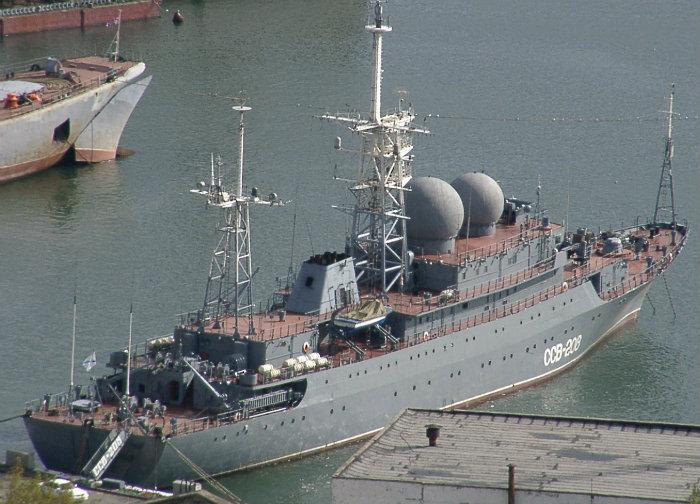
The Vishnya class are intelligence gathering ships completed in the late 1980s, like the one pictured above.

The detection was made 30 miles SE of Amukta Pass (52°27′31″N 172°00′55″W). This is well East of Eareckson Air Force Base (52°42′44″N 174°06′49″E) on Shemya and the former US Naval Air Facility, Adak (51°52′41″N 176°38′46″W).

Distances from Dutch Harbor (53°54′10.5″N 166°31′06.2″W):

  • Shemya 802 miles
  • Adak 446 miles
  • Amukta Pass 242 miles

The report seems to say that Haley simply stumbled across this Russian vessel. This suggests that it had been inside the US EEZ for at least two days before it was detected. That probably is not something to get excited about, but there may, of course, be more to this than we are aware.

USCGC Alex Haley moored in Nome, AK.

“Combating Transnational Drug Flows,” A Conversation with the Deputy Director of Joint Interagency Task Force –South

The US Naval Institute brings us this video from the Center for Strategic and International Studies.

The accompanying article provides a brief overview, but I really recommend watching the entire interview. It is excellent. It even touches on Illegal, Unregulated, Unreported fishing.

There is an acknowledgement that resources made available for interdiction have declined even while seizures are up (as is the traffic in illegal drugs), but there is also good news in the successes of partner nations.

Again, there is no substitute for watching the interview.

“Iran Fires Ballistic Missile From A Shipping Container At Sea” –The War Zone

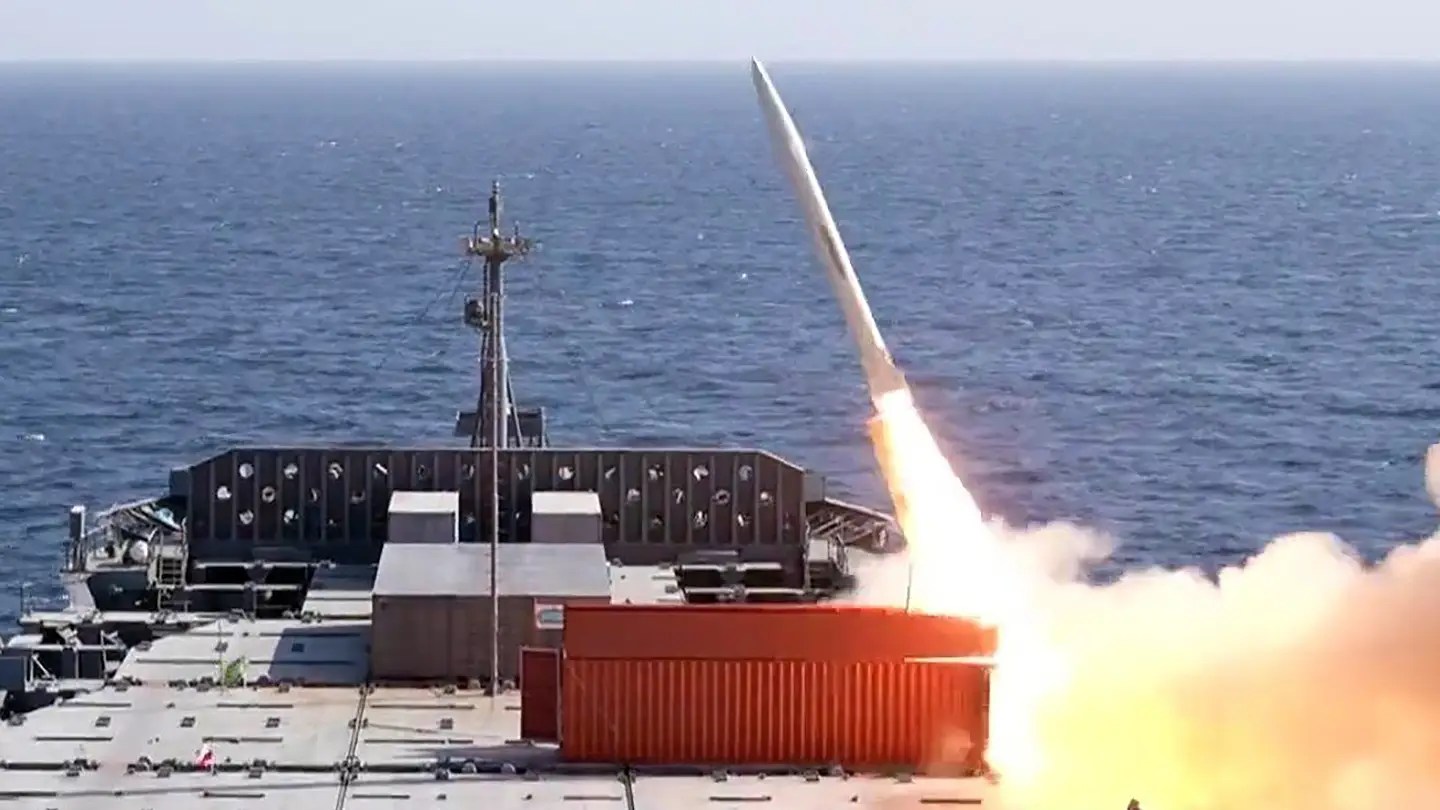
The country’s IRGC-linked Tasnim News Agency reports that two “Fateh class” ballistic missiles were recently launched from Shahid Mahdavi, which the Iranian Navy took delivery of in March 2023 after it was converted from a state-owned and operated container ship known as the Sarvin. Iranian State Media

The War Zone reports,

Iran’s Islamic Revolution Guards Corps (IRGC) has fired two ballistic missiles from launchers disguised as standard shipping containers that were hosted aboard one of its sea base-like vessels. This particular combination, which has not been seen to date, greatly expands the reach with which those weapons could be used to strike potential targets by surprise, especially given that shipping containers can be embarked on any vessel that has the space to accommodate them.

Iran’s liberal transfer of technology to proxies and the inherent deniability of containerized missile systems aboard nondescript vessels opens a number of unpleasant possibilities.

Launching from the sea complicates defenses because it means new potential threat axes.

This potentially threatens the US as well as our allies. Defenses designed to intercept ICBMs don’t necessarily work against shorter ranged ballistic missiles or cruise missiles. Those destroyers intercepting ballistic missiles over the Red Sea are not patrolling off the US coast ready to intercept missiles aimed at US cities.

“Army Cancels High-Speed Armed Reconnaissance Helicopter Program” –The WarZone

Sikorsky’s Raider X, advanced compound helicopter design (FARA prototype)

The Warzone reports,

The U.S. Army says it is cancelling its Future Attack Recon Aircraft (FARA) program which had been centered on the acquisition of a new type of high-speed armed scout helicopter. This is part of a larger restructuring the Army plans for its future fleets of helicopters and other crewed and uncrewed aircraft.

This is essentially half of the Army’s Future Vertical Lift program. The Coast Guard has been following the program in anticipation of development of vertical takeoff and landing aircraft that would offer “twice the range and twice the speed” of existing helicopter types. We might still see that in a version of the Bell V-280 for land-based operations.

Note this video is four years old, so the prototype has been flying for a long time. I have heard concern about the downwash, but if you look at the windsock visible from time 2:20, downwash does not seem to be excessive. My back of the envelope calculations suggests the overpressure directly under the rotor discuses would be about 67% higher under the V-280’s props compared to the H-60J’s rotor. That might be mitigated at the hoist pickup point because, unlike in the H-60, the props are not rotating over the fuselage of the V-280.

It does appear that the H-60s may have a new engine option in the future.

The FARA cancellation is part of what the Army is currently calling the Aviation Investment Rebalance. The service says it will delay production of the General Electric T901 turboshaft engine developed under the Improved Turbine Engine Program (ITEP), which had been heavily tied to FARA, as part of this plan. The immediate focus will now be on integrating T901s onto existing AH-64 Apache attack helicopters and UH-60 Black Hawk utility helicopters.

GE Aerospace claims, “The T901 engine provides 50% more power 25% better specific fuel consumption, and reduced life cycle costs -with fewer parts, a simpler design, and proven, reliable technology.” 

Basically, the Army has decided that Unmanned aircraft and Satellites can do the job of scouting better and cheaper, as well as safer, than a helicopter. This means they will be putting more money into those areas.

The Coast Guard might still benefit in its maritime domain awareness and its search function. I have not put much thought into the possibility that UAS (and perhaps satellites) might supplement or replace fixed wing for the SAR search function or MEP detection, but those are real possibilities.

I am disappointed that we are not likely to see a ship-based helicopter with twice the range and twice the speed any time soon, but on the other hand, we are already using UAS for search that have many times the endurance of the H-65 or even the H-60. For that function, endurance is more important that speed.

“U.S. Approves Potential $3.9B MQ-9B UAV Sale to India” –USNI

An MQ-9 Sea Guardian unmanned maritime surveillance aircraft system flies over the Pacific Ocean during U.S. Pacific Fleet’s Unmanned Systems Integrated Battle Problem (UxS IBP) 21, April 21. UxS IBP 21 integrates manned and unmanned capabilities into challenging operational scenarios to generate warfighting advantages. US Navy Photo

The US Naval Institute News Service reports,

The State Department greenlit a potential $3.9 billion deal of General Atomics MQ-9B drones to India today…The proposed package for the Indian military includes 31 SkyGuardian unmanned aerial vehicles, 310 Small Diameter Bombs and 170 Hellfire missiles. Associated radars and anti-submarine equipment for the maritime-focused SeaGuardian variant, a derivative of the SkyGuardian, were also included.

It appears, India will join Allies Australia, Belgium, Canada, Italy, Japan (Coast Guard and Maritime Self Defense Force), the Netherlands, and the UK as operators of the MQ-9 for Maritime Domain Awareness.

$3.9B is a scary number if you are the Coast Guard, but this is a large, comprehensive, and probably multi-year procurement, probably including training and support. This is also a joint service procurement with the Indian Air Force getting eight aircraft, the Indian Army eight, and the Indian Navy sixteen.

This is what the US Coast Guard Acquistions Directorate (CG-9) says about Land-based UAS,

“The Coast Guard has validated a mission need for land-based UAS to significantly enhance ocean surveillance in support of the service’s operations. Coast Guard land-based UAS flight crews are jointly operating maritime-variant Predator UAS (Guardian) on maritime missions with Customs and Border Protection to enhance the Coast Guard’s understanding of potential land-based UAS solutions and support the development of a land-based UAS requirements package.”

That sounds suspiciously like, we are doing the same thing we have been doing for what, the last two decades? I can understand the hesitance to get into land based UAS before Sense and Avoid systems, allowing Remotely Piloted Air Systems (RPAS) to operate in the national airspace, were developed, but they are available now. Time to move on this.

We don’t have to jump in with both feet. We can do what we are still doing with Scan Eagle and use contractor owned and operated systems, but let’s at least see what the latest systems can do for us.

Maybe a detachment of land based UAS like the MQ-9B Sea Guardians in Florida or Puerto Rico, where they can support the 20 Webber class District 7 FRCs that do not have organic air assets.

” U.S., CARICOM reaffirm cooperation on guns, drugs and youth violence” –The Watch

Map of the Caribbean Sea and its islands. Photo credit: Wikipedia Commons, author–Kmusser, all data from Vector Map.

Below is a post from the NORTHCOM on-line magazine “The Watch.” This seems to suggest we will be getting better Caribbean Maritime Domain Awareness.


THE WATCH STAFF, Jan. 17, 2024

The U.S. and the Caribbean Community (CARICOM, an intergovernmental organization linking 15 member states), along with the Dominican Republic, have reaffirmed their efforts to combat illegal activities in the Caribbean that threaten their national security interests.

The signatory nations released a diplomatic note on November 22, 2023, outlining steps to achieve three goals: substantially reduce illicit trafficking, advance public safety and security, and prevent youth crime and violence in the Caribbean.

The agreement reiterates goals set out in a 2010 agreement, the note states, and promises new efforts to tackle regional issues.

CARICOM, the Dominican Republic and the U.S. also “welcome” a U.N. mission to restore safety and security in Haiti, according to the statement.

The agreement authorizes work to strengthen maritime prosecutions and encourage regional cooperation on maritime law enforcement, implementing the Caribbean Maritime Security Strategy to improve defense and law enforcement cooperation, as well as operational capacity and security.

Maritime domain awareness technology will be employed to disrupt criminal networks and deter narcotics, firearms, human trafficking, and illegal fishing. To do that, the agreement states, CARICOM countries will need to complete a memorandum of understanding to access and share information via live feeds from sensors, radars and identification systems.

The U.S., CARICOM and the Dominican Republic pledged to create two working groups on maritime issues and border and port security in 2024.

The agreement also bolsters efforts to stem youth violence, tighten efforts to bring transnational criminal organizations to justice, and promises help to improve Caribbean judicial and law enforcement capabilities.

The goals echo homeland defense objectives articulated by the commander of U.S. Northern Command and the North American Aerospace Defense Command, Gen. Glen D. VanHerck, who singled out the Bahamas, a key Caribbean ally, as crucial to the defense of the southeastern approaches to the homeland.

VanHerck praised the Bahamas for its cooperation in increasing domain awareness in the region and enhancing Caribbean security.

“Our partners in the Royal Bahamian Defence Force (RBDF) continue to punch above their weight as they continue to provide important contributions to regional security. USNORTHCOM and the RBDF operate maritime surveillance systems at Great Inagua and Coral Harbour, and plans are on track to add a third site in the coming years. That shared capability has significant benefits for domain awareness in the southern approaches to North America,” VanHerck told Congress in March 2023 testimony.

The agreement also promises to increase cooperation with France, the Netherlands and U.K. to improve regional security in their Caribbean overseas territories.

“Navy’s 4th Fleet sets sights on command center upgrades for drone ops” –Defense Scoop

Commercial operators deploy Saildrone Voyager Unmanned Surface Vessels (USVs) out to sea in the initial steps of U.S. 4th Fleet’s Operation Windward Stack during a launch from Naval Air Station Key West’s Mole Pier and Truman Harbor, Sept. 13, 2023. (U.S. Navy photo by Danette Baso Silvers/Released)

Defense Scoop reports,

“We have the robots and we’re making lots of progress there, but in terms of what we have at the headquarters and how we actually manage the command for it [and] how we manage that data — it’s overwhelming,” Rear Adm. Jim Aiken said.
I have been a bit disappointed, we have heard so little from 4th Fleet about their effort to integrate uncrewed systems into their operations.
4th Fleet is particularly important to the Coast Guard since it manages drug interdiction operations in the Caribbean and Eastern Pacific. There are also a significant number of Coast Guard personnel on the 4th Fleet staff, so there is an opportunity to learn a lot from their experience with uncrewed systems.
From what we had heard, 4th Fleet has had a good picture of drug smuggling traffic but were short of surface assets to do the actual intercepts and boardings. The uncrewed assets are obviously not helping with that. While they almost certainly provide some good data, they are also introducing a lot of noise into the system that 4th Fleet was not ready to filter out.