New Zealand’s “OPC” (OPV) in Action

NavalToday reported on HMNZS Otago recently returned from an almost three month voyage doing Coast Guard style operations, including fisheries enforcement, in the Ross Sea, near Antarctica. Interesting they feel an obligation to do fisheries 2000 miles frim New Zealand.

HMNZS Otago is a ship similar in concept to the Offshore Patrol Cutter, being an ice strengthened medium sized (1,900 ton, 85 meter) offshore patrol vessel. The class was discussed along with a few other potential Arctic Patrol Cutters here and to a limited extent as the basis for a potential OPC design here.

CG Cuts=30% Increase in Drugs

The US Naval Institute’s News Service has a summary of Admiral Papp’s testimony before the House’s Homeland Security Subcommittee on Border and Maritime Security. He outlines what he sees as the effect of budget cuts and sequestration.

He connected the cuts to a general decline in patrol activity,

“Papp acknowledged the sequestration’s impact in another way in answering a question about why the Coast Guard’s patrols in the air and on the water declined by more than 6,000 hours last year because of “asset failures,” in the words of a Department of Homeland Security inspector general’s report.”

Another New Coast Guard

German Navy blog Marine Forum reports,

“27 Jan….KENYA
“The government has announced plans to establish a coast guard to supplement the Kenya Navy … will patrol Kenya’s territorial waters and safeguard marine interests in its exclusive economic zone … money set aside for an offshore patrol vessel (no details) already under construction in India.”

I have to think most smaller countries don’t really need a Navy–they do need a Coast Guard.

Kenya is in East Africa. They have been helpful in countering piracy primarily based in Somalia.

New International Cooperation

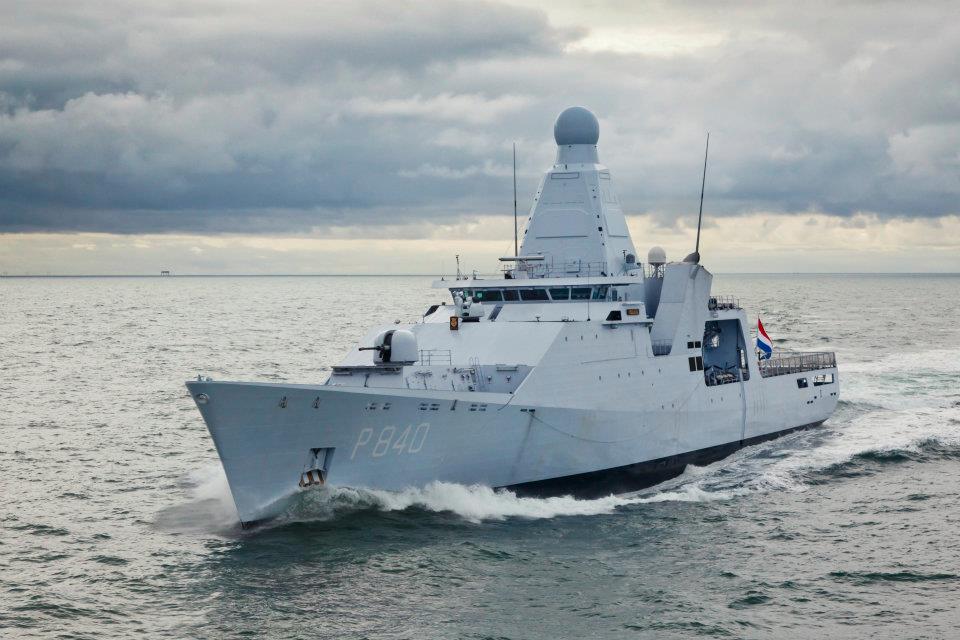
File:HNLMS Holland.jpg
Photo credit: DelamontagneNL, via Wikipedia, Zeeland’s sistership HNLMS Holland
Putting Law Enforcement Detachments on foreign ships is now relatively routine, but a reader (thanks Gils) has informed me of a new level of cooperation. “HNLMS Zeeland, one the new Dutch (Holland class–Chuck) OPVs, left for the Dutch Caribbean yesterday. They will first go to Key West to pick up a USCG helicopter.
Additionally he tells me, “On January 11 the Facebook page of the Dutch MoD in the Caribbean & Caribbean Coast Guard (section) posted the following text: Yesterday a formal agreement has been agreed upon between the United States and the Netherlands to station helicopters from the U.S. Coast Guard on Dutch ships engaged in counter-narcotics operations.  The ultimate form of cooperation for safety on and from the sea!”
The Holland class are a new class of relatively large OPVs. At 3,750 tons full load they are sized between the Hamilton class and the Bertholfs. Zeeland was commissioned only last year. Deliveries of new NH90 NATO frigate helicopters to the Netherlands Navy have been delayed, this explains the need for a Coast Guard helicopter.

New Chinese Cutters–How Many?–Sorry, I’ve Lost Count

The China Defense Blog has three new posts with several photos of new Chinese Coast Guard Cutters.

The first is news of the award of a contract for four new 5,000 ton cutters. and while the text says they will be similar to an earlier 5,000 ton cutter (CMS01), the illustration that accompanies the story shows a very different ship, in many ways similar to the National Security Cutter. It appears there is a medium caliber gun on the bow. (This would be a significant but not unexpected change for the Chinese Coast Guard.) There is a frame over what appears to be a stern ramp not unlike that on the NSC. The hull shape also appears similar to the NSC.

The second post reports the commissioning of the second of two 4,000 cutters commissioned this month.

A third post asks, “What would a 12,000 ton Coast Guard Cutter Look Like?” reports as was reported here earlier, China’s intention to build the world’s largest Offshore Patrol Vessel. They don’t have any illustration of the new ship, but they do say it will have a 76mm gun, two 30mm, facilities to support two Z-8 helicopters, and a top speed of 25 knots.The size of the helicopters is notable. The Z-8 is a large, three engine, 13,000 kg helicopter based on the Aérospatiale SA 321 Super Frelon. The transport version of this helicopter can transport 38 equipped troops. The same airframe is also used for SAR, ASW, and vertical replenishment. The post also says it shows photos of new 3,000 ton cutters, but all the photos except those of hull number 3306 were referred to elsewhere as 4,000 ton cutters.

New hull numbers seen in this series of posts are 1401, 2401, 3401, 3306, and MSA-01). Unlike most earlier Chinese cutters, all of these ships have helicopter decks.

This is the fruition of their earlier stated ambition to build 36 cutters in three years for the Chinese Maritime Surveillance Agency (CMS, only one of four agencies that combined to form their Coast Guard).

Chinese to Build World’s Largest Cutter

File:JapanCoastGuard Shikishima.jpg
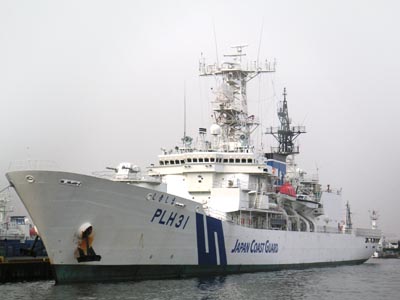
Japanese Coast Guard Cutter Shikishima, this class of two are currently the largest offshore patrol vessels in the world. Photo from Japanese Wikipedia; ja:ファイル:JapanCoastGuard Shikishima.jpg

German Navy blog “Marine Forum” reports (21 January) that the

China Ship-building Industry Corporation has been contracted with developing and building a 10,000-ton and another 4,000-ton surveillance ship.
(rmks: for paramilitary China Coast Guard or China Marine Surveillance)

Meanwhile, in a move designed to bolster their claims in the South China Sea, they also report,

With Vietnam: China will expand paramilitary infrastructure at Sansha City (Paracel Archipelago) in the South China Sea … permanently base a 5,000-ts patrol ship (rmks: prob. China Marine Surveillance – CMS) and begin regular patrols.

Don’t expect China’s new 10,000 ton cutter to look like a US Coast Guard Cutter. The Chinese seem to measure their Coast Guard primarily in comparison to the Japanese Coast Guard which has until now operated the largest cutters in the world, two 9,350 full load, Shikishima class high endurance helicopter carrying cutters. Like their Japanese counterparts, they are likely to be built to merchant standards, will be only lightly armed, but will have excellent aviation facilities. The additional tonnage is likely to give them an advantage if they get in a “shoving match” with opposing coast guards, and they are likely to have a secondary military transport role. With a relatively large number of boats, they could probably land a fair number of personnel in a relatively short time. By way of comparison the National Security Cutters are 4,500 tons full load.

Honoring More CG Heroes–Naming Ten More Cutters

File:Proposed modification to the Damen Stan patrol vessel for the USCG.jpg

US Coast Guard Illustration

As names were announced for the first fourteen Webber class Fast Response Cutters, the official USCG blog, “Coast Guard Compass” gave a short description of the service of the enlisted heroes these ships were named for. (You can find links to these fourteen posts here.)

Now ten more names have been selected and Coast Guard Compass is again posting descriptions of their service. The first five are:

Coast Guard to help the Forrest Service–Fire Aviation

Fire Aviation is reporting an interesting wrinkle in the story of the transfer of Coast Guard C-130s to the Forrest Service,

“We were surprised to hear from Mrs. Jones (a Public Affairs Specialist for the Forest Service at the National Interagency Fire Center-Chuck) …that a joint U.S. Coast Guard and U.S. Forest Service program office will provide logistics, operations, training, maintenance, and support for the C-130H aircraft. The Coast Guard has been managing a fleet of C-130s since 1959, using them for long range search and rescue, drug interdiction, illegal migrant patrols, homeland security, and logistics. They have 24 older C-130Hs which are being upgraded with new center wing boxes and cockpit equipment with new multi-function displays. In 2008 they began replacing some of the C-130Hs with new C-130Js; they have six now with three more on order. All these numbers were valid before the Coast Guard agreed to send seven C-130Hs to the USFS if the Coast Guard could get the 14 almost new C-27J aircraft from the military that had been earmarked for the Forest Service.”