“U.S. Coast Guard authenticates keel for offshore patrol cutter Pickering” –News Release

USCGC Pickering Artist rendering starboard quarter. Credit: Austal

Below is a Coast Guard news release. Good to see progress on the Austal portion of the OPC program.


Dec. 9, 2025

U.S. Coast Guard authenticates keel for offshore patrol cutter Pickering

WASHINGTON — The Coast Guard authenticated the keel for the future Coast Guard Cutter Pickering during a ceremony Monday in Mobile, Alabama.

Keel authentication is a time-honored shipbuilding tradition marking the formal start of a vessel’s construction. During the ceremony, the sponsor’s initials are applied to a ceremonial keel plate that will be installed on the cutter, symbolically indicating the keel is “truly and fairly laid.”

Adm. Kevin Lunday, acting commandant of the Coast Guard, attended the event along with Rep. Mike Ezell of Mississippi, chairman of the House Transportation and Infrastructure Subcommittee on Coast Guard and Maritime Transportation; Michelle Kruger, president of Austal USA; and more than 100 guests.

“This event highlights the progress made towards delivering this much-needed asset to the nation,” said Rear Adm. Chad Jacoby, deputy commandant for systems and chief acquisition executive. “With OPC design and modeling activities fully complete and production underway, we are gaining speed towards recapitalization of our medium endurance fleet.”

Ravi Khamsourin, an advanced welder with Austal USA, placed the initials of the sponsor, Dr. Meghan Pickering Seymour, on the ceremonial keel plate. Pickering Seymour is Pickering’s great-great-great-great-great-granddaughter.

Pickering is named after a revenue cutter built in 1798 that bore the same name. The vessel was named in honor of Timothy Pickering, the second secretary of war. Pickering fought in the American Revolution as a colonel and served as adjutant general of Gen. George Washington’s army in 1777. He later served as secretary of state, a U.S. senator and a member of the House of Representatives from Massachusetts. He advocated for construction of the first frigates built to enforce tariff and trade laws and prevent smuggling.

Pickering will be the third Coast Guard vessel to carry the name. In addition to the original revenue cutter Pickering, the Coast Guard operated a concrete-hull floating base bearing the name Pickering during the 1920s.

The OPC acquisition program addresses the Coast Guard’s long-term need for cutters capable of deploying independently or as part of task groups. The cutters provide essential capability for the Coast Guard to control, secure and defend U.S. borders and maritime approaches, facilitate maritime commerce vital to economic security and strategic mobility, and respond to contingencies. Acquisition of 25 OPCs will complement the service’s national security cutters, fast response cutters and polar security cutters as part of the Department of Homeland Security’s layered security strategy.

Delivery of Pickering is scheduled for 2027.

Some Background on the OPC Program and the Cutter X Alternative

Below is my input to a discussion among my classmates. It is mostly history, but hopefully useful. As I was preparing this, I was struck by the realization that when the Crew Rotation Concept was thrown out, it should have resulted in a complete revision of our program of record.

When the program of record began, it was to replace 12 WHECs, 32 WMECs, and 49 WPBs, a total of 93 vessels with 8 NSCs, 25 OPCs, and 58 FRCs, a total of 91 vessels. 

 
This plan also assumed the NSCs and OPC would use the Crew Rotation Concept that would have theoretically provided about a third more underway days than conventionally crewed cutters.
 
The Crew Rotation Concept was ultimately discarded, taking with it about 1980 underway ship days or eleven ship years.
 
This was partially offset by adding NSCs #9 and #10, but we are still getting the equivalent of nine large patrol cutters less than originally planned.
Coast Guard missions seem to be expanding. This has been partially addressed by building more FRCs than originally planned. The FRCs have exceeded our expectations and we are planning to have 77 of them, but we are still looking at only 35 large patrol cutters, 10 NSCs and 25 OPCs. I don’t think that is enough.
The Coast Guard has been describing the OPCs this way, The OPC will provide a capability bridge between the national security cutter, which patrols the open ocean in the most demanding maritime environments, and the fast response cutter, which serves closer to shore.”
 
That is not really true. The OPC and the NSC are virtually the same size. The OPC may be intended to replace the MECs, but in fact it is 1250 tons larger than the Hamilton class WHECs and 2.5 times the size of a WMEC270. The OPC will also have a crew almost the size of that of the NSC. With a range of over 10,000 nautical miles they are high endurance cutters. 
 
In 2012 the OPCs were expected to cost about half of what an NSC cost, now the costs to build and operate are approaching that of an NSC. 
Since 2012 I have been suggesting that we could meet the need for more large cutters by building a true medium endurance cutter by basically putting the crew and equipment of a FRC in a large hull (at least 80 meters/262 feet) and trading off some OPCs and FRCs for these medium size ships. https://chuckhillscgblog.net/2012/10/12/the-dhs-cutter-study-trade-offs-and-the-case-for-cutter-x/
Two years later I did a revised look. https://chuckhillscgblog.net/2014/09/28/cutter-x-revisited/ and along the way, I pointed out several ships that could fill the Cutter X role. Actually they just seem to be the typical Offshore Patrol Vessel.
The Japanese are building a class that reflects the Cutter X ideas, a relatively large ship, 312 feet in length, about half the displacement of the OPCs, with a crew of only 30. https://chuckhillscgblog.net/2025/11/14/offshore-patrol-vessels-for-the-japanese-maritime-self-defense-force-launched/
Since the geopolitical situation has changed and war with China looks more likely I have begun to think we should start building cutters that are more immediately useful in the event of war.
Congress has been telling the Navy they need to look at building Corvettes to bulk up their numbers and the next Navy league magazine is supposed to have a story about the proposal. Assuming these are ASW capable corvettes, this might be a class that could be built as a dual service ship, serving in both the Navy and Coast Guard.

Austal Launches First Steel Ship / Good News for OPC Program?

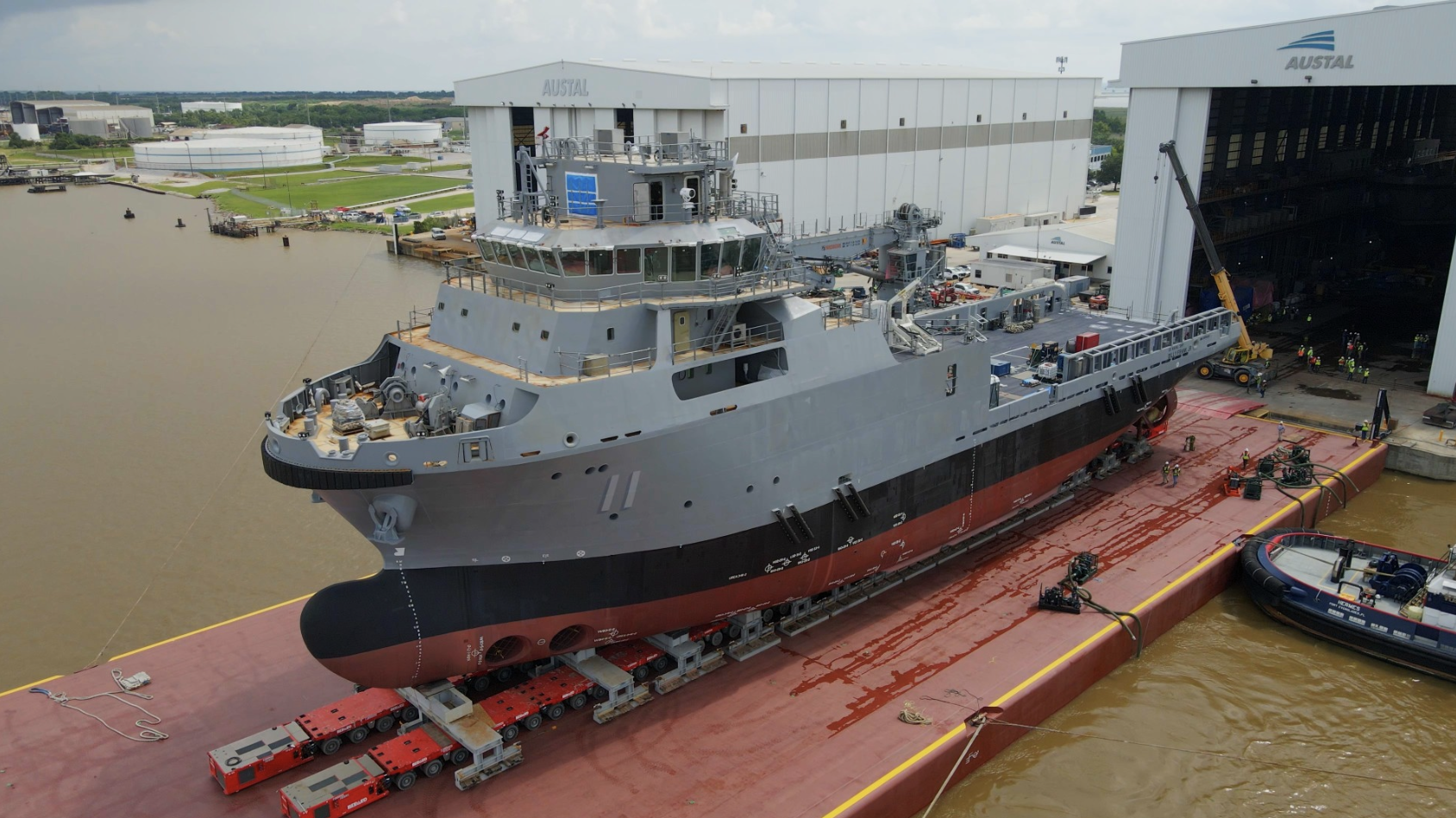
Future USNS Billy Frank Jr. (T-ATS 11), June 2025

Below is an Austal USA news release,

Hopefully, this success suggests the Austal portion of the Offshore Patrol Cutter program will move along faster than the Eastern portion.

This ship, the future USNS Billy Frank, Jr. is the first in the second phase of procurement of a planned class of ten. The first five were contracted to Gulf Island Fabrication. The shipyard and the contract passed to Bollinger, 19 April 2021.

Austal got their contract for up to five in October 2021 (FY2022).

These are simpler ships than the OPCs, costing less than $80M each, but their full load displacement is actually more than that of the OPCs. The rate of progress seems to bode well for the OPCs. Billy Frank was laid down 14 November 2023 and launched 14 June 2025, 17 months later.

Certainly the Independence class trimaran Littoral Combat Ships that Austal has been building for 20 years are at least as complex as the OPC, and the last one, USS Pierre (LCS-38) went from keel laying to launch in only 14 months. We can’t expect construction of the first OPC to go that quickly, but for later ships it might be possible.

Two of the Bollinger ships are reportedly completed, but I have seen no indication they are  in service yet. The first took 41 months from laid down to launch, the second took 52 months to reach the same milestones. The third and fourth Bollinger built ships had keels laid in 2022 but have yet to be launched.

But were they late?:

It appears that the Austal contract actually anticipated faster delivery than we are seeing.

“The projected delivery for T-ATS 11 is in early FY 2025, with one more ship delivering in FY 2025, and two ships delivering in FY 2026.”

The Bollinger contract anticipated a slower delivery,

“The projected delivery for T-ATS 6 is in FY 2026, with follow-on Bollinger ships delivering each subsequent FY.”

Offshore Patrol Cutters: 

Austal got the Phase II contract for up to eleven OPCs in June 2022 and began building their first OPC in late August 2024. With Austal completing their last LCS, I hope to see rapid progress on OPCs #5-15.


JUNE 18, 2025

AUSTAL USA LAUNCHES FIRST STEEL SHIP FUTURE USNS BILLY FRANK JR. (T-ATS 11)

MOBILE, Ala. – Austal USA successfully launched the company’s first steel ship, the future USNS Billy Frank Jr. (T-ATS 11), on June 14.  Named after a native American Korean War veteran who, as an activist, fought for justice and environmental preservation in the Northwest United States, Billy Frank Jr. is a Navy Towing, Salvage and Rescue Ship – one of 3 under construction at Austal USA and the first steel product of the company’s state-of-the-art automated steel panel line.

“It was amazing to see the flawless rollout of our first steel ship,” said Harley Combs, vice president of surface ship programs. “The completion of this milestone is the result of the hard work and dedication of our talented workforce.  I am so proud of all they have accomplished.”

At 3,100 metric tons, T-ATS 11 is the heaviest ship Austal USA has launched to date. The launch was executed using the proven process used to launch most of the 32 Navy ships the company has built and delivered to the Navy over the last 15 years.

T-ATS will provide ocean-going towing, salvage and rescue capabilities to support fleet operations. T-ATS will be a multi-mission common hull platform capable of towing U.S. Navy ships and will have 6,000 square feet of deck space for embarked systems. The large, unobstructed deck allows for the embarkation of a variety of stand-alone and interchangeable systems. The T-ATS platform will combine the capabilities of the retiring Rescue and Salvage Ship (T-ARS 50) and Fleet Ocean Tug (T-ATF 166) platforms. T-ATS will be able to support current missions including towing, salvage, rescue, oil spill response, humanitarian assistance, and wide-area search and surveillance. The platform also enables future rapid capability initiatives such as supporting modular payloads with hotel services and appropriate interfaces.

With the ship over 85 percent complete at the time of launch, the future USNS Billy Frank Jr. will now prepare for her next major milestone, engine light off, as she gets ready for sea trials and delivery.

“USCG Polar Security Cutter Program Offers DOGE An Easy ‘Win’”–Forbes

Forbes’ always perceptive Craig Hooper takes a look at the Polar Security Cutter program and finds it ripe for cancellation, “years late, wildly over-budget, and both the budget and the schedule are at risk of slipping even further into the red…”

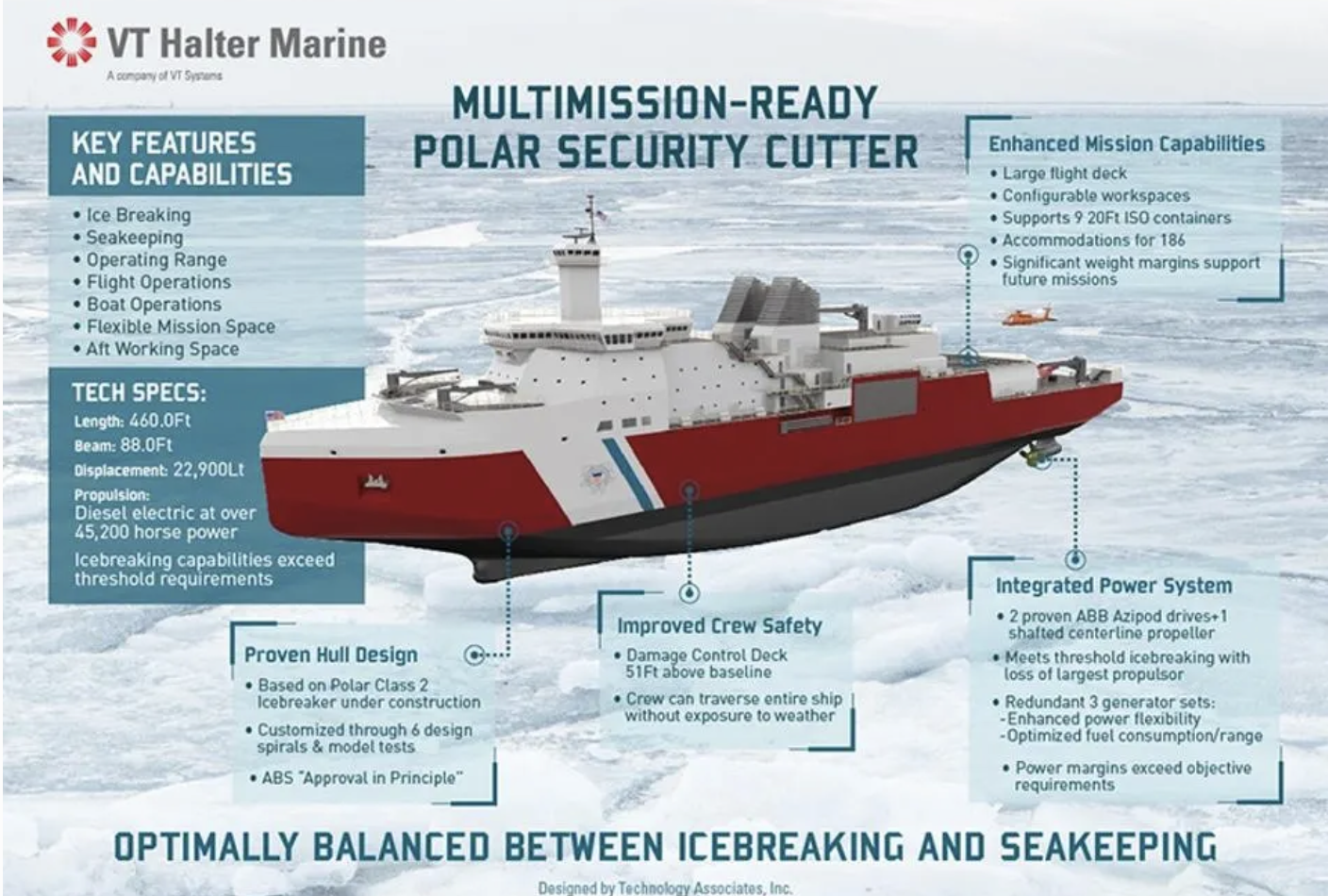
I still want to know who decided that the Coast Guard should award this critically important contract to a relatively inexperienced and less than fully successful shipyard even though they had failed to offer a proven design as had been required by the original solicitation and apparently repeatedly lied that the design was building (See the graphic from VT Halter above, “Proven Hull Design”).

I don’t know enough to agree that the Polar Security Cutter contract should be cancelled, but I do think Hooper would agree that it is time to start procurement of the Medium Icebreakers we know we need, even if the first is to be built in a foreign yard.

Given his comments on the Offshore Patrol Cutter (OPC) program in the same article, I think he might also agree that the Coast Guard should be looking at an alternate design for a medium endurance cutter replacement to be built in lieu of at least some of the planned OPCs.

The first OPC has yet to be delivered, and the costs are likely to increase. If the PSC aligns with the OPC’s ugly performance trends, starting PSC construction with this amount of design uncertainty puts the Coast Guard at real risk of an even bigger fiasco…Sadly, these Coast Guard tastemakers don’t reflect that the building rate–as it is now–appears unable to meet the positively glacial building pace set by years-late and massively over-budget Offshore Patrol Cutter.

Thanks to Paul for bringing this to my attention. 

“Bulgaria’s Second MMPV Launched by Local Shipyard” –Naval News

Naval News reports,

The second of two MMPVs (Multipurpose Modular Patrol Vessels–Chuck) was launched ahead of schedule. According to the contract, it was supposed to take place in April 2025. The two MMPVs are being built under a contract signed November 12, 2020 between the Bulgarian Ministry of Defence and the German shipbuilding group Fr. Lürssen Werft (now NVL – Naval Vessels Lürssen). The vessels will cost about BGN 984 million gross (about EUR 503 million).

These are a significant step up from the earlier Lürssen designed 80-meter Darussalam class built in Germany for the Royal Brunei Navy and the Arafura class building in Australia.

They are to be equipped with two twin launchers for RBS15 Mk3 anti-ship missiles, 8 cells for MBDA VL MICA surface to air missiles, Leonardo OTO Super Rapid 76mm gun, Rheinmetall Millennium 35mm CIWS, and 324mm light weight ASW torpedoes. They will have a SAAB combat management system and a hangar for a Eurocopter AS565MB Panther helicopter, an aircraft that is an evolution of the H-65 design.

Specifications indicate:

  • Displacement: 2,300 tons
  • Length: 90 meters (295′)
  • Beam: 13.5 meters (44.3′)
  • Max Speed: variously reported as 20 to 24 knots
  • Range: 3000 nautical miles at 14 knots.
  • Crew: 70

These ships remind me very much of the new Damen designed Pakistani 2,600 ton, 98 meter OPVs. The layout is much the same:

  • Gun and VLS AAW system forward of the bridge elevated above the main deck
  • Anti-ship cruise missiles behind the bridge
  • Uptakes
  • Hangar with a 35mm CIWS mounted on the roof
  • Flight deck that extends all the way to the stern
  • Reconfigurable space below the flight deck.

Reconfigurable space is becoming common but what really sets these two classes apart from other OPVs is the VLS launchers for small surface to air missiles. On the slightly larger Pakistani ships, which appear more capable, the missile is a bit larger and the gun smaller. The Pakistani ship also has a pair of 30mm guns similar to the Mk38 Mod4.

I think we are going to start seeing this general layout on more OPVs in the future.

Given the need for more than the currently planned 36 large cutters, and the increasingly hostile geopolitical environment, building something like these smaller, cheaper, but more combat capable ships, in greater numbers, rather than the last ten planned OPCs might be worth considering.

I would suggest we could build a cutter with configurable space sufficient to support a towed array, a flight deck, hangar, and magazines sufficient to support an MH-60R, eight Mk41 VLS (sufficient for16 ESSMs and four vertical launch ASROCs) forward of the bridge. Launchers for up to eight Naval Strike Missiles (we don’t need to carry the missiles themselves all the time), SeaRAM, and one or two 30mm Mk38 Mod4s. This should all be possible on a 25 knot ship of less than 3000 tons.

“Austal USA Cuts Steel on Yard’s First Offshore Patrol Cutter, First OPC Argus to Sail in Winter” -USNI

Future USCGC Pickering (Image: Austal USA)

The US Naval Institute news service reports Austal has begun to cut steel for the future USCGC Pickering, the first of eleven Offshore Patrol Cutters contracted to be built by Austal if all options are exercised.

The first four OPCs (915-918) are being built by Eastern. Rear Admiral Campbell, Acquisitions Directorate (CG-9), went on to say of Argus (915) the first of the four, “Dock trails start probably in January and get underway in the early spring and the acceptance trails in [the] third quarter of [Fiscal Year 2025],”

It will be interesting to see if the fourth Eastern OPC (918) is actually delivered before the first Austal OPC (919).

Below is the Acquisitions Directorate’s news release about the event.


Production begins for the Coast Guard’s fifth offshore patrol cutter

The Coast Guard joined Austal USA on Aug. 29 at the contractor’s facility located in Mobile, Alabama, to mark the start of production of the fifth Offshore Patrol Cutter (OPC), Coast Guard Cutter Pickering. Pickering is the first of up to 11 cutters that will be delivered to the Coast Guard through the Stage 2 contract with Austal USA and the fifth OPC to enter production.

Pickering is named after a Revenue Cutter of the same name, built in 1798. That vessel was named in honor of the second Secretary of War, Timothy Pickering. Pickering, who later served as Secretary of State before becoming a U.S. senator and member of the House of Representatives from Massachusetts, advocated for and oversaw the construction of the first frigates built to enforce tariff and trade laws and to prevent smuggling. The cutter is the third Coast Guard vessel to carry the Pickering name. In addition to the Revenue Cutter Pickering, the Coast Guard operated a concrete-hull floating base in the 1920s. The newest addition to the Pickering legacy is expected to be delivered to the Coast Guard in late 2027.

OPCs play an important role in addressing the Coast Guard’s long-term need for cutters that can deploy independently or part as a task group. The OPC will provide a capability bridge between the national security cutter, which patrols the open ocean in the most demanding maritime environments, and the fast response cutter, which serves closer to shore. The ships will feature state-of-the-market technology and will replace the service’s 270-foot and 210-foot medium endurance cutters, which are becoming increasingly expensive to maintain and operate. OPCs are a part of the Department of Homeland Security’s layered security strategy, performing a variety of missions such as responding to disasters, rescuing mariners, performing drug interdictions, uncovering smuggling activities and enforcing fisheries laws.

For more information, visit the Offshore Patrol Cutter Program page.

“Q&A: Vice Admiral Andrew J. Tiongson, Commander, Pacific Area and Commander, Defense Force West, U.S. Coast Guard” –Seapower

Tiongson speaks at a press conference before the crew of the Coast Guard Cutter Waesche offloads 18,219 pounds of cocaine, worth more than $239 million, on Dec. 6, 2023. U.S. Coast Guard

The Navy League’s on-line magazine, Seapower, has an interview with the Pacific Area Commander. There is a lot of good information here.

HC-130Js (and C-27Js):

CGAS Sacramento will “transition” to HC-130Js. Pacific Area certainly needs the long range aircraft because, while 84% of the US EEZ is in Pacific Area they have only three fixed wing air stations (Kodiak, Barbers Point, and Sacramento) while Atlantic Area has five fixed wing air stations to cover only 16% of the US EEZ.

What will happen to the C-27Js? No mention was made of these. They might go to Guam. That would be helpful in providing fixed wing search aircraft in the Western Pacific. Recently there was a SAR case in the Western Pacific. A C-130 was dispatched from Barbers Point, but the flight was so long the crew needed a day’s rest before the aircraft could be used in the search. On the other hand, Guam might not be an optimal location since it is so far West. There are other options.

Fast Response Cutters:

As I read the statement, the intention is to have a total of six FRCs in Guam and add a fourth in Hawaii.

His discussion about these little ships clearly indicates that their nominal five-day endurance (same as the preceding 110 foot WPBs) is being exceeded regularly.

“The FRCs, first off, are game changers for the Coast Guard in general. Back in the day, we had patrol boats that were limited in terms of the sea states they could handle, the food that they could carry, the number of crew members and certainly their duration at sea. The FRCs have changed that.”

Six WPCs in the same port is not unusual. District 7 has three different ports, each homeport to six or seven Webber class, but this may be a move toward replicating a PATFORSWA type organization to support 7th Fleet in the Western Pacific.

Large Patrol Cutters:

There was a brief discussion of the Offshore Patrol Cutters, but no indication of when they are expected to arrive in PACAREA.

A second “Harriet Lane or Indo-Pacific support cutter” is on PACAREA’s unfunded priority list. For some reason, I think this may happen.

Commercial Icebreaker Procurement:

Plans for the commercial icebreaker (Aiviq) were discussed. It will be homeported in Juneau, as reported here in March, but still has not been purchased and it will take two years to complete changes to make it fully operational.

The admiral was asked, “Is the commercial icebreaker going to be crewed by Coast Guardsmen or by a contract crew?” and there was no definitive answer. Should the Coast Guard adopt a hybrid crew, as has been done by some Navy vessels it would be a major change in Coast Guard policy.

The Eastern Pacific Drug Transit Zone: 

Atlantic Area cutters are not assisting in Eastern Pacific drug transit zone interdiction efforts, as they normally would, because they are heavily engaged in migrant interdiction operations.

Trusted Partner:

The Area Commander talked a lot about what being a trusted partner meant, about partnerships with Asian coast guards, and the outsized effect of having a few good people in liaison positions.

The Félix Éboué class, a Modern, Minimalist, Medium Endurance Cutter

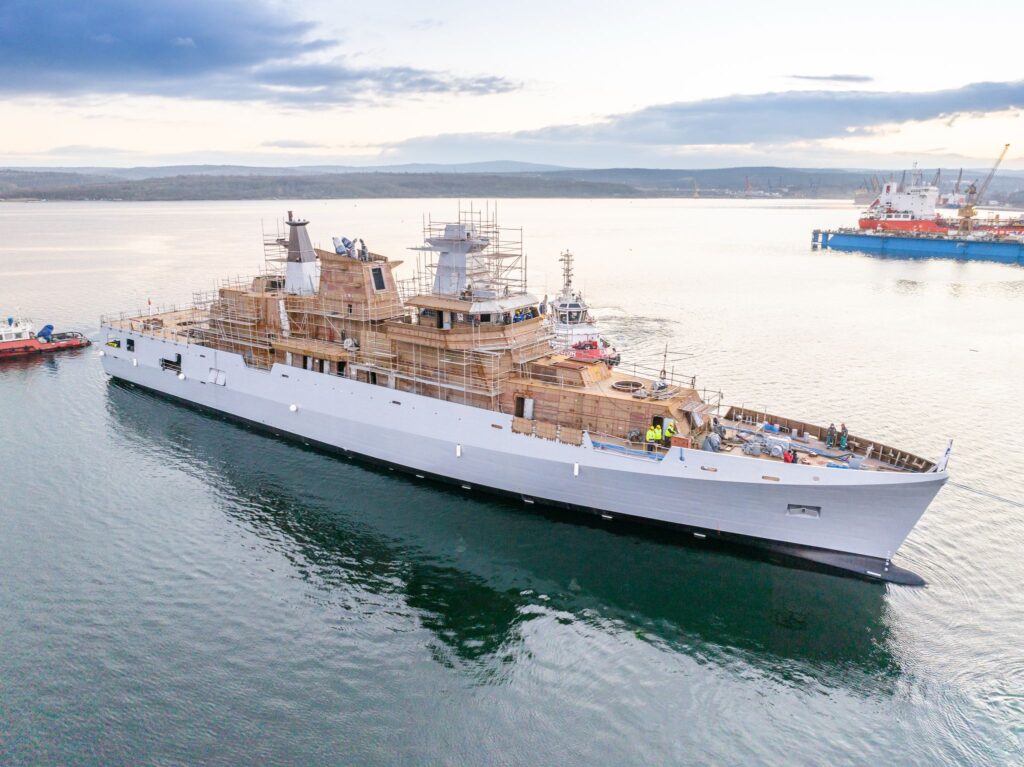
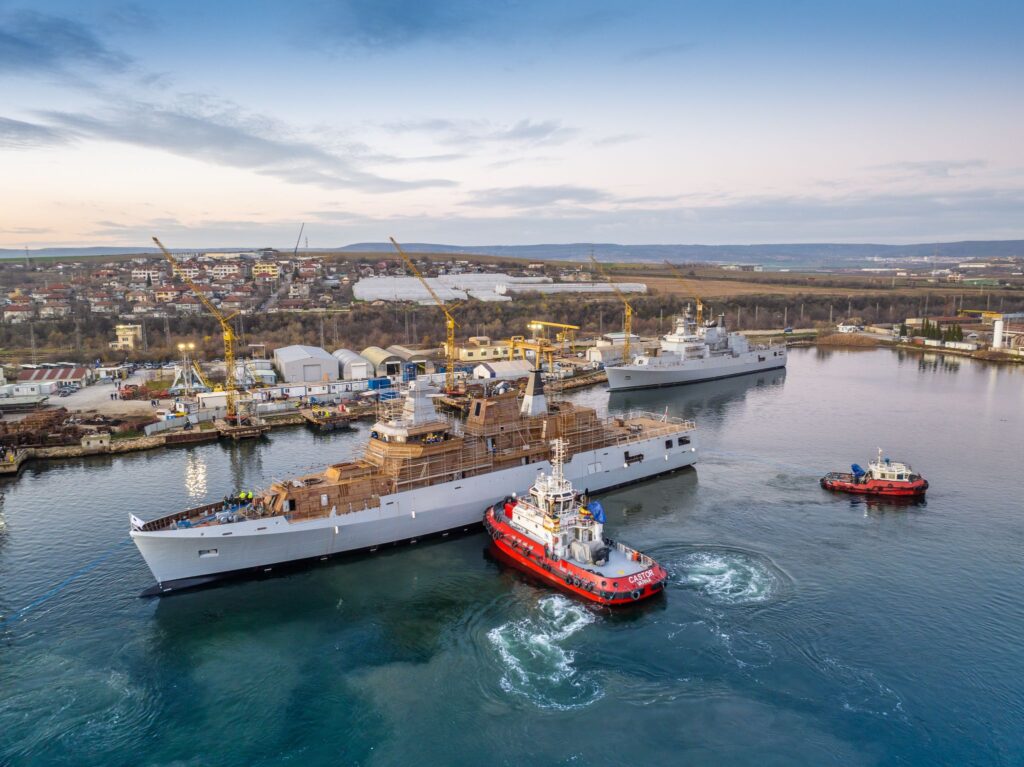
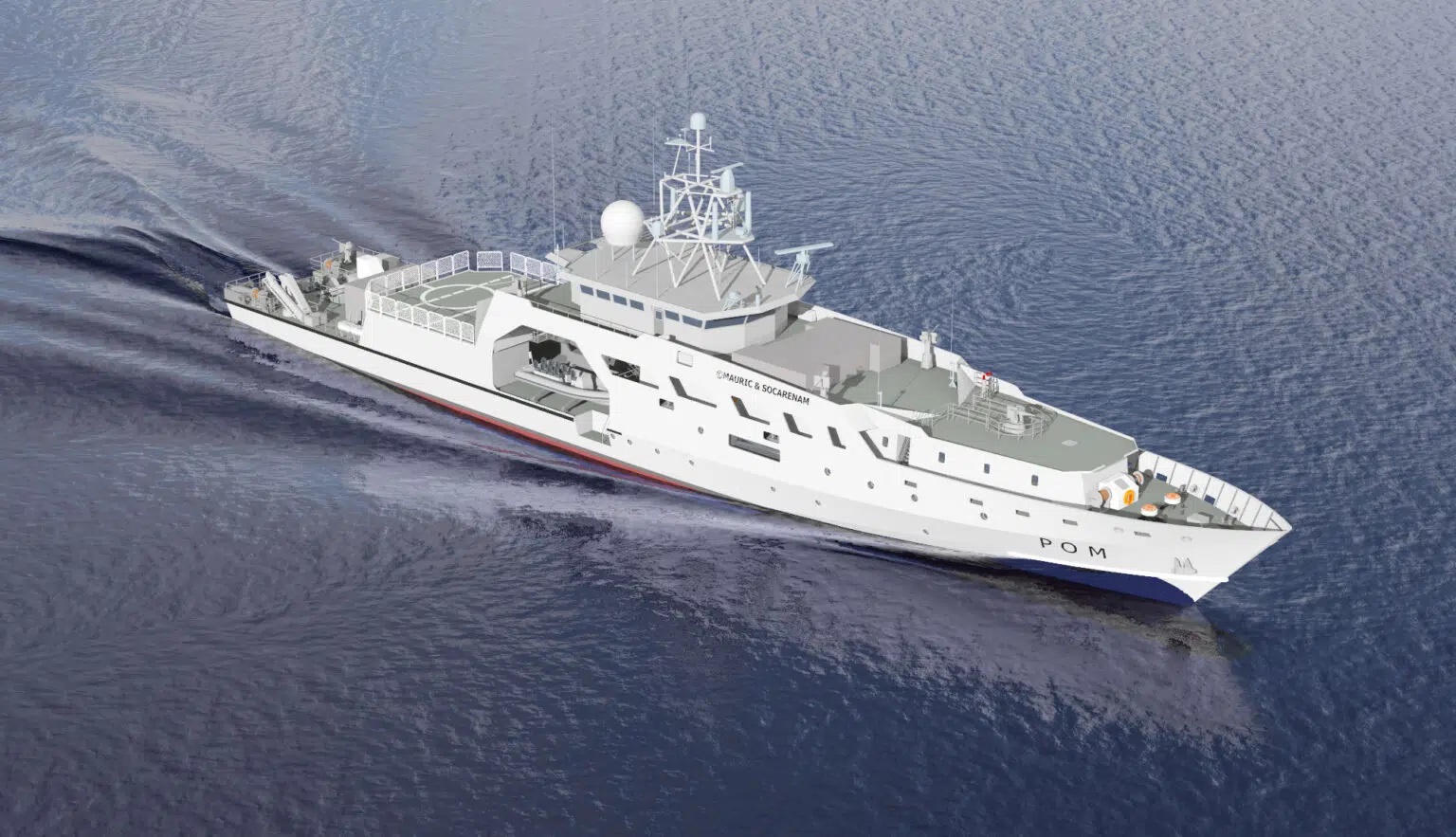
An artist’s rendering, Félix Éboué class or Patrouilleurs Outre-mer (POM)

The Offshore Patrol Cutter (OPC) is described as, “…a capability bridge between the national security cutter, which patrols the open ocean in the most demanding maritime environments, and the fast response cutter, which serves closer to shore.”

That may have been the intention, but that is not what we got.

While the National Security Cutter is better than the WHECs they replaced in almost every way, the OPCs are not only better than the WMECs they will replace, but they are also, in every way except maximum speed, better than the WHECs as well. Instead of a high/low mix of cutters, they all turned out high end. We should not be surprised the OPCs construction and operating costs approach those of the NSCs.

Construction costs are typically proportional to displacement. The OPCs’ displacement is 98% that of the NSC and 1232.8% (more than 12 times) that of the Fast Response Cutters.

This would not be a bad thing, if we had enough NSCs and OPCs to meet our large patrol cutter needs, but I don’t think we will ever get there.

We are expected to ultimately end up with only 36 large patrol cutters, fewer than we have had in decades and fewer than other Coast Guards with far smaller EEZs.

A new fleet mix study has been completed, but the results have not been made public (Why not? This is not transparency). I suspect it shows a need for substantially more than 36 large patrol cutters.

If we look at the previous “Fleet Mix Study,” now over a dozen years old, which minimized requirements because it did not consider “High Latitude regions of the ice shelf and Deployable Operations Group (DOG),” and assumed that NSCs would use the “Crew Rotation Concept” that was expected to allow them to operate 230 days per year, to meet all statutory requirements, the study indicated the Coast Guard needed 66 large cutters, 30 more than currently planned, and 91 FRCs.

If we want significantly more large patrol cutters than currently planned, perhaps we need a smaller, cheaper alternative to the OPCs that requires a smaller crew and are more economical to operate. In previous posts, I have referred to this alternative as (Cutter X).

Thinking Ahead: 

Getting funding for more than two OPCs per year is probably unrealistic. The last OPC is not expected to be commissioned until 2038, 14 years from now. If we continue to build only two large patrol cutter a year, will not be able to grow the fleet until after 2038 and then it will grow slowly because the National Security Cutters will start aging out.

We might not be able to continue to build OPC sized patrol cutter after 2038. The Coast Guard will want to build Arctic Security Cutters (or perhaps Arctic Patrol Cutters). Both the Juniper class WLBs and Keeper class WLMs will need to be replaced.

(Where is our long-range shipbuilding plan?)

If we started in the next year of two, we could be producing true medium endurance cutters in significant numbers before the planned completion of the OPC program. On a 3 for 1 or even 2 for 1 exchange for the last few OPCs, if we tried, we could start to grow the fleet perhaps as early as 2032.

That is why the Félix Éboué class is worth a look. It is, what I believe may be, the absolute minimum fully capable Offshore Patrol Vessel. It covers all the bases. It is good enough for most operating areas. That is not to say, there are no good reasons for some add–ons, but I think it is a kind of benchmark. It is also a good representation of Cutter X. There are reasons we might want to go bigger, but before you increase the quality of the individual cutters, first we need to have enough.


The French Experience

France, like the US has a huge Exclusive Economic Zone (EEZ), the largest in the world, 11,691,000 km2 (4,514,000 sq mi). The US EEZ is 11,351,000 km2.

Unlike the US, the French don’t have a coast guard that operates ocean going ships to enforce laws and protect sovereignty. The French Navy does this, and uses a fleet of Offshore Patrol Vessels, some of which are referred to as frigates.

The Félix Éboué class is their newest class of OPVs. They are intended specifically to patrol the waters of French overseas territories in the Pacific and Indian Oceans. They will be based, two each, at NouméaTahiti and La Réunion. They replace the P400 class, which are slightly larger than the Webber class WPC, which were found to be inadequate.

I have found some very good photos of the second ship of the class being fitted out, that show details I had not seen before, and would like to share them. I will also bring forward some of my earlier commentary with updates, so as to consolidate information on this interesting class.

Comparison with Webber class WPC (FRC):

Below is a comparison between the FRC and the Félix Éboué class (POM) that was included in an earlier post, updated with information about the propulsion system on the French ships.

French overseas patrol vessel (POMs) Auguste Bénébig. Photo: http://www.meretmarine.com

Like an FRC:

I always thought these looked like oversized Webber class, the proportions are similar, and the much larger POM is not much more complicated than the Webber class. The crew of the POM is 30, only six more than that of the FRC. Both have a bridge with a 360-degree view positioned well aft, minimizing vertical acceleration. Both have an 8 meter boat in a stern ramp. The armament is similar with four .50 cal. machine guns and a single medium caliber gun in the bow, a 20mm on the POM and a 25mm on the FRC. The POM uses slightly less powerful diesel engines, 2x ABC 16V DZC medium speed diesels 3.7MW each @ 1,000rpm, for a total of about 9924 HP compared to 11,600 for the FRC. (I am told the POM’s engines are also more economical and simpler to maintain.) But the French ships still manage to make 24 knots, a couple of knots more than claimed for the OPC. With similar crew and systems, they should not cost much more than the FRCs to operate.

Unlike an FRC:
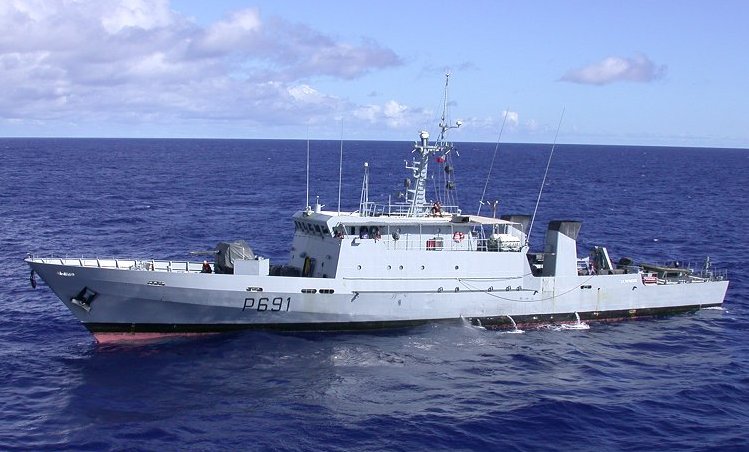
P400 patrol ship Tapageuse at sea near Tahiti (18 June 2003). Photographer: Jean-Michel Roche

While they would have been thinking of their existing 373 ton P400 class pictured above, it might appear to us that they wanted a ship to do the same sorts of missions the Webber class Fast Response cutters (FRC) are doing out of Guam, but they recognized that these ships would be far from any major naval base and that they would need to travel great distances and would be exposed to extreme weather conditions, so they needed to be larger (1300 tons vs 353 tons for the FRC) and have greater range (5500 miles vs 2500) and endurance (30 days vs 5 days).

Having chosen a larger hull, they took advantage of the greater volume and deck space to add a second RHIB, a multimode radar, space for 29 passengers (roughly a platoon of Marines), a sickbay, a dive locker, space for a 20 foot containerized mission module, a flight deck and hangar for a 700-kilogram-class rotor-blade drone (not yet deployed), and a holding area for up to six prisoners.

Some sources also indicate the French ships also have electric motors that would allow them to cruise on the ship’s service generators and secure the main propulsion engines, but I have seen no specifics.

The Photographs: 

The second of the French Navy’s six new overseas patrol vessels (POM), the Teriieroo a Teriierooiterai, which will be based in French Polynesia and has been named in tribute to a Companion of the Liberation native of this Pacific territory, Photo: http://www.meretmarine.com

The Teriieroo at Teriierooiterai fitting out at the end of July, 2023 in Boulogne. Photo: http://www.meretmarine.com

Stern ramp for 8 meter RHIB. French Navy overseas patrol vessel (POM), Teriieroo a Teriierooiterai, fitting out 2023. Photo: http://www.meretmarine.com

Second 8 meter RHIB and davit (only) on starboard side. French Navy overseas patrol vessel (POM), Teriieroo a Teriierooiterai, fitting out 2023. Photo: http://www.meretmarine.com

Aliaca aerial drone on its launch catapult. French Navy overseas patrol vessel (POM), Teriieroo a Teriierooiterai, fitting out 2023. Photo: http://www.meretmarine.com

Recovery System for Unmanned Air System, French Navy overseas patrol vessel (POM), Teriieroo a Teriierooiterai, fitting out 2023. Photo: http://www.meretmarine.com

“EASTERN SHIPBUILDING GROUP COMMENCES PHASE II OF MAJOR INFRASTRUCTURE IMPROVEMENTS” –News Release

Future USCGC Argus at launch Eastern Shipyard

Below is a news release from Eastern Shipbuilding Group. Hopefully these improvements will shorten construction times for the remaining Eastern built OPCs. It will almost certainly put Eastern in a better position to bid on the last group of OPCs which should be built at a rate of at least two completions per year.

If nothing else, any increase in US shipbuilding capabilities is good news.

Eastern has had their share of difficulties with the OPC program. Hopefully they will surprise us with increasing success on the three ships that follow the future USCGC Argus.


15 May, 2024

EASTERN SHIPBUILDING GROUP COMMENCES PHASE II OF MAJOR INFRASTRUCTURE IMPROVEMENTS

PANAMA CITY, FL – Eastern Shipbuilding Group, Inc (ESG) is proud to announce the commencement of phase two of a significant infrastructure improvement project at its Nelson Street government shipbuilding facility. This phase includes the construction of 1,000 linear feet of additional bulkhead and berthing space, installation of associated heavy weather mooring infrastructure, the extension of the launch facility by 120 feet to increase the total launch way length to over 500 feet, and the final dredging of vessel berthing spaces and the shipyard turning basin. These enhancements will significantly increase ESG’s capability to construct and deliver multiple ships per year, supporting future Department of Defense (DOD) shipbuilding goals.

“This infrastructure improvement project represents a major investment in our government shipbuilding capabilities,” said Joey D’Isernia, Chairman and CEO of ESG. “The increased capacity and shipyard enhancements will allow us to better support the Navy’s initiative to expand the shipbuilding industrial base in order to meet the demands of the national defense strategy.”

The addition of 1,000 linear feet of bulkhead will provide ESG with more berthing space to better support construction programs that require multiple vessel deliveries per year. The extension of the launch way by 120 feet will enable ESG’s Nelson Street government shipyard to accommodate larger vessels more than 500 feet, expanding its capacity to construct a variety of ships to meet the evolving needs of the U.S. Navy and other government agencies. The project is expected to be completed in the summer of 2025.

ESG is known for its expertise in designing and constructing a wide range of complex vessels, including U.S. Coast Guard Offshore Patrol Cutters, the newest U.S. Army Corps of Engineers Medium Class Hopper Dredge, fully automated multipurpose offshore support vessels, and the most technologically advanced modern factory trawlers. The expanded capacity resulting from this infrastructure improvement project will further strengthen ESG’s position as a leader in the shipbuilding industry.

“Kongsberg Maritime to supply Promas propulsion systems for the United States Coast Guard’s new Offshore Patrol Cutter programme” –Kongsberg Maritime

Below is a news release from Kongsberg Maritime. This will maintain continuity with the four ships being built by Eastern.


Kongsberg Maritime has been selected by Austal USA to supply its Promas propulsion system to the latest ship in the United States Coast Guard’s new Offshore Patrol Cutter (OPC) Heritage Class programme.

This initial contract is to supply Kongsberg Maritime equipment for the fifth ship, Coast Guard Cutter Pickering, which is the first to be built by Austal USA at their yard in Mobile, Alabama.

The Coast Guard’s new OPC programme represents a significant investment in maritime capability and is expected to run up to 25 ships. The new vessels will replace the Coast Guard’s medium endurance cutters and meet the need for long-term offshore capability to maintain current and future mission effectiveness.

Promas combines rudder and controllable pitch propeller into one propulsion system which optimises the hydrodynamic properties of the ship and delivers increased efficiency and thrust while using less energy. For the OPC, as well as twin Promas, Kongsberg Maritime is contracted to supply steering gear, rudders, fin stabilisers and tunnel thrusters.

Björn ten Eicken, Kongsberg Maritime, Vice President – Naval, said: “Kongsberg Maritime has a proud history of supplying mission critical technology to United States Coast Guard programmes.

“We have supplied our propulsion systems for naval and governmental forces for more than 80 years, and we’re delighted to have developed an efficient and effective system specifically suited to the challenging and varied operations of these new ships. Our Promas systems typically deliver efficiency savings of around 6%, so vessels are able to extend their range, something which can be crucial on longer missions.

“We’re looking forward to working with the Coast Guard and Austal USA on delivering these highly-capable ships.”

The OPC vessels will be able to provide long range patrol capability. At 360 feet long, they will have a displacement of 3,700 long tons, maximum speed of 22.2 knots, and a range of 9,050 nautical miles at 14 knots.