Up-Gunning the China Coast Guard–Add 22 New Type 056 Corvettes

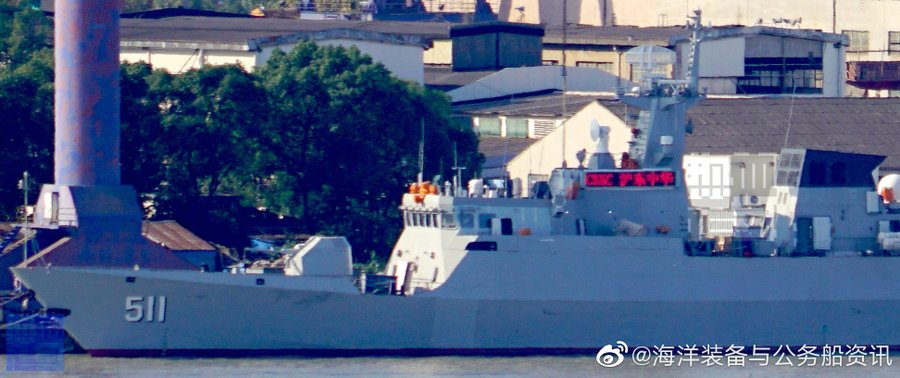
Type 056 corvette, credit 樱井千一

We have a report from Defence.PK, that 22 PLAN Type 056 corvettes are being transferred to the China Coast Guard. These ships are the early models that were completed without the more sophisticated anti-submarine warfare capabilities of the Type 056A. Rather than upgrade them, the Chinese Navy will build 22 additional Type 054A Frigates.

Reportedly they are adding a LED billboard and the missiles are being removed. Probably the torpedoes as well. But that still leaves a 120 round/minute 76 mm gun and a pair of 30mm Guns.

The China Coast Guard already has more large cutters than the US Coast Guard, despite of the fact that their EEZ is less than 20% that of the US, even if all their outrageous claims were accepted. But most of these cutters have no guns of 20mm or larger. 22 AK-176 76mm guns and 44 30mm Guns will substantially increase the China Coast Guard’s firepower.

These 1500 ton 25 knot ships are a handy size for an area like the South China Sea.

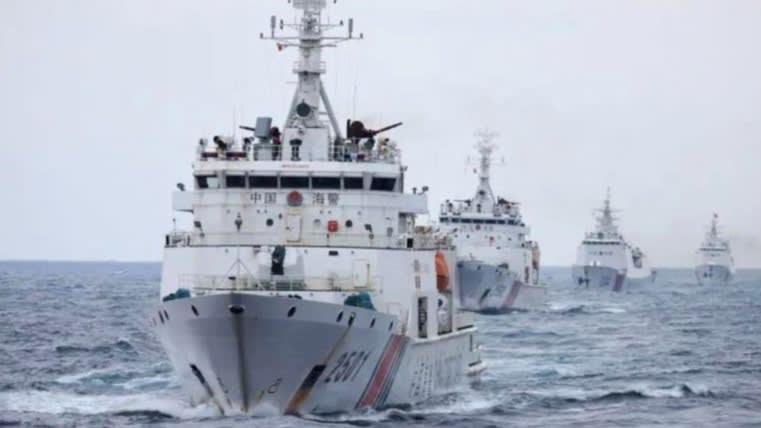
Unlike the US Coast Guard, the China Coast Guard tends to operate their cutters in groups. Three of these, snuggled up to you, at close range, could be very intimidating even to a DDG like those the US Navy uses for Freedom of Navigation Exercises. For relatively unarmed Asian Coast Guard cutters, it would be much more so.

Chinese Naval Forces don’t have a lot of naval victories in their past so the Battle of Paracel Islands, where they defeated the Vietnamese by opening fire at very close range, must assume outsized importance in their imagination.

Image

I note, the cutters China used when they recently turned back a Philippine resupply effort in the South China Sea, included at least one armed with a 76mm gun.

In case you missed it, below is a statement from the US Ambassador to the Philippines (and to China).

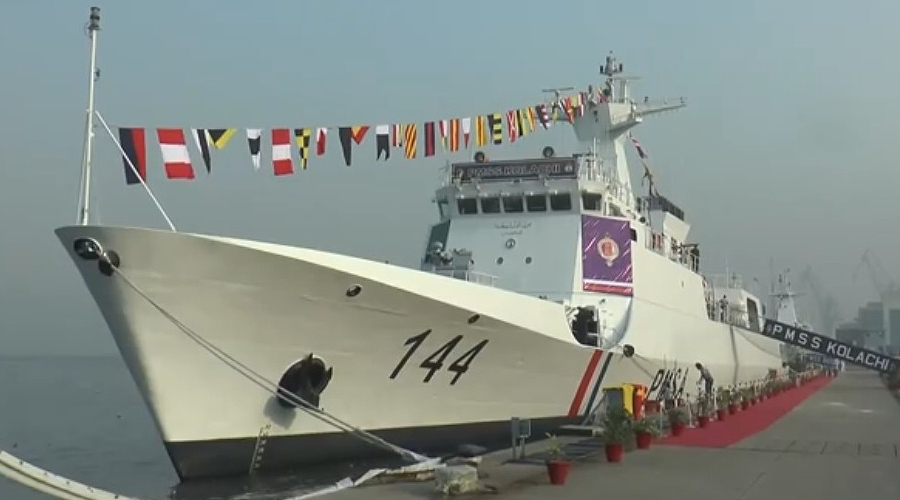
“VESSEL REVIEW | KOLACHI – NEW LARGE PATROL VESSEL FOR PAKISTAN MARITIME SECURITY AGENCY” –Baird Maritime

Photo: PMSA

Baird Maritime reports delivery of a Chinese designed Offshore Patrol Vessel to the Pakistan Maritime Security Agency (PMSA), the maritime safety and law enforcement arm of the Pakistan Navy. This second ship was reportedly built in Pakistan while the first was produced in China.

This ship may look a bit familiar. It appears to be a variant of the Type 056 corvette. 72 of the corvettes were inducted into the Chinese PLA Navy between 2013 and 2019. Variants of the class also serve with the Bangladeshi and Nigerian Navies and the China Coast Guard.

There is a Pakistani Coast Guards distinct from the PMSA, but it falls under the authority of the Pakistani Army and functions more like Customs and Border Protection and its Air and Marine Unit, being limited to operations on shore and within the 12 mile limit.

“Fincantieri To Design And Build New Multirole OPV For Italian Coast Guard” –Naval News

The future multirole offshore patrol vessel (unità d’altura multiruolo) of the Italian Coast Guard.

Naval News reports the award of a contract for a new Italian CG cutter.

The order, which concludes the tender procedure and has a value of approximately 80 million euros, provides for the construction of a multirole OPV and the related temporary support services for a duration of 5 years. There is also an option for the construction of a further 2 vessels.

The Italian Coast Guard is a quarter the size of the US Coast Guard and is part of the Italian Navy. Historically, offshore Coast Guard functions were frequently performed by the Italian Navy. Their Coast Guard only began building larger specialized coast guard Offshore Patrol Vessels a little over a decade ago.

The new ship(s) appears generally similar to the two earlier Dattilo class OPVs commissioned in 2013 and 2014. At a reported 85 meters in length it will be about ten meters shorter. USCGC Hamilton exercised with a Dattilo class cutter during its European deployment back in April.

This and previous Italian OPVs appear to be derived from Offshore Support Vessel (OSV) practice. There is no indication of speed, but I would expect about 18 knots, this being the speed of previous Italian OPVs. All previous Italian OPVs had provision for taking containers aboard, so that also appears likely. There is no provision for a hangar. No mention is made of armament, but judging from the artist’s renderings and current Italian Coast Guard/Navy practice, it is likely to be an Leonardo Oto Melara/Oerlikon KBA 25 mm/80 remote weapon system which fires the same 25x137mm round as the Mk38 but at up to more than 550 rounds per minute supplemented by 7.62mm machine guns. Following previous practice, the new ship(s) is probably fitted for but not with the OTO Melara 76mm.

European Patrol Corvette

European Patrol Corvette

Defense News reports on the status of the European Patrol Corvette program.

We did talk about this program earlier. France, Italy, and Spain are already committed for a total of 20 ships and Greece is also expected to participate. It seems likely other will join the program.

These ships will perform many of the functions we associate with Coast Guard cutters, particularly in the case of the French Navy. The ships are close in size and general characteristics to the Offshore Patrol Cutters but will be better armed and slightly faster.

If the program continues to grow, this will be a relative large class and will all most certainly will be exported.

“Between 2009 and 2018, China produced 136 military ships, of which 11 were exported, he said, while two U.S. shipbuilders built 78 ships, of which six were exported. Twelve European yards produced 80 ships, of which 49 were for the export market…”

This is part of a movement to “rationalize” the European shipbuilding industry. Recently we have seen a move by Fincantieri and Navantia to increase cooperation. Ultimately this may effect US shipbuilding. Fincantieri owns Marinette Marine that builds the Freedom class LCS and that built USCGC Mackinaw, the 16 Juniper class WLBs, and the 14 Keeper class WLMs. Navantia has partnered with Bath Iron Works, to among other things offer a candidate for the Offshore Patrol Cutter.

“U.S. Coast Guard cutter trains with Indonesia’s Maritime Security Agency” –News Release

Members onboard U.S. Coast Guard Cutter Munro man the rails during a maritime engagement with the Indonesia Maritime Safety Agency in the Singapore Straight, Sept. 20, 2021. Coast Guard Cutter Munro is currently deployed to the Western Pacific to strengthen alliances and partnerships, and improve maritime governance and security in the region. (U.S. Coast Guard photo by Marine Corps Sgt. Kevin G. Rivas)

Below is a Pacific Area News release, more of USCGC Munro’s adventures in the Western Pacific. You can also see the four accompanying photos here.

Indonesia has a unique organization that includes two coast guard like institutions,

The relationship between the two agencies seems to have been in flux. The Indonesian Navy also has a number of patrol boats that would correspond to US Coast Guard patrol boats. The Indonesian Navy is also constructing Offshore Patrol Vessels comparable to large Coast Guard Cutters.

The Indonesian ship seen in the photographs is KN Dana (323), a 80 meter Offshore Patrol Vessel, one of a class of three Damen designed vessels of the Bakamla. There is also a larger 110 meter OPV, all are relatively new.

united states coast guard

News Release

U.S. Coast Guard Pacific Area
September 21, 2021
Contact: Coast Guard Pacific Area Public Affairs
Office: (510) 437-3375
D11-DG-M-PACAREA-PA@uscg.mil
Pacific Area online newsroom

U.S. Coast Guard cutter trains with Indonesia’s Maritime Security Agency

U.S. Coast Guard and Indonesian Coast Guard U.S. Coast Guard Captain Novak waves to Indonesian Coast Guard vessel U.S. Coast Guard and Indonesian Coast Guard

Editors’ Note: Click on images to download high resolution version.

ALAMEDA, Calif. — The U.S. Coast Guard Cutter Munro (WMSL 755) conducted operations and exercises with the Indonesian Maritime Security Agency and coast guard, the Badan Keamanan Laut (known as BAKAMLA), September 20, in the Singapore Strait.

 Together, the crews participated in ship-to-ship communications drills, multi-unit maneuvering and maritime domain awareness while at sea.

 “These maritime exercises with our Indonesian partners forge a stronger relationship, allowing our respective crews to work together and build on each others’ strengths,” said Munro’s Commanding Officer Capt. Blake Novak. “Strengthening our alliances and partnerships fosters our unified commitment to a free and open Indo-Pacific and promotes peace, security, prosperity and the sovereign rights of all nations.”

 The U.S. Coast Guard partnership with Indonesia continues to grow stronger. In 2019, the Coast Guard Cutter Stratton conducted engagements with BAKAMLA as part of the Western Pacific deployment, including a port call in Batam and an exercise in the Riau Islands Province. The Stratton also participated in Cooperation Afloat Readiness and Training with the Indonesian Navy in 2019.

Munro, a 418-foot national security cutter, departed its home port of Alameda, California, in July for a months-long deployment to the Western Pacific. Operating under the tactical control of the U.S. Navy’s 7th Fleet, the cutter and crew are engaging in professional exchanges and capacity-building exercises with partner nations and patrolling and conducting operations as directed. National security cutters like Munro feature advanced command and control capabilities, aviation support facilities, stern cutter boat launch, and increased endurance for long-range patrols, enabling the crews to disrupt threats to national security further offshore.

“The U.S. Coast Guard is proud to operate with the Indonesian Maritime Security Agency and coast guard to enhance capabilities, strengthen maritime governance, security and promote rules-based international order,” said Vice Adm. Michael F. McAllister, commander U.S. Coast Guard Pacific Area. “Strengthening partnerships contributes to the region’s maritime common good in search and rescue, law enforcement, marine environmental response and other areas of mutual interest.” 

As both a federal law enforcement agency and an armed force, the USCG is uniquely positioned to conduct defense operations in support of combatant commanders on all seven continents. The service routinely provides forces in joint military operations worldwide, including the deployment of cutters, boats, aircraft, and deployable specialized forces.

More photos from Munro’s Western Pacific deployment are available here. Subscribe here to receive notifications when new photos are added.


Bangladesh OPVs and a New USV, Worth the Read

A couple of stories brought to my attention by readers,

Bangladesh Navy , BNS Bijoy, armed with 1 x H/PJ-26 76 mm main gun, 4 × C-704 AShM, and 2 × Oerlikon 20 mm auto cannons

First a look at how Bangladesh has been using a couple of second hand British built Castle class OPVs. (Bangladesh now has two former USCG WHECs, so its good to see they take care of their ships. Thanks to Sven for bringing this to my attention.)

USV sighted in San Diego

Second, a report of a new unmanned surface vessel operating in San Diego. Looks like a test mule rather than a final product. (Thanks to CaptnMike for sending me the link.)

“New Drone Surveillance System to be Deployed on Canadian Coast Guard Vessels in Trials Funded by DRDC” –Kongsberg Geospatial

Image credit: Kongsberg Geospatial

Below is a news release from .Kongsberg Geospatial. It talks about a demonstration of their sensor data management system, called MIDAS, to be conducted with the Canadian Coast Guard, in conjunction with the Martin UAV V-BAT fixed-wing vertical take-off and landing (VTOL) Unmanned Aerial System (UAS).

What really got my attention is that their illustration, above, appears to indicate that they expect to operate the V-BAT from Hero Class Cutters. These cutters are closely related to the USCG Webber class, but are smaller, 14 feet shorter and over three feet narrower. If they do succeed in operating it off the Hero Class, then we should also be able to operate it off the Webber class cutters.

We have talked about V-BAT before, and in fact, it was operated for a short evaluation from USCGC Harriet Lane. You can read about V-BAT here and here.

Sounds like a very interesting demonstration. Perhaps CG R&D could send an observer.


New Drone Surveillance System to be Deployed on Canadian Coast Guard Vessels in Trials Funded by DRDC

Ottawa, CA: Kongsberg Geospatial announced today that it has been selected by Defence Research and Development Canada (DRDC) to conduct trials of a new long-endurance UAV surveillance system for the Canadian Coast Guard. The Martin UAV V-BAT aircraft was selected to provide the unique ability to combine take off and landing from the small confines aboard ship with the long endurance of a fixed-wing aircraft while carrying multiple sensors.

Combining a unique Vertical Take-off aircraft and new sensor data PED solution allows for rapid collection and analysis of sensor data

The aircraft will communicate with the Kongsberg Geospatial sensor data management system, called MIDAS, which allows a range of sensor data, including full-motion video from unmanned systems to be processed and exploited in near real-time by analysts on board Canadian Coast Guard ships. MIDAS provides the capability to compare historical and live data from the mission area, and to examine sensor data with a variety of tools, including motion and object detection, in near-real time. This near real-time analytical capability can greatly enhance the effectiveness of UAVs for a variety of mission types.

The V-BAT Unmanned Aerial System (UAS) provided by Martin UAV is a fixed-wing vertical take-off and landing (VTOL) aircraft specifically designed to operate from very small spaces on ships, land, and nearly any environment. The V-BAT is a long-endurance aircraft capable of carrying multiple sensors, including land and maritime wide area surveillance.

Kongsberg Geospatial’s MIDAS is derived from technologies created for the NATO Alliance Ground Surveillance project which required the storage and retrieval of vast amounts of intelligence data for Intelligence Analysts. The system directly addresses the problem that the vast majority of UAVs have no standards-compliant capability to process, exploit, and distribute (PED) their sensor data where it is being used. MIDAS provides a fully standards-compliant system that allows intelligence analysts to view, process, and analyze sensor data in near real-time, from where the drone is being operated. MIDAS has packaged these capabilities into a tactical and portable form factor to enables those surveillance capabilities to be deployed as a portable system on board a ship, or in a temporary command post.

CINTIQS Military Technology Consulting will be providing consulting services for the planning and conduct of the flight trials and sensor employment to validate systems performance.

The combination of the Martin UAV V-BAT and the Kongsberg MIDAS sensor data management system will allow Coast Guard vessels to significantly expand their surveillance range for search and rescue missions, and for the surveillance of the movement of icebergs, without requiring the use of manned aircraft.

Build Your Own UAS Control System with TerraLens®

Real-Time Geospatial SDK

TerraLens® powers the real-time display in the IRIS UxS™ Ground Control Station

“UAVs are a useful tool, but they only truly effective if they can collect sensor data that results in actionable intelligence”, said Ranald McGillis, President of Kongsberg Geospatial. “Our MIDAS system allows users to fully exploit raw sensor data, and derive useful intelligence at the tactical edge where the UAV is being used. In a search and rescue context, that could mean using infrared sensors, or near real-time motion detection to locate a subject when visibility or weather conditions are poor.”

About Kongsberg Geospatial: Based in Ottawa, Canada, Kongsberg Geospatial creates precision real-time software for mapping, geospatial visualization, and situational awareness. The Company’s products are primarily deployed in solutions for air-traffic control, Command and Control, and air defense. Over nearly three decades of providing dependable performance under extreme conditions, Kongsberg Geospatial has become the leading geospatial technology provider for mission-critical applications where lives are on the line. Kongsberg Geospatial is a subsidiary of Kongsberg Defence & Aerospace.

Media contact: 1-800-267-2626 or reach us by email at info@kongsberggeospatial.com

About Martin UAV: Based in Plano, TX, the mission of Martin UAV is to build the world’s most advanced unmanned systems. Our technology team specializes in building tactical systems from the ground up, addressing the vast capability gaps left by legacy technologies and current government programs of record around the world. With decades of research and development, our platforms offer cutting edge applications and engineering feats unmatched in the government or commercial sectors of today.

About CINTIQS: Based in Ottawa, Canada, CINTIQS is a veteran-owned and operated MilTech (Military Technology) business focused on helping Canadian technology companies solve the problems that matter most to those in uniform. CINTIQS represents the highest concentration of tactical, operational, and strategic-level military intelligence expertise in Canada. In combination with their technical and industry/business depth, the company provides the expertise you need to succeed in the ultra-competitive global defence market.

About the Canadian Coast Guard: Headquartered in Ottawa, the Canadian Coast Guard is the coast guard of Canada. Founded in 1962, the coast guard is tasked with marine search and rescue, communication, navigation and transportation issues in Canadian waters, such as navigation aids and icebreaking, marine pollution response and providing support for other Canadian government initiatives. The coast guard operates 119 vessels of varying sizes and 22 helicopters, along with a variety of smaller craft.

About DRDC: Based in Ottawa, Canada, Defence Research and Development Canada is the Department of National Defence’s and Canadian Armed Forces’ science and technology organization. DRDC develops and delivers new technical solutions and advice for not only DND/CAF, but also other federal departments, and the safety and security communities.

Norway’s Coast Guard Jan Mayen-class vessel

Norway’s Coast Guard Jan Mayen-class vessel (Picture source: Vard)

We have some new information on Norway’s three new very large ice capable Arctic patrol ships. Naval News reports they will be equipped with inertial navigation systems and we have the artist’s concept above I had not seen previously.

“We’re very proud to be supporting the Norwegian Coast Guard in securing Norway’s exclusive economic zone (EEZ), internal and territorial waters.”, states Regis Blomme, Sales Director at iXblue. “The arctic zone, in which the new vessels will operate, is a very challenging environment and our Fiber-Optic Gyroscope (FOG) based INS and Netans NDDCS have already proven to offer highly accurate, resilient, and secure navigation in such Northern latitudes. We particularly want to thank Vard for their strong vote of confidence in our technology and look forward to our collaboration with them.”

As we noted earlier,

“Deliveries of the three vessels are scheduled from Vard Langsten in Norway in 1Q 2022, 1Q 2023 and 1Q 2024 respectively. The hulls will be built at Vard’s Tulcea, Romania, shipyard…”

Specifications are:

  • Displacement: 9,800 tons
  • Length: 136.4 meters (447.4 ft) loa
  • Beam: 22 meters (72.16 ft)
  • Draft: 6.2 meter (20.3 ft)
  • Speed: 22 knots.

Note–VARD is also the designer for the Offshore Patrol Cutters.

Looking at the China Coast Guard, What Has Xi Wrought?

Photo: William Colclough / U.S. Coast Guard

The photo above, which looks so much like a National Security Cutter, headed a Marine Link report “China Authorizes Coast Guard to Fire on Foreign Vessels if Needed.” It prompted me to look again at the Wikipedia entry for “Equipment of the China Coast Guard.”

According to Wikipedia, the China Coast Guard has very few aircraft, “a handful of Harbin Z-9 helicopters (their version of the Eurocopter AS365 which is very similar to the H-65–Chuck), and a maritime patrol aircraft based on the Harbin Y-12 transport.”

Their total number of personnel is only about a third that of the USCG.

But when you look at their fleet of large cutters, it is a very different story.

This Chinese coast guard ship is equipped with weapons believed to be 76-millimeter guns. © Kyodo

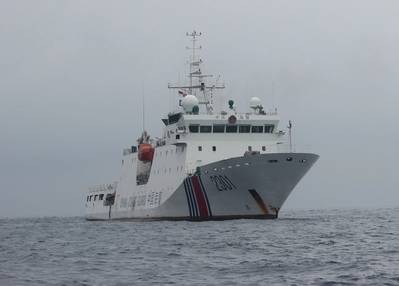
The China Coast Guard (CCG) has about three times the number of large cutters (1,000 tons or larger) as the USCG. They have well over 100, including at least 60 larger than the 270s. This, in spite of the fact that their EEZ, even including their “Nine Dash Lines” claims disputed by Taiwan and other nations is less than a fifth that of the US. Their internationally recognized EEZ is less than 8% of that of the US.

Virtually all these cutters were acquired in the last 15 years. While most CCG cutters are lightly armed, that is changing rapidly, with 76mm guns and 30mm Gatling guns becoming increasingly common. Many of the new cutters are built on the same hulls as PLAN frigates and corvettes.

“As of July 1, 2018, the China Coast Guard was transferred from civilian control of the State Council and the State Oceanic Administration, to the People’s Armed Police, ultimately placing it under the command of the Central Military Commission”

The CCG does not do buoy tending or icebreaking. Primary responsibility for SAR and maritime regulatory activities are invested in other agencies. There is a 25,000 member China Maritime Safety Administration, which has a few large cutters of its own, and a 10,000 member China Rescue and Salvage Bureau with its own cutters.

I think it is fair to say the China Coast Guard is much more focused on its para-military role than the US Coast Guard. Should China attempt to invade Taiwan, I feel sure the China Coast Guard will be transporting troops and providing naval gunfire support. They might even undertake small scale surprise landings own their own, perhaps in multiple locations simultaneously.

“Pakistan Navy commissioned its new PNS Tabuk Damen corvette OPV 1900” –Navy Recognition

PNS Tabuk during sea trials. (Picture source Damen)

NavyRecognition reports the commission of the second of two Damen designed offshore patrol vessels (OPV) built in Romania for the Pakistani Navy.

The Damen OPV 1900 has a hull-length of 90 m, a maximum speed of 22 knots, and a full-load displacement of 1,900 tons. The ship can launch two high-speed RHIBs of 11.5 meters and 6.5 meters simultaneously and also has the capability to accommodate two TEUs for special mission-based operations. The rear deck of the ship is able to transport both a helicopter and a UAV.

According to Janes, the ships are 2,300 tons (presumably full load), 91.3 meters (299.5′) in length, with a beam of 14.4 m (47.2′), a draft of 4 m (13.1′), and a complement of 138.

Below is a video shot on the first ship of the class. You can see that it also includes a hangar. Weapons and additional sensors are to be fitted in Pakistan. The video indicates the ship will be equipped with two 30mm cannon and anti-ship cruise missiles. The model, seen in the video at time 1m30s, shows the vessel equipped with what appears to be a single barrel mount similar to the Mk38 forward, but the mount on the aft starboard corner of the superstructure, looks like a Chinese Type 730 CIWS that includes a seven barrel Gatling gun. That weapon is currently in service with the Pakistani Navy. You would think the same weapon would be used in both positions, but the more sophisticated CIWS might not take kindly to the green water that is likely to come over the bow. The model also shows launchers for eight anti-ship cruise missiles, presumably of Chinese origin, like the C-802. The ships are also reportedly being given an ASW capability.