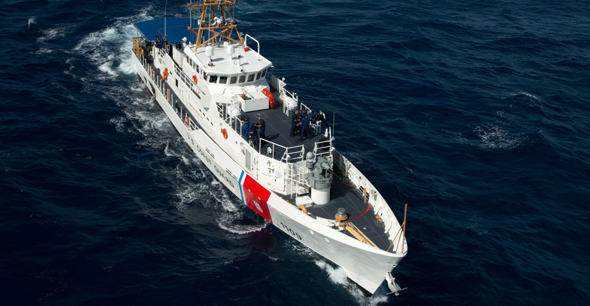
Unmanned SAR Assets

sUAS

MarineLink has a short post about a European effort to use networked Unmanned Air and Surface Vehicles (UAVs and USVs) to do SAR. I don’t find their particular scenario persuasive, but there probably are roles for these systems.

Unmanned systems have some potential advantages over Manned assets although they are unlikely to ever replace them.

  1. It may be possible to have UAVs more widely distributed than manned CG Air assets.
  2. UAVs operating from SAR stations might also be able to get into the air more quickly  than manned aircraft because they do not have to contend with other air traffic that may be operating on the field.
  3. At least for some applications they may be cheaper to operate.

Frankly, I had thought of unmanned systems as primarily Law Enforcement assets, but the Coast Guard is looking as the possibility of locating personnel in the water using small UAVs.

USVs:

I have a hard time visualizing a use for Unmanned Surface Vessels (USV), but perhaps there might be a benefit in dropping a USV to a distressed vessel or person(s)  in the water either from a fixed wing or a UAV.

UAVs might be used:

  1. For communications relay.
  2. To deliver medication or medical equipment.
  3. Small UAVs might be used to confirm the location of vessels in distress before other units arrive.
  4. To deliver pumps, communications equipment, or other even inflatable liferafts.

Any Other Ideas?

Any other potential uses?

Authorization Bill Has Some Surprises

Federal Times is reporting the contents of the Coast Guards latest authorization bill, and there are some surprises.

The item I was particularly pleased to see, was a apparent interest in something I feel should be more closely watched, cutter days available.

Part of that requirement would be to implement a standard for tracking the number of days Coast Guard cutters are in operation at sea, and include days in which cutters are undergoing maintenance or repair.

That should be revealing. In considering what should be expected, I would suggest we look back a few years, say take a five year average from 1998 to 2002 as a baseline.

There are lots of other proposed changes, not the least is that it is to cover two years. I suggest you check it out.

Towed Airborne Lift of Naval Systems (TALONS)

DARPA’s Towed Airborne Lift of Naval Systems (TALONS) effort seeks to develop a low-cost, fully automated parafoil system to extend small ships’ long-distance communications and improve their maritime domain awareness. DARPA developed TALONS as part of Tern, a joint program between DARPA and the U.S. Navy’s Office of Naval Research that seeks to enable forward-deployed small ships to serve as mobile launch and recovery sites for medium-altitude, long-endurance unmanned aerial systems.

Navy Recognition reports on two initiatives that are part of the TERN,  “a joint program between DARPA and the U.S. Navy’s Office of Naval Research that seeks to enable forward-deployed small ships to serve as mobile launch and recovery sites for medium-altitude, long-endurance unmanned aerial systems.”

We have talked about TERN before, it is intended to allow the LCS and similar sized ships to have persistent overhead surveillance by Unmanned Air Systems (UAS). The post talks about a launch and recovery system for fixed wing UAS, “SideArm,” but there is also this discussion of a towed system that looks like it might be applicable to units as small as WPBs and give them many of the advantages of a UAS with far less overhead.

DARPA’s TALONS effort seeks to develop a low-cost, fully automated parafoil system to extend small ships’ long-distance communications and improve their maritime domain awareness. Towed behind boats or ships, TALONS could carry ISR and communications payloads of up to 150 pounds between 500 and 1,500 feet in altitude—many times higher than current ships’ masts—and greatly extend the equipment’s range and effectiveness. Following successful ground-based tests, DARPA will conduct at-sea testing this year and potentially transition the technology to the U.S. Navy.

Why is this important? With a mast head height of say 36 feet the horizon distance is only about 7 nautical miles. Go to 500 feet and it is over 26 miles. Go to 1500 feet and it is over 45 miles. Effectively search widths could be multiplied several times over.

It doesn’t take much power to keep a parafoil up. In my neighborhood, there is a good sized man who flies a powered foot launched version out of our local open space. He has the engine and prop on his back, launches into the wind with just a short walk or run. Landings are frequently at walking speeds. That people (admittedly braver than I) are willing to entrust their lives to these things has to say something about their reliability.

(Historical note: During WWII, the Germans used an manned unpowered autogyro, the Focke-Achgelis FA-330, that was towed behind U-boats in an effort to extend their visible horizon.)

CG funding, DHS not interested, Perhaps DOD would be

I’ve read reports of Congressional hearings lately that, combined with the continual erosion of Coast Guard AC&I funding have crystalized my view that the Coast Guard’s funding methods need some tweeking.

SOUTHCOM

First there is this story of SOUTHCOM (Marine Gen. John Kelly)’s testimony before the Senate Armed Services Committee in which he pleads for additional Coast Guard cutters to allow him to act on intelligence his organization already has.

“We got 158 metric tons of cocaine last year, without violence, before it ever even made it to Central America,” he said. “I do that with very, very few ships. I know that if sequestration’s happened, I would be down to maybe one, maybe two, Coast Guard cutters. That means, of the 158 tons that I would expect to get this year, I’d probably, if I’m lucky, get 20 tons. All the rest would just come into the United States along this incredible efficient network.”

He later explained, “Once it gets ashore in Central America and moves up through Mexico, we’re taking almost nothing off the market.”

General Kelly has taken to using unusually strong language including the words “defeat” and “existential theat.”

He also suggests that returning ISIS fighters might use the drug and people smuggling routes to enter the US from Latin America

NORTHCOM

Then there is this post from DefenseNews, reporting fireworks, as the Senate Armed Services Committee grilled Adm. William Gortney (NORTHCOM), Thomas Dee (Deputy Assistant Secretary of the Navy for Expeditionary Programs and Logistics) and Vice Adm. Charles Michel (Coast Guard’s Deputy Commandant for Operations) about the Armed Services’ ability to operate in the Arctic and particularly about procurement of another icebreaker.

NORTHCOM has new concerns about the Arctic. Not only have the  Russians been building up military forces in the Arctic, they also have new weapons that might make a conventional cruise missile strike against the US feasible.

If we need to rebuild the DEW line to meet a new threat, we are going to need more icebreakers.

The Problem

The irony, of course, is that the Senate Armed Services Committee, as powerful as it may be, has essentially no direct influence on the Coast Guard’s budget, but perhaps it should.

The Coast Guard is after all an Armed Service of the United States at all times.

The Coast Guard has gotten some funding occasionally through the Navy, but not surprisingly this is an anomaly. Organizational dynamics being what they are, the Navy will always think money spent on the Coast Guard as a diversion and will want to either end it as quickly as possible, do the task with Navy assets, or have it funded from the Coast Guard budget. So getting anything like regular funding through the Navy is unlikely.

The DOD budget is not constructed the way you might think. All the money does not go to the services. A substantial part of the budget goes to the Department itself and a number of agencies of the Department outside control of the individual services. In the 2015 DOD budget request this amounted to 18.1 percent ($89.8 billion) – to fund the Defense-Wide account, which includes the Defense Health Program, intelligence agencies, Missile Defense Agency, Defense Advanced Research Projects Agency, and the many smaller DoD agencies. This is actually the fastest growing part of the DoD budget.

Perhaps there is a way DOD can transfer money to supplement the Coast Guard budget to answer the needs of Combatant Commanders (COCOMs) just as it funds independent agenies.

Something to Watch–off Yemen

Quoted from the German Navy Blog, Marine Forum, both entries dated 17 April.

  • Seven US Navy combat ships deployed off Yemen (Gulf of Aden; southern Red Sea): The entire IWO JIMA Amphibious Ready Group (IWO JIMA, NEW YORK, FORT McHENRY plus 2,200 embarked Marine), destroyers FORREST SHERMAN and WINSTON S CHURCHILL, (both belong to THEODORE ROOSEVELT CSG), minesweepers DEXTROUS and SENTRY, and dry cargo ship CHARLES DREW.

  • (Unconfirmed) reports that Iran is sending „seven to nine ships – some with arms“ toward Yemen. (rmks: if true, will be labelled „delivery of humanitarian aid“)

The US obviously does not want the Iranians to introduce more arms into the conflict. They or the Sunni Coalition may attempt to board the Iranian vessels if they enter Yemeni territorial waters. If this is done by US forces, there is a good chance Coasties will be in the boarding parties.

Counter-Drug help from Canada?

HMCS Ssaskatoon, Mar. 2007, Photo by Rayzlens

HMCS Saskatoon near Esquimalt, British Columbia and A CH-149 Cormorant helicopter that is practicing personnel transfers. Date March 2007 Photo by Rayzlens

The Canadians have been helping with Drug Interdiction Operations. They call it Operation Caribbe, but if I read between the lines correctly, their participation may be increasing.

Some changes are expected in the composition Canadian Navy, and in the way they operate. For the next few years, their fleet is going to be reduced by two supply vessels and two destroyers and their crew members are to be diverted to the twelve Kingston Class “Coastal Defense Vessels” that are normally manned only by reservists, and to more intense boarding training.

This should allow the Kingston class to be underway more, and I would expect they will want to work with Coast Guard LEDETs. They are already being employed in counter-drug ops. In March four were deployed for this purpose. Being relatively slow and having no helicopter deck, they may not be ideal for counter-drug operations, but they have proven useful.

These little ships are similar in size to 210s, shorter but beamier, and 30 years younger.

Displacement: 970 t (970.0 t)
Length: 55.3 m (181.43 ft)
Beam: 11.3 m (37.07 ft)
Draught: 3.4 m (11.15 ft)
Propulsion: 2 × Jeumont DC electric motors
4 × 600 VAC Wärtsilä SACM V12 diesel alternators
2 × Z drive azimuth thrusters
Speed: 15 kn (27.78 km/h)
Range: 5,000 nmi (9,260.00 km)
Complement: 31 to 47

The Canadian Navy’s intent,

The Kingston-class ships are staffed entirely by the naval reserve. Under the new plan, the ships will be staffed 60 per cent by reserves and 40 per cent by the regular forces. That still doesn’t account for everyone, and the navy says sailors on land will focus on more advanced boarding-party and anti-terrorism training.

Hopefully the Coast Guard may be seeing even more of these little ships.


“The Sea Based Logistics Response to the Haiti Earthquake”–Thinkdefence


The day following the Haitian Earthquake, Commandant, Adm. Thad Allen discusses the Coast Guard Response.

British Blog, Thinkdefence, has an interesting and very detailed examination of the response to the 2010 Earthquake in Haiti. There seems to be an omission of the 270s role as first US ships on scene, but it is really focused on the delivery of relief supplies. The blogger has a recognized fascination with containers that is almost a running gag, so don’t be surprised if there is a lot of talk about containers.

It is a great primer for disaster response planning.

Coastal Patrol Boats Boost Naval Presence–NDIA

WPC Kathleen_Moore

National Defense Magazine has published an article about the Navy’s Coastal Patrol Craft, primarily focusing on those based in Bahrain, but also discussing how those in the US might be used. The Coast Guard’s Patrol Boats in the Gulf are also mentioned.

Perhaps the most interesting item in the article was that two of the PCs are now equipped with unmanned aerial systems (UAS). If it fits on the Cyclone class it will almost certainly fit on the Webber class WPCs.

Because the Navy no longer rotates crews between the US and the Persian Gulf the three Navy PCs still based in the US have been moved to Jacksonville and may be made available to support CG drug enforcement missions.

They talk about the addition of Griffin missile system to the Cyclone class which we have discussed previously.

For me the topic inevitably raises some questions. Both the Navy’s Cyclone class and the CG 110s at Bahrain will need to be replaced at some point.

The Navy has done extensive service life extensions on the Cyclone class in hopes of giving them a 30 year service life. All of these boats except one entered service between 1993 and January 1996. Meaning they have to start funding their replacements in approximately FY2019. The LCS were officially their replacements, but reading the article, it is apparent the LCS can’t do many of the things the Cyclone class are currently doing simply because they are too big. Might the Navy be interested in their own version of the Webber class?

All the 110s will be 30 years old by 2022. The earliest the 58 planned Webber class could be finished would be 2022 assuming building six per year, but it is much more likely to be 2026 or later.

It would probably be in the Coast Guard’s interest for the Navy to also build Webber class PBs. Probably the only way that could happen is if they saw it in operation in the Persian Gulf. Replacing the six WPBs in Bahrain with Webber class by the end 2017 would give the ships a chance to demonstrate their capabilities.

Webber class WPCs assigned to the 5th Fleet should be upgraded in ways similar to the changes made to the Cyclone class, including the addition of Griffin missiles. It would be an opportunity to see if the Webbers could fulfill the missions of the Cyclone class. It would also be an opportunity to see how the other Webbers might be upgraded.

“China’s Second Navy” (the China CG)–USNI

The April, 2015 issue of US Naval Institute Proceedings has published an article which can be read on line, examining the Chinese Coast Guard and how it is using its blue water fleet, the largest fleet of cutters in the World (80 ships of over 1,000 tons and still growing).

It is worth a read. The author tracks the changing tactics employed by Chinese Law Enforcement vessels, and he sees a progression of increasingly aggressive actions.

Observations on the New Naval Strategy

HMAS Success (AOR-304) refuelling probe goes in for a hook-up with the US Coast Guard Cutter USCGC Waesche (WMSL-751) as the Royal Australian Navy Auxilliary Oiler Replenishment Ship conducts a dual RAS (Replenishment at Sea) off the coast of Hawaii during the Sea Phase of Exercise RIMPAC 2014, 19 July 2014. (RAN Photo by Leading Seaman Brenton Freind RAN)

HMAS Success (AOR-304) refuelling probe goes in for a hook-up with the US Coast Guard Cutter USCGC Waesche (WMSL-751) as the Royal Australian Navy Auxilliary Oiler Replenishment Ship conducts a dual RAS (Replenishment at Sea) off the coast of Hawaii during the Sea Phase of Exercise RIMPAC 2014, 19 July 2014. (RAN Photo by Leading Seaman Brenton Freind RAN)

I know many of you do not have the time or inclination to read the strategy, although it is not particularly long for such a document, so in addition to commenting on the contents, I will provide a Coast Guard “Readers Digest” version outlining the elements that are specific to the Coast Guard.

AN OVERVIEW:

In considering this strategy, it would be good to keep in mind this is not a strategy for war; it is a strategy for maintaining the peace, the sometimes violent peace that has become the new norm. As such, it assumes the Coast Guard will continue exercising its normal peacetime priorities. It does not define Coast Guard wartime roles or suggest how the Coast Guard might be shaped to be more useful in wartime.

If you look at the title, “A Cooperative Strategy for 21st Century Seapower: Forward, Engaged, Ready,” the words cooperative, forward, and engaged are particularly relevant in describing the thrust of the strategy.

It expects US naval forces to cooperate and engage with allied and friendly force both to improve relations and strengthen and encourage these friendly forces. The Coast Guard has a major role in this, in bringing expertise in a board range of governance functions that friendly navies and coast guards can relate to.

The Navy also expects to have a substantial part of its force “forward.” Not only forward but also geographically widely distributed. This violation of the Mahanian maxim to keep your battle force concentrated has been the norm for decades, but it has been a reflection of the preponderance of the US Navy that may be eroding. It is a calculated risk that the benefits of working with allies and being on scene to deal with brush fires, outweighs the potential risk of having an isolated Carrier Strike Group or Amphibious Ready Group overwhelmed by a concentration of hostile forces.

The strategy talks about surge forces, but frankly the potential is far more limited than it was when the Navy was larger. For the Coast Guard this “forward” strategy, combined with the apparently ever increasing concentration of US Navy forces in only a few homeports, has important implications. There are long stretches of the US coast that may be hundreds of miles from the nearest US Navy surface combatant.

If a suspicious vessel is approaching the US, that must be boarded to determine its nature and intent, the boarding is likely to be done by a Coast Guard cutter, and not by a National Security Cutter, but by something much smaller. The cutter is also unlikely to have any heavily armed backup.

ORGANIZATION:

Section I THE GLOBAL SECURITY ENVIRONMENT, talks about geopolitical changes since the strategy was last issued, and current military challenges.

Section II FORWARD PRESENCE AND PARTNERSHIP, looks at the specific areas of operation, specifically the Indo-Asia-Pacific, Middle East, Europe, Africa, Western Hemisphere, and the Arctic and Antarctic.

Section III SEAPOWER IN SUPPORT OF NATIONAL SECURITY, talks about the strategy in terms of missions, broken down as “All Domain Access,” Deterrence, Sea Control, Power Projection, and Maritime Security.

Section IV FORCE DESIGN: BUILDING THE FUTURE FORCE, attempts to describe the future force that it contends will be “Flexible, Agile, and Ready.” It goes on to talk about Forces, People, Concepts, and Capabilities.

GEOGRAPHIC PERSPECTIVE: The plan starts getting into specifics regarding the Coast Guard when it talks about specific regions.

Indo-Asia-Pacific Region

“The Coast Guard will rotationally deploy National Security Cutters and deployable specialized forces with the Navy and Marine Corps to safeguard U.S. territorial waters and the Exclusive Economic Zone (EEZ). Additionally, the Coast Guard will work with regional partners and navies using joint and combined patrols, ship-rider exchanges, and multinational exercises to build proficient maritime governance forces, enhance cooperation in maritime safety and security, and reduce illegal, unreported, and unregulated fishing. These multinational efforts are furthered through the Oceania Maritime Security Initiative and participation in the North Pacific Coast Guard Forum.”

Now I’m not sure what the first sentence is getting at. Usually when DETs deploy with the Navy, it is not for operations in the US EEZ, unless perhaps they are talking about the occasional deployment with ships transiting the US EEZ around islands in the Western Pacific, if so they might have been more specific. I don’t know why the strategy in several places refers to the National Security Cutter rather than simply cutters. I think this might have been an attempt to sell the NSC, which is a job now complete, but it frankly does nothing to justify the Offshore Patrol Cutter which can also do this type of work.

This is the first of several mentions of the Coast Guard’s potential for capacity building with navies and coast guards of friendly nations.

Middle East

The Coast Guard will deploy personnel to build partner nation capacity for maritime governance and simultaneously conduct maritime security, infrastructure protection, and Port State Control activities. Coast Guard patrol boats and deployable specialized forces on Navy and coalition ships will counter illicit maritime activity.

It does appear that the Coast Guard patrol boats in Bahrain are expected to remain there. Does this mean these now overage boats will be replaced in the future? Will they or their replacements receive weapons upgrades similar to those of the Navy Cyclone class counterparts?

Europe–No mention of the Coast Guard. Even so the CG will probably be involved in capacity building in Eastern Europe, as it has been in the past.

Africa–the Coast Guard is again mentioned in terms of capacity development and partnership station type activities. There is also interestingly a statement that a base will be developed in Africa.
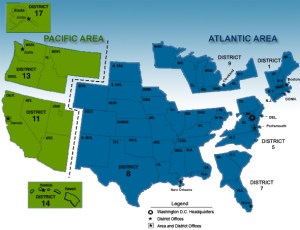
Coast Guard District and Area Organization

Coast Guard District and Area Organization

Western Hemisphere

We will strengthen partnerships and capacity in the Western Hemisphere to protect the homeland and to counter illicit trafficking and transnational criminal organizations. Coast Guard recapitalization efforts will produce a fleet of highly capable, multi-mission ships and aircraft, including the Offshore Patrol Cutter and the C-27J Spartan maritime patrol aircraft to counter threats, particularly in the Caribbean Sea, Gulf of Mexico, and eastern Pacific Ocean. The Navy will maintain its base at Guantanamo Bay, Cuba, to support joint and combined military operations and to enhance interagency efforts to develop regional security and cooperation. The Marine Corps will employ task forces or SPMAGTFs to support security cooperation activities that increase interoperability with regional partners and strengthen their capacity to interdict transnational criminal organizations. We will employ amphibious ships and other platforms, including Littoral Combat Ships, Joint High Speed Vessels, Afloat Forward Staging Bases, hospital ships, other Military Sealift Command ships, and Coast Guard platforms, to conduct humanitarian assistance and disaster response missions. We will also employ maritime patrol aircraft such as the P-8A Poseidon and unmanned aerial vehicles. Other ships and aircraft will provide periodic presence for recurring military-to-military engagements, theater security cooperation exercises, and other missions.

That is the entire section. Surprisingly no specific mention of using Navy ships for drug interdiction. Use of Navy vessels is mentioned only in the context of “humanitarian assistance and disaster response missions” and “military-to-military engagements, theater security cooperation exercises, and other missions.”

512px-Antarctica_CIA_svg
Competing claims in the Antarctic

Arctic and Antarctic:

Consistent with the predicted growth in maritime activity, the Sea Services will assess Arctic access and presence needs, improve maritime domain awareness, and pursue cooperation with Arctic partners to enhance the maritime safety and security of the region. This will require us to further develop our ability to operate in the Arctic, including in ice-covered and ice-obstructed waters. The Coast Guard will apply the multi-mission capabilities of the National Security Cutter to provide a tailored seasonal presence for command and control and aerial surveillance, and will begin the design process for a new, heavy icebreaking capability to support operations in both the Arctic and Antarctic. The Coast Guard will also pursue the formation of a maritime assistance, coordination, and operations group, open to members of the eight Arctic Council nations. The purpose of this group will be coordination of multinational search and rescue operations, training exercises, maritime traffic management, disaster response, and information sharing.

Again this is the entire section. DOD Maritime Domain Awareness is going to be very important here, and apparently it is already good. Looks like the Navy is content for the Coast Guard to be the face of US Naval presence in the Arctic. Again there is reference to the NSC which is not ice-strengthened and no mention of the OPC which is.

MISSION PERSPECTIVE: The Strategy refers to five essential functions–all domain access, deterrence, sea control, power projection, and maritime security.

All domain access: Not surprisingly there is no mention of a Coast Guard role in kicking in the door.

Deterrence: “The Coast Guard maintains a continuous presence in our ports, internal waterways, along our coasts, and offshore, providing an additional layer of defense against maritime threats.”
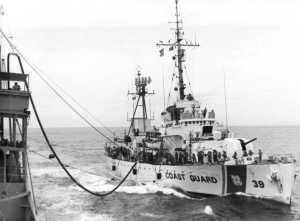
USCGC_Owasco_(WHEC-39)_conducting_UNREP_Market_Time
Cutter Owasco (WHEC-39) unreps while engaged in Operation Market Time off the coast of Vietnam.

Sea Control: There is no mention of a Coast Guard role in Sea Control. There should be. Sea Control frequently involves Visit, Boarding, Search and potentially Seizure of non-military vessels, e.g. merchant and fishing vessels. The Coast Guard is ideally suited for this role and has conducted this type of operation in war zones in the past, notably the Markettime Operation during the Vietnam War. In fact the common Coast Guard missions of drug and alien migrant interdiction are forms of sea control that potentially protect the US from non-state actors, but these missions are reflected in the Maritime Security mission.

When it comes to counting assets that might be used to exercise sea control, the Navy has roughly 110 cruisers, destroyers, frigates, LCS, and patrol craft and many of these, particularly the 85+ cruisers and destroyers, probably will have higher priority missions. The Coast Guard includes over 100 patrol boats and about 40 larger patrol vessels that routinely exercise sea control on an almost daily basis.

Force Projection: No mention of a Coast Guard role in Force Projection.

121203-G-XX000-001_CPO Terrell Horne

Maritime Security: It is here that the Coast Guard truly comes into its own.

We conduct maritime security operations by locating and monitoring vessels suspected of carrying illicit cargo or persons. If required, we intercept and board these vessels in support of U.S. law or international sanctions. Operating with the Coast Guard’s unique legal authorities, naval forces combat the illegal drug trade, human trafficking, and the unlawful exploitation of natural resources, particularly in the Western Hemisphere. Maritime security operations further support the broad maritime governance activities of the United States. These include assuring access to ice-covered and ice-obstructed waters in the Arctic and Antarctic.

Because all nations share in the collective benefits of maritime security, it is a promising area for expanded cooperation with our allies and partners. Through multinational exercises and training, we will conduct maritime security force assistance to combat transnational organized crime and protect fisheries and maritime commerce. This function supports the naval missions of defending the homeland, protecting maritime commons, and strengthening partnerships.
WPC Kathleen_Moore

FORCE DESIGN, BUILDING THE FUTURE FORCE

There is not a lot here specific to the Coast Guard. There is discussion about acquisition and personnel policies, but they appear to reflect Navy Department aspirations.

There is potential in the concept of modularity for allowing Coast Guard assets, particularly cutters, to more rapidly transition to a wartime outfit.

This section includes a listing of projected required capabilities tied to each of the missions discussed above. It is in the Maritime Security section that we find statements relevant to the Coast Guard and its missions:

To combat terrorism, illicit trafficking, piracy, and threats to freedom of navigation in the maritime domain, we will:
■ Increase our capabilities in integrated maritime detection, monitoring, and intelligence, along with those of our allies and partners, to improve global maritime domain awareness. This involves exploring more stringent Automated Identification System reporting requirements for vessels weighing less than the currently mandated 300 tons, as well as fielding innovative technologies that enhance effectiveness against the small vessel threat.
■ Strengthen the International Port Security Program to further ensure the integrity and legitimacy of commercial vessels and cargo traveling to our shores.
■ Enhance our interoperability and capability to perform visit, board, search, and seizure in contested environments.
■ Improve interoperability between Navy and Coast Guard vessels, aircraft, and shore facilities, in accordance with the National Fleet Policy to maximize sea control and maritime security capabilities.
■ Support our allies and partners through training, exercises, and the provision of capabilities, via foreign military sales and financing, to increase their capacity to address maritime security challenges.

IMG_4135

EVALUATION:

This is not a war plan so much as a plan for preventing war. From a Coast Guard perspective, it has largely canonized the status quo and the existing recapitalization program of record. It recognizes the Coast Guard’s unique authorities and its ability to contribute to capacity building. It seems to promise greater integration of a multiservice Maritime Domain Awareness.

On the other hand it does nothing to define Coast Guard wartime missions or how it might transition to a wartime footing. The force structure section does nothing to inform the design of Coast Guard equipment so that it might be more useful in wartime. It also does nothing to help that Coast Guard patrol boat I talked about at the beginning that is about to attempt to stop and board a potential hostile vessel that may be about to make an unconventional attack on a US port.

This is only the second iteration of the three service cooperative strategy. It is a marked improvement in specificity over the previous document. Hopefully there will be a process of continual improvement in succeeding editions.