Chuck Hill's CG Blog

Chuck Hill's CG Blog

This Day in Coast Guard History, June 22

Based on the Coast Guard Historian’s timeline, https://www.history.uscg.mil/research/chronology/
With inspiration from Mike Kelso

June 22

1818  Boarding parties from the Revenue cutter Dallas seized the privateer Young Spartan, her crew, and the privateer’s prize, the Pastora, off Savannah, Georgia.  The crew of the Pastora had been set adrift and their fate remained unknown.  The New York Evening Post noted that the crew of the privateer had committed offenses “that can only be expiated by making their exits on the gallows.” (July 3, 1818 issue).

1936  Congress passed an act to define jurisdiction of Coast Guard.  In one of the most sweeping grants of police authority ever written into U.S. law, Congress designated the Coast Guard as the federal agency for “enforcement of laws generally on the high seas and navigable waters of the United States.”
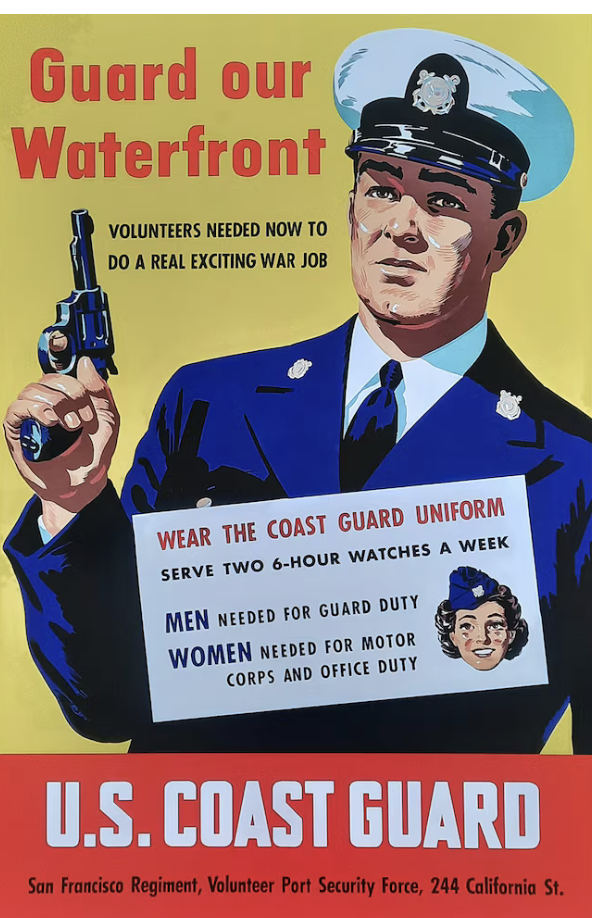
World War II-era Temporary Reserve Recruiting Poster. Photo by Capt. Bob Desh, U.S. Coast Guard retired

1940  Port Security responsibilities were undertaken again for the first time since World War I when President Franklin Roosevelt invoked the Espionage Act of 1917.  The Coast Guard was to govern anchorage and movement of all vessels in U.S. waters and to protect vessels, harbors, and inland or coastal waterways of the U.S.  The Dangerous Cargo Act gave the Coast Guard jurisdiction over ships with high explosives and dangerous cargoes.

1948  Congress enacted Public Law 738, which authorized the operation of floating ocean stations for the purpose of providing search and rescue communication and air-navigation facilities, and meteorological services in such ocean areas as are regularly traversed by aircraft of the United States.

Commandant’s inspection and where 82-footers tie up at Da Nang, Vietnam. (ADM E. J. Roland, USCG, and Assistant Sec. Reed) 24 July 1965. USCG photo by PH1 Nichols

1965  Coast Guard forces in Vietnam fired their first shot of the war when LT John M. Cece, commanding CGC Point Orient, gave the order to “commence fire” while patrolling the 17th Parallel.  The cutter was assigned to Coast Guard Squadron One.

“Point Orient was assigned to Division 12 of Squadron One to be based at Da Nang, along with USCGC Point Arden, USCGC Point Caution, USCGC Point Dume, USCGC Point Ellis, USCGC Point Gammon and USCGC Point Welcome. After sea trials, the Division left Subic Bay for Da Nang on 16 July 1965 in the company of USS Snohomish County, their temporary support ship. After almost two weeks at sea, they arrived at their new duty station on 20 July and began patrolling the coastal waters near Da Nang. Duty consisted of boarding Vietnamese junks to search for contraband weapons and ammunition and check the identification papers of persons on board. Permanent engineering and logistic support of Division 12 was provided by a U.S. Navy non-self-propelled floating workshop, YR-71. Point Orient became the first Coast Guard unit in Vietnam to engage the enemy on 24 July 1965 after being fired on from the shore by machine guns and mortars while attempting to board a junk. She returned fire but the results were unknown. During this time, the WPB’s were directed to paint the hulls and superstructures formula 20 deck gray to cover the stateside white paint. This increased the effectiveness of night patrols.”

Lt. (j.g.) Beverly Kelley, first woman to command a U.S. military vessel, on the bridge of the 95-foot cutter Cape Newagen. (U.S. Coast Guard photo)

1977  Secretary of Transportation Brock Adams introduced Ensign Beverly G. Kelley and Boatswain’s Mate 3/c Debra Lee Wilson during a press conference as two of 12 women who had been assigned to sea duty.  “This is the first time in Coast Guard history that women have been sent to sea.”   Both women had orders to report to the Morgenthau later that year.

The Coast Guard Cutter Alert (WMEC 630) conducts an engagement coincidental to operations with members of the Guatemalan Navy August 23, 2022, five miles south of Puerto Quetzal, Guatemala. The engagement to strengthen law enforcement and search and rescue capabilities with our partners in Guatemala included joint pursuit training with two Guatemalan small boats, and a search-and-rescue exercise with the Guatemalan vessels Kukulkan and the Kaibil Balam. U.S. Coast Guard courtesy photo.

1982  The first successful hostage rescue at sea occurred when a combined Coast Guard/FBI boarding party deployed from CGC Alert took control of the 890-foot Liberian-flagged motor tanker Ypapanti.  The incident began on May 16, 1982 when the Ypapanti anchored off the entrance to Delaware Bay after it was denied entrance to U.S. waters by COTP Philadelphia, due to the lack of required safety equipment aboard.  Initially the CGCs Hornbeam, Active, and Point Franklin responded.  After the situation stabilized, Active and Point Franklin departed while Hornbeam stood by the tanker to monitor the situation and to act as on scene commander; she was relieved on May 29 by Alert.  During the next few days the tanker’s crew mutinied and seized control of the tanker from the master in a wage dispute.  After a prolonged period of unsuccessful negotiations and threats by the crew to kill various officers and to set fire to the vessel, the Alert went alongside the tanker on June 22, 1982.  A senior Coast Guard negotiating team went aboard to present one last wage/repatriation offer to the crew.  When this offer was rejected a combined Coast Guard/FBI boarding team went aboard from the Alert and took control of the Ypapanti without injury.  The vessel was then returned to the control of the master and 12 loyal crewmen.  Twenty-four mutineers were detained on board the Alert and were transferred to the custody of the INS in Cape May.

The Reliance Class Cutter USCGC Valiant (WMEC-621) underway on a routine fisheries patrol in the Gulf of Mexico.

2020  The crew of Coast Guard Cutter Valiant (WMEC 621) returned home to Naval Station Mayport, Florida, Monday after completing a 9-week patrol conducting operations in the Windward Passage between Haiti and Cuba in support of Coast Guard 7th District and Operation Southeast Watch.  Valiant patrolled over 11,000 nautical miles in the Caribbean, working closely with the Navy and Coast Guard Cutters Diligence (WMEC-616), Resolute (WMEC-620), Kathleen Moore (WPC 1109), William Trump (WPC 1111), and Raymond Evans (WPC 1110). Valiant increased Coast Guard presence along the northern coasts of Haiti, Dominican Republic, Cuba, and the Windward Passage, working to prevent an anticipated surge of illegal immigration and human smuggling amidst the COVID-19 global pandemic. Throughout this patrol, Valiant served as the Cutter Tasking Unit, directing all Coast Guard assets supporting Operation Southeast Watch in the Windward Passage. In order to deter an illegal exodus from Haiti, Valiant maintained an overt presence by frequently transiting the Canal de la Tortue, a heavily trafficked, deep-water passage between the Tortuga Island and the Northern Haitian coastline.

The USCGC Bear (WMEC 901) approaches the pier in Portsmouth, Virginia, Monday. Bear returned home following a 74-day deployment to the northern Atlantic Ocean where crew members conducted living marine resources enforcement to ensure federal regulations compliance in U.S. waters, and the crew also took part in the Canadian Armed Forces-led, multinational naval exercise Operation Nanook. (U.S. Coast Guard photo by Petty Officer 2nd Class Brandon Hillard)

2023  CGC Bear (WMEC 910) returned home to Coast Guard Base Portsmouth, VA, on 22 June 2023, following a 65-day Caribbean Sea patrol. While underway in the Seventh Coast Guard District’s area of responsibility and in support of Joint Interagency Task Force–South, Bear conducted six counterdrug interdictions and seized a total of 8,558 pounds of cocaine worth an estimated $97 million. Bear conducted counterdrug operations as part of a multi-faceted approach to combatting illicit narcotics trafficking across maritime borders. Part of this effort included other Coast Guard assets, a Helicopter Interdiction Tactical Squadron aircrew from Jacksonville, Florida, and a deployable specialized forces unit from the Pacific Tactical Law Enforcement Team. Bear also conducted vertical replenishment with the U.S. Navy vessel Little Rock (LCS-9). Little Rock deployed its SH-60 Seahawk helicopter and crew to successfully deliver 5,566 pounds of seized cocaine to Bear’s flight deck. Bear moored in Miami, last Friday, 16 June 2023, and offloaded the combined 14,153 pounds of cocaine worth an estimated $186 million.

“Coast Guard Announces Conditions of Entry for Vessels Arriving from Sudan to Enhance U.S. Port Security” –CG News

Sudan displayed in dark green color, claimed territories not administered in light green

An interesting short announcement from Coast Guard News.


Coast Guard Announces Conditions of Entry for Vessels Arriving from Sudan to Enhance U.S. Port Security

Oct. 7, 2024

The Coast Guard has announced conditions of entry for vessels arriving from the Republic of Sudan in the Federal Register.

I Think We’re Going to Need More Lawyers — “Maritime Implications of Recent US Supreme Court Rulings” –Marine Link

Marine Link reports on, “Maritime Implications of Recent US Supreme Court Rulings.”

The impacts for regulatory agencies such as the FMC, USCG, and EPA could be widespread. As an initial matter, the Loper Bright ruling may open up the opportunity for regulated entities to challenge agency interpretations of ambiguous statutory provisions. The result of such potential increased litigation – and the lack of deference for an agency’s interpretation – is that maritime stakeholders will be increasingly reliant upon, and subject to, court interpretations of law. There is also an associated risk that, without deferring to agency interpretations, differing jurisdictions can more easily reach differing results when interpreting ambiguous statutes. As such, entities operating in multistate operations, such as maritime operators, may encounter greater difficulty in complying with the law when moving between jurisdictions.

There are also changes to the Statute of Limitations.

This is all well outside my wheelhouse, but feel free to comment and discuss the implications.

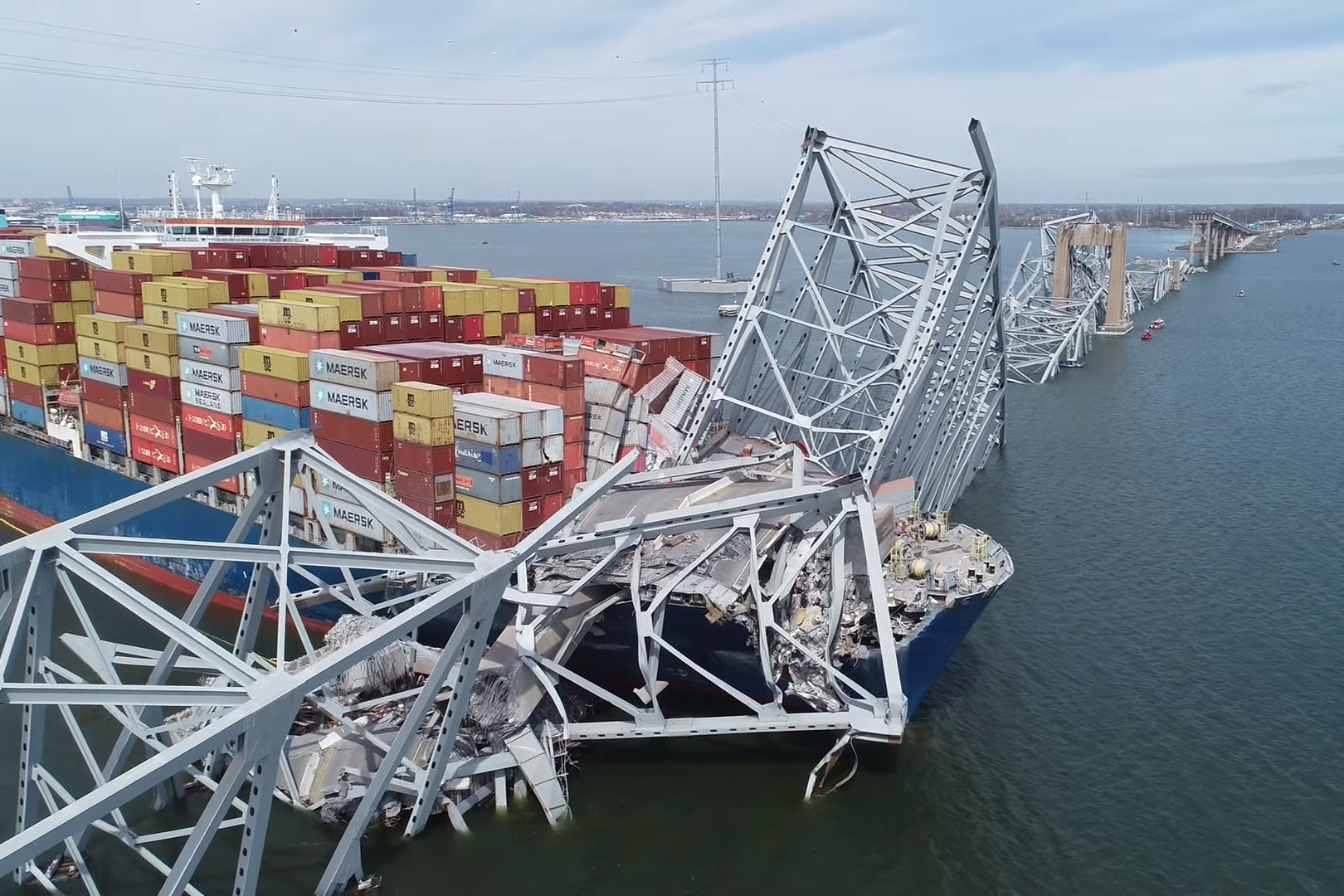
“Coast Guard response to Key bridge collapse reveals a strained service” –DefenseNews

NTSB drone image of Francis Scott Key Bridge and Cargo Ship Dali, 26 March 2024

Defense News reports on the Coast Guard response to the allision that brought down the Key bridge in Baltimore and how it strained the service’s resources.

“…four Coast Guard cutters, at least 10 boats…27 Coast Guard civilians, 23 volunteers, 275 active duty service members and 82 reservists…These employees have been drawn from their home stations all over the country, including some as far as Alaska and California. That also means these stations are donating staff to the recovery effort in Maryland, and the Coast Guard’s operations lead said the service doesn’t have much to spare as it is.”

It is a story of an organization that, while under stress, responded successfully. It is also a cautionary tale that if we had two such emergency operations simultaneously, full response might not be possible.

It should also be seen as a testament to the Coast Guard’s agility, responsiveness, and resilience in spite of current personnel shortages.

There is also some encouraging news about steps being taken to close the Coast Guard’s current personnel shortages.

Congress has shown its intent to take action. The House cleared a bill on May 14 to authorize $12 million to fund recruiters and offices for the Coast Guard Recruiting Command and an additional $9 million for recruiting capability in fiscal 2025. That passed in a 376-16 vote.

The bill also aims to improve quality of life for Coast Guard service members, a factor that, like pay competitiveness and work-life balance, may give the private sector an edge.

With a particularly bad Hurricane season predicted, it’s good to remind the Administration and Congress that we have to be ready to do more than normal day to day operations. The Coast Guard is more than a first responder. The Coast Guard moves resources in anticipation of disaster.

Incidentally the bill linked in the quote above is H.R.7659 – Coast Guard Authorization Act of 2024. It is very interesting as evidence of Congress’s intentions. Take a look but be aware the Authorization is separate from the budget and even if signed into law, the authorization does not mean projects are actually funded.

“Gaza Pier Announced by the US, How the US Military Builds a Pier, Joint Logistics Over the Sea” –What’s Going on with Shipping

Above is a YouTube video, talking about the pier that is expected to be built to bring supplies into Gaza as announced in the President’s State of the Union address.

Reportedly this will not involve putting US “boots on the ground” in Gaza, but…the Coast Guard may be involved in providing waterside security, states-side load out, and perhaps in the processing of shipments through Cyprus.

The War Zone discusses the risks of the operation here, “This Is How The U.S. Could Set Up a Gaza Beachhead, But Not Without Risks.”

A US Army logistics ship is already on the way.

U.S. Army Vessel General Frank S. Besson (LSV-1) from the 7th Transportation Brigade (Expeditionary), 3rd Expeditionary Sustainment Command, XVIII Airborne Corps, departed Joint Base Langley-Eustis, Va., March 9, 2024, en route to the Eastern Mediterranean carrying the first equipment to establish a temporary pier to deliver vital humanitarian supplies. (U.S. Central Command photo)

Meanwhile, World Central Kitchens is working on its own possible solution. It is not unlikely other non-government organizations will want to bring in supplies as well. Presumably these supplies will also have to be processed through Cyprus where the Israelis have set up a check point.

“Boats of the United States Coast Guard” –CG-9

Response Boat, Medium (RB-M). Photo from Vigor

A friend (thanks Lee) brought this little book to my attention.

“Boats of the United States Coast Guard”

Don’t know how I missed this, but seems very comprehensive, 30 pages and 44 different types of craft.

“Coast Guard completes mission at Naval Base Guantanamo Bay” –MyCG

Coast Guardsmen from Port Security Unit 307 conduct seaward security for Department of Defense assets and personnel at Naval Station Guantanamo Bay, Cuba, April 25, 2022. During the nine-month deployment, unit operations focused on maritime defense, providing more than 30,000 hours of around-the-clock waterside and shore side anti-terrorism and force protection. U.S. Coast Guard by photo by Lt. Cmdr. Glenn Sanchez.

Just passing this along from MyCG.


June 16, 2023

Coast Guard completes mission at Naval Base Guantanamo Bay

By Lt. Cmdr. Jeannie Shaye, Coast Guard Public Affairs Officer

NAVAL BASE GUANTANAMO BAY, Cuba — U.S. Coast Guard Port Security Unit (PSU) 305 members conducted a casing of the colors ceremony at Naval Base Guantanamo Bay Tuesday, marking the end of the Coast Guard’s 21-year mission supporting Joint Task Force Guantanamo (JTF-GTMO).

Coast Guard Commandant Adm. Linda Fagan presided over the historical ceremony and presented a Coast Guard Unit Commendation award to the men and women of PSU 305.

Port Security Units are part of the Coast Guard’s deployable specialized forces and have served JTF-GTMO as the Maritime Security Detachment (MARSECDET) in support of Operation Enduring Freedom for over 21 years. The Virginia-based PSU 305 was the first PSU deployed to Guantanamo Bay in 2002 in support of Operation Enduring Freedom, and this tour completes their fifth unit deployment.

“Thanks to the quiet resolve and careful watch of our Port Security Units for the past 21 years, the work our Nation has conducted here has been done safely and securely,” said Fagan during the ceremony.

Coast Guard PSUs and Maritime Safety and Security Teams have provided maritime anti-terrorism force protection for JTF-GTMO since 2002 as a part of the Global War on Terror.

There have been 39 unit rotations to Guantanamo Bay since the Coast Guard began supporting the mission. The men and women assigned to the MARSECDET collectively provided over 200,000 underway hours conducting around-the-clock waterside patrols and over 50,000 hours of shoreside anti-terrorism and force protection defense security to Department of Defense assets and personnel at Naval Station Guantanamo Bay.

Upon the conclusion of the JTF-GTMO mission, PSUs will continue to remain an agile expeditionary force provider that play a critical role in protecting strategic maritime operations in an environment of increasing global competition. In addition, PSUs will participate in national-level joint and combined exercises to increase readiness and proficiency for the full spectrum of PSU capabilities.

“This is an exciting time for the PSU community,” said Capt. Matthew Michaelis, Pacific Area Deputy Chief of Operations. “As the focus shifts from a long-standing enduring mission, we look forward to supporting future missions that align with their diverse set of capabilities. Our PSUs recently completed three joint DoD exercises and are preparing for additional exercises overseas with DoD and some of our trusted partners.  The increased focus on interoperability will better prepare our PSUs to deploy in a joint or multi-lateral environment as they were designed, while also creating opportunities to evolve and uncover new and novel ways for their employment.”

PSUs are Coast Guard Reserve-staffed units that support our nation with well-equipped, trained, and organized expeditionary forces that can rapidly deploy worldwide for anti-terrorism and force protection operations or in defense of high-value assets. Eight PSUs are strategically positioned throughout the country and assigned to the Coast Guard Pacific Area commander in Alameda, Calif.

JTF-GTMO is a U.S. Southern Command task force responsible for the safe, humane, legal care and custody of law of armed conflict detainees; collection and dissemination of intelligence; and supporting military commissions, periodic review boards, and habeas review.

The MARSECDET responsibilities were turned over in May to servicemembers assigned to the Naval Station Guantanamo Bay’s Navy Harbor Patrol Unit and Marine Corps Security Forces.

Following the ceremony, PSU 305 members will return home to Joint Base Langley-Eustis, Va.

Indo-Pacific Strategy of the United States

U.S. Coast Guard Cutter Munro and Japan Coast Guard Patrol Vessel Large Aso, transit together in formation during a maritime engagement in the East China Sea Aug. 25, 2021. U.S. Coast Guard members aboard the Munro deployed to the Western Pacific Ocean to strengthen alliances and partnerships and improve maritime governance and security in the region. (Photo courtesy of Japan Coast Guard)

The Whitehouse has issued a new Indo-Pacific Strategy, and it specifically mentions the US Coast Guard.

The document calls out China for its aggressive behavior,

This intensifying American focus is due in part to the fact that the Indo-Pacific faces mounting challenges, particularly from the PRC. The PRC is combining its economic, diplomatic, military, and technological might as it pursues a sphere of influence in the Indo-Pacific and seeks to become the world’s most influential power. The PRC’s coercion and aggression spans the globe, but it is most acute in the Indo-Pacific. From the economic coercion of Australia to the conflict along the Line of Actual Control with India to the growing pressure on Taiwan and bullying of neighbors in the East and South China Seas, our allies and partners in the region bear much of the cost of the PRC’s harmful behavior. In the process, the PRC is also undermining human rights and international law, including freedom of navigation, as well as other principles that have brought stability and prosperity to the Indo-Pacific.

It recognizes the value and values of our allies and partners,

For centuries, the United States and much of the world have viewed Asia too narrowly—as an arena of geopolitical competition. Today, Indo-Pacific nations are helping to define the very nature of the international order, and U.S. allies and partners around the world have a stake in its outcomes. Our approach, therefore, draws from and aligns with those of our closest friends. Like Japan, we believe that a successful Indo-Pacific vision must advance freedom and openness and offer “autonomy and options.” We support a strong India as a partner in this positive regional vision. Like Australia, we seek to maintain stability and reject coercive exercises of power. Like the ROK, we aim to promote regional security through capacity-building. Like ASEAN, we see Southeast Asia as central to the regional architecture. Like New Zealand and the United Kingdom, we seek to build resilience in the regional rules-based order. Like France, we recognize the strategic value of an increasing regional role for the European Union (EU). Much like the approach the EU has announced in its Strategy for Cooperation in the Indo-Pacific, American strategy will be principled, long-term, and anchored in democratic resilience.

It calls for action in five areas:

  1. ADVANCE A FREE AND OPEN INDO-PACIFIC
  2. BUILD CONNECTIONS WITHIN AND BEYOND THE REGION
  3. DRIVE REGIONAL PROSPERITY
  4. BOLSTER INDO-PACIFIC SECURITY
  5. BUILD REGIONAL RESILIENCE TO TRANSNATIONAL THREATS

There is mention of the Coast Guard is in the section “BOLSTER INDO-PACIFIC SECURITY” on page 13.

We will also innovate to meet civilian security challenges, expanding U.S. Coast Guard presence, training, and advising to bolster our partners’ capabilities. We will cooperate to address and prevent terrorism and violent extremism, including by identifying and monitoring foreign fighters traveling to the region, formulating options to mitigate online radicalization, and encouraging counterterrorism cooperation within the Indo-Pacific. And we will strengthen collective regional capabilities to prepare for and respond to environmental and natural disasters; natural, accidental, or deliberate biological threats; and the trafficking of weapons, drugs, and people. We will improve cybersecurity in the region, including the ability of our partners to protect against, recover from, and respond to cybersecurity incidents.

Coast Guard roles presumably extend beyond interdiction and fisheries to include assistance with intelligence, port security, and maritime industry cybersecurity.

The strategy refers to ten lines of effort that are to be pursued in the next 12 to 24 months. The first is “Drive New Resources to the Indo-Pacific” (p.15),

Building shared capacity requires the United States to make new regional investments. We will open new embassies and consulates, particularly in Southeast Asia and the Pacific Islands, and increase our strength in existing ones, intensifying our climate, health, security, and development work. We will expand U.S. Coast Guard presence and cooperation in Southeast and South Asia and the Pacific Islands, with a focus on advising, training, deployment, and capacity-building. We will refocus security assistance on the Indo-Pacific, including to build maritime capacity and maritime-domain awareness.

Sounds like this may include Coast Guard attachés attached to diplomatic staffs and possibly some new basing.

There is a second line of effort that will undoubtably involve the Coast Guard, “Partner to Build Resilience in the Pacific Islands” (p.17),

The United States will work with partners to establish a multilateral strategic grouping that supports Pacific Island countries as they build their capacity and resilience as secure, independent actors. Together, we will build climate resilience through the Pacific Region Infrastructure Facility; coordinate to meet the Pacific’s infrastructure gaps, especially on information and communications technology; facilitate transportation; and cooperate to improve maritime security to safeguard fisheries, build maritime-domain awareness, and improve training and advising. We will also prioritize finalization of the Compact of Free Association agreements with the Freely Associated States.

A Maritime Executive post, New U.S. Indo-Pacific Strategy Singles Out China’s “Coercion”, notes,

In the security arena, the new strategy reiterates that the United States has maintained “a strong and consistent defence presence necessary to support regional peace, security, stability, and prosperity”, pointing to the South China Sea and the East China Sea as a priority. However, it is interesting that while the document underscores the importance of freedom of navigation in the Indo-Pacific, not a single paragraph mentions the US Freedom of Navigation Operations Program (FONOPS) carried out by the US Navy, which has stirred controversy. Conversely, the strategy emphasises the importance of the Coast Guard to lead maritime security cooperation in the region, in “advising, training, deployment, and capacity-building … including to build maritime capacity and maritime-domain awareness”. Indeed, in 2021, the US Coast Guard announced a joint maritime training centre with the Indonesian Coast Guard in Batam.

The emphasis on coast guard cooperation can be seen as a positive gesture since it will be less provocative and sensitive compared to a military presence in the region. And more importantly, coast guard operations in Southeast Asia are very much required to tackle maritime security threats such as illegal fishing.

Thanks to Paul for bringing this to my attention. 

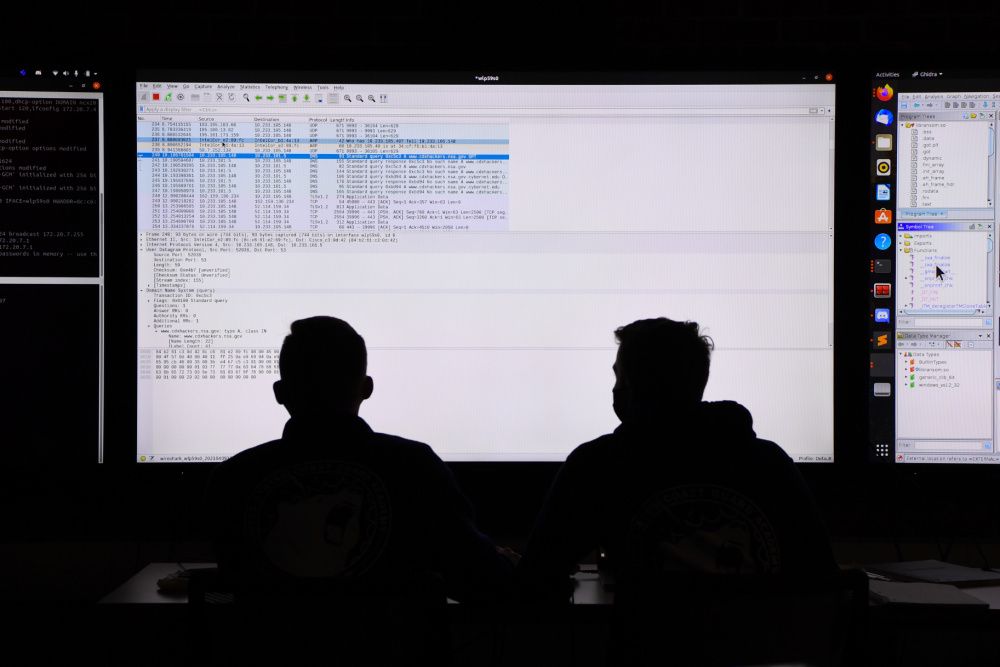
“PORT CYBERSECURITY: INCORPORATING THE IAPH’S NEW GUIDELINES INTO THE ISPS CODE” –CIMSEC

A team from the U.S. Coast Guard Academy participated in the National Security Agency’s 20th annual National Cyber Exercise (NCX), a three-day cyber competition that tests the offensive and defensive cybersecurity skills virtually, April 8-10, 2021. The Coast Guard Academy recently instituted a Cyber Systems degree to meet the needs of the services cyber security strategy of defending cyber space, enabling operations, and protecting infrastructure. (U.S. Coast Guard photo by Petty Officer 2nd Class Hunter Medley)

I can’t even spell cyber, but it is obviously important. This post is about a different kind of Port Security, and it is written by a serving Coast Guard officer, “Commander Michael C. Petta, USCG, is the Deputy Chair, the Director for Maritime Operations, and a professor of international law at the Stockton Center for International Law at the U.S. Naval War College.”

I found this statement particularly interesting,

Within the past few weeks, subversive actors backed by a foreign nation, according to the testimony of the Director of the U.S. Cybersecurity and Infrastructure Agency, breached servers and planted malicious code at a port facility in Houston, Texas.