Vice News has a nice piece you may find interesting, “‘Hull Envy’, the Looming Crisis of the US Coast Guard.” This is a message we need to spread around.
“Hull Envy,” the Looming Crisis of the US Coast Guard
11

Vice News has a nice piece you may find interesting, “‘Hull Envy’, the Looming Crisis of the US Coast Guard.” This is a message we need to spread around.
DefenseNews is reporting that “Pre-preliminary design and system selection for the frigate will be completed in October 2015,” Chris Johnson, a spokesman with the Naval Sea Systems Command, said May 28.
I don’t think it should be too much of a stretch, that the systems on the OPC should include a subset of those to be used on the frigate, with another subset of the frigate’s systems planned into the ships for inclusion if conditions warrant the upgrade. Design for Wartime, but equip for peacetime.
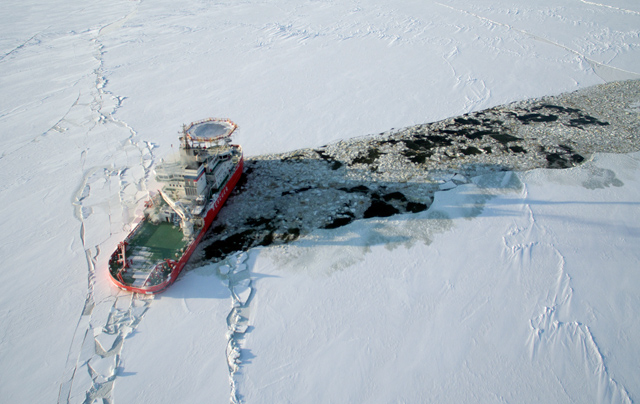
 Russia’s ’50 let Pobedy’ is currently the world’s largest icebreaker, displacing over 25,000 tons. Photo: Creative Commons
gCaptain reports the Russians are building three huge 33,540 ton 173.3 meter (569 foot) nuclear powered icebreakers that are expected to be delivered by 2020, with the first to be completed in 2017.
These ships will be almost two and a half times as large as the Polar Class.
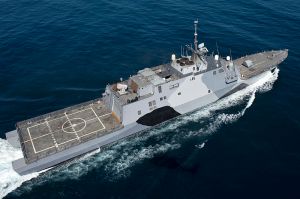
US Navy Photo. USS Freedom
Marinelink is reporting that LCS-1, USS Freedom, has completed “Rough Water Trials” (Seakeeping and Structural Loads Trials) off the coast of Oregon. A couple of thoughts.
Did we do these instrumented tests with either the National Security Cutter or a Webber class?
The Navy took quite a while before they got around to doing these and has already made a lot of decisions in the absence of test results.
When I first learned that the Navy had a 30 year shipbuilding plan, I thought it was silly, too many unknowns, too many variables. But I have changed my mind. The Coast Guard has made a serious tactical error in not paralleling the Navy planning process and creating a similar annual 30 year plan.
In the federal government budget process, the default allocation is that an agency will get the same proportion of the budget they got last year, in fact the same amount they got last year adjusted for inflation. The Coast Guard has not even been getting that. Increasing that proportion is always difficult.
When you concentrate on only one project at a time (it has been the National Security Cutter, now it is becoming the Offshore Patrol Cutter or OPC) without recognizing all the work that will be required in out years, it is too easy for Congress and the Administration to figure they can stretch out the project at hand without realizing it results in a growing backlog. Current Coast Guard public planning budget documents generally look only five years ahead, but most procurements take at least ten years to realize. The Navy considers ten years “near term” planning. The OPC project, as currently planned, will require funding at least through FY2030 and almost certainly some follow-up beyond that.
But FY2030 is not an end point. Keeping in mind that typically we need to start planning for replacement ten years before it is actually needed, the Coast Guard will not only need Polar Icebreakers, it will also need to begin several more replacement projects:
We need a plan to replace them all. We need to look at least 30 years into the future which would now mean FY2046. It would be the best argument for a realistic Coast Guard shipbuilding budget.
This is the Navy’s latest 30 year plan in tabular format.

The order includes 4x Stan Patrol 5009 Coastal Patrol Vessels (middle); 2x Fast Crew Supply 5009 Utility Vessels (top) ; 6x Interceptor DI 1102 Interceptors (bottom). Picture: DAMEN
NavyRecognition reports that Trinidad and Tobago is purchasing 12 vessels from Damen. As is typical for Damen products the number represents nominal length and beam in meters.

Photo credit: MKFI. 57 mm Bofors Mk 3 gun in stealth turret at the bow of Swedish Visby class corvette Nyköping (K34) in Aura river in Turku during the Northern Coasts 2014 exercise public pre sail event.
NavyRecognition has an update on the Malaysian Gowind project. This light frigate is probably similar to what VT Halter might have come up with for the OPC, less the missiles and ASW equipment of course, but I would particularly like to take notice of the way the Bofors 57mm Mk3 mount which is otherwise essentially identical to our Mk110 mounts, is treated. It is similar to the installation in the photo above.
When the CG first fielded the 270s, we had problems with green water coming over the bow and impacting the gun. The Malaysian frigate has a fixed structure, with doors on top, where the gun barrel is recessed forward of the rotating gun shield that is intended to make the mount more stealthy, but it looks like it would also protect the mount from heavy seas as well. That might be reason enough for the CG to do something similar.

China Coast Guard Crest
The Office of Naval Intelligence (ONI) has issued incredibly detailed information on China’s Navy and para-military naval organizations in an unclassified form.
Perhaps most impressive is the PLA Navy Identification Guide which includes their coast guards. The sheer number of vessels in their coast guard type organizations is staggering.
The Diplomat offers their take on these new intelligence products. The author, “Andrew S. Erickson is an Associate Professor in the Strategic Research Department at the U.S. Naval War College and a core founding member of the department’s China Maritime Studies Institute (CMSI). He serves on the Naval War College Review’s Editorial Board.”
You can access all of these products here.

Launch of USCGC Mackinaw (WLBB-30) on April 2, 2005. Photo by Peter J. Markham.
gCaptain is reporting that the severe conditions in the Great Lakes over the last two winters and the resulting loss of iron production, have prompted support for another Great Lakes icebreaker at least as large as Mackinaw.
“This is the second year in a row a brutal winter has slowed early season shipments of iron ore and other cargos on the Lakes. In April 2014, shipments of iron ore totaled just 2.7 million tons, a staggering 53.3 percent below the month’s long-term average.
“As a result, Rep. Candice Miller (R-MI) included a provision in the Coast Guard Authorization Act of 2015 (H.R. 1987) approved by the House Transportation and Infrastructure Committee that directs the U.S. Coast Guard to design and build a new, multi-mission icebreaker to enhance its capabilities on the Great Lakes.”
This could be an opportunity not only to build another icebreaker for the Great Lakes but also to design the three Medium Icebreakers the High Latitude Study has shown the Coast Guard needs.
A ship along the lines of Russia’s new oblique icebreaker would be particularly useful in the Great Lakes in that it would open a channel wider than the beam of the icebreaker itself.
NavyRecognition reports on the presentation of the Raytheon’s AN/SPY6(V) Air and Missile Defense Radar at the recently completed SEA-AIR-SPACE trade show.
This is the radar that has been selected to go on the Flight III version of the Burke class DDG. Most of the emphasis has been on larger installations, but the good news for the Coast Guard is that these systems are modular, based on two foot square elements than each constitute a separate radar, so that it can be scaled down as well as up. These fixed arrays would normally be arranged with four arrays positioned to each cover a 90 degree sector. Raytheon claims arrays consisting of nine elements arranged in a 3×3 square (6 ft x 6 ft) provides performance similar to the 12 foot octagonal AN/SPY-1D on existing Burke class DDGs. It appears the intention is that the Flight III ships will have roughly octagonal arrays consisting of 37 elements, 14 foot across. There is also an option for an even larger array of 69 elements in an octagonal 18 foot diameter array.
These radars are reportedly capable of performing virtually every type of radar function including air and surface search and firecontrol. Reportedly the radar will be “qualified” in 2017 and the initial operational capability will be attained in 2023, presumably with the first flight III DDG.
When might we consider using these?
The Bertholf was commissioned in 2008 so the class will start needing mid-life renovations some time after 2023.
The Offshore Patrol Cutter construction program is expected to be stretched out with funding over 15 years and deliveries will probably extend from FY2021 to FY2035. Over so long a period it would not be unreasonable to expect that there will be a “B class” with updated systems. By that time, these systems may be so common it may be reasonable to replace the planned radar suite with these fixed systems.
At the very least, at some point it might be advisable to convert at least one of each class to accept this or a similar system as a prototype for war emergency conversion. This might be something DOD would pay for.
 Chuck Hill's CG Blog