One of our readers, David Van Dyk, a student at Liberty University, was able to attend the CSIS introduction event for the updated Strategy, and has provided a report of his impressions.
With standing room only and camera crews capturing their footage, Chief of Naval Operations Admiral Jonathan Greenert, Commandant of the Marine Corps General Joseph Dunford and Commandant of the Coast Guard Admiral Paul Zukunft took the stage during the Center for Strategic and International Studies (CSIS) event entitled “A Cooperative Strategy for 21st Century Seapower.”
John Hamre, CEO of CSIS since January 2000, introduced the military leadership on stage, remarking that the Navy and Marine Corps have “loved each other like brothers; Cain and Abel.”
While rivalries between the Sea Services were realized years back, a new cooperative strategy looking forward is not only smart but paramount to our nation’s defense and ability to project power on the high seas and around the coastline.
The meeting’s purpose was to establish and introduce a document signed by all three Sea Service chiefs. “A Cooperative Strategy for 21st Century Seapower: Forward, Engaged, Ready” (CS21R) was penned because of the changing environment, changing threats and changing resources. While all three changes are major actors on the national stage of security and safety, it requires a unity of effort from not only the United States Sea Services, but of those around the world, working in unison to tackle problems ranging from military aggression to disaster relief.
Changing Environment
In a rapidly changing world, the sea services need to align their focus and adapt to the environment. This requires major changes, one of which is the Arctic. According to CS21R, the Arctic is becoming a major player in maritime trade.
“Rising ocean temperatures present new challenges and opportunities, most notably in the Arctic and Antarctic, where receding ice leads to greater maritime activity,” CS21R states. “In the coming decades, the Arctic Ocean will be increasingly accessible and more broadly used by those seeking access to the region’s abundant resources and trade routes.”
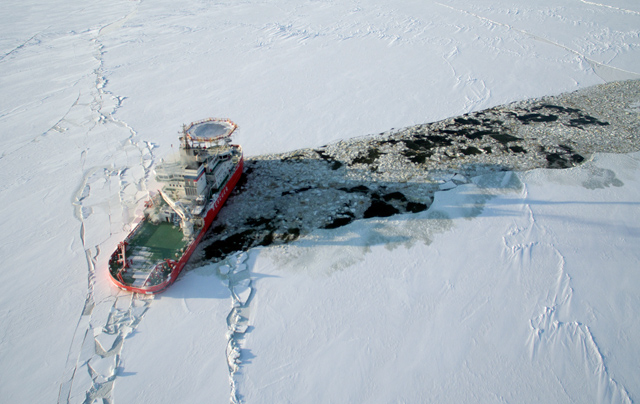
With research vessels and ice breakers blazing their own trails through the region, responsible practices must not only be encouraged but enforced. The Arctic Council, made up of eight partner nations, will be chaired by the United States from 2015 to 2017, allowing American leaders to map out a strategic and engaged plan for the changing northern environment. The Coast Guard, according to the document, will also be entering a design phase for a new icebreaker capable of handling the harsh conditions of the Arctic Ocean.
“Some of our biggest concerns in the Arctic (are that) someone’s going to fall in it or oil spills in it and it affects the way of life in the Arctic domain,” Admiral Zukunft said. “We have an Arctic Strategy in place that aligns with a national strategy for the Arctic region.”
Witnessing firsthand the increasing activity in the Polar Regions, the Coast Guard Cutter Polar Star rescued 26 crewmembers aboard an Australian fishing vessel, Antarctic Chieftain, that was trapped in freezing temperatures Feb. 18. Since the Polar Star had just finished “Operation Deep Freeze” to replenish McMurdo Station, according to a Reuters report, they were able to sail 800 miles and cut through 150 miles of ice to reach the vessel and save all lives aboard by towing it to open waters.
Another changing environment mentioned in the document is the increasing amount of trade occurring on the oceans, meaning more traffic for important commercial waterways.
“Skyrocketing demand for energy and resources, as evidenced by a projected 56 percent increase of global energy consumption by 2040, underscores the criticality of the free flow of commerce through strategic maritime crossroads, including the Straits of Hormuz and Malacca, as well as the Panama and Suez Canals,” the document reads. “Closer to home, dramatic changes in energy production and transportation, as well as the completion of the Panama Canal expansion project, will fundamentally alter shipping patterns within the United States and globally.”
The Panama Canal expansion project is nearing a conclusion with 85 percent completed, and it is expected to be fully operational early next year, according to the Christian Science Monitor. With post Panamax vessels taking on 14,000 containers, the new enlargement will bring seaborne giants of commerce to East Coast ports, bringing additional security challenges to Navy and Coast Guard assets.
While CS21R does not mention it, Nicaraguan lawmakers have been dealing with a Chinese billionaire named Wang Jing, Chairman and CEO of the Hong Kong Nicaragua Development (HKND) group, in building their own canal to handle, they claim, even larger ships. While details of the plan remain under intense scrutiny, the competition building in this changing region will only grow larger as maritime trade increases.
“Oceans are the lifeblood of the interconnected global community, where seaborne trade is expected to double over the next 15 years,” CS21R states. “Ninety percent of trade by volume travels across the oceans.”
Changing Threats
While operating in a changing environment, the Sea Services recognize the changing threats taking place in and around these areas. These threats, whether from state or non-state actors, will need to be dealt with both effectively and efficiently.
According to Zukunft, transnational organized crime is worth $750 billion annually. These networks utilize their illicit activities to help fund terrorist activities as well as their own nefarious enterprises.
“Transnational criminal organizations (TCOs) remain a threat to stability in Africa and the Western Hemisphere, especially in Central America and the southern approaches of the U.S. homeland,” CS21R states. “Their networks facilitate human trafficking and interrelated flows of weapons, narcotics and money, all of which could be exploited by terrorists to attack our homeland, allies and overseas interests.”
Transnational criminal organizations are operating not only along the coastlines and drug transit zones of the western hemisphere but also throughout Africa, where terrorist and piracy networks often share intelligence and money to fund illicit activities along the western African coast.
“Construction Battalions (Seabees), Explosive Ordnance Disposal units, Navy SEALs and other Naval Special Operations Forces, as well as Coast Guardsmen and Marines, will continue working alongside partner security forces to combat terrorism, illicit trafficking, and illegal exploitation of natural resources through initiatives such as the African Maritime Law Enforcement Partnership and the Africa Partnership Station,” CS21R states. “West African nations rely heavily on maritime forces to combat illicit trafficking, which have links to terrorist enterprises.”
Another theatre of operations where there is a changing threat is the Indo-Asia-Pacific region, where China’s actions are being hotly contested by Indo-Asian allies, including Japan, Vietnam, the Philippines and Singapore.
“Consistent with developing strong partnerships and relationships, Filipinos have been strong partners for many years,” General Dunford said. “We had a little bit of a dip in the relationship, but that’s a compelling reason for us to cooperate more closely than we have over the past few years.”
According to Reuters, China’s actions have led Japan to recently sign a security agreement with Vietnam and the Philippines, forming an alliance that will counter China’s growing presence throughout the South and East China Sea. This agreement includes the first ever joint naval exercises between Japan and the Philippines, as well as intelligence sharing between the geopolitical adversaries of China.
“With strategic attention shifting to the Indo-Asia-Pacific, we will increase the number of ships, aircraft and Marine Corps forces postured there,” CS21R states. “By 2020, approximately 60 percent of Navy ships and aircraft will be based in the (Indo-Asian-Pacific) region. The Navy will maintain a Carrier Strike Group, Carrier Airwing and Amphibious Ready Group in Japan, add an attack submarine to those already in Guam and implement cost-effective approaches such as increasing to four the number of Littoral Combat Ships (LCS) forward-stationed in Singapore.”
The Coast Guard’s strong ties with several other coast guards in the volatile region will aid in diplomatic discussions and information sharing.
“…The Coast Guard will work with regional partners and navies using joint and combined patrols, ship-rider exchanges and multinational exercises to build proficient maritime governance forces, enhance cooperation in maritime safety and security and reduce illegal, unreported and unregulated fishing,” CS21R states. “These multinational efforts are furthered through the Oceania Maritime Security Initiative and participation in the North Pacific Coast Guard Forum.”
Changing Resources
With budgets under scrutiny and the almighty dollar being hard-pressed, the Sea Services need to fight battles effectively and efficiently by realizing the changing resources available for widespread use.
“In this time of fiscal austerity, our force is sized to support defeating one regional adversary in a large, multi-phased campaign, while denying the objectives of, or imposing unacceptable costs on, another aggressor in a different region,” CS21R states. “This force-sizing construct also ensures our capability and capacity to support global presence requirements.”
In a question and answer period during the CSIS event, Megan Eckstein, a staff writer with USNI News, asked the three admirals how they would handle their services concerning the possible constraints of the FY16 budget, which received acknowledged chuckles from the largely Capitol Hill audience.
“We have to replace the current Ohio-class submarine,” Admiral Greenert said. “We don’t have the money associated to do that without ruining the shipbuilding account which permeates all that this strategy is about for the future. That is my number one conundrum right now.”
Dunford offered a different view into the budget issue, speaking of his recent meeting with Marine Corps leaders reviewing the service’s capabilities in unifying combatant commanders.
“This is really not just FY16 … this is about capability development over the next three to five, frankly seven to eight years,” Dunford said. “It’s not so much about buying more radios. It’s about us coming together and identifying the capability that we need to have and making sure that’s properly resourced.”
According to Zukunft, the Coast Guard needs to not only provide a defensive measure along the coast and in the ports, but also be able to stop dangerous and illegal shipments from even entering the Exclusive Economic Zone (EEZ).
“If you have a shipment destined for the United States, you want a goal line defense inside the sea buoy, or do you want the ability to exert US sovereignty into the territorial seas of where that ship departed?” Zukunft said. “I’d much rather have the latter, but we’re not going to have that as a nation if we don’t make this investment to build affordable ships, but…also the ability to exert our sovereignty well beyond the sea buoy.”
In the revised document, the Sea Services realized the challenges a tighter budget would have on their day to day operations and the need to cooperate on a deeper and more streamlined level.
“A smaller force, driven by additional budget cuts or sequestration, would require us to make hard choices,” CS21R states. “Specifically, in the event of a return to sequestration levels of funding, the Navy’s ability to maintain appropriate forward presence would be placed at risk.”
Changing environments, threats and resources will force the Sea Services to adapt and recognize the fluctuations across world geopolitics. Unifying efforts with allies and partners will enhance Americas own Sea Services, offering opportunities for deeper associations with countries from Latin America to the South China Sea. Whatever the environment and threat may be, America’s Navy, Marines and Coast Guard will remain ready, willing and able to handle the coming century.




 Chuck Hill's CG Blog