Two More New Medium Icebreaker–Not for the Coast Guard

EdisonChouestOffshoreAHTSicebreaker

Drawing by North American Shipbuilding, click for larger

gCaptain reports that Edison-Chouest is building another icebreaker (Anchor Handling Tug Supply (AHTS) ship), with an option for a second. Another gCaptain post appears to indicate that they are in fact building two.

These vessels appear to be similar to the earlier M/V Aiviq.

If I read the report correctly, each ship will have Four 5060 KW generators. If so these ships will each have more horsepower (20,240 KW/27,131 SHP) than the diesel electric engines of the Polar class (18,000 HP), more than the Glacier (16,000 KW/21,000 SHP), and almost as much as the Healy (22,400 KW/30,027 SHP). They will be more than twice as powerful as the Wind class breakers (12,000 SHP), the National Science Foundation’s leased M/V Nathaniel B. Palmer (9,485 kW/12,720 HP), or USCGC Mackinaw (6,800 KW/9,119 SHP). They will also be more powerful than all but one of Canada’s icebreakers

They will be Polar Class 3. Polar class 3 means “Year-round operation in second-year ice which may include multiyear ice inclusions.” It appears we might be seeing the emergence of a whole class of privately owned American medium icebeakers.

Researching this, I found reference to two similar, if perhaps less capable, Class 4 icebreakers, both built in 1983 in Canada, as commercial AHTS vessels, one, CCGS Terry Fox, is now used by the Canadian Coast Guard, and her sister ship, Vladimir Ignatyuk, is now owned by Russia’s Murmansk Shipping Company and was chartered by the National Science Foundation to lead the break-in to McMurdo sound two seasons, during the Antarctic summers of 2011/12 and 2012/13.

The Russian icebreaker Vladimir Ignatyuk breaking a path in the annual sea ice to McMurdo Station, Antarctica on January 26, 2012. Credit: Steve Royce

The Russian icebreaker Vladimir Ignatyuk breaking a path in the annual sea ice to McMurdo Station, Antarctica on January 26, 2012.
Credit: Steve Royce

So far I have seen no indication of official Coast Guard interest in filling the stated requirement for three medium icebreakers. These ships do not have the redundancy we would like in a our ships. But that could be fixed. Plus lower cost might allow a different kind of redundancy, assigning two ships to the task rather than only one, allowing an organic Coast Guard self rescue capability that the Commandant has pointed out is missing with our current very limited icebreaker fleet. If the cost of these is similar to that of the M/V Aiviq ($200M, 16,240 KW/21,760 HP), even after upgrades to meet Coast Guard requirements, e.g. flight deck, hangar, communications, etc., and additional overhead that are included in Coast Guard procurement cost, we should be able to build a medium Icebreaker of similar capability for a third the $1B cost of a heavy icebreaker.

Is a medium icebreaker sufficient for our needs? We already have a documented requirement for three medium icebreakers in addition to three heavy icebreakers compared with the current fleet of one each. In a Defense News interview the Commandant pointed out, “First of all, it’s heavy ice breaking capability. Last year the Polar Star had to rescue a medium ice breaker from China. Just before they arrived, the wind shifted and they were able to get out on their own. Clearly, [that] is no place for a medium ice breaker. It does require heavy ice-breaking capability.” While I would never suggest that a Heavy icebreaker is not desirable, in fact the MV Xue Long (Snow Dragon) is more ice strengthened cargo ship than icebreaker with a large hull (21,025 tons) and relatively weak engines (13,200 KW/17,694 HP) and would be considered by the Coast Guard a light polar breaker (less than 20,000 HP). Historically the Operation Deepfreeze break-in has been done most frequently by ships we would now classify as medium or light icebreakers.

If you look at this chart, prepared by the Coast Guard, in 2013, of the 78 icebreakers of over 10,000 HP, operated by 17 countries, only eight of them were Heavy icebreakers (=>45,000 SHP). 34 were medium icebreakers of 20,000 to less than 45,000 HP, and 36  were smaller icebreakers of 10,000 to less than 20,000 HP. Interestingly, in addition to five heavy icebreakers, four medium, and two smaller icebreakers have managed to make it to the North Pole.

Even if funding can be found for a new heavy icebreaker, by the time it is built, we will again have only one heavy icebreaker (unless Polar Sea is reactivated), because the Polar Star will almost certainly be out of service by the time it enters service. We really need to consider alternatives to give us the numbers we need in the not too distant future. Apparently there is agreement we need at least two more medium icebreakers in addition to USCGC Healy. Getting them into the budget looks a lot more do able than a $1B heavy icebreaker, and far, far easier than two Heavies.

Defense News Interviews the Commandant

DefenseNews.Com just posted a three part video interview with the Commandant. Each segment is five to ten minutes in length.

Impact of Sequestration: http://www.defensenews.com/videos/defense-news/2015/03/01/24221471/

The Commandant notes, in the first two months of 2015 we have seized more drugs than we seized in all of 2013. He talks about establishing priorities and specifically mentions the Arctic and Western Hemisphere Drug enforcement.  He did not say what will drop out.

Capability vs Affordability http://www.defensenews.com/videos/defense-news/2015/03/01/24221423/

The Commandant has quite properly put emphasis on the OPC, and he has hit the point that spreading out procurement will cost more in the long run. He talked about icebreakers and discussed how we will need help funding them. He is pushing the results of the previous High Latitude study, saying the US needs three heavy and three medium icebreakers.

Coast Guard Modernization http://www.defensenews.com/videos/defense-news/2015/03/01/24221467/

Here he repeated themes from the State of the Coast Guard address. The importance of defending against Cyber attacks both within the Coast Guard and in the larger Maritime Transportation industry, the formation of an Arctic CG forum, and making the Coast Guard a hostile environment for those that might attempt sexual assault.

Observations

Seems the Commandant has recognized the need to sell the service and push for more funding, particularly for AC&I. It would not hurt to see the rest of the Coast Guard repeating the themes that he seems to have focused on, to make sure the message gets delivered.

The Commandant will continue to focus on the six major topics he highlighted in the State of the Coast Guard Address. Specifically I expect to see a lot more Coast Guard effort in the Eastern Pacific Transit Zone; we will continue to hear that the US needs three heavy and three medium icebreakers as the Commandant pushes for supplemental icebreaker funding; less obvious, but I think he is laying the ground work for an attempt to speed up the OPC construction schedule which would require at least another $500M annually in the AC&I account. There will be a lot more emphasis on cyber and tougher action on sexual assault. In terms of the objective of “maximizing return on investment,” I think we will see closer examination of fuel efficiency, manning, and other operating economies as a basis for where to invest modernization dollars.
RFP for Webber Class Cutters #33-58

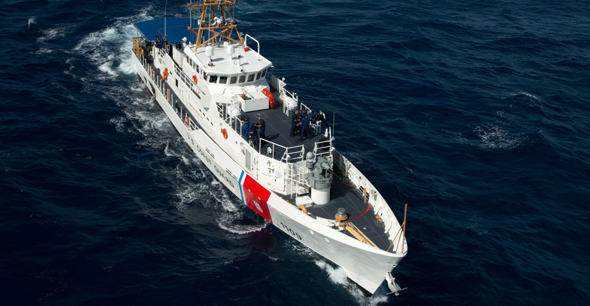
WPC Kathleen_Moore

The Acquisitions Directorate has finally published a Request for Proposal for Construction of the remaining 26 of the planned 58 cutters of the Webber Class. Deadline for submission is June 5.

It appears this might have been done a year earlier. The Coast Guard awarded contracts to Bollinger for units 31 and 32 on 27 Feb 2015 that I don’t believe were options on the original contract. In fact the existence of options should not have precluded contracting with other shipbuilders.

I still must question why there was apparently no attempt to frame this as a Multi-Year Procurement (MYP) rather than a series of options. The Webber class were approved for “full rate production” 18 Sept. 2013. This is an ideal program for a Multi-Year Procurement that might have save more than 10% compared to exercising yearly options. Additionally it would have provided greater incentives for competition.

State of the Coast Guard Address–2015

Coast Guard Commandant Adm. Paul Zukunft delivers his first State of the Coast Guard Address and outlines how America’s Coast Guard will meet the challenges of today while preparing for complexities that remain ahead. U.S. Coast Guard video by Telfair. H. Brown, Sr.

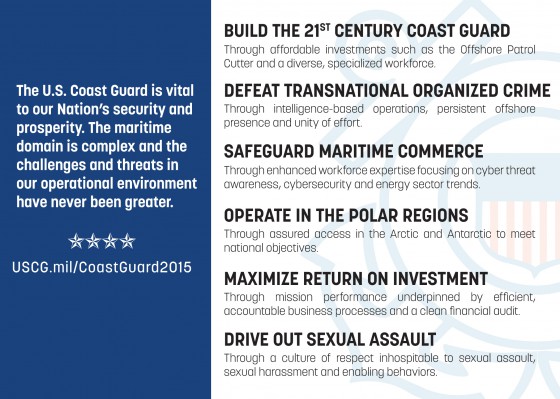
The Commandant has issued his State of the Coast Guard address, and I think you will find it well said, even inspiring. You can watch it above or read more here.

State-of-the-Coast-Guard-2015-560x399

“A Cooperative Strategy for 21st Century Seapower: Forward, Engaged, Ready” Kickoff, 13 March

There is an upcoming event some of you might be interested in. It is the introduction of the new Navy/USCG/USMC strategy, “A Cooperative Strategy for 21st Century Seapower: Forward, Engaged, Ready”, slated for roll-out on March 13. Speakers include the Commandant, the Chief of Naval Operations, and the Commandant of the Marine Corps.

It will likely fill up quickly, so sign up soon if you want to go.

When: 3/13/2015 11:30 AM – 12:30 PM
Where: 1616 Rhode Island Avenue, N.W. Washington, DC 20036
Registration: http://my.csis.org/csis/CSIS1700/CSISEventRegistration.aspx?eventcode=2015_065
Cost: Free

Anyone want to be my on-scene reporter?

Ten More Hero Namesakes for the Webber Class

The Coast Guard Compass has published ten more names that will be applied to Webber Class WPC.

Announcements of previous names are here and here. There was a bit of a change in that the name of Joseph Napier was reassigned to WPC-1115 when WPC-1110 was named after Raymond Evans.

Previously assigned Cutter names assigned were:

Bernard C. Webber (WPC-1101)
Richard Etheridge (WPC-1102)
William Flores (WPC-1103)
Robert Yered (WPC-1104)
Margaret Norvell (WPC-1105)
Paul Clark (WPC-1106)
Charles David (WPC-1107)
Charles Sexton (WPC-1108)
Kathleen Moore (WPC-1109)
Raymond Evans (WPC-1110)
William Trump (WPC-1111)
Isaac Mayo (WPC-1112)
Richard Dixon (WPC-1113)
Heriberto Hernandez (WPC-1114)
Joseph Napier (WPC-1115)
Winslow W. Griesser (WPC-1116)
Richard H. Patterson (WPC-1117)
Joseph Tezanos (WPC-1118)
Rollin A. Fritch (WPC-1119)
Lawrence O. Lawson (WPC-1120)
John F. McCormick (WPC-1121)
Bailey T. Barco (WPC-1122)
Benjamin B. Dailey (WPC-1123)
Donald H. Horsley (WPC-1124)
Jacob L. A. Poroo (WPC-1125)

I cannot be sure which hull numbers will be assigned to each of the names, but the names in the order they were announced are:

Joseph Gerczak
Richard T. Snyder
Nathan Bruckenthal
Forrest O. Rednour
Robert G. Ward
Terrell Horne III
Benjamin A. Bottoms
Joseph O. Doyle
William C. Hart
Oliver F. Berry

Presumably they will be WPC-1126 through WPC-1135.

FY2016 Budget–First Look

We now have access to the proposed Coast Guard Budget for FY2016 in several levels of detail in the form of pdfs. These range from a one page “fact sheet” to over 500 pages of Congressional justification.

FierceHomelandSecurity, also gives us a quick overview including how it fits in the larger Department budget. The Department’s budget is up 7.3% while the Coast Guard budget is up by only 1.6%.

The good news is that the budget has increased, the bad news is that all the increase can be accounted for by the increase in retired pay. In real terms, it is another cut, though not a big one.

In support of the DHS’s strategic objectives, the FY 2016 Budget provides for the acquisition of six Fast Response Cutters, continues to invest in pre-acquisition activities for an affordable Offshore Patrol Cutter and funds vessel sustainment projects for two 140’ WTGB Icebreaking Tugs and a 225’ Seagoing Buoy Tender.  The budget also continues sustainment and conversion work on legacy fixed and rotary wing aircraft, missionization of the C-27J aircraft received from the Air Force, and investment in Command, Control, Communications, Computers, Intelligence, Surveillance, and Reconnaissance (C4ISR) systems.

It is a bit surprising that the cut in the AC&I account is not larger than it is, considering the Coast Guard is not ready to fund any new large ships in 2016. The NSC program is just finishing up and there is a small amount for that and some money to prep the OPC program, but no new starts for major cutters.

The six Webber class “Fast Response Cutters” puts the program back on track to continue delivering four per year since only two were included in 2015. This program will be with us until far into the future, with the last delivered in 2026 at the current rate.

Major Renovations for the 140 icebreaking tugs have already begun. The Acquisition Directorate, CG-9, is reporting work on the second vessel, Penobscot Bay has begun. Looks like C-27J integration is getting a boost.

I still wonder when we will start doing something about the inland fleet.

Office of Naval Research, “Naval Future Force Science and Technology Expo”

Don’t often mention “trade shows.” I don’t think I ever have, but this is one that the CG might want to attend.

What: Naval Future Force Science and Technology EXPO
When: Feb. 4-5, 2015
Where: Walter E. Washington Convention Center in Washington, D.C.

Among the things the Coast Guard might benefit from are developments in Maritime Domain Awareness, ship design and survivability, and developments in unmanned systems.

Perhaps not immediately applicable to the Coast Guard, but looks like they will also have a good discussion on development of electromagnetic railguns. These might have the advantage for the Coast Guard of being effective ship stoppers, while having the advantage of requiring no explosives be carried on the ship–a good reason for the new ships to have robust generator capacity.

Commandant Remarks and Q&A–USNI/CSIS on CSPAN

Earlier we talked briefly about the Commandant’s address to the USNI and CSIS Maritime Security Dialog. This is the entire address.

It is about 53 minutes, of which the first half is prepared remarks and the second half Q&A.

I think you will find it worth the time.

Thanks again to James WF for pointing me to this.

Commandant Addresses Surface Navy Association Symposium

Thursday the Commandant addressed the annual Surface Navy Association symposium in Arlington, Virginia. Navy Times has a short description of his address. It is certainly worth the read. Reading it, I get the impression, perhaps this Commandant is thinking outside the box, and recognizes that business as usual is not cutting it.

The summary includes comments on Drug Enforcement, Migrant Interdiction, and Polar Operations.

Thanks to James WF for bringing this to my attention.