Navy Rethinking Ship Designations–Time for the CG to do so too?

cropped-uscgc_waesche_by_yerba_buena_island2.jpg
Photo: Doesn’t this look like a Patrol Frigate?

The USNI is reporting that, “The modified Littoral Combat Ship (LCS) class will be redesigned as frigates, Secretary of the Navy Ray Mabus announced on Thursday at the Surface Navy Association 2015 symposium on Thursday.”

Mabus noted, ““It’s not an ‘L’ class ship,” he said. “When I hear ‘L’ I think amphib, so does everybody else.”

The FF designation for the LCS will be the first of a planned set of nomenclature changes for other ships classes as well that will come in the coming weeks, Mabus said.

Apparently he also intends to address the designations of the Afloat Forward Staging Base (AFSB), the Mobile Landing Platform (MLP), and the Joint High Speed Vessel (JHSV).

I will repost something I quoted in a comment to a previous post regarding an article by Norman Polmar in the US Naval Institute Proceedings “US Navy-LCS, JHSV, MLP…What?”

Quoting his conclusion: “Unquestionably, the LCS, JHSV, and MLP designations must be changed—it is logical and sensible to do so. It can be done with the stroke of a pen by a Secretary of the Navy notice. At the same time, two other ship classes should have their hull numbers changed: The three ships of the Zumwalt (DDG-1000) class and the three submarines of the Seawolf (SSN-21) class should be assigned realistic hull numbers within their respective types, and thus be in accord with the 90-year-old directive that stated ships were to be designated in sequential order within their designation types…“The U.S. Navy’s basic ship-designation system is excellent and deserves to be carried out professionally and logically.”

Perhaps it would be a good time for the Coast Guard to take another look at their designation system too, and bring them back into line with the Navy system. I talked about this earlier, “Ship Type Designations–The Bertholfs are Minesweepers?”

The designations currently chosen for the Bertholf class (WMSL) and the Offshore Patrol Cutter (WMSM) are do not fit within the established and customary designation conventions of either the US Navy or NATO.

I would suggest, W-PFL (CG Patrol Frigate, Large) for the Bertholfs and W-PFM for the Offshore Patrol Cutters or more simply W-PL (CG Patrol, Large) and W-PM (CG Patrol, Medium). We might also apply the new designations to existing WHECs and WMECs as well.

We might also want to take a look at icebreakers and AtoN vessels, but those designations are really less problematic.

The 2015 Budget is Coming, Really it is, Maybe, Sometime

While the rest of the Federal Government has a 2015 budget, Homeland Security still does not. The DefenseDaily reported the bill out of committee in the House, describing the provisions, including this regarding the Coast Guard:

“The bill would give the Coast Guard $439.5 million above the president’s request, primarily by rejecting proposed cuts “that would have gutted vital Coast Guard operations,” according to the news release. The House committee increased Coast Guard funding to allow more cutter and aviation operating hours, training and maintenance; and to purchase the eighth National Security Cutter, two Fast Response Cutter patrol boats, an additional C-130J aircraft and one H-60 remanufactured helicopter.”

At this point the bill has been approved by the House and sent on to the Senate. DefenseNews talks about why Homeland Security is tied up in Immigration Policy.

It is good to see some additional operational funds, but I am frankly disappointed that there are only two Webber class WPCs included. This was the administration request, but I had hoped to see more added as has been done in the past. It could still happen, so we will have to wait and see.

This does raise the question of what CG-9, the Acquisitions Directorate, is doing about the contract for follow-on WPCs? All options on Bollinger’s original winning bid have expired. The Coast Guard paid for and now owns the design. A new bidding process was expected for the remaining ships, but last year’s buy was apparently negotiated without competition. As the number of ships remaining to be built gets smaller the ability and incentive for other yards to compete against Bollinger’s already established assembly line will decrease.

We also seem to have missed the opportunity for making a Multi-Year Procurement (See also).

Largest Ship

You have to see this. Makes aircraftcarriers look small.

gCaptain reports the arrival of the largest ship in the world at Rotterdam. There are different ways to measure ships, but this is 382 meters (1,253 feet) in length and 124 meters wide (407 feet) of beam, anyway you look at it, this thing is big. It is made for picking up and moving offshore drilling rigs.

2014 Polar Shipping Review–The Maritime Executive

The Maritime Executive has an excellent article reviewing what has been happening relative to shipping in the Polar regions, including some not too favorable comments on the recently released “Polar Code,” resource exploitation, ice breaker and ice capable vessel construction, the variability of polar weather, and the much lower than expected traffic in the Arctic last year.

Germany to Build Four OPVs for Israel

Photo Credit: jimmyweee, Malaysian OPV Pahang, IMDEX2007

Photo Credit: jimmyweee, Malaysian OPV Pahang, IMDEX2007

DefenseNews is reporting that Germany will be building four Offshore Patrol Vessels for the Israeli Navy. Israel has seen a need for OPVs to protect its growing offshore energy industry.

Israel had previously considered the Lockheed “international” LCS design, but it was deemed too expensive. The design selected is a version of the MEKO A100. Two versions of this design are already in service, The Kedah class (pictured above) with the Malaysian Navy and the K-130 class corvettes of the German Navy.

It will be interesting to see how these ships turn out. They will be similar in size, perhaps a bit smaller than the Offshore Patrol Cutters.

A late addition:

Israel_Navy_Saar_6_MEKO_TKMS_1

Added Nov. 16, 2020.


Operation Mare Nostrum Influences Frigate Design

DefenseNews is reporting Adm. Giuseppe De Giorgi, chief of the Italian Navy says their experience with their massive migrant interdiction operation “Mare Nostrum,” that saved over 150,000, is influencing the design of future frigates.

“The experience of Mare Nostrum has helped shape the design of Italy’s new frigates, which are dual use and can engage in large-scale rescues. Openings on the sides of the vessels allow people to disembark from fishing boats as they would on a dock.

“These ships will have a large space under the flight deck which is wired and plumbed so containers with bathrooms or hospital facilities can be installed, not to mention sleeping quarters. We will also be able to store large inflatable boats for special forces, which can be used, alongside landing craft, to evacuate Italian nationals from conflicts where helicopters are vulnerable to man-portable air-defense systems.

“I think this is the future. Increasingly, I don’t think countries will be able to deploy separate naval forces for policing, civil use and military use. I believe a navy must be designed from the start to be as flexible as possible.

“There are other innovations on the new ships. We are aiming to use electric propulsion up to 10 knots and to use bio-fuel and liquid gas fuel. The fuel tanks are being designed to use regular fuel as well as liquid gas. I think we are the first to do this.

“Additionally, the frigates will be able to provide electricity and drinking water for a community of 6,000 hit by a natural disaster.

“We will also be able to carry sea-skimming robots to clear up pollution on the surface, with the polluted water then stored in the tanks of a new refueling ship we are also designing.”

Italy has both a Coast Guard and a maritime Customs Service, but neither has large patrol vessels (over 1,000 tons) like the USCG, so the Italian Navy performs some coast guard functions.

The next class of US Coast Guard cutter, the Offshore Patrol Cutter, includes a design requirement to hold, shelter, and feed up to 500 illegal immigrants on deck. There are still a number of unknowns, but there is reason to believe that the winning design may also include provision for support of containerized modules and a hybrid propulsion system even though neither were included in the specification.

Aside from the ability to provide electricity to communities ashore, the excess generator capacity of a hybrid propulsion system may also allow the vessels to support electrically powered weapons like lasers and rail-guns.

Budget According to American Society of Naval Engineers

An interesting Power Point (pdf)https://www.navalengineers.org/…/Documen…/Carnevale_2014.pdf about how the Federal Budget and Geopolitics influence Naval Shipbuilding from the American Society of Naval Engineers. Of course most of it is about Navy shipbuilding, but they do touch on Coast Guard programs and there are a couple of items worthy of note.

First on page 8, “Total Federal Spending, Who’s Spending the Money” one entry notes that over the three years between 2010 and 2013 the Dept. of Homeland Security spending has gone up 36%. While I seem to recall, Coast Guard spending has actually declined.

On page 33 is “FY15 USCG Vessels Appropriations Status.” It show the differences between the Administration request, and the House and Senate mark-ups. Most significantly, while the Administration asked for only two Webber class WPCs ($110M), the House included four ($205M), and the Senate six ($318M). In-service Vessel Sustainment was also bumped up. The Administration requested $24.5M, the House included $34.5M and the Senate $49M. There was another bump, Senate added $8M for Polar Icebreaker Preservation, which I presume was for the Polar Sea. The House cut the OPC program $10M and zeroed the Icebreaker program (-$6M).

The last thing of interest to me on this page was that while the Administration asked for $803M for Coast Guard vessels, the House requested a bit over $83M more ($884.347M), and the Senate $240.5M more ($1,043.5M). The FY2014 continuing resolution was $999M

Taiwan builds a Very Different Cutter X

Always nice to see what others are doing.

We have talked about a cutter X before, that is, a cutter larger than the Webber class, but smaller than the Offshore Patrol Cutter, that would allow more days cruising at a distance from their home ports than is possible for the Webber class.

Focus Taiwan is reporting (it is their video above) Taiwan is building ships in this class but in a very different form, for a very different purpose. It measures 60.4 meters in length and 14 meters in width, with a crew of 41. It is fast at 38 knots and has a range of 2,000 nautical miles. (This is actually less than the range of the Webber class, but if this is quoted for a higher cruise speed, the range could actually be greater than that of the Webber class at the same lower speed.) The great beam is the give away, the hull is something unusual.

Janes.com has pictures of the hull out of the water. A separate Janes report lists the armament as eight Hsiung Feng II (HF-2) and eight ramjet-powered Hsiung Feng III (HF-3) anti-ship missiles, an “Otobreda 76 mm gun, four 12.7 mm machine guns for close-range ship defence and a Mk 15 Phalanx close-in weapon system (CIWS) to defeat incoming projectiles and hostile aircraft.”

We have seen a similar hull form before.

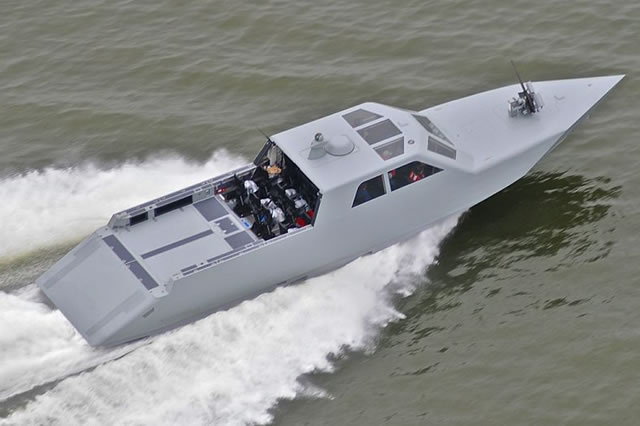
Special Operations Command, Combatant Craft, Medium

Combatant_Craft_Medium_Mark_1_CCM-Mk1_USSOCOM_2

Navy Recognition has a story on the Navy’s planned 60 foot “Combatant Craft, Medium” or CCM.

Characteristics as follows:
CCM Mk1 main characteristics (as provided by USSOCOM):
Length: approximately 60’
Speed: 40
Range: 400 nautical miles
Crew: 4
Payload: 7750 lbs.
Passengers: up to 19
Engine: Twin forced induction diesel engines driving props
Hull: Double step hull made of aluminum

See the story linked above for more photos and details.

Monster Offshore Facility

The New York Times calls it, “The Biggest Ship in the World (Though It Isn’t Exactly a Ship)”

“It’s called Prelude, and it’s bigger than big. More than 530 yards long and 80 yards wide, it was constructed with 260,000 metric tons of steel, more than was used in the entire original World Trade Center complex, and it’s expected to displace 600,000 metric tons of water, or as much as six aircraft carriers.”

This one is to be anchored in North West of Australia, but if one comes to the US EEZ, it is going to be an incredible Marine Inspection task.