The MarineLog has reported that Canada has issued a Request for Proposal (RFP) for seven 19 meter motor lifeboats, with an option for three more.
Canada Issues RFP for 62 foot Motor Surf Boat
3

The MarineLog has reported that Canada has issued a Request for Proposal (RFP) for seven 19 meter motor lifeboats, with an option for three more.

Photo credit: NavyRecognition, Model of the P18N OPV on the CSOC stand during AAD 2014. Click to enlarge.
NavyRecognition reports delivery of another cutter similar in concept to Cutter X. This time it is first of two being built in China for Nigeria.
P18N Offshore Patrol Vessels have a displacement of 1,700 tons, a length of 95 m, width of 12.2 m and beam of 3.5 m. It is powered by two MTU 20V 4000M diesel engines (I believe this is essentially the same engine as in the Webber class WPCs–Chuck). The maximum speed is 21 knots. The endurance of the vessel is 20 days at sea (range 3000 nautical miles at 14 knots) for a crew of 70 sailors.
The range and speed are certainly adequate for their purposes, but “nothing to write home about,” and the hangar is only suitable for UAVs, but it is actually better equipped in some ways than the proposed Cutter X with a 76mm gun and two 30mm. This probably contributes to the size of its 70 member crew.
Nigeria is modernizing their forces. The Nigerian Navy took over the former USCGC Chase in 2011, and they expect to get the Gallatin in 2015. Nigeria is the source of much of our imported oil, and they have an ongoing insurgency and a serious piracy problem.
If the helicopter on the model pictured above looks familiar, it is a Z-9, a Chinese license built version of the French helicopter that was the basis for the H-65. Chinese variants include both ASW and attack helicopter versions.
CIMSEC is taking a week to look at Ship Design and one of their first posts deals with Offshore Patrol Vessels. It is a two parter. You can read it here and here.
The posts include an extensive bibliography and notes that some might find interesting. This is the information on the author, “Dr. Alexander Clarke is our friend from the Phoenix Think Tank in the United Kingdom and host of the East-Atlantic edition of Sea Control.”
Would like to call attention to something retired Navy and Marine Corp flag officers are doing to lobby for better funding for the Navy. It is a letter signed by 95 retired flag officers. Perhaps it would not be unreasonable to expect the Coast Guard’s retired flag officers to do something similar.
While the Navy may be in trouble, the Coast Guard is in a far worse situation. While some of these officers may have be to an extent muzzled by the Department, there is nothing to stop their speaking out now, and if anything the situation has gotten progressively worse since they left the service.
Frankly I find it hard to understand why there is not more outcry about the Coast Guard’s budget. All I seem to see is happy talk about the wonderful new assets, while the Fleet continues to age. We really need a sense of urgency.
Sunday there will be a streaming live interview that some of you might find interesting. It is on a podcast called Midrats. There is an opportunity to contribute to the discussion both by phone and using an online discussion tool. It would not hurt to have a little Coast Guard representation there as well to clarify how he sees the role of the Coast Guard in the National Fleet. If you miss it on Sunday, it is archived on line or you can pick it up on itunes. You can also find the connection through the USNI blog or through the Eaglespeak blog.
Below is a quote in full of the program description. I don’t think they will mind my passing it along.
Please join us at 5pm EST on 9 Nov 14 for for Midrats Episode 253: “The Fleet we Have, Want, and Need – with Jerry Hendrix”
What is the proper fleet structure for the USN as we design our Navy that will serve its nation in mid-Century?
Join us for a broad ranging discussion on this topic and more with returning guest, Henry J. Hendrix, Jr, CAPT USN (Ret.), PhD.
Fresh off his recent retirement from active duty, Jerry is a Senior Fellow and the Director of the Defense Strategies and Assessments Program at the Center for a New American Security (CNAS).
A Naval Flight Officer by training, his staff assignments include tours with the Chief of Naval Operation’s Executive Panel (N00K), the Office of the Undersecretary of Defense for Policy (Force Development) and the OSD Office of Net Assessment.
His final position in uniform was the Director of Naval History.
Hendrix also served as the Navy Fellow to the Weatherhead Center for International Affairs at Harvard University. He has a Bachelor Degree in Political Science from Purdue University, Masters Degrees from the Naval Postgraduate School (National Security Affairs) and Harvard University (History) and received his doctorate from King’s College, London (War Studies).
He has twice been named the Samuel Eliot Morison Scholar by the Navy Historical Center in Washington, DC, and was also the Center’s 2005 Rear Admiral John D. Hays Fellow. He also held the Marine Corps’ General Lemuel C. Shepherd, Jr. Fellowship. He authored the book Theodore Roosevelt’s Naval Diplomacy and received a number of awards, including the United States Naval Institute’s Author of the Year and the Navy League’s Alfred T. Mahan Award for Literary Achievement.Listen in here (or use that link to pick the show up later) or visit us on iTunes.
Pakistan’s “TheNews” is reporting, “The State Department has made a determination approving a possible Foreign Military Sale to Pakistan for GRC43M Cutters and associated equipment parts training and logistical support for an estimated cost of 350 million.”
They are to be built by Westport Shipyard, Inc. (Westport, WA), a company best known as America’s largest yacht builder. We have seen an example of this 43 meter (143 foot) class before. They were demonstrated for the Coast Guard in 2011.
This composite construction vessel is closer to the original concept of the FRC than the Webber Class, and it appears that the cost is about three quarters that of the Webber class. Claims are also made of lower maintenance and longer hull life. They are also faster. Now that the initial contract for the Webbers has run its course, perhaps it would be a good time to reevaluate these as an alternative.
Thanks to Lee for bringing this to my attention.
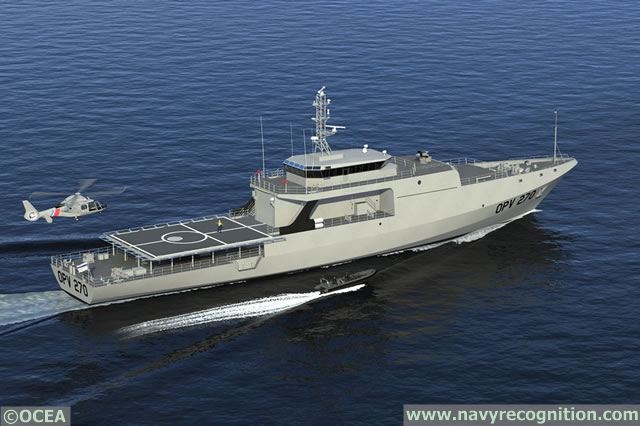
Janes360 is reporting that the Philippine Coast Guard has inked a 90M Euro ($113M) deal for the purchase of five vessels. One is to be an 82/83 meter (270 foot) aluminum hulled patrol vessel and the other four are 24 meter (79 foot) patrol boats.
NavyRecognition, reporting on OCEA participatin in the EuroNaval trade show, has some details on the OPV 270.
“OPV 270 is a 83 m (270 ft) long marine aluminum made ship. It carries 44 crew members and can take 3 to 6 VIP passengers on board, in addition to 20 ordinary passengers. 35 survivors can also be taken on board. It can travel over 4.500 to 8.000 km at 15 knots and its maximum speed, which depends of the load, can reach 26 knots. its endurance is from 30 to 45 days.”
This earlier report by DefenseStudies includes some photographs of the 24 meter patrol boat in service with the Nigerian Navy, and a short discussion of how they are expected to be used. (Incidentally the “West Philippine Sea” is the Philippine name for the South China Sea.)
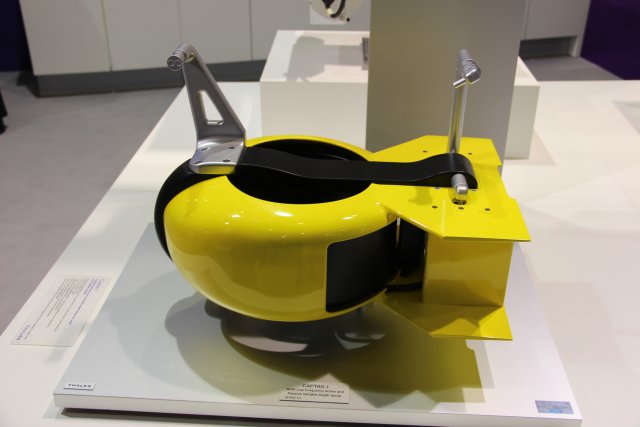
Photo credit: NavyRecognition. Thales CAPTAS 1
As expected, the EuroNaval 2014 trade show is offering some interesting products. This one might be of interest if the Coast Guard ever decides to get back into the ASW mission. Thales, maker of some of the most highly respected sonars in the world, is offering both hull mounted and towed active/passive sonars for vessels as small as 300 tons. The towed sonar is the CAPTAS 1, joining two previous members of a family of systems that share common technology. The Largest of these, the CAPTAS 4 is being evaluated for the ASW module for the LCS.
Coast Guard Compass has reported the release of the “Coast Guard Western Hemisphere Strategy.” I have only made a very cursory scan. At this point I will only note that one thing I frequently see in strategies (including this one) is an apparent presumption that a “multi-layer” strategy is always better, when actually a comprehensive, well executed single layer may be better than a porous multi-layered approach which dilutes our effort. The illegal importers of drugs prove on an almost daily basis that our current multi-layered efforts are far less than 100% effective. By extension we cannot expect them to be effective in intercepting potentially more disastrous security threats.

Singapore is building a new class of patrol vessels that look very much like my proposal for “Cutter X”, trading some Webber class and some larger ships for an intermediate design, costing about half what an OPC would cost, basically putting the equipment and crew (with some augmentation) of a Webber Class into a larger more seaworthy hull, to allow them to be used for extended operation in environments that do not require the ice strengthened hull and ability to launch and recover helicopters and boats in sea state five provided by the OPC.
Singapore is building eight of the ships under the project name “Littoral Missions Vessel” to replace eleven smaller, 500 ton, Fearless class patrol vessels that are approaching 20 years old. These ships are reportedly 80 meters in length (262.5 feet), displace 1200 tons (probably a light displacement), have a beam of 12 meters (39.4 feet), a range of 5,000 nautical miles at 15 knots, and a speed of 27 knots, all with a crew of only 30, though they do include additional accommodations for 30 more. (more here)
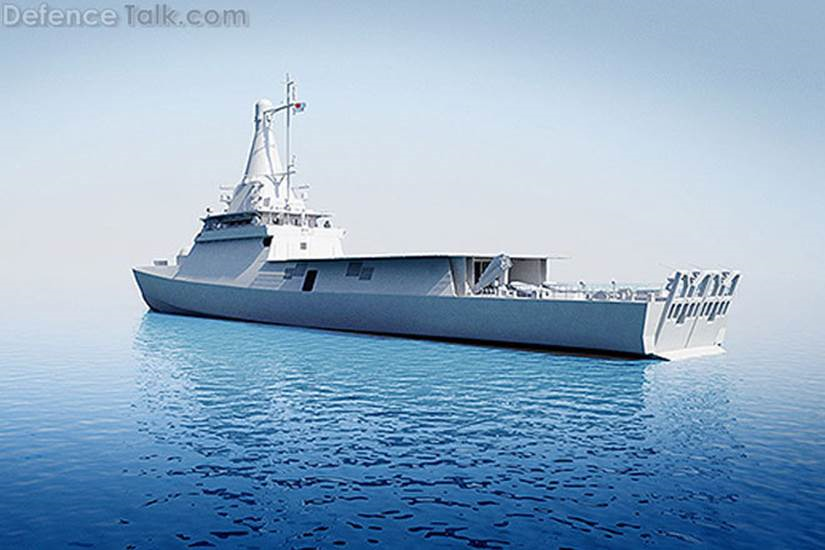
It appears these ships will use the same engines as the Webber Class. It is not clear how many of these engines they are using. Two would give them almost 12,000 HP which would almost certainly be good for at least 24 knots, but it might require three or four engines to make 27 knots. (reports now indicate the class has two engines totallin about 12,000 HP)
In some respects these ships are more capable than the proposed cutter, in that they will have a 76mm gun and firecontrol system, in addition to smaller remotely operated weapons. It also appears to have space reserved for a small AAW missile system. On the other hand, while the flight deck can handle an H-60, the ship, unlike the French L’Adroit which was my model for “cutter X”, has no helicopter hangar, although it might be possible to add one using the same solution employed on L’Adroit (putting it under the bridge).
Soon, I expect to do an update of the “Cutter X” proposal, based on where we are now in the cutter recapitalization program.
 Chuck Hill's CG Blog