“Broken Breakers” –What’s Going On With Shipping

Sal Mercogliano’s video, like the one above are generally about merchant shipping, but he occasionally touches on the Coast Guard, as he has done here. This video is a brief overview of where we are in terms of icebreakers. It avoids the usual temptation to compare the US icebreaker fleet with the number the Russians operate, but it still paints a pretty bleak picture of the current situation.

I am hoping we will start hearing some good news about the program in the near future, but we have an identified need for nine icebreakers. But there does not seem to be a sense of urgency. It seems the Coast Guard has done nothing to start procurement of the medium icebreakers we know we need. There is no reason we could not have the two programs running parallel. For instance, we could have a prototype Arctic Security Cutter built in Finland and outfitted in the US. I think we can honestly say that currently there is no US shipyard capable of taking on the project other than Bollinger, and they are already working at capacity. We can increase capacity over time, but we need some help.

I suspect the feeling is that the medium icebreaker (Arctic Security Cutter) procurement can’t begin until the heavy icebreaker (Polar Security Cutter) program is completed, but that is not necessarily the case. Sure, it would require a larger acquisitions budget, but you never know until you ask. Right now, we haven’t even done the low-cost research it would take to plan the acquisition. Particularly if the Polar Security Cutter Program is further delayed, it would be good to have medium icebreakers plans prepared so that we can accomplish something.

We have the new ICE Pact agreement with Canada and Finland. It is long past time to start the medium icebreaker procurement planning process. I’d begin by asking if we can’t do with something simpler like the Arctic Patrol Ships all the other Arctic nations are currently building.

Cutter Size Ships Building in Latin America

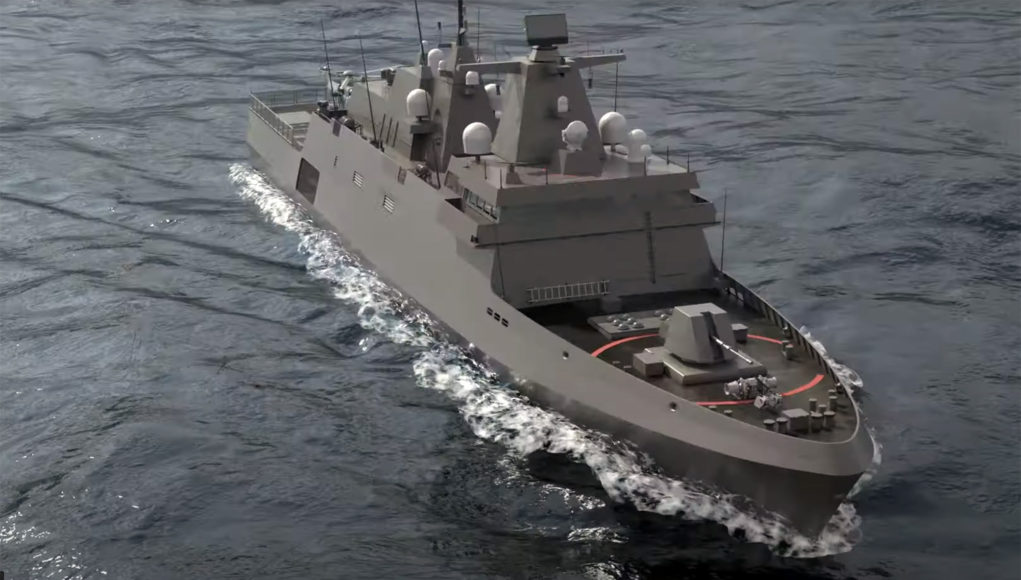
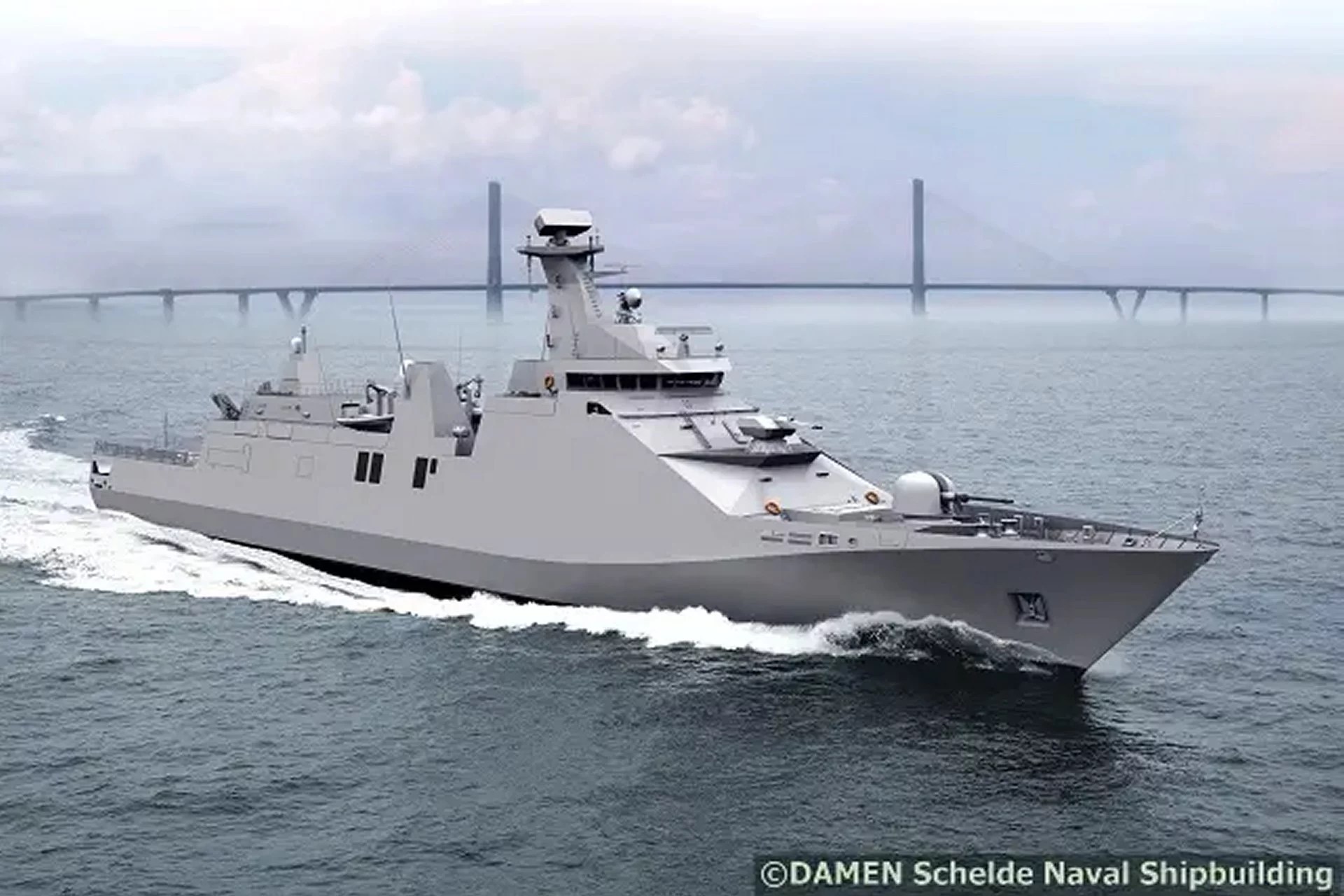
Damen SIGMA 10714 for Colombia

Always interesting to see what other countries are doing in terms of ships that will perform coast guard style missions. In some countries, these are their largest warships.

Two recent reports from Latin America.

In both cases they have chosen to build ships with the assistance of experienced European shipbuilders. Both are smaller than either the National Security Cutter or the Offshore Patrol Cutter.

Brazil has launched the first of a planned eight Tamandaré-Class Frigates, pictured above, designed by ThyssenKrupp Marine Systems of Germany. It is evolved from earlier MEKO designs that include the German K130 Braunschweig class corvettes and the Israeli Sa’ar 6.

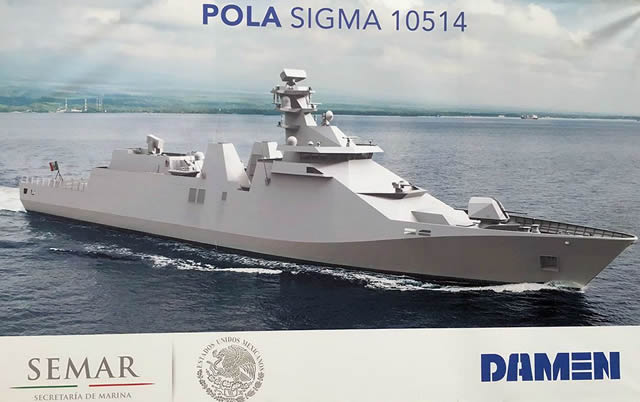
Colombia has contracted with Damen, designers of the USCG Fast Response Cutters, to help locally build the first of five planned light frigates that will replace four somewhat smaller sized Admirante Padilla class ships commissioned 1983/4. The design is a Damen SIGMA 10714 design, meaning it is 107 meters (353′) in length with a beam of 14 meters (46′). The design is closely related to ships built in Mexico (pictured below) and in Indonesia.

Mexico’s Damen SIGMA 10514, ARM Benito Juárez (POLA-101)

Maybe One Small Step Closer to a Polar Security Cutter

Photo of a model of Halter Marine’s Polar Security Cutter seen at Navy League’s Sea-Air-Space Exhibition have surfaced. Photo credit Chris Cavas.

Saw this new Navy contract on a list of DOD Contracts for Aug. 12, 2024.

Bollinger Mississippi Shipbuilding, Pascagoula, Mississippi, is awarded a $37,990,331 firm-fixed-price modification to previously awarded contract (N00024-19-C-2210) to exercise an option for provisioned item orders to procure a diesel generator. Work will be performed in Rostock, Germany (90%); Mankato, Minnesota (5%); and Lafayette, Indiana (5%), and is expected to be completed by December 2025. Fiscal 2021 procurement, construction, and improvement (Coast Guard) funds in the amount of $37,990,331 will be obligated at time of award and will not expire at the end of the current fiscal year. Naval Sea Systems Command, Washington, D.C., is the contracting activity.

That is a mighty expensive emergency generator. It was not clear where this generator was going. Googling the contract number, I found this reference to the contract, connecting it to the Polar Security Cutter.

Contracts For April 23, 2019

NAVY

VT Halter Marine Inc., Pascagoula, Mississippi, is awarded a $745,940,860 fixed-price incentive-firm contract for the detail design and construction of the U.S. Coast Guard (USCG) Polar Security Cutter (PSC) (formerly the Heavy Polar Ice Breaker). The PSC program is a multiple year Department of Homeland Security Level 1 investment and a USCG major system acquisition to acquire up to three multi-mission PSCs to recapitalize the USCG fleet of heavy icebreakers which have exhausted their design service life. The PSC’s mission will be to ensure continued access to both polar regions and support the country’s economic, commercial, maritime, and national security needs. This contract includes options which, if exercised, would bring the cumulative value of this contract to $1,942,812,266. Work will be performed in Pascagoula, Mississippi (61 percent); Metairie, Louisiana (12 percent); New Orleans, Louisiana (12 percent); San Diego, California (4 percent); Mossville, Illinois (4 percent); Mobile, Alabama (2 percent); Boca Raton, Florida (2 percent); and various other locations (3 percent), and is expected to be completed by June 2024. If all options are exercised, work will continue through November 2027. Fiscal 2019 procurement, construction, and improvement (Coast Guard); and fiscal 2018 and 2017 shipbuilding and conversion (Navy) in the amount of $839,224,287 will be obligated at time of award and will not expire at the end of the current fiscal year. This contract was competitively procured via the Federal Business Opportunities website, with three offers received. The Naval Sea Systems Command, Washington, District of Columbia, is the contracting activity (N00024-19-C-2210).

I presume this is for the first of class since construction has not yet begun, but there was also this,

Contracts For Dec. 29, 2021

NAVY

VT Halter Marine Inc., Pascagoula, Mississippi, is awarded a $552,654,757 fixed-price incentive modification to previously awarded contract N00024-16-C-2210 to exercise an option for the detail design and construction of the second Coast Guard Polar Security Cutter. Work will be performed in Pascagoula, Mississippi (61%); Metairie, Louisiana (12%); New Orleans, Louisiana (12%); San Diego, California (4%); Mossville, Illinois (4%); Mobile, Alabama (2%); Boca Raton, Florida (2%); and other locations (3%), and is expected to be completed by September 2026. Fiscal 2021 procurement, construction, and improvement (Coast Guard) funds in the amount of 485,129,919 (80%); fiscal 2020 procurement, construction, and improvement (Coast Guard) funds in the amount of $100,000,000 (17%); and fiscal 2019 procurement, construction, and improvement (Coast Guard) funds in the amount of $20,000,000 (3%) will be obligated at time of award and will not expire at the end of the current fiscal year. The Naval Sea Systems Command, Washington, D.C., is the contracting activity.

The Félix Éboué class, a Modern, Minimalist, Medium Endurance Cutter

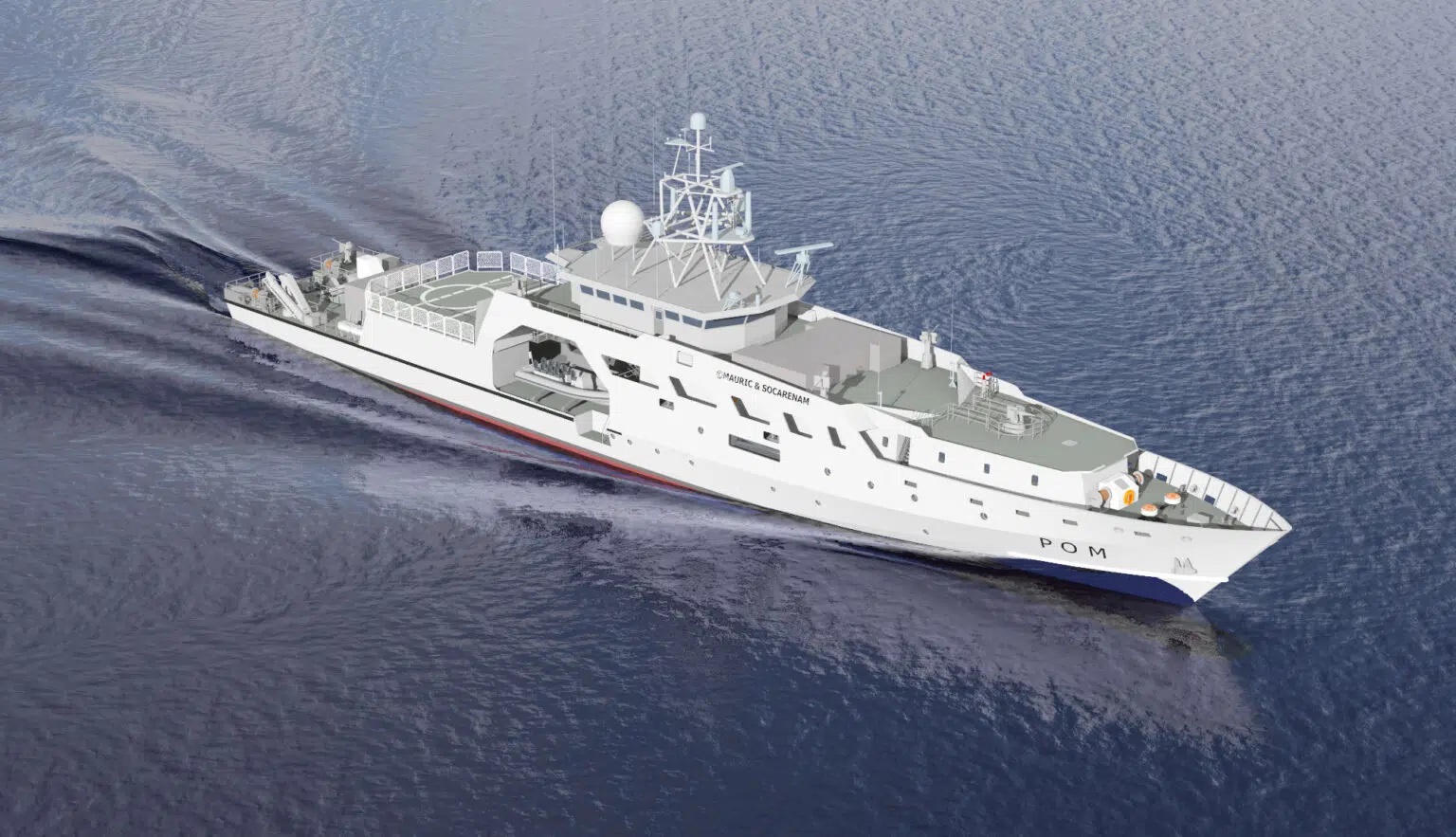
An artist’s rendering, Félix Éboué class or Patrouilleurs Outre-mer (POM)

The Offshore Patrol Cutter (OPC) is described as, “…a capability bridge between the national security cutter, which patrols the open ocean in the most demanding maritime environments, and the fast response cutter, which serves closer to shore.”

That may have been the intention, but that is not what we got.

While the National Security Cutter is better than the WHECs they replaced in almost every way, the OPCs are not only better than the WMECs they will replace, but they are also, in every way except maximum speed, better than the WHECs as well. Instead of a high/low mix of cutters, they all turned out high end. We should not be surprised the OPCs construction and operating costs approach those of the NSCs.

Construction costs are typically proportional to displacement. The OPCs’ displacement is 98% that of the NSC and 1232.8% (more than 12 times) that of the Fast Response Cutters.

This would not be a bad thing, if we had enough NSCs and OPCs to meet our large patrol cutter needs, but I don’t think we will ever get there.

We are expected to ultimately end up with only 36 large patrol cutters, fewer than we have had in decades and fewer than other Coast Guards with far smaller EEZs.

A new fleet mix study has been completed, but the results have not been made public (Why not? This is not transparency). I suspect it shows a need for substantially more than 36 large patrol cutters.

If we look at the previous “Fleet Mix Study,” now over a dozen years old, which minimized requirements because it did not consider “High Latitude regions of the ice shelf and Deployable Operations Group (DOG),” and assumed that NSCs would use the “Crew Rotation Concept” that was expected to allow them to operate 230 days per year, to meet all statutory requirements, the study indicated the Coast Guard needed 66 large cutters, 30 more than currently planned, and 91 FRCs.

If we want significantly more large patrol cutters than currently planned, perhaps we need a smaller, cheaper alternative to the OPCs that requires a smaller crew and are more economical to operate. In previous posts, I have referred to this alternative as (Cutter X).

Thinking Ahead: 

Getting funding for more than two OPCs per year is probably unrealistic. The last OPC is not expected to be commissioned until 2038, 14 years from now. If we continue to build only two large patrol cutter a year, will not be able to grow the fleet until after 2038 and then it will grow slowly because the National Security Cutters will start aging out.

We might not be able to continue to build OPC sized patrol cutter after 2038. The Coast Guard will want to build Arctic Security Cutters (or perhaps Arctic Patrol Cutters). Both the Juniper class WLBs and Keeper class WLMs will need to be replaced.

(Where is our long-range shipbuilding plan?)

If we started in the next year of two, we could be producing true medium endurance cutters in significant numbers before the planned completion of the OPC program. On a 3 for 1 or even 2 for 1 exchange for the last few OPCs, if we tried, we could start to grow the fleet perhaps as early as 2032.

That is why the Félix Éboué class is worth a look. It is, what I believe may be, the absolute minimum fully capable Offshore Patrol Vessel. It covers all the bases. It is good enough for most operating areas. That is not to say, there are no good reasons for some add–ons, but I think it is a kind of benchmark. It is also a good representation of Cutter X. There are reasons we might want to go bigger, but before you increase the quality of the individual cutters, first we need to have enough.


The French Experience

France, like the US has a huge Exclusive Economic Zone (EEZ), the largest in the world, 11,691,000 km2 (4,514,000 sq mi). The US EEZ is 11,351,000 km2.

Unlike the US, the French don’t have a coast guard that operates ocean going ships to enforce laws and protect sovereignty. The French Navy does this, and uses a fleet of Offshore Patrol Vessels, some of which are referred to as frigates.

The Félix Éboué class is their newest class of OPVs. They are intended specifically to patrol the waters of French overseas territories in the Pacific and Indian Oceans. They will be based, two each, at NouméaTahiti and La Réunion. They replace the P400 class, which are slightly larger than the Webber class WPC, which were found to be inadequate.

I have found some very good photos of the second ship of the class being fitted out, that show details I had not seen before, and would like to share them. I will also bring forward some of my earlier commentary with updates, so as to consolidate information on this interesting class.

Comparison with Webber class WPC (FRC):

Below is a comparison between the FRC and the Félix Éboué class (POM) that was included in an earlier post, updated with information about the propulsion system on the French ships.

French overseas patrol vessel (POMs) Auguste Bénébig. Photo: http://www.meretmarine.com

Like an FRC:

I always thought these looked like oversized Webber class, the proportions are similar, and the much larger POM is not much more complicated than the Webber class. The crew of the POM is 30, only six more than that of the FRC. Both have a bridge with a 360-degree view positioned well aft, minimizing vertical acceleration. Both have an 8 meter boat in a stern ramp. The armament is similar with four .50 cal. machine guns and a single medium caliber gun in the bow, a 20mm on the POM and a 25mm on the FRC. The POM uses slightly less powerful diesel engines, 2x ABC 16V DZC medium speed diesels 3.7MW each @ 1,000rpm, for a total of about 9924 HP compared to 11,600 for the FRC. (I am told the POM’s engines are also more economical and simpler to maintain.) But the French ships still manage to make 24 knots, a couple of knots more than claimed for the OPC. With similar crew and systems, they should not cost much more than the FRCs to operate.

Unlike an FRC:
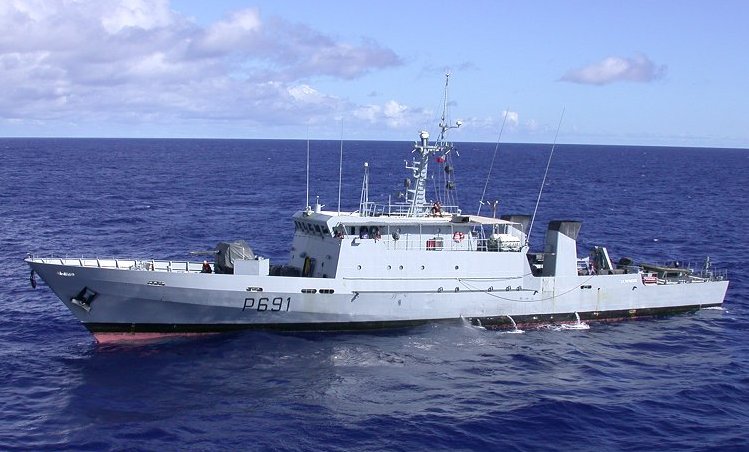
P400 patrol ship Tapageuse at sea near Tahiti (18 June 2003). Photographer: Jean-Michel Roche

While they would have been thinking of their existing 373 ton P400 class pictured above, it might appear to us that they wanted a ship to do the same sorts of missions the Webber class Fast Response cutters (FRC) are doing out of Guam, but they recognized that these ships would be far from any major naval base and that they would need to travel great distances and would be exposed to extreme weather conditions, so they needed to be larger (1300 tons vs 353 tons for the FRC) and have greater range (5500 miles vs 2500) and endurance (30 days vs 5 days).

Having chosen a larger hull, they took advantage of the greater volume and deck space to add a second RHIB, a multimode radar, space for 29 passengers (roughly a platoon of Marines), a sickbay, a dive locker, space for a 20 foot containerized mission module, a flight deck and hangar for a 700-kilogram-class rotor-blade drone (not yet deployed), and a holding area for up to six prisoners.

Some sources also indicate the French ships also have electric motors that would allow them to cruise on the ship’s service generators and secure the main propulsion engines, but I have seen no specifics.

The Photographs: 

The second of the French Navy’s six new overseas patrol vessels (POM), the Teriieroo a Teriierooiterai, which will be based in French Polynesia and has been named in tribute to a Companion of the Liberation native of this Pacific territory, Photo: http://www.meretmarine.com

The Teriieroo at Teriierooiterai fitting out at the end of July, 2023 in Boulogne. Photo: http://www.meretmarine.com

Stern ramp for 8 meter RHIB. French Navy overseas patrol vessel (POM), Teriieroo a Teriierooiterai, fitting out 2023. Photo: http://www.meretmarine.com

Second 8 meter RHIB and davit (only) on starboard side. French Navy overseas patrol vessel (POM), Teriieroo a Teriierooiterai, fitting out 2023. Photo: http://www.meretmarine.com

Aliaca aerial drone on its launch catapult. French Navy overseas patrol vessel (POM), Teriieroo a Teriierooiterai, fitting out 2023. Photo: http://www.meretmarine.com

Recovery System for Unmanned Air System, French Navy overseas patrol vessel (POM), Teriieroo a Teriierooiterai, fitting out 2023. Photo: http://www.meretmarine.com

Navy Issues Large Contract for Development of Unmanned Surface Vehicles

A U.S. Navy L3 Harris Arabian Fox MAST-13 drone boat and the U.S. Coast Guard cutter USCGC John Scheuerman transit the Strait of Hormuz on April 19, 2023. (Information Systems Technician 1st Class Vincent Aguirre/U.S. Coast Guard)

Below the break is a quote from DOD “Contracts for June 14, 2024.”
This is a big step toward procurement of an “Unmanned Surface Vehicle Family of Systems.” There can be little doubt the Coast Guard will exploit some of these developments and will probably participate in some of the testing, as they have done with 4th and 5th Fleet. 
Of the 49 partners mentioned, Bollinger is the only one I recognize as a ship builder. Could this mean we will see a Fast Response Cutter emerge as an Optionally manned or Unmanned Surface Vehicle? Probably not, but…
The funding structure is interesting. This is potentially an almost one billion dollar contract, but the initial commitment is only $49,000, $1,000 to each of the contractors. Sounds like they built in a lot of flexibility.

A multiple-award contract to support current and future unmanned surface vehicle family of systems and subsystems is awarded to the following 49 industry partners: Anduril Industries Inc.,* Costa Mesa, California (N0002424D6306); Applied Research Associates Inc., Albuquerque, New Mexico (N0002424D6307); Asymmetric Technologies LLC,* Dublin, Ohio (N0002424D6308); AT&T Corp., Oakton, Virginia (N0002424D6309); Atlas Technologies Inc.,* North Charleston, South Carolina (N0002424D6313); Autonodyne LLC,* Boston, Massachusetts (N0002424D6315); Beast Code LLC,* Fort Walton Beach, Florida (N0002424D6316); Bigelow Family Holdings LLC, doing business as Mettle Ops,* Sterling Heights, Michigan (N0002424D6317); Bollinger Shipyards Lockport LLC, Lockport, Louisiana (N0002424D6318); CACI Inc. – Federal, Chantilly, Virginia (N0002424D6319); Carnegie Robotics LLC, doing business as CR Tactical,* Pittsburgh, Pennsylvania (N0002424D6320); Cydecor Inc.,* Arlington, Virginia (N0002424D6361); DELTA Resources Inc., Alexandria, Virginia (N0002424D6363); Fairbanks Morse LLC, Beloit, Wisconsin (N0002424D6364); Teledyne FLIR Surveillance Inc., North Billerica, Massachusetts (N0002424D6365); General Atomics Aeronautical Systems Inc., Poway, California (N0002424D6366); GIRD Systems Inc.,* Cincinnati, Ohio (N0002424D6367); Herren Associates Inc.,* Washington, D.C. (N0002424D6368); Honeywell International Inc., Clearwater, Florida (N0002424D6369); IERUS Technologies Inc.,* Huntsville, Alabama (N0002424D6370); Integer Technologies LLC,* Columbia, South Carolina (N0002424D6371); KIHOMAC Inc.,* Reston, Virginia (N0002424D6372); Leonardo Electronics US Inc., Huntsville, Alabama (N0002424D6373); MAK Technologies Inc., Cambridge, Massachusetts (N0002424D6374); Marine Ventures International Inc.,* Stuart, Florida (N0002424D6375); Marinette Marine Corp., Marinette, Wisconsin (N0002424D6376); Metron Inc.,* Reston, Virginia (N0002424D6378); Microsoft Corp., Redmond, Washington (N0002424D6379); Murtech Inc.,* Glen Burnie, Maryland (N0002424D6380); NewSat North America LLC,* Indian Harbour Beach, Florida (N0002424D6381); Noblis MSD LLC, Philadelphia, Pennsylvania (N0002424D6382); Novetta Inc., McLean, Virginia (N0002424D6383); Ocean Specialists Inc.,* Stuart, Florida (N0002424D6384); PACMAR Technologies LLC,* Honolulu, Hawaii (N0002424D6377); Persistent Systems LLC,* New York, New York (N0002424D6385); Physical Sciences Inc.,* Andover, Massachusetts (N0002424D6386); Prescient Edge Corp.,* McLean, Virginia (N0002424D6387); Programs Management Analytics & Technologies Inc.,* San Diego, California (N0002424D6388); Reliability & Performance Technologies LLC,* Dublin, Pennsylvania (N0002424D6389); Saab Inc., East Syracuse, New York (N0002424D6390); Scientific Systems Co. Inc.,* Woburn, Massachusetts (N0002424D6391); Secmation, LLC,* Raleigh, North Carolina (N0002424D6392); SES Government Solutions Inc., Reston, Virginia (N0002424D6393); SIMIS Inc.,* Portsmouth, Virginia (N0002424D6394); Sparton DeLeon Springs LLC, De Leon Springs, Florida (N0002424D6395); Systems and Proposal Engineering Co.,* Manassas, Virginia (N0002424D6396); Systems Technology & Research Inc.,* Huntsville, Alabama (N0002424D6397); TDI Technologies Inc.,* King of Prussia, Pennsylvania (N0002424D6398); and Triton Systems Inc.,* Chelmsford, Massachusetts (N0002424D6399), are each awarded a firm-fixed-price, fixed-price-incentive-firm-target, cost-plus-incentive-fee, cost-plus-fixed-fee, and cost only, indefinite-delivery/indefinite-quantity contract for the procurements involving one or more functional areas, i.e. payloads, non-payload sensors, mission support systems, autonomy and vehicle control systems, ashore and host platform elements, and logistics and sustainment for the Unmanned Surface Vehicle Family of Systems. The maximum dollar value for all (total number) contracts combined is $982,100,000. Each awardee will be awarded $1,000 (minimum contract guarantee per awardee) at contract award. Work will be performed in various locations in the contiguous U.S. and is expected to be completed by February 2025. These contracts include a five-year ordering period option which, if exercised, will continue work through February 2030. Fiscal 2024 research, development, test and evaluation (Navy) funding in the amount of $49,000 will be obligated at the time of award and will expire at the end of the current fiscal year. All other funding will be made available at the delivery or task order level as contracting actions occur. These contracts were competitively procured via SAM.gov and there were 55 offers received. Naval Sea Systems Command, Washington Navy Yard, D.C., is the contracting activity.

Japan to Build Five Large Cutters for Philippine Coast Guard

Japanese built Philippine Coast Guard cutter BRP Melchora Aquino

The EurAsian Times reports that Japan and the Philippines have finalized their largest security agreement to date.

“The US $507 million project is funded by an Official Development Aid loan from the Japan International Cooperation Agency. Around $425 million will be utilized in constructing five 97-meter-long multi-mission response vessels (MRRV) and a five-year integrated logistics support package…The patrol vessels are expected to be delivered between 2027 and 2028.”

The Philippine CG already has two ships of this type. We talked about this class earlier. Final specs, if there are no changes, from NavyRecognition,

“The MRRV has a length of 96.6 meters (317 feet–Chuck), a maximum speed of not less than 24 knots, and has a complement of 67 crew members. She has a two 6600 kW (6.6MW) diesel engines.”

That is about 17,700 HP. By comparison, the OPCs, which are longer and twice as heavy. will have 19,520 HP.

It appears the Philippine Coast Guard still has not armed their cutters with anything larger than .50 caliber machine guns. This class does have water cannon. Their Japanese counterparts are armed with either 20mm Gatling guns or Bushmaster II 30mm chain guns in Remote Weapon Stations.

Meanwhile the Philippine Navy is also buying Offshore Patrol Vessels, six from S. Korea. They will be much more heavily armed.

“EASTERN SHIPBUILDING GROUP COMMENCES PHASE II OF MAJOR INFRASTRUCTURE IMPROVEMENTS” –News Release

Future USCGC Argus at launch Eastern Shipyard

Below is a news release from Eastern Shipbuilding Group. Hopefully these improvements will shorten construction times for the remaining Eastern built OPCs. It will almost certainly put Eastern in a better position to bid on the last group of OPCs which should be built at a rate of at least two completions per year.

If nothing else, any increase in US shipbuilding capabilities is good news.

Eastern has had their share of difficulties with the OPC program. Hopefully they will surprise us with increasing success on the three ships that follow the future USCGC Argus.


15 May, 2024

EASTERN SHIPBUILDING GROUP COMMENCES PHASE II OF MAJOR INFRASTRUCTURE IMPROVEMENTS

PANAMA CITY, FL – Eastern Shipbuilding Group, Inc (ESG) is proud to announce the commencement of phase two of a significant infrastructure improvement project at its Nelson Street government shipbuilding facility. This phase includes the construction of 1,000 linear feet of additional bulkhead and berthing space, installation of associated heavy weather mooring infrastructure, the extension of the launch facility by 120 feet to increase the total launch way length to over 500 feet, and the final dredging of vessel berthing spaces and the shipyard turning basin. These enhancements will significantly increase ESG’s capability to construct and deliver multiple ships per year, supporting future Department of Defense (DOD) shipbuilding goals.

“This infrastructure improvement project represents a major investment in our government shipbuilding capabilities,” said Joey D’Isernia, Chairman and CEO of ESG. “The increased capacity and shipyard enhancements will allow us to better support the Navy’s initiative to expand the shipbuilding industrial base in order to meet the demands of the national defense strategy.”

The addition of 1,000 linear feet of bulkhead will provide ESG with more berthing space to better support construction programs that require multiple vessel deliveries per year. The extension of the launch way by 120 feet will enable ESG’s Nelson Street government shipyard to accommodate larger vessels more than 500 feet, expanding its capacity to construct a variety of ships to meet the evolving needs of the U.S. Navy and other government agencies. The project is expected to be completed in the summer of 2025.

ESG is known for its expertise in designing and constructing a wide range of complex vessels, including U.S. Coast Guard Offshore Patrol Cutters, the newest U.S. Army Corps of Engineers Medium Class Hopper Dredge, fully automated multipurpose offshore support vessels, and the most technologically advanced modern factory trawlers. The expanded capacity resulting from this infrastructure improvement project will further strengthen ESG’s position as a leader in the shipbuilding industry.

“Marine News’ 2024 US Shipbuilding Report” –Marine Link

Future USCGC Argus at launch Eastern Shipyard. Presumably the furture USCGC Chase in the background. 

Marine Link has a report that gives us a look at how shipbuilders look at their industry and their relationship with Government.

This includes comments from both Ben Bordelon, president and CEO of Bollinger Shipyards that is building the Fast Response Cutters and the new Polar Security Cutters, and Joey D’Isernia, the chairman and CEO of Eastern Shipbuilding Group that is building the first four Offshore Patrol Cutters.

There is also a good deal of discussion about new technology being applied to tugs that the Coast Guard might want to consider if we choose to replace the 65 foot and 140 foot icebreaking tugs.

This banner hangs over a passageway in one of the shops at Bollinger’s Lockport shipyard.

“Kongsberg Maritime to supply Promas propulsion systems for the United States Coast Guard’s new Offshore Patrol Cutter programme” –Kongsberg Maritime

Below is a news release from Kongsberg Maritime. This will maintain continuity with the four ships being built by Eastern.


Kongsberg Maritime has been selected by Austal USA to supply its Promas propulsion system to the latest ship in the United States Coast Guard’s new Offshore Patrol Cutter (OPC) Heritage Class programme.

This initial contract is to supply Kongsberg Maritime equipment for the fifth ship, Coast Guard Cutter Pickering, which is the first to be built by Austal USA at their yard in Mobile, Alabama.

The Coast Guard’s new OPC programme represents a significant investment in maritime capability and is expected to run up to 25 ships. The new vessels will replace the Coast Guard’s medium endurance cutters and meet the need for long-term offshore capability to maintain current and future mission effectiveness.

Promas combines rudder and controllable pitch propeller into one propulsion system which optimises the hydrodynamic properties of the ship and delivers increased efficiency and thrust while using less energy. For the OPC, as well as twin Promas, Kongsberg Maritime is contracted to supply steering gear, rudders, fin stabilisers and tunnel thrusters.

Björn ten Eicken, Kongsberg Maritime, Vice President – Naval, said: “Kongsberg Maritime has a proud history of supplying mission critical technology to United States Coast Guard programmes.

“We have supplied our propulsion systems for naval and governmental forces for more than 80 years, and we’re delighted to have developed an efficient and effective system specifically suited to the challenging and varied operations of these new ships. Our Promas systems typically deliver efficiency savings of around 6%, so vessels are able to extend their range, something which can be crucial on longer missions.

“We’re looking forward to working with the Coast Guard and Austal USA on delivering these highly-capable ships.”

The OPC vessels will be able to provide long range patrol capability. At 360 feet long, they will have a displacement of 3,700 long tons, maximum speed of 22.2 knots, and a range of 9,050 nautical miles at 14 knots.

Norway to Build Dual Service (Coast Guard/Navy) Ships

The future fleet plan of the Royal Norwegian Navy. Click to enlarge.

Naval News reports,

The Norwegian government today announced their new long-term defence plan for the period 2025 to 2036. Under the name of The Norwegian Defence Pledge, the plan envisions significant growth which not only will see the country reach NATO’s target of 2 % of GDP to defence already this year, but also see that figure pass 3 % towards the end of the period.

Significantly for their Coast Guard,

A major standardization program is envisioned for the Coast Guard – a branch of the Navy – and non-surface warfare vessels of the Navy. The current seven classes of patrol vessels, corvettes, mine-countermeasure vessels, and auxiliaries will be replaced by two different standardized designs – a medium-sized platform for coastal waters and a large for offshore work – with modular weapons and sensor fits. A total of 18 medium and 10 large vessels are to be acquired.

Saying these will replace the corvettes means they will replace the Skjold class missile corvettes.

Norwegian Skjold class corvette Storm. From Wikipedia.

This program bears watching. The Norwegians may be showing us how to make Coast Guard cutter that can be quickly equipped to make a useful contribution in war time.