DOD Arctic Strategy, 2024, a Critique

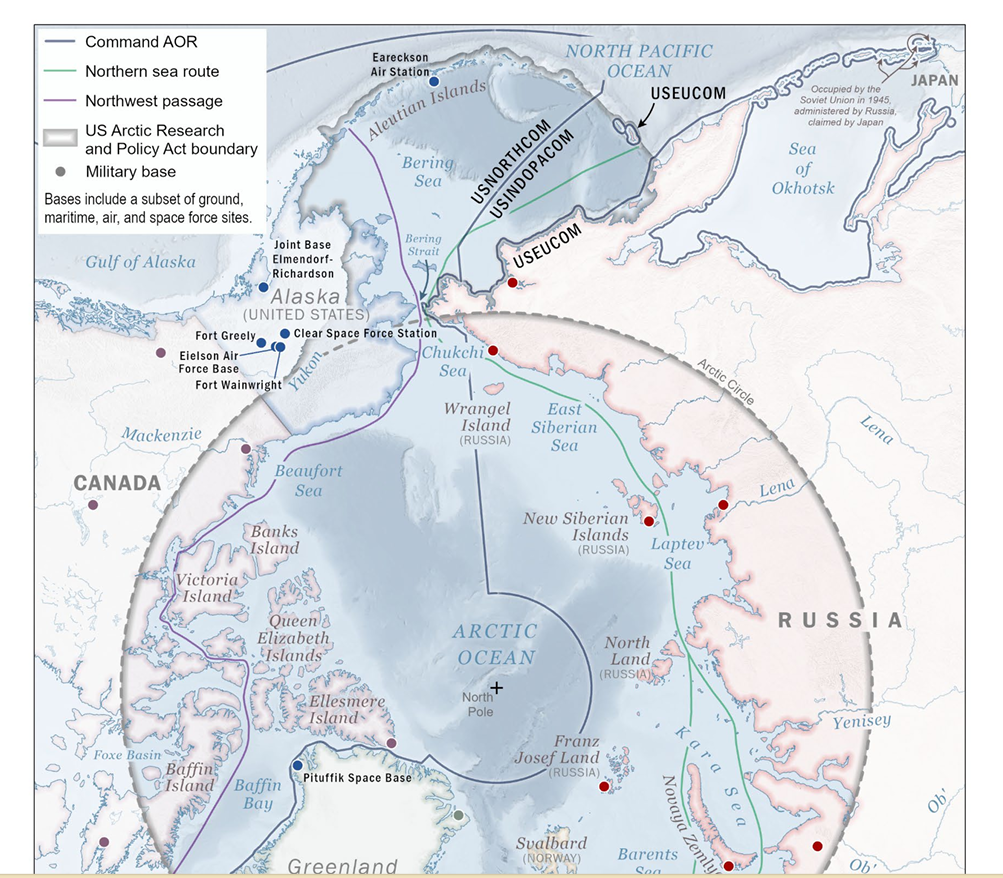
Screen grab from page 2 of the DOD Arctic Strategy, 2024

Here is a link to the new DOD Arctic Strategy here. I found it disappointing. There isn’t much strategy here. I would sum it up as–we are going to keep doing what we are doing, but we are going to do it better. (See critique below.)

“This strategy will strengthen the ability of the United States to build integrated deterrence and effectively manage risk to U.S. interests in the Arctic region by enhancing our domain awareness and Arctic capabilities; engaging with Allies, partners, and key stakeholders; and exercising tailored presence.”

About the US Coast Guard:

The US Coast Guard or USCG was mentioned in three places, once in a caption of a picture of USCGC Healy and these two paragraphs.

DoD will partner with the Department of Homeland Security (DHS), including through the U.S. Coast Guard (USCG), which plays a vital role in maintaining U.S. presence in the Arctic region and supporting domain awareness. The USCG is responsible for operating and maintaining the United States’ icebreaking capability, and DoD will continue to support the USCG’s long-term acquisition of at least eight polar icebreakers that will provide needed icebreaking capability for both military and civilian purposes, including PR/SAR. While disaster response is not a force sizing or shaping requirement, DoD remains ready to support DHS and the Federal Emergency Management Agency in the event of disaster, terrorist attack, or other mass-casualty incident in the Arctic when directed by the President or when requested by a lead Federal department or agency and approved by the Secretary of Defense.

Service-specific, Joint, Interagency, and Combined Exercises. Security and stability in the Arctic depend, in  part, on the Joint Force’s ability to respond rapidly and   effectively to threats in the region. Exercises increase interoperability with Allies and partners, validate plans, train our ability to rapidly deploy to all parts of the Arctic region, and provide an opportunity to test equipment in Arctic conditions. As such, the Joint Force will continue to exercise frequently in the Arctic through Service specific training, joint exercises —to include with USCG— and
combined exercises with our Allies and partners. DoD will
ensure CCMDs with Arctic equities work toward global integration through joint exercises and ensure key exercise lessons inform capability requirements and strategic planning.

That’s it.

About Icebreakers: Icebreakers are mentioned twice, it the paragraph above and here,

The PRC seeks to bolster its operational expertise in the Arctic, where its presence, while limited, is increasing. The PRC operates three icebreakers—the Xue Long, Xue Long 2, and Zhong Shan Da Xue Ji Di—which enable the PRC’s dual civil-military research efforts in the Arctic. Over the course of the PRC’s 13 Arctic research expeditions to date, the vessels have tested unmanned underwater vehicles and polar-capable fixed-wing aircraft, among other activities. People’s Liberation Army Navy (PLAN) vessels have also  demonstrated the capability and intent to operate in and around the Arctic region through exercises alongside the Russian Navy over the past several years.

Critique:

“DoD will reach this end state through a monitor-and-respond approach.”

In other words, we will be reactive rather than proactive. 

The threat to Europe in the Polar regions is just part of the long running NATO defense problem. No real change there, except the formal extension of NATO into Sweden and Finland.

The Air Threat over the Pole to North America is looked after by NORAD. Apparently, NORAD does not look after Greenland, but that does not seem to be a central problem.

Ground operations in the Arctic are always going to be difficult. There may be small unit operations but no need to worry about an invasion of North America coming over the pole. NORTHCOM is exercising both land and air assets that would be needed to deal with realistic threats.

The North Slope oil fields and the associated pipeline are probably a target if we become engaged in a long-term conflict that involves combat in or over the arctic. The oil fields are not mentioned in the strategy,

What has changed?

The opening of the Arctic Ocean to maritime commerce has made it a possible avenue for logistics between Russia and China with the potential for militarily valuable shipments moving both ways between the Russian Arctic coast on one end and the Russian Pacific Coast, North Korea, or China on the other. The weakness of Russian transcontinental land transportation systems makes the Northern Sea Route particularly important.

The door to be shut or left open is the Bering Strait.
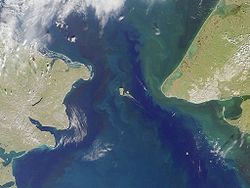
Bering Strait. 44 Nautical miles (82km) wide, with the Diomede Islands in the center.

The “strategy” mentions the Bering Straits only as a choke point,

The Arctic includes multiple strategically significant maritime chokepoints. Reduction in sea ice
due to climate change means chokepoints such as the Bering Strait between Alaska and Russia and the Barents Sea north of Norway, are becoming more navigable and more economically and militarily significant.

We would certainly want to deny use of the Strait by our enemies and ensure that we and our allies have the option to transit through the Strait.

The planned deep-water port in Nome (currently on hold) will be essential to forces that might be used to control access to the Bering Strait. We would also want to make sure St Lawrence Island and Little Diomede remain in US hands. The US might also want to seize Big Diomede. None of these strategic locations are mentioned in the plan.
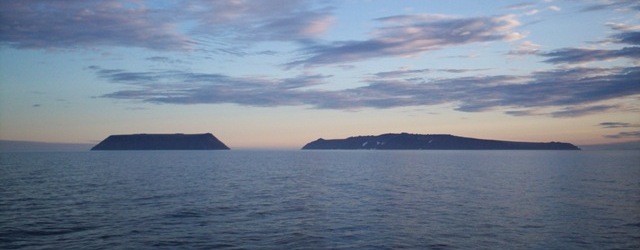
Diomede Islands: Little Diomede Island or Kruzenstern Island (left) and Big Diomede Island or Ratmanov Island in the Bering Sea. Photo is from the north. Photo by Dave Cohoe.

But who is in charge?

First look at the map at the head of this post. They have divided the Arctic so that operations there are under three different Unified Combatant Commands, USEUCOM, USINDOPACOM, and USNORTHCOM. In other words, no one below the President is in charge over the whole area.

These are the Unified Combatant Commander’s Areas of Responsibility. What is not made clear in this graphic is that all of Russia including the larger Asian part is under USEUCOM.

Perhaps most critically, the Pacific interface with the Arctic is under all three COCOMs.

  • USEUCOM is responsible for the Russian land areas in spite of the fact that the Bering Strait is 4521 statute miles from the COCOM’s headquarters in Stuttgart, Germany, and that is the shorter distance West from Stuttgart across the Atlantic and over the US, rather than over Russia. –This has got to be wrong.
  • USNORTHCOM has the Bering Strait and the Eastern half of the Bering Sea but normally they have no significant naval force. Their primary responsibility is the air defense of the US and Canada.
  • USINDOPACOM, which has the naval assets in the Pacific that might be used to attack Russian assets in Asia has responsibility for only the Western half of the Bering Sea below the Bering Strait.

This division of responsibility, placing Russian Asia under USEUCOM, also means that if the US should be at war with both China and Russia, then at least officially, conducting the war in the Pacific would be under two or perhaps three different COCOMs. I doubt this would actually work this way.

Three New Strategies, National, Arctic, Coast Guard

October seems to be the month for new strategic documents. Normally I would like to read and summarize the highlights, but I just have not had the time and I don’t want to delay getting the information out. Maybe we will take a look at them in more detail or we can discuss in the comments. You can access them here:

I have had a little time to look at the Arctic strategy and it tells me there will be Icebreakers on the Atlantic side as well as the Pacific. There is of course a lot more, but I did not see anything surprising.

“While China makes Pacific islands tour, US Coast Guard is already on patrol” –CNN

U.S. Coast Guard Cutter Munro is tied up in Suva, Fiji, during a visit to the port city April 22, 2022.  The port call was part Operation Blue Pacific, that aims to counter illegal, unreported and unregulated fishing, and strengthen relationships to enhance maritime sovereignty and security throughout the Indo-Pacific. (U.S. Coast Guard photo courtesy of Office of the FMSRCC, Republic of Fiji Navy)

The Coast Guard got some national recognition for its work in the Western Pacific from CNN. It is being recognized as a counter to increasing Chinese influence in the region.

The Coast Guard’s website shows cutters have spent hundreds of days and steamed thousands of miles in the past two years helping Pacific island nations.

I have not seen this website, but I would like to. I found this one, but it is not a Coast Guard website.

The story mentions the Coast Guard’s role in the administration’s Indo-Pacific Strategy, which goes well beyond fisheries. The Strategy was discussed here.

“Chinese Assessment of New U.S. Naval Strategy” –USNI

The US Naval Institute news service provides a translation of a Chinese review of the Tri-Service Naval Strategy, “Advantage at Sea.”

It is, in my view, a surprisingly even handed evaluation. Not that it does not reflect the Chinese position, but it is at least fairly accurate.

One particular paragraph references the US Coast Guard.

Third, the U.S. will also introduce a new style of struggle, namely, it will bolster competition in the “gray zone.” That is, the U.S. will take greater action in the domains of social media; supply chains, especially defense industry chains; and space and cyber. A fairly obvious early indicator of this was that the USCG—which traditionally operates in the vicinity of the U.S. coast to defend the security of U.S. territory—has recently moved forward into the South China Sea region. It is preparing to conduct military operations in the South China Sea, with the aim of striking China’s maritime forces as well as bolstering joint law enforcement with regional states in the South China Sea, in order to respond to China’s South China Sea rights protection operations.

The idea of the USCG moving into the South China Sea “with the aim of striking China’s maritime forces” is a bit far fetched, but the rest is reasonably accurate and reflects the Strategy’s recognition of the Coast Guard as uniquely qualified to counter aggression in the “Gray Zone.”

“A Blue Arctic, a Strategic Blue Print for the Arctic” –Dept. of the Navy

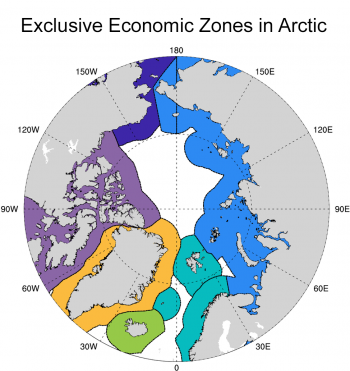
This map show the exclusive economic zones (EEZs) within the Arctic: Canada (purple), Greenland (orange), Iceland (green), Norway (turquoise), Russia (light blue), and USA (dark blue). As sea ice reduces there will be more opportunity for ice to drift from one EEZ to another, which has implications for the potential spread of pollutants.
Credit: DeRepentigny et al., 2020

Naval News has a short interview/critique of the new, 28 page, Navy publication, New U.S. Strategic Blueprint for a Blue Arctic is No Revolution – Naval News

 “Are the options outlined under “Build a More Capable Arctic Naval Force” enough to close the gap in your opinion?

“Timothy Choi – In short, no. No options are actually outlined. The document only serves to remind the navy that yes, Arctic conditions should be kept in mind when building future naval forces, without any indication on what kind of forces will be necessary. This is part of the problem with the “blueprint” – the Arctic is discussed in such general terms that it becomes impossible to give specific directions when it comes to force structure requirements and composition. For instance, the Russian submarine threat in northern Europe requires a very different set of capabilities than helping the coast guard monitor the EEZ off Alaska. Even worse, the USCG is only mentioned briefly even though any Arctic naval force development around North America would have to be done in close coordination with the USCG’s icebreaking capabilities. If a “blueprint” is supposed to describe in minute details the components of a completed ship design, this document is a long way from that and is closer to an initial Request for Information.”

The Naval News post includes a link or you can go directly to the document here: ARCTIC BLUEPRINT 2021 FINAL.PDF (defense.gov)

DOD Indo-Pacific Strategy Report, 1 June 2019

Winkel Tripel projection, WGS84 datum, central meridian : 150°E. Source Wikipedia Commons, Author: Eric Gaba

The DOD has issued a 64 page unclassified Indo-Pacific Strategy Report

Below is the press release quoted in full. Sorry, I have not read it yet, so no commentary. The US Coast Guard and coast guard organizations are mentioned a number of time. 


The Department of Defense’s Indo-Pacific Strategy Report was publicly released the morning of June 1, 2019, and can be accessed here, under “Publications” on Defense.gov.

The first Indo-Pacific Strategy Report released by the Department, the document is a comprehensive articulation of DoD’s role within a whole-of-government strategy for the Indo-Pacific region.  As an implementation document, the report provides clarity on the U.S. National Defense Strategy as it applies to the region and highlights the role of allies and partners in implementing our shared vision for a free and open Indo-Pacific.

The report details the Department’s enduring commitment to upholding a free and open Indo-Pacific.  The execution of this vision is articulated in the context of preparedness, partnerships, and the promotion of a networked region.

Acting Secretary of Defense Patrick M. Shanahan delivered key messages from the report during his plenary remarks at the 18th Asia Security Summit: the IISS Shangri-La Dialogue in Singapore.

U.S. Coast Guard releases new Arctic Strategic Outlook

The Arctic, note the US includes the Aleutians and the Bearing Sea as part of the Arctic

The following is a Coast Guard news release quoted in full. (the full 48 page document is here)

Release Date: April 22, 2019

WASHINGTON – The U.S. Coast Guard, today released its newest strategy to address its expanding role in the Polar Regions.

As the Arctic region continues to open, and strategic competition drives more actors to look to the Arctic for economic and geopolitical advantages, the demand for Coast Guard leadership and presence will continue to grow.

As the Nation’s primary maritime presence in the Polar Regions, the Coast Guard advances national interests through a unique blend of polar operational capability, regulatory authority, and international leadership across the full spectrum of maritime governance. The Coast Guard will continue to work with our allies and partners on the mutual goal of ensuring a safe, secure, and cooperative Arctic, even as our aspiring near-peer competitors maneuver for strategic advantage in the area.

“The Arctic Strategic Outlook reaffirms the Coast Guard’s commitment to American leadership in the region through partnership, unity of effort, and continuous innovation.

We understand the significant investment required to secure the Arctic, and we appreciate and embrace the trust the American people have placed in the U.S. Coast Guard. We will remain vigilant in protecting our national interests in the Polar Regions,” said Admiral Karl L. Schultz, Commandant of the U.S. Coast Guard.

Since the release of the Coast Guard Arctic Strategy in 2013, the resurgence of nation-state competition has coincided with dramatic changes in the physical environment of the Arctic, which has elevated the region’s prominence as a strategically competitive space. The United States is an Arctic Nation, and the U.S. Coast Guard has served as the lead federal agency for homeland security, safety, and environmental stewardship in the Arctic region for more than 150 years.

Click here to see the full strategic outlook.

Below is the ALCOAST on the same subject. 

R 221114 APR 19
FM COMDT COGARD WASHINGTON DC//DCO//
TO ALCOAST
UNCLAS //N16000//
ALCOAST 128/19
COMDTNOTE 16000
SUBJ:  RELEASE OF THE CG ARCTIC STRATEGIC OUTLOOK
1. Today the Commandant announced the promulgation of the Coast Guard’s Arctic Strategic
Outlook, which emphasizes the region’s integral role in U.S. National Security. Since the
release of the Coast Guard Arctic Strategy in 2013, the resurgence of nation-state competition
has coincided with dramatic changes in the physical environment of the Arctic, which has
elevated the region’s prominence as a strategically competitive space. In recognition of
the U.S. Coast Guard’s long history as America’s leader in the region, the strategic outlook
updates the Service’s vision to ensure safe, secure, and environmentally responsible maritime
activity with the following Lines of Effort:
   a. LOE 1 Enhance Capability to Operate Effectively in a Dynamic Arctic: The Service has
ample authorities and a robust network of strong and resilient partnerships, but there are
critical gaps in capability and capacity that must be filled in order to uphold American
sovereignty and deliver mission excellence.
   b. LOE 2 Strengthen the Rules-Based Order: The Coast Guard will lead institutions and
cooperate with partners to promote rule of law and prevent malign influence in the Arctic.
   c. LOE 3 Innovate and Adapt to Promote Resilience and Prosperity: The Service will
collaborate with partners and stakeholders to develop innovative ways to deliver
mission-critical services, including search and rescue, incident management, law enforcement,
and marine safety, to this remote region.
2. Each line of effort depends on Partnership, Unity of Effort, and a Culture of Innovation
to succeed.
3. The Coast Guard’s mission in the Arctic is enduring, but the strategic context has changed.
The Nation needs a modern, flexible, innovative service to meet the challenge of providing
holistic security in the novel and dynamic Arctic maritime domain. Since 1867, the Coast Guard
has played a major role in protecting our Nation’s interest in this region, and will continue
to do so as the Arctic changes, adapting and innovating to be Always Ready for the missions
today and of the future.
4. More information and copies of the strategy can be found at: www.uscg.mil/arctic/.
5. POCs: Shannon Jenkins at (202) 372-1564 or Shannon.R.Jenkins@uscg.mil.
6. VADM Daniel B. Abel, Deputy Commandant for Operations, sends.
7. Internet release is authorized.

Including the Coast Guard in Navy Planning

There is a lot going on in Navy Department planning now, prompted by the rise of a real near peer competitor in the form of the Chinese Navy. In fact the Chinese Navy is currently building ships faster than the US Navy. The trend line is not favorable so, its time to think.

Defining a Coast Guard role in a major naval conflict could have major impact on our shipbuilding, our equipment, and our budget.

Force Structure Assessment:

There will be a new “Force Structure Assessment.” It seems we already have an answer for the total number, since 355 some time in the future, has become a law, but this one is expected to better detail the types of ships needed.

The Coast Guard fleet is a significant portion of the “National Fleet” and it needs to be included in the calculus of what will be available and how it will be used.

Surface Forces, the Sea Control Mission:

The Commander Naval Surface Forces has published a new document, “Surface Force Strategy, Return to Sea Control.”

The strategy describes the return to sea control and implementation of Distributed Lethality as an operational and organizational principle for achieving and sustaining sea control at will.

Reading it over, you might notice it says nothing about the Coast Guard. Despite the admission of Cuttermen to the Surface Navy Association, we are still largely invisible to the Navy.

Don’t expect to see a war winning strategy here. This is really an administrative strategy in an attempt to find out what that strategy should be. It is laced with buzz words and power-pointese. It does nothing to tell us how we will find, fix, and kill the other guy before he finds, fixes, and kills us. Still there are some indications.

The big change is that the Navy’s surface forces are saying they will no longer circle the wagons around the carrier and play defense while the aviators provide all the offense. They have begun to see themselves as offensive players. There are even those that now suggest that the carriers should be protecting the surface forces rather than the other way around.

The strategy talks about being Forward, Visible, and Ready.

It talks about the concept of Distributed Lethality:

  • Increase the offensive lethality of each warship
  • Distribute offensive capability geographically
  • Give ships the right mix of resources to persist in a fight

Then they talk about “four Ts”

  • Tactics
  • Talent
  • Tools
  • Training

Hopefully there really is a strategy somewhere in the classified material spaces, but this administrative strategy mostly says we are going to do a lot of good things that we all recognize as good things, and we will do them better than we did in the past. It says nothing about what they will stop doing in order to make time to do these additional things.

What is clear, is that, if the Coast Guard is going to play in the Sea Control game, we are going to need to be part of the network, otherwise, at best we may just get in the way, at worst, we might be road kill in a blue on blue engagement.

Really I think we have a lot to contribute to “sea control.” The Navy has the resources to contend for the opportunity to have control of the seas, but they don’t actually have the platforms to exercise control of the sea. That requires not only excluding enemy combatants–always a hard thing, particularly when those combatants are submarines, but also checking merchant ships to make sure they are not carrying out tasks for the enemy. You also have to protect your own logistics, resupply, and merchant ships and frequently those of your allies. The Chinese have figured out that attacking our logistics is a useful strategy.

Sea Control is many faceted and I have seen few explanations that deal with all aspects. Like a blind man describing an elephant we authors tend to see only certain aspects or elements of the problem.

Cutters will be needed for escort logistics vessels, for open ocean rescue, and for boarding vessels to determine their nature and intent. These are not things you want DDG and cruisers doing.

Even dominant naval powers face the possibility of submarine or unconventional attacks and will want to shutdown the enemies covert as well as overt use of the sea.

Gray Zone Conflicts: 

The Chief of Naval Operations has said that the Navy needs to be able to compete and prevail in ‘Gray Zone” Conflicts.

But is not really just the Navy, the Coast Guard is part of the National Fleet and a potentially important element in any response violations of norms of international conduct, and it can do so without raising tensions to extent use of Navy assets frequently engender

Additional Reading:

If you are interested in an insight into some of the issues shaping the strategy debate, US Naval Institute has published a pair of fictional future history scenarios that highlight some of the issues.

The first, and probably most important of these, is “How We Lost the Great Pacific War.” Like the author, I question the wisdom of having single carrier task groups forward deployed, where they may serve more as bait than deterrent.

The second which takes a different view and looks primarily at the Marine’s role is “How We Won the Great Pacific War.”

CIMSEC just completed a series of eight post on “Bringing Back Sea Control Week.” that was mostly interesting, but still short of comprehensive.

If you really want to get into it, there is a reading list here.

To me the best source is still Julian Corbett’s “Some Principles of Maritime Strategy.” You have to rethink the distribution of roles in light of new technology, but that is itself a useful exercise.