The War Zone reports, “A French Navy helicopter used machine gun fire to shoot down a Houthi drone over the Red Sea today.”
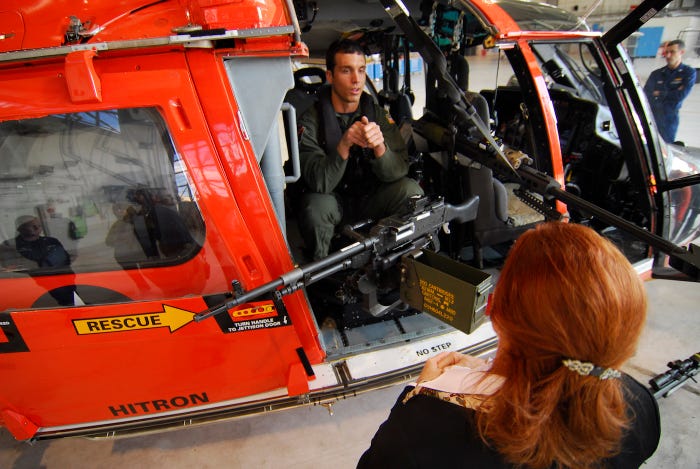
This is a potential Coast Guard capability, given its airborne use of force capability includes a door mounted rifle caliber machine gun, though I do not know if every Coast Guard Air Station has qualified gunners. The .50 caliber sniper rifle included in the package might even be more effective than the machine gun.
I am not suggesting the Coast Guard send helicopters to the Red Sea, but when the Coast Guard provides protection for vessels transiting to sea, it has generally been done with small boats with crew served rifle caliber machine guns. Ballistic Missile submarines have been an exception. They may be escorted by 82 foot patrol boats with .50 caliber machine guns in remote weapon stations. Perhaps the Coast Guard should consider providing an armed helicopter overwatch. An armed helicopter could be effective against hostile surface systems as well as air systems.
Petty Officer 2nd Class Anthony Phillips, a precision marksman at Helicopter Interdiction Tactical Squadron, displays the weaponry used by a HITRON during missions, February 23, 2010. US Coast Guard/Petty Officer 1st Class Bobby Nash
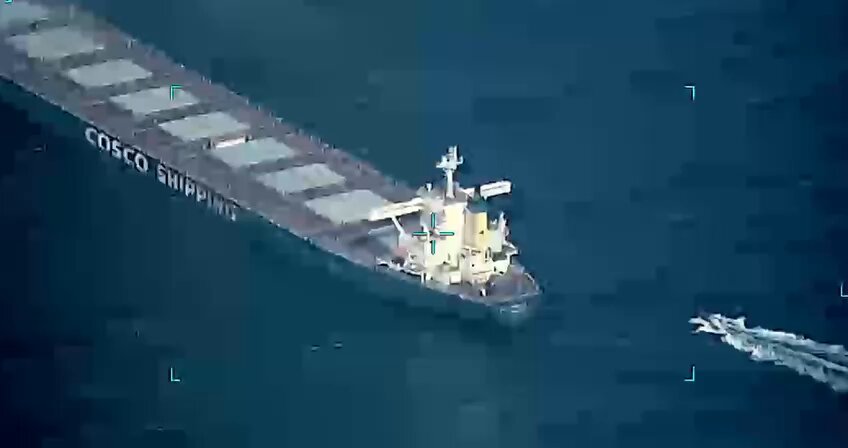
Below is a video taken by the French helicopter (an AS565 Panther, similar to the Coast Guard’s H-65s) as it shoots down the drone.
A US Navy helicopter demonstrated this capability over eight years ago. It is certainly less expensive than bringing down a drone with a missile. On the other hand, I would not want to be in a helicopter near a drone if the Navy decides to use a missile to destroy the drone.
This is essentially half of the Army’s Future Vertical Lift program. The Coast Guard has been following the program in anticipation of development of vertical takeoff and landing aircraft that would offer “twice the range and twice the speed” of existing helicopter types. We might still see that in a version of the Bell V-280 for land-based operations.
Note this video is four years old, so the prototype has been flying for a long time. I have heard concern about the downwash, but if you look at the windsock visible from time 2:20, downwash does not seem to be excessive. My back of the envelope calculations suggests the overpressure directly under the rotor discuses would be about 67% higher under the V-280’s props compared to the H-60J’s rotor. That might be mitigated at the hoist pickup point because, unlike in the H-60, the props are not rotating over the fuselage of the V-280.
It does appear that the H-60s may have a new engine option in the future.
The FARA cancellation is part of what the Army is currently calling the Aviation Investment Rebalance. The service says it will delay production of the General Electric T901 turboshaft engine developed under the Improved Turbine Engine Program (ITEP), which had been heavily tied to FARA, as part of this plan. The immediate focus will now be on integrating T901s onto existing AH-64 Apache attack helicopters and UH-60 Black Hawk utility helicopters.
GE Aerospace claims, “The T901 engine provides 50% more power 25% better specific fuel consumption, and reduced life cycle costs -with fewer parts, a simpler design, and proven, reliable technology.”
Basically, the Army has decided that Unmanned aircraft and Satellites can do the job of scouting better and cheaper, as well as safer, than a helicopter. This means they will be putting more money into those areas.
The Coast Guard might still benefit in its maritime domain awareness and its search function. I have not put much thought into the possibility that UAS (and perhaps satellites) might supplement or replace fixed wing for the SAR search function or MEP detection, but those are real possibilities.
I am disappointed that we are not likely to see a ship-based helicopter with twice the range and twice the speed any time soon, but on the other hand, we are already using UAS for search that have many times the endurance of the H-65 or even the H-60. For that function, endurance is more important that speed.
An MQ-9 Sea Guardian unmanned maritime surveillance aircraft system flies over the Pacific Ocean during U.S. Pacific Fleet’s Unmanned Systems Integrated Battle Problem (UxS IBP) 21, April 21. UxS IBP 21 integrates manned and unmanned capabilities into challenging operational scenarios to generate warfighting advantages. US Navy Photo
The State Department greenlit a potential $3.9 billion deal of General Atomics MQ-9B drones to India today…The proposed package for the Indian military includes 31 SkyGuardian unmanned aerial vehicles, 310 Small Diameter Bombs and 170 Hellfire missiles. Associated radars and anti-submarine equipment for the maritime-focused SeaGuardian variant, a derivative of the SkyGuardian, were also included.
It appears, India will join Allies Australia, Belgium, Canada, Italy, Japan (Coast Guard and Maritime Self Defense Force), the Netherlands, and the UK as operators of the MQ-9 for Maritime Domain Awareness.
$3.9B is a scary number if you are the Coast Guard, but this is a large, comprehensive, and probably multi-year procurement, probably including training and support. This is also a joint service procurement with the Indian Air Force getting eight aircraft, the Indian Army eight, and the Indian Navy sixteen.
This is what the US Coast Guard Acquistions Directorate (CG-9) says about Land-based UAS,
“The Coast Guard has validated a mission need for land-based UAS to significantly enhance ocean surveillance in support of the service’s operations. Coast Guard land-based UAS flight crews are jointly operating maritime-variant Predator UAS (Guardian) on maritime missions with Customs and Border Protection to enhance the Coast Guard’s understanding of potential land-based UAS solutions and support the development of a land-based UAS requirements package.”
That sounds suspiciously like, we are doing the same thing we have been doing for what, the last two decades? I can understand the hesitance to get into land based UAS before Sense and Avoid systems, allowing Remotely Piloted Air Systems (RPAS) to operate in the national airspace, were developed, but they are available now. Time to move on this.
We don’t have to jump in with both feet. We can do what we are still doing with Scan Eagle and use contractor owned and operated systems, but let’s at least see what the latest systems can do for us.
Maybe a detachment of land based UAS like the MQ-9B Sea Guardians in Florida or Puerto Rico, where they can support the 20 Webber class District 7 FRCs that do not have organic air assets.
Shahed-136One Way Attack Uncrewed Air Vehicle (), Source: Covert Shores
Covert Shores makes some interesting observations and asks pointed questions particularly in regard to the terminal homing phase of how the low-cost slow cruise missiles make their attacks on moving targets.
Hitting fixed target in Ukraine is very different from hitting a moving target hundreds of miles off the coast. Even an oil tanker is very small in the vastness of the ocean. The mission would need target location intelligence, and the drone would need targeting during its attack phase. The former is the same for any anti-ship weapon and can be achieved by patrol aircraft, fishing boats. Or, as possibly the case in the Chem Pluto attack, by the target broadcasting its position via AIS (automated information system).
The final phase targeting is more interesting. We do not know, at least in the public sphere, how the drones targeted the tankers. Whether it was a human-in-the-loop camera, or some form of automation.
Do they have satellite communications? Target recognition software? Home on AIS?
Presumably we have recovered at least one of the failed drones and can answer the question, but there is an even simpler solution.
Forward observers in one or more of the many Dhows that traffic the area, who call in a UAV when they have a target, and who can take over control of the drone when it arrives on scene, steering it into the target. This would be a continuation of what we saw with the Houthi remote control explosive motorboats, which unlike the USVs we are seeing in the Russo-Ukraine War, had no satellite link and were apparently steered by a second vessel within line of sight of the target and the attacking USV. It is not unlikely the Iranians and Houthi have a network of such nondescript vessels.
The slow speed of the UAVs does present something of a challenge in getting to the right place at the right time, but that is mitigated by the predictability of shipping lanes and the consistent speed of merchant vessels.
“An Indian Navy warship intercepted the MV Lila Norfolk on Friday afternoon, less than a day after the navy received news that it had been hijacked off Somalia’s coast in the North Arabian Sea.”
The crew of 21 had taken shelter in a citadel. By the time the Indian Navy destroyer, INS Chennai, had arrived, the pirates had fled.
The MV Lila Norfolk “was kept under continuous surveillance using MPA (Maritime Patrol Aircraft–Chuck), Predator MQ9B & integral helos.”
Notably, the Indian Navy is one of several users of the MQ-9B Sea Guardian Medium Altitude Long Endurance UAS including the Japan Coast Guard, the UK, Taiwan, and Greece. The US Coast Guard after years of observation of Customs and Border Protection’s use of earlier model MQ-9 Predators, the USCG has yet to procure or even experiment with a shore based long endurance UAS.
Below is a news release from AeroVironment reporting autonomous takeoff and landing from USNS Burlington (T-EPF-10), pictured below, at speeds of over 20 knots. I also found the video above that shows operation from a smaller vessel and provides more detail of how the unmanned aircraft is operated and supported.
CARIBBEAN SEA (Aug. 25, 2021) The Spearhead-class expeditionary fast transport ship USNS Burlington (T-EPF 10) operates off the coast of Haiti, Aug. 25, 2021. Burlington is deployed to U.S. Naval Forces Southern Command/U.S. 4th Fleet to support humanitarian assistance and disaster relief (HADR) efforts in Haiti following a 7.2-magnitude earthquake on Aug. 14, 2021. (U.S. Navy photo by Mass Communication Specialist 2nd Class Jack D. Aistrup)
Another good video here:
It appears 4th Fleet is trying to fulfill their self proclaimed role as the Fleet for Innovation.
AEROVIRONMENT’S JUMP 20 MEDIUM UAS DEMONSTRATES MARITIME AUTONOMOUS TAKEOFF AND LANDING AT VESSEL SPEEDS OVER 20 KNOTS
NOVEMBER 07, 2023
ARLINGTON, Va., November 07, 2023 – AeroVironment, Inc (NASDAQ: AVAV) today announced the company’s JUMP 20 VTOL Medium UAS exceeded expectations during the recent U.S. Naval Forces Southern Command/4th Fleet Hybrid Fleet Campaign Event (HFCE) that demonstrated human-machine teaming in the maritime domain. The JUMP 20 provided ship-based intelligence, surveillance, reconnaissance, and targeting (ISR-T) support to USFOURTHFLT and USSOUTHCOM during the week-long, at-sea exercise onboard USNS Burlington. The JUMP 20 has previously flown over 130,000 land-based hours in support of U.S. Special Operations Command combat deployments, and the expansion of JUMP 20 operations into the shipboard environment allows AeroVironment to provide these services globally.
During HFCE, JUMP 20 showcased its ability to launch and recover at vessel speeds over 20 knots, with fully autonomous flight from takeoff to landing. The JUMP 20 requires neither launch or recovery equipment, nor personnel on the flight deck during launch and recovery, maximizing operational safety and flexibility for users. JUMP 20’s vertical takeoff and landing (VTOL) capability, and class-leading endurance and payload capacity expand the operational capabilities of U.S. and allies to compete and win in the era of great power competition. The JUMP 20 demonstrated how uncrewed systems will support distributed operations across multiple domains, supporting national security objectives and our warfighters.
“The shipboard flight environment is dynamic and challenging. JUMP 20 is a proven combat-effective platform, and the system’s performance during HFCE illustrates the value to maritime operations. JUMP 20’s ability to launch and land at speed, and without personnel intervention, enhances the ship’s operational effectiveness and enables operators to focus on important mission tasking,” said Shane Hastings, AeroVironment’s vice president and product line general manager for Medium UAS. “As we continue to demonstrate and prove the effectiveness of the JUMP 20 platform, we look forward to getting this capability in the hands of our sailors, Marines, and allies operating in the maritime environment.” AeroVironment JUMP 20 is deployed to U.S. and allied militaries around the world, and it can be provided on a contractor-owned / contractor-operated (COCO) basis to maximize operational flexibility.
GULF OF OMAN, An Aerovel Flexrotor unmanned aerial vehicle launches from the deck of the Arleigh Burke-class guided-missile destroyer USS McFaul (DDG 74) in the Gulf of Oman, in an image released Oct. 6. US Navy photo.
Below is a 6 October news release from U.S. Naval Forces Central Command Public Affairs. It notes Coast Guardsmen were involved, presumably PATFORSWA, but no details of how. All the photo here accompanied the release.
MANAMA, Bahrain —
Last month, naval forces in the Middle East region successfully integrated unmanned platforms with traditionally crewed ships and aircraft to conduct enhanced maritime security operations in the waters surrounding the Arabian Peninsula.
Seven task forces falling under U.S. 5th Fleet integrated 12 different unmanned platforms with manned ships for “manned-unmanned teaming” operations, tracking Iranian Navy and Islamic Revolutionary Guard Corps Navy (IRGCN) ships and small boats over several days during routine patrols in and around the Strait of Hormuz.
This operation bolstered presence in and around a critical chokepoint that in recent months has seen Iran unlawfully seize internationally flagged merchant ships.
Unmanned underwater vehicles (UUVs), unmanned surface vehicles (USVs) and unmanned aerial vehicles (UAVs) were involved in the operation.
“We have been operating UAVs and UUVs in the region for years,” said Capt. Joe Baggett, Director of Maritime Operations for U.S. Naval Forces Central Command and U.S. 5th Fleet. “Adding our new USVs, and then integrating all of these platforms into fleet operations, is how we expect to fly and sail well into the future.”
Sailors, Marines, Coast Guardsmen, ships and aircraft from Task Force 51/5 (Amphibious/Marine), Task Force 52 (Mine Countermeasures), Task Force 53 (Logistics), Task Force 55 (Surface Warfare), Task Force 56 (Expeditionary), Task Force 57 (Patrol/Reconnaissance) and Task Force 59 (Unmanned/Artificial Intelligence) conducted the operations.
“The integration of new, multidomain unmanned platforms into routine fleet operations provides more ‘eyes on the water,’ enhancing maritime domain awareness and increasing deterrence in the region,” said Vice Adm. Brad Cooper, Commander, U.S. Naval Forces Central Command and U.S. 5th Fleet.
Cooper added that collectively, these platforms support the safe navigation and free flow of commerce through vital regional chokepoints, particularly around the Strait of Hormuz.
“This enhanced maritime security serves as a deterrent against malign activity and strengthens regional stability, which is good for everybody,” he said.
U.S. Naval Forces Central Command/U.S. 5th Fleet’s area of operations encompasses about 2.5 million square miles of water area and includes the Arabian Gulf, Red Sea, Gulf of Oman, Gulf of Aden, Arabian Sea and parts of the Indian Ocean. This expanse, comprising 21 nations, includes three critical choke points at the Strait of Hormuz, the Suez Canal and the Strait of Bab al Mandeb.
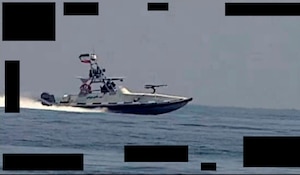
STRAIT OF HORMUZ (Oct. 6, 2023) An undated still image released on Oct. 6 from video taken by an Arabian Fox MAST-13 unmanned surface vessel of two Islamic Revolutionary Guard Corps Navy patrol speedboats in the Strait of Hormuz.
STRAIT OF HORMUZ (Oct. 6, 2023) An undated still image released on Oct. 6 from video taken by an Arabian Fox MAST-13 of an Islamic Revolutionary Guard Corps Navy patrol speedboat in the Strait of Hormuz.
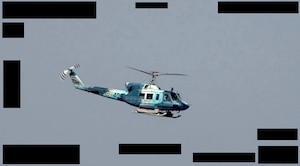
STRAIT OF HORMUZ (Oct. 6, 2023) An undated still image released on Oct. 6 from video taken by an Arabian Fox MAST-13 unmanned surface vessel of an Iranian Navy AB-212 helicopter in the Strait of Hormuz.
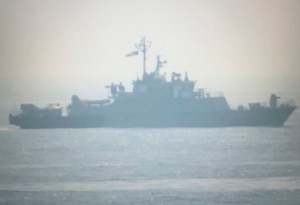
STRAIT OF HORMUZ (Oct. 6, 2023) A undated still image released on Oct. 6 from video taken by a MARTAC T-38 Devil Ray unmanned surface vessel of an Islamic Revolutionary Guard Corps Navy warship in the Strait of Hormuz.
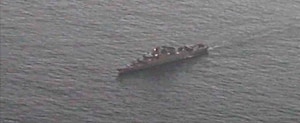
STRAIT OF HORMUZ (Oct. 6, 2023) An undated still image released on Oct. 6 from video of an Iranian Navy frigate taken by an Aerovel Flexrotor unmanned aerial vehicle (AAV) in the Strait of Hormuz.(U.S. Navy photo)
STRAIT OF HORMUZ (Oct. 6, 2023) An undated still image released on Oct. 6 from video taken by an Arabian Fox MAST-13 unmanned surface vessel of an Iranian unmanned aerial vehicle in the Strait of Hormuz.
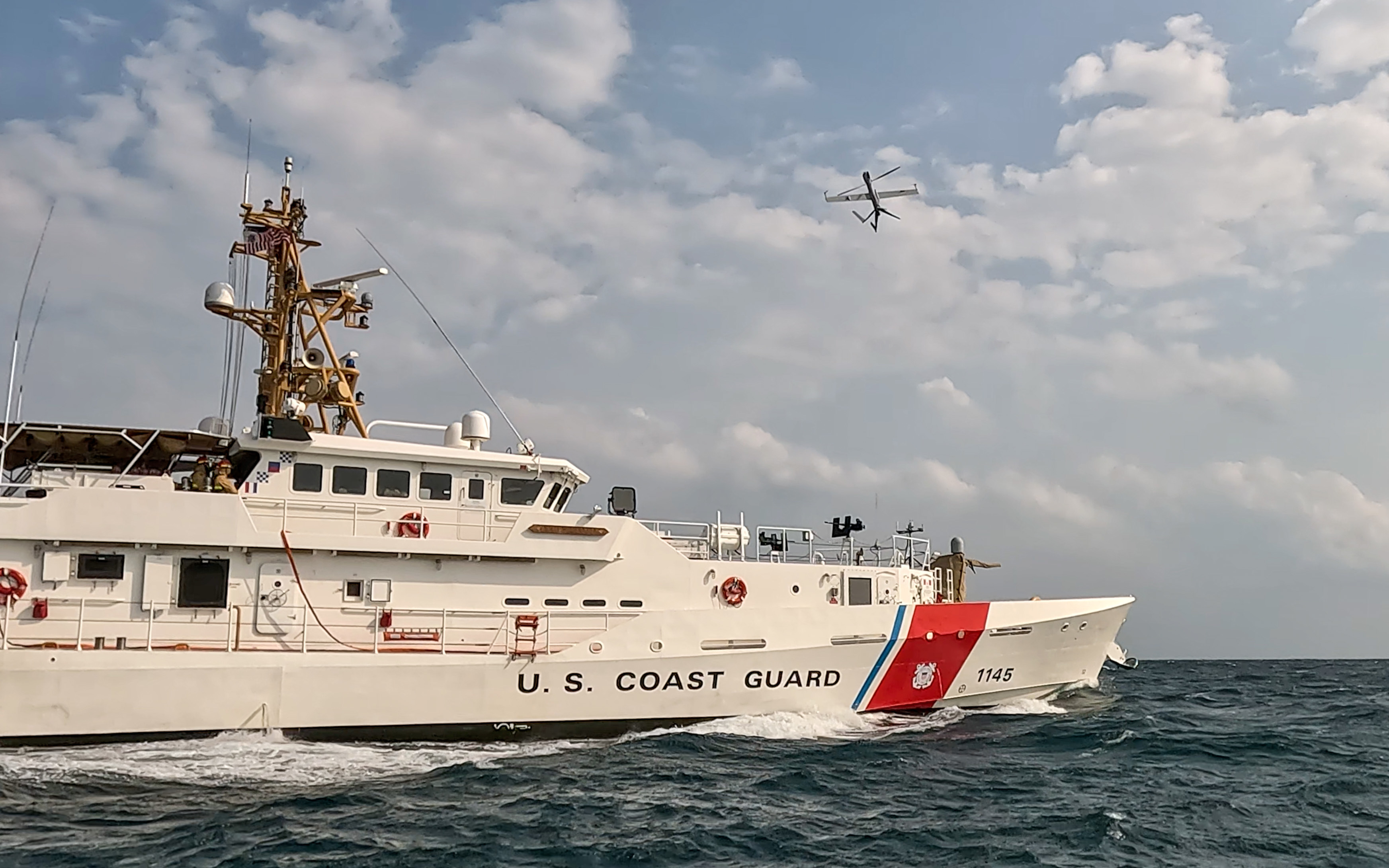
221207-N-NO146-1001 ARABIAN GULF (Dec. 7, 2022) An Aerovel Flexrotor unmanned aerial vehicle (UAV) takes off from U.S. Coast Guard fast response cutter USCGC Emlen Tunnell (WPC 1145) transiting the Arabian Gulf, Dec. 7. U.S. 5th Fleet’s Task Force 59 launched the UAV during Digital Horizon, a three-week event focused on integrating new unmanned and artificial intelligence platforms, including 10 that are in the region for the first time. (U.S. Navy photo)
We have begun to see very capable, vertical takeoff and landing (VTOL) unmanned air systems that fall into the DOD Group Two standard.
Weight: 21 to 55 pounds (10 to 25 kg)
Nominal operating altitude: <3500 feet or 1 km above ground level.
Speed: <250 knots
Recently Elbit Systems reported they would be providing a Group 2 VTOL to the Israeli Army, and we have the photo above of an Aerovel Flexrotor taking off from a Webber class patrol craft,
These small, unmanned air systems (UAS), which can combine sophisticated sensors and endurance of four to over 24 hours, may be better search platforms than our H-65 helicopters.
Group 2 UAS are even smaller than the Martin V-Bat. It appears, they might be able to operate from Webber class cutters. Operating UAS from the Webber class on a regular basis would provide them much of the air search advantage of larger flight deck equipped cutters.
Below is a news release on another aircraft in this class, the Edge Autonomy VXE30. The VIDAR sensor referred to in the news release, is also used on the Scan Eagle (a catapult launched Group 2 UAS) used on National Security Cutters. There is more on the unmanned VXE30 here.
Edge Autonomy’s VXE30 UAS. The VXE30 vertical take-off and landing (VTOL) solution is the latest and most advanced version of the “Stalker” series of small uncrewed aerial systems (sUAS) from Edge Autonomy.
Sentient’s AI-enabled ViDAR optical sensors soar on Edge Autonomy’s VXE30 “Stalker” UAS in successful live demonstrations
ViDAR – Sentient’s AI-enabled wide area motion imagery deployed for real-time maritime surveillance at the edge
VIRGINIA BEACH, Va. (Aug 29, 2023) – Sentient Vision Systems (Sentient) has successfully completed live demonstrations of its AI-enabled ViDAR (Visual Detection and Ranging) payload deployed on Edge Autonomy’s VXE30 UAS. The VXE30 vertical take-off and landing (VTOL) solution is the latest and most advanced version of the “Stalker” series of small uncrewed aerial systems (sUAS) from Edge Autonomy. When coupled with Sentient’s ViDAR, the VXE30 provides a passive, wide area search capability, enabling it to serve a myriad of maritime operations. The joint capability will be on display at DSEI 2023, 12-15 September in London.
ViDAR, developed by Sentient, utilizes AI; Computer Vision, and Machine Learning integrated with Electro-Optic and Infrared (EO/IR) sensors to passively detect objects that are difficult to spot by the human eye or recognize on a conventional radar. With these enhanced capabilities, Stalker will be more capable of accurately detecting and locating people, objects, and vessels (day and night) far from the operator.
ViDAR has been deployed on intelligence, surveillance, and reconnaissance missions (ISR), maritime patrol and border protection, as well as search and rescue missions since 2015. ViDAR is proven to be effective in challenging maritime conditions up to Sea State 6 (very rough with waves 13 to 20 feet high/ 4 to 6 meters).
Sentient has successfully evolved ViDAR into a compact, lightweight, low power form factor—low SWaP (size, weight, and power) — suitable for deployment on small Group 2 / NATO Class 1 UAS such as the VXE30. Its successful integration onto the VXE30 demonstrates its broad operating envelope and ability to provide unprecedented long-endurance imaging capability in contested environments all around the world.
Joshua Stinson, Edge Autonomy’s Chief Growth Officer said, “The integration of ViDAR onto the VXE30 is an essential part of our UAS deployment program. ViDAR’s passive detection system will further the VXE30’s capabilities to remain undetected in a contested environment while carrying a powerful maritime detection sensor that provides a real-time picture of the maritime domain. This capability could make all the difference in a mission’s success.”
Paul Harris, Sentient’s VP of Business Development agreed and said, “We are delighted to be working with Edge Autonomy to demonstrate how effective ViDAR is at increasing the utility of the small and agile VXE30 for the challenges of the modern battlespace. We look forward to displaying our joint capabilities at DSEI.”
With close to 4,500 systems deployed, Sentient’s AI-enabled sensor edge solutions for wide area motion imagery are proven for detection in missions worldwide.
Sentient Vision Systems specializes in passive, modular optical sensors for persistent, wide area motion imagery. Sentient’s artificial Intelligence (AI)-enabled edge solutions better detect and identify small objects in real time, on land and at sea. With more than 20 years of development in moving target indication, AI computer vision and machine learning, Sentient has deployed thousands of systems worldwide in the field of Intelligence, Surveillance, Search and Rescue, enhancing situational awareness, accelerating informed decisions, and saved numerous lives. Follow Sentient on LinkedIn , Vimeo, YouTube and Twitter
Edge Autonomy is a leader in providing innovative autonomous systems, advanced optics, and resilient energy solutions to the U.S. Department of Defense, the U.S. Federal Civilian Agencies, allied governments, academic institutions, and commercial entities. Edge Autonomy draws on a 34+ year history of aerospace engineering, advanced manufacturing expertise, and technologically advanced manufacturing. With headquarters in San Luis Obispo, CA, and key production capabilities abroad, Edge Autonomy’s 400+ team members deliver results in multiple markets. Follow Edge Autonomy on LinkedIn, Facebook and Twitter.
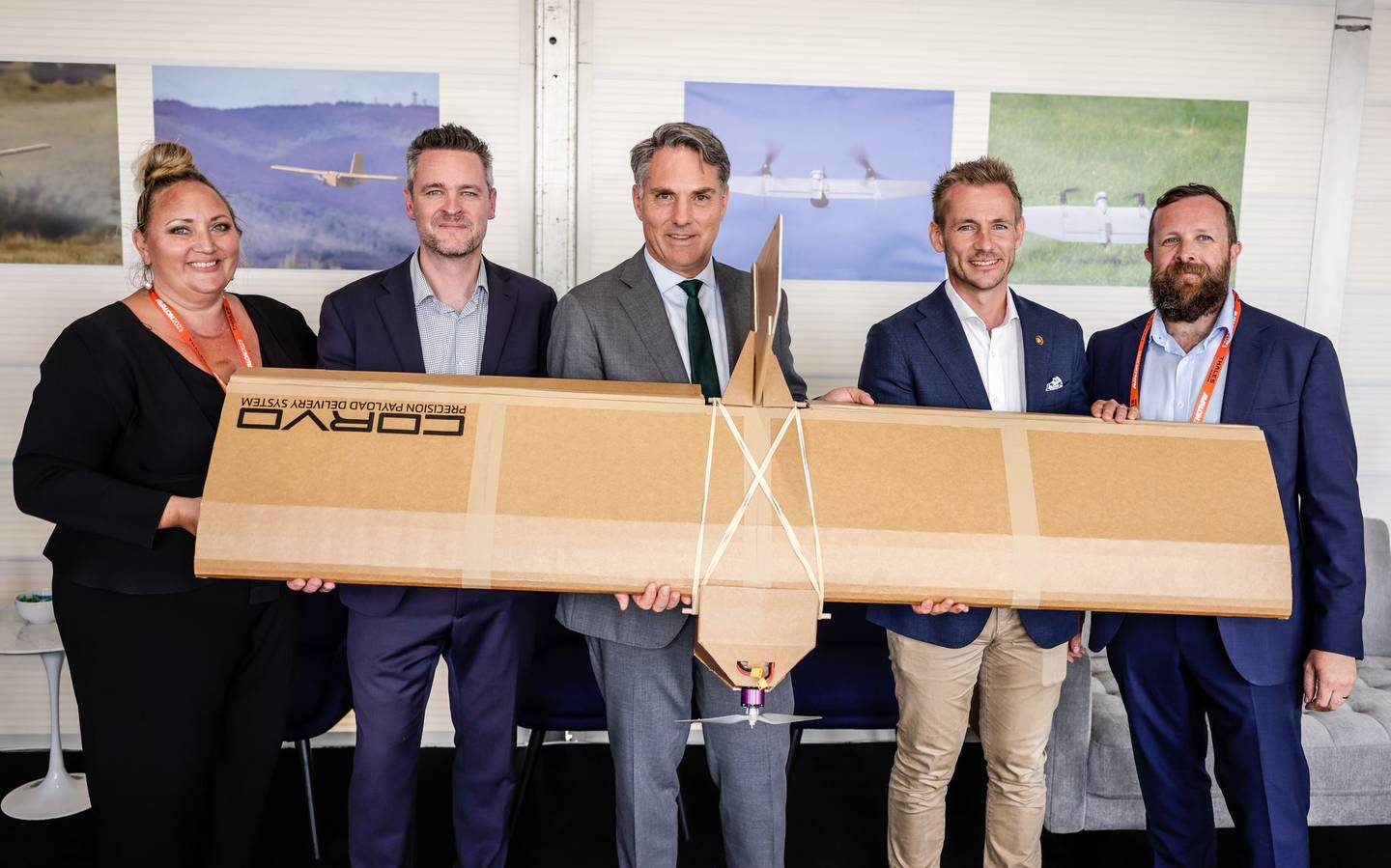
SYPAQ company officials host Australian Deputy Prime Minister Richard Marles and the Ukrainian ambassador to Australia, Vasyl Myroshnychenko, during a March 2023 event following Australia’s donation of 600 Corvo Precision Payload Delivery System drones to Ukraine. (SYPAQ photo)
Ukrainian soldiers have received hundreds of drones, gifted to them by Australia, to capture surveillance video crucial for preparing missions to retake ground from Russian forces.
The data comes from GoPro cameras strung from holes punched into disposable cardboard drones.
This shows just how simple it can be to get an Unmanned Air System ISR capability, or perhaps a weapons delivery capability.
Two V-200 “Sea Falcon” VTOL UAV on the helideck of German Navy’s corvette Braunschweig. Note, this is a relatively small ship, about the size of a 270, with a beam of 13.28 m (43 ft 7 in), about the same as a Hamilton class 378′. Picture by Commander of the German Naval Aviation.
UMS SKELDAR and Ultra Maritime unveiled their jointly developed anti-submarine warfare (ASW) solution at DSEI 2023…The solution, a Rotary Wing UAS providing an ASW sonobuoy dispensing capability, is based on the SKELDAR V-200 Uncrewed Aircraft System (UAS) and was developed as part of a contract under the Canadian Department of National Defence’s (DND) Innovation for Defence Excellence and Security (IDEaS) program.
This is an interesting idea. By itself, without any weapon, it may not be very useful, but it might prove a useful addition to a mix that includes ASW helicopters on standby for prosecution and ships with gear for monitoring and interpreting sonobuoy transmissions.
The Skeldar doesn’t have the endurance of the Scan Eagle, used by the Coast Guard, but it does have a much higher payload weight, 40 kg (88 pounds) compared to Scan Eagle’s 5 kg (11 pounds) and Skeldar doesn’t require separate launch and recovery equipment. (As it seems in all aircraft, there is a tradeoff between payload and fuel.)
The extra payload weight may not make much difference if you can pack everything you want into that 5 kg on the Scan Eagle, but it does open up options, larger sensors, light logistics cargo runs, and the ability to drop things.
Other than sonobuoys and weapons there are a number of things we might want to be able to drop from a UAS: buoys to measure drift for a SAR case, radios or pumps to a vessel in distress, lifejackets, or inflatable rafts.
This is a Canadian program. The Canadian Navy uses Skeldar, CU-176 Gargoyle in Canadian service, on their DeWolf class Arctic Offshore Patrol Ships (AOPS). If the Canadian Navy chooses to continue development of this sonobuoy drop capability, presumably they will also use the UAS on some of their frigates, or perhaps they are working toward an ASW role for their AOPS.







 Chuck Hill's CG Blog