“MARTIN UAV PARTNERS WITH SOUTHCOM ON ENHANCED COUNTER NARCOTICS OPERATIONS” –Press Release

V-Bat from Martin UAV

Below is a press release about a vertical take-off Small Unmanned Air System (sUAS) that we discussed earlier, after it was flown from USCGC Harriet Lane August 13-14, 2020. The deployment reported below occurred shortly before the demonstration on the Harriet Lane.  

We have no indication of how many of the airframes and how many people were people were involved in the demonstration, but the sortie rate appears impressive. Over a 300 day period, the system(s) flew 273 sorties for a total of 1340.7 flight hours. Given that the ship was probably not underway all 300 days, looks like they got at least one sortie per day with an average of 4.9 hours per sortie.


PLANO, Texas, November 10, 2020 – Martin UAV successfully demonstrated the shipboard integration of its V-BAT as well as its impressive maritime capabilities in support of United States Southern Command’s counter-narcotics operations in the Eastern Pacific from October 6, 2019, to July 31, 2020.

Support for the mission included the highly visible Enhanced Counter Narcotics Operations that began April 1 and was kicked off by the President of the United States.

The 10-month mission started with a demonstration of the V-BAT’s small footprint, quick set-up, rapid deployment, and true Vertical Takeoff and Landing (VTOL) capabilities. Upon successful completion, a technology assessment to support the USSOUTHCOM Exercises and Coalition Affairs Directorate, Long Duration, Long Dwell (LD2) started upon successful completion of the shakedown.

By leveraging commercial off-the-shelf technologies, LD2’s goal is to enhance the execution of the Department of Defense’s strategic objectives. Over the course of the demonstration, the V-BAT flew an unprecedented 273 sorties for a total of 1340.7 flight hours.

“This mission helped catapult Martin UAV’s V-BAT into the maritime environment, showcasing its ability to withstand and perform in tropical conditions, including strong crosswinds and unexpected storms with rain exceeding 10mm per hour,”

– Heath Niemi, VP of Global Sales & Development.
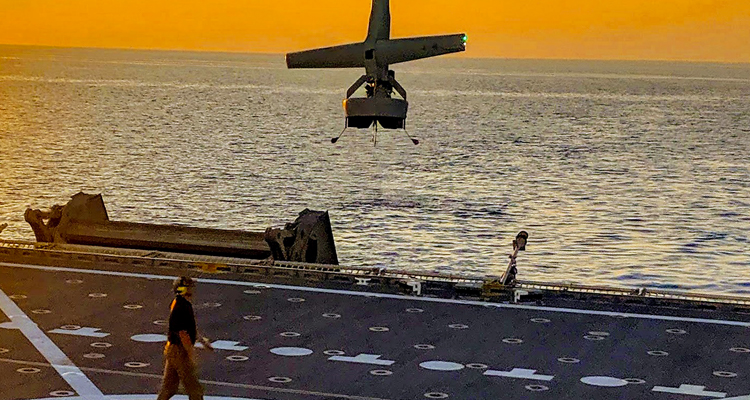
Night Landing with Martin UAV’s V-BAT

About Martin UAV:

Martin UAV is a private, advanced technology company based in Plano, TX. The company specializes in building wholly-unique, unmanned aircraft systems and associated flight control software. The company’s systems are commercially developed to fill critical operational needs in tactical & confined operational environments. Its V-BAT series aircraft is the only single-engine ducted fan VTOL that has the ability to launch & recover from a hover, fly 8+ hours in horizontal flight, and make mid-flight transitions to “hover & stare” at any time throughout a given mission set.

Small Unmanned Systems Used in Response to Hurricane Sally

Below is a news release from the Eighth district. The thing I found surprising, was that in the video below, it reports that three USCG drone pilots flew 95 flights totaling 16 hours and 34 minutes (about 10.5 minutes per flight). You will see some of the drone video below. Above is a better look at the equipment being used.

united states coast guard


Video Release

U.S. Coast Guard 8th District Heartland
Contact: 8th District Public Affairs
Office: 504-671-2020
After Hours: 618-225-9008
Eighth District online newsroom

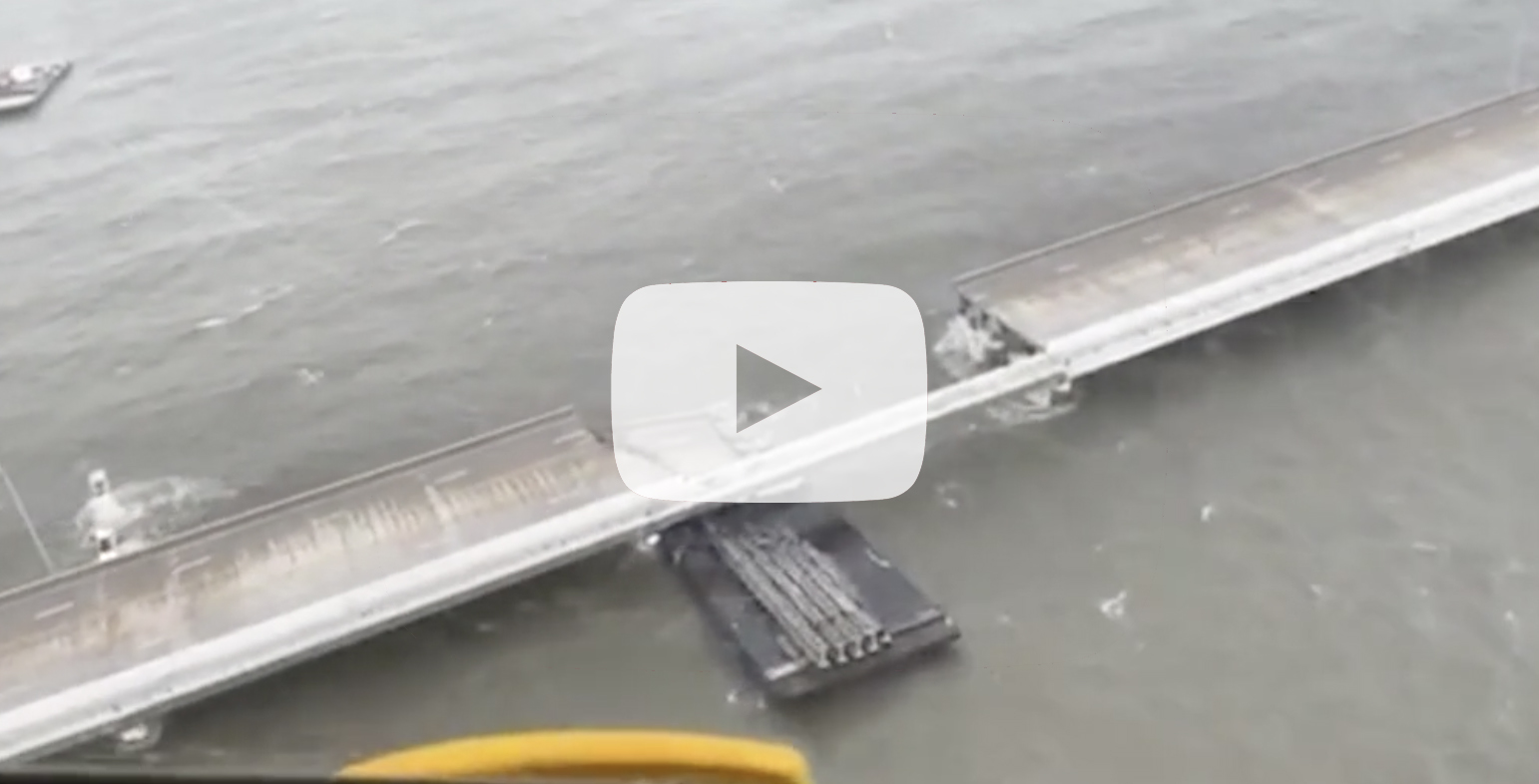
Coast Guard ends 37-day response to Hurricane Sally aftermath on Gulf Coast

This video highlights the Coast Guard's role in marine environmental response operations after Hurricane Sally. Hurricane Sally made landfall in Alabama on Sept. 16, 2020. Coast Guard video by Petty Officer 2nd Class Edward Wargo 

Editors’ Note: Click on image to download high-resolution version.

MOBILE, Ala. — The Coast Guard Sector Mobile Incident Command has concluded a 37-day coordinated response effort to Hurricane Sally along the Gulf Coast, Thursday.

Many parts of Alabama and the Florida Panhandle sustained damage during Hurricane Sally when it made landfall September 16th as a Category 2 hurricane. Since then, 1,132 vessels have been assessed for potential pollution threat to the environment. All sources of pollutants have been mitigated and contractors continue to conduct salvage operations in Escambia, Santa Rosa, and Baldwin Counties. 

The Coast Guard federal on-scene coordinator and the state on-scene coordinator from the Florida Department of Environmental Protection coordinated efforts to remove weathered oil, discovered on a half-mile area of Johnson Beach, Florida, in consultation with Federal Trustees:

  • Department of Interior’s U.S. Fish and Wildlife Service
  • National Oceanic & Atmospheric Administration’s National Marine Fisheries Service
  • National Park Service

The impacted area was located on federally designated, critical habitat and marine protected areas as well as being designated as culturally significant to federally recognized tribes.

Coast Guard Sector Mobile Sally Marine Environmental Response (MER) partnered with wildlife response specialists to save the life of a brown pelican. It was found heavily oiled at Day Break Marina in Pensacola, Florida. After a three-week rehabilitation process, it was safely released into the Northwest Florida Wildlife Sanctuary.

“The Coast Guard concluded its response to Hurricane Sally well ahead of our anticipated timeline, ” said Cmdr. Kelly Thorkilson, Coast Guard Hurricane Sally MER incident commander. “Coast Guard members deployed from across the nation, collaborated with our partner agencies, and quickly integrated new technologies which greatly enhanced frontline operations resulting in a more efficient response.” 

There were 148 Coast Guard responders whose combined efforts totaled an estimated 17,630 work hours. Members managed logistics, resources, and operations including; vessel assessments and facilitating the deployment of 11,650 feet of containment boom. Additionally, three drone pilots flew a total of 95 unmanned aerial system flights to pinpoint pollution along the Gulf Coast. 

Any additional pollution incidents should be reported to the National Response Center at 1-800-424-8802.

For more information follow us on Facebook and Twitte


“MQ-9B SeaGuardian Maritime UAV: Which Missions ? Which Customers ?” –Naval News

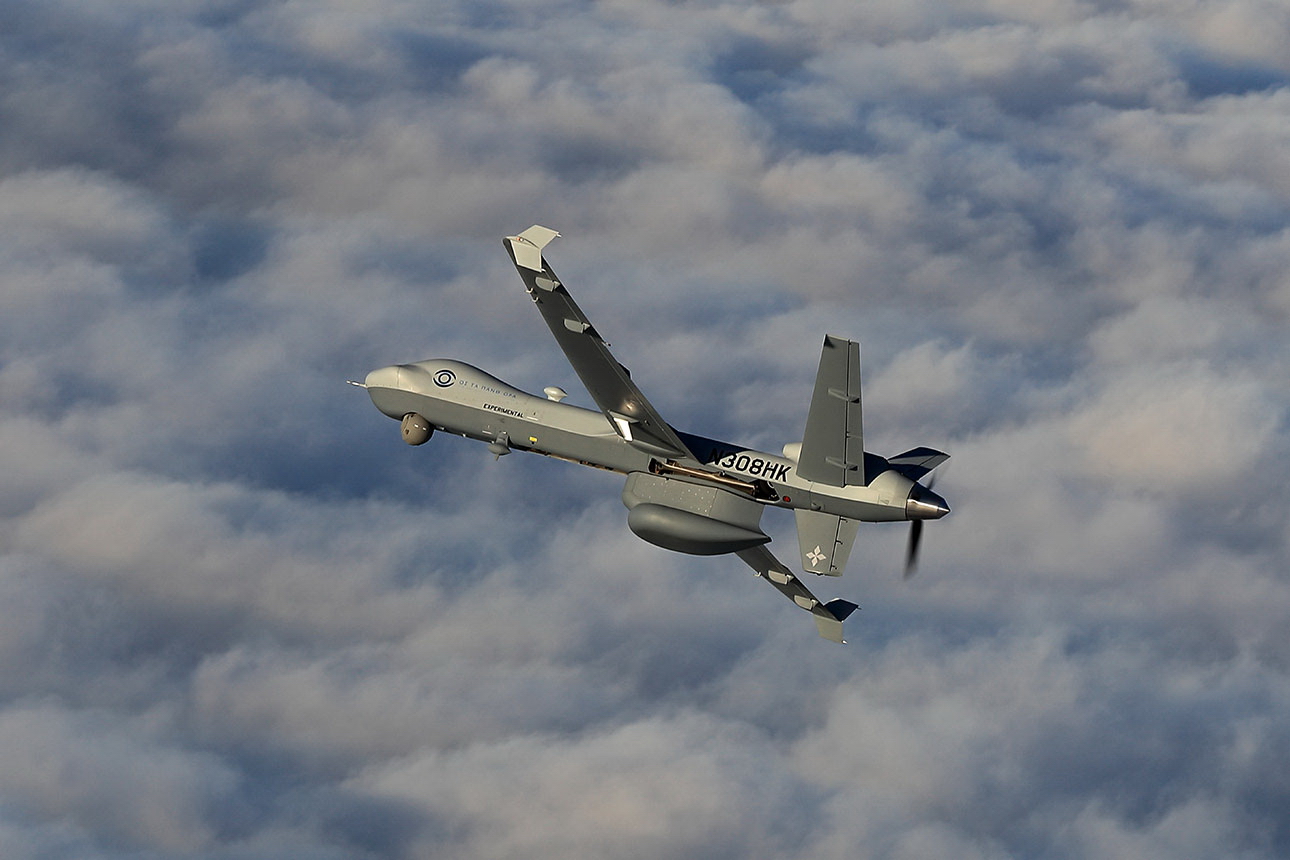
MQ-9B Seaguardian during the maritime capabilities demonstration flight over Southern California waters in September 2020. GA-ASI picture.

NavalNews reports on the Maritime version of the Predator UAV, the MQ-9B Seaguardian, including its sensors and market success.

In addition to different sensors, this model is different from the MQ-9s that the Coast Guard has flown with Customs and Border Protection (CBP) in that they are intended to operate in civilian airspace. CBP has been operating MQ-9 UAVs for 15 years.

Congress seems not only willing to support Coast Guard operation of land based medium altitude long endurance (MALE) UAVs like the Seaguardian. They are actually pushing the Coast Guard. They can not seem to understand why we have not done it already.

In addition to the possibilities of use in the drug transit zones, these long range, long endurance aircraft could be especially useful in detecting IUU activity in the Western Pacific where there normally are no Coast Guard air assets.

“British Army drone to fly over English Channel to monitor migrant boats” –Independent

Thales Watchkeeper WK450

Like the US Coast Guard, the UK Border Force conducts Alien Migrant Interdiction Operations. They are reportedly getting some assistance from the British Army in the form of Unmanned Air Vehicles (UAV) being used to patrol the English Channel.

The UAVs are Thales Watchkeeper WK 450s (manufacturer’s brochure here) an improved version of the Israeli Elbit Hermes 450 with the addition of a dual-mode synthetic aperture radar and ground moving target indication system, providing all weather target acquisition.

The Watchkeeper program has not been cheap, about 1.2 billion pounds to provide and support 54 drones, and it has had its problems. They were supposed to have been operational in 2010, but apparently only reached Initial Operational Capability in 2014. Five have crashed. Regarding the current fleet,

“45 Watchkeeper airframes were in service as at 23 July 2020. 13 have flown in the past 12 months and 23 have been in storage for longer than 12 months. Of those flying, 10 have been operated by the Army from Akrotiri in Cyprus and Boscombe Down in Wiltshire, three have been used for test and evaluation. The airframes in storage are held at specific, graduated, levels of readiness. This is commensurate with practices used on other Defence capabilities and assets.”

The airframes are:

  • Length: 19.69 ft (6 m)
  • Span: 34.45 ft (10.5 m)
  • Engine: Winkel rotary, 52 hp
  • Max Speed: 95 knots
  • Operational Radius: 200 km; 108 nm (Line of Sight)
  • Endurance: 16+ hours
  • Service ceiling 18,045 feet (5,500 m)

This means, it is about half the size of the familiar MQ-1 Predator, also a bit slower and their service ceiling is lower.

The British Maritime and Coastguard Agency (MCA) has selected Israel’s Elbit to demonstrate the capabilities of their larger Eblit Hermes 900 UAVs. which has capabilities similar to those of the MQ-1. Meanwhile the RAF is also flying surveillance over the English Channel. 

Martin V-BAT “Guard evaluates new technology for unmanned aircraft system operations” –Acquisitions Directorate (CG-9)

Below I have reproduced a story from the CG-9 Website. To put this into perspective the V-Bat system has a slightly smaller wing span than the ScanEagle (9′ vs 10’3″) and weighs about twice as much (88 lbs (40 kg) vs 44-48.5 lb. (22 kg)), heavier, but still easily handled. There is a skid under the nose to allows the V-BAT to be laid on the deck. Cruise speeds are similar. Dash speed is actually a little higher for the V-BAT (90 vs 80 knots). V-BAT has “Wind Limitations: 20 kt + 5 kt gust spread” for takeoff that should be relatively easy to achieve by adjusting course and speed to minimize wind over deck, but it might be a factor if we want to launch during a chase. V-BAT has a 182cc 15 HP 2-cylinder EFI engine which can use either a Gas-Oil Mix or JP-4/5/8. It has a remote start and can provide 500 watts onboard electrical power. It has a 350 mile range (statute miles I presume, so about 300 nautical miles) and has a highly accurate fuel monitoring system

Martin V-BAT UAV

Interestingly, for operation from say a Webber Class FRC, there is also a smaller electric eV-BAT.

  • Wing Span: 5 ft
  • Length: 4 ft
  • Weight: 18 lbs
  • Ceiling: 5k ft
  • Speed: 50 kts
  • Propulsion: 3 HP electric motor

The electric eV-BAT is probably both very reliable and very quiet. I am guessing, based on what I know the technology it has an endurance of about 20 minutes. Its sensors would be limited by the lower payload weight.

Don’t believe any of these smaller UAVs have a “sense and avoid” system to prevent mid-airs so they, and the surrounding air space, has to be monitored while they are airborne.

The News Release:

—-

Guard evaluates new technology for unmanned aircraft system operations

V-BAT vertical take-off and landing

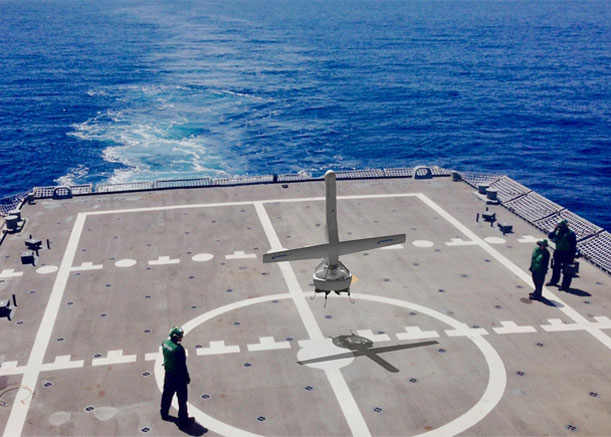
A V-BAT vertical take-off and landing (VTOL) unmanned aerial system prepares to land on the flight deck of the Military Sealift Command expeditionary fast transport vessel USNS Spearhead during a C4F “innovation cell” test of the VTOL. Photo courtesy of Martin UAV V-BAT.


The Coast Guard Research and Development Center (RDC), Coast Guard Atlantic Area and U.S. Southern Command (USSOUTHCOM) conducted a collaborative unmanned aircraft system (UAS) pilot program utilizing a vertical takeoff and landing (VTOL) UAS Aug. 13-14. The pilot program utilized contractor-owned, contractor-operated UAS services on-board Coast Guard Cutter Harriet Lane in the USSOUTHCOM area of responsibility for a short-term deployment.

“SOUTHCOM has long had interest in the demonstration of this technology, and we are always looking for opportunities to advance our knowledge of its capabilities,” said Cameron Stanley, command science adviser for USSOUTHCOM. “This was a great opportunity to evaluate the potential use of this technology alongside our critical interagency partners to advance the state of practice and enable our collective response to common operational challenges.”

The Martin UAV V-BAT was used for this program; it is the first-ever VTOL medium range UAS to be evaluated during an operational Coast Guard patrol. Because of the vertical takeoff, a VTOL UAS does not require any additional gear on the flight deck to support operations, unlike other UAS that require launch and recovery devices.

The deployment is providing the RDC invaluable data for supporting future VTOL medium range UAS capabilities and efforts involving Beyond Visual Line of Sight operations. While the evaluation is looking at how successfully VTOL systems take off and land on board a Coast Guard cutter, patrol data can be used to refine the concept of operations and requirements for installing and integrating VTOL UAS across current and future cutter classes.

UAS technology has already proven to be a game changer for the Coast Guard. Information provided by sensors aboard UAS “impacts timelines for obtaining a statement of no objection for boarding vessels, provides situational awareness for boarding crews prior to embarking on targets of interest and provides a better covert means for tracking targets of interest,” resulting in enhanced maritime domain awareness and mission execution, explained Stephen Dunn, RDC aviation research scientist. “The VTOL system takes things a step further by reducing the footprint of the UAS for future Coast Guard cutter acquisitions,” Dunn said.

For more information: Research and Development Center program page and Research, Development, Test and Evaluation program page

“Defense Unit Certifies Five Small Commercial UAS for Government Use” –Seapower

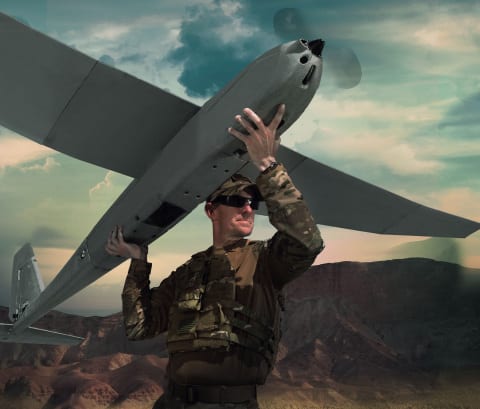
Puma LE (long endurance) unmanned aircraft. Photo from Aerovironment

Come September you will be able to get your small unmanned air system off the GSA schedule.

The Navy Leagues magazine Seapower reports that,

“The Defense Innovation Unit (DIU), a Department of Defense organization that accelerates commercial technology for national defense, announced the availability of five U.S.-manufactured drone configurations to provide trusted, secure small Unmanned Aircraft Systems (sUAS) options to the U.S. government, the Pentagon said in an Aug. 20 release. “

Seapower’s July/August Coast Guard Issue.

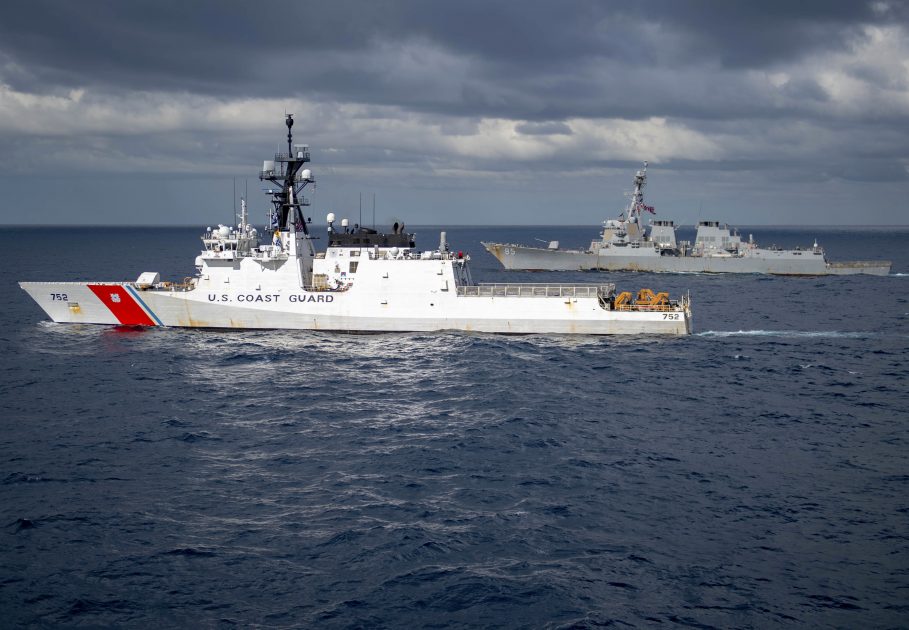
USCGC Stratton (WMSL-752), left, and the U.S. Navy Arleigh Burke-class guided-missile destroyer USS McCampbell (DDG-85) maneuver in formation during Talisman Sabre 2019 on July 11, 2019. US Navy Photo

The July/August issue of the Navy League’s magazine Seapower included a lot of Coast Guard content. I will not try to cover everything included, much of which has already been covered here, but I will mention a few things that stood out for me.

The Commandant’s Interview:

There was an interview with the Commandant, Admiral Schultz, that I found most interesting. There was a fair amount of information that was new to me.

Icebreakers:

Perhaps most significant was a comment regarding the Medium icebreaker.

“We also are looking to build probably a medium breaker, potentially what we’re going to call the Arctic security cutter — a little less capability in terms of icebreaking, but that capability would get us back to being an Atlantic and Pacific icebreaker Coast Guard.(emphasis applied–Chuck)

It may be that, if this ship is intended to transit the St Lawrence Seaway and work part time in the Great Lakes, like Canada’s proposed six “Program Icebreakers,” it would preclude the option of simply building six Polar Security Cutters rather than the three heavy and three medium icebreakers called for in the High Latitude Study. Alternately we might have four heavy Polar Security Cutters (PSC) in the Pacific and two Arctic Security Cutters (ASC) in the Atlantic.

The interview goes on to state, referring to its planned five year long progressive service life extension program, “…we could keep the 44-year-old Polar Star around here probably through the end of the decade if things go well.” (emphasis applied–Chuck)

The Western Pacific:

The Commandant noted that the Coast Guard had advisers in the Philippines, Vietnam, Fiji, and that an additional adviser would go to Malaysia and an attache to Australia to work with Australia and New Zealand. That there would also be an advisor assigned to Guam to work with the Commonwealth of Micronesia and the Federated States of Micronesia.

The Coast Guard is becoming more involved in countering Illegal, Unregulated, and Unreported (IUU) fishing, and will be providing leadership in international forums.

In reference to the forthcoming Tri-Service Maritime Strategy the Commandant said we could expect, “…to see the Coast Guard bring some unique capabilities to that conversation, particularly in the Indo-Pacific region.” 

Unmanned Systems:

Regarding land based systems the Commandant noted, “..we’ve completed prototype deployment of ScanEagle in Puerto Rico and Texas.” and “We teamed with U.S. Southern Command and CBP and employed one of those (MQ-9–Chuck) in an operation out of Panama that proved tremendously successful.”

He also mentions the possibility of using UAS of all sizes and mentioned the possibility of unmanned surface systems as well.

Cyber:

Sighting the FY2021 budget, Admiral Schultz said, “That is one of the biggest growth areas for humans in the Coast Guard here in the past budget cycle or two. There is somewhere north of 150 additional cyber warriors in the budget before the Congress right now.” 

“Insitu’s ScanEagle Performs ISR for Coast Guard”

There is a short one page report on the use of ScanEagle. It notes that ScanEagle is currently installed on six National Security Cutters and will be installed on all NSCs.

“A standard pack-out for a deployment of three ScanEagle UASs. The sensor systems include an electro-optical/infrared camera, a laser pointer, a communications relay, an automatic identification system (AIS), and visual detection and ranging (VIDAR)–a surface search capability.”

Interesting that it includes a laser pointer on the Coast Guard aircraft because that is usually used as a designator for laser homing weapons.

“The Era of the New Cutters”

This was a three page story, most of which is familiar to regular readers of this blog, but there was one nugget I had not seen before. “…the Coast Guard still will need to pursue a service-life extension program on six of the ships to ensure sustained fleet capability until the OPC program is finished.”

This almost certainly refers to the service life extension program (SLEP) for 270 foot WMECs. This is, I believe, the first time I have seen a number of ships mentioned, so not the whole class of 13. Notably it is only six so don’t expect a SLEP for 210s. They will soldier on in their current configuration until their long delayed retirement.

“General Atomics SeaGuardian UAV To Conduct Validation Flights For Japan Coast Guard” –Naval News

GA-ASI Concludes Successful Series of MQ-9 Demonstrations in Greece

Naval News reports that the Japanese Coast Guard will be testing the General Atomic SeaGuardian beginning in mid-September. There was another demonstration in Greece a few months ago.

“The purpose of the flights is to validate the wide-area maritime surveillance capabilities of RPAS for carrying out JCG’s missions, including search and rescue, disaster response, and maritime law enforcement. The flights are expected to run for approximately two months and will include support from the Japan Maritime Self Defense Force (JMSDF) at its Hachinohe base in Aomori Prefecture.”


The SeaGuardian system will feature a multi-mode maritime surface-search radar with Inverse Synthetic Aperture Radar (ISAR) imaging mode, an Automatic Identification System (AIS) receiver, and High-Definition – Full-Motion Video sensor equipped with optical and infrared cameras….The featured Raytheon SeaVue surface-search radar system provides automatic tracking of maritime targets and correlation of AIS transmitters with radar tracks.

Maybe we ought to ask if we could send an observer.

“British Coast Guard To Trial CAMCOPTER VTOL UAV For Unmanned SAR Missions” –Naval News

Bristow’s Sikorsky S-92 SAR helicopter flying alongside a Camcopter VTOL UAV. Bristow picture.

Naval News reports that the British Coast Guard is conducting trials using the Schiebel S-100. (We have talked about this UAV before.)

These systems provide us with an option to keep our Sikorsky S92 helicopter crew at Caernarfon on standby for lifesaving events, while the unmanned aircraft are tasked with providing safety overwatch and monitoring which those manned aircraft would otherwise have been sent to carry out. Bristow began initial testing with Schiebel in 2018, with a view to bringing these UAVs into service during the current UKSAR contract. We are proud to have successfully completed these first missions on behalf of HM Coastguard.”

Emerging Unmanned Air System Technologies

The unmanned air system (UAS) market is rapidly expanding and innovation has been rapid. The Coast Guard is just entering the field. Current plans are to provide ScanEagle UAS on all Bertholf class National Security Cutters (NSC) and all Argus class Offshore Patrol Cutters OPC). There is also an intention to procure long range, long endurance land based UAS for maritime domain awareness.

So far there is no indication of a decision to procure UAS for smaller vessels (like WPBs or WPCs) or for sectors or air stations for use in support of local Search and Rescue (SAR) or Marine Environmental Protection (MEP) missions. Issues of operating UAS in domestic airspace are still unresolved, but the potential is too great not to find solutions. Ultimately they are likely to become ubiquitous in Coast Guard operations.

Meanwhile the Army is looking at procuring a new generation of UAS. They are testing four airframes, all are vertical take-off.

Three of the contenders – Arcturus UAV’s Jump 20, L3 Harris Technologies’ FVR-90, and Textron’s Aerosonde HQ – share a similar configuration, something we’ve never seen on a full-size manned aircraft. Each of them has wings and a pusher propeller in back for forward flight, but also quadcopter-style mini-rotors for vertical takeoff and landing. The fourth, equally unconventional design is Martin UAV’s V-Bat, a “tail-sitter” that has a single large fan for both vertical and forward flight, changing from one mode to the other by simply turning 90 degrees.

The potential to operate these from small spaces is obvious and with autonomous take-off and landing it is likely training for operators may not be too demanding, as the Coast Guard will one day, hopefully, move to providing their own operators for Coast Guard owned systems.

There is even emerging technology that may allow autonomous landing on moving ships.

“One of the technologies we’ve been looking at is very simple, but will help in the landing of our UAVs,” Venable said. “It’s an optical landing system by Planck Aerosystems that uses something like a QR code that is about 3 feet square, and the aircraft scan it, locks on and lands on it.”