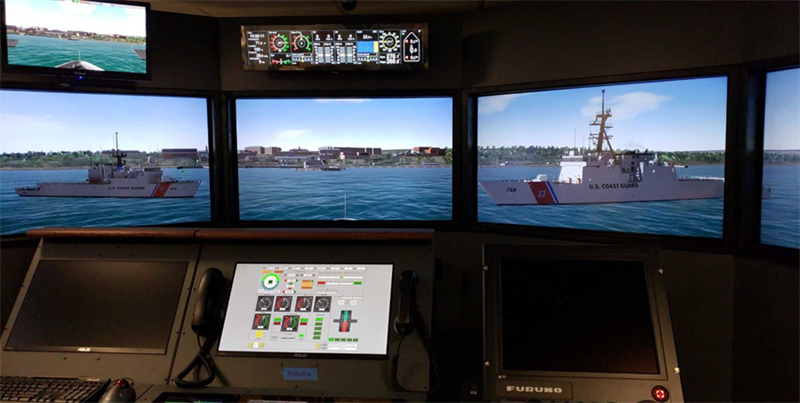
MarineLink reports that Wartsila has upgraded the simulators at the Coast Guard Academy’s Ship Control and Navigation Training System (SCANTS) facility.

MarineLink reports that Wartsila has upgraded the simulators at the Coast Guard Academy’s Ship Control and Navigation Training System (SCANTS) facility.
Note the hearing does not actually begin until time 57:45.
The video above is of a U.S. House Armed Services Committee hearing on “Future Force Structure Requirements for the United States Navy.”
While most of it is not closely related to the Coast Guard, there were considerations that may be significant for the Coast Guard. There is also discussion of a new class of combatant smaller than the recently selected 7,000 ton FFG(X) that might be shared in common with the Coast Guard.
Witnesses were:
Links are provided to prepared statements by Bryan Clark and Ronald O’Rourke that are more comprehensive than their initial oral statements.
There were questions or comments about increased coordination and interoperability with the Coast Guard at time 1:09:15, 3:07:45 and 3:14:00.
There was mention of operating in the Arctic at time 3:03:00, but most of that was about submarines.
There was much discussion about the Navy’s failure to provide a 30 year ship building program (time 1:33:00 and throughout the hearing). The Coast Guard has never provided a long term shipbuilding program despite a Congressional mandate to provide a 20 year shipbuilding projection.
Perhaps the most interesting development was an apparent general agreement that there was a need for a class of combatants, smaller than the new frigates. At time 1:15:50 Admiral Roughhead, talked about the need for a high-low mix of surface ships. Time 1:23:00 Mr Clark, said there was a need a more diversified fleet including more smaller ships. 2:59 Corvettes were discussed by Mr. Clark.
The written statement by Mr. Clark reflected a Hudson Institute study that suggested a need for 91 corvettes. I think we could make a good case that at least some of them should be painted white with racing stripes.
Mr. O’Rourke’s written statement suggested the possibility of “Coordination with Coast Guard Shipbuilding,”
As can be seen from the above list of options, there is currently some potential, at least in theory, for coordinating procurement of smaller Navy surface combatants with procurement of Coast Guard cutters—something that might increase production economies of scale and help optimize the nation’s shipbuilding effort at the national level (rather than sub-optimize it at the individual service level).
Such coordination could be viewed as consistent with Navy-Coast Guard policy statements: On at least three occasions in recent years—in 2002, 2006, and 2013—Navy and Coast Guard leaders signed joint National Fleet Policy Statements to provide (as stated in the 2013 edition) “direction and guidance for our Services to achieve commonality and interoperability for 21st century maritime and naval operations.” The document states that “This Policy is particularly important in light of: significantly constrained fiscal resources; the growing costs of acquiring, training, and maintaining technologically advanced forces; and the complexity and lethality of national security threats and challenges confronting the Nation in and from the maritime domain.” It states further that “This Policy enables Navy and Coast Guard forces to effectively and efficiently support each other while identifying specific methods and measurements, avoid redundancies and achieve economies of scale to maximize our Nation’s investment of increasingly scarce resources.” The 2013 National Fleet Policy Statement was followed in 2015 by a joint Navy-Coast Guard National Fleet Plan for implementing the National Fleet Policy Statement.
These smaller combatants might be based on the National Security Cutter or the Offshore Patrol Cutter, or might be a new design that would give birth to a new class of cutters that could make a more meaningful contribution to the National Defense. Personally I could see a modification of the current OPC design to provide greater speed by say providing a gas turbine or a second set of diesels, with the Navy variant armed much I suggested earlier and the Coast Guard variant a bit more lightly armed but readied for rapid upgrade. These ships could presumably achieve 27 to 28 knots and could be built in second line shipyards.
If the Navy and Coast Guard start talking soon, we could probably see this new class replace the last six or eight OPCs in the program of record, replace the NSCs as they age out, and grow the large cutter fleet.
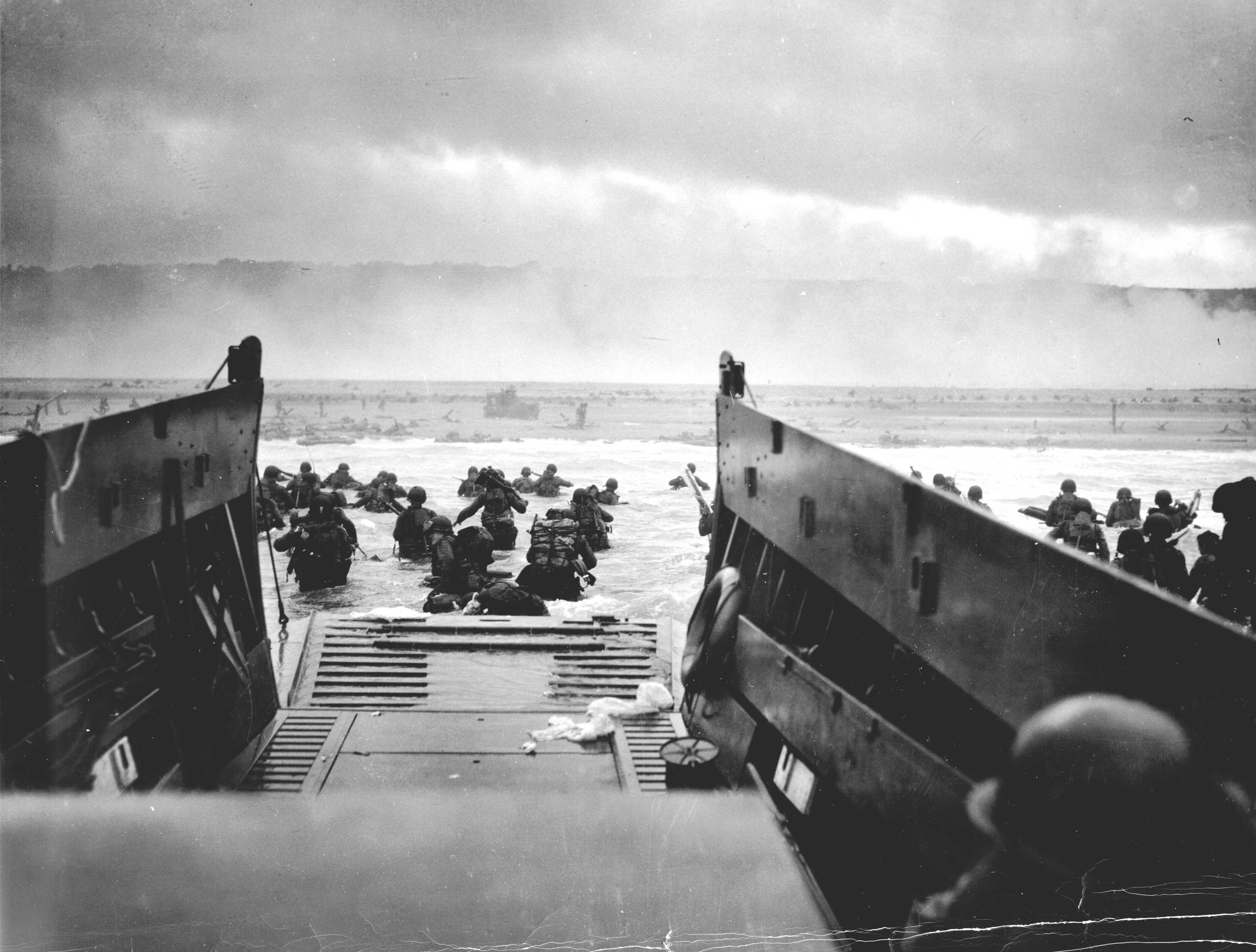
A LCVP (Landing Craft, Vehicle, Personnel) from the U.S. Coast Guard-manned USS Samuel Chase disembarks troops of Company E, 16th Infantry, 1st Infantry Division (the Big Red One) wading onto the Fox Green section of Omaha Beach (Calvados, Basse-Normandie, France) on the morning of June 6, 1944. American soldiers encountered the newly formed German 352nd Division when landing. During the initial landing two-thirds of Company E became casualties.
It is the anniversary of the D-Day landings on the beaches of Normandy.
The Coast Guard Compass has a story of one of the men rescued that day by the 83 foot cutters that provided rescue service.
We have remembered the day before.
To provide some measure of the part played by the Coast Guard, below are some of the citations accompanying awards for action in support of the operation. You will note it was a particularly rough day for Coast Guard manned Landing Craft, Infantry (LCI). We lost four.
—
FRITZCHE, Edward H. CAPT, USCG, WWII, Legion of Merit, For exceptionally meritorious conduct, both in the preparation and execution of the amphibious assault on the coast of France June 6, 1944. Captain Fritzche was in command of a main group of the Assault Force, composed of a mixed fleet of American and British transports and American landing craft. He brought these ships and craft to their predetermined stations in the transport area, successfully effected their prompt and efficient unloading and expedited the assault troops and equipment to the designated beaches.—Gold Star in lieu of a second Legion of Merit, For meritorious conduct as commanding officer of a Coast Guard transport prior to and during the amphibious invasion of Southern France August 15, 1944. He efficiently organized and trained his ship and boat group to execute the assigned mission of loading transporting to the assault area and landing the embarked Army assault units on the invasion beaches. His able conduct contributed materially to the effective establishment of the beachhead and to the over all success of the invasion.

A convoy of Landing Craft Infantry (Large) sails across the English Channel toward the Normandy Invasion beaches on D-Day, 6 June 1944. Each of these landing craft is towing a barrage balloon for protection against low-flying German aircraft. Among the LCI(L)s present are: LCI(L)-56, at far left; LCI(L)-325; and LCI(L)-4. Photograph from the U.S. Coast Guard Collection in the U.S. National Archives. Photo #: 26-G-2333
GISLASON, Gene R., LT, USCGR, WWII, Silver Star, For outstanding heroism as Commanding Officer of the USS LCI (L) 94, while landing assault troops in Normandy June 6, 1944. He successfully directed his ship through numerous beach obstacles to the proper beach, discharged his troops and retracted while his ship was seriously damaged from heavy enemy fire. Ship’s communications, engine telegraph and electric steering were disabled by direct hits on the pilothouse which killed three crewman and one screw and shaft were rendered inoperative by beach obstacles. By his coolness under fire and excellent seamanship, Lt Gislason overcame these difficulties and brought his ship off the beach on hand steering and one screw. He later supervised repairs and in four hours enable the LCI (L) to remain operative in the assault area for three weeks.
HENLEY, Coit T., LTJG, USCGR, WWII, Normandy invasion, Silver Star, For heroism as Commanding Officer of the USS LCI(L) 85 while landing assault troops in Normandy, France, June 6, 1944. Lt Hendley successfully landed his troops despite the mining of his vessel, fire in three compartment and concentration of enemy fire while unloading. His courage and seamanship in directing repairs and retracting from the beach resulted in saving the lives many wounded aboard.
IMLAY, Miles Hopkins, CAPT, USCG, WWII, Invasion of Sicily and Normandy, Legion of Merit, For exceptionally meritorious conduct as Commander of the Reserve Attack Group during the Sicilian invasion campaign. With outstanding skill and expert seamanship, Captain Imlay brought the group under his command to the scene of action and with speed and precision dispatched them to the designated beaches, as they were required. Following the initial assault, he assisted in the support of the Army at Licata, and later was temporarily Commander of the Advance Base at Porto Empedocles, participating in the opening of that port while under enemy gunfire.—Gold Star in lieu of Second Legion of Merit, For exceptionally meritorious conduct as Commander of the LST convoy of a Major Task Force during the assault upon Italy in September 1943. Charged with the difficult assignment of brining the vessels under his command safely through the hazardous course between Bizerte, Tunisia , and the Gulf of Salerno, Italy, Captain Imlay (the Commander) performed his essential duties with outstanding skill, successfully reaching the designated assault beaches at the assigned time despite extremely adverse weather conditions and fierce enemy aerial opposition.—Silver Star, For conspicuous gallantry as Deputy Commander of an Assault Group participating in the initial invasion on the coast of France , June 6, 1944. Undaunted by heavy enemy fire, Captain Imlay courageously took station close to the shore on the early morning of D-Day and throughout the most bitter period of the fighting, coolly and promptly made spot decision on the reorganization, grouping and dispatching of craft to the beach, subsequently relieving the Task Group Commander of his duties when he withdrew his transport from the assault area, immediately thereafter, he was placed in charge of operations afloat as assistant to the naval Officer in Charge of one of the beaches and discharging the duties of this responsibility with distinctive professional ability, contributed essentially to the rapid clearing of the backlog of ships.
OXLEY, Gene E., Sea. 1c [ Seaman, First Class], WWII, USCGR, Silver Star, For gallantry while on the USS LCI(L) 85 during the assault on the coast of France June 6, 1944 and for extraordinary courage in volunteering and twice taking a line ashore, in the face of heavy machine gun and shell fire in order to assist troops unloading from the ship to the bench through chest deep water.

SALMON, Robert M., LT, USCGR, WWII, Normandy invasion, Silver Star, For gallantry as commanding officer of a U.S. LCI (L) while landing assault troops in Normandy, France June 6 1944. He pressed the landing of troops despite the mining of his vessel a serious fire forward and heavy enemy gunfire. He supervised the unloading of troops, directed the fire fighting despite the loss of proper equipment and exhibiting courage of high degree remained with the ship until it was impossible to control the progress of the fire and it was necessary to abandon ship over the stern. After abandoning he directed a party searching for fire fighting equipment and subsequently fought the fire on another LCI (L) and assisted her commanding officer until she was abandoned.
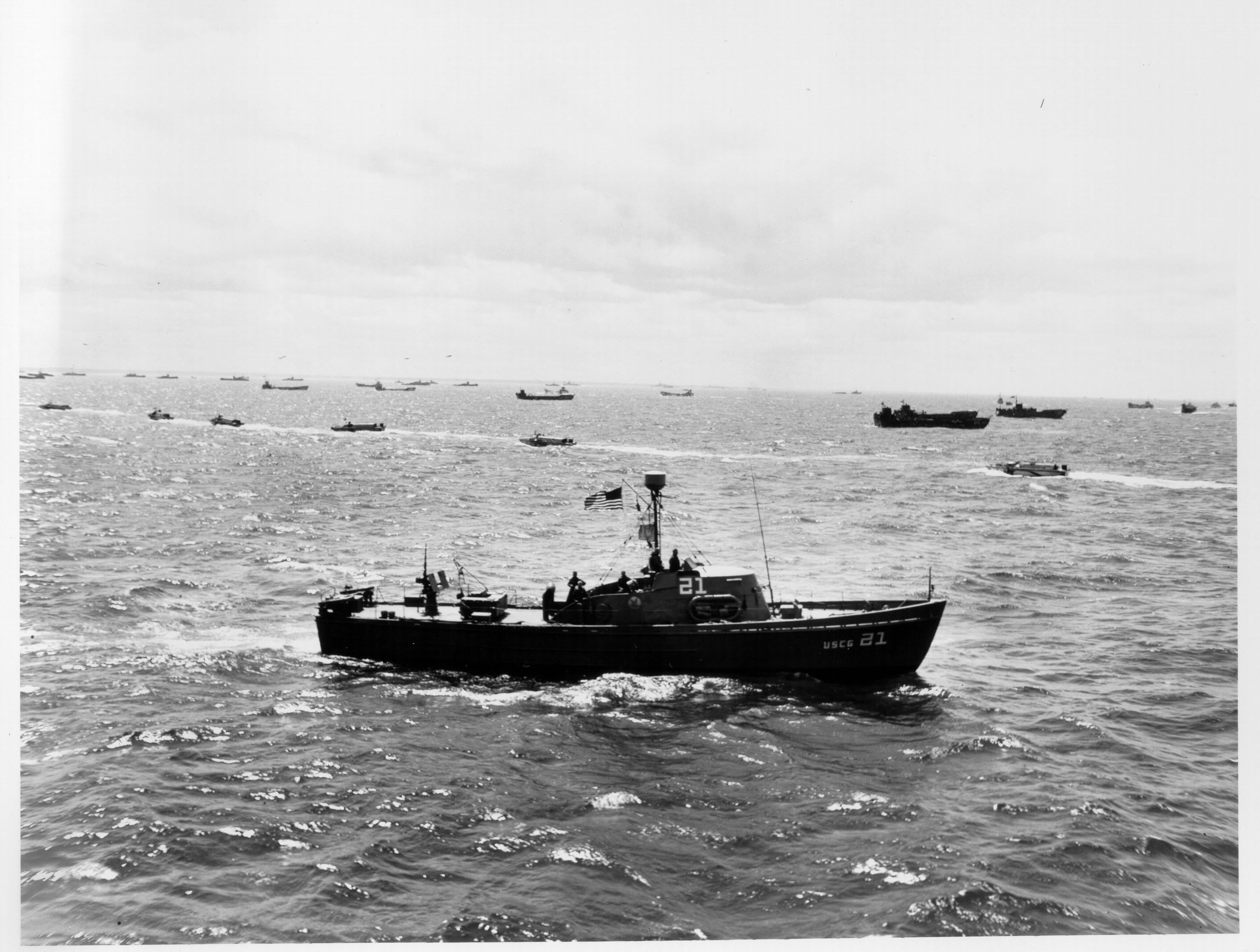
USCG 83 ft patrol boat, probably June 1944. Photographer unknown.
VERNON, Albert, LTJG, USCGR, Bronze Star, For meritorious service as Commanding Officer of a Coast Guard Cutter in rescuing survivors of the invasion off the coast of France June 6, 1944. During D-Day, his cutter rescued 97 men. Each rescue was effected in the face of constant enemy fire from the beach which was in no way allowed to deter the splendid rescue operations.
VYN, Arend, Jr., LTJG, USCGR, Silver Star, For gallantry in action as commanding officer of USS LCI 91 in the assault on the cost of France June 6, 1944. LTJG Vyn beached his ship and discharged the Army elements therein the face of murderous fire and a labyrinth of obstacles and mines. In spite of the fact that his ship was mined and repeatedly struck by artillery fire and small arm fire, he continued to land the army load in the face of certain loss of his ship. his determination to put the Army ashore was in keeping with the highest traditions of the offensive spirit of the U.S. Naval Service.
CLARK, George C., LTJG, USCGR, British Distinguished Service Cross, During the landing of Commandos at Quistreham by LCI (S) on 6 June 1944 Lt. Clark’s cutter was detailed to act as escort to LCI (S). HM LCI(S) 524 on clearing the beach after landing troops received a direct hit and blew up in a sheet of flames leaving a mass of blazing Octane petrol on the water. Although his cutter burned Octane petrol, he did not hesitate to steer his craft into the flames and rescue the commanding officer and some of his men.

The 83-foot Coast Guard cutter USCG 1 off Omaha Beach on the morning of D-Day, tied up to an LCT and the Samuel Chase

Photo: CSBC Corporation
Like many Asian nations, Taiwan is rapidly expanding their Coast Guard Administration (CGA). Naval News reports that Taiwan has launched it’s largest Coast Guard vessel ever, “Chiayi” (CG-5001). This is only part of a general major expansion.
“CGA has a programme to build 141 coast guard ships from 2018 to 2027. The programme includes four 4000-ton class patrol vessels, six 1000-ton class patrol vessels, twelve 600-ton class patrol vessels, seventeen 100-ton class patrol boats, fifty-two 35-ton class patrol boats and fifty littoral utility boats. Taiwanese media also reported that the CGA is considering to establish aviation units, and have sent a report on this issue to the parliament in April.”
Nominally these are 4,000 ton ships, but given the Asian tendency to use light displacement, its full load approach 5,000 tons. This may be reflected in the ship’s hull number, 5001, since, while most of their larger ships have three digit hull numbers, some of their smaller vessels have five digit hull numbers, where the first two or three digits that reflect their nominal displacement.
We talked briefly about these ships earlier. Interestingly the Taiwanese refer to these ships as frigates. The description says the “frigate is equipped with rockets and machine guns.”
After much searching, I finally found some more detailed information about these ships.
The Chiayi, which will be deployed at the CGA’s central base, is 125 meters (410 feet) long, 16.5 meters (54.1 feet) wide and can travel up to 10,000 nautical miles at a maximum speed of 24 knots, the CGA said.
In terms of its weapons system, it will be equipped with a 2.75-inch rocket launcher, two 20 millimeter cannons, and several water cannons with a range of 120 meters, the CGA said.
The Chiayi is one of four 4,000-ton CGA patrol ships commissioned to CSBC at a total cost of NT$ 11.74 billion (US$392 million), according to Hsieh Ching-chin (謝慶欽), head of the CGA Fleet Branch.
It appears they are at least as large as the Offshore Patrol Cutters and National Security Cutters, perhaps a little larger.

What is the 2.75 inch rocket launcher referred to above? I found reference to a “multi-barrel Zhenhai rocket system” in a post about their new 600 ton cutter with a wave piercing catamaran hull, that included the artist’s presentation, seen above, of the vessel with what appears to be multiple rocket launcher on the bow. These might be a Taiwanese equivalent of the APKWS guided rocket system. If the rockets were not guided, they would be relatively useless for Coast Guard applications.
There is a discussion of the history and missions of the Taiwan Coast Guard Authority from 2017 here..
The Taiwanese Coast Guard is about 1/3 the size of the US Coast Guard, even though its EEZ is only about 1/136th that of the US. It has at least 14 ships of over 1000 tons.
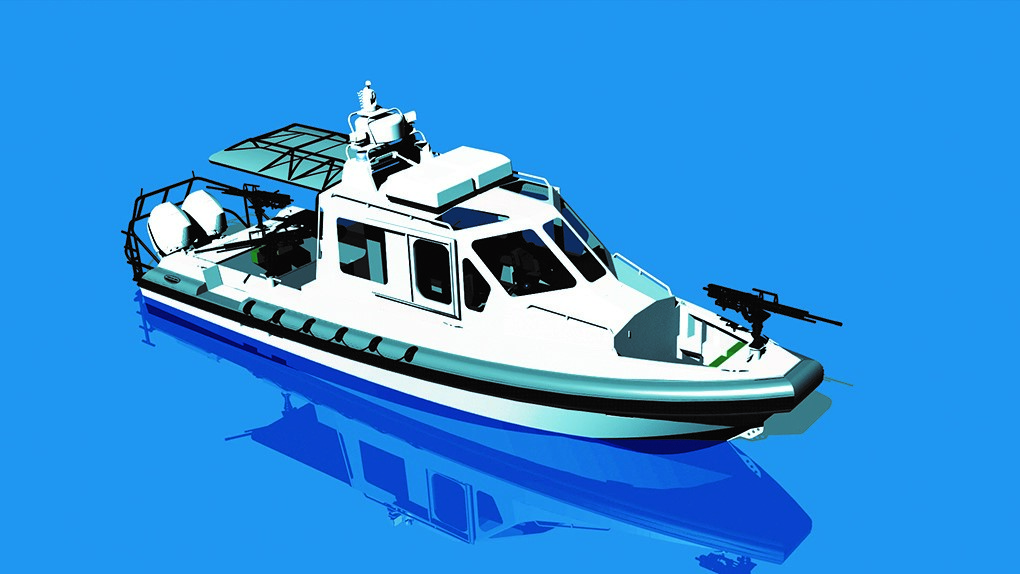
“Lake Assault Boats has been chosen to produce up to 119 Force Protection-Medium (FP-M) patrol boats by the U.S. Navy. The five-year contract carries a maximum value of $56 million, and the first deliveries will begin in November 2020.” (Note there is access to the bow by a hatch, not included on this illustration–Chuck)
Below is a press release from Lake Assault Boats. This is about $470,600 per boat if all 119 are completed :
SUPERIOR, Wis. (Feb 24, 2020) – Lake Assault Boats, part of Fraser Shipyards and a leading manufacturer of fire, patrol, and rescue craft, has been chosen to supply up to 119 Force Protection-Medium (FP-M) patrol boats to the U.S. Navy. The five-year Indefinite Delivery Indefinite Quanity (IDIQ) contract carries a maximum value of $56 million, and the first deliveries will begin in November 2020.
The FP-M patrol boats will provide security for U.S. Navy Ships and personnel from waterborne threats in and outside of Navy ports around the world. “We are honored to be chosen by the U.S. Navy to supply it with these versatile and powerful FP-M patrol craft,” said Chad DuMars, Lake Assault Boat vice president of operations. “Our FP-M vessels will be engineered and built to the same high manufacturing and quality control standards as our patrol and fire boats currently in service throughout North America.”
An operational requirement for the boats is to provide Anti-Terrorism/Force Protection patrols for U.S. Navy Installations, which includes; patrol, interrogation of other waterborne assets, and escorting large vessels in and out of port in various weather and water conditions throughout the year, day and night. Each of the 33-foot long craft will have a 10-foot beam and feature a full cuddy cabin. Twin 225-hp outboard motors will power each boat, which will carry four weapon mounts capable of accommodating up to .50 caliber machine guns. The aluminum V-hull boats are protected by a polyurethane foam collar wrap.
“Our selection, after a long and rigorous competitive bid process, represents a significant accomplishment for Lake Assault Boats and our sister company, Fraser Shipyards,” explained DuMars. “Our entire team is very excited and prepared to provide these boats to serve with the U.S. Navy.”
Thanks to Lee for bringing this to my attention.
A look back at Coast Guard participation in the Battle of the Atlantic, with a short excursion into the Mediterranean.
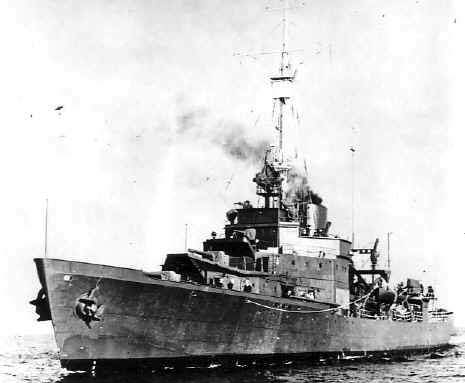
USCGC Alexander Hamilton (WPG-34)
January 29, 1942, Shortly after dropping the tow of a disabled merchant ship, USCGC Alexander Hamilton was torpedoed on the starboard side by the German submarine U-132, which had been patrolling the Icelandic coast near Reykjavík. The explosion killed twenty men instantly and the total death toll was 26. Hamilton capsized and sank Jan. 30. U-132 would sink 10 ships (39,496 tons) and damage one (6,690 tons). The U-boat would destroyed by the explosion of her last victim, 4 Nov. 1942, with the loss of all 47 aboard.

USCGC Icarus (WPC-110) arriving at Charleston Navy Yard with prisoners of war from the U-boat U-352, 10 May 1942, US Navy photo
May 9, 1942, USCGC Icarus sank U-352 south of Cape Hatteras, 15 dead and 33 survivors. The Navy did an extensive intelligence report on the U-352 and its sinking which is still available on line.

USCGC Thetis (WPC-115)
June 13, 1942, USCGC Thetis, Icarus’ sister ship, sank U-157 in the Gulf of Mexico north of Havana, Cuba with all hands. 52 dead. U-157 had sunk one ship, an American Tanker named Hagen, two officers and four crewmen were lost and three more injured.
Dec. 17, 1942 USCGC Ingham was credited with sinking U-626, but that now seems unlikely. U-626 went missing 14 December 1942 in the North Atlantic south of Iceland. There is no explanation for its loss. 47 dead (all hands lost). She had been underway a total of only 14 fruitless days.
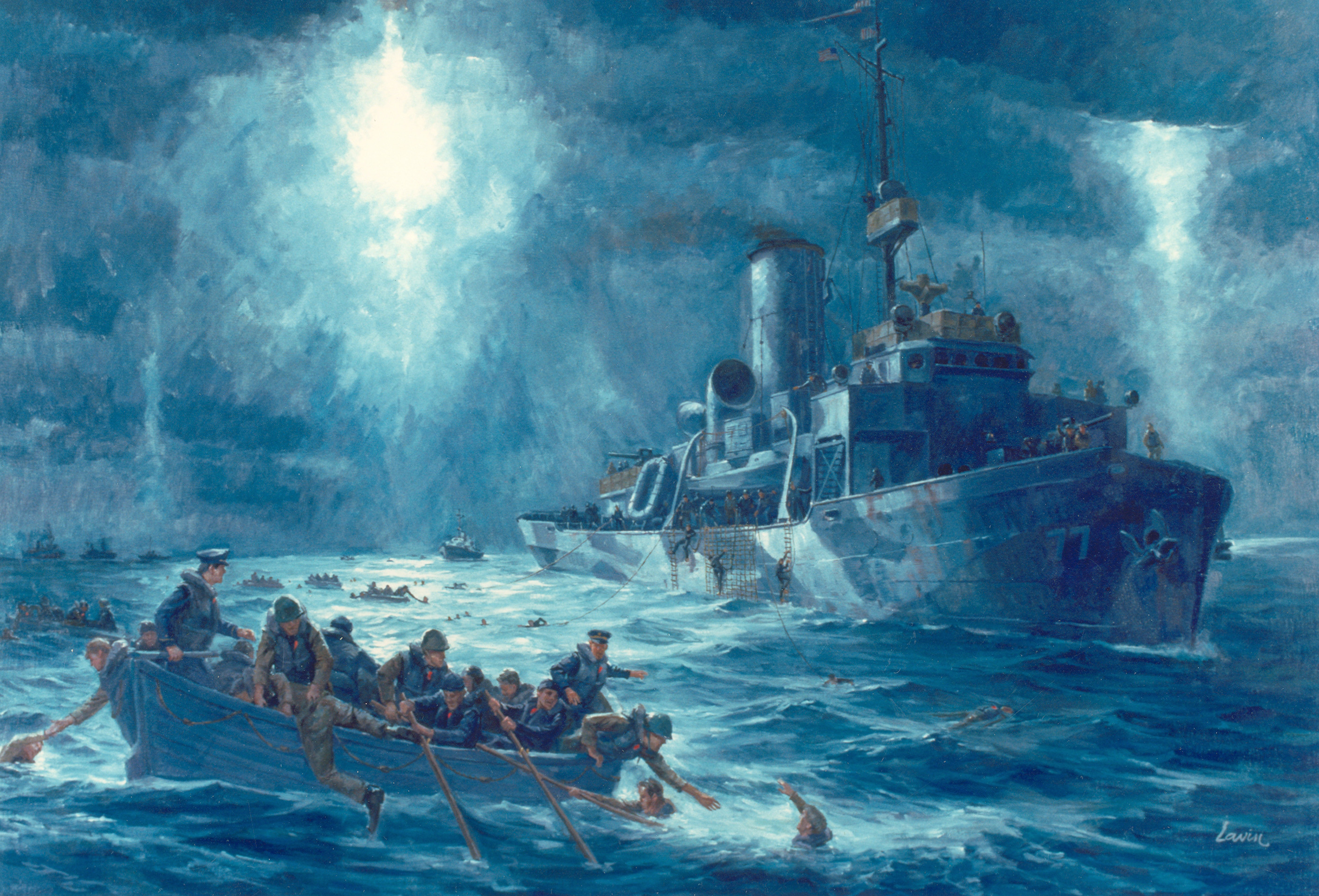
Escanaba rescuing survivors from USAT Dorchester. USCG Image.
Feb. 3, 1943 The Army Transport Dorchester being escorted by the 240 foot Tampa (WPG-48) and two 165 foot “A” class cutters, Escanaba (WPG-77) and Comanche (WPG-76), is torpedoed and sunk by U-223. Despite extraordinary effort by the escorts, of the 904 aboard, there were 675 dead and only 229 survivors. And U-223? She would sink for otherwise destroy two more merchant vessels, a Canadian frigate, and, on the last day of her existence, sink a Royal Navy destroyer, HMS Loferey, using an acoustic homing torpedo (189 dead). U-223 was
Sunk on 30 March 1944 in the Mediterranean Sea north-east of Palermo, in position 38.48N, 14.10E, by depth charges from the British destroyers HMS Laforey and HMS Tumult and the British escort destroyers HMS Hambledon and HMS Blencathra. 23 dead and 27 survivors.
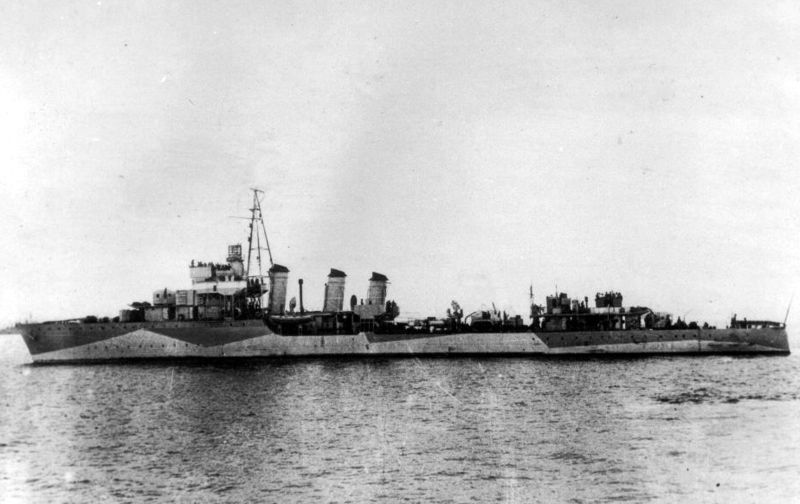
Polish destroyer en:ORP Burza in 1940 in Great Britain. Republic of Poland, Polish Government in Exile.Ministry of Information War Photo Service, London 1940. Press released by Polish Government 1940. Source: Jerzy Pertek Morze w ogniu 1939-1945 : na frontach i za kulisami wojny morskiej T. 1-2. 2nd Edition Poznań 1975
Feb. 22, 1943, Polish destroyer ORP Burza depth charged and force to the surface U-606. USCGC Campbell rammed U-606 sinking the sub in the North Atlantic east of Newfoundland. Campbell was damaged when a diving plane pierced the hull at the engineroom, leaving her dead in the water. Burza protected her until she was taken in tow. U-606, 36 dead and 11 survivors.

USCGC Campbell (WPG-32) heading to port at Norfolk Navy Yard. 26 July 1943. US National Archives, photo 80-G-76569
Mar. 8, 1943, USCGC Spencer sank U-633 in the North Atlantic south-west of Iceland. All hands (43) were lost with the U-boat. U-633 had only one war patrol and had sunk one ship, the British merchant steamer Guido of 3,921 tons.
At 08.55 hours on 8 March 1943 the Guido was torpedoed and sunk by U-633 about 450 miles east-southeast of Cape Farewell. The vessel was a romper (it had left the convoy and running ahead–Chuck) 10 miles off the starboard bow of convoy SC-121. Eight crew members and two gunners were lost. The master, 28 crew members and six gunners were picked up by USCGC Spencer (WPG 36) and landed at Londonderry.

USCGC Spencer (WPG-36) in 1942 or 1943. Spencer sank U-175 with assistance of USCGC Duane, on April 17, 1943.
April 17, 1943, USCGC Spencer sank U-175 in the North Atlantic south-west of Ireland. The U-boat suffered 13 dead and had 41 survivors. U-175 had had three war patrols and had sunk 10 ships, total tonnage 40,619 GRT, including four US flag and two US owned of Panamanian registry. 65 crewmember or armed guard died in these ten sinkings.
USCGC Escanaba explodes and sinks off Ivigtut, Greenland, probably as a result of a torpedo. There were only two survivors out of a crew of 103 rescued by the USCGC Raritan.
Jan. 12, 1944 USCGC Duane goes into yard for conversion to an Amphibious Force Flagship, all the remaining 327s will soon follow, ending their career as anti-submarine escorts.
Mar. 9,1944, Coast Guard manned Destroyer Escort, USS Leopold (DE-319) is torpedoed and sunk by an acoustic homing torpedo (GNAT–German Navy Acoustic Torpedo) launched by U-255. U-255 survived the war, having completed 15 war patrols and sinking 12 ships totaling 56,031 tons including seven American merchant ships in addition to USS Leopold.
On 9 March 1944 the US Coast Guard manned USS Leopold (Cmdr. Kenneth Coy Phillips, USCG) was on her second voyage and escorting the convoy CU-16, when she got an acoustic contact about 400 miles south of Iceland and turned to investigate it. But before the destroyer escort reached the U-boat, she was hit at 22.00 hours by a Gnat from U-255 and was abandoned. The vessel broke in two and remained afloat, but both parts sank early the next morning in position 58º44’N, 25º50’W. 172 died which includes all 13 officers and only 28 ratings survived who were picked up by USS Joyce (DE 317).
Apr. 16, 1944, USS Gandy (DE-764) and Coast Guard manned Destroyer Escorts USS Joyce (DE-317) and USS Peterson (DE-152) sank U-550, 70 miles south of Nantucket, Mass, 44 dead and 12 survivors. Some two hours after the attack USS Joyce and USS Peterson together pick up 56 survivors from the American tanker Pan Pennsylvania that was the first and only ship sunk by U-550. 25 were lost with Pan Pennsylvania.

Coast Guard manned Destroyer Escort USS Menges, victim of a German Acoustic Homing Torpedo, May, 1944
May 3, 1944, Coast Guard manned Destroyer Escort, USS Menges is torpedoed off the Mediterranean coast of North Africa, by U-371 using a GNAT but survived. 31 were killed and 25 wounded. A 95′-long section of the stern portion of Navy manned sister ship USS Holder‘s hull was used to repair USS Menges
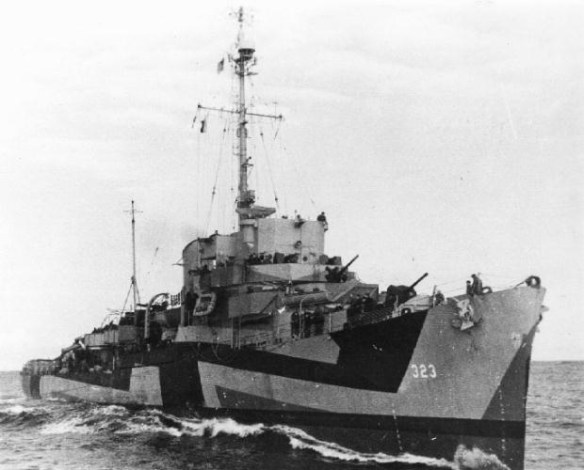
USS Pride (DE-323), Coast Guard manned destroyer escort
May 4, 1944 U-371 is sunk by Coast Guard manned Destroyer Escorts USS Pride and USS Joseph E. Campbell, the French destroyer escort Sénégalais and the British escort destroyer HMS Blankney sank U-371 (3 dead and 49 survivors) in the Mediterranean Sea north-east of Bougie but not before U-371 also put a torpedo (GNAT) into the Free French Destroyer Escort Sénégalais (built as USS Corbesier (DE-106) damaging her as well. U-371 had made 19 war patrols and sank or damaged 19 ships.
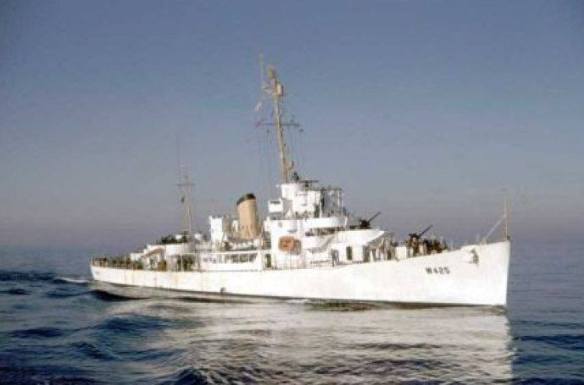
USS Lowe (DE-325) in its later guise as USCGC Lowe (WDE-425)
March 18, 1945, Coast Guard manned Destroyer Escorts Menges, Pride, Mosley, and Lowe sank U-866 South East of Halifax, 55 dead (all hands lost). U-866 spent a total of 50 days at sea and had not damaged any allied shipping.
On 18 Mar 1945, U-866 was sunk by the only hunter-killer group in the North Atlantic manned completely by US Coast Guard personnel, consisting of four destroyer escorts, USS Pride (DE 323), USS Mosley (DE 321), USS Lowe (DE 325) and USS Menges (DE 320).
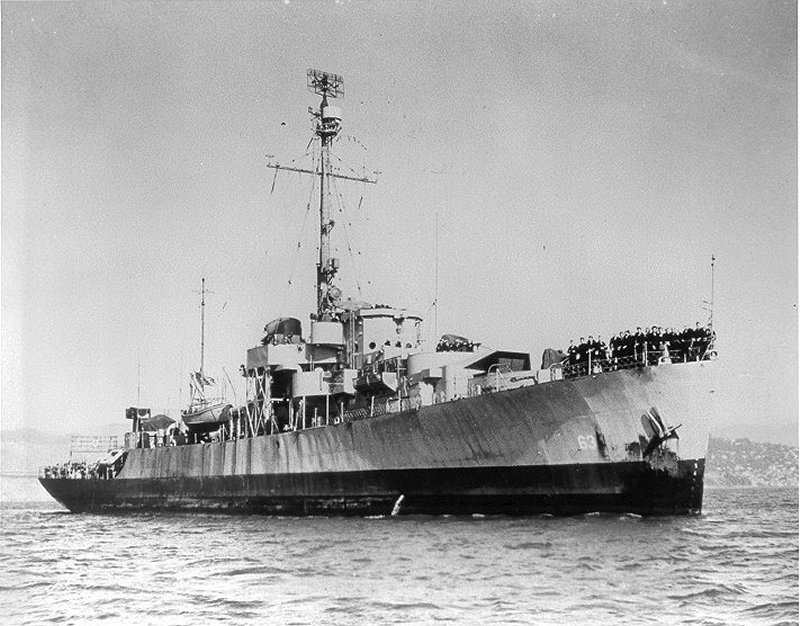
USS Moberly (PF-63) Off San Francisco, CA in early 1946.
Naval Historical Center photo NH 79077
May 7, 1945, USS Atherton (DE-169) and Coast Guard manned Frigate USS Moberly (PF-63) sank U-853 in the North Atlantic south-east of New London. 55 were lost with U-853. The U-boat had sunk two ships, totaling 5,783 tons. 61 died on the two ships sunk by U-853.
—-
Overall the Germans lost 768 U-boats (reported losses vary). Some were lost to accidents or mine, but in general about 200 were lost to US aircraft, about 200 to allied aircraft, and about 200 to allied surface vessels. US surface vessels sank 38 (last I heard). US surface ships also, of course, sank a large number of Japanese and some Italian submarines.
In terms of human lives, 28,000 German U-boat crew of the total 40,900 men recruited into the service lost their lives and 5,000 were taken prisoners of war. Some 30,000 men of the allied merchant service died, in addition to an unknown number of Allied naval personnel.
You may have heard that a Coast Guard aircraft had sunk a U-boat. This was U-166, previously credited to a J4F-1 Grumman Goose (USCG V-212/Y). When the wreck was found, it was determined that it had been destroyed by depth charges from the US patrol craft USS PC-566. 52 dead (all hands lost).
—
In this short retelling of selected engagements, I cannot help but notice five escort vessels fell victim to German Navy Acoustic Torpedoes (GNATs). Two sank, one total constructive loss. and two badly damaged, but repaired.
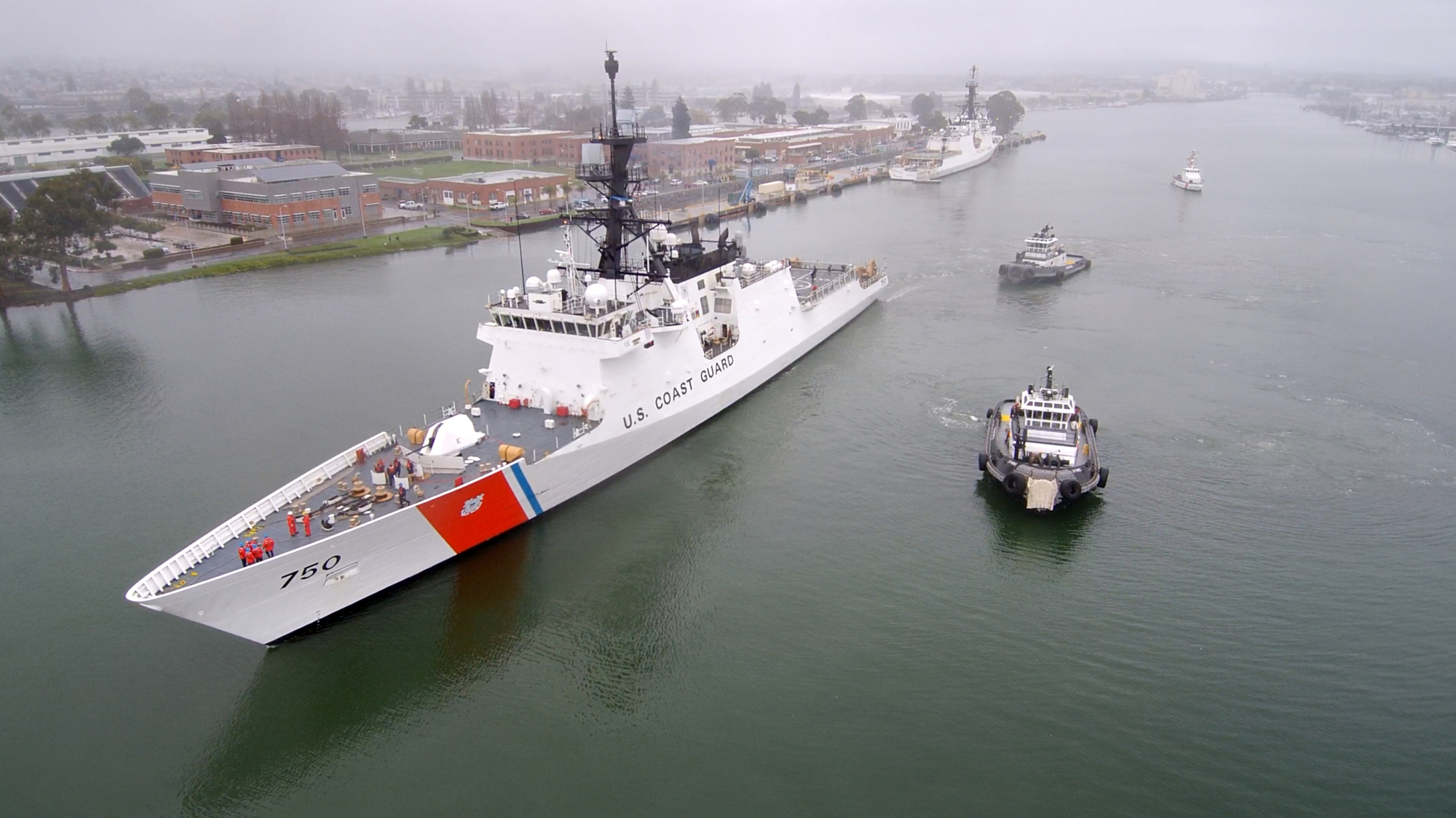
The US Naval Institute has an argument in favor of funding National Security Cutter #12
The author talks about the shortage of ships both because of the failure of the crew rotation concept and because of the shortfall revealed in the Fleet Mix Study. This has been discussed in the Congressional Research Service report on Cutter Acquisition.
What I found new, was information about SOUTHCOM interceptions,
In congressional testimony last year, Admiral Craig Faller, Commander, U.S. Southern Command, noted: “The Coast Guard’s presence any given day is six to eight cutters. . . . But, keep in mind, we’re talking about covering areas the size of the United States—with from six to 10 ships. And so, the interdiction percentage with the current assets we have is about 6 percent of the detections. So, we need more ships.”
that is a lower interception rate than previously reported, and impact on jobs,
The NSC is an indispensable national asset. The economic impact of the NSC production line touches nearly 500 suppliers across 39 states. An additional ship order would help jumpstart the U.S. economy and have an immediate and profound effect on a host of U.S. suppliers, who stand ready to deliver. Moving forward with a 12th NSC is low risk.
If we had been further along with the Offshore Patrol Cutter (OPC), I would say, just build another OPC instead of a twelth NSC, but we were way behind in starting the OPC program and the difficulties at Eastern put us even further behind.
The OPC program is so far behind, that the Bertholf is likely to be 30 years old before the 25th OPC is ready for its first operational mission. Plus we really do need more than 36 large patrol cutters, but the fact we have not done a new Fleet Mix Study in almost ten years does not help our case.

Kenneth J. Braithwaite, U.S. ambassador to Norway and the nominee to become the next Navy secretary, in 2018. During his Senate Armed Services Committee confirmation hearing on May 7, Braithwaite spoke of the importance of the U.S. foothold in the Arctic to counter “Great Power Competitors” China and Russia. U.S Navy/Mass Communication Specialist 1st Class Theron J. Godbold
The Navy League on-line magazine is reporting that the current nominee for Secretary of the Navy, a former Navy P-3 patrol plane commander, is saying that he will be a strong advocate for a Navy presence in the Arctic.
Braithwaite also told Sen. Dan Sullivan (R-Alaska) that he would be a strong advocate for a strategic Arctic port large enough to handle destroyers and icebreakers. The nearest such port is Anchorage, Alaska, which is 1,500 miles from the Arctic Circle, Sullivan added.
“The great news is the United States Navy has been up there for many, many years,” Braithwaite said. “You may not see them, but they’re up there. As it begins to become more navigable on the surface, we also need to make sure that our presence is noted.”
“We continue to need to be vigilant,” he added. “We continue to need to be present. That requires an adequate-size Navy to be there.”
“It will be a priority of mine.”
We talked about Arctic port development earlier:
Coast Guard Compass is “the official blog of the U. S. Coast Guard,” but the Compass is broken. While it appears to welcome comments, in fact they do not seem to work. Over the past three weeks I have attempted to comment three times on two different stories, but they never showed up. All the stories currently visible on the blog end with the notation, “no comments.”

A typical day on the Imperial Star Destroyer Kimball. (stolen from Kimball’s Facebook page)
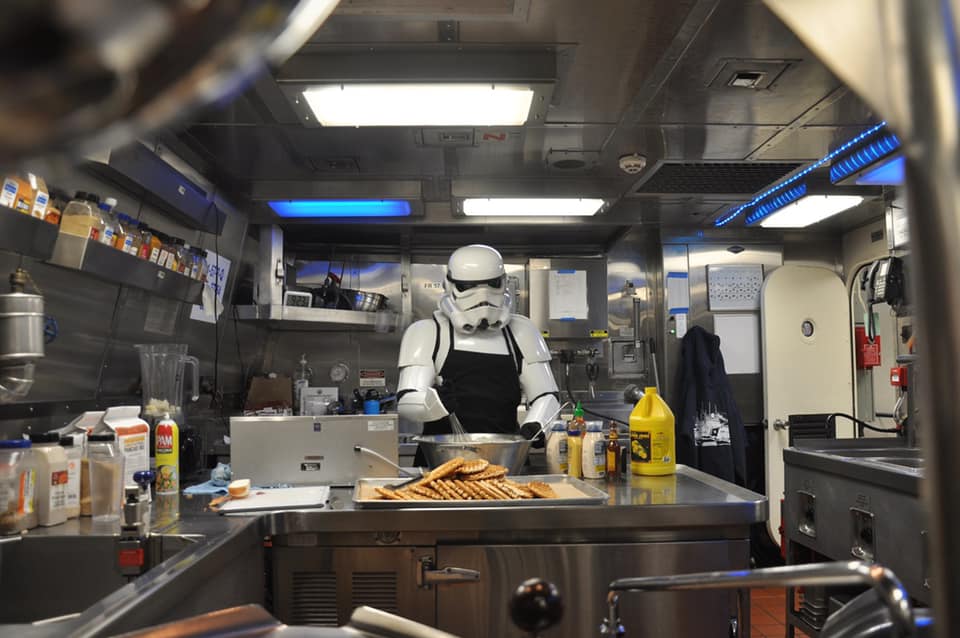
Yummm…waffles!
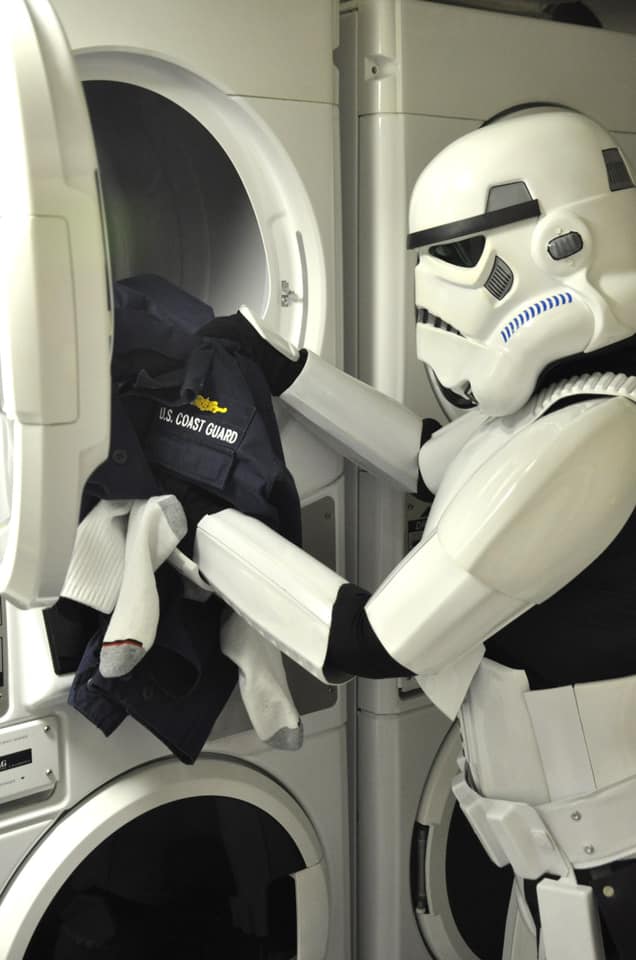
“This isn’t my laundry?!”
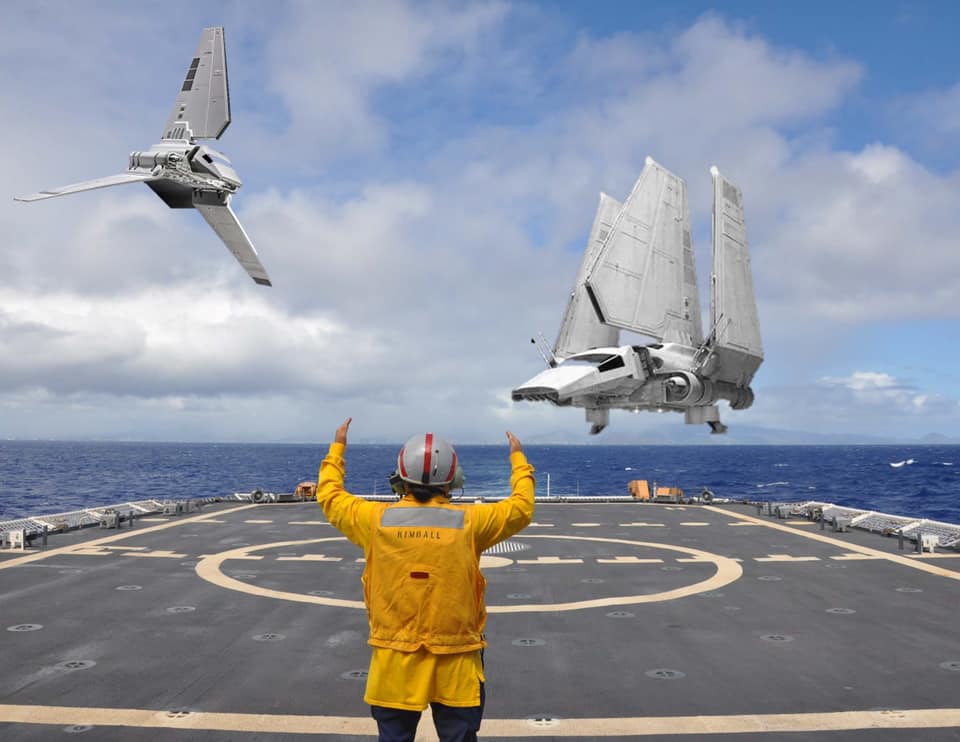
Touch and Goes
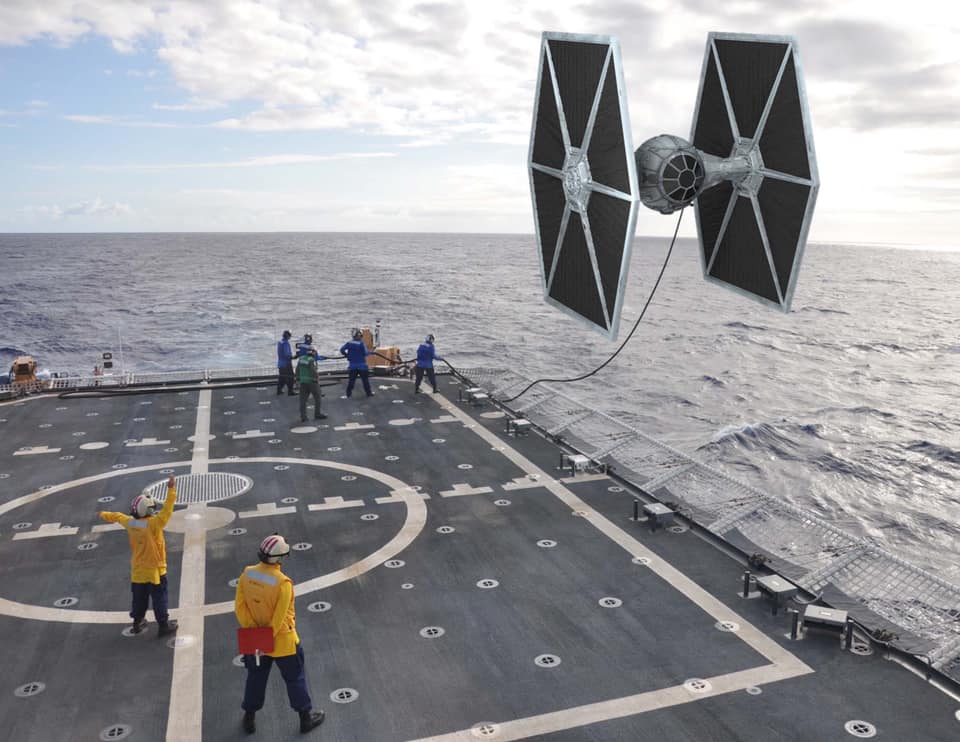
HIFR (Hot In Flight Refuel)
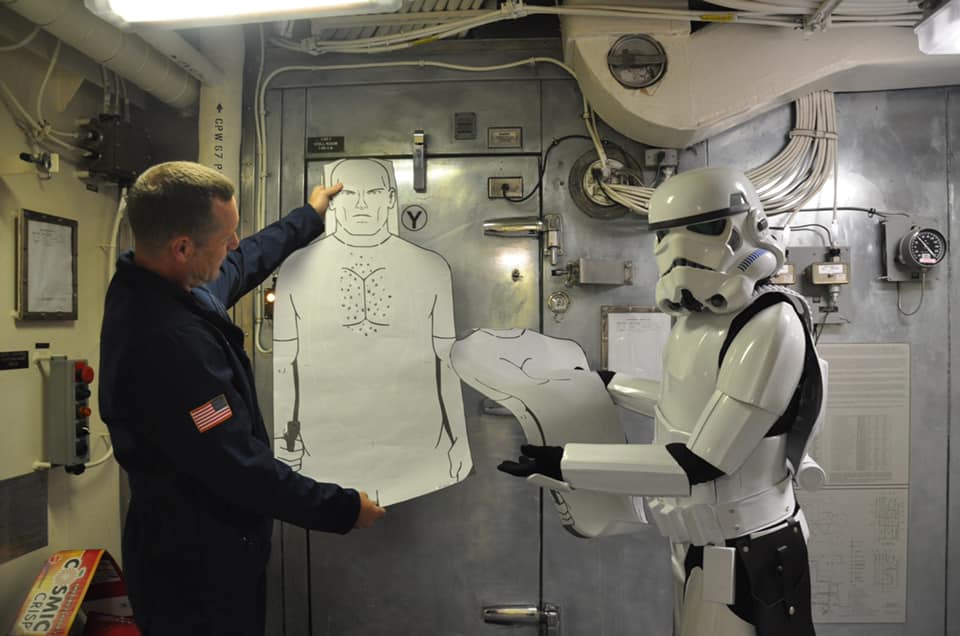
All hands qualified at the range, except for TK-0756 (…again)
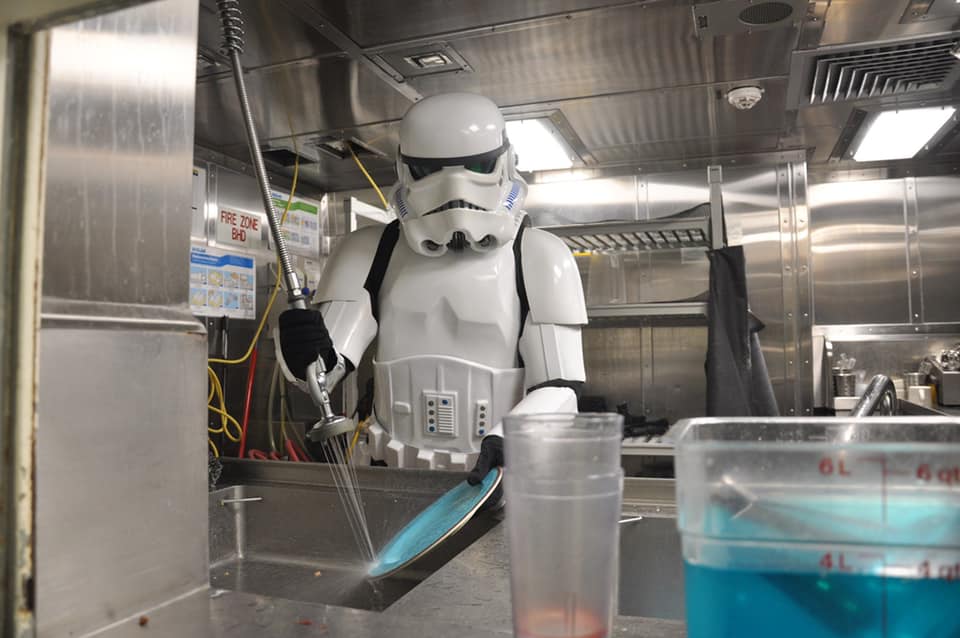
TK-0756 on Messcook duty
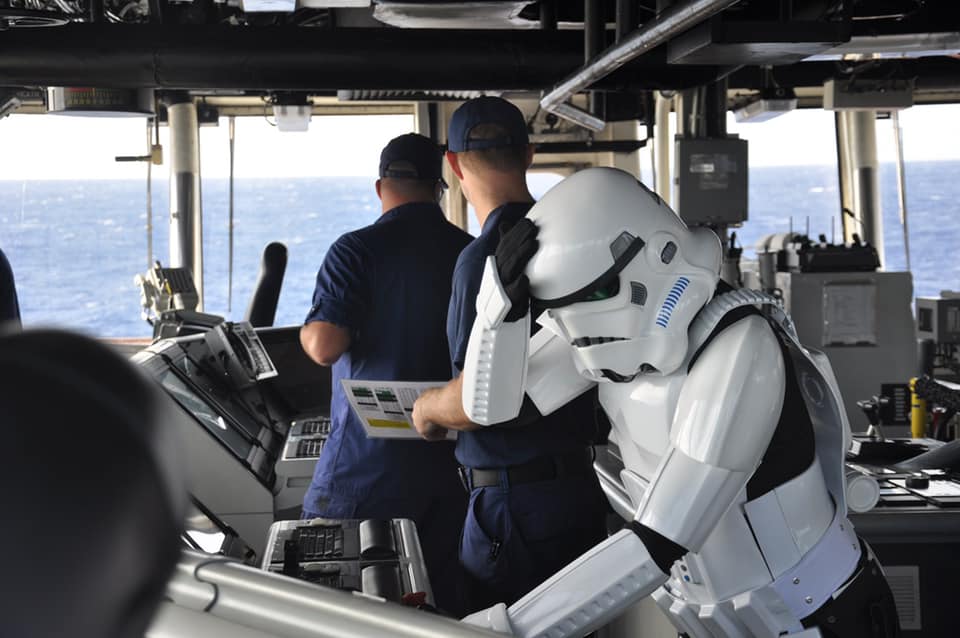
“What is the password to unlock the Detention Block!?”

Main Control

“Conn, Lookout. Rebel X-wing fighters inbound!”
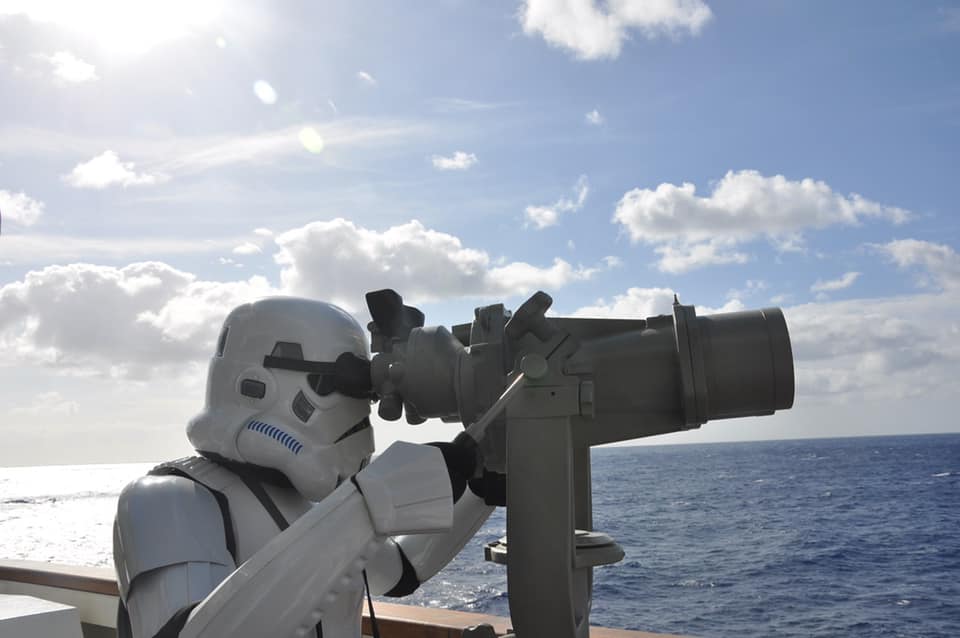
“Contact bears 115 degrees relative, position angle 2”
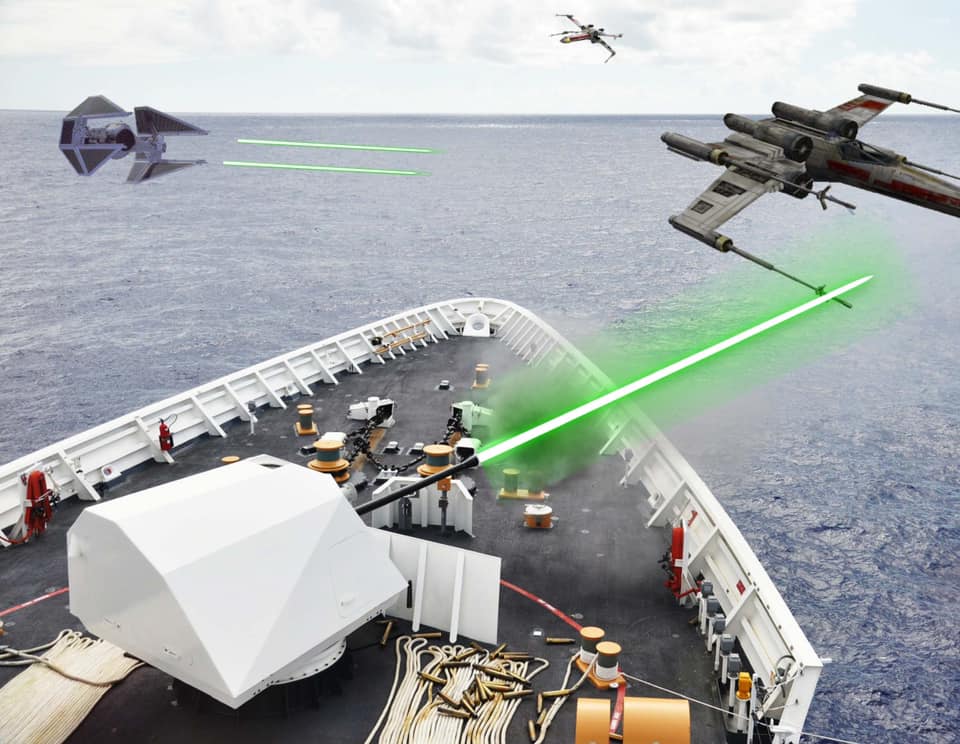
General Quarters!

 Chuck Hill's CG Blog