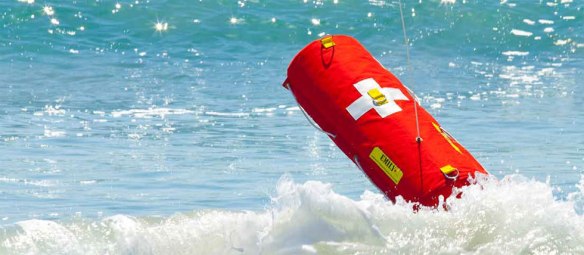
EMILY the robotic lifeguard, “Emergency Integrated Lifesaving Lanyard”

emily-surf-breaching

NavyRecognition is reporting, “The EMILY (Emergency Integrated Lifesaving Lanyard) robotic lifeguard will be showcased by the Office of Naval Research (ONR) during the Sea-Air-Space 2016 Exposition held May 16 to 18 at the Gaylord Convention Center in National Harbor, Maryland. The robot will also be displayed at the ONR’s booth (number 1004).”

“Outfitted in bright orange, red and yellow colors, each cylindrical EMILY buoy is 4-feet long and weighs 25 pounds. It’s powered by a jet engine system similar to a mini jet ski, shoots a water jet stream for propulsion and travels up to 22 mph. EMILY also has two-way communication radios, a video camera with a live feed to smartphones and lights for night rescues.

“‘EMILY is made of Kevlar and aircraft-grade composites and is virtually indestructible,’ said Mulligan, CEO of Hydronalix, a maritime robotics company. ‘The devices can be thrown off a helicopter or bridge and then driven via remote control to whoever needs to be rescued.'”

To me the description of its use and capabilities seems incomplete. For instance, could this be used to tow a rescue swimmer to a vessel in distress? and how was it “used to rescue nearly 300 Syrian migrants from drowning in the waters off the Greek Island of Lesbos”?

Looks like a piece of gear we should look into. If one of our readers gets a look at it, I would welcome first hand impressions.

Apparently it is already for sale to the general public.

USNI Coast Guard Essay Contest

Huntington Ingalls Industries (HII, builder of the Bertholf class cutters) is sponsoring a Coast Guard Essay contest with the US Naval Institute.

Challenge: Advance new thinking about the U.S. Coast Guard’s critical role in the 21st Century. No issue is too big or too narrow as long as it makes the Coast Guard stronger. This does not mean authors canot be critical and take on conventional wisdom and current practices. In fact, we encourage you to push the ‘dare factor.'”

  • Word Length: 3,000 maximum
  • Deadline: 31 August 2016
  • Submit to: essay@usni.org
  • Winners will be announced in the October Proceedings.
  • More info here: http://www.usni.org/cgessay

Cash prizes of $5000, $2500, and $1500.

I suspect there are several among the readership here that might have some ideas.


Document Alert: A Ten-Year Prioritization of Infrastructure Needs in the U.S. Arctic

There is a new report, “A Ten-Year Prioritization of Infrastructure Needs in the U.S. Arctic,” prepared by The U.S. Committee on the Marine Transportation System Arctic Marine Transportation Integrated Action Team for the U.S. Department of Transportation.

I have quoted a portion of the Executive Summary below”

EXECUTIVE SUMMARY

“This document, “A Ten-Year Prioritization of Infrastructure Needs in the U.S. Arctic” (Prioritization Framework), presents a framework to address Arctic infrastructure gaps by identifying needs that are considered to be critical requirements for a safe and secure U.S. Arctic Marine Transportation System (MTS) over the next decade.

“This report by the U.S. Committee on the Marine Transportation System (CMTS) fulfills directive 1.1.2 under the White House National Strategy for the Arctic Region (NSAR) 2014 Implementation Plan objective to “Prepare for Increased Activity in the Maritime Domain.” The deliverable for 1.1.2 is to “Deliver a 10-year prioritization framework to coordinate the phased development of Federal infrastructure through Department and Agency validated needs assessment by the end of 2016.” Transportation Secretary Anthony Foxx tasked this action to the CMTS in a May 2014 memorandum.

“Using the CMTS 2013 report U.S. Arctic Marine Transportation System: Overview and Priorities for Action (CMTS 2013 Arctic Report) definitions, this Prioritization Framework organizes the U.S. Arctic MTS into five core components:

  • Navigable Waterways
  • Physical Infrastructure
  • Information Infrastructure
  • Response Services
  • Vessels

“The recommendations set forth for consideration in this report are grouped into three categories under each of the five primary components: (1) infrastructure considerations that require both near-term planning and implementation; (2) infrastructure considerations requiring near term planning for mid- to long-term implementation; and (3) infrastructure considerations requiring long-term planning and implementation. This categorization facilitates the discussion of many coordinated infrastructure needs while acknowledging planning and funding requirements and limitations.

“Over the past five years, with the continuing trend in diminishing Arctic sea ice, discussions and projections for the Arctic as a new international trade route have increased. Some vessels, particularly smaller recreational vessels, currently operating in the Arctic are neither designed nor equipped for hazardous Arctic conditions. 2 As sea ice retreats, the lack of U.S. Arctic infrastructure to support increased maritime activity grows more apparent. Limited nautical charts, aids to navigation, communication, emergency response, and rescue capabilities make operations difficult and potentially dangerous. Other elements contributing to accident risks in the Arctic include inadequate maritime infrastructure and environmental and economic uncertainties, all major challenges identified in the CMTS 2013 Arctic Report.

“To address some of these risks, a number of studies have examined the gaps and potential infrastructure needs of the U.S. Arctic MTS. These needs include not only physical infrastructure such as ports, support vessels, and communication networks, but also the informational infrastructure enabling mariners to operate safely, such as nautical charts and electronic aids to navigation. The NSAR Implementation Plan (IP) identifies separate actions related to Arctic communications and aviation infrastructure [Objectives 1.2 Sustain and Support Evolving Aviation Requirements; and 1.3 Develop Communication Infrastructure in the Arctic]. This report synthesizes existing information on Arctic MTS infrastructure and gaps in order to distill requirements for future infrastructure needs over the next decade.

“There are 43 recommendations put forward in this report for necessary elements of a comprehensive Arctic MTS. This framework necessarily involves elements of the traditional definition of infrastructure, but also includes communication, planning, management, environmental policies, regulatory implementation, and the human element, all of which are required for safe, secure, and successful maritime transportation.

“Of the total list of recommendations, 25 are near-term recommendations to address the current gaps in U.S. Arctic infrastructure.

Presumably there will be interest in what they say about icebreakers. There are mentions elsewhere in the document, but this is a quote of the specific icebreaker section.

“The current Federal fleet of Polar icebreakers consists of one medium icebreaker (USCGC Healy) and one heavy icebreaker (USCGC Polar Star). The Polar Star is the only active heavy icebreaker and is primarily used in the Antarctic. The Healy is used primarily to support science missions in the Arctic, but may also be used to support other Coast Guard statutory missions such as search and rescue or provide persistent command and control capability, as required.

“It is important to note that capabilities of Coast Guard icebreakers often far exceed minimum international standards for icebreaking vessels, such as International Association for Classing Societies. These standards identify minimum power and structural survivability requirements of a single purpose vessel operating in ice infested waters. Unlike commercial vessels that are built to perform single missions with minimal crews, Coast Guard assets are multi-purpose vessels that incorporate aviation support, command and control, and additional power and endurance requirements necessary to perform all missions. The Coast Guard has assessed all available commercial icebreakers and has determined no currently operating vessel meets these critical mission and performance requirements for either a heavy or medium icebreaker. As a result, acquisition of new assets is the only viable option for obtaining additional icebreaking capacity.

“The Coast Guard currently has an acquisition program that will replace the capabilities of the Polar Star when complete. Due to lengthy design and production and anticipated decommissioning of the Polar Star, the Coast Guard will not provide additional capacity within the 10-year horizon. While Coast Guard icebreaking support has been used to facilitate commerce in emergency situations, such as the 2014 fuel resupply in Nome, the Coast Guard does not intend to use these vessels to facilitate routine commercial maritime traffic or to support commercial drilling operations.”

So does not look like we will even be considering vessels like the AIVIQ or the icebreakers that had been being built for Shell Oil construction of which has been suspended.

In addition to icebreakers, it looks like this will have implications for SAR, AtoN, Communications, and Marine Environmental Protection.



Contract Awarded for Remaining Webber Class

USCG_Sentinel_class_cutter_features

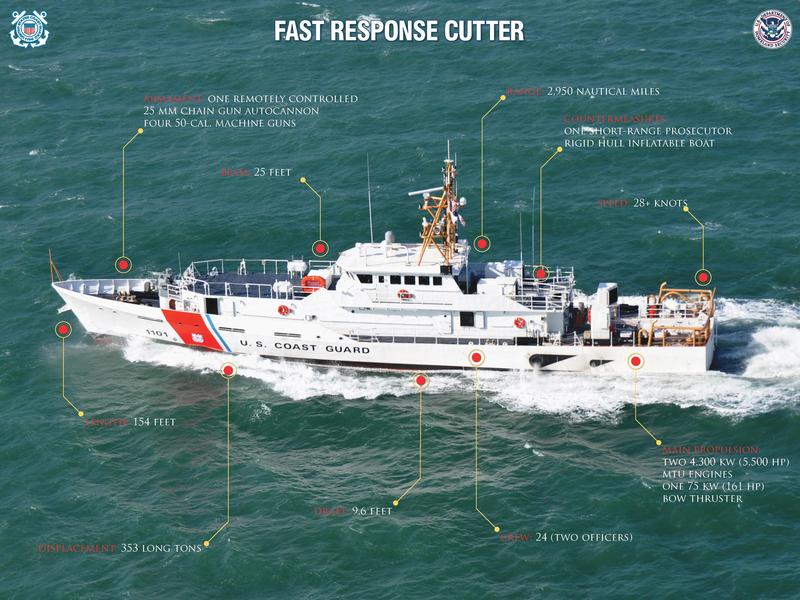
The Acquisitions Directorate has announced the award of a contract for the 26 remaining planned Webber Class Fast Response Cutters to Bollinger Shipyards LLC. Rather than the Multi-Year Procurement (MYP) I had hoped for, but really did not expect, this is a $318.6M contract for six with options for the remaining twenty in groups of four to six. It is really not to late to think about a MYP in FY2017 or 2018 since right now, neither the shipyard nor the Coast Guard have any definitive assurance that the remaining ships, beyond the first six in the contract, will be completed. Each additional year’s increment is dependent on future appropriations.

Currently the program has delivered 17 vessels. 15 more are under construction or have been funded. The 26 expected to be procured under this contract will complete the 58 in the program of record.

These vessels are 154×26.6×9.5 ft. 28 knots, with a crew of 22 (normally actually 24). They are armed with Mk38 mod2 or mod3 stabilized 25mm gun and four crew served .50 cal.

Malaysia’s New Patrol Boat–UAS Ready

MalaysiaNewGenerationPatrolCraft

IHS Jane’s 360 is reporting on Malaysian Coast Guard’s six projected “New Generation Patrol Craft (NGPC).”

“The NGPC has been based on a design by Germany-based Fassmer Shipbuilding Company. According to specifications provided by Destini, the platform features an overall length of 44.25 m an overall beam of 7.7 m and a design draught of 1.95 m. Powered by two 1920 kW MTU engines, the vessel can attain a top speed of 24 kt and a standard range of 2,000 n miles at 12 kt. The ship displaces 297 tonnes and can accommodate a crew of 41.”

This means they will be similar to, but slightly smaller than the Webber Class WPCs.

The unique thing about this class is that they are built to use a mini-Unmanned Aerial System, in this case the Thales Fulmar. NavalToday reports the purchase of these systems. Fulmar looks similar in size and capability to the Scan Eagle.

This certainly suggest that we could probably operate Scan Eagle, or something similar from the Webber class.

Photo: The Thales Fulmar

LRASM for Ports, Waterways, and Coastal Security

Lockheed Martin supplied Navy Recognition with the first image showing a deck-mounted quadruple Long Range Anti-Ship Missile (LRASM) launcher. According to our source, this "top side" launcher graphic is a notional concept that could be used on an appropriately sized surface vessel, such as the Arleigh Burke class (DDG 51) or Littoral Combat Ship (LCS) classes.

Discussion on an earlier post suggesting the Coast Guard might want to fit our new major cutters “for but not with” Long Range Anti-ship Missiles (LRASM) has prompted me to rethink the suggestion and advocate for equipping them with the missile in peacetime.

One of the Coast Guard’s peacetime missions is of course Ports, Waterways and Coastal Security (PWCS).

“The PWCS mission entails the protection of the U.S. Maritime Domain and the U.S. Marine Transportation System (MTS) …prevention and disruption of terrorist attacks… Conducting PWCS deters terrorists from using or exploiting the MTS as a means for attacks on U.S. territory, population centers, vessels, critical infrastructure, and key resources.”

I have been concerned that the Coast Guard has not had adequate weapons to deal with a terrorist attack using a medium to large sized merchant ship, and currently I don’t believe there is any other organization capable of answering this threat in the 30 or more port complexes terrorists might find worthwhile targets, in a timely manner. Navy surface forces are too geographically concentrated. The over 200 nautical mile range and the ability to strike selected locations on a target ship suggest LRASM could possibly provide an answer.

If we had LRASM on all National Security Cutters (NSC) and Offshore Patrol Cutters (OPC), in perhaps a dozen ports on the Atlantic, Pacific, and Gulf coasts, Honolulu and Kodiak, its over 200 mile range fired from cutters, including possibly those in port, could cover all of these ports (except Guam), and have a weapon on target within about 20 minutes of launch.

To effectively counter the threat, I think we need to get a weapon on target within an hour of positive identification of the threat. This would require improved coordination between units. In addition to providing a datum, course, and speed, presumably an intercepting unit, boat or aircraft, would need to transmit a photograph of the target to be incorporated in the missiles memory and aim points would be chosen some time during mission planning. We would need to coordinate with air traffic control. A command decision to authorize use of the weapon and updates on the target position course and speed would also be needed. Because we might have 40 minutes or less from threat identification to launch, these steps would likely have to proceed in parallel with mission planning progressing prior to authorization.

New units appear to be on the way to developing the kind of common tactical picture we need to facilitate both decision making and targeting. We could start developing the capability with the National Security Cutters based at Alameda (San Francisco Bay) and Charleston, SC, even if the system could not be completed until the last OPCs are delivered in about 2034.

Naval Science and Technology, “Future Force”

Eaglespeak has brought to my attention a quarterly magazine that is available on line, that I had not been previously aware of: Naval Science and Technology, “Future Force”

It has a number of interesting articles, including:

  • Weather satellites
  • Wave Prediction
  • Ice prediction
  • Using unmanned ground vehicles for maritime interdiction boardings, and
  • Detecting Lasers

I have added the magazine to the recommended blog lis for future reference.