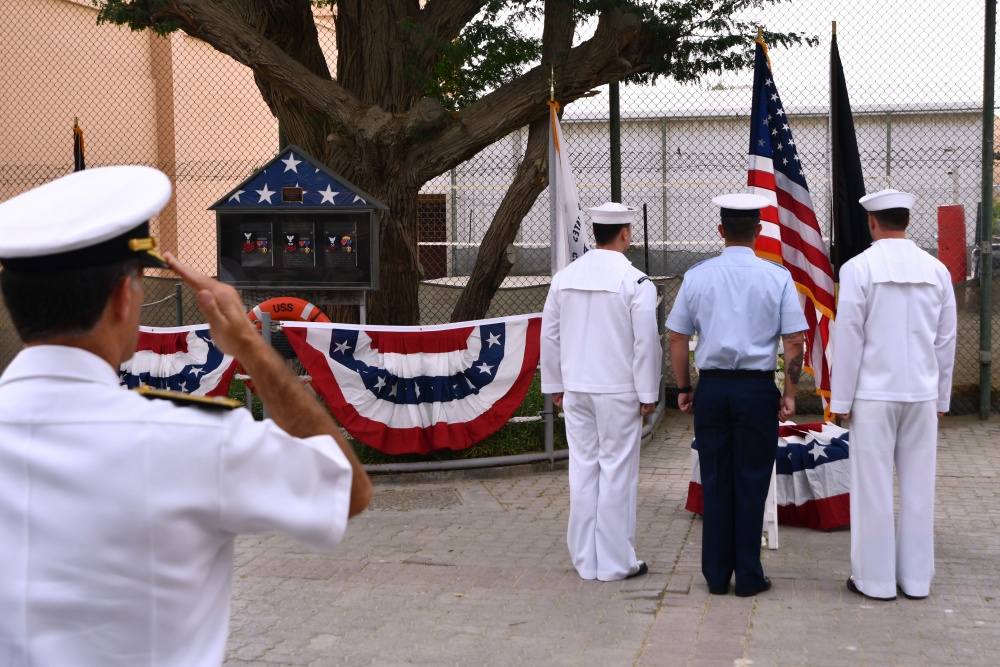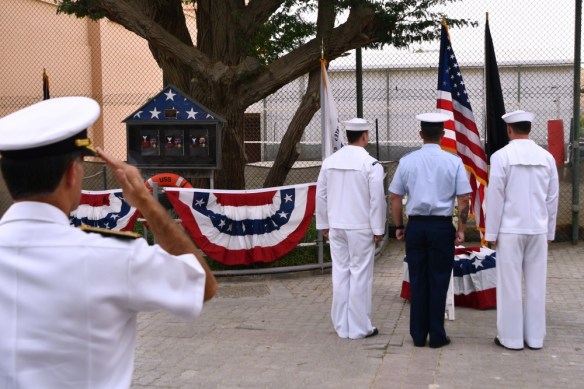
MANAMA, Bahrain (April 24, 2018) Vice Adm. Chris Aquilino, commander of U.S. Naval Forces Central Command, salutes as Sailors and Coast Guardsmen participate in a wreath laying ceremony to honor Coast Guardsman Damage Controlman 3rd Class Nathan B. Bruckenthal, Signalman 2nd Class Christopher E. Watts and Boatswain’s Mate 1st Class Michael J. Pernaselli who perished while conducting maritime security operations in the Northern Arabian Gulf on April 24, 2004. Firebolt is assigned to Commander, Task Force 55, in the U.S. 5th Fleet area of operations in support of maritime security operations to reassure allies and partners and preserve the freedom of navigation and the free flow of commerce in the region. (U.S. Navy photo by Mass Communication Specialist 1st Class Mark Meredith/Released)
The following is a Navy news release. I believe there is an error in that I believe there was a second Coast Guardsman on the RHIB when the incident occurred.
Story Number: NNS180424-30Release Date: 4/24/2018 4:26:00 PM
By Mass Communication Specialist 1st Class Mark Meredith, U.S. Naval Forces Central Command Public Affairs
MANAMA, Bahrain (NNS) — Sailors and Coast Guardsmen gathered for a wreath laying memorial service and 5k run at Naval Support Activity Bahrain April 24 to remember and honor their fallen shipmates who made the ultimate sacrifice 14 years ago.
The service honored Coast Guardsman Damage Controlman 3rd Class Nathan B. Bruckenthal, Navy Signalman 2nd Class Christopher E. Watts and Navy Boatswain’s Mate 1st Class Michael J. Pernaselli who perished while conducting maritime security operations in the Northern Arabian Gulf April 24, 2004.
Coast Guard Patrol Forces Southwest Asia (PATFORSWA) Commodore, Capt. Clinton Carlson was the guest speaker and spoke to the service and dedication of the men who lost their lives.
“At the time, I was a young lieutenant, assigned to Port Security unit 311 in San Pedro, California,” he said. “For the 311 Sailors, the attack was personal. This was family, and for me it was one of those days that I will always remember where I was because my Coast Guard, and the nature of my service had changed forever.”
On April 24, 2004, Firebolt was in the vicinity of the Khawr Al Amaya Oil Terminal in Iraq, with the mission of defending the terminal against attack. A suspicious dhow was spotted nearby, and Firebolt deployed a rigid-hull inflatable boat (RHIB) manned by six Sailors and a U.S. Coast Guardsman to investigate the vessel. The dhow, realizing the RHIB was in pursuit, sped toward the oil terminal. The RHIB maneuvered into position to intercept the vessel, but the dhow exploded in an apparent suicide attack. Minutes later, two other dhows exploded prematurely in what was an attempted coordinated attack on Iraq’s offshore oil infrastructure. Though the crew of the RHIB had successfully protected the oil platform, the wake created by the explosions capsized the small boat, claiming the lives Pernaselli, Watts and Bruckenthal, who was the first Coast Guardsman to die in action since the Vietnam War.
The commanding officer of Firebolt, Lt. Cmdr. Roger Young, also gave remarks, stressing the sacrifice the service members made for their shipmates.
“I am pleased to report that the memory of our shipmates has not been forgotten and their sacrifice likely spared the lives of countless other Sailors onboard every warship that sailed the Arabian Gulf,” said Young. “Their sacrifice serves as a reminder that the threat we face is real and that no mission is routine.”
The memorial honoring the legacies of these brave service members stands across the courtyard from the PATSFORSWA headquarters, and features the service members’ rating badges, a folded flag and a life ring from Firebolt.
This year’s memorial service holds particular significance for the Coast Guard, as they took delivery of the USCGC Nathan Bruckenthal, a 154-foot patrol craft, in March 2018.
“Their devotion to duty and selfless sacrifice continue to serve as shining examples to all of us who strive to make the world more secure,” said Capt. Carlson. “They remind us that no mission is routine and that true security has been hard-earned through challenging naval operations among U.S. and allied forces through the years.”
U.S. 5th Fleet area of operations encompasses about 2.5 million square miles of water area and includes the Arabian Gulf, Gulf of Oman, Red Sea and parts of the Indian Ocean. The expanse comprises 20 countries and includes three critical choke points at the Strait of Hormuz, the Suez Canal and the Strait of Bab al Mandeb at the southern tip of Yemen.
PATFORSWA’s mission is to command, train, equip and provide mission ready Coast Guard forces to conduct maritime security operations in U.S. Central Command’s (CENTCOM) area of responsibility.
Thanks to Bryant’s Maritime Blog for bringing this to my attention.
Addendum
Thanks to Bill Wells we can add an addendum. There was a second coastguardsman on the RHIB when the explosion occurred, BM1 Joseph Ruggiero. His story is here. There is a video here.