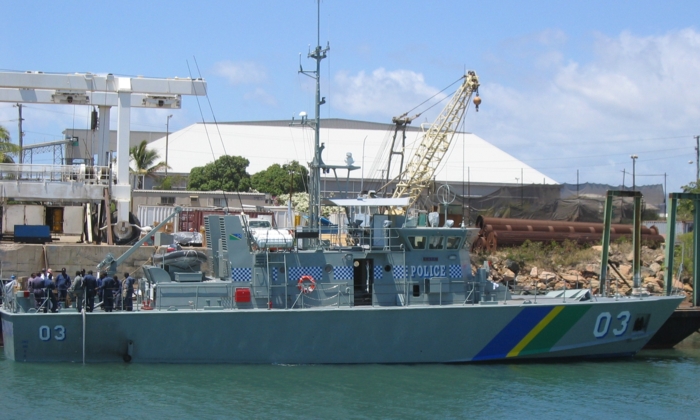
Australia Plans to Provide Patrol Boats to Pacific Island Nations

RSIPV_Tata_Pacific_Patrol_Boat
Photo credit: Angra at en.wikipedia: Royal Solomon Islands Police Vessel Lata in Townsville Harbour during a 2005 maintenance visit, one of the boats to be replaced

MarineLink is reporting that Australia is planning to reprise its earlier Pacific Patrol Boat Program of providing patrol boats to island nations in the Pacific. The Program will build over 20 steel hulled patrol boats.

“…the rugged Australian-made patrol boats are worth $594 million with through life sustainment and personnel costs estimated at $1.38 billion over 30 years.

“Replacement patrol boats will be offered to all current participating states including Papua New Guinea, Tonga, Solomon Islands, Fiji, Tuvalu, Kiribati, Samoa, Vanuatu, Federated States of Micronesia, Palau, Republic of Marshall Islands, Cook Islands and new member Timor-Leste.”

Of those 13 states the US has obligations to three of them, the Federated States of Micronesia (FSM), the Republic of the Marshall Islands (RMI) and the Republic of Palau, under the Compact of Free Association.

Characteristics of existing PPB as listed in Wikipedia:
Displacement: 162 tons full load
Length: 31.5 m (103 ft)
Beam: 8.1 m (27 ft)
Draught: 1.8 m (5.9 ft)
Propulsion: 2 Caterpillar 3516TA diesels, 2820 hp (2.1 MW), 2 shafts
Speed: 20 knots (37 km/h; 23 mph)
Range: 2,500 nautical miles @ 12 knots
Endurance: 10 days
Complement: 14-18
Furuno 1011 I band surface search radar

Given the expected price of the new patrol boats, I suspect the new boats may be larger, perhaps similar to the Australian Armidale class.

At the very least we can expect that the US Coast Guard may be involved in training for the crews of some of these boats. There is also a good possibility of cooperative operations.

Russia’s “coast guard” in the Arctic

Interesting short report from Russian Media about how they expect to handle emergencies in the Arctic, including the use of nuclear powered icebreakers.

Somehow this also got inserted into the article, “In April, Russian President Vladimir Putin announced a unified system of deployment for navy surface ships and new generation submarines.” so their kind of emergency may not be the kind of emergency that would first come to the USCG mind.

While this may not reflect only maritime experience, there was also an interesting admission, “According to the Russian Emergency Ministry there are more than 100 emergency situations in the Russian Arctic annually, both natural and man-made. There has been a steady increase in the number of incidents caused by humans, especially transport accidents (30%), and explosions and fires related to technical equipment (24%).”

Given the extent of Russia’s Arctic coast line they have invested heavily in icebreakers.

“Currently, Russia’s nuclear icebreaker fleet consists of four icebreakers, with two reactors each and 75,000 total horsepower (Rossiya, Sovetskiy Soyuz, Yamal and 50 Let Pobedy)(about the same power as the Polar class-Chuck), and two icebreakers, with one reactor each and 40,000 total horsepower (Taymyr and Vaygach).” (a bit less powerful than Healy-Chuck)

DefenseNews–Interview with Admiral Papp

DefenseNews has a short interview with outgoing Commandant, Admiral Papp. Generally nothing too surprising except perhaps the statement that he wrote fitness reports for all the CG flag officers every year and followed it up with counseling, certainly an onerous if extremely important task.

Overall an interesting and relatively short read.

I think I’m going to miss Admiral Papp.

Ireland’s New OPV, Samuel Beckett

Thought I had posted about this ship earlier, but could not find it, if I did. At any rate our friend at Think Defence has done a nice write up. This class (90 meters), may be the evolutionary immediate predecessor of Eastern’s OPC proposal, being a development of the New Zealand Protector class OPV (85 meters), which was in turn a development of the Irish Róisín Class (80 meters). The Samuel Beckett class is notable for their low cost, hybrid propulsion, and small crew size.

Russia Builds an OPC

NavyRecognition is reporting the launch of the first for a class of ships being built for the Maritime Border Guards of the Federal Security Service of the Russian Federation (FSB, successor of the KGB). The ship is similar in many respect to the projected Offshore Patrol Cutter.

Named “Ocean,” she is reportedly ice strengthened with a displacement of 2,700 tons, a speed of 20 knots, a range of 12,000 miles, and a 60 day endurance. She has a hangar and flight deck, at least two RHIBs, and a 76mm gun. Unlike previous classes used by the Maritime Boarder Guards this is not an adaptation of a Navy design.

Drug Enforcement Return on Investment

FierceHomelandSecurity is reporting on testimony of both the Commandant and the Commander of SouthCom, Marine Corps Gen. John Kelly, before a joint hearing of the House Transportation and Infrastructure and Foreign Affairs subcommittees.

“Joint Interagency Task Force South, which is part of Southcom and includes the Coast Guard, (other–Chuck) military services and other agencies, seizes the majority of the cocaine bound for the United States, said Marine Corps Gen. John Kelly, the Southcom commander. Yet it receives only 1.5 percent of the federal government’s total counternarcotics budget, he said.”

Commandant Adm. Robert Papp, who appeared alongside Kelly, said that in the past five years, the Coast Guard seized more than twice the amount of cocaine as all domestic law enforcement agencies – federal, state and local – combined.

Over the last five years, Coast Guard ships and law enforcement detachments operating in the offshore regions have removed more than a million pounds of cocaine with a wholesale value of nearly $17 billion. This is more than two times the amount of cocaine seized by all other U.S. federal, state and local law enforcement agencies combined.

While I have my own reservations about the effectiveness of efforts to restrict supply, if you are going to attempt to cut supply, it sure looks like funding Coast Guard efforts should be the first place to put your money.

Canadian Natives ban Government and Civilian Craft

Interesting news article here. A native group is displeased with the performance of Canadian Fisheries authorities and has taken matters into their own hands:

“Until further notice, Stz’uminus First Nation will prohibit access to its core territory in the Salish Sea by all vessels, including but not limited to, commercial fishing vessels, Fisheries and Oceans Canada vessels, and any non-Native civilians and government officials,” John Elliott, chief of the Ladysmith-area band said in a statement released Friday.