New Cutter for Ecuador

NavyRecognition is reporting the award of a contract for a fourth Damen 2606 patrol boat to be built in Ecuador for the Ecuadorian Coast Guard. Apparently this boat is the latest version of the USCG’s 87 foot patrol boats.

NavyRecognition illustrated their story with a photo of a member of the class in Saudi Arabian service (completed 2002/3). Reportedly the Ecuadorian boats will have a speed of 30 knots. Specs for the Saudi boat from my Combat fleets of the World also indicate a speed of 30 knots as opposed to 27 knots for the 87 ft WPBs and that they use two MTU 12V396 TE94 diesels for 4,430HP as against two MTU 8V396 TE94 diesels for 2,950HP for the WPBs, so same series engines but a 50% larger version. There appears to be some differences in the hull too as the discontinuity in the main deck is further forward in the Saudi boats (which were built in the Netherlands).

With boats built under Coast Guard Contracts for the US Navy, Yemen, and Malta, and additional boats built or building for Venezuela, Saudi Arabia, and Ecuador these boats are becoming relatively common.

OPC and the LCS Replacement (SSC), Sister Ships?

I am not the only one seeing a possible opportunity for commonality between the Coast Guard’s Offshore Patrol Cutter (OPC) and the Navy’s projected Littoral Combat Ship (LCS) replacement. Here is a comment from Tim Colton’s Maritime Memos.

“The LCS program having proved unaffordable, largely thanks to the Navy’s idiotic passion for bells and whistles, they are now looking for suggestions for what they call a small surface combatant, or SSC. Read the announcement on FedBizOpps… The key words in the RFI are right up front: Small surface combatants enable the Navy to implement the Defense Strategic Guidance (DSG) imperative to develop innovative, low-cost, and small-footprint approaches to achieve our security objectives.

“It sounds as though we now have a potential overlap between the Navy’s SSC and the Coast Guard’s OPC, but that’s not necessarily a bad thing. In fact, it would be nice if, for a change, the Navy could manage to build some affordable ships. I know, shades of Gary Hart, but I think this is what we need, not more SSNs at $1.8 billion a pop. May Day, 2014.”

There is more information on the solicitation here.

Quoting from the solicitation, “This type of ship provides Combatant and Fleet Commanders a uniquely suitable asset for Theater Security Cooperation tasking and select sea control missions. These small surface combatants build and strengthen maritime relationships by operating with partners and allies in various theaters of operation.”

They are “asking for existing and mature design concepts.” The eight shipyards that bid on the OPC, and particularly the three that were selected, should be in a particularly good position to meet the demands of the solicitation.

We know they want more survivability and range, but they also want low cost and small footprint. To me that means a ship of similar size to the existing LCS but without the requirement for extreme speed that has made them high strung, crowded, and fragile. A slightly lengthened OPC can meet the requirements. Replace the 57mm with a larger gun and the Mk38 mod2 with CIWS/RAM/SeaRAM. Install CAPTAS (active/passive variable depth/towed array sonar) aft and use the extra length to add VLS and a second CIWS/RAM/SeaRAM, and you have a very viable, long ranged Small Surface Combatant.

If the Navy and Coast Guard could share a common Small Surface Combatant, they could probably be made in very economically.

Coast Guard Role in RIMPAC

Stars and Stripes is providing some details of the 2014 RIMPAC exercise (“23 nations heading to Hawaii for RIMPAC as exercise details emerge”) to be conducted June 25 to August 4, and it appears the Coast Guard will have a significant role to play, including significant interaction with the People’s Liberation Army-Navy (PLAN).

Referring to PLAN participation “…an oiler, frigate and destroyer will participate in a “maritime interdiction operations” task force under a U.S. Coast Guard cutter commanding officer, Lt. Lenaya Rot­klein, a spokes­woman for the Navy’s 3rd Fleet in San Diego, said Monday.

“The maritime interdiction operation involving the Chinese destroyer, frigate and oiler was referenced in December by the Navy as being under the Coast Guard cutter Waesche and including two Royal Brunei Navy ships, a French frigate, a U.S. frigate and the Pearl Harbor-based cruiser USS Port Royal.”

Call for Panga Task Force

FierceHomelandSecurity is reporting that authorities in California are calling for a formalized, standing Federal/State Task Force to deal with smuggling by “Pangas” high powered and seaworthy open boats being used to smuggle drugs and people into California.

“While smugglers have also used cross-border tunnels and ultra-light aircraft to sidestep land border security, pangas have proven cheap and effective. Marijuana seizures from panga boats jumped from 3,800 to 120,000 pounds from 2008 to 2012, the report says.”

The Coast Guard has of course been attempting to intercept this traffic all along. We have even lost a man in this enforcement effort.

Perhaps most important is a proposal to increase Maritime Domain Awareness,

“The report also recommends that California work with federal agencies to install advanced radar and sonar technologies along the state’s coast to detect more of the vessels that currently evade authorities.”

New Budget Process

Fiercehomelandsecurity is reporting that the Department (DHS) is initiating a new budget process, that would make it more top down.

DHS is building a process where it will define its mission and objectives, then determine what resources it needs and look across components to avoid overlaps and inefficiencies.

“My impression is that the DHS budget process is too stovepiped,” Johnson told the House Appropriations subcommittee on homeland security, during a March 11 hearing.

Johnson, a former general counsel for the Defense Department who took over at DHS in December, said he used the DoD budget process as a model.

Perhaps this is what is needed to make the Department a bit more coherent in its approach to its missions. Perhaps it would be too much to hope for, but perhaps the Department will see that Customs’ Aviation and Marine units largely unnecessarily duplicate Coast Guard assets.

I don’t have any problem with the Department defining mission and objectives or eliminating  overlaps and inefficiencies. I do think they might be out of their depth in determining what resources it needs.

The new Secretary comes from the DOD and looks to their process as a model, but DOD is not necessarily the most efficient of organizations. DOD staff over and above the armed services themselves, is grossly inflated and part of the reason is that there is a lot of second guessing of the services expertise by an ever growing civilian bureaucracy, a model DHS cannot afford to duplicate.

Intercept at Sea, Israeli Style

I’ve seem several reports of the Israeli seizure of a Panamanian flag vessel, the KLOS-C, reportedly transporting long range rockets and perhaps other weapons being shipped by Iran to terrorists in Gaza. But NavyRecognition’s is the first report I’ve seen that actually showed the seizure. They also the show the reported route of the weapons.

The intercept point looks to be a bit over 700 miles from the nearest Israeli port. Apparently the crew of the Panamanian ship is claiming they had no idea what they were carrying.

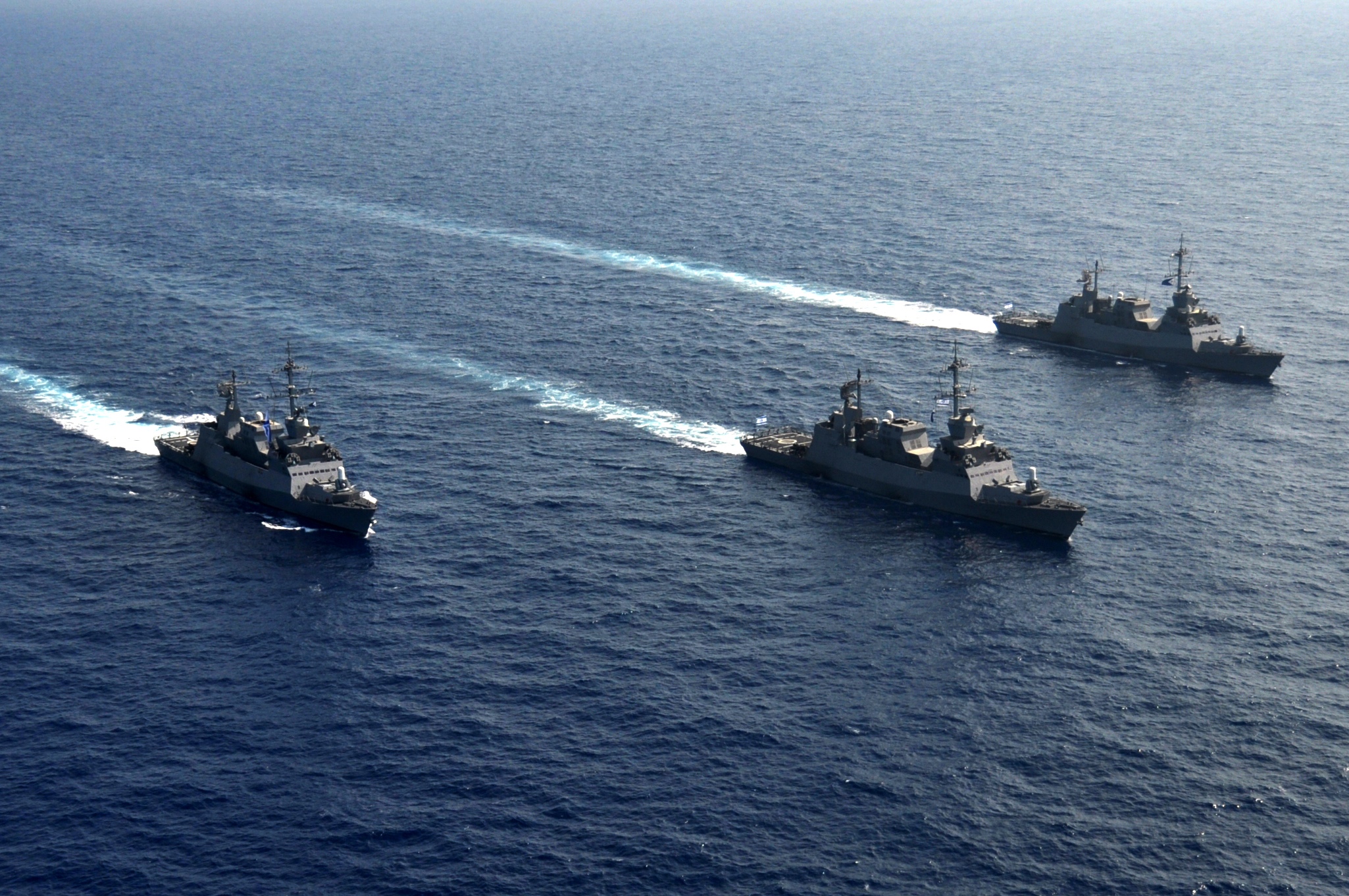
It is interesting to see the forces the Israeli Navy used to make this seizure. They did not scrimp. They apparently made the boarding using three RHIBs and they had at least two surface combatants on scene, a Sa’ar 5 corvette (1,275 tons full load, larger than a 210, but smaller than a 270) and a missile boat, which appears to be a Sa’ar 4.5 (488 tons full load, about a third larger than an FRC). From the video it is obvious they had an aircraft on scene, possibly a helicopter from the Sa’ar 5. It may have been overkill in this case but both of the two Israeli vessels carried anti-ship missiles and a CIWS. The Sa’ar 5 corvette is also equipped with short range AAW missiles, and the missile boat has a 76 mm.

File:Three Sa'ar 5 Class Missile Corvettes Going For a Cruise.jpg


Photo: Israeli Sa’ar 5  corvettes. Israeli Defense Forces photo

File:Saar45nirit011.jpg


Photo: Sa’ar 4.5 missile boat, Israeli Defense Force photo

State of the Coast Guard Address

I’m afraid I’m a bit late with this, but if you have not seen or heard Admiral Papp’s State of the Coast Guard Speech you can read it here.

Actually it is a good speech, and it cites several indicators that the Acquisitions Directorate has gotten its act together. Lots of other issues addressed as well.

Coast Guard Foundation Setting Up Douglas Munro Scholarship Fund

The Maritime Professional is carrying an announcement from the

“The Coast Guard Foundation, a nonprofit organization committed to the education and welfare of Coast Guard members and their families, announced today it has established the Douglas Munro Scholarship Fund. Named for the only Coast Guard member to be awarded the Medal of Honor, the new scholarship will help children of Coast Guard members achieve their goals of a college education.”

Check out the Maritime Professional post for details including a limited edition challenge coin offer.