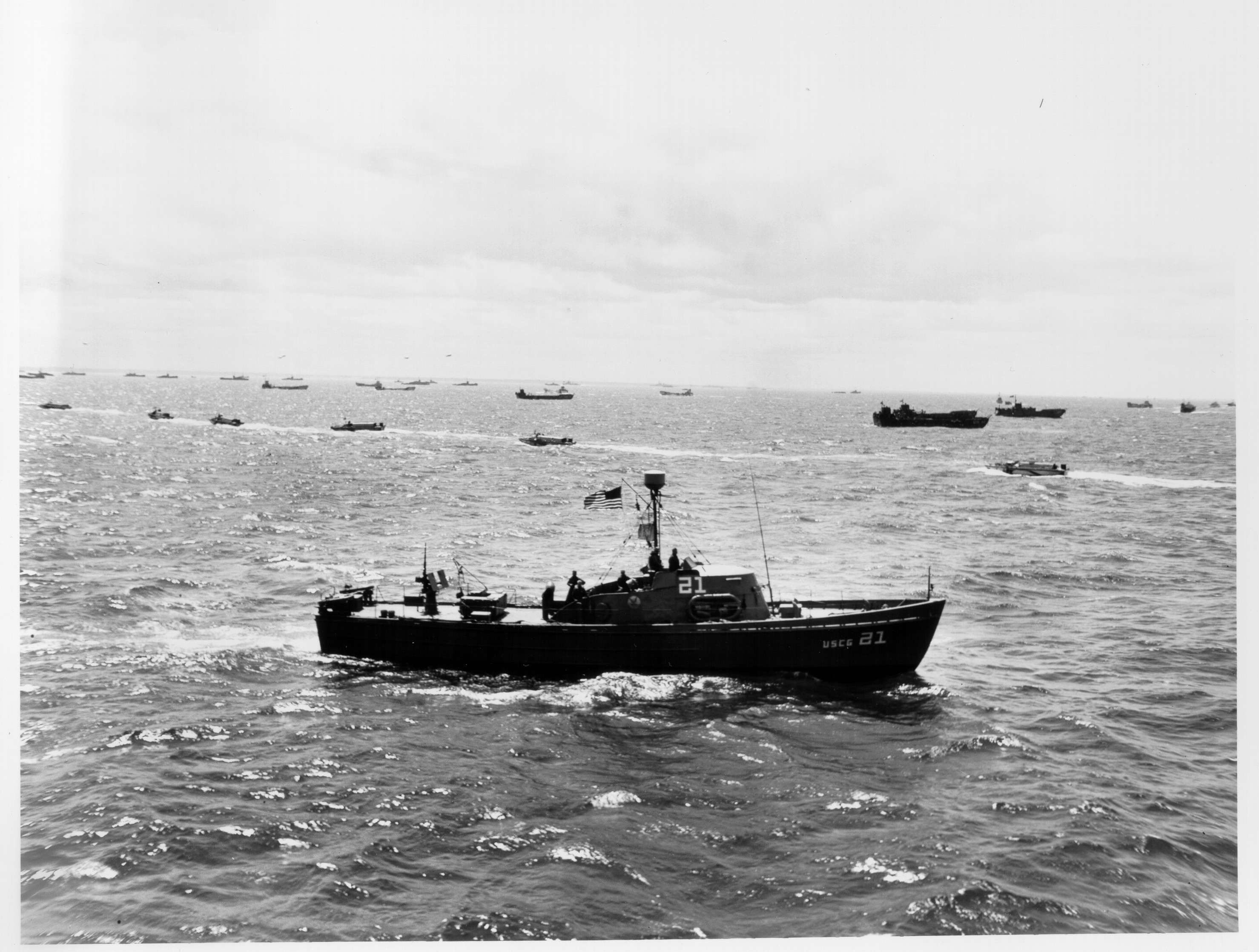
The Navy has initiated a “request for information” (not a request for proposal yet) for a new maritime security/force protection patrol boats about 40 foot (12 meters) in length to replace about 100 existing 25 and 34 foot boats. You can read the solicitation here.
Can’t help but think there would be some benefit if they selected a hull in common with the Coast Guard.
To some extent this sounds a bit like the Coast Guard’s Response Boat Medium (RB-M), but in has some specific requirements for transportability that might rule out a version of the RB-M.
The other CG boat that might provide a basis is the Long Range Interceptor.
The solicitation does include some requirement I don’t think were part of the CG specifications that would require some modification. Here are the specifics:
Mobility & Operational Responsiveness –
Note: The Navy desires to meet boat speed and endurance requirements as specified below and will allow for flexibility in payload requirements. Payload may be varied in order to meet boat speed and endurance requirements.
• Cruise Speed of 25 knots
• Sprint Speed of 40 knots
• 12 hours endurance at patrol to cruise speed
• Range: 250 nautical miles
• Capable of carrying mission payload of at least 4,000 pounds and up to 8,000 pounds (desirable); mission payload includes weapons, ammunition, crew, passengers, and any portable/removable mission systems
• Length: 40 feet (nominal)
• Capable of operating in seas with a 3 feet significant wave height; shall have reduced operating capability in up to 5 feet significant wave heights
• Crew: 2-Operators and 3-Gunners/System Operators; Additional seats and space are desired for up to four additional mission personnel; Shock mitigating seats required for all crew and mission personnelPropulsion –
• Boat must be powered by diesel fuel and be capable of operating on JP-5 and JP-8
• Propulsion equipment should be suitable for operating in shallow water with vegetation, debris and obstaclesSurvivability (Ballistic Protection) –
• At a minimum the craft requires protection against 7.62 mm ball rounds for personnel and critical equipment (e.g., propulsion system and controls)
Lethality (Armament) –
• Space and weight needed for three weapons mounts suitable up to .50 caliber guns
• Space and weight needed for a single station Stabilized Small Arms Mount (SSAM), suitable for up to a .50 caliber gun or MK 49 or MK 50 Gun Weapon SystemsSustainability (Reliability) –
• The craft will allow for affordable Total Ownership Costs by leveraging hull, mechanical and electrical systems that are already in use by the Navy; Leveraging systems that will allow for increased PB-X buying power commonality with other NECC boats is desired
• Innovative hull, mechanical and electrical systems are of interest provided that they can be fielded and supported within the next 2 to 4 years, employ non-developmental technologies, and have proven reliabilityTransportability –
• Sea
– Capable of being transported as deck cargo on Naval Amphibious and Military Sealift Command ships; Specifically, the craft will be launched and recovered; floated-on and off well-deck Amphibious type ships; or transported on a Roll-On/Roll-Off cargo ship with own trailer
• Land
– Must be road transportable on U.S. and NATO roads/highways and comply with applicable oversize load restrictions without escort
– Road transportable also includes off-road (dirt, gravel without significant obstacles) with rough terrain capable trailer
– Capable of launch and recovery from a road transport trailer on a boat ramp
– Capable of being towed by existing NECC prime movers such as a Freightliner FL80 tow truck (40,000 pounds tow) or Medium Tactical Vehicle Replacement MK36 Wrecker truck (22,000 pounds tow)
– In preparation for land, air, or sea transport the craft must allow for removal and stowage of fendering, masts, arches and platforms and weapons; transportation preparation should take less than 4 hours
– The craft shall have hoist fittings that allow for crane launching and external airlift• Air
– Internal air transportable in a C-5 or C-17 (see Department of the Army Field Manual Number 55-9, Chapter 2. Air Mobility Command Aircraft for space and weight restrictions)
– External air transportable by the CH-53 (34,700 pound weight limit)Other Desired Characteristics:
• Minimum operating depth of no greater than 5 feet with a target vessel draft of 3 feet or less
• The hull draft structural design shall be compliant with ABS High Speed Craft (HSC) or Det Norske Veritas (DNV) that are appropriate for the construction material, hull form and speed of the PB-X
• The following stability standards are desired: US Navy Standards for single compartment flooding; and, US Navy Small Craft Beam winds and rolling; passenger crowding standards
• The following electronics/systems will be provided by the boat builder: Commercial AIS,
GPS Chart plotter, Radar, Marine VHF, Emergency Positioning Indicating Radio Beacon (EPIRB), Law Enforcement lights/siren
• The craft should be capable of launching, operating and recovering unmanned systems such as a MK18 Mine Countermeasures Underwater Vehicle System Mod MK 18 Mod 2 (approximate dimensions: 10 feet x 12 inches; weight 500 pounds)
• Construction standards should allow for a service life of 15 to 20 years
• The craft should be outfitted with heavy duty commercial grade fendering/rubrails or strakes, or foam filled sponsons preferred.
(Thanks to Lee for bringing this to my attention.)