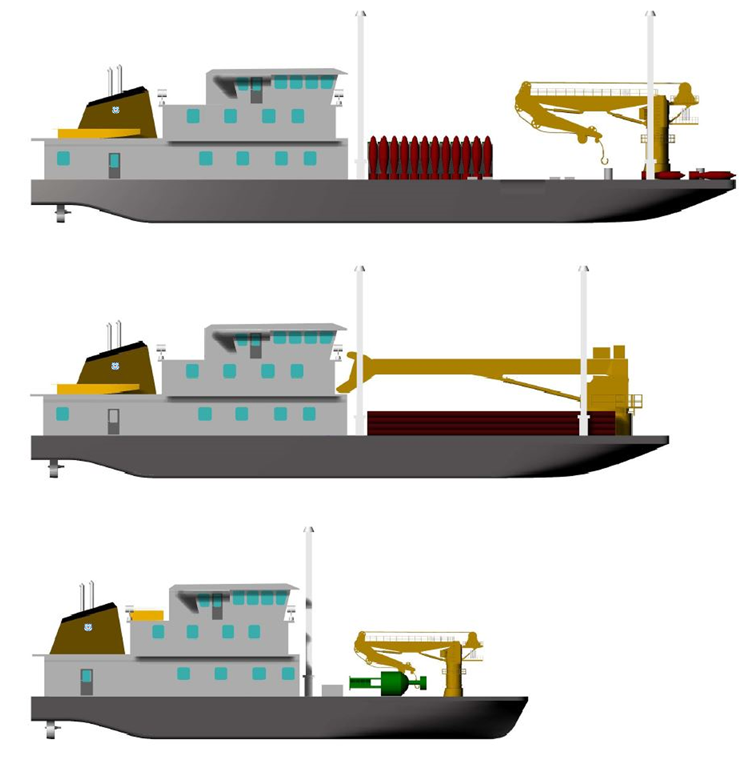
Denver-based Birdon America, Inc. a subsidiary of Australia’s Birdon Pty Ltd, reports that it has awarded a first round of major subcontracts in support its $1.187 billion contract to design and build 27 Waterways Commerce Cutters (WCC) for the U.S. Coast Guard.
I am passing along this announcement. This does not constitute and endorsement. I have no idea who these people are.
Illegal, unreported and unregulated (IUU) fishing for tuna in the Pacific region is estimated to amount to almost 200,000 tonns annually. Fisheries are of critical importance to the region with many nations working collaboratively to combat IUU fishing and increase traceability.
Learn how Starboard Maritime Intelligence and Spire Maritime have joined forces to help tackle this issue in the Pacific Ocean, using real-time AIS, AIS Position Validation, algorithms, and machine learning. AIS Position Validation is the new and unique data set from Spire Maritime that independently calculates a vessel’s location at the time of AIS transmission, even when AIS messages do not include valid GPS data.
Join our webinar on 9th August 11AM UTC with Iain Goodridge, Senior Director of RFGL at Spire, and Joseph Corbett, Chief Data Scientist at Starboard to find out how you can partner with our solutions to combat this growing concern. Learn how real-time AIS, and AIS Position Validation along with algorithms and machine learning, can be used to:
Understand fishing vessel manoeuvres and confirm compliance with measures to combat IUU fishing.
Uncover more intel on the location of fishing vessels that have gone dark.
Uncover vessel behavior anomalies and spoofing, in real time.
If you are interested to learn more about all the capabilities of AIS Position Validation, and how this unique data set allows you to independently validate a vessel’s reported position, detect vessels not reporting a validated GPS position or detect vessels reporting an incoherent position, then don’t hesitate to get in touch with us.
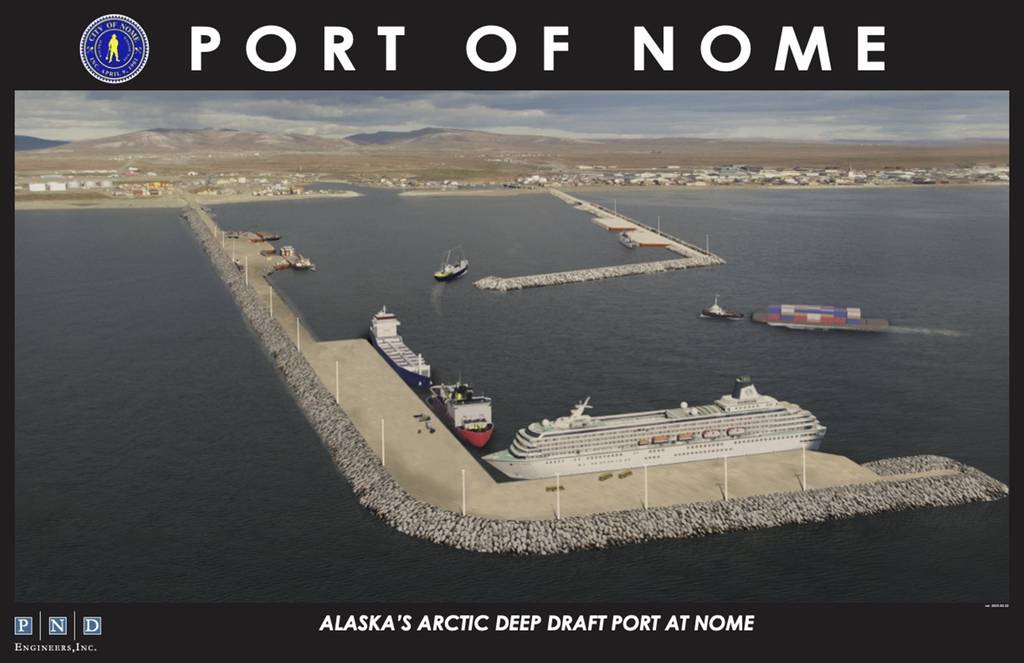
This rendering provided by the City of Nome shows how the Port of Nome, Alaska, will appear following an expansion project that will cost more than $600 million. Shipping lanes that were once clogged with ice for much of the year along Alaska’s western and northern coasts have relented thanks to global warming, and the nation’s first deep water Arctic port should be operational in Nome by the end of the decade. (PND Engineers Inc./City of Nome via AP)
Workers will dredge a new basin 40 feet (12.2 meters) deep, allowing large cruises ships, cargo vessels, and every U.S. military ship except aircraft carriers to dock, Port Director Joy Baker said.
Nome in red. Adapted from Wikipedia’s AK borough maps by en:User:Seth Ilys.
We have been talking about a deepwater port in the area for some time,
Nome isn’t actually in the Arctic, despite the fact that the US government defines the Arctic to include the Bering Sea. The Arctic Circle runs just a little North of Nome, essentially at the Bering Strait. The Bering Strait connects the Pacific with the Arctic Ocean and is about 44 nautical miles (82 kilometers) wide at its narrowest point. Whoever controls the Bering Strait can regulate traffic between the Pacific and the Arctic Oceans. Having a nearby deepwater port would certainly help, if it were desirable to regulate that traffic. Nome is within 160 nautical miles of the Russian side of the Strait.
Traffic through the Strait has increased and the possibility of a cruise ship disaster in the Arctic is probably a District 17 nightmare, but I think the probability is low that large numbers of CG units will be based at Nome. As noted earlier, I don’t think we will see either large patrol cutters (unless it is the Alex Haley) or FRCs based there but moving one of the Juniper class seagoing buoy tenders there, with its light icebreaking capability might make sense. A medium icebreaker might be a possibility, but that is a very long shot.
As I have noted before, the US Navy’s Pacific Fleet surface ships have not really shown much interest in operating in the Arctic. Their “Arctic” exercises have been in the Gulf of Alaska or little, if at all, North of the Aleutians.
We might see Air Force and Marines in the area in time of War. Airpower and/or shore based anti-ship missiles could control surface traffic through the Strait. Those forces would have to be supplied, which would mean logistics shipping to what we now know will be the deepwater port at Nome. The shipping would presumably require naval protection, air and/or surface.
The USCGC Oliver Henry (WPC 1140) crew arrives in Manus, Papua New Guinea, on Aug. 14, 2022, from Guam as part of a patrol headed south to assist partner nations in upholding and asserting their sovereignty while protecting U.S. national interests. The U.S. Coast Guard is participating with partners to support the Pacific Islands Forum Fisheries Agency-led Operation Island Chief and the larger Operation Blue Pacific through patrols in the Western Pacific in August and September 2022. (U.S. Coast Guard photo by SW3 Victor Villanueva, NMCB-FOUR)
A couple of recent articles about the US relations with Palau and Papua New Guinea.
Map of the exclusive economic zones in the Pacific.
There has long been interest in a US base on Manus, Papua New Guinea, but this is politically sensitive. Basing cutters there that protect an important economic resource and occasionally rescue the locals when they get in trouble, would probably be most welcome.
On the map above, Manus and Guam do not look that far apart, but Manus is 1,737.88km (938 nautical miles) SSE of Guam. That is about the distance from Miami to New York City.
Cutters based in Manus would be closer to parts Freely Associated States (FAS) of Palau and Federated States of Micronesia than cutters based in Guam and much closer to most non-FAS Micronesian nations. It might also be a good place to site a fixed wing forward operating base (CGAS Honolulu DET).
If we do end up with additional Webber class based outside Hawaii and Guam, we might need a squadron support organization similar to, and perhaps even larger than, PATFORSWA, to support all FRCs based in the Pacific South and West of Hawaii, e.g. a PATFORSWPAC.
The USCGC Sycamore (WLB 209) crew participates in a navigation exercise with HDMS Knud Rasmussen (P570), a Royal Danish Navy Knud Rasmussen-class patrol vessel and the FNS Fulmar (P740), a French Navy patrol vessel, off the coast of Southern Greenland, June 13, 2023. Deployed forces demonstrated U.S. Coast Guard capabilities to build partner capacity and expertise in search and rescue, navigation, and damage control. These efforts solidify key strategic relationships while achieving mutual Danish, Greenlandic, and U.S. goals in the North American Atlantic Arctic and Northwest Atlantic Ocean. (U.S. Coast Guard photo by Lt. Cmdr. Katherine Blue)
Just passing along this very nice photo and caption from the Defense Visual Information Distribution Service (DVIDS). I have added links to describe the vessels involved.
In May, the U.S. Coast Guard will start a strengthened and pointedly direct anti-SASH campaign that will extend across the maritime industry. SASH is an acronym for sexual assault/sexual harassment, and this new effort adds muscle to Marine Safety Information Bulletin (MSIB Number: 1-23) “Reporting Sexual Misconduct on U.S. Vessels” released in February. The new bulletin supersedes a previous one from late 2021.
I don’t normally report on Marine Safety topics. Never really had any experience in that area, but this could affect every boarding officer.
USCGC Northland (WMEC 904) approaches the pier, March 30, 2023 in Portsmouth, Virginia. Northland conducted a 62-day maritime safety and security deployment in the Florida Straits and Windward Passage while patrolling in support of Homeland Security Task Force – Southeast and Operation Vigilant Sentry. (U.S. Coast Guard video by Senior Chief Petty Officer Melissa Leake)
Just passing this along. Remember what happened last time we had a delay in approval of an increase in the debt ceiling?
Hello everyone,
Please take a moment to join our Rapid Response email campaign in support of Congresswoman Scholten’s “Pay Our Coast Guard Parity Act of 2023”.
The Coast Guard is vital to America’s national and economic security, yet they are not covered by the same paycheck protections as other members of the armed forces. With the very real possibility of a government shutdown in the near future, it is imperative that we provide the men and women of the Coast Guard with the financial security that they and their families have earned!
Please use the link below to learn more about this issue and to send a letter directly to your Members of Congress by just clicking send! Let’s get to work!
A U.S. Navy L3 Harris Arabian Fox MAST-13 drone boat and the U.S. Coast Guard cutters USCGC John Scheuerman and USCGC Charles Moulthrope transit the Strait of Hormuz on Wednesday, April 19, 2023. (Information Systems Technician 1st Class Vincent Aguirre/U.S. Coast Guard)
Below the break, I have reproduced a U.S. Naval Forces Central Command (NAVCENT) news release.
Meanwhile, Defense One reports the remarks of a Pentagon spokesman on the subject,
In the meantime, Ryder said, the U.S. military will be increasing the “rotation of in-theater assets patrolling the Strait of Hormuz with the intent of bolstering our vigilance and our presence at this location.” Those assets include “manned and unmanned aerial platforms, as well as surface naval vessels from the Navy, [and] the Coast Guard, to help enhance our maritime surveillance.”
Would love to know the rules of engage for both NAVCENT and Islamic Revolutionary Guard Corps Navy. Move, counter-move, counter-counter-move.
PATFORSWA is sure to be front and center.
NEWS | May 12, 2023
U.S. to Increase International Coordination, Presence in Strait of Hormuz
By U.S. Naval Forces Central Command Public Affairs
MANAMA, Bahrain – U.S. 5th Fleet is working with regional allies and partners to increase the rotation of ships and aircraft patrolling in and around the Strait of Hormuz following Iran’s recent unlawful merchant vessel seizures.
The increased force presence supports multinational efforts to deter threats to commercial shipping and reassure regional mariners. In addition to heightened patrols, U.S. 5th Fleet is bolstering international maritime security collaboration among the International Maritime Security Construct and European Maritime Awareness in the Strait of Hormuz.
“Iran’s unwarranted, irresponsible and unlawful seizure and harassment of merchant vessels must stop,” said Vice Adm. Brad Cooper, commander of U.S. Naval Forces Central Command, U.S. 5th Fleet and Combined Maritime Forces. “U.S. 5th Fleet and our partners are committed to protecting navigational rights in these critical waters.”
Iran has harassed, attacked or interfered with the navigational rights of 15 internationally flagged merchant vessels over the past two years. This pattern of destabilizing behavior is contrary to international law and disruptive to regional security.
Below are four videos produced by Naval News, reporting aspects of the IMDEX Asia 2023 Trade Show, some of which included paid sponsorship.
I have also reproduced the commentary that accompanied each video where it was posted on YouTube.
Day 1 at IMDEX Asia 2023. In this video, we focused on the MRCV (multi-role combat vessel) program of the Republic of Singapore Navy (RSN).
We interviewed Saab, the prime contractor for the basic design phase, ST Engineering, prime contractor for the detailed design, and Thales who will provide multi-function radars for the these vessels. The RSN shared an animated video with us which we comment.
The design of the MRCVs incorporates the ’mothership’ concept, where a manned vessel is able to operate multiple unmanned systems to expand its surveillance and influence over a large area. The MRCVs will support the operations of unmanned drones and vessels, which will be key force multipliers for the RSN’s operations. It will be configurable to be fitted with modular mission modules so that it can conduct a wide range of missions from peace to war. In addition, we will incorporate automation and data analytics into our combat and platform systems to enhance situational awareness, accelerate decision-making, and improve efficiencies in logistics and engineering support.
The ’mothership’ concept is a natural progression from the RSN’s unmanned journey since the early-2000s. We incorporated the lessons learnt from past shipbuilding projects, including the locally designed littoral mission vessels. We also leveraged technology, such as 3D modelling and detailed model testing, to test and evaluate the design. At the same time, our RSN operators and engineers work closely with the Defence Science and Technology Agency (DSTA) engineers during the design stage to ensure that operational, logistics and maintenance requirements are properly incorporated.
Day 2 at IMDEX Asia 2023 in Singapore. In this video, we discuss the Mine Counter Measure (MCM) vessel built by German shipyard Abeking & Rasmussen for the Indonesian Navy (TNI AL). We also meet with Kraken of Canada to find out more about their KATFISH High-Speed Towed Synthetic Aperture Sonar system. Last but not least, we learn all the details about the MU90 lightweight torpedo (and a key future feature: hard kill counter-torpedo) with Eurotorp.
At IMDEX Asia 2023, Rafael Advanced Defense Systems highlighted for the first time the IRON BEAM’s naval application and unveiled the new C-DOME Mission Module. =====================
Rafael’s NAVAL IRON BEAM is designed to quickly and effectively engage and neutralize a variety of threats, including short-range ballistic rockets, drones and UAVs of various sizes. Like its land-based variant, the naval application can be integrated into an existing air defense system such as the IRON DOME, thus constituting a complementary, cost-effective defense solution, in addition to the kinetic air defense capability. The company also showcased its newest configuration of the naval application of IRON DOME, known as the C-DOME Mission Module. With C-DOME already tested and operational in the Israeli Navy, RAFAEL has developed the C-DOME Mission Module concept for local defense applications, providing advanced solutions for OPVs, auxiliary ships, and other naval support ships and assets, enabling them with advanced air defense capabilities, without the need for deck penetration, vessel hull retrofit or complex platform integration.
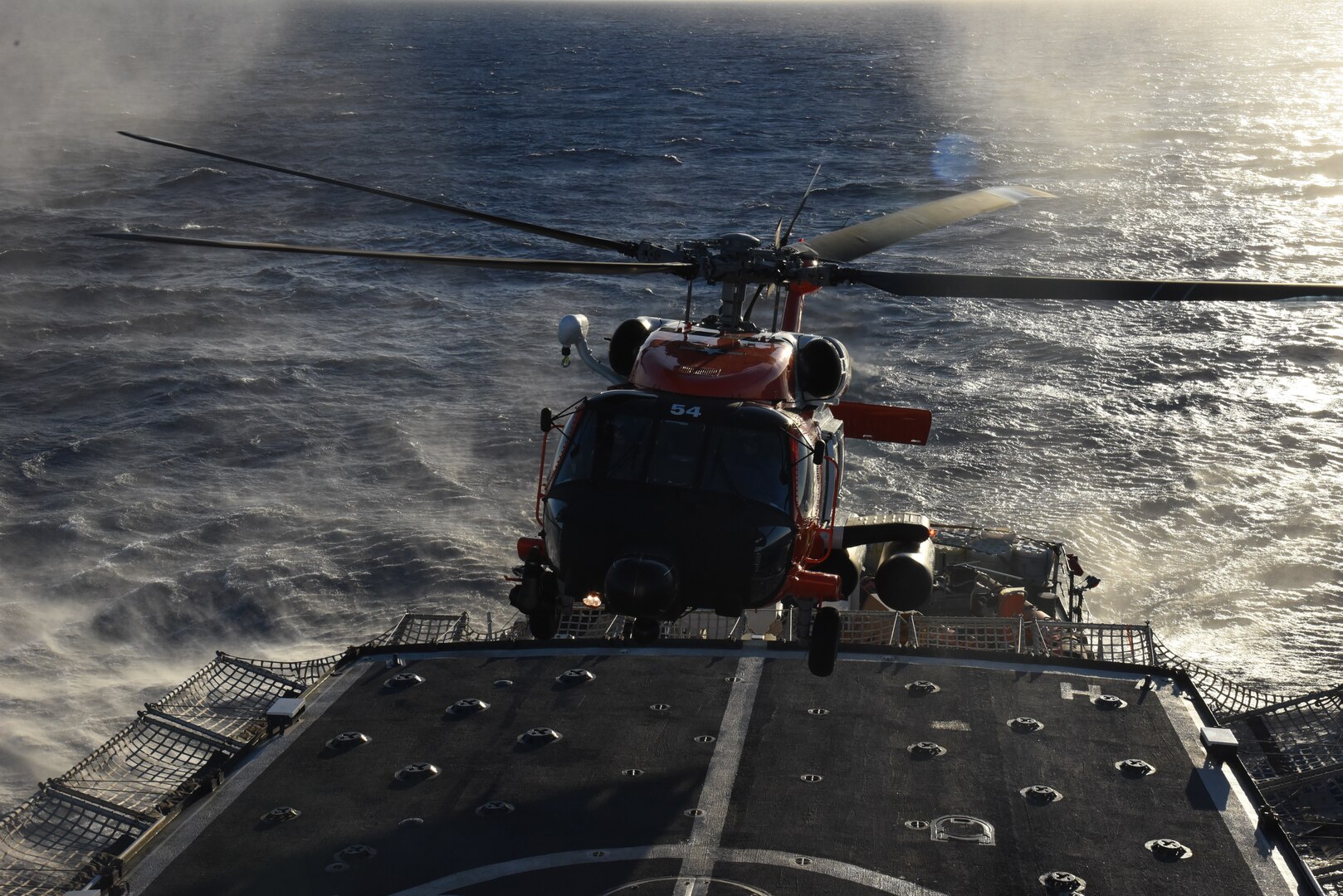
The photo above accompanied the press release reproduced below. There is no caption or credit attached to the photo (I hate that). There is no mention of flight ops in the news release. The helicopter may not actually be landing, but that’s what it looks like. This may have just been a training flight with no aviation detachment embarked. The 270s were designed to operate H-60 size helicopters, but it has been very rare. As the service moves to a homogeneous rotary wing fleet of all MH-60s, it should become common.
Doesn’t look like the 210s could operate H-60s at all. That is a mighty small flight deck. My understanding is that the first four 270s had a design flaw that meant that while an H-60 could land on the ships, they could not traverse the deck and be hangared. That means only ten of the 27 currently commissioned WMECs (Haley, 13 x 270s, 13 x 210s) will be able to operate MH-60s. (I assume Haley has the capability.)
The other 17 ships are not going to be replaced anytime soon. Unless they are decommissioned without replacement, it looks like the last 210 will not go out of service until 2031 (at least 62 years old at that point); the four earliest 270s not before 2033 (at least 49 years old); and the last WMEC not until 2038 (Really looks like 2039 to me).
If the Coast Guard wants to continue operating helicopters from these less capable ships, they may have to keep at least a few H-65s for another ten years. The CG has put a lot of money and effort into upgrading these aircraft, reportedly increasing their service life by 10,000 hours. That is a lot of hours. The conversions to MH-65E are not even completed yet. As of 27 April, 2023, 63 of 98 have been completed. It looks like enough MH-65s could be maintained to support the WMECs that cannot support the MH-60 until they are decommissioned, but the service may choose not to do so.
We are seeing a lot of 210s and even 270s operated without an embarked helicopter, particularly while operating in the Caribbean where fixed wing support is readily available and where the flight decks are often used as a holding area for migrants.
There is also the possibility that the ships would be better served by replacing the helicopter with an Unmanned Air System. At least in terms of search capability, a UAS is probably a better choice, but we haven’t seen a UAS capable of HITRON’s airborne use of force/armed overwatch function so essential for the drug interdiction mission.
May 11, 2023
USCGC Thetis returns home following 66-day multi-mission Caribbean Sea patrol
KEY WEST, Fla. – The crew of the USCGC Thetis (WMEC 910) returned to their home port in Key West, Thursday, following a 66-day patrol in the Florida Straits and Caribbean Sea.
Thetis’ crew contributed to the interdiction, care and repatriation of 125 migrants from Haiti and Cuba while patrolling the Seventh Coast Guard District’s area of responsibility in support of Operation Vigilant Sentry and Homeland Security Taskforce — Southeast.
During the patrol, Thetis’ crew rescued 31 Cuban migrants from an overcrowded, adrift and homemade vessel in the South Florida Straits. The boarding team safely embarked the migrants aboard Thetis, where Petty Officer 1st Class William Ice, a health services technician assigned to Thetis, provided a lifesaving emergency procedure for one of the migrants. During another case, Thetis watch standers spotted a Haitian sailboat in distress and provided rescue assistance to the 13 Haitians.
Additionally, working with Bahamian Customs Department, Thetis safely returned 54 Haitian migrants to their point of departure in the Bahamas after their overcrowded and unseaworthy vessel was intercepted in transit to West Palm Beach, Florida.
“I am so proud of the crew’s hard work and professionalism this patrol,” said Cmdr. Gavin Garcia, commanding officer of Thetis. “It takes a great deal of teamwork within the ship as well as coordination with other organizations to meet the demands of two of the Coast Guard’s main missions in the South Florida Straits: search and rescue and maritime law enforcement.”
Thetis is a 270-foot Famous-class medium endurance cutter. The cutter’s primary missions are counter-narcotics operations, migrant interdiction, living marine resources protection, and search and rescue in support of U.S. Coast Guard operations throughout the Western Hemisphere.