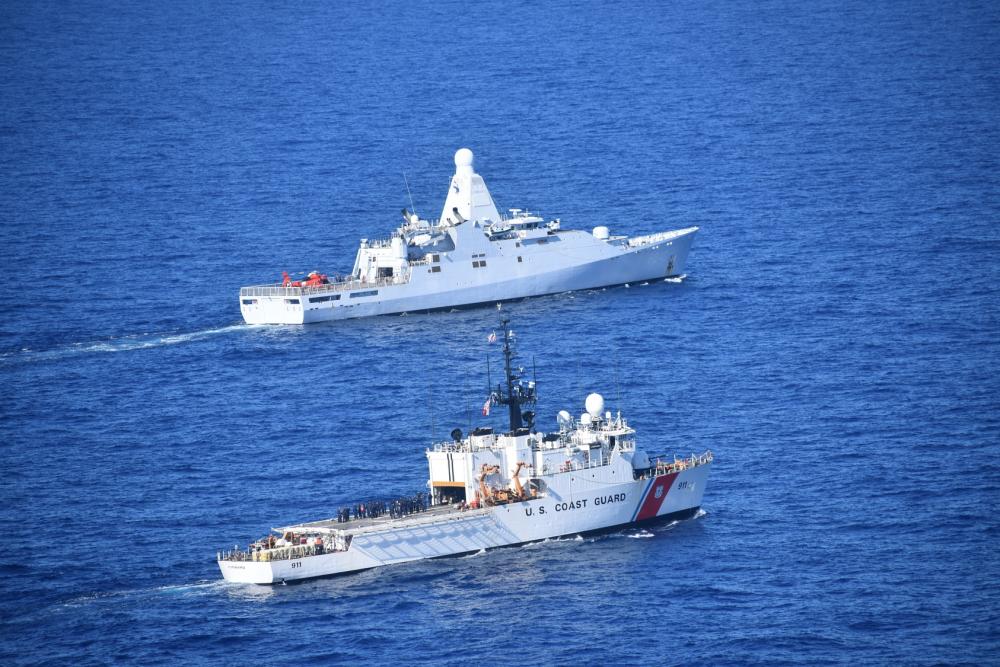
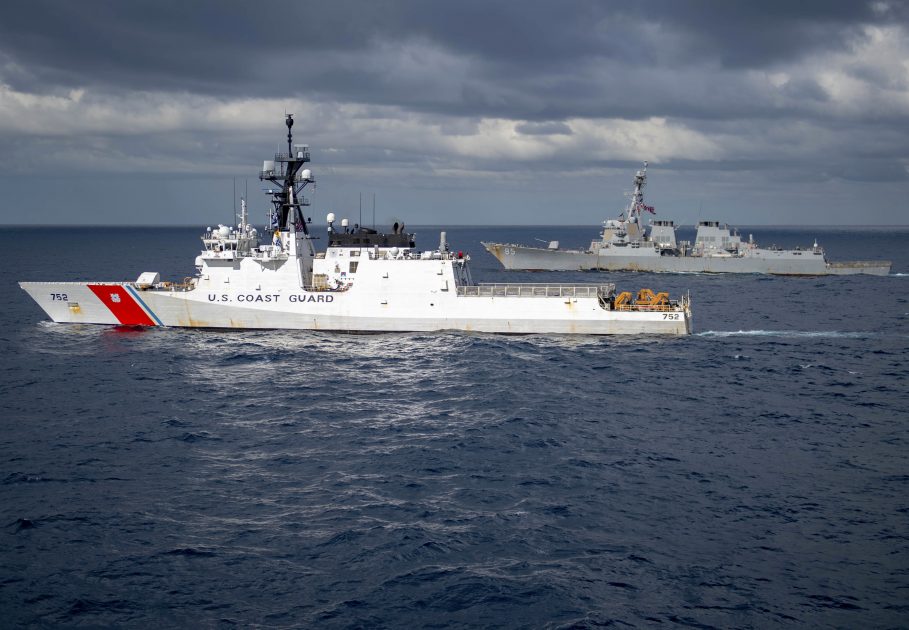
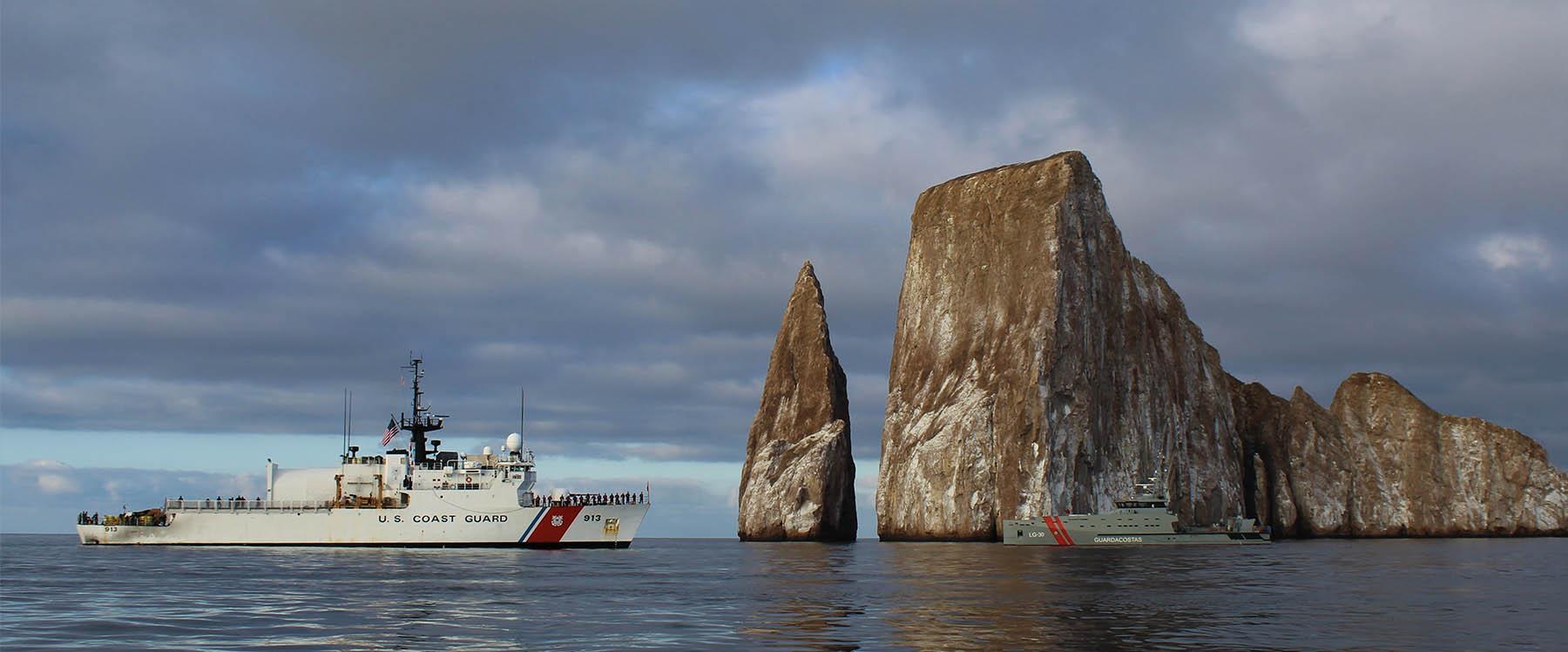
“U.S. Coast Guard cutter departs Japan following joint training with Japan Coast Guard” –PACAREA

Below is a Pacific Area news release.

One thing the Japan Coast Guard would have seen in any tour of a National Security Cutter (NSC) is the close relationship between the USCG and the US Navy. I can’t say that the NSCs are highly capable warships, but they are much more capable than any Japan Coast Guard cutter.

I think it is fair to say that the US Coast Guard benefits from the relationship with the US Navy in terms of secure communications, intelligence gathering, weapons support, and training. The country in turn has a significant naval auxiliary it can call on in time of war.

The Japan Coast Guard’s relationship with the Japanese Maritime Defense Force is much more distant. I think that needs to change.

If there is any doubt that cutters in the Western Pacific have become a regular thing, note,

“Recent U.S. Coast Guard cutter deployments to the Western Pacific include the Coast Guard Cutters Bertholf (WMSL 750) in 2019, Stratton (WMSL 752) in 2019, Waesche (751) in 2020, Munro (WMSL 755) in 2021 and the Midgett (WMSL 757) in 2022.”


Feb. 16, 2023

U.S. Coast Guard cutter departs Japan following joint training with Japan Coast Guard

KAGOSHIMA, Japan – The U.S. Coast Guard Cutter Kimball (WMSL 756) departed Kagoshima Thursday following a multi-day visit where the crew conducted a joint training exercise and professional exchanges with Japan Coast Guard members.

Crewmembers from the Kimball and the Japan Coast Guard conducted combined operations and search-and-rescue exercises in Kagoshima Bay Tuesday with multiple sea and air assets. The crews performed collaborative mission planning, boat handling and helicopter operations, and demonstrated techniques for locating, recovering and hoisting a simulated distressed swimmer.  These activities enhance the partnership and interoperability between the services in cooperative safety and security missions, including search-and-rescue operations.

While in port, Kimball’s command visited the Japan Coast Guard’s 10th Regional Headquarters and provided tours of the cutter to multiple groups of Japan Coast Guard servicemembers and community members.

The professional engagements expanded on a recently signed memorandum of cooperation between the two sea services.

The U.S. Coast Guard and the Japan Coast Guard signed an expanded memorandum of cooperation in May 2022, which added annexes to include standard operating procedures for combined operations, training and capacity building, and information sharing. The two services established a new perpetual operation to strengthen relationships, increase bilateral engagements, and focus on maintaining a free and open Indo-Pacific.

The new operation’s name, SAPPHIRE, is an acronym for Solid Alliance for Peace and Prosperity with Humanity and Integrity on the Rule of law-based Engagement. It honors the gem regarded as an emblem of integrity and affection found throughout the Indo-Pacific.

Since signing the SAPPHIRE memorandum of cooperation, the two services have conducted multiple joint training exercises and operations across the Pacific Ocean.

“The U.S. Coast Guard endeavors to continue strengthening our relationships with the Japan Coast Guard through engagements like ours in Kagoshima that build on the foundation laid out in SAPPHIRE,” said Capt. Thomas D’Arcy, Kimball’s commanding officer. “Our oceans are global maritime superhighways facilitating commerce, food security, and transportation. Collaborative engagement with the Japan Coast Guard, who also value strong maritime governance, enables greater connection and a more open and secure Indo-Pacific.”

By partnering with like-minded nations, the U.S. Coast Guard seeks to strengthen global maritime governance to preserve sovereignty, share information to facilitate force-multiplying partnerships, and demonstrate professional standards of behavior to reinforce the rule of law at sea through the global deployment of cutters and personnel.

Recent U.S. Coast Guard cutter deployments to the Western Pacific include the Coast Guard Cutters Bertholf (WMSL 750) in 2019, Stratton (WMSL 752) in 2019, Waesche (751) in 2020, Munro (WMSL 755) in 2021 and the Midgett (WMSL 757) in 2022.

“Expanded U.S. Coast Guard presence in the Western Pacific facilitates professional coast guard exchanges like our crews conducted in Kagoshima with the Japan Coast Guard,” said D’Arcy. “Presence and human-to-human interactions like we experienced this past week builds the connective tissue that embodies durable networks, strengthens the safety and security of all countries and fosters a committed network of partners with shared principles and norms in the maritime domain.”

Commissioned in 2019, Kimball is one of nine Legend-class national security cutters in service and one of two homeported in Honolulu. National security cutters are 418-feet long, 54-feet wide, and have a 4,600 long-ton displacement. They have a top speed of more than 28 knots, a range of 12,000 nautical miles, endurance of up to 90 days, and can hold a crew of up to 170. These cutters are the centerpiece of the U.S. Coast Guard’s fleet, capable of executing the most challenging operations, including supporting maritime homeland security and defense missions at home and abroad.

U.S. Navy Collecting Surveillance Balloon Debris + Late Addition

ATLANTIC OCEAN (Feb. 23, 2021) — USCGC Charles Moulthrope (WPC 1141) conducted Astern Refueling at Sea training with the USCGC Venturous (WMEC 625). This evolution provides vital fuel to extend the endurance and range of FRC and provided an excellent training opportunity for both crews. (U.S. Coast Guard photo by Petty Officer 1st Class Sydney Niemi/Released)

Below is a DOD news release, and the first one I have seen that names the Coast Guard units participating (Venturous, Richard Snyder and Nathan B. Bruckenthal). Thanks to Paul for bringing this to my attention.

I have also added the transcript of a briefing that was issued earlier that contains additional information.


U.S. Navy Collecting Surveillance Balloon Debris
Feb. 6, 2023 | By David Vergun

The U.S. military today began collecting the remnants of a Chinese high-altitude surveillance balloon shot down by an Air Force fighter over the weekend.

Air Force Gen. Glen D. VanHerck, commander of the North American Aerospace Defense Command and U.S. Northern Command, said the recovery effort began about 10 a.m. Rough seas thwarted safe, comprehensive debris collection yesterday, he said.

On Saturday, an F-22 Raptor fighter from the 1st Fighter Wing at Langley Air Force Base, Virginia, fired one AIM-9X Sidewinder missile at the balloon, which had floated southeastward across the United States.

It fell about six miles off the coast of South Carolina into about 50 feet of water. No one was hurt.

Precautions are being taken during the salvage operation in case explosives or toxic substances are present, VanHerck said.

Due to changing ocean currents, it’s possible that some debris could escape notice and wash ashore. VanHerck said members of the public can be assist by informing local law enforcement personnel if they spot remnants of the balloon; they should not collect it themselves.

The USS Carter Hall, an amphibious landing ship, is collecting debris in the vicinity of the splashdown, he said.

The USNS Pathfinder, a survey ship, is mapping the ocean floor using sonar for the debris search, VanHerck said.

Explosive ordnance members and at least one unmanned underwater vehicle are also participating, he said.

In addition, VanHerck said the Coast Guard cutters Venturous, Richard Snyder and Nathan B. Bruckenthal, along with Coast Guard aviation support, are keeping the area safe for military personnel and the general public.

The FBI and Naval Criminal Investigative Service agents are embedded with salvage operations personnel to assist in counterintelligence work, he added.

VanHerck mentioned that the Federal Aviation Administration was helpful in closing air space when the balloon was being shot down.

It’s truly been an interagency team effort, VanHerck noted.


(Late addition)
Gen. Glen VanHerck, Commander, North American Aerospace Defense Command and United States Northern Command, Holds an Off-Camera, On-The-Record Briefing on the High-Altitude Surveillance Balloon Recovery Efforts
FEB. 6, 2023

STAFF:  Well, good afternoon, everyone, and thank you for joining us. It’s my pleasure to introduce General Glen VanHerck, commander of North American Aerospace Defense Command and U.S. Northern Command, who will provide an update on the ongoing recovery operations following the takedown of the Chinese high-altitude balloon that violated U.S. airspace.

Today’s discussion is on the record. Please note that the focus of the discussion is on NORAD and NORTHCOM’s current operations as they relate to the recovery effort, so I appreciate you keeping your questions focused there. I’ll turn it over to General VanHerck for some brief opening comments, and then we’ll open it up to your questions.

General VanHerck, over to you, sir.

GENERAL GLEN VANHERCK:  Hey, thanks a lot, Pat, and thanks a lot to the entire team here for the opportunity to get together and talk a little bit about the operations that ongoing right now to salvage as much as we can of the Chinese high-altitude balloon primarily for the safety and security of — of folks in the local area, but also to recover and exploit that in any way that we can.

So let me just walk through a few things that are — that are ongoing for you here. We continue to — to focus on safe execution of a recovery while effective recovery so that we can exploit that, and to provide as much information as we can to the media, the public, Congress — everybody that has an interest in what we’re actually finding.

So the USS Carter Hall, a U.S. Navy ship under the command and control of NORTHCOM through my Navy component, now the North, Navy North, led by Admiral Daryl Caudle, they’re on station in the vicinity of the splashdown, and they’ve been collecting debris, category — categorizing the debris since arrival. The U.S. Navy Ship Pathfinder is also on station. The Pathfinder is a ship that conducts survey operations using sonar and other means to map out the debris field. It’s capable of conducting oceanographic, hydrographic, bathymetric surveys of the bottom of the ocean to do that. And they’ll eventually produce us a map — they’re in the process of doing that, and I expect to have much more today — of the full debris field. But we expect the debris field to be of the rough order of magnitude of about 1,500 meters by 1,500 meters, and so, you know, more than 15 football fields by 15 football fields. But we’ll get a further assessment of that today.

Yesterday’s sea states did not allow us to conduct some of the operations that we would have liked to have conducted such as underwater surveillance. And so those forces that provide the explosive ordnance disposal to make sure the scene is safe, they’re out today, this morning, and they went out in what’s called a rigid hull inflatable boat this morning, Eastern time approximately 10:00 o’clock, to proceed to the — the area to utilize unmanned underwater vehicles using side scan sonar to further locate sunken debris. And so we expect them to get on there and to do some additional categorization of potential threats such as explosives that may be on, hazardous materials that could be in batteries, et cetera, so we’re working very hard.

I’d remind you, this is a effort that’s in the open ocean ongoing in approximately 50 feet of water, and so we have to be very cognizant of the sea states, currents, et cetera, so we continue to — to move forward.

Very proud to have a — a Coast Guard support. We have cutters, the U.S. Coast Guard Cutter Venturous, the Cutter Richard Snyder, the Cutter Nathan Rectanual, or — so excuse me — Bruckenthal — I — I got that one right finally. Those are out of the Coast Guard. We have air station support out of Elizabeth City and Savannah, Georgia, as well, and response boats from Georgetown, South Carolina, all providing security and safety to ensure not only the safety of the men and women of the military forces conducting operation, but the general public as well, so we keep it safe in the area.

As a quick note, I would remind you that due to ocean currents, it’s possible that there may be some debris that does float ashore. And so what we would ask of the public, and you can help me with this, is avoid contact. Contact local law enforcement immediately to take care of any of that debris.

The FBI and the Naval Criminal Investigative Service agents are working closely. They’re embedded with us, with authorities to make sure that we collect that debris, and the FBI is embedded with us on our salvage operations as we collect this under counterintelligence authorities.

I don’t know where the debris’ going to go for a final analysis, but I will tell you that certainly the intel community, along with the law enforcement community that works this under counter intelligence, will take a good look at it. So we look forward to moving forward there.

Okay, so I’m happy to talk about the ongoing operations or potentially some of the operations that we conducted on Saturday, and I look forward to your questions.

I’d also like to thank one more thing is — before we go forward. This was truly an inter-agency effort. The FAA was tremendous, and I know you’re all aware that we closed airports in the area, Charleston, Myrtle Beach, as well as some others. They were tremendous.

This was all for the public safety to ensure we could accomplish this operation safely and effectively, and that’s exactly what happened. The Federal Bureau of Investigation was able to reach out to the local law enforcement communities in near real time of making this happen to ensure that folks were aware and that we made as safe and effective as an operation as possible.

And so thanks for your time, and I look forward to your questions.

STAFF:  Thank you very much, General VanHerck. We’ll go ahead and start with Associated Press, Tara Copp.

Q:  Hi, thank you for doing this. My first question is as the balloon was still transiting across the U.S., what sort of protective measures did you take to make sure that it did not collect any U.S. intelligence such as — were you able to block the balloon from transmitting anything?

And then I have a follow-up. Thanks.

GEN. VANHERCK:  Yes, so I’m not going to talk about any ongoing operations that occurred, such as attempts to use non-kinetic effects. Those are things that I need to go to Congress to talk about, I need to talk about with the department before we move forward.

What I will tell you is we took maximum precaution to prevent any intel collection. I was in close coordination with the Commander of the United States Strategic Command, and we provided counterintelligence messages out of our intelligence shop across the entire Department of Defense and the interagency so that we could take maximum protective measures while the balloon transited across the United States.

Again, this is on record previously. We did not assess that it presented a significant collection hazard beyond what already exists in actionable technical means from the Chinese.

And with that said, you always have to balance that with the intel gain opportunity. And so there was a potential opportunity for us to collect intel where we had gaps on prior balloons, and so I would defer to the intel community, but this gave us the opportunity to assess what they were actually doing, what kind of capabilities existed on the balloon, what kind of transmission capabilities existed, and I think you’ll see in the future that the — that time frame was well worth it’s value to collect,over.

Q:  Thank you. And on the prior balloons, was NORTHCOM involved in tracking the balloon that was at the early stage of the Biden Administration and also the three that transited during the Trump Administration, and what can you tell us about those that were different?

Thank you.

GEN. VANHERCK:  So those balloons, so every day as a NORAD commander it’s my responsible to — responsibility to detect threats to North America. I will tell you that we did not detect those threats. And that’s a domain awareness gap that we have to figure out. But I don’t want to go in further detail.

The intel community, after the fact, I believe has been briefed already, assess those threats to additional means of collection from additional means and made us aware of those balloons that were previously approaching North America or transited North America. I hope that answers your question.

STAFF:  All right, thank you, sir. Let’s go to Jeff Schogol Task & Purpose.

Q:  Thank you. Can you say the F-22 that shot down the balloon, will it get a balloon decal to signify the victory?

GEN. VANHERCK:  Hey, Jeff, I’ll differ to the first fighter wing. I — I will say I’m really incredibly proud of everybody that took place in this. But the F-22 was remarkable. I’d remind everybody that the call sign of the first flight was Frank 01. The secondly flight of F-22s was Luke 01; a flight of two.

Frank, Luke; Medal of Honor winner, World War I for his activities that he conducted against observation balloons. So how fitting is it that Frank 01 took down this balloon in sovereign air space of the United States of America within our territorial waters.

STAFF:  Thank you, sir. Let’s go to Natasha Laguerre from Myrtle Beach.

Q:  Hello, I see that you guys still have ships out here. Is that should be a concern for people in this area? And you also mentioned that you guys yesterday could not use the sonar panels to collect the debris under the ocean. What was it that caused it to have a stop there compared to today?

GEN. VANHERCK:  Yes, so those are under current — underwater currents and sea states, which were — that exceeded the safety parameters for the — the forces that come out of the EOD and the multiple unit two to provide that.

The area we have set up there is about a 10 mile — 10 by 10 mile area to — for safety purposes, from air traffic and a smaller area that we’re providing for security and safety on the surface. But the primary reason was absolutely for the safety of our military and our interagency partners supporting us. The sea states just didn’t allow that.

Q:  And I have a follow-up question. Could you give us an estimate of how big the balloon was? We saw that it had solar panels and it could also potentially had a recording device on it.

GEN. VANHERCK:  Yes, so the balloon assessment was up to 200 feet tall for the actual balloon. The payload itself, I would categorize that as a jet airliner type of size, maybe a regional jet such as a ERJ or something like that. Probably weighed in access of a couple thousand pounds. So I would — from a safety standpoint, picture yourself with large debris weighing hundreds if not thousands of pounds falling out of the sky. That’s really what we’re kind of talking about.

So glass off of solar panels potentially hazardous material, such as material that is required for batteries to operate in such an environment as this and even the potential for explosives to detonate and destroy the balloon that — that could have been present.

So I think that would give you an idea of the perspective of the balloon and the decision-making process along the way.

STAFF:  Thank you, sir.

Q:  Thank you.

STAFF:  Let’s go to — let’s go to Jennifer Griffin, Fox.

Q:  Thanks, General VanHerck. Can I just ask you, on the record again, because there’s been a lot made in recent days still about why this was not shot down after it crossed or neared the Aleutian Islands? Can you just explain what you were watching then, what you were thinking then? What the decision-making process was. And why it — you didn’t have enough time to do so, if that was the case?

GEN. VANHERCK:  Thanks, Jennifer. It wasn’t time. It — the domain awareness was there as it approached Alaska. It was my assessment that this balloon did not present a physical military threat to North America, this is under my NORAD hat. And therefore, I could not take immediate action because it was not demonstrating hostile act or hostile intent. From there, certainly, provided information on the status of the whereabouts of the balloon. And moving forward, kept the department and the governor — the government of Canada in the loop as my NORAD, I have a boss in Canada as well. Over.

Q:  And just to follow up, is it true you had U-2 spy planes around the balloon as it crossed the continental U.S. and that was another way that you could collect on the balloon?

GEN. VANHERCK:  So, I’m not going to get into details of the operation, what planes. What I’d tell you, Jennifer, is that we utilized multiple capabilities to ensure we collected and utilized the opportunity to close intel gaps. I’ll defer to the department, I don’t want to get in front of my discussions with Congress or others about specific details for collection.

I would point out and I think it’s important to talk about is, day to day we do not have the authority to collect intelligence within the United States of America. In this case, specific authorities were granted to collect intelligence against the balloon specifically and we utilized specific capabilities to do that, Jennifer. And I’m sorry I can’t give you further detail.

Q:  Thank you.

STAFF:  Let’s go to David Martin, CBS.

Q:  Two questions. Can you give us the names of some of the sensitive military sites that were in range of the balloon’s censors as it crossed the U.S.? And that debris field you’re describing is radically smaller than the predicted debris field that was 20 miles by 20 miles. What accounts for that? Was there — were your models off? Was there — did you figure out a different way to shoot it down? Was it — was there a warhead in that missile?

GEN. VANHERCK:  Okay, thanks, David. I’m not going to get in front of the department on specific locations, flight path. I would just tell you we took every precaution to ensure any sites in the way were covered and that we minimized any collection. So, let’s — let us talk to Congress and provide those specific details.

As far as the actual site, the 20 by 20 was a — that’s a site — and area that we cleared out from the maritime — or the notice to mariners for safety. We wanted to clear that box out. I cleared another box out that was 150 miles by 150 miles for air traffic to ensure that there was no air traffic that was potentially involved, to minimize risks to all personnel and infrastructure.

The analysis — and oh, by the way, we were able to get significant analysis throughout this process, as a cross, that enabled us to make this a much more safe and effective operation. So, in partnership with NASA, who gave us an assessment that would potentially be up to six or seven miles of debris. That’s where — that’s where we decided to make the engagement six miles off the coast so that no debris would go back over the coast.

Now, with that said, David, I think it’s important to point out, there was debris that’s expanded out further, we have collected the majority of that debris that fell in the ocean and other places. Now, what we’re talking about, is really that superstructure below that fell down and limited itself to this 1,500 meter by 1,500-meter box that we’re talking about. Does that clarify?

Q:  Yeah. And could you answer the question about whether there was a warhead in the missile?

GEN. VANHERCK:  Yeah, absolutely. There was a warhead in the missile. You can see that explosion on TV as it goes through the lower part of the balloon and right there through the superstructure.

STAFF:  All right, thank you, Gentlemen.

Let’s go to Alex Horton of Washington Post.

Q:  Hey, thanks for doing this. I was curious if you can get a little bit more detail about those other balloons, and I think the four others. You know, you had mentioned that you weren’t aware of them. So how are you aware of them now? Was it through different agencies that are helping you in review since this incident? And can you also tell us something about their location and postures? We’ve heard some states like Florida and Texas, but those are pretty large, where they appeared interested in military bases. Were they interested in military installations like this one? Thank you.

GEN. VANHERCK:  I don’t have that detail. I’d have to defer the intel community. They’ll have additional fidelity at this time.

STAFF:  Thank you, sir. Let’s go to Phil, Reuters.

Q:  Hi, there. Was there ever any thought or planning to try and potentially capture the balloon as opposed to using a — you know, a Sidewinder? And how was that munition chosen? And lastly, you know, at what point did you learn about these other balloons if you weren’t detecting them at the time? Was it all kind of retrospective upon the discovery of this one? Thank you.

GEN. VANHERCK:  So, I’m not going to get into the technical details, I will just tell you there were multiple options considered and asked for at multiple levels. The decisions that were made were based on safety first, and then effectiveness and being able to take the balloon down within our sovereign airspace and territorial waters. Again, I’ll go back — I’m going to reserve that till I talk to Congress, till I talked to others who have interest in the specific details.

STAFF:  Thank you very much. Let’s go to Jon Harper, Defense News.

Q:  Right. Thank you. Can you give us some more details about this UUV you’re using, you know, what specific type of platform it is? You know, what capabilities it has to perform this underwater detection mission? And will the UUV itself be involved in lifting debris up from the undersea domain?

GEN. VANHERCK:  Yeah, great question, and I’m not the expert. Maybe we can get that, and Pat, you can provide some additional details through my Navy component, through me I can get you that. What I can tell you is I’m sure — I can assure you that it has photographic capabilities. It’ll have capabilities to in place things such as inflatable devices, and mapping sonar, those types of things. But I can’t give you further details beyond that, because I physically don’t know.

Q:  Okay. And are there multiple UUVs involved in this or is it just one single platform that you’re using?

GEN. VANHERCK:  Yes, I don’t have that. I’m a — I’m going to make the assumption, but you can’t — I can’t guarantee this info, that they have multiple platforms and they likely can utilize multiple or single ones, depending on the scenario. But I’ll have to give you the facts on that from my Navy component.

Q:  Thanks. And just to clarify, did you say that yesterday the C-states wouldn’t allow you to deploy these UUVs, but that activity just started today?

GEN. VANHERCK:  That’s exactly what I said. There was safety concerns yesterday that prevented us from employing the EOD teams with their UUVs. And today they’re on scene as of 10 o’clock Eastern this morning.

Q:  Great. Thank you.

STAFF: John. Let’s go to Annie, Canadian Television News.

Q:  Hi, thank you very much for taking the question. As you mentioned, right after the balloon passed through Alaska it did enter Canadian airspace. I’m wondering if you can tell us who in Canada was notified when it crossed into the airspace. And what type of communication you’ve had with the Canadian officials?

GEN. VANHERCK:  — Annie. So, I’m not going to give you specific details on who or speculate in Canada had information or what the Canadian decision-making process is. My boss is General Wayne Eyre, the Chief of Defense staff on the Canadian side. And I can assure you that General Eyre was kept in the loop.

Q:  Thank you. And I’m wondering if you have any more information you can provide about how the balloon came into Canadian airspace. Whether you think that this was something done on purpose or it just sort of veered off course as it was going through the U.S.? And was this also the only balloon you’re aware of that entered Canadian airspace or were there others as well?

GEN. VANHERCK:  In my domain awareness tells me that there was one balloon. I don’t have any indications that there was a second. There was some speculation about a second one. I launched NORAD fighters, Canadian CF-18s and we were not able to corroborate any additional balloon. I do think their path was purposely built. And they utilized the winds and it’s a maneuverable platform as well, but their utilize their maneuverability to strategically position themselves to utilize the winds to traverse portions of countries that they want to see for collection purposes.

STAFF:  Thank you. Let’s go to Oren, CNN.

STAFF:  A quick follow-up and another question. In response to Jennifer Griffin, you had said you didn’t as you watched the balloon that it was a posed a military or kinetic threat. Did you, at first, believe this was a weather balloon or did you believe all along it was a surveillance balloon?

And then I was just wondering what you can say about the condition of the — of the wreckage, of the debris? Is it in relatively good condition? Is there an estimate on how many pieces it’s in? And is there an estimate on weight or mass of what there is to collect from this?

GEN. VANHERCK:  On your second question, I can’t give you that right now. I don’t know the numbers and until we get down there today, I expect later on today we’ll have additional fidelity on what debris looks like, size of pieces, weights of pieces, those kinds of things. On your first question, with regards to that, you know, my job as the Commander of NORAD’s to identify everything that approaches North America.

In this case, I would tell you, we had a good indication that it was a surveillance balloon from the beginning. I was able to corroborate that with my domain awareness capabilities and provided the — an assessment as such.

STAFF:  Thank you.

Q:  Thank you.

STAFF:  Let’s go to Mike Glenn, Washington Times. —

Q:  Thanks, sir. I was wondering, when are you planning to go (inaudible) —

STAFF:  Hey, Mike, you’re breaking up really bad.

Q:  I am?

STAFF:  Can you repeat that? Yeah, you broke up really bad.

Q:  Yeah. When are you going to Congress — God damn it.

Q:  Yeah, when are you going before Congress to talk?

GEN. VANHERCK:  All of that’s being worked, and I’m — I’m going to preserve their decision space, the department’s decision space, the president’s decision space. I — I — when I testified for confirmation, you know, conveyed to them that when asked, I will provide any testimony, and whenever they ask, I’ll be ready with the support of the department.

STAFF:  Thank you. I’ve got time for just a couple more questions. Let’s go to Lara Seligman, Politico. Lara, are you there?

Q:  Hey, Pat, it’s Lara. Did you call on me?

STAFF:  I did. I did. Go ahead, Lara.

Q:  Oh, okay, thank you. Sorry about that.

Hi, General, sir. Thanks — thanks so much for doing this. I just wanted to clarify. You said that the balloon potentially carried explosives to detonate and destroy the balloon. Can you just be — can you just clarify those comments? What — what exactly was the nature of those explosives? Were they to destroy itself? And then if it carried explosives, why — what was the assessment based on that it was not a threat?

GEN. VANHERCK:  Yeah, so I can’t confirm whether it had explosives or not. Anytime you down something like this, we make an assumption that that potential exists. We did not associate the potential of having explosives with a threat to dropping weapons, those kinds of things, but out of a precaution, abundance of safety for not only our military people and the public, we have to make assumptions such as that. I hope that answers your questions.

Q:  So — so just important clarification here:  You didn’t have a reason to think there were explosives. You just — this was out of an abundance of caution, and you thought it might potentially have them, so you had to be careful. Is that correct, or did you have reason to believe there were explosives?

GEN. VANHERCK:  I would say it was the prior. I did not have any corroboration or confirmation of explosives on this platform. That was an — an assessment that we wanted just to make sure for safety purposes.

STAFF:  Thank you. And final question will go to Brian Everstine, Aviation Week.

Q:  Hi. Thank you so much for doing this. I was hoping you could take a little bit more about the planning for the shot itself. We had talked about the modeling for the debris, but the planning, modeling for why you went with an AIM-9 versus an AIM-120. And can you talk a little — do you know if the AIM-9 has been fired at this altitude in test before?

GEN. VANHERCK:  So on the last question there, I’d have to go talk to the Air Force and their Weapon System Evaluation Program. I don’t know that they’ve tested an AIM-9 at that altitude. I’m not aware of any engagements against a high-altitude bull… — high-altitude balloon such as this. We — we did not have the weapons data, so I — I can’t confirm that.

Can you remind me of your first question?

Q:  I just was hoping you’d talk a little bit more about the planning, and why you went with an AIM-9 versus an AIM-120.

GEN. VANHERCK:  Yeah, again, it goes back to safety considerations and effectiveness. You know, the AIM-120 has a significantly-larger range, a significantly-larger missile warhead, and the effectiveness of the AIM-9 here from a safety standpoint was going to be more safe, and we assessed from an effectiveness standpoint that it was going to be highly-effective, and that was proven on Saturday.

STAFF:  All right, ladies and gentlemen, that is all the time we have available today. General VanHerck, thanks so much for taking a moment to update us. Everyone else, have a great day. Out here.

“China Will Use Antarctica For Its Ocean Monitoring Satellites” –gCaptain

gCaptain reports that China is setting up a satellite ground station at their Zhongshan research base in the Larsemann Hills by Prydz Bay (at about the 2:30 position (76°22′18″E) on the chart above). It is directly south of India. From Wikipedia,

“The bedrock of the Larsemann Hills contains an unusually high abundance of boron and phosphate minerals and is the location of discovery of four new species of mineral. In 2014, the Stornes Peninsula within the Larsemann Hills was declared an Antarctic Specially Protected Area due to its mineral diversity.”

The station is within a sector of Antarctica claimed by Australia. All claims are currently held in abeyance in accordance with the Antarctic Treaty System.

There is concern that the satellite monitoring technology will be dual use (civilian and military).

The station is relatively small now, reportedly with a population of 60 in the summer and 17 during the winter. Sounds like it will be growing.

“Coast Guard Expands Nation-Wide JROTC Program” –USCG HQ

Just passing this along. Unfortunately, opportunities to participate are still extremely limited geographically. What the country probably needs is a service agnostic, or perhaps sea service, JROTC program so that it could reach more than this very limited population.

Jan. 25, 2023

Coast Guard Expands Nation-Wide JROTC Program

USCG HQ, Washington, DCWASHINGTON — The Coast Guard is establishing four new Junior Reserve Officers’ Training Corps units for the 2023-2024 school year, bringing the national total from six to ten.

The new units will be located at:

  • Saraland High School in Saraland, Ala.
  • Aspira Business and Finance High School in Chicago
  • Clinton High School in Clinton, Miss.
  • Mission Bay High School in San Diego

The addition of the four JROTC units is the largest expansion in the program’s history, and the first time the Coast Guard will establish more than two of these units in a single year.

The Coast Guard established the JROTC program in 1989 at the MAST Academy in Miami. The program currently includes approximately 500 cadets across six high schools in the states of Delaware, North Carolina, South Carolina and Florida.

“Adding these JROTC units in four additional states demonstrates the nation-wide impact of our JROTC program,” said Rear Admiral Megan Dean, director of governmental and public affairs. “Our JROTC program provides a framework for personal and citizenship development, and the character formation we are seeing in these cadets is good for our schools, communities, the Coast Guard, and our nation as a whole.”

To participate in JROTC, students must be in grades 9-12, with some exceptions for eighth graders. They must be citizens, nationals of the United States or those lawfully admitted to the United States for permanent residence. Cadets must also maintain physical fitness, academic and personal conduct standards.

“The Coast Guard JROTC develops cadets using the COAST model, an acronym for our 5-fold pillars of Citizenship, Operations, Advancement, Service, and Teamwork,” said Cmdr. Clay Cromer, Coast Guard JROTC program manager. “These pillars guide our program mission of ‘Developing Service-Minded Citizens of Character’ and help our cadets achieve success both in the classroom and in their daily lives.”

The National Defense Authorization Act 2023 provided specific direction for the program’s future – the Coast Guard must establish and maintain at all times a JROTC unit in every Coast Guard District by December 31, 2025. The six JROTC units are currently located in only two of the Coast Guard’s nine Districts, with this year’s expansion adding three for a total of five Districts with active JROTC units.

For more information about the JROTC program visit https://www.uscg.mil/community/JROTC.

“HELGE INGSTAD REPORT ENGLISH 2021” –YouTube

A recent Marine Link report, “Norway Naval Officer Goes on Trial Over Oil Tanker Collision,” included the video above. Thought you might find it interesting.

Sure, there was a lot of sophisticated equipment that they apparently couldn’t get to work but it also looks like a lot of basics missing as well.

Was a collision alarm ever sounded?

The crew of 137 was extremely small for such a sophisticated ship. Did this mean there was no messenger and/or lookout assigned the bridge watch that might have been used to reestablish communications? It almost certainly means there was minimal redundancy in the skills of the crew.

Did the ship have sound powered phones for emergency communications?

There was a failure to close watertight fittings as spaces were evacuated.

The whole thing looks like a cautionary tale. Don’t put too much faith in high tech. Certainly use it, but don’t forget the basics of good damage control.

“USCGC Decisive returns home from Eastern Pacific Ocean deployment, completing final patrol”

The Reliance-class medium endurance cutter USCGC Decisive (WMEC 629) conduct at sea engagements with the navy of Guatemala in the territorial seas of Guatemala on Oct. 25 – 26, 2021. The U.S. Coast Guard conducts routine deployments in the Southern Command area of responsibility, works alongside partners, builds maritime domain awareness, and shares best practices with partner nation navies and coast guards. (U.S. Coast Guard photo)

Below is a pretty standard East Pacific patrol news release, except for the fact that this is Decisive’s final patrol. The old girl, one of the newest of the 210s, is going out after a successful patrol.

I suppose after the numerous delays, this was inevitable, but the first Offshore Patrol Cutter, the future USCGC Argus, isn’t even in the water yet. With the loss of Decisive, we will be down to 36 patrol cutters of more than 1,000 tons, same as in the current program of record. (Original program of record would have given us 33 NSCs and OPCs plus 58 FRCs for a total of 91. Current total in commission is 84 or 85, NSCs, FRCs, and WMECs). With the OPC program extending 15 years into the future, we may see the number of large patrol cutters drop even further.

30 years ago:

The Coast Guard’s last spasm of patrol cutter construction ended in 1992 when the last 110 foot WPB was commissioned. The last 270 foot WMEC had been commissioned in 1991, but the program had still not replaced all the WWII construction. 30 years ago the Coast Guard had 47 large patrol cutters (12×378; 13×270; 16×210; 3×213; Storis; 1×205; 1×180 converted to MEC) in addition to 49 Island class for a total of 96.

I think we are now, and will be for the foreseeable future, seriously short of larger patrol cutters. Some of them may not have to be as big as OPCs, just need better range and seakeeping than the Webber class, but we will not have a good case unless we complete the new Fleet Mix study that reflects current mission requirement that Congress has been asking for. We really need to do this.

News Release

U.S. Coast Guard Atlantic Area


USCGC Decisive returns home from Eastern Pacific Ocean deployment, completing final patrol

Stock Image of USCGC Decisive

Editors’ Note: To view the stock image above or download high-resolution imagery, click on the photo.

PENSACOLA, Fla. — The crew of the USCGC Decisive (WMEC 629) returned to their homeport in Pensacola, Friday, following a 33-day patrol in the Eastern Pacific Ocean, concluding 55 years of service to the Nation.

Decisive patrolled the Eastern Pacific Ocean in the Coast Guard Eleventh District’s area of operations. While underway, the Decisive’s crew supported the Coast Guard’s drug interdiction and search and rescue missions to promote safety of life at sea and deter the flow of illegal narcotics into the United States.  

While deployed, Decisive’s crew collaborated with Coast Guard assets and foreign military aircraft to detect, deter, and interdict illegal narcotics voyages. At one point, Decisive disrupted two vessels suspected of drug trafficking in the same night. Decisive also collaborated with the USCGC Alert (WMEC 630) to safely transfer three suspected smugglers. While aboard Decisive, the detainees received food, water, shelter and medical attention.

“The crew’s remarkable professionalism, competence and determination were on full display as we met the diverse challenges of operations at sea,” said Cmdr. Aaron Delano-Johnson, commanding officer of Decisive. “Whether it was conducting simultaneous boardings or our skilled engineers conducting voyage repairs in Panama, the crew exceeded expectations at every turn. After a successful, final patrol for Decisive, we are looking forward to returning home to our family and friends on shore.”

During the patrol, Decisive traveled more than 6,000 miles and traversed through the Panama Canal. By transiting the historic waterway, Decisive’s crew earned their Order of the Ditch certificates, a time-honored nautical tradition recognizing mariners who have crossed the Panama Canal between the Atlantic and Pacific Oceans.

Decisive is a 210-foot, Reliance-class medium endurance cutter with a crew of 72. The cutter’s primary missions are counter drug operations, migrant interdiction, and search and rescue in support of U.S. Coast Guard operations throughout the Western Hemisphere.

For information on how to join the U.S. Coast Guard, visit GoCoastGuard.com to learn about active duty and reserve, officer and enlisted opportunities. Information on how to apply to the U.S. Coast Guard Academy can be found here.

For more, follow us on FacebookInstagram and Twitter.

“Coast Guard, partners tracking Russian vessel off Hawaiian Coast” –D14

Vishnya class intelligence ship Kareliya (Picture source: Russian MoD)

Below is a news release from D14. The subject is a bit unusual. The accompanying video shows two vessels. One is a Russian Navy Vishnya class intelligence ship, presumably Kareliya, being either towed or perhaps receiving fuel from a ship that appears to be a merchant tanker. The tanker does have some unusual structures forward and amidships. It is not the first time this particular intelligence ship has operated off the coast of Hawaii.

The intelligence vessel (AGI) is probably there to observe missile tests from Barking Sands.

News Release

U.S. Coast Guard 14th District Hawaii and the Pacific

Coast Guard, partners tracking Russian vessel off Hawaiian Coast

Russia Spy

Editors’ Note: Click on video to download a high-resolution version.

HONOLULU — In recent weeks, the U.S. Coast Guard has continued to monitor a Russian vessel, believed to be an intelligence gathering ship, off the coast of the Hawaiian Islands.
 
While foreign military vessels may transit freely through the U.S. economic exclusive zone (EEZ), as per customary international laws, foreign-flagged military vessels have often been observed operating and loitering within Coast Guard District Fourteen’s area of response.
 
The Coast Guard continues to coordinate with Department of Defense partners, providing updates to foreign vessel movements and activities and to appropriately meet presence with presence to encourage international maritime norms.  
 
“The U.S. Coast Guard is currently monitoring the Russian vessel operating in the vicinity of Hawaii,” said Cmdr. Dave Milne, chief of External Affairs. “As part of our daily operations, we track all vessels in the Pacific area through surface and air assets and joint agency capabilities.
The Coast Guard operates in accordance with international laws of the sea to ensure all nations can do the same without fear or contest. This is especially critical to secure freedom of movement and navigation throughout the Blue Pacific.” 
 
As a part of the Department of Homeland Security, the Coast Guard is the lead federal agency for at-sea enforcement of U.S. fisheries laws; additionally, the Coast Guard assists in the enforcement of laws on the high seas subject to the jurisdiction of the United States’ exclusive economic zone. Law and treaty enforcement account for approximately 1/3 of the Coast Guard’s annual budget. 

For breaking news follow us on twitter @USCGHawaiiPac

“USCGC Frederick Hatch (WPC 1143) completes expeditionary patrol in Oceania, home for Christmas” –Forces Micronesia / Sector Guam

The crew of the USCGC Frederick Hatch (WPC 1143) arrive in Kosrae, Federated States of Micronesia, on Dec. 15, 2022, and also brought Staff Sgt. Gary Likiak, U.S. Army and part of the local FSM embassy team, home for the first time in six years. The Frederick Hatch crew completed a 41-day 7100-nautical mile expeditionary patrol throughout Oceania returning home in time for Christmas 2022. Under Operations Rematau and Blue Pacific, this patrol countered illegal, unreported, and unregulated fishing in the exclusive economic zones of the Federated States of Micronesia, the Republic of the Marshall Islands, and the Republic of Nauru by enforcing applicable laws, regulations, and individual countries’ sovereignty. The crew strengthened partnerships through established bilateral maritime law enforcement agreements, shiprider operations, subject matter exchanges, and community engagements. (U.S. Coast Guard photo)

Another Guam based WPC makes an extended patrol in the Western Pacific.

Apparently, this was the first patrol under an “Expanded Maritime Law Enforcement Agreement” with the Federated States of Micronesia (FSM).

“The expanded agreement builds on the existing bilateral shiprider agreement between the two countries. It establishes procedures for authorizing the U.S. to conduct maritime law enforcement boardings on behalf of FSM to combat illicit maritime activity when an FSM law enforcement officer is not present. More specifically, the agreement provides a coordinating mechanism and process for U.S. law enforcement personnel to work with the FSM National Police, Division of Border Control and Maritime Surveillance to receive approval from the FSM to act under the agreement.”

News Release

U.S. Coast Guard Forces Micronesia / Sector Guam

USCGC Frederick Hatch (WPC 1143) completes expeditionary patrol in Oceania, home for Christmas

The USCGC Frederick Hatch (WPC 1143) crew conduct a fisheries boarding in the Federated States of Micronesia exclusive economic zone on Nov. 17, 2022 The command of the USCGC Frederick Hatch (WPC 1143) hosts Minister of Foreign Affairs and Trade Kitlang Kabua, and her team while in Majuro, Republic of the Marshall Islands, on Dec. 5, 2022.  The crew of the USCGC Frederick Hatch (WPC 1143) arrive in Kosrae, Federated States of Micronesia, on Dec. 15, 2022, and also brought Staff Sgt. Gary Likiak, U.S. Army and part of the local FSM embassy team, home for the first time in six years.
The USCGC Frederick Hatch (WPC 1143) crew visit the Republic of the Marshall Islands Sea Patrol Maritime Surveillance Administration on Dec. 5, 2022 Petty Officer 2nd Class Brandon Chapleau and a shiprider from the Nauru National Police conduct a boarding on the fishing vessel New Splendor off Nauru on Dec. 11, 2022.  Lt. j.g. Mary Sims of the USCGC Frederick Hatch (WPC 1143) sits with youth in Majuro, Republic of the Marshall Islands, on Dec. 5, 2022.

Editor’s Note: Click on the images above to view more or download high-resolution versions.

SANTA RITA, Guam — The crew of the USCGC Frederick Hatch (WPC 1143) completed a 41-day 7100-nautical mile expeditionary patrol throughout Oceania on Dec. 23, returning home in time for Christmas.

Under Operations Rematau and Blue Pacific, this patrol countered illegal, unreported, and unregulated fishing in the exclusive economic zones of the Federated States of Micronesia, the Republic of the Marshall Islands, and the Republic of Nauru by enforcing applicable laws, regulations, and individual countries’ sovereignty. The crew strengthened partnerships through established bilateral maritime law enforcement agreements, shiprider operations, subject matter exchanges, and community engagements.

“This patrol exemplified the operational advantage the Fast Response Cutter provides the Coast Guard in Oceania, displaying our ability to successfully complete fisheries enforcement and search and rescue missions over 1,800 nautical miles from home. Mixed with fantastic port calls and impactful community relations events, the last 41 days were a testament to the Hatch crew’s adaptability and diligence that made this patrol so successful. It has been an honor to sail with each of them. Making it home for Christmas is a great reward, especially after being away for Thanksgiving,” said Lt. Patrick Dreiss, USCGC Frederick Hatch’s commanding officer.

The crew hosted students from high schools and colleges as well as community members during their port calls to share the missions of the U.S. Coast Guard and provide a look at the ship itself. They also participated in local sporting events and cultural activities. When departing the Republic of the Marshall Islands, the team took on an additional temporary crewmember, Staff Sgt. Gary Likiak, U.S. Army, and part of the local embassy team. Likiak rode along to Kosrae, which is also home for him – the first time he’s been home in six years.

“Reinvigorating our bi-lateral agreements with our partners in the region after COVID-19 was the main objective of this patrol, and our successes with shipriders aboard and warm hospitality received at each island both allowed us to achieve this goal,” said Dreiss.

Of note, on this patrol, the Frederick Hatch team hosted shipriders from the maritime enforcement branches of the FSM, RMI, and Nauru governments. This activity was the first time shipriders could accompany U.S. Coast Guard crews in several years as Pacific Island partners resume normal operations after limiting travel as a COVID precaution.

The team conducted 16 boardings, issued five warnings, and found no significant violations. The fishing vessels were tuna longliners and purse seiners.

On Dec. 17, the Frederick Hatch crew, after departing Kosrae, enacted the newly expanded agreement for maritime law enforcement operations, conducting two boardings on licensed fishing vessels operating in the FSM exclusive economic zone.

“It was very fulfilling to have an opportunity to enact the Expanded Maritime Law Enforcement Agreement for the first time after watching the program develop over the last year,” said Dreiss. “It provides the U.S. Coast Guard with another avenue to support our regional partners and continues to lay the groundwork for increasing Illegal, Unregulated, and Unreported Fishing enforcement in the region.”

The expanded agreement builds on the existing bilateral shiprider agreement between the two countries. It establishes procedures for authorizing the U.S. to conduct maritime law enforcement boardings on behalf of FSM to combat illicit maritime activity when an FSM law enforcement officer is not present. More specifically, the agreement provides a coordinating mechanism and process for U.S. law enforcement personnel to work with the FSM National Police, Division of Border Control and Maritime Surveillance to receive approval from the FSM to act under the agreement.

“This was an excellent warm-up of our bilateral relations and fisheries enforcement process following COVID. It was great to have local experts with us again and provide services to our FSM, RMI, and Nauru partners,” said Capt. Nick Simmons, the commander of U.S. Coast Guard Forces Micronesia/Sector Guam. “The successful application of the expanded agreement now allows us to support our partners better. FSM occupies more than one million square miles of the Pacific Ocean and ranges 1,700 miles from West (Yap) to East (Kosrae) with the enforcement team in Pohnpei. This agreement allows us to help our partners overcome the logistics that limited enforcement in the past when it is difficult to get a shiprider out to the field.”

The U.S. Coast Guard flags IUU-F as one of the top threats to our oceans and a significant regional destabilizing factor. The United States continues to emphasize the ocean’s health and good governance, as evidenced by expanded measures to combat illegal fishing in the FY2023 National Defense Authorization Act. Notable items include an expanded High Seas Drift Net Act, improvements to NOAA’s Seafood Import Monitoring Program, programs aimed at reducing the impacts of ships and other vessels on marine mammals, and a federal ban on buying or selling shark fins in the U.S.

The U.S. Coast Guard regularly exercises 11 bilateral fisheries law enforcement agreements on behalf of the United States with countries throughout the Pacific islands. Shiprider agreements allow maritime law enforcement officers to observe, board, and search vessels suspected of violating laws or regulations within a designated EEZ or on the high seas. These law enforcement activities bolster maritime law enforcement operations and maritime domain awareness and provide a mechanism to conduct integrated operations within the Pacific. This expanded agreement is the first of its kind. It seeks to overcome the challenges of the Oceania region’s vast distances while leveraging limited enforcement resources and the trust built between nations over decades.

The U.S. Coast Guard maintains strong partnerships with the maritime forces in the region through extensive training and subject matter expert exchanges. FSM, also known as the Big Ocean State, has one of the world’s largest EEZs, with waters rich in sea life. RMI, located halfway between Hawaii and Australia north of the equator, is an archipelago of 29 atolls, five low coral islands, and 1,151 islets that shares maritime borders with FSM, Kiribati, and Nauru.

RMI’s exclusive economic zone of 1.2 million square kilometers (463,322 square miles). Nauru is the smallest island nation and the third smallest country in the world, with around 10,000 inhabitants. Fishing is essential to their food security. FSM and RMI are signatories to a Compact of Free Association with the United States. They are Pacific Islands Forum Fisheries Association members and party to the South Pacific Tuna Treaty, as is Nauru.

In addition to fisheries enforcement, the Frederick Hatch crew conducted a search and rescue case medically evacuating a 31-year-old Vietnamese fisherman to a higher level of medical care in Pohnpei on Nov. 20.

The cutter’s boarding team learned of the fisherman’s injuries while conducting a bilateral fisheries boarding with an FSM Marine Police Officer aboard the fishing vessel Ocean Galaxy 195 nautical miles (224 statute miles) south of Pohnpei. The ship is a 69.4-meter (227-foot) purse seiner flagged out of Nauru. The fisherman reportedly fell 12 feet earlier the same day, sustaining a head and possible spinal injury. He was conscious and talking but lost feeling and motion in his right arm and both legs, exhibiting severe concussion symptoms.

“It was an absolute team effort by every member of Frederick Hatch to medevac the injured crewmember from the Ocean Galaxy successfully. Witnessing each crewmember perform at the highest level after completing two boardings earlier the same day to help a fellow mariner was awesome to watch,” said Dreiss.

Operation Rematau is how U.S. Coast Guard Forces Micronesia/Sector Guam supports the overarching Coast Guard endeavor Operation Blue Pacific to promote security, safety, sovereignty, and economic prosperity in Oceania. Rematau means people of the deep sea. It recognizes the wisdom of the Pacific Island Forum leaders in that securing the future requires long-term vision and a carefully considered regional strategy for the Blue Pacific Continent. Op Rematau reinforces U.S. commitment to working together to advance Pacific regionalism based on the Blue Pacific narrative. This action supports U.S. national security objectives, bolstering regional maritime governance and security.

The Frederick Hatch is the 43rd 154-foot Sentinel-class fast response cutter named for a surfman and lighthouse keeper who was a two-time Gold Life Saving Medal recipient. The Service commissioned the ship along with its sister ships, Myrtle Hazard (WPC 1139) and Oliver Henry (WPC 1140), in Guam in July 2021. These cutters are a vital part of the U.S. Coast Guard’s enduring regional presence serving the people of the Pacific by conducting 10 of the Service’s 11 statutory missions with a focus on search and rescue, defense readiness, living marine resources protection, and ensuring commerce through marine safety and ports, waterways, and coastal security.

For more U.S. Coast Guard Forces Micronesia/Sector Guam news, visit us on DVIDS or subscribe! You can also visit us on Facebook or Instagram at @USCGForcesMicronesia or Twitter @USCGFMSG. 

Thanks for a Successful 2022 –Best Year to Date

USCGC Duane on North Atlantic Convoy Duty

Thanks to all of you who have come by and made the writing worthwhile. Special thanks to those who have contributed by your comments or by simply pointing me to articles of interest.

Readership is at an all-time high with 260,989 views. and 103,295 visits.

Top ten posts of 2022

  1. “U.S. Navy’s New 40-Foot Defiant Patrol Boat” –Naval News, Plus FMS Patrol Boat (2022)
  2. A New 30mm Round –Maybe a Reason to Upgrade the Mk38 Mounts (2020)
  3. “Fixing the Coast Guard Academy’s Priorities” –USNI (2022)
  4. “Here Is What…Missiles Actually Costs” –The Drive (2020)
  5. 50mm Chain Gun, More Detail (2019)
  6. Top Ten Navies by Aggregate Displacement, 1 January 2022. Analysis and diagram by u/Phoenix_jz (2022)
  7. New 76mm Gun Mount Solves Frequent Siting Problems (2022)
  8. “Storm causes damage at beloved Portland Head Light in Maine” –WCVB5, Boston (2022)
  9. What Does It Take to Sink a Ship? (2011)
  10. Ukrainian Cutter, former USCGC Cushing, Reported Sunk (2022)

The blog has an international readership with about 30% of the views being from outside the US. Top ten nations, other than the US, in terms of views of the blog were the UK (8,563), Canada, Philippines, Australia, Germany, Singapore, Finland, New Zealand, The Netherlands, and Russia (1953). In all 33 nations had 500 or more views.

History of the blog:

The blog began in July 2012 as an offshoot of Dan Trimble’s CGBlog where I was a contributor. When Dan retired his blog, I began my own and Dan was kind enough to help me and transfer all my previous work to this blog. That is why you can still see my post that predate the blog. (Thanks Dan.)

Top ten posts of all time:

  1. What Does It Take to Sink a Ship? (2011) (24,796 views)
  2. Navy, this is Coast Guard, we need to talk (2019) (19,124)
  3. OPV to OPC (2012)
  4. Three Nations Share German OPV Design (2014) (11,061)
  5. The Navy’s New Patrol Boat (2012)
  6. Case for the Five Inch Gun (2012) (9,728)
  7. 50mm Chain Gun, More Detail (2019)
  8. Alternate Weapons for New Large Cutters? (2012)
  9. What Might Coast Guard Cutters do in Wartime? Part 2, Coast Guard Roles (2012)
  10. New 40 mm Gun (2016) (5,760 views)

(Last year’s recap here)

“2022 Hopley Yeaton Awards winners announced” –My CG

Below is an announcement from MyCG. I have added some photos.

Dec. 29, 2022

2022 Hopley Yeaton Awards winners announced

By Kathy Murray, MyCG Writer

Congratulations to the winners of the 2022 Hopley Yeaton Awards!

Named for legendary seafarer Capt. Hopley Yeaton, the first officer commissioned into the service, these annual awards recognize the individuals and crews who best exemplify what it means to be a Coast Guard cutterman.

The Douglas Munro Chapter of the Surface Navy Association announced this year’s recipients, who were selected from a highly competitive pool of nominees that a panel of 56 active duty and retired cuttermen reviewed.  By category, the winners include:

Excellence Awards  

PACIFIC OCEAN (July 30, 2022) U.S. Navy Petty Officer 1st Class Humberto Alba, a naval aircrewman tactical-helicopter, attached to Helicopter Maritime Strike Squadron (HSM) 37, deployed on U.S. Coast Guard Legend-class cutter USCGC Midgett (WMSL 757), looks down at a USCGC crewmember after taking off during flight operations during Rim of the Pacific (RIMPAC) 2022. (U.S. Coast Guard photo by Petty Officer 3rd Class Taylor Bacon)

  • Large Cutter – Coast Guard Cutter Midgett. Honorable Mention: Coast Guard Cutters Hamilton and Kimball.

USCGC Dauntless being launched on 21 October 1967.

  • Medium Cutter – Coast Guard Cutter Dauntless. Honorable Mention: Coast Guard Cutters Alder and Diligence.

GULF OF AQABA (Feb. 13, 2022) The U.S. Coast Guard Sentinel-class cutter USCGC Glen Harris (WPC 1144) sails near a U.S sail drone explorer during the International Maritime Exercise/Cutlass Express (IMX) 2022, Feb. 13, 2022. IMX/CE 2022 is the largest multinational training event in the Middle East, involving more than 60 nations and international organizations committed to enhancing partnerships and interoperability to strengthen maritime security and stability. (U.S. Army photo by Cpl. DeAndre Dawkins)

  • Small Cutter –  Coast Guard Cutter Glen Harris. Honorable Mention: Coast Guard Cutters Emlen Tunnell.

Superior Cutterman Awards 

Katmai Bay (WTGB 101) is tied to the pier at Group Sault Saint Marie, Michigan, Sept. 2001. USCG photo by PA1 Harry C. Craft III

  • Officer:  Lt. Michael Overstreet – Coast Guard Cutter Katmai Bay. Honorable Mention: Lt. Jonathan Upton – Coast Guard Cutter Resolute and Chief Warrant Officer 2 Sean Campbell – Coast Guard Cutter Kimball.
  • EnlistedChief Petty Officer Collin Strange, an operations specialist – Coast Guard Cutter Charles Moulthrope. Honorable Mention: Petty Officer 1st Class Christian Jankuhn, a machinery technician – Coast Guard Cutter Raymond Evans and Chief Petty Officer Roberto LLamas, a boatswain’s mate – Coast Guard Cutter Dauntless.

During Rim of the Pacific (RIMPAC) 2022, the world’s largest international maritime warfare exercises, Coast Guard Cutter Midgett became the first cutter to command two combined task forces. The crew completed 33 sea events there and responded to a fire aboard a Peruvian naval vessel, saving the ship, and rescuing/arranging treatment for two severely burned crew members. While deployed with the Navy’s 7thFleet, the Midgett also successfully operated in and around some of the world’s most politically sensitive areas, including the Malacca Straits and the South China Sea.

Operating at reduced staff levels, the crew of the Coast Guard Cutter Dauntless interdicted 18 unseaworthy migrant vessels, held, processed, and repatriated 975 Cuban and Haitian migrants in two months, and heroically rescued 27 migrants from Monito Island in treacherous surf conditions.

Coast Guard Cutter Glen Harris completed the first ever South Atlantic crossing (from Florida to Bahrain) by a fast response cutter (FRC) and the first three drug interdictions in the Middle East by a Coast Guard vessel. Its crew also saved the lives of 107 migrants on a submerged raft off the coast near Morrocco, conducted military exercises with allies in the region, and defended assets traveling through the Strait of Hormuz.

Battling freezing temperatures and gale force winds Lt. Michael Overstreet led the diverted Katmai Bay on a challenging search and rescue mission. His team got the stricken passenger vessel Huron in a side tow and safely back to the pier, while averting a major environmental disaster from jagged underwater rocks. Under his leadership, the crew successfully evacuated a patient needing immediate medical care in harrowing conditions after two boiler explosions severely limited the Katmai Bay’s heating system.

Coast Guard Cutter Hamilton leads the way for cutters Robert Goldman and Charles Moulthrope as they depart Puerto Rico April 1. National security cutter Hamilton is escorting the two fast response cutters (FRCs) across the Atlantic to Rota, Spain. From there, the FRCs will continue to their homeport of Manama, Bahrain. U.S. Coast Guard photo by Petty Officer 3rd Class Sydney Phoenix.

Acting as operations officer aboard the Charles Moulthrope for five months, Chief Petty Officer Collin Strange led planning for two large-scale international naval exercises, bolstering U.S. partnerships with the U.K., Oman, Pakistan, and the U.A.E. He also organized defense escorts through the Straits of Hormuz to protect strategic assets and counter malign Iranian activity, and led a team that collected video and evidence documenting unsafe maneuvers by Iran’s Navy in a near collision with coalition assets. In the Arabian Sea, he personally saved a ship-rider from choking, and demonstrated professionalism and technical prowess as a liaison aboard an Iraqi naval vessel during exercises with the Coast Guard, Navy, and Kuwaiti navy.

The awards will be presented at the SNA Conference awards luncheon on Jan. 11, 2023. For further details, see the ALCOAST 507/22 or email Lt. Luke Trautwein or Lt. Stephen Taylor.

Recent news: 

Resources: 

  • Winner of Hopley Yeaton 2022 cutter excellence and superior cutterman awards ALCOAST 507/22