
Navy Recognition reports on an improved Electro-Optic system evolved from one currently on the National Security Cutters.

Navy Recognition reports on an improved Electro-Optic system evolved from one currently on the National Security Cutters.
NavyRecognition reports initial unguided tests have been conducted on the proposed guided round for the Mk110 57 mm gun that is mounted on the National Security Cutters (class of 9 ships) and is expected to be deployed on the projected 25 Offshore Patrol Cutters.
If we could get a laser designator with sufficient range (over 4000 yards) I would think the CG would be more interested in the laser seeker than the millimeter radar version because we are more likely to want to target a specific area on a large target than we are to need to engage multiple small targets which would suggest the fire and forget round.
Laser designators might would be useful with small missiles like Griffin or Hellfire as well. They might be used from small boats and aircraft as well.

GAO has published a report on the National Security Cutters, GAO-16-148, contending, “Enhanced Oversight Needed to Ensure Problems Discovered during Testing and Operations Are Addressed.” Note, it goes beyond problems discovered during tests and evaluation, to include other problems encountered during operation.
Results are interesting. In many ways it sounds discouraging, with ten major deficiencies found during testing, but on the basis of my very limited experience with this sort of thing, I suspect it is at least no worse than average. After all, the cutter was rated as operationally effective and suitable. The Littoral Combat Ship program is very much a contemporary program, and it is also still undergoing testing.
During testing there were problems with the gantry on the stern, the single point davit, the gun, air search radar, and the Nulka decoy system. I did find it a bit troubling that essentially, all the weapon systems seemed to be having problems.
Probably more troubling are the problems encountered during operations, “…the NSC’s engines and generators have experienced persistent problems, the reasons for which are not yet known. As a result of these and other equipment casualties, the NSC has been operating in a degraded condition in some mission areas, even while having spent fewer days away from home port than planned.” Problems with the main engines include an inability to maintain full power while operating in warm water due to over heating and incidents of cracked cylinder heads at a higher than normal rate, page 31-35. Generator bearings are overheating and failing at an unacceptable rate, page 35/36. The generator problems have resulted in ships operating with no functional back-up generator.
You can find a list of “Initial Operational Test and Evaluation Major Deficiencies and Coast Guard plans to resolve them” in Table 5, page 23/24.
Table 6, page 28 identifies “Retrofits and Design Changes for the National Security Cutter Class with Costs over $1 Million as of June 2015” totaling $202.1M. This is of course an incomplete list, in that additional changes are expected. Changes are also expected for the ammunition hoists, and the stern and side doors.
Replacement of the Gantry Crane (page 29): The crane, intended to move boats around the stern, was not designed for a salt water environment. I’m sorry, whose idea was this? How was this ever acceptable. If the shipyard picked the crane, I think they owe us at least the cost of replacement. A replacement has apparently been successfully prototyped.
Single Point Davit, page 30: The davit doesn’t work in high sea states, and it is not compatible with the Over the Horizon Boat IV so the ships end up with three different type boats. A replacement for this has also been prototyped.
Appendix II provides a “Summary of the Key Performance Parameters of the National Security Cutter,” page 42/43.
“As we found in 2015, during 2013 and 2014 the NSC fleet spent fewer days away from home port than the Coast Guard’s interim goal of 210 days. In addition, the NSCs operated in a degraded condition in one or more mission areas during a majority of their time spent in operations from 2010 to 2014 due to major equipment casualties.”
But the ships have a degree of redundancy and a depth of capability that allowed them to carry on.
“Although the NSC was often operating with major casualties during the period we examined, during the period from September 2013 through September 2015 the NSC was not mission capable as a result of maintenance needs only about 2 percent of the time, indicating that the casualties experienced during those years did not prevent the NSC from maintaining at least partial mission capability.”
Despite the lack of maturity of these assets, in terms of routing out systemic problems, that 2% figure is far better than the legacy fleet.
There was also a somewhat surprising note that the NSCs have space, weight, and power for a mine detection system.
We have Bryant’s Maritime Consulting to thank for the link to this document.
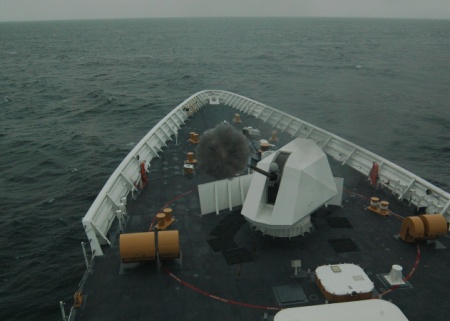
The US Naval Institute News Service recently published an article, “A Year Into Distributed Lethality, Navy Nears Fielding Improved Weapons, Deploying Surface Action Group.” As you might expect, it talked primarily about anti-ship cruise missiles, but there was a paragraph of particular interest to the Coast Guard. It appears there may be guided 57 mm projectiles in the Coast Guard’s future.
“The service is working on developing a guided 57mm round for its Mk 110 guns on the LCS and other Navy and Coast Guard ships, Surface Ship Weapons Office Program Manager Capt. Michael Ladner told USNI News last month. Fanta said at the SNA symposium that the project, which is funded and working its way through the development process now, was important because it would leverage research already being done for the guided Hypervelocity Projectile for the Electromagnetic Railgun.”
If that means we will be able to both target selected areas on a vessel and avoid the possibility of collateral damage, by shells gone astray, it will be good news.

Recently the new Chief of Naval Operations has issued a document , “A Design for Maintaining Maritime Superiority” that outlines how, hopefully, the US Navy can maintain a maritime superiority our foes will recognize and avoid confronting.
If you are looking for anything specifically regarding the Coast Guard here, you will not find it (other than the cutter in the formation on the cover). The Coast Guard is not mentioned even once, but it does talk about some things that are Coast Guard related. Perhaps we should not feel bad about this. It only mentions the Marine Corps once.
He talks about three forces that are changing the environment:
Obviously the Coast Guard facilitates and regulates marine traffic and is tapped into the global information system. In wartime, these contacts will become essential. He also talks about new trade routes opening in the Arctic, that will only be reliable if we have new icebreakers. He also talks about illegal trafficing.
“This maritime traffic also includes mass and uncontrolled migration and illicit shipment of material and people.”
For once, finally, a document explicitly recognizes the competition,
“For the first time in 25 years, the United States is facing a return to great power competition. Russia and China both have advanced their military capabilities to act as global powers. Their goals are backed by a growing arsenal of high-end warfighting capabilities, many of which are focused specifically on our vulnerabilities and are increasingly designed from the ground up to leverage the maritime, technological and information systems. They continue to develop and field information-enabled weapons, both kinetic and non-kinetic, with increasing range, precision and destructive capacity. Both China and Russia are also engaging in coercion and competition below the traditional thresholds of high-end conflict, but nonetheless exploit the weakness of accepted norms in space, cyber and the electromagnetic spectrum. The Russian Navy is operating with a frequency and in areas not seen for almost two decades, and the Chinese PLA(N) is extending its reach around the world.
“…Coupled with a continued dedication to furthering its nuclear weapons and missile programs, North Korea’s provocative actions continue to threaten security in North Asia and beyond.
“…while the recent international agreement with Iran is intended to curb its nuclear ambitions, Tehran’s advanced missiles, proxy forces and other conventional capabilities continue to pose threats to which the Navy must remain prepared to respond.
“…international terrorist groups have proven their resilience and adaptability and now pose a long-term threat to stability and security around the world.”
He recognizes budgetary limitations.
“There is also a fourth ‘force’ that shapes our security environment. Barring an unforeseen change, even as we face new challenges and an increasing pace, the Defense and Navy budgets likely will continue to be under pressure. We will not be able to “buy” our way out of the challenges that we face. The budget environment will force tough choices but must also inspire new thinking.”
Throughout there is an emphasis on understanding history and the strategic concepts of the past. There is also a recognition of the need to work with partners.
“EXPAND AND STRENGTHEN OUR NETWORK OF PARTNERS: Deepen operational relationships with other services, agencies, industry, allies and partners – who operate with the Navy to support our shared interests.
Other than the Marine Corps, the US Navy has no closer partner than the USCG. The partnership has been a long and successful one, but I would like to see the Navy be a better partner to the Coast Guard.
What I want to see:
If we have “run out of money, now we have to think.” One thing we can do, is to try to get the maximum return from the relatively small investment needed to make the Coast Guard an effective naval reserve force.
(Note there is another post on this looking at the “design” from a Navy point of view.)
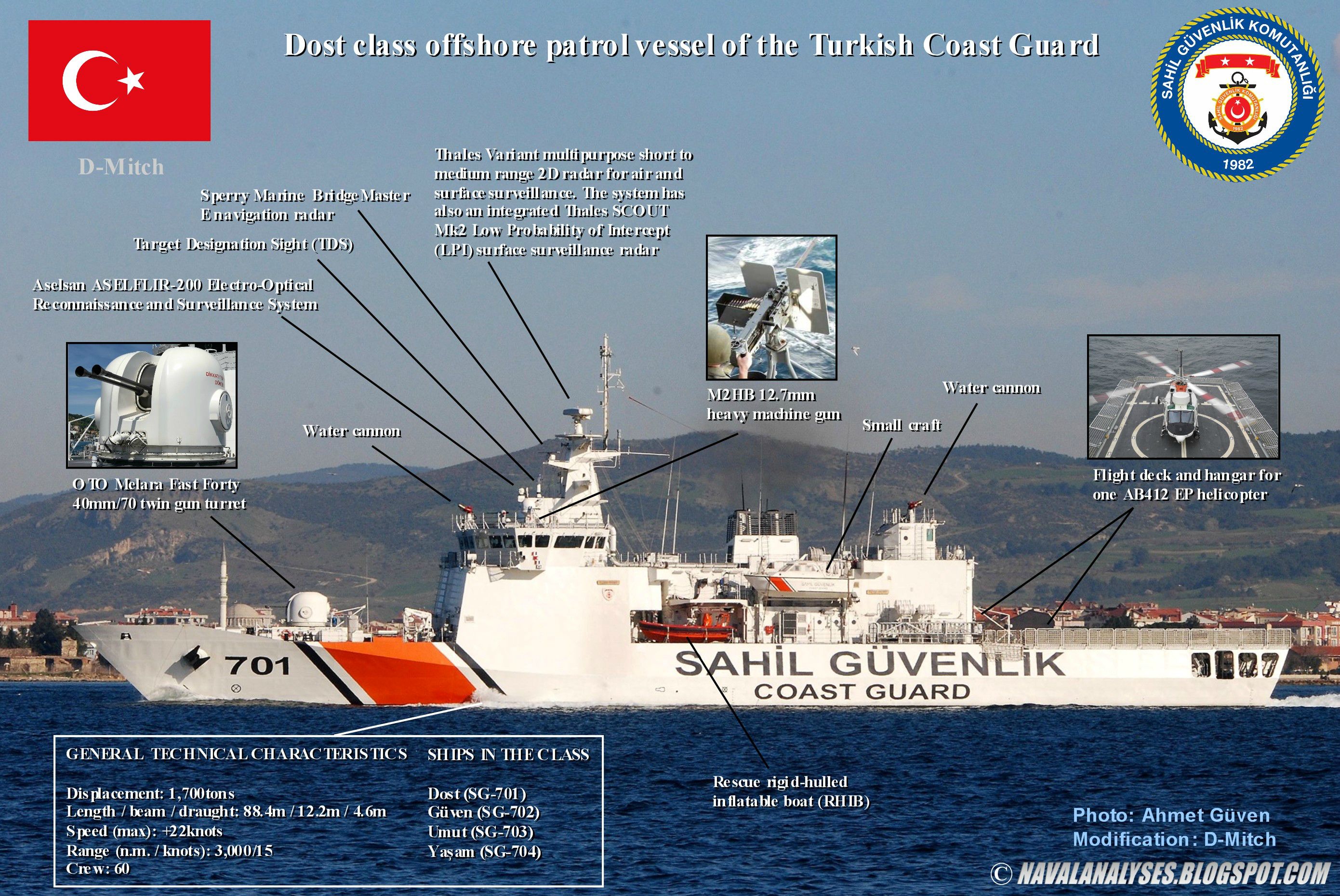
Photo: NavalAnalyses.Blogspot.Com. Click on the photo to enlarge
The German Navy Blog “Marine Forum,”
“5 January, Turkey, Acting on a tip-off / intelligence input, Turkish Coast Guard ships „Yasam“ and „Umut“ intercept Bolivian-flagged freighter „Joudi“ in international waters off Tobruk (Libya) … after receiving Bolivian government permission to board and search ship, boarding team finds 13 tonnes of cannabis.
“(rmks: first such action distant from Turkish waters; made feasible with induction of large DOST class patrol ships–emphasis applied–Chuck)”
So I looked up the class. The four ships of this class are the largest vessels in the Turkish Coast Guard. The next largest are only 210 tons. They are based on the Italian Sirio Class patrol vessels which operate under the Italian Navy but were paid for by the Transport and Navigation Ministry. I suspect the Sirio Class (appropriately modified) may have been the basis of the Marinette Marine’s OPC proposal.
Specs for the Turkish ships from my Combat Fleets of the World, 16th ed. with my translation to English units are:
The Gun: The Beda Bofors twin 40mm/70 gun is not a bad choice. It has been around for a while and it has improved over time. Current models are rated at 450 rounds per minute per barrel for 900 rounds per minute for the twin mount. That is faster than a .50 cal. M2 machine gun. The Italian Navy used this as a CIWS before switching to the improved 120 round per minute 76mm. It also has adequate range, 13,675 yards (12,500 m). This is less range than either a 57mm or 76mm, but adequate for most Coast Guard missions. There are at least four different projectiles available. The standard projectiles are about two pounds. There is also a high velocity solid tungsten alloy rod armour-piercing fin-stabilized discarding sabot (APFSDS) projectile that would probably be good for destroying fairly large diesel engines. .
If I read this correctly, the video is 380 rounds in 43 seconds.
Also from “Combat Fleets” this on the Turkish Coast Guard.
“Personnel: Approx. 2,200 total including 800 regulars and 1,400 conscripts, plus 1,050 on loan from the navy.
“Aviation: Coast Guard air assets include one Maule MX-7 light fixed-wing and three CASA CN-235 maritime patrol aircraft (the basic airframe for the HC-144, Chuck). Three Austa-Bell AB-206B Helicopters and thirteen search and rescue configured Agusta-Bell 412 helicopters. The aircraft are pained white with an orange diagonal stripe.”
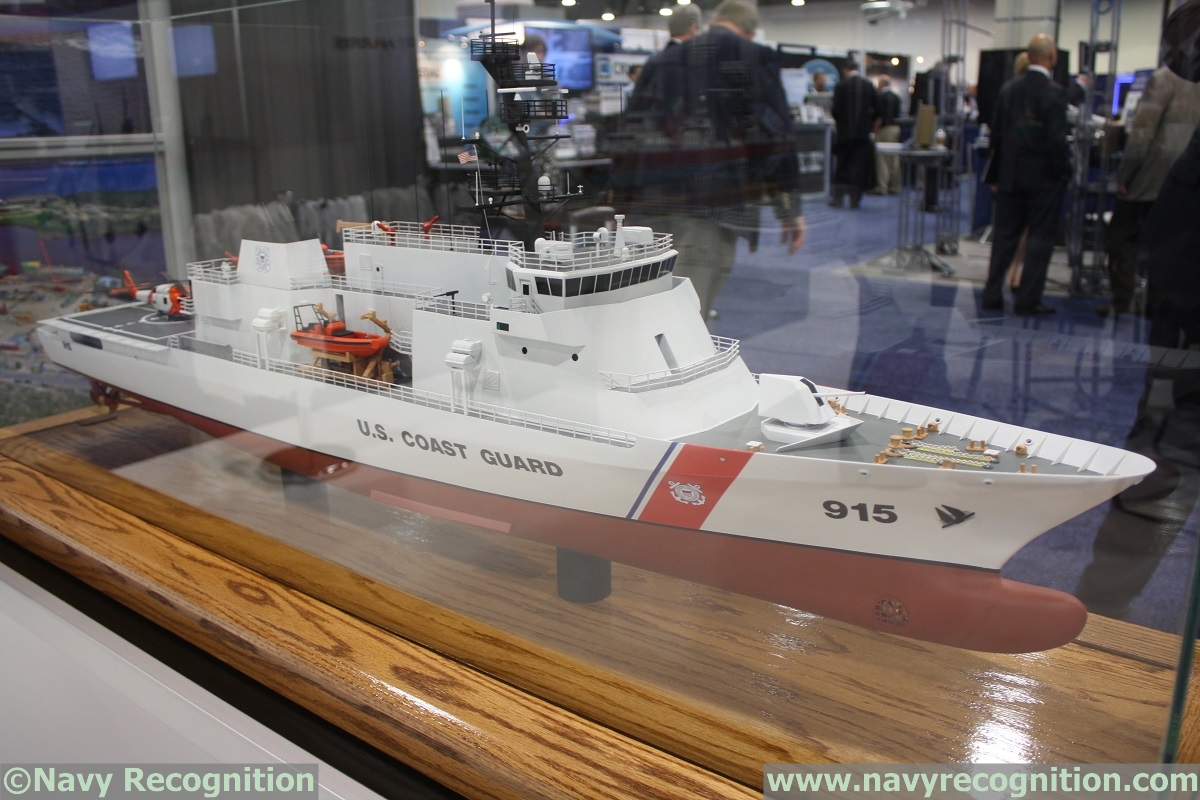
The National Fleet Plan had some clues regarding equipment that we can expect on the Offshore Patrol Cutter (OPC). Apparently there will be a lot of commonality between the Navy’s LCS and future generation frigates, the Coast Guard’s Offshore Patrol Cutters (OPC), and the Bertholf Class NSCs. My last discussion of the equipment on the OPC can be found here: “Offshore Patrol Cutters (OPC), the Other LCS” which contains information not addressed here. Generally the information below does not look much different but I will try to point out any significant differences.
Command, Control, and Communications (Ref. Section 5.5):
The recommended NTNO (Navy Type Navy Owned–Chuck)systems to meet C3 commonality and interoperability for the OPC are as follows: MIL UHF LOS 225-400 MHZ (Digital Modular Radio (DMR), ARC-210, PRC-117); MIL UHF SATCOM (DMR, ARC-210, PRC-117); Messaging (DMR SATCOM, ARC-210, PRC-117); Tactical Data Link (LINK 11; Joint Range Extension (JRE) Link-16, forwarded LINK 22); VACM (KY-100M, KY-58M, KYV-5M). (p. 22)
I am very pleased to see LINK 11, 16, and 22 on the list although this is probably a “junior edition” of these systems. These systems are becoming so ubiquitous if you don’t have them, you are more of a burden than an asset. The table on page 24 seems to indicate that the OPCs will not have an airsearch radar, but will have a multi-mode radar that will be common with Navy systems (p.50). Its not clear what that will really mean for the ship’s capabilities. As far as I can tell, the only air search on the NSCs is the EADS 3D TRS-16 which is also a multimode radar combining air search, surface search, and fire control functions. This radar is likely to be replaced by the newer EADS Cassadian TRS-4D multi-function radar.
Sensors (Ref. Section 5.6): The OPC will have a multi-mode radar, Electronic Warfare Systems, Decoy launching system, Sensitive compartmented information Network, TACAN, and CCOP (Cryptologic Carry-On Program).
The recommended systems to meet Sensor commonality and interoperability for the Offshore Patrol Cutter are as follows: TACAN; Multi-Mode Radar; IFF; SEWIP (SLQ-32/SSX-1 replacement); and MK-160 Gun System. (p. 25, 5.6.b.2)
Weapon Systems: The OPC will have a 57mm, 25mm, and .50 cal guns. (It is not addressed in this document, but there have been indications that two of the .50 cal. are to be mounted in stabilized remotely controlled weapon stations. The 25mm will presumably be a Mk38 mod2 or 3) The OPCs will not incorporate either a CIWS or degaussing (p.32). (I do have reason to suspect that the OPC is fitted for upgrade to include CIWS.)
It will also have ADNS (Automated Digital Network System), Sensitive Compartmented Information Network (SCI-Networks), Consolidated Afloat Networks and Enterprise Service (CANES).
Notes on the Ship’s Signals Exploitation Equipment System and Unmanned Aircraft System, “OPC has the same space, weight and power requirements (as the NSC–Chuck) reserved but a system has not been selected.” (p. 24)
It appears the gun firecontrol system, may include only Electro-Optical control cued by the multimode radar, and that it will not include the AN/SPQ-9B which is used on the National Security Cutters (I think this may be a change). There is a note on the Gun Fire Control System: “OPC will have a fire control radar capability (MMR-presumably multimode radar–Chuck) to provide tracking information and slew of the GWS camera, but slew and fire of the GWS cannon remains under manual control.” (p.24) Hopefully, an integration of the multimode radar with the weapon 57mm and perhaps the 25mm will permit blind firing of these systems, otherwise some visibility conditions may preclude effective fire control and certainly reaction times, particularly against air targets, will not be as good as they might have been.

Photo: Azerbaijan Coast Guard’s first Saar 62. Source: President’s Office, Azerbaijan
We have talked about these before, but now we have more details, particularly about how they are equipped.
Janes 360 reports the launching of two new vessels for the Azerbaijan Coast Guard, the first of up to six helo deck equipped, 203 foot, 470 ton, 32 knot Sa’ar 62s based on the Israeli Sa’ar 4.5 missile boat, and a sixth 32.65 m-long, 95-ton Shaldag Mk V.
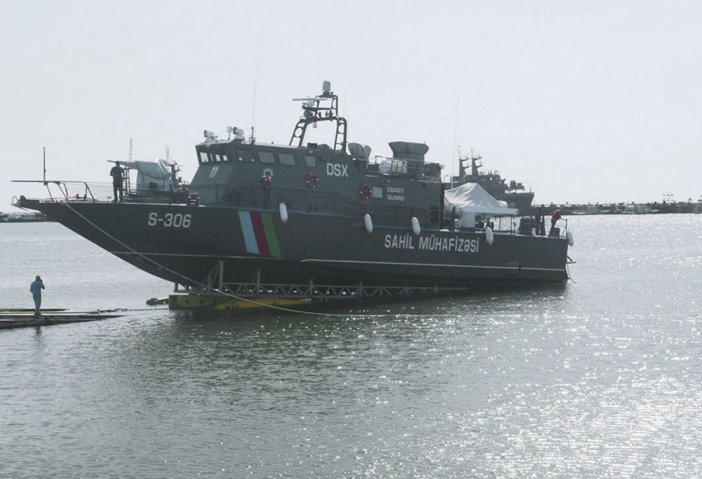
Photo: Azerbaijan Coastguard’s sixth Shaldag Mk V (Azerbaijan State Border Guard Service)
Both types use the Typhoon gun mount which is basically the same as the Mk38 mod2 used by the Coast Guard, except that, instead of using the 25 mm chain gun, these use a Soviet era 23 mm, with a higher rate of fire. Both use the Toplite Electro-Optic fire control system that is also part of the Mk38 mod2.
Most interesting, they are armed with small missile systems. the larger vessels will have an eight cell launcher for the 25 kM range Spike-NLOS.

TYPHOON MLS NLOS configuration has eight Spike NLOS missile launchers and integrated Toplite stabilized observation and target acquisition system. Photo: RAFAEL via defense-update.com
The smaller vessels have a four tube launcher for the 8 km range Spike-ER.
Azerbaijan’s neighbors on the Caspian Sea are Russia to the North, Iran to the South, and Turkmenistan and Kazakhstan on the other side of the water. They have a small navy in addition to their Coast Guard, but these will constitute a substantial reinforcement. There is appears to be a miniature naval arms race going in the Caspian Sea.
For photos, see this DefenseMediaNetwork post.
It looks like the Coast Guard will be getting a new gun mount soon. Defense.gov reports a new $30,556,246 contract for Mk38 Mod3 gun mounts that includes “fiscal 2015 weapons procurement (Coast Guard) funding in the amount of $5,341,232 …(and)… fiscal 2014 weapons procurement (Coast Guard) funding in the amount of $152,781“.
The announcement does not make clear how many systems this will buy. The contract also includes systems for the Navy and at least one system for the Philippines. Assuming the Philippines is buying only one system, it appears the contract will buy 16-17 systems, one for the Philippines, one for the National Guard/Reserve, three for the Coast Guard, and eleven or twelve for the Navy, but in the more likely case, the Philippines is actually buying two systems, then the numbers may actually be double this, which would make sense if the Coast Guard buy was for six Webber class. An FY2012 Contract for 21 Mk38 Mod2s for $24.2M would seem to indicate they cost about $1.1M each. I would like to think that, since the program has matured, this larger buy might actually cost less per unit, so that this is actually a buy of 30 or more systems (probably 32-34), with six going to the Coast Guard, two to the Philippines, two to the National Guard and Reserve, and the rest to the Navy.
DefenseMediaNetwork reports the Mk38 Mod3 offers a number of improvements over the Mod2 currently being fitted to the Webber class, including more ready ammunition on the mount (500 rounds vice 165), a coaxial .50 cal. gun (there was already a plan (pdf) to add a coaxial 7.62mm to the Mod2 version), higher elevation (75 degrees vice 40), better weather protection and serviceability, and the ability to simultaneously track up to three targets. There are also improvements to the search function of the ElectroOptic sensor that should make the system more useful in peacetime roles. They also report that BAE and Israeli manufacturer, Rafael, are considering adding the “Advanced Precision Kill Weapon System” APKWSII guided 70mm rocket system to the mount. In fact Israeli versions of this system already support surface to surface and surface to air missiles.
Most photos of the Mk38 Mod3, like the one above feature a 30mm gun which is an option, but it appears, from the language in the announcement, that these mounts will use the 25mm. I believe there is even a 40mm option. The Navy may be recycling existing 25mm guns, moving them to the new mount. Personally I would have preferred the larger caliber weapon, for its ability to take on larger surface targets. The 30mm would have almost as many rounds on the mount (420 vs 500), would be more accurate, have a greater effective range (3000 vs 2500 meters), and provide greater penetration.
You have probably heard that Four Russian naval vessels based in the Caspian Sea have launched 26 missiles against targets in Syria. This attack demonstrates a capability similar to that of the US Tomahawk missile.
What you might not realize is how small the Russians ships that launched the attack really were. While the US surface vessels equipped with Tomahawk are Burke class destroyers and Ticonderoga class cruisers of 8,000 to 10,000 tons, the Russian operation involved only a one small frigate and three small corvettes. The corvettes were smaller than a 210, and the frigate was less than two thirds the size of a 378. All four were considerably smaller than the projected Offshore Patrol Cutter. All four together displace only slightly more than a single Bertholf class.
The largest ship, Dagestan, is a Gepard class light frigate or large corvette, 1,930 tons (full load), 102.14 m (335.1 ft) in length overall, 13.09 m (42.9 ft) of beam, with eight Kalibr (SS-N-27) anti-surface missiles, SA-N-4 AAW missiles, a 76.2 mm gun, two six barreled 30 mm guns, four 533 mm (21″) heavy weight torpedo tubes, and an RBU-6000 ASW rocket launcher.
The other three, Grad Sviyazhsk, Uglich, Veliky Ustyug, were Buyan-M class corvettes, displacing 950 tons full load, with a maximum speed of 25 knots, armed with Kalibr (SS-N-27) anti-surface missiles, 100-mm and 30-mm guns, and Igla-1M air defense missiles.
While the US Navy has begun talking about distributed lethality, the Russians are practicing it.
Certainly the Coast Guard is not going to arm their ships like this in peacetime, but we might want to keep the possibility in mind if things start to go south.
 Chuck Hill's CG Blog