Russians Building Missile Armed Arctic Patrol Vessel

Project23550IceClassPatrolVessel

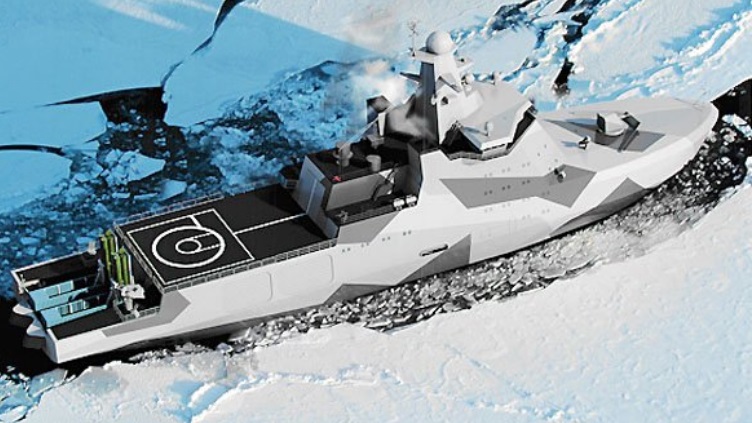
Concept image issued by the Russian Ministry of Defence of the Project 23550 ice-class patrol ships for the Russian Navy. Source: Russian MoD

Janes360 is reporting that the Russian Ministry of Defense has awarded contracts for two new ice class patrol vessels that are reportedly capable of operating in ice up to 1.5 meters thick (approx. 5 feet).

The class is described (in Russian) by the MoD as being “without analogues in the world”, and combining “the qualities of tug, ice-breaker, and patrol boat”.

To me it looks an awful lot like the Norwegian Coast Guard vessel Svalbard or Canada’s Arctic Offshore Patrol Ship that is based on the Svalbard’s design.

Jane’s notes, “A concept image released by the MoD showed the vessel armed with a medium-calibre main gun on the foredeck (likely an A-190 100 mm naval gun), a helicopter deck and hangar, and two aft payload bays each fitted with a containerised missile launch system (akin to the Club-K system offered for export) armed with four erectable launch tubes – presumably for either Club anti-ship or Kalibr-NK land-attack missiles. Although billed as patrol boats, this level of armament makes them better armed than many corvettes.”

If these are in fact containerized missile systems, then they may simply be optional equipment, added to the conceptual image to give the ship a bit more swagger, and we may never actually see this. If you are breaking ice for a vessel following close behind, you may not want missiles with their warheads and high energy fuel located near the stern where a collision with a vessel following too close might rupture a missile and start a fire.

It does suggest that a few spaces for containers could turn almost any ship into a potential missile platform.

Coast Guard Denied Use of Laser Technology

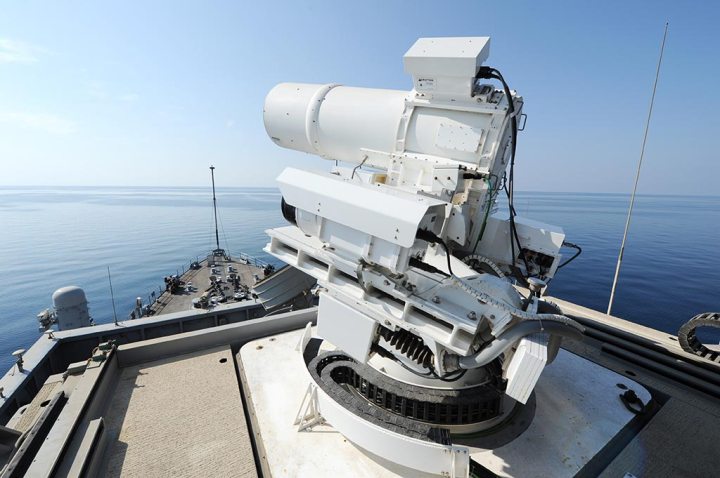
The Afloat Forward Staging Base (Interim) USS Ponce (ASB(I) 15) conducts an operational demonstration of the Office of Naval Research (ONR)-sponsored Laser Weapon System (LaWS) while deployed to the Arabian Gulf. U.S. Navy photo by John F. Williams

The Afloat Forward Staging Base (Interim) USS Ponce (ASB(I) 15) conducts an operational demonstration of the Office of Naval Research (ONR)-sponsored Laser Weapon System (LaWS) while deployed to the Arabian Gulf. U.S. Navy photo by John F. Williams

This Navy Times story is one of several I have seen that report Rep. Duncan Hunter’s (R-CA) displeasure that the Coast Guard is unable to use some of its laser equipment because of FDA regulation.

“The equipment in question is the Electro-Optical Sensor System and the PEQ-15, a laser sight with an illuminator. ESS is a turret installed on Coast Guard helicopters, with a laser illuminator that can enhance camera images, while PEQ-15 is a rifle sight with a laser illuminator. The Coast Guard is not allowed to use ESS at all, while PEQ-15 can be used on a low setting.”

Representative Hunter has done us a favor in bringing attention to the issue, but ultimately I think he will find that the FDA oversight requirement is based in law and Congress will have to change it.

There is, after all, a reason for regulating the use of lasers. We don’t like it when they are directed at our aircraft or at ships. We don’t want to blind people we are attempting to rescue. (Incidentally where is the FDA regulation of lasers in  the hands of civilians?)

“Hunter wants to cut that red tape and allow the Coast Guard to certify its own laser systems, like the other military branches…”

That is all very well, but the Coast Guard probably does not have many laser experts who can do that, and we should not trust the word of our contractors. If Representative Hunter wants to introduce a bill to cut some of the read tape, by all means allow the Coast Guard to self certify if they develop the independent expertise to do that, but it would be more immediately useful if there was simply provision for DOD certification of Coast Guard equipment. This should include automatic application of DOD certification to any DOD type Coast Guard equipment used for the purpose for which it was certified.


ALaMO–Making the 57mm Round Smart

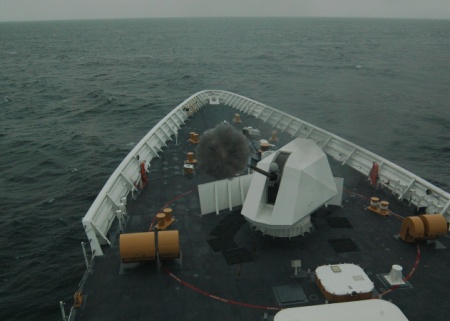
NSCfires57mm

The Navy has a program call “Navy’s Advanced Low Cost Munition Ordnance” or “ALaMO”

Justification as provided to Congress is here. The proposed budget includes $5.759M in FY2017, $25.984M in FY2018, and $24.982M in FY2019. The round is expected to be operational in 2020 (about the time the first OPC comes out).

“Advanced Low Cost Munition Ordnance (ALaMO) significantly increases 57mm MK 110 Gun Mount lethality and effectiveness against Fast Attack Craft and Fast In-Shore Attack Craft (FAC/FIAC). The 57mm ALaMO funding supports non-recurring engineering, design verification testing, environmental qualification, hazard classification, insensitive munitions and developmental testing. ALaMO will be qualified for USN use at the conclusion of the program.”

A US Naval Institute News story, “Wrapup: HASC Passes FY2017 Defense Bill With Reagan-Era Spending Levels,” indicates House Armed Services Committee interest in speeding up the program.

“A provision in the bill notes interest in the Navy’s Advanced Low Cost Munition Ordnance (ALaMO), a 57mm guided projectile that could be used on the LCS, and requests information on what it would take to achieve initial operational capability by 2019.”

Sounds like the Coast Guard should have a few of these rounds as well, both for small, fast, highly maneuverable targets, and to target specific areas on larger targets. We had some indication this was coming before.

Document Alert: Cutter Procurement–Another Report to Congress

Once again, the Congressional Research Service’s Ronald O’Rourke has revised his “Coast Guard Cutter Procurement: Background and Issues for Congress” with the new edition issued April 15. This has got to be a hot topic because previous revisions were issued March 22, January 27, and December 14, 2015. That is four revisions in four months, on average every six weeks, but the latest is only 24 days after the previous edition. I have begun to sense, we may have turned a corner. The tone of the reports has changed over these four months, from, how long will it take us to reach the “Program of Record” (POR), to consideration of, if we should perhaps go beyond the POR.

The NSC, OPC, and FRC programs pose several issues for Congress, including the following:

“whether to fund the acquisition of a 10th NSC in FY2017;

“whether to fund the acquisition of four FRCs in FY2017, as requested, or some other number, such as six, which was the number projected for FY2017 under the Coast Guard’s FY2016 budget submission;

“whether to use annual or multiyear contracting for procuring FRCs;

“whether to use annual or multiyear contracting for procuring OPCs;

“planned procurement quantities for NSCs, OPCS, and FRCs;

“the cost, design, and acquisition strategy for the OPC;

“initial testing of the NSC; and

“rotational crewing of the NSC.”

The latest revision includes three substantial Appendices:

  • Appendix A. Planned NSC, OPC, and FRC Procurement Quantities (pp 17-22)
  • Appendix B. Funding Levels in AC&I Account (pp 23-26)
  • Appendix C. Additional Information on Status and Execution of NSC, OPC, and FRC Programs from March 2016 GAO Report (pp 27-34)

Appendix C is entirely new and appears to have been the reason for the revision.

Appendix A (p. 17-22) is a fairly detailed discussion of the results of the Fleet Mix Study and asks why we so seldom hear that the program of record is not enough to assure the Coast Guard to successfully accomplish its assigned missions.

The Fleet Mix Study was made public in 2012 long after its completion in 2009. It is due for a reexamination and the Commandant has said another will be done. When that happens, we seriously need to look at more than just more of the same assets. We need to look at additional technology, equipment, and weapons that might allow us to accomplish these missions without a major increase in personnel.

Looking at “Table A-3. Force Mixes and Mission Performance Gaps” (document page 18) I would note that if we get to Fleet Mix Analysis Phase 1 (FMA-1, an increase over the POR including 9 Bertholf class NSCs, 32 OPCs and 63 Webber Class FRCs, for a total of 104 vessels), we will have addressed all the “Very High Risk Gaps” found in the Fleet Mix Study that included SAR capability, “Defense Readiness Capacity,” and “Counter Drug capacity.” What will remain are “High” or lower risks in Ports, Waterways, and Coastal Security (PWCS) and Living Marine Resources (LMR), and a low to very low risk to the Alien Migrant Interdiction Operations (AMIO) mission. This total of more than 40 NSCs and OPCs certainly should not be out of the question, after all the Coast Guard has included over 40 ships larger than a thousand tons for the last several decades.

Still, I would note that, no matter how many ships we have, the Ports, Waterways, and Coastal Security (PWCS) mission will always be at risk, unless weapons are available to quickly and reliably stop terrorists’ exploitation of a larger merchant vessel to make an attack. Guns alone are simply not up to the task. I have identified two weapons that might address this threat, (1) equipping our WPCs and possibly WPBs with light weight torpedoes that target a ships propellers or (2) equipping our larger ships with the Long Range Anti-Ship Missile (LRASM) which might allow our larger cutter to effectively support our smaller cutters and respond to an attack, even if the large cutter 200 miles from the targeted port. Either would also make our ships much more capable of making a meaningful contribution to Defense Readiness.

LRASM for Ports, Waterways, and Coastal Security

Lockheed Martin supplied Navy Recognition with the first image showing a deck-mounted quadruple Long Range Anti-Ship Missile (LRASM) launcher. According to our source, this "top side" launcher graphic is a notional concept that could be used on an appropriately sized surface vessel, such as the Arleigh Burke class (DDG 51) or Littoral Combat Ship (LCS) classes.

Discussion on an earlier post suggesting the Coast Guard might want to fit our new major cutters “for but not with” Long Range Anti-ship Missiles (LRASM) has prompted me to rethink the suggestion and advocate for equipping them with the missile in peacetime.

One of the Coast Guard’s peacetime missions is of course Ports, Waterways and Coastal Security (PWCS).

“The PWCS mission entails the protection of the U.S. Maritime Domain and the U.S. Marine Transportation System (MTS) …prevention and disruption of terrorist attacks… Conducting PWCS deters terrorists from using or exploiting the MTS as a means for attacks on U.S. territory, population centers, vessels, critical infrastructure, and key resources.”

I have been concerned that the Coast Guard has not had adequate weapons to deal with a terrorist attack using a medium to large sized merchant ship, and currently I don’t believe there is any other organization capable of answering this threat in the 30 or more port complexes terrorists might find worthwhile targets, in a timely manner. Navy surface forces are too geographically concentrated. The over 200 nautical mile range and the ability to strike selected locations on a target ship suggest LRASM could possibly provide an answer.

If we had LRASM on all National Security Cutters (NSC) and Offshore Patrol Cutters (OPC), in perhaps a dozen ports on the Atlantic, Pacific, and Gulf coasts, Honolulu and Kodiak, its over 200 mile range fired from cutters, including possibly those in port, could cover all of these ports (except Guam), and have a weapon on target within about 20 minutes of launch.

To effectively counter the threat, I think we need to get a weapon on target within an hour of positive identification of the threat. This would require improved coordination between units. In addition to providing a datum, course, and speed, presumably an intercepting unit, boat or aircraft, would need to transmit a photograph of the target to be incorporated in the missiles memory and aim points would be chosen some time during mission planning. We would need to coordinate with air traffic control. A command decision to authorize use of the weapon and updates on the target position course and speed would also be needed. Because we might have 40 minutes or less from threat identification to launch, these steps would likely have to proceed in parallel with mission planning progressing prior to authorization.

New units appear to be on the way to developing the kind of common tactical picture we need to facilitate both decision making and targeting. We could start developing the capability with the National Security Cutters based at Alameda (San Francisco Bay) and Charleston, SC, even if the system could not be completed until the last OPCs are delivered in about 2034.

LRASM Topside Launchers

Just a brief note on what is happening in the broader world of Naval warfare preparation. NavyRecognition provides conceptual drawings of topside launch tubes for the Long Range Anti-Ship Missile (LRASM).

Significantly the launchers for this much more capable missile are not expected to require any more space or support than the Harpoon missile and with upgrades it is expected to also incorporate a land attack capability.

As I have noted, the Coast Guard does not seem to have been considered in the Navy’s plans to increase “distributed lethality,” but should the need arise it looks like these would fit well between the Bridge and the 57mm on the National Security Cutters. We might also find a place for them on the Offshore Patrol Cutter. It should be possible to provide the supporting wiring, piping, control systems, etc. to support these relatively easily, even if the missiles and launchers themselves are not mounted, allowing rapid upgrade. (Cutters on Alaska Patrol have to be among the closest US units to Russian Pacific bases.)

AN-SPQ-9B, the NSC’s Air-Search Radar/Firecontrol Gets New Capability

Defense Industry Daily reports that the AN-SPQ-9B, the firecontrol system and secondary air-search on the Bertholf class National Security Cutters, is being modified to provide a Periscope Detection and Discrimination (PDD) capability.

The post also provides additional background information on the sensor.

Interestingly, the post also notes that the radar has a “Cooperative Engagement Capability” or CEC (See the April 24/12: CEC entry) which means that ships and aircraft can share a common tactical picture and weapons launched from one unit can be controlled by a different unit. If we ever get long range missiles, this could be useful.

Hopefully the Offshore Patrol Cutter will have either this system or a better replacement.


Argentine Coast Guard Sinks Chinese Fishing Vessel

This Video does not appear to show the sinking of the fishing vessel. Speckles on the hull of the F/V seen at time 0:20 and 0:50 may be bullet holes. The video does appear to show the participants.  

We have reports (here and here) that the Argentine Coast Guard (Prefectura Naval Argentina (PNA)) fired on and sank a Chinese fishing vessel (F/V), the Lu Yan Yuan Yu 010, believed to have been fishing illegally, after the F/V failed to stop after shots were fired across its bow and it allegedly attempted to ram the Coast Guard vessel. The crew reportedly was rescued, without fatalities, four by the Argentine vessel and the rest of the crew by another Chinese F/V.

ArgentineCutter

Photo by Diegoventu: PNA Doctor Manuel Mantilla (GC-24), a sistership of the Argentine vessel involved.

The PNA vessel seen in the video, Prefecto Durbes (GC-28) is one of five offshore patrol vessels (OPVs) built in Spain for Argentina. The Mexican Navy also has six similar vessels with larger flight decks and more powerful engines. In size they slot between the Reliance Class and the Bear Class, being 67 meters (220 feet) overall. Unlike the Reliance class, they have a hangar for their version of the H-65.

In addition to machine guns, these ships are reportedly armed with a Bofors 40mm/70, but looking at the video, the location where the gun was mounted (on the platform forward of the bridge and one deck above the foc’sle) is vacant. This suggest that the damage was probably done by .50 cal. machine guns. We know from our Vietnam experience that .50 cal. can sink fishing vessels, but the ranges are very short. Looking at the video the ships appeared to be no more than 300 yards apart.

It is a bit surprising no casualties were reported, although the reports say no fatalities, they do not say no injuries so that is still a possibility. Did the crew of the OPV order the Chinese crew to abandon before sinking the F/V, or did they perhaps tell them where they were not going to shoot so that the crew could assemble safely? It does not sound like it. We have only this statement from an Argentine representative that after actions by the Chinese vessel,  “…the order was given to fire on different sections of the vessel, damaging it,” It is unlikely, but not impossible, the crew helped the ship sink to destroy any evidence of wrong doing.

More on the Navy’s New Design for Maintaining Maritime Superiority

Waesche Carat 2012

This is a post I wrote for CIMSEC. under the title “A Design for Maintaining Maritime Superiority”–A Coastie’s View.” It is an expanded version of an earlier post that appeared here. The rewrite really begins about half way down under the header, “What I Want to See.”

Recently the new Chief of Naval Operations issued a document “Design for Maintaining Maritime Superiority” that outlines how, hopefully, the US Navy can maintain a maritime superiority our foes will recognize and avoid confronting.

If you look for anything specifically regarding the Coast Guard here, you will not find it (other than the cutter in the formation on the cover). The Coast Guard is not mentioned even once, but it does talk about some things that are Coast Guard related. Perhaps the Coast Guard should not feel bad about this. It only mentions the Marine Corps once.

Three Forces that are Changing the Environment

  • The first global force is the traffic on the oceans, seas, and waterways, including the sea floor – the classic maritime system.
  • A second increasingly influential force is the rise of the global information system – the information that rides on the servers, undersea cables, satellites, and wireless networks that increasingly envelop and connect the globe.
  • The third interrelated force is the increasing rate of technological creation and adoption.

Obviously the Coast Guard facilitates and regulates marine traffic, and is tapped into the global information system. In wartime, these contacts will become essential since they will form the basis for naval control of shipping. He also talks about new trade routes opening in the Arctic. These will only be reliable if we have new icebreakers. He also talks about illegal trafficking.

“This maritime traffic also includes mass and uncontrolled migration and illicit shipment of material and people.”

A Document That Explicitly Recognizes the Competition

“For the first time in 25 years, the United States is facing a return to great power competition. Russia and China both have advanced their military capabilities to act as global powers. Their goals are backed by a growing arsenal of high-end warfighting capabilities, many of which are focused specifically on our vulnerabilities and are increasingly designed from the ground up to leverage the maritime, technological and information systems. They continue to develop and field information-enabled weapons, both kinetic and non-kinetic, with increasing range, precision and destructive capacity. Both China and Russia are also engaging in coercion and competition below the traditional thresholds of high-end conflict, but nonetheless exploit the weakness of accepted norms in space, cyber and the electromagnetic spectrum. The Russian Navy is operating with a frequency and in areas not seen for almost two decades, and the Chinese PLA(N) is extending its reach around the world.

“…Coupled with a continued dedication to furthering its nuclear weapons and missile programs, North Korea’s provocative actions continue to threaten security in North Asia and beyond.

“…while the recent international agreement with Iran is intended to curb its nuclear ambitions, Tehran’s advanced missiles, proxy forces and other conventional capabilities continue to pose threats to which the Navy must remain prepared to respond.

“…international terrorist groups have proven their resilience and adaptability and now pose a long-term threat to stability and security around the world.”

Recognizing Budgetary Limitations

“There is also a fourth ‘force’ that shapes our security environment. Barring an unforeseen change, even as we face new challenges and an increasing pace, the Defense and Navy budgets likely will continue to be under pressure. We will not be able to “buy” our way out of the challenges that we face. The budget environment will force tough choices but must also inspire new thinking.”

Throughout there is an emphasis on understanding history and the strategic concepts of the past. There is also a recognition of the need to work with partners.

“EXPAND AND STRENGTHEN OUR NETWORK OF PARTNERS: Deepen operational relationships with other services, agencies, industry, allies and partners – who operate with the Navy to support our shared interests.”

Other than the Marine Corps, the US Navy has no closer partner than the US Coast Guard. And while only about one eighth the size of the US Navy, in terms of personnel, the US Coast Guard is larger than Britain’s Royal Navy or the French Navy. The partnership has been a long and successful one, but I would like to see the Navy be a better partner to the Coast Guard. This is how the Navy can help the Coast Guard help the Navy.

What I Want to See

If we have a “run out of money, now we have to think” situation, one thing we can do is to try to get the maximum return from the relatively small investment needed to make the Coast Guard an effective naval reserve force.

WPC Kathleen_Moore

We need explicit support from the Navy at every level, particularly within Congress and the Administration, for Coast Guard recapitalization. While the Navy’s fleet averages approximately 14 years old. The Coast Guard’s major cutters average over 40. The proposed new ships, are more capable than those they replace. They are better able to work cooperatively with the Navy. The nine unit 4,500 ton “National Security Cutter”program is nearing completion with funds for the ninth ship in the FY2016 budget. The 58 unit, 154 foot, 353 ton Webber Class  program is well underway with 32 completed, building, or funded. But the Coast Guard is about to start its largest acquisition in history, 25 LCS sized Offshore Patrol Cutters. Unfortunately, it appears that while the first ship will be funded in FY2018 the last will not be completed until at least 2035. This program really needs to be accelerated.

We need an explicit statement from the Navy that they expect the Coast Guard to defend ports against unconventional threats, so that they can keep more forces forward deployed. This is in fact the current reality. The Sea Frontiers are long gone. Navy vessels no longer patrol the US coast. The surface Navy is concentrated in only a handful of ports. No Navy surface combatants are homeported on the East Coast north of the Chesapeake Bay. If a vessel suspected of being under the control of terrorists approaches the US coast the nearest Navy surface vessel may be hundreds of miles away.

We need the Navy to supply the weapons the Coast Guard need to defend ports against unconventional attack using vessels of any size, with a probability approaching 100%. These should include small missile systems like Hellfire or Griffin to stop small, fast, highly maneuverable threats and we need a ship stopper, probably a light weight anti-ship torpedoes that target propellers to stop larger threats. We need these systems on not just the largest cutters, in fact they are needed more by the the smaller cutters that are far more likely to be in a position to make a difference. These include the Webber class and perhaps even the smaller WPBs.

We need to reactivate the Coast Guard’s ASW program and ensure that all the new large cutters (National Security Cutters and Offshore Patrol Cutters) have an ASW capability, if not installed on all of the cutters, at least planned, prototyped, tested, and practiced on a few ships (particularly in the Pacific). The National Security Cutters and the Offshore Patrol Cutters are (or will be) capable of supporting MH-60R ASW helicopters. Adding a towed array likeCAPTAS-4 (the basis for the LCS ASW module) or CAPTAS-2 would give them a useful ASW capability that could be used to escort ARGs, fleet train, or high value cargo shipments. Towed arrays might even help catch semi-submersible drug runners in peacetime.

IMG_4128

The Coast Guard is the low end of America’s Naval high-low mix. It is a source of numbers when numbers are needed. The Coast Guard has more assets for low end functions like blockade than the Navy. The Navy has about 105 cruisers, destroyers, LCS, PCs, and is not expected to have more than 125 similar assets for the forseeable future. The Coast Guard has about 165 patrol cutters  including 75 patrol boats 87 feet long, about 50 patrol craft 110 to 154 feet in length (58 Webber class WPCs are planned), and about 40 ships 210 foot or larger that can be called on, just as they were during the Vietnam War, when the Coast Guard operated as many as 33 vessels off the coast in support of Operation MarketTime, in spite of the fact that the Navy had almost three times as many surface warships as they do now. The current program of record will provide 34 new generation cutters including nine 4500 ton National Security Cutters and 25 Offshore Patrol Cutters that should be at least 2500 tons.

The Coast Guard provides peacetime maritime security, but is currently under-armed even for this mission. A small investment could make it far more useful in wartime.

(Note there is another post on this looking at the “design” from a Navy point of view.)