“Australian Border Force crackdown nets 30 foreign fishers, destroys three boats off Kimberley coast” –ABC.net.AU

Map showing the Kimberley Marine Park. The shaded area is a National Park Zone (‘no take’ zone).

ABC.net.au reports the Australian Border Force has seized 30 Indonesian fishers and destroyed three boats in a crackdown against illegal fishing in the 74,469 km2 (28,753 sq mi) Kimberley Marine Park, established in 2018, off Northwestern Australia. The combined catch of the three fishing vessels was over a ton of trepang (sea cucumber).

Australian sea cucumber sells for about $350 (presumably Australian $) per kilogram.(ABC Midwest & Wheatbelt: Chris Lewis)

In addition to the loss of marine catch, there is fear that the fishermen, who frequently come ashore, may bring with them livestock diseases common in Indonesia but not present in Australia.

An illegal fishing vessel is destroyed at sea.(Supplied: Australian Border Force)

Australia has been seeing a resurgence of illegal fishing in their EEZ including Marine Parks, and there have been calls for more vigorous enforcement.

“RNLN Patrol Ship Hull Vane Retrofit Matches Predicted Performance” –Naval News

Naval News reports,

The first Royal Netherlands Navy (RNLN) warship to be fitted with a novel hydrodynamic ‘wing’ is demonstrating efficiency and performance improvements in line with forecasts, according to both the Dutch Command Materiel and IT (COMMIT) and the company responsible for the modification.

I have been following this innovation for over eight years. Previous posts are listed below. This is at least the third patrol vessel equipped with this system. It has been used on French, Dutch, and Danish government vessels. Apparently previous applications have performed as advertised.

In addition to an overall 10% or better fuel savings, additional advantages include reduce air pollution, better seakeeping, quieter operation, and reduced motion that allows reduced crew stress and safer boat and flight operations.

It is certainly worth asking current users about their experience with Hull Vane, effect of marine growth, operation in ice, cleaning and maintenance requirements?

“Top Stories 2023: U.S. Coast Guard” –USNI

The US Naval Institute News Service lists their five top Coast Guard stories for 2023.

  • “Doing Less with Less” –closures and decommissionings
  • “Argus Among Us” –christening and launch of the first OPC
  • “Polar Security Cutter Delayed” –now three years behind schedule
  • “The Search for Titan” –search for the civilian deep diving submersible
  • “Operation Fouled Anchor” –handling of report on response to sexual assault allegations at the Coast Guard Academy, 1988 to 2006

Navy Plans Surface Combatants Smaller Than FFG, an Opportunity?

200430-N-NO101-150
WASHINGTON (April 30, 2020) An artist rendering of the guided-missile frigate FFG(X). The new small surface combatant will have multi-mission capability to conduct air warfare, anti-submarine warfare, surface warfare, electronic warfare, and information operations. (U.S. Navy graphic/Released)

Defense News has a short post, “Surface navy emphasizes frigates in its latest modernization plans.”

It includes a couple of statements by the Navy’s director of surface warfare that I think might be significant.

“We want to build a lot of frigates and [have] somewhat smaller, very capable ships being proliferated out through the fleet,” Rear Adm. Fred Pyle told Defense News on Dec. 7. (emphasis applied–Chuck)

and

But also of importance, he added, will be the ability to remain on station longer and require less help from fleet tankers and other logistics ships.

Ships, somewhat smaller than the 7,291 ton FFG but with long endurance. Bet it will have space for unmanned systems. Sounds like might make a decent cutter. Perhaps a dual service ship. Build the cutters with fewer weapon systems, but with the option to add them on if needed.

I may be a bit prejudiced in favor of dual service ships, because of my experience on Duane, a Treasury class cutter, a ship based on a Navy gunboat design. Because of its origin, it was better than it had to be, and outlived ships completed ten years after the 327s.

Very curious what they will come up with.


PATFORSWA Photo from USNI

Five U.S. Coast Guard Sentinel-class fast-response cutters and two Avenger-class mine countermeasures (MCM) ships sail together in the Gulf of Oman, Nov. 3, 2023. Click on the photo to enlarge. US Navy Photo

An unusual photo from the December 28 edition of the US Naval Institute News Service’s Fleet and Marine Tracker. The Avenger class, like the cutters, are based in Bahrain.

Why this get together? I presume this is an exercise in which the FRCs protect the MCM ships from Iranian drones or small craft swarm tactics. Alternately the exercise may have been for the cutters to protect high value units, with the MCM ships simulating larger ships, but FRCs already routinely escort high value units, though I don’t think I have seen this many involved in a single operation.

Late addition: 

“India orders six next-gen offshore patrol vessels from Mazagon Dockyard” –Naval Today

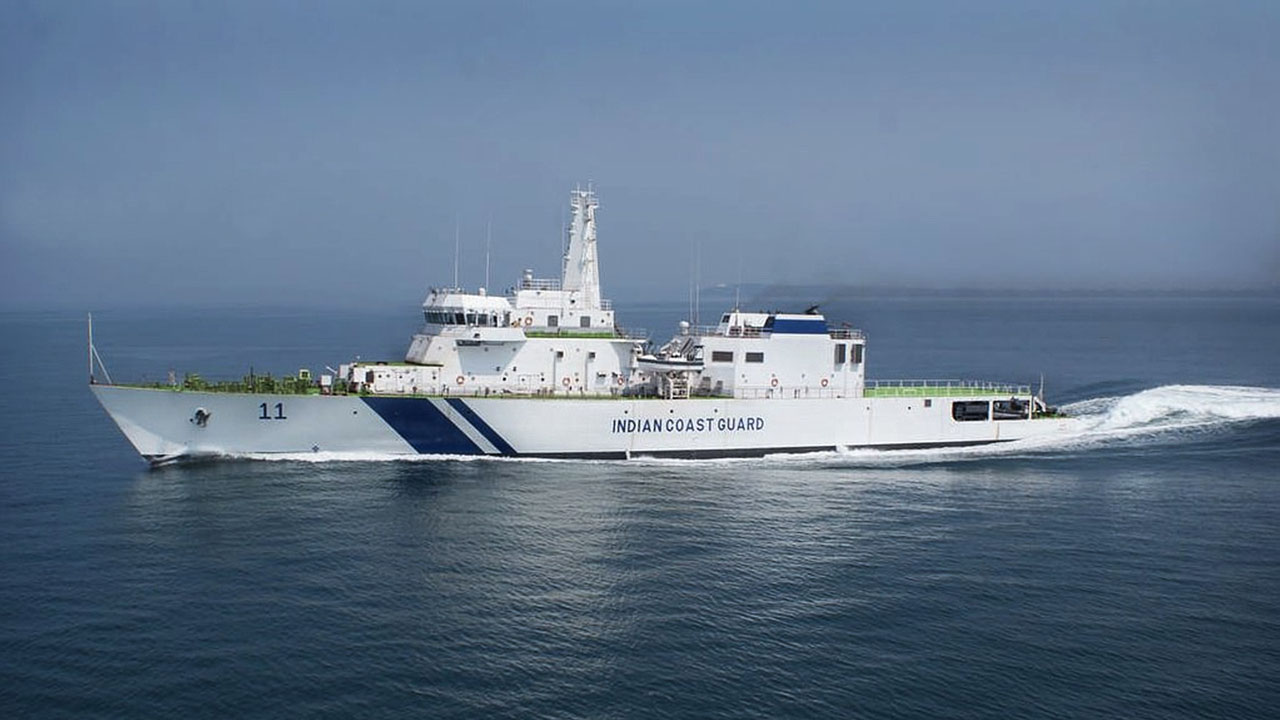
105 meter, Off Shore Patrol Vessel (OPV) ICGS Samarth, 10 November 2015, lead ship of a class of 11, photo Indian Coast Guard

Naval Today reports, “The Indian Ministry of Defence has signed a contract with Mazagon Dockyard Shipbuilders (MDL) for the construction of six next-generation offshore patrol vessels (OPVs).”

The six new ships are to be 115 meters (377′) in length, about the size of the Hamilton class cutters. I have not been able to find any additional information on their characteristics, but historically, Indian CG OPVs evolve from preceding designs, so I expect they will share many characteristics with the preceding 105 meter class pictured above and the 97 meter Vikram class; e.g. speed 23 to 26 knots; powered by two diesel engines; armed with a 30mm gun; hangar and flight deck for at least a five ton helicopter.

As for what they change, “Along with several high-tech advanced features and equipment, these 115m OPVS would be equipped with multipurpose drones, AI capability, and wirelessly controlled remote water rescue craft lifebuoy.”

The six ships are to be designed and delivered in 66 months. From contract to completion of six ships in five and a half years may sound like a tight schedule considering the US Coast Guard’s recent experience. Looking back on the previous class of eleven ships, procured in two batches, it looks possible. A $400M contract to build six vessels was awarded to GSL on 9 May 2012. All six were commissioned by 21 December 2017, less than 68 months after contract award. A follow-on contract for five ships was awarded in August 2016. The fifth ship was commissioned 16 March 2022, about 67 months from award to completion of five ships.

India benefits from the near continuous construction of Offshore Patrol Vessels (OPVs). Over the last ten years, 22 Indian built OPVs were commissioned, 18 for the Indian Coast Guard, two for the Indian Navy, and two for export.

In addition to these six OPVs, the Indian Navy is also building eleven similarly named but different 105 to 110 meter “Next Generation Offshore Patrol Vessels.

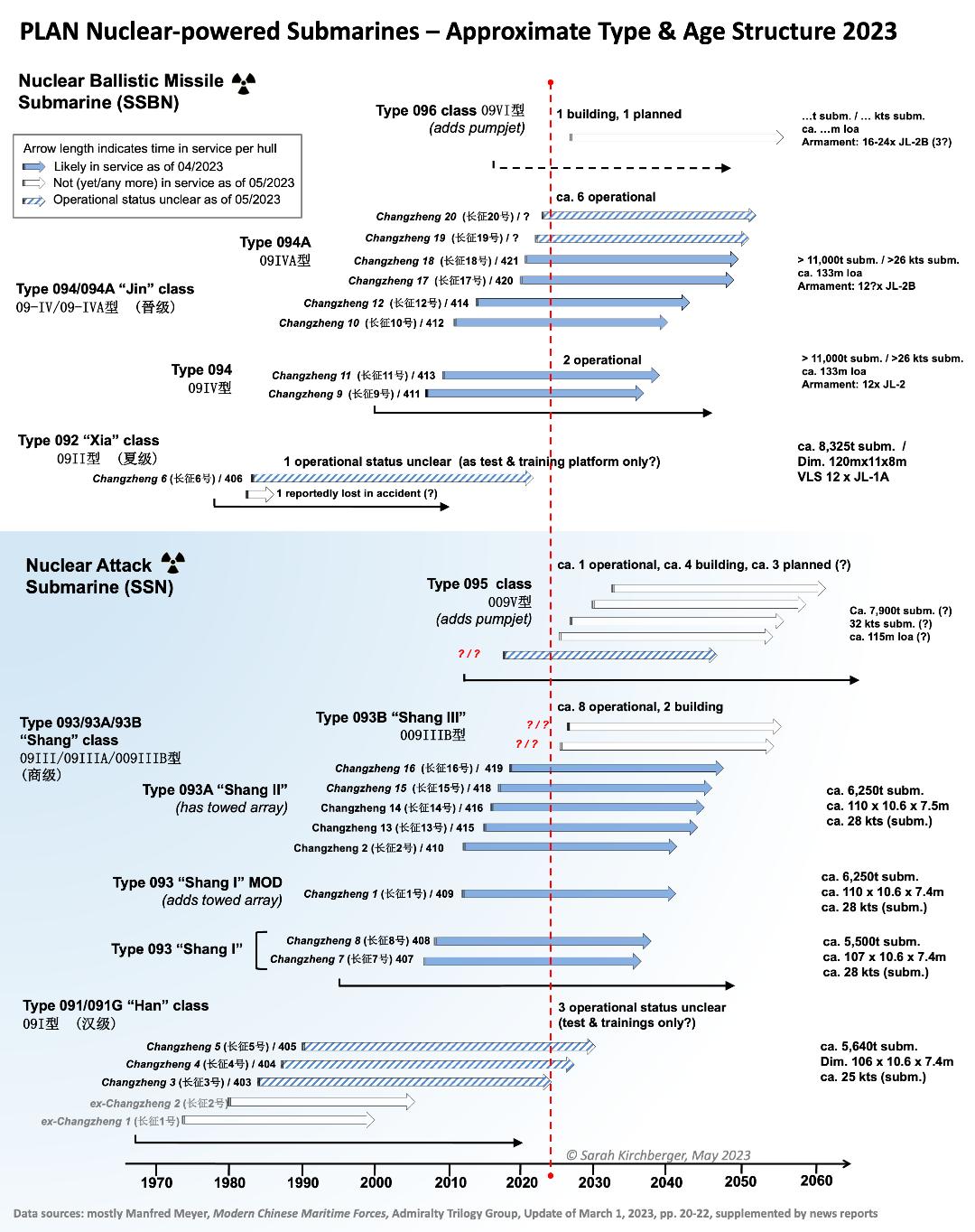
“Chinese Submariner Appointed Head of People’s Liberation Army Navy” -USNI

The infographic above is from a May 2023 post, “China’s PLAN Surface and Sub Order of Battle

The US Naval Institute News Service reports,

“China’s President Xi Jinping appointed a new Chief for the People’s Liberation Army Navy in a Monday ceremony in Beijing…Adm. Hu Zhongming…Hu was previously the PLAN Chief of Staff and is a submarine officer though details of his career are sparse, a Chinese media report in 2015 stated that Hu had a served in the PLA 92730 unit, which operates China’s nuclear submarine.”

I have not been able to confirm it, but as I recall the previous head of the PLAN was also a submariner.

It is worth noting that in October 2020 the USNI reported that China was doubling its nuclear submarine building capacity.

It appears that the Chinese intend to match or exceed the US’s normal two nuclear submarine per year build rate, while continuing to build a substantial fleet of conventionally powered air-independent submarines.

Meanwhile NORTHCOM says Russia is close to having cruise missile launching nuclear submarines cruising persistently off the US coasts.

It is becoming apparent, that in any future major conflict, submarines will be a threat, not just in distant waters, but in virtually any ocean right up to the US coast.

It is time for the Coast Guard and Navy to cooperate in redeveloping a Coast Guard role in ASW, whether it be permanently installed or containerized add-ons with Navy helicopter and personnel augmentation.

“Coast Guard Goes All-In on Zero Trust Architecture” –National Defense

A team from the U.S. Coast Guard Academy participated in the National Security Agency’s 20th annual National Cyber Exercise (NCX), a three-day cyber competition that tests the offensive and defensive cybersecurity skills virtually, April 8-10, 2021. The Coast Guard Academy recently instituted a Cyber Systems degree to meet the needs of the services cyber security strategy of defending cyber space, enabling operations, and protecting infrastructure. (U.S. Coast Guard photo by Petty Officer 2nd Class Hunter Medley)

National Defense reports,

“We need to focus on better identity management, focusing on the data side of that,” Capt. Andrew Campen, engineering services division lead at the Command, Control, Communication, Computer, Cyber and Intelligence Service Center at the Coast Guard, said at a panel at the Eastern Defense Summit in December. “[We must] realize that data is the piece that’s important, not the system itself. Identity management is key for us. Understanding data is key for us.”

“Zero Trust” is a concept that is frequently talked about, but for me at least, little understood. I don’t think I have mentioned the topic here previously.

Zero trust architecture refers to evolving cybersecurity paradigms that prioritize protecting data by repeatedly authenticating, authorizing and validating system, application and data access.

There is, of course, a desire to prevent sensitive data being stolen and a desire for operational security. Conversely there is a desire to make information usable and to act quickly on time sensitive information.

Operationally we don’t want forces diverted from an actual case by false information, but we also do not want a desire for validated information to filter out time critical but incomplete early indicators–we don’t want to be like the Duty Officer at Pearl Harbor who wanted “confirmation” before reporting USS Ward’s attack on a small submarine early on Dec. 7, 1941.

It all just sounds like good opsec, but it has been complicated by access to multi-user data bases. As the post notes, “Successfully implementing a zero trust architecture is incredibly difficult.”

UK Deploys OPV to Guyana, gCaptain/Reuters

The River-class offshore patrol vessel HMS Trent (P224) passes the Vorontsov Lighthouse while arriving in Odesa, Ukraine to participate in Exercise Sea Breeze 2021, July 2, 2021. Exercise Sea Breeze is a multinational maritime exercise cohosted by the U.S. Sixth Fleet and the Ukrainian Navy since 1997. Sea Breeze 2021 is designed to enhance interoperability of participating nations and strengthens maritime security and peace in the region. (U.S. Navy photo by Damon Grosvenor/Released)

gCaptain reports,

Britain will deploy a naval ship off Guyana later this month, its ministry of defense said on Sunday, as the South American nation faces a border dispute with neighbor Venezuela over the oil-rich Essequibo region.

The deployment follows a visit by a British junior foreign minister to Guyana earlier this month, intended to offer the UK’s support for the country, an ally and former British colony.

We have talked about Venezuela’s claim on territory internationally recognized as part of Guyana. There is a recent BBC report here.

I found it interesting that the Royal Navy is sending an Offshore Patrol Vessel to this region of potential conflict. HMS Trent is about the size of a 270 and is armed with a 30mm gun in what is essentially the same mount the US Navy is calling the Mk38 Mod4.

It is likely 4th Fleet will also have some units (probably CG cutters and maybe an LCS) in the area.

None of these ships is likely to be a match for the Venezuelan Navy, but the US could quickly have overwhelming amounts of airpower over the area.