“Top Ten Navies by Aggregate Displacement, 1 January 2024” –Analysis and diagram by Phoenix_jz

Two years ago, I did a post with a similar title from the same source. Somehow, I missed the 2023 edition. As I said in the earlier post, I don’t know , but the data appears to be credible, and it looks like readers are checking his figures. 

It is very difficult to read the tonnages at the bottom of the graph unless you are using a computer and click on the graph to see it in a larger size. 

The creator’s notes and some additional comments are below. 


Hello all!

Well, 2024 is upon us, and as such so is the third edition of my top ten navy list. For those unfamiliar, here are links to 2022 and 2023, with a general explainer of the whole concept in the 2022 version.

The long and short of it is that this graph reflects a personal tracker I keep of almost every large and moderately sized navy, and calculates the aggregate displacement of these navies. It’s not a perfect way to display the size of navies – far from it in fact – but it is at least more representative than counting numbers of hulls alone, in my opinion.

To break down what each of these categories mean;

  • Surface Warships is an aggregate of all above-water warships and major aviation and amphibious assault platforms. This category includes CVNs, CVs, CVLs, LHDs, LHAs, LPDs, CGs, DDGs, FFGs, corvettes, OPVs, CPVs, lighter patrol craft, and MCM vessels.
  • Submarines is what it says on the tin – SSBNs, SSGNs, SSNs, SSKs, and for select nations where applicable (and where information is available), special purpose submarines. Please note dedicated training submarines are counted separately.
  • AORs includes all major fleet replenishment vessels (coastal vessels do not count, however).
  • Other Auxiliaries is a very wide net that essentially captures everything else. Special mission ships, support vessels, minor amphibious assault vessels (LSDs, LSTs, LCAC’s, LCM’s, LCU’s), training vessels, tugs, coastal support vessels, hydrography ships – all essential parts of navies, but generally often paid less attention to as they’re not as flashy as the warships proper.

Interesting trends in data that I thought I would share for various navies, and thoughts and observations otherwise;

The USN is, unsurprisingly, still top dog by a huge margin. In spite a net decommissioning of five ships this year, the USN has grown overall by about 32,000 tons – four ‘cruisers’, two SSNs, four LCS, and five patrol craft decommissioned against the introduction of three destroyers, an SSN, five LCS, and a replenishment ship. It is worth noting that 2023 is the first year since 2010 that the USN has commissioned three destroyers in a year, though a repeat performance in the next couple years is unlikely – these ships were launched in 2020 and 2021, and only one destroyer per year was launched in 2022 and 2023.

No one will be surprised to hear that the PLAN has grown for the nth consecutive year, adding the final Type 055 batch I and the remaining Type 054A Batch V, for almost 50,000 tons of new surface combatants. Much of the remaining increase in displacement for this year (which totaled nearly 90,000 tons) reflected a steady pace of modernization in mine warfare, landing forces, and logistical support/other auxiliaries. As with last year, the number of minor patrol craft continue to plummet as the PLAN continues to divest many of its obsolescent brown-water combatants, or relegates them to training duties.

Moving on to ongoing construction, progress on the new destroyer batches continues at pace. At least two Type 055 Batch II appear to be under construction, and the overall number of Type 052D Batch IV appears to be at least ten. The first ship actually launched at the very end of 2022 (at Jiangnan), and two further have been launched by the same yard as well as three at Dalian. Two more remain under construction at each yard. The first of these ships to be launched appears to be on trials and will likely commission this coming year. The Type 054A program of the navy appears to have finally wrapped up (construction of the hull for the China Coast Guard continues), and the Type 054B program has continued at pace if not scale – two ships were launched this year, but modules of further units have been scarce. Rounding things out for major surface vessels, a new Type 075 LHD was launched this past December. Conspicuously absent has been sightings of any modules for new carriers. Considering Fujian (Type 003) began construction at some point from 2015 to 2017, one has to wonder if we will see China launch another carrier before the end of the decade.

Perhaps most consequential of all, however, has been the completion of new production facilities at Bohai and a resumption of Type 093 SSN launches. The first of the new Type 093B launched in 2022, and has been followed up by two more launches this year (possibly up to three). A sustained pace of two submarines a year, or even just three submarines every two years, would quickly add up could see anywhere from nine to eleven new SSNs launched by the end of 2027, and in service by early 2030s. Only time will tell what the actual drumbeat of production will be.

Russia’s VMF woes in the Black Sea have continued unabated, except less at sea and largely fueled by the Franco-British SCALP cruise missile. The most dramatic loss by far was the destruction of the Project 636.3 ‘Improved’ Kilo Rostov-on-Don in drydock at Sevastopol, but similar attacks claimed the destruction or constructive loss of a Karakurt-class corvette (under construction, not in service) and two Ropucha-class LSTs. The infamous TB-2 made a brief return to destroy a Serna-class LCU, and two other LCU’s may have finally become the first victims of Kamikaze USVs this past November, for a total of 11,407 tonnes lost.

In regards to the more regular cycle of commissioning and decommissioning, one frigate, one MCM vessel, and three corvettes were brought into service, as well as a new SSGN, SSBN, and SSK each. Against this a corvette, SSGN, SSBN, and SSK were decommissioned. Overall, in spite of losses the VMF managed a net gain of 6,324 tonnes of surface warships and submarines. Anyone who checks against my figures from last year will note that the increase in the VMF’s overall tonnage this year is far more substantial, due to the auxiliary category. Though some of this was from new vessels, this was mostly down to a badly needed overhaul and reorganization of that part of my tracker, particularly for the tug fleet. Did you know the Russian navy tug fleet displaces more than either the Argentine or Canadian navies? Now you do! Seriously – it would be the 20th largest navy in the world by itself.

As a final note on the VMF – it is worth remembering that ships commissioned in the Russian navy are not always actually in service, as ships can often languish in near-terminal refits or simply be left inactive without a formal decommissioning. Almost half the remaining Projekt 877 Kilo’s, for example, appear to be inactive at this point (5 of 10).

(In comments the author noted the following, “Russian naval losses during the war have totalled 13 vessels for 29,870 tonnes. Quite a bit – but also only about 1.4% of their current overall tonnage.” –Chuck)

The British Royal Navy observes a second year of marginal reduction in overall tonnage (-2,640t, or -0.3%), losing another Type 23 frigate as well as the last Echo-class survey ship. Against this the RFA brought into service the first MROSS, ProteusProteus represents a considerable increase in subsurface capability, though the loss of a frigate with no replacement ship to replace it for another thee to four years is painful, especially given how many of the remaining eleven ships are deep in LIFEX/Post-LIFEX refits. With that said, their new frigate programs are moving on steadily. Steel was cut on two new frigates this year – the future HMS Birmingham (4th Type 26) and HMS Active (2nd Type 31), bringing the total construction volume to five frigates building and one fitting out.

The JMSDF continues to grow, albeit at a more moderate pace this year (+6,530t, or +0.9%), inducting a new Mogami-class frigate and Taigei-class attack submarine, while shifting another Oyashio-class from the active fleet to a training role. Two more FFM were launched this year, though surprisingly they have not started construction on the next pair. This past November, it was announced that the Mogami-class FFM would be curtailed at 12 units (of 22 planned), and followed on by an evolution of the design known as FMF-AAW. The FMF-AAW will feature greater air and surface warfare capabilities. Twelve such ships are planned.

The Indian Navy’s growth in 2023 was far less dramatic than in 2022, but still noteworthy (+9,200t, or +1.5%), as adding a new conventional attack submarine and destroyer to the fleet has finally pushed them over the 600,000-tonne line.

The Marine Nationale grew by almost 9,000 tonnes (2.1%) this year, largely down to the retirement and replacement of a patrol ship, nuclear attack submarine, and tugs with an equal number of replacements. Though it is worth noting that the new attack submarine is not fully operational yet – that will happen in 2024 – so technically the MN’s attack submarine fleet is really four boats at this point in time.

The saga of eight and ninth place swapping around continues, as the ROKN has managed to move back to the position of eighth largest navy in the world. In 2023 they added a net 15,374t (+4.3%), commissioning four Daegu-class frigates, a second KSS-III class attack submarine, an MCM vessel and a pair of LCACs, against the decommissioning of two corvettes and five PKM’s.

In contrast, the Marina Militare continues to feel the bite from the two FREMM sold to Egypt, as well as delays in brining the LHD Trieste into service – intended for 2023 but again pushed back, now to the spring of 2024. The first PPA ‘Light+’, Raimondo Montecuccoli, was brought into service in 2023 – an OPV on paper, but light frigate in practice. Against this one of the elderly Maestrale-class frigates, Zeffiro, was retired, as was one of the fleet’s AORs (Vesuvio) and a water tanker (Bormida), resulting in a real drop of 7,073 tonnes (-1.9%). The drop seen versus the chart versus last year is more dramatic (totals 16,632 tonnes), which reflects both cleaning up data on old auxiliary platforms for which information is scarce, and correcting some minor sheet errors, which totaled 9,559 tonnes.

The outlook should be looking up in the future – as previously mentioned, the LHD Trieste should enter service this year, as should the fourth and fifth PPA. The first of two replacement FREMM (GPe) was launched in late 2023 and a second will follow this spring, with both being slated to enter service in 2025 alongside the sixth PPA and second Vulcano-class replenishment ship – barring any delays.

Finally, the Indonesian Navy saw another year of growth, adding a net 9,930 tonnes (+3.1%), with another hospital ship commissioned, a new survey ship, corvette, and two new MCM vessels and FACs each, as well as several patrol boats. The TNIAL continues a steady program of domestic construction of patrol craft, and construction is ongoing on two Iver Huitfelt derivative frigates, with the keel of the first vessel laid down this past August. They have also cut steel on a new hydrography ship, which will launch in Indonesia and complete fitting out in Germany.

What comes next in terms of major platforms for the TNIAL is somewhat up in the air. As with the year prior, there has been no progress made on the procurement of six FREMM from Italy, despite a contract being signed two and a half years ago (June 2021). In spite of this, they have expressed interest in procuring two PPA to bolster their patrol fleet. In the interest of expediting procurement, they are looking at two ‘Light+’ configuration vessels currently fitting out at Muggiano – Marcantonio Colonna (due for delivery to the MMI in the latter half of 2024) and Ruggiero di Lauria (due for delivery to the MMI in mid-2025). According to the General Manager of Fincantieri’s Naval Vessels Division, Dario Deste, a contract for the two vessels could be signed in the first half of 2024.

(In answer to a question the author added this in the comments–Chuck)

No.11 to 20 are as follows for 1 January 2024;

  • 11: Turkey – 297,298t
  • 12: Taiwan – 268,958t
  • 13 Egypt – 232,046t
  • 14: Spain- 229,373t
  • 15: Germany – 226,655t
  • 16: Australia – 224,074t (decided to add the National Support Squadron, which added about 30kt)
  • 17: Greece – 189,184t
  • 18: Brazil – 162,29t
  • 19: Chile – 161,404t
  • 20: Argentina – 138,620t
(A reader, , added this–Chuck)

Listed by ranking for this year:

Nation Change from 2023 (tonnes) 2023 Ranking Change from 2022 (tonnes) 2022 Ranking
United States +55,658 1st +250,308 1st
China +93,567 2nd +99,299 2nd
Russia + 211,333 3rd +166,682 3rd
United Kingdom -2,640 4th -5,815 4th
Japan +6,530 5th +23,790 5th
India +9,200 6th +62,349 6th
France +8,925 7th +12,145 7th
South Korea +15,374 9th +7,153 8th
Italy -16,632 8th -3,452 9th
Indonesia -70 10th +17,709 10th

Probably not surprising given all these nations are competing more or less with each other, but the rankings have basically remained the same except for Italy and South Korea trading places in 2023, then reverting to their 2022 places again this year. Nobody previous top 10 navy has left the club either.

However, do note that not all of the year-to-year tonnage differences are due to actual changes in fleet size/composition. As Phoenix mentioned in his post, the Russians in particular got a huge tonnage jump this year because he changed the way he counts auxiliaries, and given the discrepancy between his reported +32k figure for the USN and the numbers, there’s probably some math correction involved there too.


“Government of Canada Orders the MQ-9B SkyGuardian RPAS from GA-ASI” –General Atomic News Release

Below is a General Atomics Aeronautical Systems, Inc. (GA-ASI) news release, in English and French, reporting a contract for eleven MQ-9B UAS and associated support. The SkyGuardian MQ-9B is not quite the same as the SeaGuardian MQ-9B that is being widely used for maritime reconnaissance. SkyGuardian has systems to allow it to sense and avoid air traffic in the national air space. It is not clear at this point if the two payload packages are compatible and that a SeaGuardian with sense and avoid is also possible.

It is also not clear that the FAA is ready to permit operation of this system in US airspace, though acceptance by European and Canadian authorities argues strongly in favor.

Canadian Government announcement here.

SAN DIEGO – 19 December 2023 – The Government of Canada has signed a contract to purchase a fleet of MQ-9B SkyGuardian Remotely Piloted Aircraft Systems (RPAS) from General Atomics Aeronautical Systems, Inc. (GA-ASI). The order includes the associated Certified Ground Control Stations and support equipment from GA-ASI. The first delivery is expected in 2028.

The SkyGuardian RPAS is interoperable with Canada’s domestic missions and its continental defence missions through NORAD, as well as with Canada’s closest allies – including the Five Eyes Alliance (FVEY) and NATO – for seamless integration with current and future Canadian defence, civil air, and ground assets.

“Canada’s vast territory and complex terrains, including in the Arctic, require a cost-effective multi-mission RPAS solution that can endure long periods on station, fly in harsh weather environments, and safely operate in all airspaces,” said Linden Blue, CEO of GA-ASI. “MQ-9B SkyGuardian delivers those critical capabilities. GA-ASI and Team SkyGuardian Canada are honored by this opportunity to become a key partner to Canada for the very long term in delivering these no-fail defence and security outcomes.”

Team SkyGuardian Canada is a coalition of leading Canadian businesses – including CAE, MDA Ltd., and L3Harris Technologies – that are working with GA-ASI on MQ-9B development, delivery, and sustainment. Canada’s investments in the RPAS Project and Team SkyGuardian Canada are a direct reflection of Canada’s vested domestic interest in pursuing leading-edge RPAS technologies.

GA-ASI has had a long, successful, and proud history with Canadian industry that continues to grow. Nearly every system that GA-ASI has delivered throughout its more than 30-year history has contained some level of Canadian content, including sensors, propulsion equipment, and training/simulation systems and services. CAE, MDA Ltd., L3Harris, and GA-ASI are committed to delivering the world’s premier RPAS capability to Canada while creating domestic economic benefits and work opportunities.

MQ-9B is the next generation of RPAS, delivering exceptionally long endurance and range, with auto takeoff and landing under SATCOM-only control, and will be able to operate in unsegregated airspace using the GA-ASI developed Detect and Avoid system. First customer deliveries of MQ-9B began in 2022 to the U.K. Royal Air Force, and contracts have been signed with Belgium and the U.S. Air Force, in support of Special Operations Command. The Japan Coast Guard is currently operating the MQ-9B for maritime operations, which the Japan Maritime Self-Defense Force (JMSDF) also selected for its Medium-Altitude, Long-Endurance (MALE) RPAS Trial Operation Project. MQ-9B has additionally supported various U.S. Navy exercises this year, including Northern EdgeIntegrated Battle Problem, and Group Sail.

“We look forward to working with our Team SkyGuardian Canada partners to deliver our industry leading RPAS for Canada’s dynamic mission requirements. GA-ASI is the world leader in reliable, cost-efficient, and sustainable remotely piloted aircraft systems. These aircraft perform advanced interoperable and systems-of-systems operations for our valued customers around the world – all at a fraction of the carbon footprint impact as traditional manned systems performing similar missions,” added Blue.

About GA-ASI

General Atomics Aeronautical Systems, Inc. (GA-ASI), an affiliate of General Atomics, is a leading designer and manufacturer of proven, reliable RPA systems, radars, and electro-optic and related mission systems, including the Predator® RPA series and the Lynx® Multi-mode Radar. With more than eight million flight hours, GA-ASI provides long-endurance, mission-capable aircraft with integrated sensor and data link systems required to deliver persistent situational awareness. The company also produces a variety of sensor control/image analysis software, offers pilot training and support services, and develops meta-material antennas.

Avenger, Lynx, Predator, and SkyGuardian are registered trademarks of General Atomics Aeronautical Systems, Inc.

Le Gouvernement Du Canada Commande Le SATP GA-ASI SkyGuardian MQ-9B

SAN DIEGO – Le 19 décembre 2023 – Le gouvernement du Canada a signé un contrat pour l’achat d’une flotte de systèmes d’aéronefs télépilotés (SATP) MQ-9B SkyGuardian® auprès de General Atomics Aeronautical Systems, Inc. (GA-ASI). La commande comprend les stations de contrôle au sol certifiées et l’équipement de soutien de GA-ASI. La première livraison est prévue en 2028.

Le SATP SkyGuardian est interopérable pour les missions nationales du Canada et ses missions de défense continentale de NORAD, ainsi qu’avec les alliés les plus proches du Canada, notamment l’Alliance du Groupe des cinq (Five Eyes Alliance, FVEY) et l’OTAN, afin de permettre une intégration sans faille avec les ressources canadiennes actuelles et futures en matière de défense, d’aviation civile et d’opérations terrestres.

« En raison de l’immensité du territoire canadien et de la complexité des terrains, y compris dans l’Arctique, le Canada a besoin d’une solution SATP multimission efficace en termes de couts, capable de rester longtemps en station, de voler dans des conditions météorologiques exigeantes et de fonctionner en toute sécurité dans tous les espaces aériens », a déclaré Linden Blue, président-directeur général de GA-ASI. « Le MQ-9B SkyGuardian possède toutes ces capacités essentielles. GA-ASI et l’équipe SkyGuardian Canada sont honorés de l’occasion qui leur est donnée de devenir un partenaire clé du Canada à très long terme pour atteindre ces résultats sans faille en matière de défense et de sécurité. »

L’équipe SkyGuardian Canada est une coalition d’entreprises canadiennes de premier plan, dont CAE, MDA Ltd. et L3Harris Technologies. Celles-ci collaborent avec GA-ASI au développement, à la livraison et au maintien en service du MQ-9B. Les investissements du Canada dans le projet de SATP et l’équipe SkyGuardian Canada reflètent directement l’intérêt national du Canada à poursuivre les technologies de pointe de SATP.

GA-ASI est fière d’entretenir avec l’industrie canadienne une longue et fructueuse histoire qui ne cesse de s’enrichir. Presque tous les systèmes livrés par GA-ASI au cours de ses plus de 30 ans d’existence ont comporté un certain niveau de contenu canadien, notamment des capteurs, des équipements de propulsion et des systèmes et services de formation et de simulation. CAE, MDA Ltd, L3Harris, et GA-ASI se sont engagés à fournir au Canada la capacité de SATP chef de file au monde, tout en suscitant des retombées économiques et des possibilités d’emploi au pays.

Le MQ-9B est la nouvelle génération de SATP offrant une endurance et un rayon d’action exceptionnellement long, un décollage et un atterrissage automatiques sous contrôle SATCOM uniquement, et il sera capable de fonctionner dans l’espace aérien général à l’aide du système de détection et d’évitement conçu par GA-ASI. Les premières livraisons de MQ-9B ont commencé en 2022 pour la Royal Air Force du Royaume-Uni, et des contrats ont été signés avec la Belgique et l’armée de l’air des États-Unis pour soutenir le commandement des opérations spéciales. La Garde côtière du Japon utilise actuellement le MQ-9B pour ses opérations maritimes. La Force maritime d’autodéfense japonaise (JMSDF) l’a également sélectionné pour son projet d’essai de SATP à moyenne altitude et longue endurance (MALE). Le MQ-9B a également été utilisé cette année dans le cadre de divers exercices de la marine des États-Unis, notamment pour les opérations Northern EdgeIntegrated Battle Problem et Group Sail.

« Nous sommes fébriles de travailler avec nos partenaires de l’équipe SkyGuardian Canada afin de fournir nos SATP de pointe pour répondre aux exigences des missions dynamiques du Canada. GA-ASI est le chef de file mondial des systèmes d’aéronefs télépilotés fiables, rentables et durables. Ces aéronefs assurent des opérations interopérables et des solutions « systèmes de systèmes » avancées pour nos précieux clients dans le monde entier, tout cela avec une fraction de l’empreinte carbone des systèmes classiques pilotés effectuant des missions similaires », a ajouté M. Blue.

À propos de GA-ASI

General Atomics Aeronautical Systems, Inc. (GA-ASI), une filiale de General Atomics, est un concepteur et un fabricant de premier plan de systèmes d’aéronefs télépilotés (ATP), de radars, de systèmes électro-optiques et de systèmes de mission connexes fiables et éprouvés, notamment la série d’ATP Predator® et le radar multimode Lynx®. Avec plus de huit millions d’heures de vol, GA-ASI fournit des aéronefs de longue durée, aptes aux missions, dotés de capteurs intégrés et de systèmes de liaison de données nécessaires pour assurer une connaissance permanente de la situation. L’entreprise produit également divers logiciels de contrôle de capteurs et d’analyse d’images, propose des services de formation et de soutien aux pilotes et développe des antennes en méta-matériaux.

Avenger, Lynx, Predator et SkyGuardian dont des marques déposées de General Atomics Aeronautical Systems, Inc.

Coast Guard Submarine?

Covert Shores reports the Rubin Design Bureau, which has designed most of Russia and the Soviet Union’s submarines, has proposed a submarine for the Russian Coast Guard.

“The BOSS (Border and Offshore Submersible Sentry) submarine is a concept which has been around for a few years. It is unlikely that Russia will ever build it, but it is all the same an interesting possibility.”

Apparently, the Russian Coast Guard did not ask for a submarine, but the design bureau thinks, even if they don’t want it, it might be exportable.

It’s small, about the size of a World War II vintage German Type VII U-boat, “…60 – 70 meters (197 – 230 feet) long depending on customer configuration, and displaces around 1,000 tons.” Being submersible it could submerge to wait out rough weather.

I do kind of like the way it’s equipped, boat for boarding, VTOL UAS for search, gun for firing warning shots, 10 km range small surface to surface missiles for engaging small fast highly maneuverable targets, and torpedoes capable of forcibly stopping any size vessel.

“Indian Navy Commandos Retake Ship In Arabian Sea” gCaptain/Reuters

The Indian Navy approaches the M/V Lila Norfolk in the Indian Ocean, January 5, 2024. Photo courtesy Indian Navy

gCaptain reports,

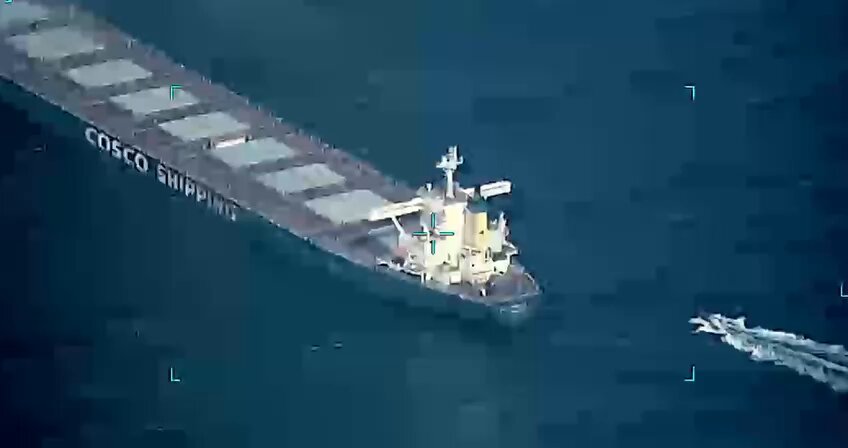
“An Indian Navy warship intercepted the MV Lila Norfolk on Friday afternoon, less than a day after the navy received news that it had been hijacked off Somalia’s coast in the North Arabian Sea.”

The crew of 21 had taken shelter in a citadel. By the time the Indian Navy destroyer, INS Chennai, had arrived, the pirates had fled.

The MV Lila Norfolk “was kept under continuous surveillance using MPA (Maritime Patrol Aircraft–Chuck), Predator MQ9B & integral helos.

Notably, the Indian Navy is one of several users of the MQ-9B Sea Guardian Medium Altitude Long Endurance UAS including the Japan Coast Guard, the UK, Taiwan, and Greece. The US Coast Guard after years of observation of Customs and Border Protection’s use of earlier model MQ-9 Predators, the USCG has yet to procure or even experiment with a shore based long endurance UAS.

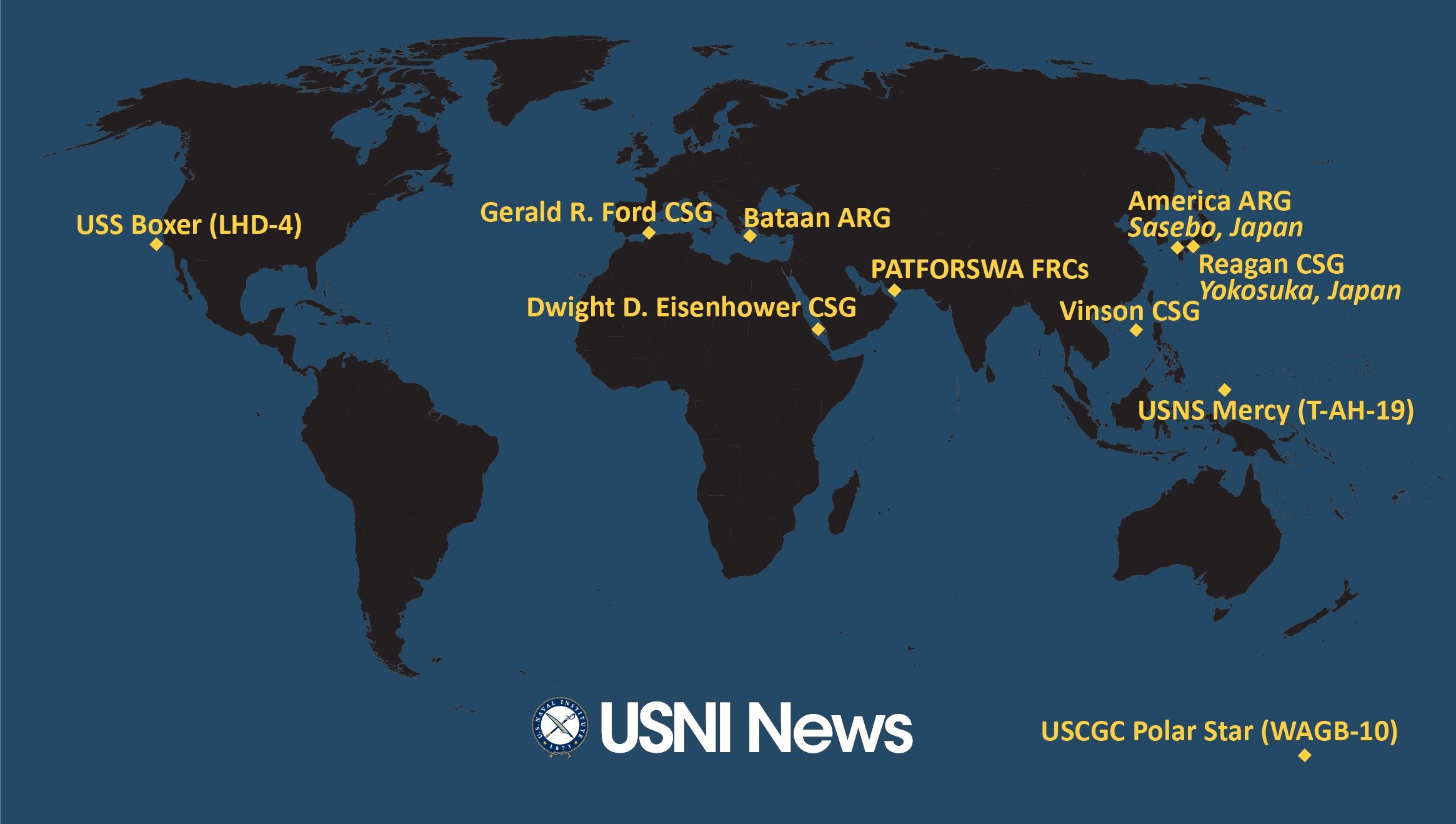
“USNI News Fleet and Marine Tracker: Jan. 4, 2023”

The report shows 31% of the commissioned (USS) ships are deployed. 20.6% of the “Battle Force” ships (USS & USNS) are underway.

The post includes information about PATFORSWA drug seizures, 24, 26, and 28 December and notes that USCGC Polar Star arrived at McMurdo Station in time to celebrate the new year. It also included a video of the ship breaking ice.

“Joint Warning To Houthis: Cease Attacks Or Face Consequences” –The Drive

The Drive reports,

A dozen nations on Wednesday issued a joint warning to the Iranian-backed Houthis in Yemen, demanding that they cease attacking commercial shipping in the Red Sea…“We call for the immediate end of these illegal attacks and release of unlawfully detained vessels and crews” the U.S., Australia, Bahrain, Belgium, Canada, Denmark, Germany, Italy, Japan, Netherlands, New Zealand, and the United Kingdom demanded in the joint statement published by the White House Wednesday.

The text of the warning is below the break.

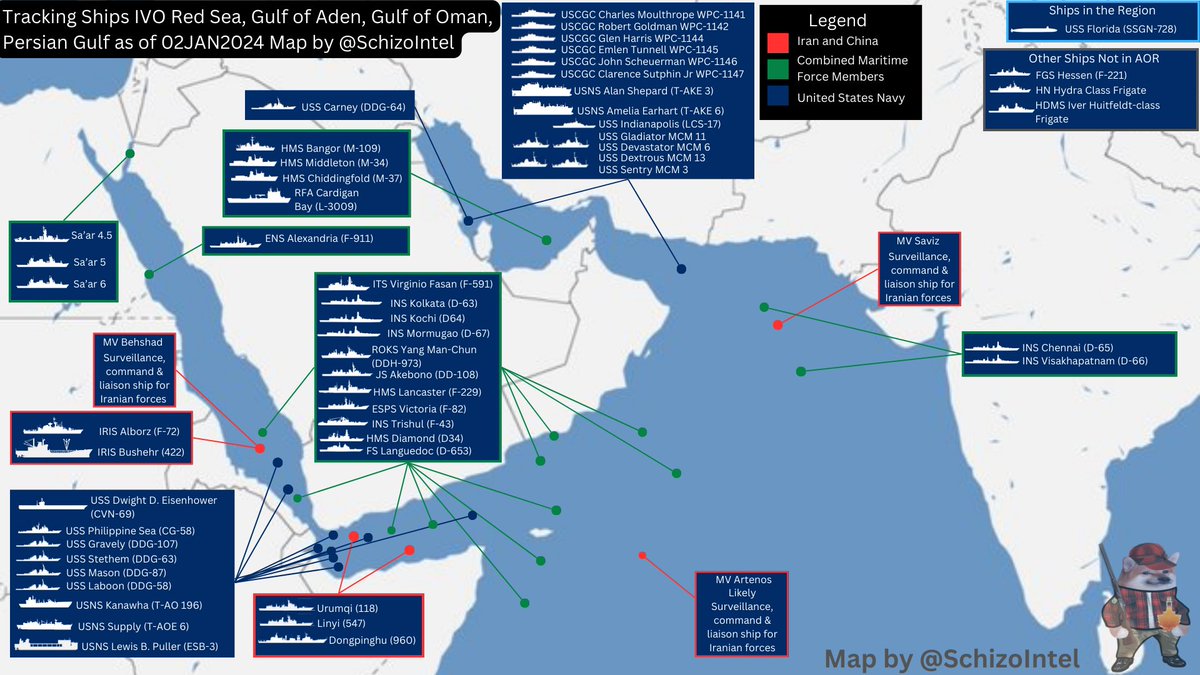
Click on the graphic to enlarge. Credit: Intelschizo@Schizointel


Coast Guard Patrol Forces Southwest Asia, PATFORSWA, Three FRCs, Three Drug Seizures in Four Days

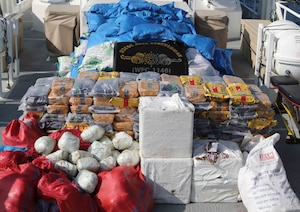
ARABIAN SEA (Dec. 28, 2023) Bags of illegal narcotics seized from a vessel are stacked on the deck of the U.S. Coast Guard Sentinel-class fast response cutter USCGC Robert Goldman (WPC 1142) in the Arabian Sea, Dec. 28. Robert Goldman was operating under Combined Task Force 150, one of five task forces under Combined Maritime Forces, the largest multinational naval partnership in the world. CTF 150 focuses on maritime security operations outside the Arabian Gulf. (Photo by U.S. Coast Guard courtesy photo)

Below is a U.S. Naval Forces Central Command – Combined Maritime Forces – U.S. 5th Fleet news release, followed by a second earlier news release. Something puzzling is that there seems to be a relatively new “catch and release” policy regarding the smugglers and smuggling vessels. 

CMF-assigned Cutter Seizes Hashish and Methamphetamines in North Arabian Sea | January 02, 2024, MANAMA, Bahrain

A U.S. Coast Guard cutter patrolling under the command of Combined Task Force 150 of the Combined Maritime Forces seized hashish and methamphetamines with a total estimated street value of $24.3 million Dec. 28 in the North Arabian Sea.

It was the third seizure by a CMF-assigned cutter in four days, following seizures by USCGC Clarence Sutphin Jr. (WPC 1147) and USCGC John Scheuerman (WPC 1146) of hashish, heroin, methamphetamines and pills with a total estimated street value of $24.5 million Dec. 24 and Dec. 26 in the Gulf of Oman.

A team from USCGC Robert Goldman (WPC 1142), a Sentinel-class cutter, boarded a dhow at approximately 6:30 a.m. local time Dec. 28 after it displayed indicators consistent with illicit drug trafficking.

Aboard, the team discovered over 300 bags of drugs containing 3,514 kilograms of hashish and 417 kilograms of methamphetamines.

The Robert Goldman team released the dhow and disposed of the illicit drugs.

The mission of Combined Task Force 150 is to disrupt the ability of non-state actors to move weapons or drugs, or engage in other illicit activities, in the Gulf of Oman, Arabian Sea and Indian Ocean.

This interdiction marked the twelfth time Combined Task Force 150 assets have seized illegal narcotics at sea since France took command in July 2023.

Combined Maritime Forces is a multinational maritime partnership committed to disrupting criminal and terrorist activities by restricting their freedom of maneuver across approximately 3.2 million square miles of international waters encompassing some of the world’s most important shipping lanes.

Since 2021, units assigned to the Combined Maritime Forces have seized more than $1 billion in illegal drugs while patrolling waters across the Middle East.


CMF Forces Seize Illegal Drugs in Gulf of Oman, January 02, 2024, MANAMA, Bahrain

U.S. Coast Guard cutters assigned to the Combined Maritime Forces seized illegal drugs with a total estimated street value of $24.5 million on Dec. 24 and Dec. 26 from vessels in the Gulf of Oman.

GULF OF OMAN (Dec. 26, 2023) Bags of illegal narcotics seized from a vessel are stacked on the deck of the U.S. Coast Guard Sentinel-class fast response cutter USCGC John Scheuerman (WPC 1146) in the Gulf of Oman, Dec. 26. John Scheuerman was operating under Combined Task Force 150, one of five task forces under Combined Maritime Forces, the largest multinational naval partnership in the world. CTF 150 focuses on maritime security operations outside the Arabian Gulf. (Photo by U.S. Coast Guard courtesy photo)

At approximately 2 p.m. local time (10 a.m. Greenwich Mean Time) on Dec. 24, a team from USCGC Clarence Sutphin Jr. (WPC 1147), a Sentinel-class cutter patrolling under the command of Combined Task Force 150 of the Combined Maritime Forces, boarded a dhow after it displayed several indicators consistent with illicit drug trafficking.

Aboard, the crew discovered 90 kilograms of heroin with an estimated street value of $3.2 million.

After testing and seizing the narcotics, the team disembarked the dhow, allowing it to continue on its journey.

GULF OF OMAN (Dec. 26, 2023) Bags of illegal narcotics seized from a vessel are stacked on the deck of the U.S. Coast Guard Sentinel-class fast response cutter USCGC John Scheuerman (WPC 1146) in the Gulf of Oman, Dec. 26. John Scheuerman was operating under Combined Task Force 150, one of five task forces under Combined Maritime Forces, the largest multinational naval partnership in the world. CTF 150 focuses on maritime security operations outside the Arabian Gulf. (Photo by U.S. Coast Guard courtesy photo)

At approximately 5 a.m. local time (9 a.m. Greenwich Mean Time) on Dec. 26, a team from USCGC John Scheuerman (WPC 1146), a Sentinel-class cutter patrolling under the command of Combined Task Force 150 of the Combined Maritime Forces, boarded a dhow after it also displayed several indicators consistent with illicit drug trafficking.

Aboard, the team discovered 261 kilograms of methamphetamines, 2,936 kilograms of hashish, 142 kilograms of heroin and 75,000 pills with the potential to be abused as opium substitutes, with a total estimated street value of more than $21.3 million.

The John Scheuerman team released the dhow’s crew and disposed of the illicit drugs.

The mission of Combined Task Force 150 is to disrupt the ability of non-state actors to move weapons or drugs, or engage in other illicit activities, in the Gulf of Oman, Arabian Sea and Indian Ocean.

These interdictions marked the tenth and eleventh times Combined Task Force 150 assets have seized illegal narcotics at sea since France took command in July 2023.

Combined Maritime Forces is a multinational maritime partnership committed to disrupting criminal and terrorist activities by restricting their freedom of maneuver across approximately 3.2 million square miles of international waters encompassing some of the world’s most important shipping lanes.

Since 2021, units assigned to the Combined Maritime Forces have seized more than $1 billion in illegal drugs while patrolling waters across the Middle East.

Five members of Japan Coast Guard Aircrew Die in Runway Collision

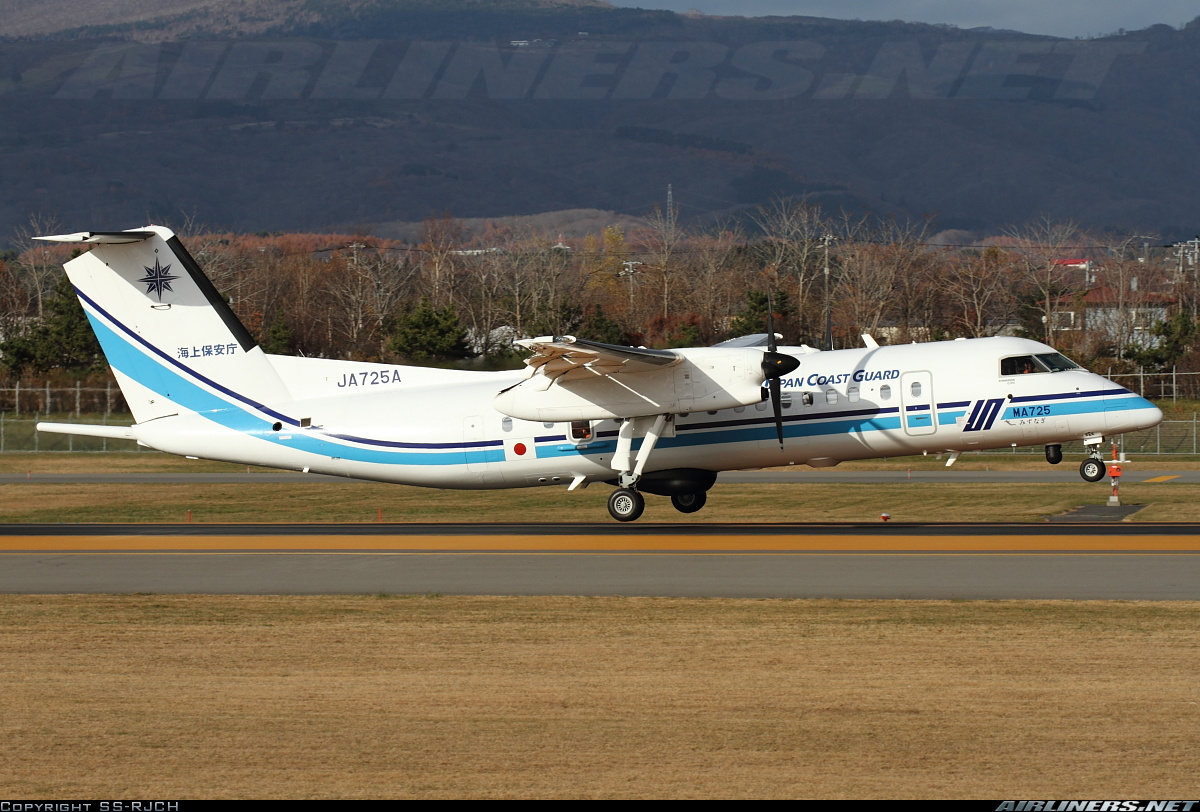
Japan Coast Guard DASH-8-315

A fatal runway collision between a Japan Airlines Airbus A350 and Japan Coast Guard aircraft is being widely reported.

The Japan Coast Guard Bombardier Dash-8 aircraft was heading to western Japan to deliver aid to those caught up in the New Year’s Day earthquake that has killed at least 48 people.

The airliner landed on a runway the JCG aircraft was using as it prepared to take off.

All aboard the JAL aircraft were successfully evacuated. The five of the six crewmembers of the JCG aircraft were killed. One is seriously injured.

“Inside the U.S. Coast Guard patrols off Peru in mission to stop overfishing” –NBC News

NBC News reports on Coast Guard efforts to counter Illegal, Unregulated, Unreported fishing off Peru. The report is not really very clear in that it states the Chinese vessels are outside Peru’s territorial waters but is not clear if they are saying they are outside the 12 mile limit or they are outside the EEZ. The way it was phrased it sounded like they were referring to the 12 mile limit, but the distinction is frequently poorly understood by the media.

Previous Operation: PERU, 10.07.2023, Courtesy Photo, USCG District 11
The Coast Guard Cutter Alder approaches a squid fishing vessel while CG-2007, a C-130 from Air Station Barbers Point in Hawaii, flies over (upper left) during Operation Southern Shield 2023, October 2023. The Coast Guard recently completed the first high-seas boardings and inspections off the coast of Peru under a newly adopted multi-lateral agreement to monitor fishing
and transshipment operations within the South Pacific Regional Fisheries Management Organization (SPRFMO)Convention Area. (U.S. Coast Guard photo)

It is clear that USCGC Alder is off Peru. This is the second time the Pacific Area has used this buoy tender to conduct a distant fisheries patrol, having completed a previous similar patrol 29 November 2023. During the earlier patrol, enforcement was under the auspices of the South Pacific Regional Fisheries Management Organization (SPRFMO). That is probably the case here as well.

Thanks to Paul for bringing this to my attention.

“Australian Border Force crackdown nets 30 foreign fishers, destroys three boats off Kimberley coast” –ABC.net.AU

Map showing the Kimberley Marine Park. The shaded area is a National Park Zone (‘no take’ zone).

ABC.net.au reports the Australian Border Force has seized 30 Indonesian fishers and destroyed three boats in a crackdown against illegal fishing in the 74,469 km2 (28,753 sq mi) Kimberley Marine Park, established in 2018, off Northwestern Australia. The combined catch of the three fishing vessels was over a ton of trepang (sea cucumber).

Australian sea cucumber sells for about $350 (presumably Australian $) per kilogram.(ABC Midwest & Wheatbelt: Chris Lewis)

In addition to the loss of marine catch, there is fear that the fishermen, who frequently come ashore, may bring with them livestock diseases common in Indonesia but not present in Australia.

An illegal fishing vessel is destroyed at sea.(Supplied: Australian Border Force)

Australia has been seeing a resurgence of illegal fishing in their EEZ including Marine Parks, and there have been calls for more vigorous enforcement.