Saildrones Set Sail in Support of U.S. 4th Fleet’s Operation Windward Stack” –4th Fleet

Below is a 4th Fleet News Release. Ten Saildrones will be operating in the Caribbean.

NEWS | Sept. 13, 2023

Saildrones Set Sail in Support of U.S. 4th Fleet’s Operation Windward Stack

By U.S. Naval Forces Southern Command/U.S. 4th Fleet Public Affairs

Commercial operators began deploying 10 Saildrone Voyager Unmanned Surface Vessels (USVs) out to sea today, a critical first step in U.S. 4th Fleet’s Operation Windward Stack.

Launched from Naval Air Station Key West’s Mole Pier and Truman Harbor, the Saildrones’ mission once on station is to improve maritime domain awareness, or MDA, by detecting and quantifying targets that pass within range of the Saildrones’ sensors.

Operation Windward Stack is a long-term operation of unmanned and manned forces working together, also known as a hybrid fleet, as envisioned by the Secretary of the Navy and the Chief of Naval Operations. Windward Stack is part of 4th Fleet’s unmanned integration campaign, which provides the Navy a region to experiment with and operate unmanned systems in a permissive environment, develop Tactics, Techniques, and Procedures (TTPs) against near-peer competitors, and refine manned and unmanned Command and Control (C2) infrastructure, all designed to move the Navy to the hybrid fleet.

First, operators and watchstanders at U.S. 4th Fleet will conduct tests and coordinate information flow as the solar-powered Saildrones sail into the Caribbean. “Operation Windward Stack begins with testing as we integrate the information we receive from the Saildrones into our fleet command center to further increase maritime domain awareness in the U.S. Southern Command Area of Responsibility (AOR),” said Lt. Cmdr. John Clark, U.S. 4th Fleet’s Current Operations (COPS) Director. “We will eventually have the opportunity to work through the command and control of both manned and unmanned forces operating throughout our region.”

The 10 Saildrones will serve as the initial unmanned vessels in the operation. Plans are to add additional USVs, unmanned aerial vehicles (UAVs) and manned maritime forces over the next few months to further challenge C2 integration and to expand the MDA coverage.

“We were able to demonstrate coordinated operations of manned and unmanned forces during UNITAS LXIV, a multinational maritime exercise, but that was for a relatively short time,” said Capt. David Fowler, U.S. 4th Fleet Maritime Operations Center (MOC) Director. “With Windward Stack, we’re going to coordinate these operations for many months. That is how we will truly learn what these unmanned vessels can do for us on a day-to-day basis.”

U.S. Naval Forces Southern Command/U.S. 4th Fleet supports USSOUTHCOM’s joint and combined military operations by employing maritime forces in cooperative maritime security operations to maintain access, enhance interoperability, and build enduring partnerships in order to enhance regional security and promote peace, stability and prosperity in the Caribbean, Central and South American region.
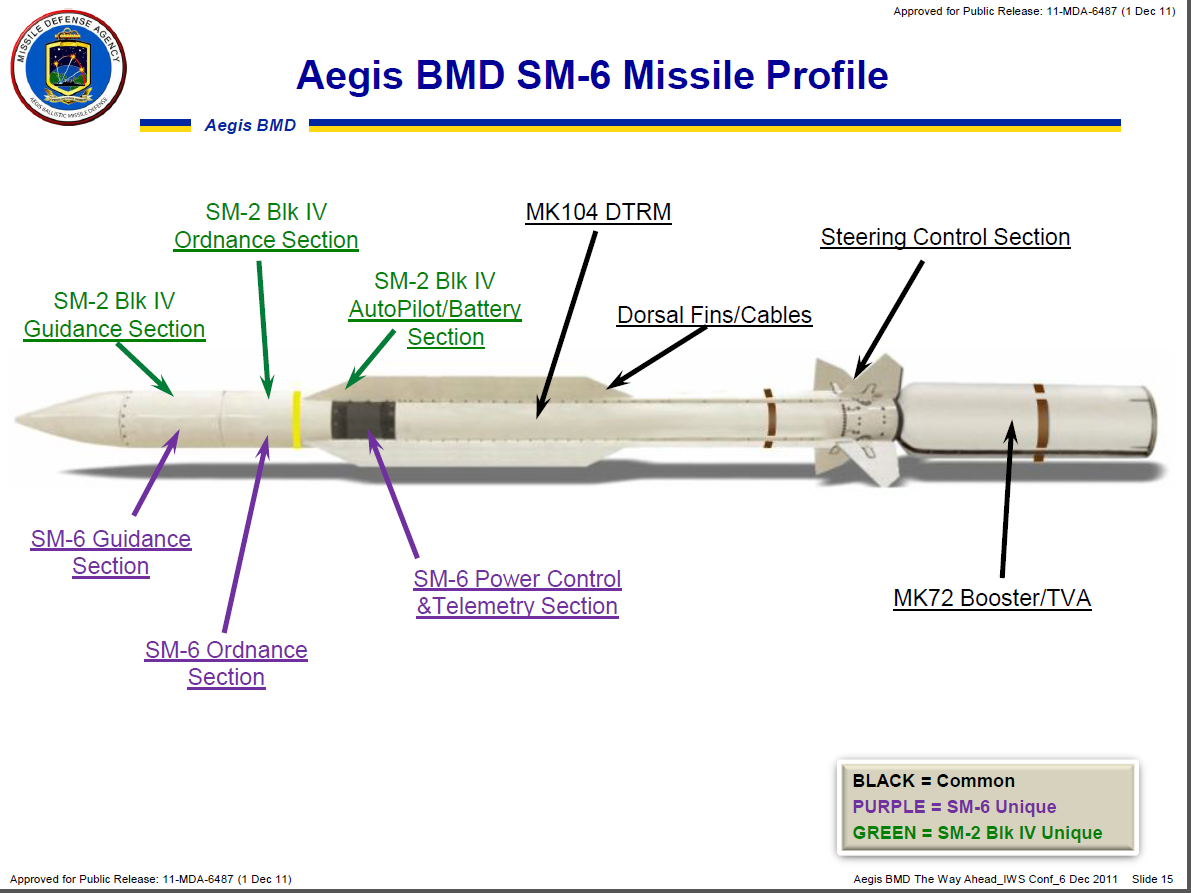
Containerized SM-6 Launcher

The Navy Leagues on-line magazine, Seapower, has a recent post, U.S. Naval Forces Europe and Danish Defense Forces Train on SM-6 Missile Launcher Together.

Allies training together is routine, but there was a real surprise in the story,

The containerized configuration of the SM-6 launcher augments the U.S. Navy’s operational flexibility, facilitating rapid deployment and utilization in diverse theaters of operation, thereby underlining the commitment of the United States to ensure the security interests of itself and its allies.

—There is a containerized launch system for SM-6—

This means any ship with a good air search radar, sufficient deck space, and can handle the additional topside weight (like perhaps an NSC, OPC, or even an LCS) can have both a long range AAW missile system and a long range high supersonic anti-ship/anti-surface missile system.

As an Anti-Air system, the SM-6 incorporates an active radar seeker, so it does not require the radar illuminators that dominated the architecture of most AAW missile ships which used semi-active homing.

Quoting Wikipedia,

The RIM-174 Standard Extended Range Active Missile (ERAM), or Standard Missile 6 (SM-6), is a missile in current production for the United States Navy. It was designed for extended-range anti-air warfare (ER-AAW) purposes, providing capability against fixed and rotary-wing aircraft, unmanned aerial vehicles, anti-ship cruise missiles in flight, both over sea and land, and terminal ballistic missile defense. It can also be used as a high-speed anti-ship missile. The missile uses the airframe of the earlier SM-2ER Block IV (RIM-156A) missile, adding the active radar homing seeker from the AIM120C  AMRAAM in place of the semi-active seeker of the previous design. This will improve the capability of the Standard missile against highly agile targets and targets beyond the effective range of the launching vessels’ target illumination radars. Initial operating capability was planned for 2013 and was achieved on 27 November 2013.

I probably should not have been surprised by this since the army is planning on towed launchers for both Tomahawk and SM-6.

Presumably the launcher is based on the Mk41 VLS and if so, it should be able to launch a variety of weapons including ESSM, a shorter ranged, smaller, much cheaper missile that can be quad packed into the launcher, and vertical launch ASROC.

“The Long Blue Line: Villarreal – Silver Star savior of Vietnam 55 years ago” –MyCG

MyCG has a great first-person Vietnam war story. There is another telling of the same story with more background here. Check it out.

I note, we don’t have a Webber class cutter named after either of these two silver star recipients, EN2 Larry D. Villarreal and GM1 Willis J. Goff.

We need to honor these men.

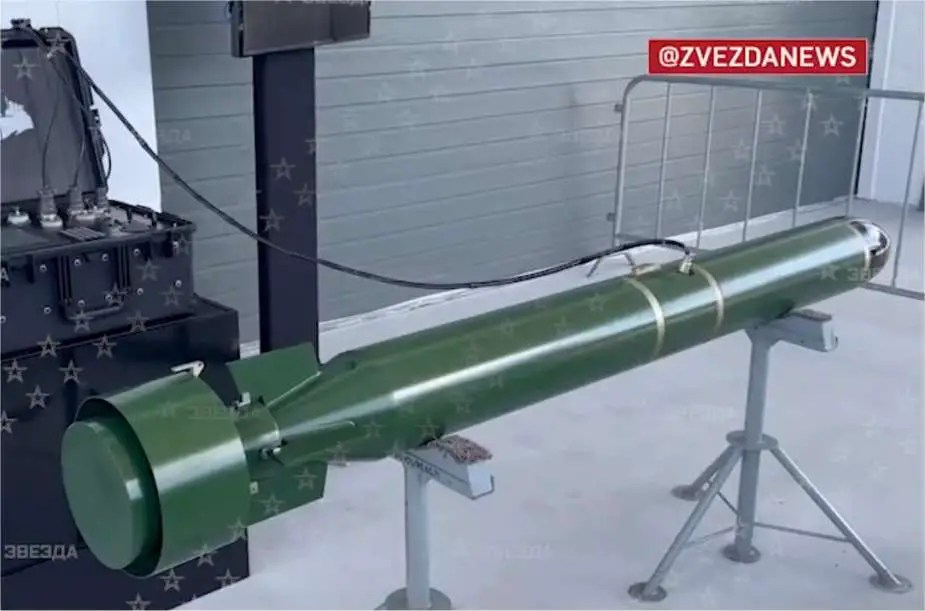
“Army 2023: Russian firm Gidropribor displays new torpedo” –Navy Recognition

New torpedo on the Gidropribor booth at Army 2023. (Picture source: Zvezda)

Navy Recognition reports, a Russian firm has developed a compact torpedo,

“It can target submarines, unmanned underwater vehicles, which is very relevant today, and surface ships…220mm in caliber, varies in length from 2.1 to 2.4 meters and weighs between 100 and 140 kg.”

I suspect the Russians saw what the US was doing with the Common Very Light Weight Torpedo (CVLWT) and figured we had a good idea.

The CVLWT is reportedly 6.75″ (171mm) in diameter, about 85″ (2.16 meters) in length, and weighs about 220 pounds (100 kilos).

I contend the Coast Guard could use the CVLWT to forcibly stop even large merchant ships that might be used by terrorists or for other nefarious purposes, probably without sinking it, which might lead to serious unintended consequence.

“Army Long Range Missile Launcher Spotted on Navy Littoral Combat Ship” –USNI

An Army MK 70 missile launcher on the flight deck of Littoral Combat Ship USS Savannah (LCS-28) in San Diego, Calif. Photo obtained by USNI News

The USNI News Service reports,

A portable missile launcher capable of firing a combination of long-range anti-ship and anti-air weapons was spotted this week undergoing testing aboard a Littoral Combat Ship in San Diego, Calif., according to photos provided to USNI News.

Based on a series of photos reviewed by USNI News, the launcher is a Lockheed Martin MK 70 containerized vertical launching system that is capable of firing both a Raytheon Standard Missile 6 and a Tomahawk Land Attack Missile. It was spotted on the flight deck of Independence-class LCS USS Savannah (LCS-28), which was pier-side in San Diego, according to a USNI News review of the images.

If you can operate Army missile launchers from an LCS you can also operate them from a Coast Guard cutter.

This could be particularly useful in Alaska where there are no Navy ships and limited road infrastructure. Launchers could be flown to meet cutters already in Alaskan waters long before Navy ships could reach the area.

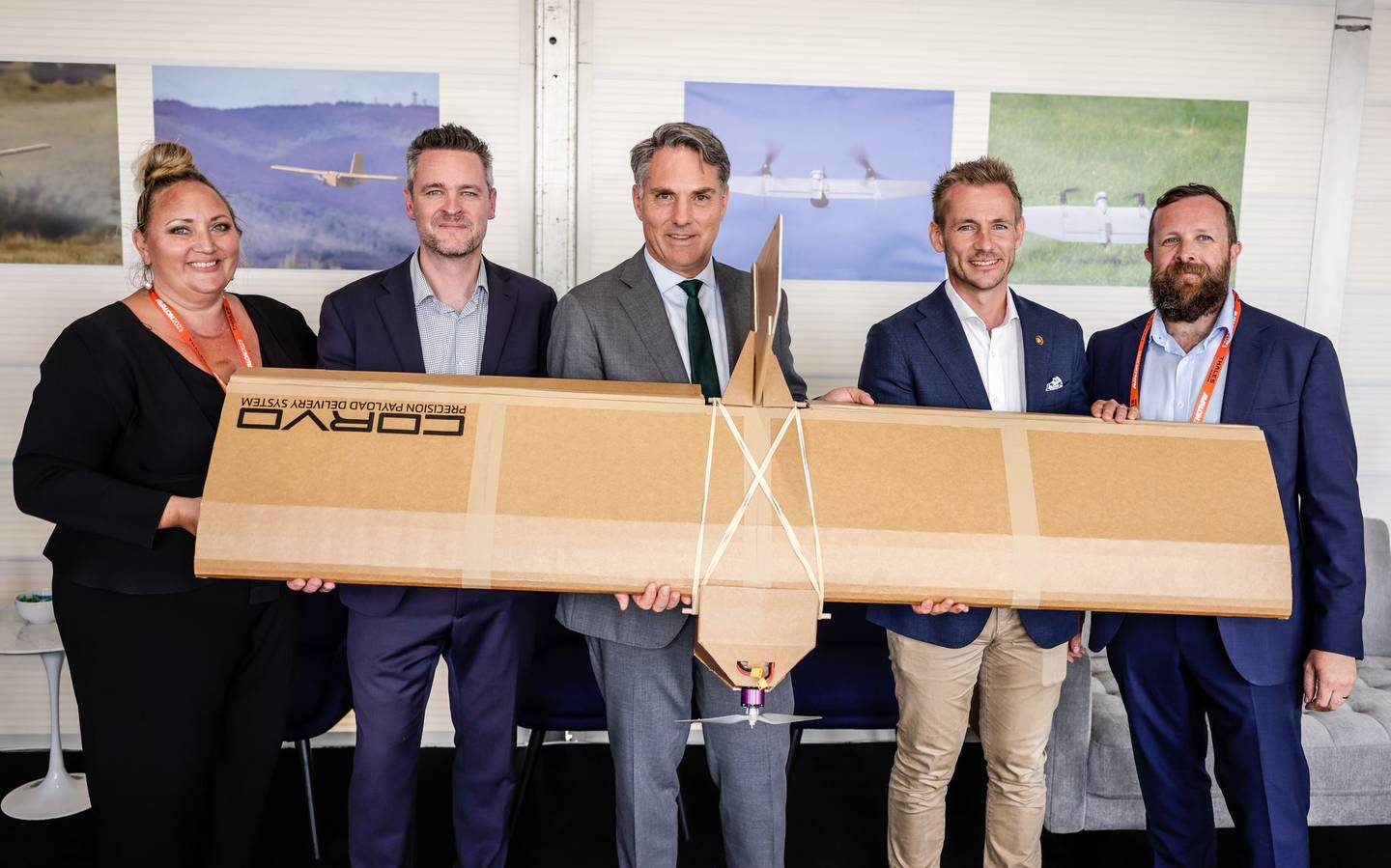
“Cardboard drone vendor retools software based on Ukraine war hacks” –DefenseNews

SYPAQ company officials host Australian Deputy Prime Minister Richard Marles and the Ukrainian ambassador to Australia, Vasyl Myroshnychenko, during a March 2023 event following Australia’s donation of 600 Corvo Precision Payload Delivery System drones to Ukraine. (SYPAQ photo)

Defense News reports,

Ukrainian soldiers have received hundreds of drones, gifted to them by Australia, to capture surveillance video crucial for preparing missions to retake ground from Russian forces.

The data comes from GoPro cameras strung from holes punched into disposable cardboard drones.

This shows just how simple it can be to get an Unmanned Air System ISR capability, or perhaps a weapons delivery capability.

Plus, cardboard is stealthy.

“UMS SKELDAR And Ultra Maritime Unveil UAS-Based ASW Solution At DSEI 2023” –Naval News

Two V-200 “Sea Falcon” VTOL UAV on the helideck of German Navy’s corvette Braunschweig. Note, this is a relatively small ship, about the size of a 270, with a beam of 13.28 m (43 ft 7 in), about the same as a Hamilton class 378′. Picture by Commander of the German Naval Aviation.

Naval News reports,

UMS SKELDAR and Ultra Maritime unveiled their jointly developed anti-submarine warfare (ASW) solution at DSEI 2023…The solution, a Rotary Wing UAS providing an ASW sonobuoy dispensing capability, is based on the SKELDAR V-200 Uncrewed Aircraft System (UAS) and was developed as part of a contract under the Canadian Department of National Defence’s (DND) Innovation for Defence Excellence and Security (IDEaS) program. 

This is an interesting idea. By itself, without any weapon, it may not be very useful, but it might prove a useful addition to a mix that includes ASW helicopters on standby for prosecution and ships with gear for monitoring and interpreting sonobuoy transmissions.

The Skeldar doesn’t have the endurance of the Scan Eagle, used by the Coast Guard, but it does have a much higher payload weight, 40 kg (88 pounds) compared to Scan Eagle’s 5 kg (11 pounds) and Skeldar doesn’t require separate launch and recovery equipment. (As it seems in all aircraft, there is a tradeoff between payload and fuel.)

The extra payload weight may not make much difference if you can pack everything you want into that 5 kg on the Scan Eagle, but it does open up options, larger sensors, light logistics cargo runs, and the ability to drop things.

Other than sonobuoys and weapons there are a number of things we might want to be able to drop from a UAS: buoys to measure drift for a SAR case, radios or pumps to a vessel in distress, lifejackets, or inflatable rafts.

Wikipedia reports, UMS Skeldar V-200 UAS is used by the militaries of six nations. It is used by the German Navy on their K130 Braunschweig class corvettes (pictured above), and will be used by the Belgian and Netherlands Navies on their City class mine countermeasures vessels.

This is a Canadian program. The Canadian Navy uses Skeldar, CU-176 Gargoyle in Canadian service, on their DeWolf class Arctic Offshore Patrol Ships (AOPS). If the Canadian Navy chooses to continue development of this sonobuoy drop capability, presumably they will also use the UAS on some of their frigates, or perhaps they are working toward an ASW role for their AOPS.

Tour of Bollinger’s Lockport Yard, Where FRCs Are Built

“Creating Cutters for the Next Generation of Heroes,” This banner hangs over a passageway in one of the shops at Bollinger’s Lockport shipyard.

The Navy and Coast Guard have had a lot of bad news from the ship building industry lately. Delays and cost overruns seem to the norm. Both the Polar Security Cutter and the Offshore Patrol Cutter programs are running well behind schedule. The Fast Response Cutter program has been a notable success story, delivering on time and on budget in spite of Covid, category 4 Hurricane Ida in 2021, and the recent supply chain problems. It looks like the program will soon start to wind down.

I recently had the opportunity to tour Bollinger’s Lockport, Louisiana shipyard where the Coast Guard Webber class cutters are being built. A retired Coast Guard mustang, Mark Matta, Director Program Management at the yard, explained the operation of the yard and showed me around.

Before we start looking at the yard itself, I will mention a few things I learned in the course of our conversations.

  • The Lockport yard was optimized exclusively for production of FRCs. They employed about 600 people but that is declining as the program has slowed. They are understandably concerned about the loss of talent that will occur as the program ends.
  • The ships were built in four major sections or blocks, stern, mid-body, bow, and superstructure.
  • They have a second dedicated facility at Tampa to facilitate the handover of the ships to the Coast Guard.
  • They will have a continued relationship with the FRCs because of long term sustainment and warrantee work.
  • The yard demonstrated an ability to produce a new ship every 70 days and they believe they could have improved on that rate.
  • The yard was able to deliver on time following Hurricane because, when it struck, their work was already three months ahead of schedule.
  • They are still feeling the effects of Hurricane Ida.
  • The program went into a phase II with upgrades beginning with FRC #33.
  • The ships are built to American Bureau of Shipping (ABS) warship standards and inspected by ABS.
  • Sound powered phones are still an important part of the internal communications system. The FRCs have a very extensive network of sound powered phones.
  • The Coast Guard crews are given six weeks of training prior to commissioning by a Bollinger subsidiary.
  • Extra racks and storage are being added to every berthing area.
  • The Mk38 systems on the PATFORSWA cutters have been upgraded to use the 30mm gun. Given that it, unlike the 25mm has an airburst round, it probably has a good capability against UAS. Presumably this change was made at the same time other Counter UAS systems were installed. The 30mm will also be more effective against small craft.

(Construction Zone–Photos of the yard will return shortly.)

“China’s Massive New Maritime Patrol Ship Looks Like A Cruise Ship Inside” –The Drive

China Maritime Safety Administration’s Haixun-09

This came out in 2021. I missed it at the time, but it is still interesting. Have not heard any reports of the utilization of this massive ship since it was completed.

There is plenty of speculation within the post as to how the ship will be used. Note this is not China Coast Guard. The China Maritime Safety Administration was the only one of China’s five agencies with Coast Guard like missions that was not consolidated into the China Coast Guard.

Guns as Counter-UAS Weapons

A couple of videos from a The Drive post, “Gepard’s 35mm Cannons Blast Russian Drones Out Of The Sky In First-Person Video.”

TheFlakpanzer Gepard was not designed specifically for UAS. It was designed in the ’60s and fielded in the ’70s to protect against low flying aircraft like attack helicopters and the Soviet counterpart of the A-10 attack aircraft, the SU-25 Frogfoot.

The twin 35 mm guns are much more powerful weapons than the 25 and 30 mm weapons mounted on the Mk38 gun systems. Presumably in the counter UAS role they are using the “AHEAD” anti-missile rounds, rounds that might have been designed specifically to take out UAS, that fire 152, 3.3 gram tungsten metal sub-projectiles. The guns have a very high muzzle velocity (3,400 ft/sec for the AHEAD round) and a much higher rate of fire (550 rounds per minute per gun).

With the AHEAD round, the projectile weight is 1.65 lbs. (0.750 kg) compared with 0.406 lbs. (0.184 kg) for the 25mm HEI and HEI-T rounds, and 0.79 lbs. (0.362 kg) 30mm HEI-T round so the potential radius of destruction is substantially greater.

Still the 30mm with airburst ammunition should be effective, but it will probably require more rounds to get the job done and will have shorter effective range. Unless the 25mm has an airburst round it is unlikely to be effective.

It might be worth considering that while the Gepard’s firecontrol is radar, the Mk38 firecontrol is electrooptic. I can’t say unequivocally that that is a disadvantage, but it might be. Surely the drone builders will attempt to include countermeasures against both types of firecontrol.