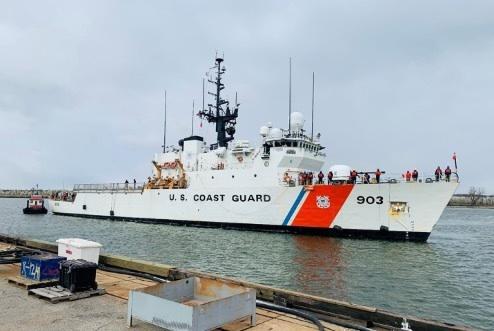
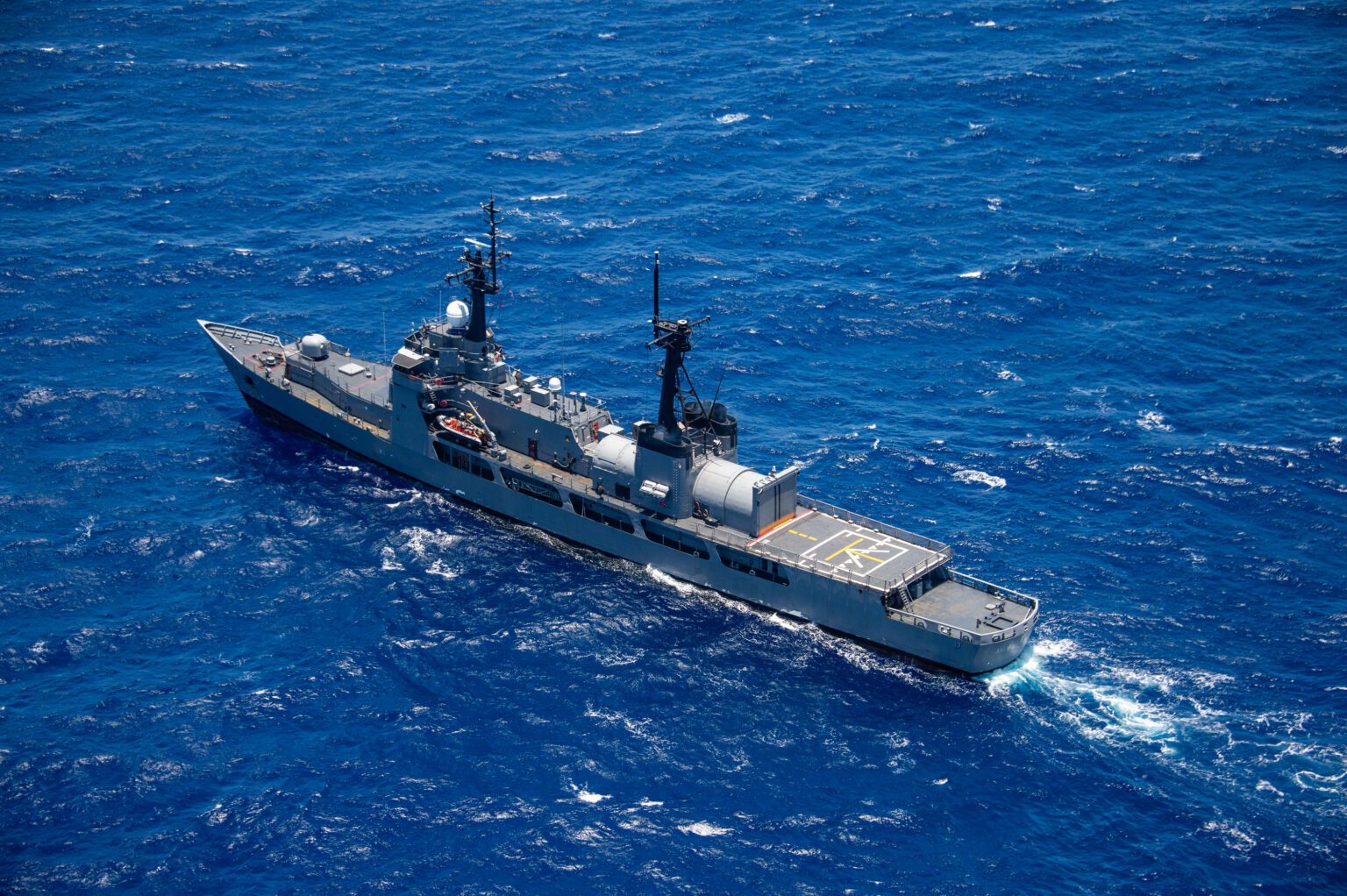
The U.S. Coast Guard Cutter Harriet Lane arrives at the Coast Guard Yard for a service life extension in Baltimore, March 28, 2022. The cutter will remain in Baltimore without the crew for approximately nine months during the overhaul project.
The US Naval Institute News service reported on remarks by Pacific Area Commander Vice Adm. Andrew Tiongson Wednesday, February 15, during an address to the WEST conference, hosted by the U.S. Naval Institute and the Armed Forces Communications and Electronics Association.
What he said:
Sometime in 2024, one of the WMEC 270s currently based in Portsmouth, VA that has (or will) undergo a Service Life Extension Program (SLEP) will be moved to a new homeport, somewhere in the Western Pacific. Admiral Tiongson specifically said, “…it can be anywhere from Sasebo [Japan] to Honolulu,” I don’t think he was ruling out ports west of Sasebo, and
“… this year, the Coast Guard is sending three national security cutters to the Indo-Pacific. Hawaii-based cutter USCGC Kimball (WMSL-756) is currently deployed and operating in U.S. 7th Fleet “with the Japan coast guard,” he said. Two more national security cutters are scheduled to deploy to the region this year.”
(All I know about the status of the WMEC270 SLEP program is here.)
Speculation:
The Mission:
This is explicitly a commitment to countering Illegal, Unregulated, Unreported (IUU) fishing done primarily, but not exclusively by the Chinese, and to stand up for our friends against Chinese bullying, particularly in regard to their expansive unrecognized claims in the South China Sea.
If, as the Admiral says, the MEC will provide 185 days away from homeport, and if we continue to deploy three National Security Cutters to the area annually for about two months each, we have the potential to have a large patrol cutter on task, either underway or making a diplomatic port visit all year round.

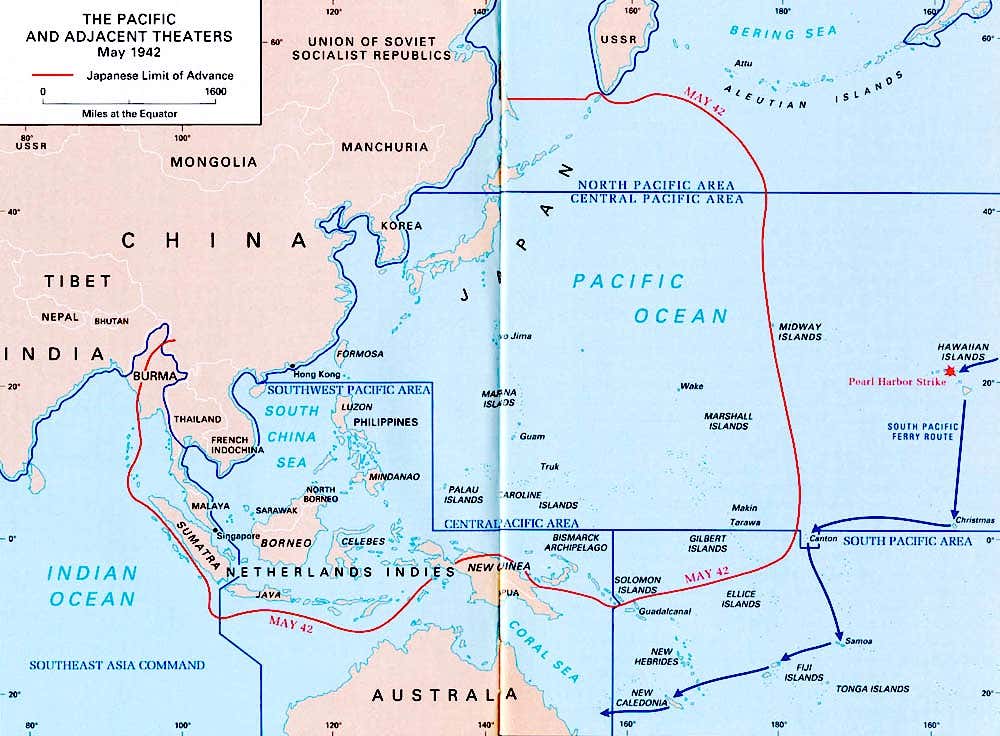
The map above, which shows the maximum extent of Japanese advance across the Pacific during WWII, was the best I could find to show potential homeports. Geography hasn’t changed and I think it may be evocative.
Homeport?: There are certainly several possibilities, but my interpretation is that this is largely about the South China Sea, so geography should play heavily in the choice of the homeport for the transferred cutter.
Honolulu is an easy answer, since we already have a major base supporting large cutters there, but it is far from where I think this ship is expected to work. It is the only port in the Western Pacific where a Coast Guard Airstation could provide a helicopter to deploy with the cutter (Kodiak is about as far West, but not really a player). Beside requirig long transits, being homeported in Honolulu would not help our outreach efforts while the ship is in port, as it might if the ship were based in a partner nation.
Guam is also a possibility. It is 6,126 kilometers or 3,308 nautical miles West of Honolulu. We have a buoy tender and three Webber class FRCs there. There are also a pair of Navy submarine tenders there that should be able to provide a degree of support. There is a Navy helicopter squadron there that might be able to provide a helicopter to deploy with the ship, but like Honolulu in port time there will not help a partner nation.
Singapore is at a critical strategic strait and has been used by the US Navy as home away from home for Littoral Combat Ships. Singapore is a wealthy and sophisticated nation. They don’t seem to need any help from us. We will want to visit and maintain good relations, but I don’t think we want to homeport there.
Sasebo, Japan, already has a major US Navy base, so support is not a problem. Like Guam the US Navy in Japan probably has helicopters that could deploy with the cutter. Japan Coast Guard is both very experienced and extremely large, with more large cutters than the US Coast Guard. Again, we will want to visit and maintain good relations, but I don’t think we have a lot to offer them.
Embed with the Philippine Coast Guard, perhaps sharing a homeport with the Philippines’ new 97 meter Japanese built cutters BRP Teresa Magbanua and BRP Melchora Aquino. This is where I think the WMEC should be. It is close to the center of action. The Philippines has seen the benefits of allowing US military access and a cutter might be the most welcome form of US military presence. Joint patrols are planned. A cutter based in the Philippines would foster greater interoperability. Shipboard helicopter operation is in its infancy in the Philippine Coast Guard. Frequent ready access to a flight deck equipped US Coast Guard cutter and crew could help them mature this capability.
Embarked Aircraft?:
It seems likely the transferred cutter may frequently operate without an embarked USCG helicopter. A UAS seems to be a good idea, at least the same ScanEagle system currently on the NSCs.
Hosting a partner nation’s helo on board might be beneficial to both services and would improve interoperability.
The End Game:
Ultimately, I think the US is hoping to open a chapter of Combined Maritime Forces, a 34 member country law enforcement alliance, or to form something similar, in the Western Pacific. This could be the beginning.




 Chuck Hill's CG Blog